Sunday, October 24, 2010

Blazing Saddles (1974)

In the Portland neighborhood I grew up in, a family with four sons lived below me in a cul-de-sac. I was in grade school. Three of the brothers were in middle school and one brother was in high school. They were like my big brothers and their interests influenced me. They collected baseball cards so I collected baseball cards. They were into butterflies so I was into butterflies.  They were old enough to go see movies that I couldn't see and I remember they were fond of comedies.  BLAZING SADDLES (1974) was one of those films they saw and talked about.  They would repeat funny lines from the film.  Having not seen the film, I could only try to visualize what they were talking about in my head. It never worked.  At some point, I was finally old enough to see BLAZING SADDLES and fully enjoy the humor that had tickled my older friends funny bones.

In the early 1970's, Woody Allen and Mel Brooks were the court jesters of the comedy genre. Their unique brand of comedy, in particular the film spoof, was widely popular.  Allen and Brooks were the best of the best. Woody Allen film spoofs were more intellectual.  He poked fun at the prison breakout genre with TAKE THE MONEY AND RUN (1969); the science fiction genre with SLEEPER (1973); and Russian literature in LOVE AND DEATH (1975).

Mel Brooks's humor was a bit more sophomoric and silly. Some of the jokes and gags in BLAZING SADDLES would make a fourth grader laugh today. Brooks's films are loving spoofs of more traditional Hollywood film genres.  HIGH ANXIETY (1977) makes fun of Hitchcock's films. YOUNG FRANKENSTEIN (1974) is a wink to the Universal Frankenstein films.  And of course, BLAZING SADDLES is a wet kiss to the western.  Brooks respects and honors these genres even as he has fun with them. What Brooks and his screen writers Norman Steinberg, Andrew Bergman, Richard Pryor, and Alan Uger are really skewering in BLAZING SADDLES is racism.  The stupidity of racism.  Brooks doesn't hold back. Jews, blacks, and gays (and don't forget the Irish) - no minority is spared but the ultimate jab is at bigots and racists.  Brooks portrays them as idiots and buffoons. He exposes the absurdity of racism.

The westerns BLAZING SADDLES most resembles are the Michael Curtiz film DODGE CITY (1939), George Marshall's DESTRY RIDES AGAIN (1939), and Howard Hawk's RIO BRAVO (1959). The basic premise is the backbone of many a great western. The railroad's expansion out west hits a snag when the construction encounters quicksand along its path. For the railroad to continue, a detour is found but standing in the way is the town of Rock Ridge. Hedley (not Hedy that's Hedley) Lamarr (Harvey Korman), a crooked Attorney General working for the moronic Governor William J. Lepetomane (Mel Brooks) hires a bunch of outlaws to terrorize the citizens of Rock Ridge so that they will abandon their town.  Rock Ridge has no sheriff so Lamarr sends in who he believes will be the worst candidate for the job -- a black man named Bart (Clevon Little). The citizens of Rock Ridge resist at first -- mostly due to their bigotry but Sheriff Bart with the aid of the recently sober Waco Kid (Gene Wilder) outwits the gang of outlaws trying to drive them out of town.

It's a pretty basic plot but it's within that framework that Brooks weaves his comedy anarchy. Although set in the 19th century West, Brooks uses anachronisms for laughs.  A medieval executioner works next to Lamarr's office. Nazi soldiers and Hell's Angels motorcycle gang members make up some of the outlaw gang. In a wagon train flashback scene, a very Jewish Indian Chief (also Mel Brooks) allows Bart's black family to continue west. And in the film's greatest set piece, the big western fight scene between the citizens of Rock Ridge and the outlaws spills over from the Warner Brothers western back lot into a Busby Berkley musical set.  Reality is broken down literally as fighting cowboys crash through the wall of the sound stage and mix with male dancers in tuxedos and coat tails, much to the chagrin of the director (Dom Deluise). The past and the present get intertwined all for the sake of a good laugh (Monty Python's films and television show would also continue this comedy style).

BLAZING SADDLES tweaks all the familiar western stereotypes with black sheriff Bart (Clevon Little) and his Gucci riding bag or Lili Von Shtupp (Madeline Kahn), an Elmer Fudd sounding German cabaret singer that pays homage to Marlene Dietrich's character in DESTRY RIDES AGAIN. There's the quick drawing gunslinger turned recovering alcoholic and philosopher Jim aka the Waco Kid (Gene Wilder) and Mongo (Alex Karras), the bad guy's burly henchman who punches horses but is recruited over to the good side. Veteran Western character actors Slim Pickens and David Huddleston contribute to the Western realism and even Ben Johnson (THE WILD BUNCH) makes a cameo appearance. Gene Wilder, Dom Deluise, Madeline Kahn, and Harvey Korman would be part of the Mel Brooks repertoire appearing in future Mel Brooks films. For Wilder, I wish he and Brooks had made more films together. They reached their comedy zenith with YOUNG FRANKENSTEIN (which Brooks and Wilder co-wrote together). Wilder would go it alone after YOUNG FRANKENSTEIN and some of his films like THE WORLD'S GREATEST LOVER (1977) or HAUNTED HONEYMOON (1986) never lit the comedy world on fire.


To me BLAZING SADDLES is the godfather of the raunchy comedy that would continue with such films as ANIMAL HOUSE (1978) and STRIPES (1981) all the way to AMERICAN PIE (1999) and now Judd Apatow's comedies like THE 40-YEAR OLD VIRGIN (2005) and KNOCKED UP (2007).  The combination of gross out humor, nudity, and crude language has replaced the smart, sophisticated comedies of the past.

The lifespan of the film spoof has continued as well in part to BLAZING SADDLES. AIRPLANE (1980), HOT SHOTS (1991), and THE NAKED GUN (1988) series all owe their success to BLAZING SADDLES.  Across the pond, the Monty Python comedy troupe from England would follow soon afterward with their own irreverent takes on King Arthur and the biblical film. 

BLAZING SADDLES has held up pretty well over the years.  The film starts out a little slowly and some of the jokes and scenes don't quite get the laughs they intended but Brooks's BLAZING SADDLES was ahead of its time in sheer outrageousness, its fearlessness in tackling stereotypes and situations most films never dared. I would dare to say Mel Brooks was a leading pioneer in the type of modern comedy we see today.

Thursday, September 30, 2010

Charade (1963)

I don't get to play charades much but when I do play with my family or friends, it's always an enjoyable evening as guests or family try to guess my acting out words or actions or famous people.  It's a light-hearted game that usually brings laughs and groans. But when looking at the deeper meaning of charade, it's a sad word. Charade means deception or fake.

CHARADE (1963) directed by Stanley Donen is pretending to be a Hitchcock thriller, a cinematic love letter to NORTH BY NORTHWEST (1959). Although the plots are very different, both films have Cary Grant in the lead; a case of many mistaken identities; plenty of sexual innuendo between Grant and Audrey Hepburn; a trippy title sequence by Maurice Binder (who did many of the James Bond opening credits); and many moments of suspense. 

Donen had primarily made musicals like SINGING IN THE RAIN (1952) and  SEVEN BRIDES FOR SEVEN BROTHERS (1954)) early in his career but in the 1960's he made two Hitchcock like thrillers with CHARADE and later ARABESQUE (1966) with Gregory Peck and Sophia Loren playing the Cary Grant/Eva Marie Saint type roles. CHARADE doesn't have the great subtext and set pieces Hitchcock's great string of films in the 1950's had but the screen play by Peter Stone is smart and confident and clever with plenty of red herrings. There's an interesting musical score by composer Henry Mancini (THE PINK PANTHER films and BREAKFAST AT TIFFANY'S). Besides the dream team of Cary Grant and Audrey Hepburn, CHARADE showcases some supporting actors that would become very familiar to moviegoers for the next three decades - Walter Matthau, James Coburn, and George Kennedy. And did I mention the film is mostly filmed in Paris?


CHARADE revolves around the dead husband of Regina Lampert (Audrey Hepburn) and the missing $250,000 he stole from the U.S. government and four war buddies in 1944 during World War II. Charles Lampert is murdered and thrown from a train in the first seconds of the film. At his wake in Paris, three of the men cheated out of their cut of the money show up to confirm Lampert is dead: the behemoth Herman Scobie (George Kennedy); the squirrely Leopold Gideon (Ned Glass); and the smooth-talking Tex Panthollow (James Coburn). They quickly turn their attention to Regina who they're convinced knows where the missing loot is.  Regina has a partial ally in the mysterious Peter Joshua (Cary Grant) who has taken a keen interest in her and her predicament. First, Peter shows up during her French Alps vacation. Later, he attends the wake as well. But is Peter's interest in Regina friendly or is he the fourth partner in crime looking for his share?

Regina receives a call from Hamilton Bartholomew (Walter Matthau) with the U.S. Embassy who discloses that her deceased husband was part of an OSS mission with four other men, ordered behind German lines to deliver $250,000 to the French Underground.  The men decide to steal the money from the U.S. government but their plans go awry when they're ambused by the Germans. Lampert escaped with the money and left the others to be caught or killed. Bartholomew, representing the U.S. government also wants the money back. And he warns Regina that the fourth man may be the one who killed her husband, a man called Carson Dial.

As the hunt for the missing quarter of a million dollars gets more intense, Regina begins to fall for Peter. But can she trust Peter?  Each time Peter is left with one of the three conspirators, they end up dead. Is Peter Carson Dial? CHARADE'S finale ends with a clever reveal of where the $250K is hidden and Regina being pursued into an empty Paris theater by the fourth man, Carson Dial.

It all sounds like pretty heavy stuff but director Donen keeps the style light and fun punctuated with brief episodes of violence. There's a scene in a Paris jazz club where Grant and Hepburn, getting to know each other, play a game where they have to exchange an orange from their neck to another patron's neck that is very avant garde and unusual. Grant has a few comic scenes that he pulls off with his usual expertise. CHARADE even has a French Police Inspector Edouard Grandpierre (Jacques Marin) who is a mixture of Clouseau and Hercule Poirot for some comic relief.

CHARADE is a great title for this thriller. Several characters are pretending to be people they really are not. Is Cary Grant in cahoots with the war veterans trying to recover their piece of the $250K or is he working on his own? Hepburn's dead husband turns out to be a former OSS agent, something he never told her. Even Hepburn's marriage was a charade as her dead husband turns out to be someone totally different than she thought.


As good a romantic lead as Cary Grant was, he does begin to show his age a little bit in CHARADE. I call it the Robert Redford syndrome where an actor who has played the handsome romantic lead for most of his career starts to look his age and still tries to play romantic roles with younger actresses. Redford tried it in HAVANA (1990) and INDECENT PROPOSAL (1993) and it didn't work.  Grant manages to pull it off with Hepburn and their age difference isn't too bothersome.  But Grant realized his romantic lead days were setting.  He made only two more films after CHARADE and retired from films in 1967. Grant and Hepburn have great chemistry which overcomes their age difference. For me, Audrey Hepburn is the female equivalent of Cary Grant - sophisticated, beautiful, and charming.

Director Donen sprinkles the film with Hitchcock references. Donen uses high angle shots throughout the film and the finale has Audrey Hepburn chased into an empty theater that echoes of THE 39 STEPS (1935) and THE MAN WHO KNEW TOO MUCH (1956). Even the motif of the wrong man that Hitchcock used over and over his flip flopped in CHARADE as it's the woman, in this case Hepburn's Regina, who is mistakenly implicated in her husband's chicanery.

"Imitation is the sincerest form of flattery," English writer Charles Caleb Colton once said. Ultimately, CHARADE is much more than a Hitchcock imitation. While borrowing the style of the master of suspense, CHARADE stands on its own as a unique thriller starring two of Hollywood's reigning stars - Cary Grant and Audrey Hepburn.

Friday, September 3, 2010

Dr. Jekyll and Mr. Hyde (1931 and 1941 Versions)

For whatever reasons, author Robert Louis Stevenson's Dr. Jekyll and Mr. Hyde has never reached the dizzying heights of horror fame like Dracula or Frankenstein or the Wolfman.  The story of a good man who creates a devilish concoction that turns him into an evil man, Stevenson's DR. JEKYLL AND MR. HYDE has appeared many times on stage and film and even cartoons.  Famed actor John Barrymore played the good doctor in a 1920 silent film version of the English classic.  Besides the two versions I will discuss, there have been many other versions of Stevenson's tale and some variations as well such as Hammer Films DR. JEKYLL AND SISTER HYDE (1971) in which Jekyll turns into a murderous woman (I haven't seen it yet so don't ask me how he accomplishes this ...yet!).  Julia Roberts played Jekyll's maid in MARY REILLY (1996) and most recently, Mr. Hyde appeared as a computer generated murderous behemoth in both THE LEAGUE OF EXTRAORDINARY GENTLEMEN (2003 ) and VAN HELSING (2004).

My first encounter with Jekyll and Hyde was a Warners Bros Bugs Bunny cartoon as a kid called HYDE AND HARE. Bugs Bunny is taken home by Dr. Jekyll where Hyde/Jekyll and Bugs run amok. But why does Jekyll explore his dark side?  What makes him want to become such a vile and evil monstrosity?  I've never read Stevenson's story so with a recent DVD purchase of two DR. JEKYLL AND MR. HYDE films (Paramount's 1931 version and MGM's 1941 version), I began my film research into the world of Jekyll and Hyde.


In the 1931 version, directed by Rouben Mamoulian, Dr. Jekyll (played by Fredric March) is an upscale English doctor who loves good music, fine art, and has dedicated his life to helping the afflicted and less fortunate citizens of London as a physician.  While giving a speech at what I assume is a medical school, Jekyll first reveals his interest in the two sides of man -- the good self and the bad self.  His goal is to separate evil from good. Jekyll's engaged to be married to Muriel Carew (Rose Hobart) but Muriel's father Brigadier-General Carew (Halliwell Hobbes) won't set a wedding date for the two love birds. Jekyll, a bit impatient that he can't be with the woman he loves sooner, goes out one night with his friend Dr. Lanyon (Holmes Herbert).  As they walk the streets of London, Jekyll rescues a beautiful, lower class music hall girl Ivy Pearson (Miriam Hopkins) from some roughnecks. Helping her back to her room, Jekyll finds himself attracted to the sexually provocative Ivy.

This chance encounter sets Jekyll off on discovering his alter ego -- his sadistic, sexual, animal side.  After hours upon hours in his laboratory, Jekyll drinks a serum that transforms him into the evil Mr. Hyde. Hyde tracks down Ivy in the music hall, terrorizing her, eventually almost imprisoning her in her own apartment.  Meanwhile, Brigadier-General Carew finally gives Jekyll and Muriel a date to be married.  Jekyll swears off Mr. Hyde for good but then Ivy comes to visit him, seeking help from her tormentor Mr. Hyde.  Jekyll promises Ivy she'll never see Hyde again.  But as Jekyll heads to his engagement party that night, he witnesses a violent encounter between a bird and a cat that triggers the transformation of Jekyll back into Hyde without Jekyll even drinking the serum.

Hyde returns to Ivy's apartment with deadly consequences.  Hyde is chased through the streets of London and back to his laboratory where he reveals his terrible secret to Dr. Lanyon.  Hyde is beginning to take over Jekyll.  When a visit to his fiancee Muriel triggers another change into Hyde and he nearly kills Muriel, Lanyon leads the police to Jekyll's residence where Hyde is shot and killed.

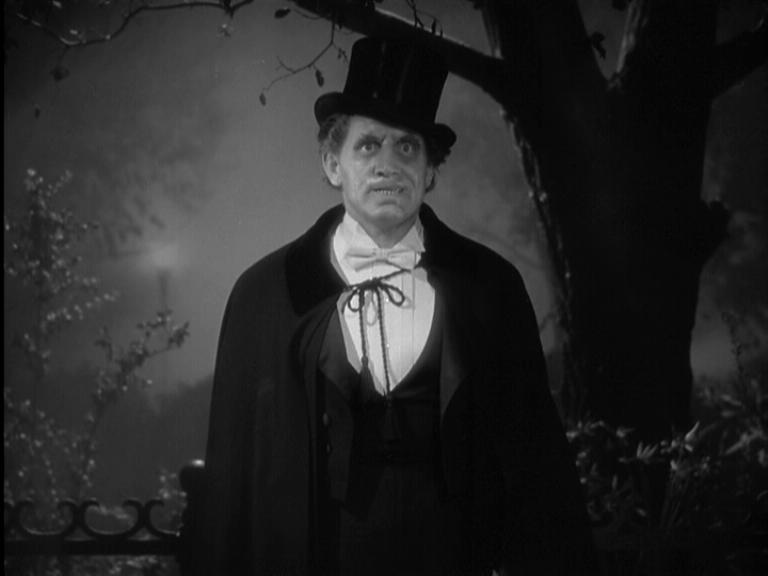
I loved the make-up decisions for this version. Fredric March's Mr. Hyde is very ape-like, almost a Neanderthal in top hat and cloak.  Hyde is a brute, a savage and March relishes the role.  Hyde is Jekyll's id, acting upon all the impulses good Victorian men restricted themselves from. It almost seems like Jekyll's sexual frustration from having to wait for permission to marry Mariel drives him to become Hyde. March would end up winning an Academy Award for his performance as Jekyll and Hyde.  Not until Anthony Hopkins as Dr. Hannibal Lecter in THE SILENCE OF THE LAMBS (1991) would another horror performance win an Oscar.

For those expecting this 1932 version of DR. JEKYLL AND MR. HYDE to be tame, think again.  This film has more menacing violence and open sexuality then anything I had expected in a film from the 1930's. This version of JEKYLL AND HYDE is pre-code meaning it was able to get away with some images and themes that moral censors would soon clamp down on in future films. Miriam Hopkins oozes promiscuity as Ivy Pearson, exposing bare thigh and cleavage to Jekyll as he tends to her injury early in the film.  Jekyll and Ivy even kiss openly on her bed, usually taboo for films of this era.  Fredric March's Hyde torments Ivy both mentally and physically.  "I'm no gentleman," Hyde sneers at her.  Hyde's words hurt her almost as much as his actions.  Mr. Hyde reverberates in today's headlines as "good" husbands and boyfriends abuse women all over the world.


Director Rouben Mamoulian's film making style adds greatly to DR. JEKYLL AND MR. HYDE.  Split screen and wipes are used extensively.  Mamoulian opens the film with a long POV (point of view) shot as Dr. Jekyll prepares to attend a party.  For a few minutes, we are Jekyll.  Mamoulian uses several different techniques for March's transformation from Jekyll to Hyde. The most clever is a filter done while filming that allows actor March to transform into Hyde right before our eyes.  It is startling metamorphosis.  Later, Mamoulian reverts to the time lapse change for Hyde that worked so well for Lon Chaney Jr as THE WOLFMAN.

The 1941 version of DR. JEKYLL AND MR. HYDE has a more famous cast and director and a bigger budget.  Spencer Tracy plays both Dr. Henry Jekyll and Mr. Hyde.  The stunning Lana Turner is Jekyll's fiancee now called Beatrix Emery and playing against type Ingrid Bergman is the bar girl Ivy Peterson (not Pearson like the first film). Directed by Victor Fleming (who directed THE WIZARD OF OZ and GONE WITH THE WIND both in 1939), this JEKYLL AND HYDE follows the 1932 version closely in some aspects and differs in others.

This version does a better job of showing Jekyll's scientific interest in the good and bad side of the human soul.  In the film's opening sequence, we see Jekyll take an interest in a parishioner at his church, injured in a work accident months earlier, exhibits wild behavior when before the accident he had been a loving husband. Director Fleming shows Hyde as a workaholic, already experimenting with animals as he tests serums that make a docile rabbit violent and back to being docile.  The medical establishment as well as Beatrix's stern father Sir Charles Emery (Donald Crisp) won't allow experiments on humans so Jekyll uses himself as a test case.


Tracy's Mr. Hyde make-up is more subtle than March's with just wild hair and thicker eyebrows doing most of the work.  Tracy uses his voice very well to create his own misogynistic Hyde. As he continues to change into Hyde, the make-up gets a little more elaborate.  This JEKYLL AND HYDE has some incredible Freudian dreamscapes during Jekyll's early transformations.  The most outrageous dream montage has Jekyll on a cart pulled by a white and black horse.  He whips furiously at them and the horses transform into the two women in his life - Beatrix (Turner) and Ivy (Bergman).  Another dream sequence has the sexually frustrated Jekyll uncorking Beatrice from a champagne bottle juxtaposed with images of waves crashing and fire billowing.

There's a nice dynamic in the triangle of Jekyll, Beatrix, and Beatrix's father Sir Charles.  Jekyll and Beatrix flirt and sneak kisses at every chance much to the consternation of Sir Charles played with great prudeness by Donald Crisp.  As he holds up their engagement and wedding plans, Sir Charles unwittingly drives Jekyll to cave in to his baser desires and urges, ultimately causing Jekyll to find within himself the terrible Mr. Hyde.

When we first meet Bergman's Ivy, Jekyll (Tracy) and his best friend Dr. John Lanyon (Ian Hunter) rescue her from a drunken thug. Bergman just didn't seem right for the part compared to Miriam Hopkins in the earlier version.  Bergman's Swedish accent is a bit too thick and she doesn't ooze sexiness.  But Bergman's perfomance grows on you. Tracy plays Jekyll a bit more as a charming rogue and sparks do fly when Ivy seduces Jekyll in her apartment.

It's easy to see why great actors like Fredric March or Spencer Tracy wanted to play Dr. Jekyll.  It's two roles in one with each character so vastly different than the other. Tracy's Jekyll is charismatic and sympathetic. His Hyde is chilling as he taunts and harasses waiters and patrons in his quest for Ivy, even bribing the owner of the Palace of Frivolities to fire Ivy so Hyde can control her.  "He ain't a man. He's the devil," Ivy tells Jekyll. Tracy and Bergman have some great scenes as Hyde and Ivy in her apartment and in one terrifying sequence, Hyde (Tracy) throws a bunch of grapes violently at Ivy's (Bergman) face, the fruit hitting her hard, bringing her to tears as he  proclaims, "The world is yours, darling...the moment is mine."  It's a shocking scene.


Director Fleming keeps the mood interesting with plenty of foggy London street sets and Jekyll's impressive laboratory. He's not quite the visionary that Moumalian was but the pace and style of his JEKYLL AND HYDE is comparable to the former.

I was thinking that Dr. Jekyll is a much braver scientist than Dr. Frankenstein in that Frankenstein experiments on dead bodies whereas Jekyll uses his body for his experiments.  Throughout film and pop culture, Jekyll and his alter ego Hyde will materialize in many forms. Comic book characters like Dr. Bruce Banner and his alter ego The Incredible Hulk or Peter Parker and his alter ego Spider Man owe some thanks to Stevenson's Jekyll and Hyde.  Films like THE FLY (1958 or 1986) or ALTERED STATES (1980) take the Jekyll/Hyde formula to new levels as good men of science go awry with their experiments.

So which DR. JEKYLL AND MR. HYDE is better?  I don't think you can go wrong by watching either one. The first version is a bit more raw and audacious.  The latter film is more slick with bigger stars. Both films have fine performances by all the actors.  So watch the newer version with Spencer Tracy or the older one with Fredric March, whichever one suits your fancy and mood.  Or better yet, be your own Jekyll and Hyde and watch them both.

Tuesday, August 17, 2010

The Americanization of Emily (1964)

One of the goals of this blog was to watch films that I had never seen before.  THE AMERICANIZATION OF EMILY (1964) fell perfectly into that category.  James Garner stars in it and I like James Garner.  I always thought my father looked a bit like James Garner when they were both young men.  Julie Andrews plays the female lead and I quickly made two quick, rash judgments.  First, I was sure this film was directed by Blake Edwards, famous for THE PINK PANTHER films and also the husband of Julie Andrews.  Secondly, I thought the film might be similar to YANKS, a film about American soldiers in England during World War II mingling with English women.  Guess what?   I was wrong on both counts. 

THE AMERICANIZATION OF EMILY is set during World War II in London just before the D-Day invasion. There is a relationship between an American Navy man (James Garner) and a young English woman (Julie Andrews) but EMILY is much more than just a love story.  It is a very funny, scary comedy drama about war, heroism, and cowardice.  It is directed by Arthur Hiller not Blake Edwards and written by Paddy Chayefsky who would go on to write more scathing black comedies like THE HOSPITAL (1971) and NETWORK (1976). 

Based on the novel by William Bradford Huie, THE AMERICANIZATION OF EMILY is about "dog robbers" or personal attendants to a general or admiral.  This particular dog robber is Lt. Commander Charlie Madison (James Garner) a personal attendant to Admiral William Jessup (Melvyn Douglas). Charlie is like a hotel concierge. His job is to entertain the admiral and his guests with food, alcohol, and women while the admiral tries to win favors for his beloved Navy.  D-Day is just a week away and Admiral Jessup feels the Navy is getting shafted in the buildup to the great battle, becoming "the runt of the litter" as the armed forces goes.

Charlie tries to enlist the help of a pretty English driver Emily Barham (Julie Andrews) to be one of his hostesses and play bridge with the admiral at one of his parties but Emily will have none of it.  She's not impressed with Americans over in London or their use of chocolate to bribe anyone for anything.  Charlie thinks she's a prig. Emily doesn't want to be "Americanized."  Emily has lost her father, her brother, and her husband to the war.  She's almost desensitized to being in love.  Charlie fought in Guadalcanal when he had an epiphany in the jungle.  He discovered he was a coward and loved life.  Naturally, Charlie and Emily will fall in love...but not without enduring several obstacles.


Admiral Jessup comes up with the insane idea to have Charlie and his fellow dog robber buddy Lt. Commander Paul "Bus" Cummings (James Coburn) go to Omaha Beach on D-Day.  Jessup insists "the first dead man on Omaha Beach must be a sailor" and  he wants Charlie and Cummings to film it.  In Jessup's view, this will ensure the Navy gets its due during D-Day.  He even proposes that this dead sailor will be buried in a brand new Tomb of the Unknown Sailor. When Jessup has a nervous breakdown, Cummings takes over the plan.  Neither he nor Charlie want to die for their slightly mad Admiral but as they try to not be on the first boats to France, circumstances put them directly in the battle with Charlie running for his life on Omaha Beach with surprising results.

Immediately upon viewing, EMILY has some striking similarities to a similar black comedy, Stanley Kubrick's DR. STRANGELOVE (also 1964).  Both films have satirical views on war and the so called generals and admirals and presidents who preside over war.  Both films were shot in England and in black and white.  Both films have crazy military leaders with cockeyed ideas. In DR. STRANGELOVE, it's General Jack D. Ripper (Sterling Hayden)  instigating nuclear war. In EMILY, the Admirals's warped plan has Charlie's best friend Cummings trying to shoot him at Omaha Beach so that he'll be the first dead sailor. Even actor Keenan Wynn appears in both films. EMILY has a slightly more optimistic outlook but it's not a coincidence that STRANGELOVE and EMILY came out the same year.

Writer Paddy Chayefsky writes some great long speeches that both Garner and Andrews get to deliver. Not many movie screenplays then or now offer that luxury for actors.  One of Chayefsky's greatest speeches will be delivered by Peter Finch in NETWORK  as doomed news anchorman Howard Beale ("I'm as mad as hell and I'm not going to take it anymore") but I would rank Garner's speech to Andrews about Europe and England's view of Americans right up there with Chayefsky's best.

For me, the sign of a good screenplay is when both the lead actors and supporting actors all have great roles.  Supporting actors William Windom, Joyce Grenfell, Liz Fraser, Steve Franken, even the three  "nameless" broads that James Coburn tries to score with all stand out.

James Coburn would soon become a leading man in films like IN LIKE FLINT (1966) and it's easy to see why with his good looks, blond hair, and killer smile. But he was a great supporting actor too as he proved in THE MAGNIFICENT SEVEN (1960), CHARADE (1963) and THE GREAT ESCAPE (1963) which incidentally, he co-starred with James Garner in.


I have a great affinity for James Garner.  As previously mentioned, he reminds me of my father in appearance.  But Garner starred in my favorite television show of the 1970's - THE ROCKFORD FILES. Garner's golden years in film lasted about 12 years and then he headed to television to play Jim Rockford, a shaggy private detective who drove a cool Camaro.  It didn't dawn on me until later as I would see TV actors like Telly Savalas (KOJAK) or Rock Hudson (MCMILLAN AND WIFE) that television is where film actors go when their leading man days are over.  Garner and Julie Andrews, so good together in EMILY would do another film together VICTOR VICTORIA (1982), this one directed by Andrews husband Blake Edwards.

One of the pleasures of film watching is to come upon a hidden gem like THE AMERICANIZATION OF EMILY and be completely and utterly enthralled with it. Just when you think you've seen every great film ever made, you discover there are still some out there.  So go my movie loving friends.  Go and discover your hidden film gem.

Sunday, July 25, 2010

Westworld (1973)

The science fiction thriller WESTWORLD (1973) has a lot of interesting things going for it.  First, it's directed by one of the most popular fiction authors of the 20th Century, Michael Crichton.  Crichton  had written two novels already - THE ANDROMEDA STRAIN and THE TERMINAL MAN and both were made into films.  Whereas most novelists would move on to their next book, Crichton chose to write and direct what is in essence a hybrid sci-fi western B film.  I would put WESTWORLD on my list of guilty pleasures to view.  It's such a simple idea. A theme park for adults that offers three choices: Medieval World, Roman World, and Westworld. Visitors pay a thousand dollars a day to live out their fantasies whether it be robbing a bank in the 1880's or jousting with the Black Knight or living it up in decadent Rome with human like robots playing most of the roles for the guests to interact with.

I first saw WESTWORLD on television probably in the 1980's.  I don't recall seeing the whole film but I remember Richard Benjamin sleeping with the girl robot and the robots turning on the guests, killing them.  And I remember Yul Brynner as the unstoppable Gunslinger but more about him in a moment.

In the film WESTWORLD, the company that runs this adult amusement park is called Delos.  Their slogan is THE VACATION OF THE FUTURE - TODAY.  Peter Martin (Richard Benjamin), a recently divorced Chicago lawyer, is going to Westworld for the first time with his buddy John Blane (James Brolin), a repeat visitor. Blane's hope is to get Martin some fun and adventure after Martin's bitter divorce.  Westworld is the answer.  If a guest wants a gunfight, they have a gunfight.  If the guest wants to be in a barroom brawl, a barroom brawl it is.  There are even robot western prostitutes to entertain the guests.  Besides Blane and Martin, the film also follows the exploits of a meek banker (Dick Van Patten) who wants to be Westworld's next sheriff and another guest (Norman Bartold) who's fantasy is to woo a medieval queen.


Behind the scenes at  Delos, technicians and programmers in white coats run the park, direct and coordinate the events, and fix the robots each night after their daily gunfights, bank robberies, and jousts.  But the theme park is not running as smoothly as it seems. Delos's Chief Technician (Alan Oppenheimer) is noticing more and more malfunctions from the robots.  He notes that it began in Roman World and like a virus or disease, has worked its way over to the other theme parks.

Crichton builds the suspense nicely, never rushing it. He shows the tourists interacting with the robots and the danger that is possible. Subtle little incidents hint that all is not well in Delos. A robot rattlesnake bites Blane. A medieval wench slaps a guest when she should accept his advances. It's only a matter of time before the black shirted Gunslinger that Peter keeps shooting will have his revenge. When it does happen, the payoff is perfect.  When the technicians try to cut off the robots power and disarm them, that action fails and their control room loses power and oxygen, bringing about their doom as well.

As the robots revolt, all hell breaks loose. As Peter flees the Gunslinger and crosses over from Westworld to Roman World, there's a great shot of a faux Roman bust of some emperor lying in a river bed. Just as Rome fell for its excesses, so too will Delos's theme parks as the robots rebel against their creators.

WESTWORLD touches on a theme that Crichton will explore again and again.  Science gone astray.  In THE ANDROMEDA STRAIN (1971), a military satellite bring back a deadly virus. In JURASSIC PARK (1993), dinosaurs cloned from DNA wreak havoc on an island that was planned to be a theme park.  And in WESTWORLD, it's robots that turn on the tourists they are meant to entertain.

Even though WESTWORLD is a  B movie, the directing, editing, photography, and acting is all first rate.  Benjamin and Brolin are likable and Brolin especially has fun playing an Eastwood/Leone like cowboy on his vacation.  I never understood why Brolin never quite made it big in films.  He had the looks and the charisma.  The casting of Yul Brynner as the Gunslinger is probably what makes WESTWORLD so memorable.  Brynner pays homage to his cowboy character in THE MAGNIFICENT SEVEN (1960) and with his perfectly bald dome and clean shaven face, Brynner looks like he could be a robot.


The Gunslinger is an early incarnation of the unstoppable machine that director James Cameron will create in THE TERMINATOR films.  The machine that just keeps coming and coming even after having acid and fire thrown at it. And the theme park Westworld Crichton will revisit later in his novel and the subsequent film JURASSIC PARK which is to be a theme park until the dinosaurs destroy the place.

The story moves briskly, maybe too much so.  We never get to see what happens to the Dick Van Patten sheriff character and Roman World is hardly shown at all which could have been a budgetary limitation.  But Crichton has a lot of fun with WESTWORLD as well.  In a sublime piece of irony, as Peter flees the pursuing Gunslinger, he comes across a white coated technician repairing his golf car out in the desert.  The technician brags about the robot model and how he's unstoppable.  Peter rides on and the technician is shot and killed by his creation - the Gunslinger.

Michael Crichton would direct only a few more films after WESTWORLD including THE GREAT TRAIN ROBBERY (1979), COMA (1978), and LOOKER (1981) and he would go on to write many more best-selling novels that mostly involved some kind of science fiction theme.  But I do think one of his best stories he ever told was not a novel but a film and screen play called WESTWORLD.

Sunday, July 18, 2010

Batman (1989)

I grew up on the campy BATMAN TV series of the 60's with Adam West as Batman , Burt Ward as Robin the Boy Wonder and a host of over the hill movie stars and comedians as the Arch Villains i.e. Cesar Romero (the Joker), Frank Gorshin (the Riddler), or Burgess Meredith (the Penguin). When I lived in Los Angeles, I even visited the entrance to the Bat Cave somewhere in Griffith Park. But once you grow older, campy isn't quite as interesting. I was excited when it was announced that a new darker, more mature Batman movie was going to be made and to helm this franchise was the perfect director - Tim Burton.

Burton's BATMAN (1989) jump started the whole super hero film franchises that had vanished after Christopher Reeve's SUPERMAN films in the mid-1970's. BATMAN was the event of 1989 as I recall and producers Peter Guber and Jon Peters did a great job of hyping their film, so much so that viewing it recently, it's a bit painful to watch compared to the bigger, badder, even darker THE DARK KNIGHT (2008). The Prince songs now seem very Warner Brothers cross-promotional and Gotham City is just a big, sterile London movie set. So has the THE DARK KNIGHT completed knocked my beloved 1989 BATMAN from super hero film glory?


Not exactly.  The strength of this BATMAN are the actors.  With all the well earned accolades and awards given to the late Heath Ledger for his rendition of the Joker in THE DARK KNIGHT, it's hard to believe 21 years ago we were bestowing similar praise to Jack Nicholson's Joker, believing his was the definitive performance.   Nicholson's Joker is a bit more likable and accessible than Ledger's but he'll still kill an innocent bystander or his girlfriend (Jerry  Hall) in an instance.  Ledger's performance is amazing but Nicholson's Joker is inspired. And Michael Keaton's Bruce Wayne/Batman is equally interesting. Usually the super hero plays second fiddle to the more colorful super villain but Keaton holds his own, making Bruce Wayne a delightfully absent minded millionaire and his Batman just a hair less homicidal than the Joker. I give Keaton's Bruce Wayne a slight nod over Christian Bale's  Bruce Wayne in THE DARK KNIGHT.  I do like the look of Val Kilmer's Bruce Wayne in BATMAN FOREVER (1995) but I need to see that film to make a final verdict.

BATMAN pits Bruce Wayne aka Batman against his arch-nemesis Jack Napier aka the Joker. Napier/the Joker (Jack Nicholson) works for Boss Carl Grissom (Jack Palance), Gotham City's resident crime boss. But Grissom doesn't trust Napier and sets him up to be caught by the police at a chemical factory Grissom owns. Batman (Michael Keaton) shows up, Gotham's new caped crusader, and accidentally knocks Napier into a pool of acid. The acid not only corrodes Napier's face into an unnatural grin, it causes Napier to go insane. Reborn as a white skinned, green haired homicidal criminal, the Joker begins a war on his fellow crime bosses, Gotham City, and Batman.

Bruce Wayne/Batman is haunted by the death of his mother and father, gunned down in front of his eyes by a mugger with the catch phrase, "Have you ever danced with the devil in the pale moonlight?" His parents deaths lead Wayne to use his wealth to fight against the forces of evil. Aided by his faithful man servant Alfred (Michael Gough), Batman matches wits with the Joker and his gang as the Joker poisons the city's toiletry products in an attempt to terrorize Gotham City. The two also battle for the affections of photo journalist Vickie Vale (Kim Basinger).

The Batman/Joker/Vale triangle is an interesting element.  All three are touched and affected by violence. Vale photographs images of famine and war for a news magazine and is drawn to Batman in his crusade to stop violence in Gotham City. Wayne's parents were murdered by a gunmen who we will eventually discover was a young Jack Napier. Because of their deaths, Wayne turns to crime fighting and as the Batman, Wayne causes Napier to become the Joker, in essence creating his nemesis. The chemistry between Keaton and Basinger is great too, a connection of two lonely souls I never full appreciated when I first saw BATMAN in a San Fernando Valley multiplex.


BATMAN falters toward its climax as director Burton and writers Sam Hamm and Warren Skaaren seem to run out of plot ideas as the Joker tries yet again to harm Gotham City with poison gas from a giant parade balloon and Batman comes out of nowhere with the Bat Jet to thwart him. Action scenes are not Tim Burton's strong suit and most of the action pieces in this film are clunky and not very well staged. BATMAN was only Tim Burton's third mainstream film and over his amazing career, he will get better with action scenes. Burton's strong suit are his flourishes of macabre and his visual and design flair.  Besides the aforementioned bad Gotham city set, Burton hits it dead-on with the Bat Cave and the Gotham Museum and Vale's apartment and even the Hammer film like Gothic cathedral where Batman and the Joker have their final duel. The late production designer Anton Furst (FULL METAL JACKET) deserves some credit as well for the film's look. I forgive them for the poor Gotham City set, probably a casualty due to the actor's salaries and the the high cost of filming outdoors on location. 

Some of the characters integral to the Batman mythology aren't too prominent in this BATMAN. Harvey Dent (Billie Dee Williams) and Commissioner Gordon (Pat Hingle) are very peripheral.  Only Alfred has a key role, acting as a surrogate parent and partner for Bruce Wayne/Batman.

Tim Burton does tip his hat to the BATMAN TV series. Nicholson's Joker owes a slight nod to the TV Joker Cesar Romero with his crazed laughter and theatrical nature. The Bat Mobile is more a muscle car in this film then the 60's TV car. And when the Joker's henchmen wear Joker buttons on their coats, I  smiled to myself knowing that Burton had watched a few BATMAN TV episodes during his research to get the henchmen just right.

In the end, I was pleasantly surprised that BATMAN held up a little better than I thought to the more recent and well made interpretations of Bob Kane's original hero. Keaton and Nicholson and Basinger contribute immensely to this comic book film being taken seriously and the choice of a young, imaginative Tim Burton put super hero movies back into our consciousness and paved the way for the likes of SPIDER MAN, IRON MAN, and even the Batman reboot THE DARK KNIGHT.

Tuesday, June 8, 2010

Dr. Zhivago (1965)

Before there was CGI (Computer Generated Images), there was David Lean. Before filmmakers could create armies of mummies at war with each other or alien spaceships destroying Manhattan with the help of computers, director David Lean was the master of the epic image. Whether it was blowing up a real bridge and destroying a real train in THE BRIDGE OVER THE RIVER KWAI (1957) or filming a vast Arabian desert with a singular camel rider in LAWRENCE OF ARABIA (1962), Lean was the visionary filmmaker who did it for real. No computer animation. No Hollywood special effects. If he needed thousands of extras, he used thousands of extras. If he need to film in Sri Lanka or Morocco or Finland or India, he went there.

David Lean made 16 films (he was an editor before he became a director), but he's probably most famous for his three sprawling epics at the zenith of his career.  DR. ZHIVAGO (1965) is Lean's third epic after BRIDGE and LAWRENCE. As much as I loved those two films, ZHIVAGO never really piqued my interest. Maybe it was the Russian history element which always confused me. Maybe I was a film snob and just didn't want to see a three hour historical love story. But Lean made only two more films after ZHIVAGO so if I wanted to see another David Lean blockbuster, this was the one to watch.

Based on the novel by Boris Pasternak and adapted by screenwriter Robert Bolt (who won an Academy Award for ZHIVAGO), DR. ZHIVAGO is big soap opera set against the turbulent Russia in the early 20th century.  It's easy to see why Bolt won an Academy Award for his screenplay as the story is complicated with many interesting characters and stories and subtext.

DR. ZHIVAGO recounts the tragic story of love found and lost against the backdrop of the Bolshevik uprising, World War I, and the Russian Revolution. Yuri Zhivago (Omar Sharif) is a middle-class doctor and poet, married to his adopted parents daughter Tanya (Geraldine Chaplin).  Yuri meets, falls in love and has an affair with a young dressmaker named Lara (Julie Christie). Lara is engaged to a political labor activist Pasha (Tom Courtenay) but involved in a disastrous affair with an older, arrogant Russian official Viktor Komarovsky (Rod Steiger).

Yuri and Lara never meet officially for the first part of the film but Yuri  has chance encounters with Lara, on the trolley and in her mother's studio, that stir something in him.  Both Yuri and Lara will lose their innocence early in the film.  For Yuri, it's watching his beloved snow covered Moscow turn bloody as government dragoons (guards) with swords attack a workers rally, murdering many demonstrators and wounding others including Pasha. Yuri tries to assist the injured but guards force him back. For Lara, she loses her innocence when Komarovsky rapes her. Afterward, she follows Komarovsky to a Christmas party and tries to shoot him with Pasha's gun, wounding him in the hand. Yuri and Tanya are there, mesmerized by this beautiful, fragile creature. Pasha arrives before the police and leads Lara away.

WWI erupts and Yuri and Lara's lives are thrown in disarray.  Lean depicts the horrors of the war in a concise, effective montage.  Returning from the front, Yuri and Lara meet face to face for the first time, he as a military doctor and she a nurse.  Back in Moscow, civil unrest encroaches on Yuri's family life as his home is taken over by the people forcing Yuri, Tanya, and Tanya's father Alexander (Ralph Richardson) to flee Moscow by train and head east, back to their birthplace.

On the train ride back, Yuri encounters Lara's husband Pasha, who's now a scarred, revolutionary named Strelnikov. Yuri learns that Lara also has fled eastward.  Yuri eventually finds Lara, working in a library and they consummate their love.  Yuri tries to remain faithful to his wife Tanya but his passion for Lara is too great. As he tries to visit her again one day, Yuri is kidnapped by the Reds and forced to live and fight with them as they attack the Whites. When Yuri finally escapes some time later and returns to his home, he finds Tanya and his kids have left but Lara and her daughter still there. Komorovsky shows up (he's now the Minister of Justice) but this time to make amends by helping to get Lara and her daughter away before the wrong side finds them. The sleigh can only fit three so Yuri stays behind.  He never sees Lara again nor does he ever learn that they had a child together.

DR. ZHIVAGO is first rate from Freddie Young's beautiful cinematography to the editing and production design and the lush score by Maurice Jarre with the mesmerizing 'Lara's Theme' played throughout the film. Once you hear it, you'll be humming it for a couple of weeks afterward. 


The characters in DR. ZHIVAGO all have incredible arcs which only a three hour film can allow to happen. Omar Sharif and Julie Christie are fantastic as the doomed lovers but I really enjoyed Rod Steiger, Tom Courtenay, and Geraldine Chaplin. Steiger redeems himself after assaulting Lara by rescuing her and her daughter. Courtenay transforms from dutiful committed comrade Pasha to bloodthirsty revolutionary Strelnikov. He's too blinded by his ideals to notice what a beautiful wife he had in Lara. And speaking of dutiful wife, Chaplin as Tanya is moving. She loves her husband and still loves him even when she knows he loves someone else too. Even cinematic wild man Klaus Kinski has a nice couple of scenes on the train as Kostoyed, a political activist of some sort.

Lean and Bolt never offer easy answers or explanations in DR. ZHIVAGO. There are no credits at the beginning explaining what year the film begins or a brief tutorial on Russian history. And unless you got your doctorate in Russian history, I'm not exactly sure which side were the Bolsheviks and who were the Mensheviks and later the Whites and the Reds. Did Viktor rape Lara or not? Is the young woman that Yuri's half-brother Yevgraf (Alec Guinness) interviews in the prologue Yuri and Lara's long lost daughter or not? These mysteries may seem frustrating at times but it makes an audience pay closer attention.  In the end, you the audience get to decide.

DR. ZHIVAGO has some visual motifs similar to LAWRENCE OF ARABIA. Instead of a lone Lawrence against the hot shimmering desert, we have the lone figure of Zhivago isolated against white, frozen tundra. Zhivago has a CITIZEN KANE element as well.  As a child, little Yuri is given a guitar, a balalaika.  He takes the instrument with him to Moscow, nearly hits a man for almost breaking it when his adopted parents home is overrun, and takes it back to the Urals when they flee the civil war.  The guitar represents Zhivago's childhood, his lasting memory of his deceased mother.

DR. ZHIVAGO is not perfect.  I think the latter part of the film drags a bit especially the long train ride from Moscow to Siberia.  Yuri's well known as a poet but we never hear any of his poetry and he's shown writing a bit only toward the end of the film. Yuri's half brother Yevgraf shows up  in the middle of the film (as well as the beginning and end) but I was never entirely sure how he and Yuri were related. As I said, not everything in DR. ZHIVAGO is black and white (or Red and White for you Russophiles).

But DR. ZHIVAGO more than holds up as David Lean's third triumphant epic after BRIDGE and LAWRENCE. It's a shame that he didn't manage to make a few more big pictures but with the critical failure of RYAN'S DAUGHTER (1970), studios weren't as eager to give Lean more money as before. Imagine what David Lean could have done with a good Civil War story or America's push out west.  But Lean's influence can be seen in future directors films like Steven Spielberg's EMPIRE OF THE SUN (1987) or SCHINDLER'S LIST (1993).

So pick a rainy afternoon (it shouldn't be too hard if you live here in Oregon) and watch DR. ZHIVAGO from beginning to end. It's one of those films that will make you say, "They don't make them like they use to."