MGM Studios was king of the musicals from the 40's thru the 60's. Nobody did them better. CrazyFilmGuy has many musicals on his list that he still needs to see but I was finally able to catch GUYS AND DOLLS (1955) recently starring the unlikely pairing of Marlon Brando and Frank Sinatra. The hottest young actor of the 1950's with the hottest crooner of the 1950's. Ironically, Brando and Sinatra don't have that many scenes together but it is inspired casting by writer/director Joseph Mankiewicz who had worked with Brando two years earlier on JULIUS CAESAR (1953).
Although doll is probably considered a sexist term in today's vernacular, I always liked the way it was used in the 40's and 50's. A girl was something special if her man called her a doll. She wasn't inanimate or a play thing. She was his special girl. GUYS AND DOLLS is based on a 1950 play that was adapted from a book by Jo Swerling and Abe Burrows based on a couple of Damon Runyon stories. Runyon wrote about colorful shady characters like gangsters, gamblers, pickpockets, and con men, all present in GUYS AND DOLLS.
Set in a bright, colorful, stylized New York, gambler Nathan Detroit (Frank Sinatra) needs a thousand bucks to set up a floating craps game for a group of the best gamblers in town but he's squeezed by all sides. Police Lieutenant Brannigan (Robert Keith) wants to arrest him and his cronies including Nicely-Nicely Johnson (Stubby Kaye) and Benny Southstreet (Johnny Silver). A missionary Susan Brown (Jean Simmons) with the Save A Soul Mission and her band roam the streets preaching against the sins of gambling and drinking. And Nathan's longtime girlfriend, nightclub singer Miss Adelaide (Vivian Blaine) is pressuring Nathan to marry her after fourteen years of engagement.
Nathan sees a chance to win a thousand dollars when he runs into the legendary gambler Sky Masterson (Marlon Brando) who's also in town for Nathan's big craps game. Nathan bets Sky that Sky can't convince the straight-laced Sarah to fly to Havana with Sky for a night. Sky accepts the wager and immediately visits Sarah at the mission, seeking help as a sinner, to give up gambling.
As the gamblers wait for Nathan to reveal the location of the craps game, Brannigan shows up ready to arrest everyone. Benny interrupts and lies to Brannigan, telling him that the men are all here for Nathan's wedding party. This is news to Nathan but Adelaide is ecstatic until she realizes Nathan is more interested in organizing the floating craps game than marrying her. Meanwhile, Sky and Sarah fly to Havana. Sarah loosens up, drinking and dancing with Sky and even fighting with some of the locals when she gets jealous of Sky dancing with another Cuban woman.
When Sky and Sarah return to New York the next morning, they discover that Nathan borrowed the empty mission to hold one of his craps games before Brannigan chased them away. General Cartwright (Kathryn Givney), the head of the national chapter of the Save a Soul Mission, also arrives in town with plans to close the mission if Sarah can't attract more sinners. Sky confides to Sarah he took her to Havana to win a bet. He promises to deliver two dozen sinners to her next meeting. Sky finds Nathan and the rest of the boys shooting craps down in the sewers. Nathan loses all the money he's made to Big Jule (B.S. Pully) . Sky rolls the dice (and a thousand dollars to each man) against their souls. If he wins, they have to attend Sarah's prayer meeting. I'll leave it to you as to how it turns out but GUYS AND DOLLS ends with a double marriage if that's any consolation.
The revelation of GUYS AND DOLLS is watching a young Marlon Brando dancing and singing. After powerhouse dramatic roles in A STREETCAR NAMED DESIRE (1951) and ON THE WATERFRONT (1954) Brando apparently decided to go lighter in his next roles with GUYS AND DOLLS and a comedy THE TEAHOUSE OF THE AUGUST MOON (1956). We're all accustomed to Brando's dramatic performances as Stanley Kowalski or Don Coreleone. But Brando singing and dancing is deliciously unexpected. Brando looks comfortable singing and he's decent. He's also light on his feet in a Havana dance number.
Frank Sinatra is a bit understated as Nathan Detroit but then Nathan is a smooth, under control operator. Sinatra doesn't try to out act Brando but he's very confident in his role and seems born to play a Damon Runyon character. Ironically, Sinatra wanted the Sky Masterson part and was unhappy the role went to Brando. But Brando is better suited and more sexy as Masterson and Sinatra is excellent in the more comedic role as Detroit. Sinatra's confidence as an actor after his acclaimed performance in FROM HERE TO ETERNITY (1953) shows in this film and he never flinches in his scenes with Brando.
Surprisingly, Brando sings the film's signature song Luck Be A Lady although Sinatra later made Luck one of his better known songs. Most of Sinatra's singing is with other performers, just part of the ensemble. One of the joys of GUYS AND DOLLS is the dialogue. Writer/director Mankiewicz captures perfectly the Runyonese language used by all the characters, spoken in present tense and without any contractions. Runyonese is to Brooklyn what Shakespeare was to Stratford-upon-Avon. Brando, Sinatra, and especially Sheldon Leonard as Harry the Horse speak Runyon's vernacular wonderfully.
The rest of the cast in GUYS AND DOLLS are fantastic. Both Stubby Kaye as Nicely-Nicely Johnson and Vivian Blaine as Miss Adelaide reprise their roles from the 1950 play and each have a couple of nice musical solos. Jean Simmons as Sergeant Sarah Brown is surprisingly funny as the prudish missionary. Simmons and Brando have a nice chemistry together and Sarah is a perfect comic foil to the slick Sky Masterson. Although it's obvious GUYS AND DOLLS is shot on a studio backlot, director Mankiewicz and his production designer Oliver Smith create a Broadway like city set that looks dirty and more realistic than most backlot city sets I've seen in movies, right down to puddles of water and garbage in the streets. Warren Beatty's DICK TRACY (1990) owes its production and costume design to GUY AND DOLLS style.
GUYS AND DOLLS is a play adapted into a film and it still feels like a play. The story is broken down into two easy to follow storylines following the relationships between Nathan Detroit and Miss Adelaide & Sky Masterson and Sarah Brown with the floating crap game intertwined amongst both couples. GUYS AND DOLLS takes its time with both storylines. Brando and Sinatra disappear for good portions of the film when their plot line isn't center stage.
One of the great things about film are the interesting connections that can made with actors, films, and characters. In GUYS AND DOLLS, Brando plays for the first time a type of gangster (a gambler) that he will later be immortalized as when he played Don Vito Corleone, a Mafia don in THE GODFATHER (1972). As Sky Masterson, it's deja vu when he makes the other craps players an offer they can't refuse to win a thousand dollars or attend a prayer meeting. It's prophetic when Sky tells his fellow craps players he would "consider it a great personal favor" if they attended the prayer meeting. Don Corleone will make similar, deadlier offers and ask for favors to get his way. THE GODFATHER even has a subplot where a Frank Sinatra-like character named Johnny Fontane begs Corleone to help him a get a plum role in an upcoming war film. Corleone makes the film producer Woltz an offer which Woltz refuses. The producer ends up with his prized horse's head in his bed and Fontane gets the part. In reality, Sinatra jump started his film career with the WWII drama FROM HERE TO ETERNITY but I don't believe any thoroughbred race horses were killed so that Old Blue Eyes got the part.
GUYS AND DOLLS runs a bit too long at 150 minutes. MGM shamelessly promotes its Goldwyn Girls (think West Coast Rockettes) in a couple of dance numbers. A few songs could have been cut including the awful Kitty Meow Song with Miss Adelaide and yes, the Goldwyn Girls. But overall, GUYS AND DOLLS is a colorful, funny musical with great performances, an endearing love story (or two), and the one and only time a film fan will get to see Marlon Brando and Frank Sinatra acting and singing in the same film.
Saturday, February 16, 2013
Wednesday, January 16, 2013
Miracle on 34th Street (1947 and 1994)
Like most children, I was in 8th grade when I finally learned there was no Santa Claus (what do you mean 8th grade is a bit late to find out?). If my parents hadn't spilled the beans, I may have made it to high school believing in Jolly Saint Nick. I was devastated by the news. We tend to not want children to learn Santa Claus isn't real early in their formative years and yet what is wrong whether you are 8 or 48 with believing in a benevolent chubby man who brings good cheer around the world.
Which brings CrazyFilmGuy to MIRACLE ON 34TH STREET. Maybe CrazyFilmGuy is a tad late but what better holiday film about the spirit of Christmas then the original MIRACLE ON 34TH STREET (1947) and the age old question of whether Santa Claus is real or not. Next to IT'S A WONDERFUL LIFE (1946), MIRACLE ON 34TH STREET might be the second most famous Christmas film ever made and I had never seen it before. As I prepared to watch the 1947 version a few weeks ago, one of my favorite movie channels HDNET had the 1994 remake of MIRACLE ON 34TH STREET on. I had forgotten that someone even had the courage to remake the original. But after avoiding AMC's colorized version of the black and white MIRACLE over the holidays, I decided to watch the remake as well, even watching it before I viewed the original. The remake very closely follows the original and has some inspired casting but it still won't make anyone forget the first one.
Although Maureen O'Hara and John Payne get top billing in the 1947 MIRACLE ON 34TH STREET, the real star of the film is Edmund Gwenn. Gwenn steals the film and makes us believe in Santa Claus with his winning performance. Written and directed by George Seaton based on a story by Valentine Davies, MIRACLE ON 34TH STREET begins with a long tracking shot as we follow a man named Kris Kringle (Edmund Gwenn), wearing a black coat and hat, walking amongst the tall skyscrapers of New York City. Kris stops to watch the Macy's Thanksgiving Parade. He notices the Macy's Santa (Percy Helton) is drunk and scolds the impersonator. He reports it to Doris Walker (Maureen O'Hara), a Macy's employee in charge of parade talent. Noticing Kris's white beard and twinkling eyes, Doris asks if he would mind taking the other Santa's place. Kris obliges and becomes such a huge hit that she offers Kris a job as the Macy's Santa Claus in their New York department store.
Kris is struggling with the commercialism of Christmas, feeling society has taken the Christmas spirit for granted. "Seems we're all so busy trying to beat the other fellow in making things go faster and look shinier and cost less that Christmas and I are sort of getting lost in the shuffle, " Kris laments. When the store manager Julian Shellhammer (Philip Tonge) asks Kris to steer undecided kids toward Macy's overstocked, expensive toys, Kris instead tells kids and parents where the best priced toys are even if it means going to Macy's rival Gimbel's. This public service makes Kris and Macy's even more popular. Kris also tries to bring back the spirit of Christmas to Doris and her young daughter Susan (Natalie Wood, in just her third film credit). Susan doesn't believe in Santa Claus, even though their handsome neighbor, attorney Fred Gailey (John Payne) tries to change Susan's mind by taking her to meet Kris. Although impressed Kris can speak multiple languages and has a real beard, Susan will only believe in Santa if he gets her a house in the country where she wants to live with her mother.
But Kris gets on the wrong side of the store psychiatrist Granville Sawyer (Porter Hall) who wants Kris committed, believing Kris is delusional because he says he's from the North Pole and his next of kin include Prancer and Vixen. After Sawyer dispenses some poor advice to Alfred (Alvin Greenman), a young man Kris befriended who also enjoys dressing up as Santa at the local YMCA, Kris scolds Sawyer and raps him on the head with an umbrella. Sawyer with a reluctant Shellhammer has Kris sent to Bellevue Hospital for observation. Kris is resigned to staying there, even deliberately failing a test. Gailey comes to visit Kris and decides to take up Kris's case. Gailey's a believer. "Faith is believing when common sense tells you not to," Gailey says.
The case falls into the lap of Judge Henry X. Harper (Gene Lockhart), who happens to be up for reelection soon. District Attorney Thomas Mara (Jerome Cowan) tells Harper it should be an open and shut case until Gailey walks in, representing Kris Kringle. The case goes to court, "Santa Claus on trial for lunacy!" exclaims one newspaper's headline. Gailey defends Kris and to a greater extent, the spirit of Christmas. "It's not just Kris that's on trial, it's everything he stands for. It's kindness and joy and love and all the other intangibles." In the end, Harper has to make a decision that all children in New York and around the world await. Is there or is there not a Santa Claus? Harper will make the right decision.
Because MIRACLE ON 34TH STREET is in black and white, the film takes on a documentary-like feel that makes the story more realistic. Director Seaton shoots many scenes on the sidewalks of New York, inside bustling Macy's Department Store, and even amongst the hundreds of mail sorters at the U.S. Post Office giving the film an organic authenticity. Seaton treats Santa Claus as a real human being. There is no magic, no flying reindeer, no special effects, just Kris Kringle with his white beard, twinkling eyes, and red suit.
Director Seaton was a screenwriter before adding directing to his resume. Seaton wrote the Marx Brothers comedy A DAY AT THE RACES (1937) and MIRACLE ON 34TH STREET has many memorable pieces of dialogue and jokes. But the film is very well structured and takes its topic seriously, never resulting to slapstick. The film's conclusion where Gailey defends Kris from being institutionalized and comes up with how to save the case against Kris is clever. After watching many Maureen O'Hara films where she's always the tough, strong woman, her performance in MIRACLE as the disbelieving Doris Walker is refreshing. O'Hara can play vulnerable just as well. The rest of the cast is fine with Gwenn playing the role of a lifetime as Kris Kringle. John Payne as Gailey isn't the typical strong leading man but he's at ease with comedy and his friendship with Kris even letting him live with him is touching. Look for William Frawley (I LOVE LUCY'S neighbor Fred Mertz) at the end of the film as Judge Harper's campaign strategist Charlie Halloran.
I had entirely forgotten that director Les Mayfield and Producer John Hughes (yes, the John Hughes of THE BREAKFAST CLUB and FERRIE BUELLER'S DAY OFF fame) had dared to remake MIRACLE ON 34TH STREET in 1994. I barely remember any reviews but my guess is Hughes (who gets a screenwriting credit with George Seaton) was probably attracted to the young Susan Walker character. Cast in that role was a spunky newcomer named Mara Wilson who previously had been in MRS. DOUBTFIRE (1994). Wilson is no Macauley Culkin in HOME ALONE (another Hughes penned film) but Hughes writes some humorous lines for her that sound like they're coming from a young Ferris Bueller. Although little Natalie Wood was a cuter version of Susan in the original, Mara Wilson's big eyes and interesting voice coupled with Hughes' dialogue make her stand out in this updated film.
The 1994 version of MIRACLE ON 34TH STREET doesn't veer too far away from the original. Once again, Kris Kringle (Richard Attenborough), semi-retired and living in Manhattan, is recruited by Dorey Walker (Elizabeth Perkins) to replace a drunk Santa (Mike Bacarella) at the last moment at the Cole's Thanksgiving Parade. Dorey is a single working mother who lives with her daughter Susan Walker (Mara Wilson) in a nice but small New York apartment. Living next door and seemingly always available to watch Susan is handsome and single lawyer Bryan Bedford (Dylan McDermott). Kris is a huge hit as Santa Claus at the parade that Dorey asks him to be the Cole's Santa at their department store. Kris accepts.
The subplot in the newer version has Cole's rival store Shoppers Express looking to takeover the struggling Cole's. Victor Landbergh (Joss Ackland), Shopper's CEO sends his two top executives Jack Duff (James Remar) and Alberta Leonard (Jane Leeves) to close the deal. When Kris comes up with the idea of Cole's helping shoppers find toys even at their competitors, Duff and Leonard try to woo Kris away, first offering him more money to be Santa at Shoppers Express. When Kris turns down their offer, they set Kris up, causing him to strike the drunk Santa who's job Kris took. Kris is locked up, considered a threat to harm others.
Naturally, Bedford comes to Kris's rescue. He believes in Kris and knows Dorey and Susan were slowly coming around to the old man as well. Bedford represents Kris in court, the trial presided by Judge Henry Harper (Robert Prosky) with D.A. Ed Collins (J.T. Walsh) reluctantly prosecuting the man who says he's Santa Claus. This MIRACLE ON 34TH STREET takes a slightly less compelling approach to proving Kris isn't Santa Claus but don't worry kids. Santa does not get locked up in Sing Sing.
The casting of this MIRACLE ON 34TH STREET is very clever and in some instances, the new actors slightly resemble the original ones. Elizabeth Perkins as Dorey seems to channel the aura of Maureen O'Hara and their facial structure even struck me as similar (although Perkins doesn't have O'Hara's red hair). Dylan McDermott as the lawyer Bedford (his last name a wink to Bedford Falls, the town Jimmy Stewart lived in IT'S A WONDERFUL LIFE) is tall and lanky like John Payne and again, their long faces and dark hair are similar. Richard Attenborough seems born to have played Kris Kringle with his gentle laugh. Both Attenborough and the original Gwenn are English and it seems right that Santa should have that dignified accent.
The best casting is saved for the villains and director Mayfield chooses wisely with a Rogues Gallery of heavies including Joss Acklund (LETHAL WEAPON 2), J.T. Walsh (THE GRIFTERS) , and James Remar (48 HOURS). They are the perfect bad guys to try to corrupt or put Santa behind bars. Even Robert Prosky as Judge Harper, given the tough task of ruling if Santa Claus exists or not has played baddies before like in THE NATURAL (1984) so we're not quite sure of his intentions although Prosky plays him as a gruff but ultimately kind-hearted judge.
The new MIRACLE doesn't play it too sentimental which is refreshing. Hughes and Mayfield treat the source material with respect. One small pet peeve is how cinematographer Julio Macat photographs the actors with a backlight, giving everyone's head a Christmas glow. He's going for a romanticized effect but I found it irritating. Interestingly, the real Macy's refused to allow their name to be used for the remake so the name Cole's was chosen as it's replacement. I don't think I blame Macy's as the original MIRACLE ON 34TH STREET is so interconnected with them.
When you get the opportunity to watch MIRACLE ON 34TH STREET, watch the original 1947 one and make sure you're watching it in black and white. Imagine that Santa's suit is red. For those who don't like black and white films (like my teenage children), the 1994 MIRACLE ON 34TH STREET will give you color and a decent remake of a classic holiday film. In either case, the answer is yes Virginia and New York and Holland and London and Oregon and all around the world, there is a Santa Claus. Don't ever stop believing it.
Which brings CrazyFilmGuy to MIRACLE ON 34TH STREET. Maybe CrazyFilmGuy is a tad late but what better holiday film about the spirit of Christmas then the original MIRACLE ON 34TH STREET (1947) and the age old question of whether Santa Claus is real or not. Next to IT'S A WONDERFUL LIFE (1946), MIRACLE ON 34TH STREET might be the second most famous Christmas film ever made and I had never seen it before. As I prepared to watch the 1947 version a few weeks ago, one of my favorite movie channels HDNET had the 1994 remake of MIRACLE ON 34TH STREET on. I had forgotten that someone even had the courage to remake the original. But after avoiding AMC's colorized version of the black and white MIRACLE over the holidays, I decided to watch the remake as well, even watching it before I viewed the original. The remake very closely follows the original and has some inspired casting but it still won't make anyone forget the first one.
Although Maureen O'Hara and John Payne get top billing in the 1947 MIRACLE ON 34TH STREET, the real star of the film is Edmund Gwenn. Gwenn steals the film and makes us believe in Santa Claus with his winning performance. Written and directed by George Seaton based on a story by Valentine Davies, MIRACLE ON 34TH STREET begins with a long tracking shot as we follow a man named Kris Kringle (Edmund Gwenn), wearing a black coat and hat, walking amongst the tall skyscrapers of New York City. Kris stops to watch the Macy's Thanksgiving Parade. He notices the Macy's Santa (Percy Helton) is drunk and scolds the impersonator. He reports it to Doris Walker (Maureen O'Hara), a Macy's employee in charge of parade talent. Noticing Kris's white beard and twinkling eyes, Doris asks if he would mind taking the other Santa's place. Kris obliges and becomes such a huge hit that she offers Kris a job as the Macy's Santa Claus in their New York department store.
Kris is struggling with the commercialism of Christmas, feeling society has taken the Christmas spirit for granted. "Seems we're all so busy trying to beat the other fellow in making things go faster and look shinier and cost less that Christmas and I are sort of getting lost in the shuffle, " Kris laments. When the store manager Julian Shellhammer (Philip Tonge) asks Kris to steer undecided kids toward Macy's overstocked, expensive toys, Kris instead tells kids and parents where the best priced toys are even if it means going to Macy's rival Gimbel's. This public service makes Kris and Macy's even more popular. Kris also tries to bring back the spirit of Christmas to Doris and her young daughter Susan (Natalie Wood, in just her third film credit). Susan doesn't believe in Santa Claus, even though their handsome neighbor, attorney Fred Gailey (John Payne) tries to change Susan's mind by taking her to meet Kris. Although impressed Kris can speak multiple languages and has a real beard, Susan will only believe in Santa if he gets her a house in the country where she wants to live with her mother.
But Kris gets on the wrong side of the store psychiatrist Granville Sawyer (Porter Hall) who wants Kris committed, believing Kris is delusional because he says he's from the North Pole and his next of kin include Prancer and Vixen. After Sawyer dispenses some poor advice to Alfred (Alvin Greenman), a young man Kris befriended who also enjoys dressing up as Santa at the local YMCA, Kris scolds Sawyer and raps him on the head with an umbrella. Sawyer with a reluctant Shellhammer has Kris sent to Bellevue Hospital for observation. Kris is resigned to staying there, even deliberately failing a test. Gailey comes to visit Kris and decides to take up Kris's case. Gailey's a believer. "Faith is believing when common sense tells you not to," Gailey says.
The case falls into the lap of Judge Henry X. Harper (Gene Lockhart), who happens to be up for reelection soon. District Attorney Thomas Mara (Jerome Cowan) tells Harper it should be an open and shut case until Gailey walks in, representing Kris Kringle. The case goes to court, "Santa Claus on trial for lunacy!" exclaims one newspaper's headline. Gailey defends Kris and to a greater extent, the spirit of Christmas. "It's not just Kris that's on trial, it's everything he stands for. It's kindness and joy and love and all the other intangibles." In the end, Harper has to make a decision that all children in New York and around the world await. Is there or is there not a Santa Claus? Harper will make the right decision.
Because MIRACLE ON 34TH STREET is in black and white, the film takes on a documentary-like feel that makes the story more realistic. Director Seaton shoots many scenes on the sidewalks of New York, inside bustling Macy's Department Store, and even amongst the hundreds of mail sorters at the U.S. Post Office giving the film an organic authenticity. Seaton treats Santa Claus as a real human being. There is no magic, no flying reindeer, no special effects, just Kris Kringle with his white beard, twinkling eyes, and red suit.
Director Seaton was a screenwriter before adding directing to his resume. Seaton wrote the Marx Brothers comedy A DAY AT THE RACES (1937) and MIRACLE ON 34TH STREET has many memorable pieces of dialogue and jokes. But the film is very well structured and takes its topic seriously, never resulting to slapstick. The film's conclusion where Gailey defends Kris from being institutionalized and comes up with how to save the case against Kris is clever. After watching many Maureen O'Hara films where she's always the tough, strong woman, her performance in MIRACLE as the disbelieving Doris Walker is refreshing. O'Hara can play vulnerable just as well. The rest of the cast is fine with Gwenn playing the role of a lifetime as Kris Kringle. John Payne as Gailey isn't the typical strong leading man but he's at ease with comedy and his friendship with Kris even letting him live with him is touching. Look for William Frawley (I LOVE LUCY'S neighbor Fred Mertz) at the end of the film as Judge Harper's campaign strategist Charlie Halloran.
I had entirely forgotten that director Les Mayfield and Producer John Hughes (yes, the John Hughes of THE BREAKFAST CLUB and FERRIE BUELLER'S DAY OFF fame) had dared to remake MIRACLE ON 34TH STREET in 1994. I barely remember any reviews but my guess is Hughes (who gets a screenwriting credit with George Seaton) was probably attracted to the young Susan Walker character. Cast in that role was a spunky newcomer named Mara Wilson who previously had been in MRS. DOUBTFIRE (1994). Wilson is no Macauley Culkin in HOME ALONE (another Hughes penned film) but Hughes writes some humorous lines for her that sound like they're coming from a young Ferris Bueller. Although little Natalie Wood was a cuter version of Susan in the original, Mara Wilson's big eyes and interesting voice coupled with Hughes' dialogue make her stand out in this updated film.
The 1994 version of MIRACLE ON 34TH STREET doesn't veer too far away from the original. Once again, Kris Kringle (Richard Attenborough), semi-retired and living in Manhattan, is recruited by Dorey Walker (Elizabeth Perkins) to replace a drunk Santa (Mike Bacarella) at the last moment at the Cole's Thanksgiving Parade. Dorey is a single working mother who lives with her daughter Susan Walker (Mara Wilson) in a nice but small New York apartment. Living next door and seemingly always available to watch Susan is handsome and single lawyer Bryan Bedford (Dylan McDermott). Kris is a huge hit as Santa Claus at the parade that Dorey asks him to be the Cole's Santa at their department store. Kris accepts.
The subplot in the newer version has Cole's rival store Shoppers Express looking to takeover the struggling Cole's. Victor Landbergh (Joss Ackland), Shopper's CEO sends his two top executives Jack Duff (James Remar) and Alberta Leonard (Jane Leeves) to close the deal. When Kris comes up with the idea of Cole's helping shoppers find toys even at their competitors, Duff and Leonard try to woo Kris away, first offering him more money to be Santa at Shoppers Express. When Kris turns down their offer, they set Kris up, causing him to strike the drunk Santa who's job Kris took. Kris is locked up, considered a threat to harm others.
Naturally, Bedford comes to Kris's rescue. He believes in Kris and knows Dorey and Susan were slowly coming around to the old man as well. Bedford represents Kris in court, the trial presided by Judge Henry Harper (Robert Prosky) with D.A. Ed Collins (J.T. Walsh) reluctantly prosecuting the man who says he's Santa Claus. This MIRACLE ON 34TH STREET takes a slightly less compelling approach to proving Kris isn't Santa Claus but don't worry kids. Santa does not get locked up in Sing Sing.
The casting of this MIRACLE ON 34TH STREET is very clever and in some instances, the new actors slightly resemble the original ones. Elizabeth Perkins as Dorey seems to channel the aura of Maureen O'Hara and their facial structure even struck me as similar (although Perkins doesn't have O'Hara's red hair). Dylan McDermott as the lawyer Bedford (his last name a wink to Bedford Falls, the town Jimmy Stewart lived in IT'S A WONDERFUL LIFE) is tall and lanky like John Payne and again, their long faces and dark hair are similar. Richard Attenborough seems born to have played Kris Kringle with his gentle laugh. Both Attenborough and the original Gwenn are English and it seems right that Santa should have that dignified accent.
The best casting is saved for the villains and director Mayfield chooses wisely with a Rogues Gallery of heavies including Joss Acklund (LETHAL WEAPON 2), J.T. Walsh (THE GRIFTERS) , and James Remar (48 HOURS). They are the perfect bad guys to try to corrupt or put Santa behind bars. Even Robert Prosky as Judge Harper, given the tough task of ruling if Santa Claus exists or not has played baddies before like in THE NATURAL (1984) so we're not quite sure of his intentions although Prosky plays him as a gruff but ultimately kind-hearted judge.
The new MIRACLE doesn't play it too sentimental which is refreshing. Hughes and Mayfield treat the source material with respect. One small pet peeve is how cinematographer Julio Macat photographs the actors with a backlight, giving everyone's head a Christmas glow. He's going for a romanticized effect but I found it irritating. Interestingly, the real Macy's refused to allow their name to be used for the remake so the name Cole's was chosen as it's replacement. I don't think I blame Macy's as the original MIRACLE ON 34TH STREET is so interconnected with them.
When you get the opportunity to watch MIRACLE ON 34TH STREET, watch the original 1947 one and make sure you're watching it in black and white. Imagine that Santa's suit is red. For those who don't like black and white films (like my teenage children), the 1994 MIRACLE ON 34TH STREET will give you color and a decent remake of a classic holiday film. In either case, the answer is yes Virginia and New York and Holland and London and Oregon and all around the world, there is a Santa Claus. Don't ever stop believing it.
Saturday, December 15, 2012
Murders in the Rue Morgue (1932)
It was around 7th Grade that I became enamored with science fiction, horror, and mystery stories. Ray Bradbury, Theodore Sturgeon, Harlan Ellison were three of my favorite science fiction authors. Then, horror meister Stephen King arrived on the scene with his first groundbreaking novels like Carrie, Salem's Lot, and The Stand. At some point in reading horror stories, the name Edgar Allen Poe came into my consciousness. Poe, the tragic, grand American author of the macabre. I had to have Poe and my Aunt Mary answered my call at Christmas by giving me The Complete Stories and Poems of Edgar Allen Poe. I have to admit some of Poe's prose went over my head in tales like The Fall of the House of Usher or The Masque of Red Death. But other Poe stories were terrifying and I loved them like The Tell-Tale Heart or The Black Cat. A little known fact about Edgar Allen Poe is his contribution in creating the first detective fiction story with the perfectly creepy short story The Murders in the Rue Morgue published in 1841.
Naturally, Hollywood discovered Edgar Allen Poe as a source of material for films. Surprisingly, it was director/producer Roger Corman and American International Pictures that showcased Poe's works in the 1960's in films like HOUSE OF USHER (1960), THE PIT AND THE PENDULUM (1961), and TALES OF TERROR (1962), starring veteran horror film giants like Boris Karloff, Peter Lorre, and Vincent Price. But Universal Studios took the first chance with a Poe story when they made MURDERS IN THE RUE MORGUE (1932), their third horror film after the classics FRANKENSTEIN (1931) and DRACULA (1931).
I decided to reread the short story The Murders in the Rue Morgue before watching the film as it had been years since I had crossed paths with literary's first detective C. Auguste Dupin. I remembered the key mystery of who or what committed the murders but little else. It's a fantastic story. There is no doubt that author Sir Arthur Conan Doyle's Sherlock Holmes owes his origins to Poe and Dupin. Doyle even uses the same device as Poe of the detective's friend as narrator of each mystery. Because the Poe tale is a short story, Universal Studios mucked up the film version of MURDERS IN THE RUE MORGUE by having to stretch the story, bringing a mad scientist element to the film that wasn't in the short story and making Dupin a curious medical student instead of the brilliant nobleman in Poe's mystery. MURDERS IN THE RUE MORGUE had four writers involved including director Robert Florey, Tom Reed & Dale Van Every and even some additional dialogue by renowned writer/director John Huston (THE MALTESE FALCON, THE AFRICAN QUEEN).
But MURDERS IN THE RUE MORGUE does maintain many of the best elements from Poe's story. It's got the great Bela Lugosi in the lead role and director Florey is inventive with his camera work and German Expressionist sets, helped by the great cinematographer Karl Freund who also shot DRACULA and then directed THE MUMMY (1932). MURDERS opens at a carnival in Paris in 1845 full of exotic dancers, a Buffalo Bill type with Indians, and the main attraction Erik the Ape, a gorilla from Africa trained by the mysterious Dr. Mirakle (Bela Lugosi). Erik grabs a bonnet from Mademoiselle Camille L'Espanaye (Camille Fox). Her boyfriend, the medical student Pierre Dupin (Leon Waycoff later Leon Ames) tries to get it back and Erik nearly strangles him before Dr. Mirakle intervenes. But both the gorilla and Mirakle are smitten with the beautiful Camille.
Dr. Mirakle walks the streets of Paris at night in top hat (a bit like Jack the Ripper) and kidnaps a streetwalker (Arlene Francis, who later in life was a celebrity panelist on TV game show WHAT'S MY LINE?) with the assistance of his henchman Janos the Black One (Noble Johnson). He takes her back to seemingly abandoned house in the Rue Morgue where he performs strange experiments , injecting the gorilla's blood into the woman, trying to bridge the gap between man and ape. But his experiments always end with the woman dying. Janos disposes of the body in the river but the police find it. Dupin, visiting the morgue for his work, becomes intrigued as he discovers three dead women all with the same mark on their arm. Further investigation by Dupin reveals each prostitute's blood has a foreign substance in it. He later concludes it's the gorilla's blood mixed with the women's blood.
Dr. Mirakle is convinced that Camille has the right blood. He invites her to his tent to read her future but Dupin shows up instead, eager to learn more about Mirakle's experiments. Mirakle sends Erik the gorilla to kidnap Camille. Erik grabs Camille in her apartment. A crowd hears Camille's screams and rushes to her apartment where they find Camille missing and Camille's mother, Madame L'Espanaye (Betty Ross Clarke) dead, her body stuffed up a chimney.
The local French Prefect (Brandon Hurst) suspects Dupin but Dupin insists it's Mirakle and leads them to Mirakle's lair. Erik the gorilla escapes, strangling Mirakle and carrying Camille to the roof tops of Paris. Dupin steals the Prefect's gun and chases after the gorilla, finally shooting the ape who tumbles (pre-King Kong) into the Seine River. Dupin and Camille are reunited.
The film version of MURDERS IN THE RUE MORGUE makes some strange deviations from Poe's story. Poe wrote the story in 1841 but the film is set in 1845 for no apparent reason. The main character Dupin's first name is changed from Auguste to Pierre, Universal probably believing Pierre sounded more French. In Poe's story, the ape is described as an Ourang-Ourang which is what they called an orangutan back then. An orangutan is mysterious and exotic, perfect for Poe's story. But the film chose to make the creature a gorilla, a more visually familiar creature for audiences. Actor Charles Gemora wears the gorilla suit and director Florey shoots Erik mostly in long shots and fleetingly so we don't realize it's a man in a gorilla suit. It works in the beginning. For close-ups though, Florey shoots a tight head shot of a real chimpanzee for reactions, an entirely different ape. He gets away with it but just barely. Ironically, Gemora would don the ape suit again in a later 3-D remake of the Poe story called PHANTOM OF THE RUE MORGUE (1954) as Sultan the Ape, which also stars Karl Malden and a young Merv Griffin of all people.
MURDERS IN THE RUE MORGUE has some shocking moments that if the film had been made a year or so later may not have made it past the conservative Hayes Code. The scene where Mirakle tortures the streetwalker in his laboratory is horrifying. The prostitute bound to two poles resembling an X-cross as Mirakle takes her blood, actress Arlene Francis's terryifying screams is Edgar Allen Poe-like in its gruesomeness. When the streetwalker dies, Mirakle's assistant Janos disposes her into the Seine via a trapdoor, her life anonymously over. It's a tragic, powerful scene. The discovery of Madame L'Espanaye stuffed up the chimney is Poe-licious and a perfectly visualized moment from Poe's story. The film doesn't hold back from this hideous discovery either as her upside down head is exposed to all.
I had never heard of director Robert Florey but the French born director shows a visual flair in MURDERS IN THE RUE MORGUE. In one scene, he mounts the camera to a swing with Camille as she swings back and forth, chatting with Dupin. And he uses the Universal Back Lot nicely with German Expressionist matte paintings of the Paris skyline in the 19th Century. Florey even throws in the typical Universal horror staples of an angry mob in the finale and a sinister henchman (Janos) to assist the lead villain. Florey was a prolific director who directed over 50 films between 1929 and 1950 including the Marx Brothers in THE COCOANUTS (1929) and one other horror film THE BEAST WITH FIVE FINGERS (1946) before he directed a boat load of television shows.
MURDERS IN THE RUE MORGUE is Bela Lugosi's first film after his successful performance as the Prince of Darkness in DRACULA. Besides Boris Karloff, Lugosi would rule horror films in the 30's. Lugosi would have a nice run besides MURDERS appearing in ISLAND OF LOST SOULS (1932), WHITE ZOMBIE (1932), THE BLACK CAT (1934, with Karloff), MARK OF THE VAMPIRE (1935), and SON OF FRANKENSTEIN (1939, again with Karloff) before his career began to fade in the 40's and 50's. I liked Lugosi's curly hair as Mirakle, a nod to the look of Edgar Allen Poe perhaps, a far cry from his Dracula's widow peak. Lugosi conveys Mirakle's torment effectively as he tries to make a breakthrough in proving man evolved from ape. But success escapes him.
Actress Sidney Fox is easy on the eyes as Camille. She even gets top billing in MURDERS over Lugosi although Lugosi is clearly the star. Poor Ms. Fox would have as troubled and sad a career as Lugosi. Bert Roach, a former Keystone Cop in Mack Sennett's silent comedies provides the comedy as Dupin's roommate Paul. Two key supporting characters who add to the sinister nature of MURDERS IN THE RUE MORGUE are actor Noble Johnson as Janos the Black One, Mirakle's assistant in kidnapping streetwalkers for his blood transfusions and actor D'Arcy Corrigan as the corrupt Morgue Keeper. Johnson, an African American actor who also appeared in THE MUMMY and KING KONG (1933) seems almost zombie like as Janos. Corrigan's long, gaunt face is perfect as the keeper who will let anyone inspect the dead bodies for a small gratuity. Corrigan would make uncredited appearances in THE INVISIBLE MAN (1933) and THE BRIDE OF FRANKENSTEIN (1935).
MURDERS IN THE RUE MORGUE is a good example of how the original literary material, in this case Poe's short story, changes as it's adapted to a longer medium like film. In Poe's story, the murders were random and the killer unknown until the end. The orangutan's owner was a sailor who had acquired the creature on a voyage to Borneo and then lost the creature while at port in Paris. How Dupin figures this all out is what makes Poe's story so delicious and inventive. But it is a short story. Film is longer. Although I'm not crazy about the mad scientist plot line, director Florey and his writers throw in enough interesting elements (the carnival, the morgue, Paris at night) along with keeping several key pieces from the original story that it's an engaging but flawed adaptation of Poe's short story The Murders in the Rue Morgue.
Naturally, Hollywood discovered Edgar Allen Poe as a source of material for films. Surprisingly, it was director/producer Roger Corman and American International Pictures that showcased Poe's works in the 1960's in films like HOUSE OF USHER (1960), THE PIT AND THE PENDULUM (1961), and TALES OF TERROR (1962), starring veteran horror film giants like Boris Karloff, Peter Lorre, and Vincent Price. But Universal Studios took the first chance with a Poe story when they made MURDERS IN THE RUE MORGUE (1932), their third horror film after the classics FRANKENSTEIN (1931) and DRACULA (1931).
I decided to reread the short story The Murders in the Rue Morgue before watching the film as it had been years since I had crossed paths with literary's first detective C. Auguste Dupin. I remembered the key mystery of who or what committed the murders but little else. It's a fantastic story. There is no doubt that author Sir Arthur Conan Doyle's Sherlock Holmes owes his origins to Poe and Dupin. Doyle even uses the same device as Poe of the detective's friend as narrator of each mystery. Because the Poe tale is a short story, Universal Studios mucked up the film version of MURDERS IN THE RUE MORGUE by having to stretch the story, bringing a mad scientist element to the film that wasn't in the short story and making Dupin a curious medical student instead of the brilliant nobleman in Poe's mystery. MURDERS IN THE RUE MORGUE had four writers involved including director Robert Florey, Tom Reed & Dale Van Every and even some additional dialogue by renowned writer/director John Huston (THE MALTESE FALCON, THE AFRICAN QUEEN).
But MURDERS IN THE RUE MORGUE does maintain many of the best elements from Poe's story. It's got the great Bela Lugosi in the lead role and director Florey is inventive with his camera work and German Expressionist sets, helped by the great cinematographer Karl Freund who also shot DRACULA and then directed THE MUMMY (1932). MURDERS opens at a carnival in Paris in 1845 full of exotic dancers, a Buffalo Bill type with Indians, and the main attraction Erik the Ape, a gorilla from Africa trained by the mysterious Dr. Mirakle (Bela Lugosi). Erik grabs a bonnet from Mademoiselle Camille L'Espanaye (Camille Fox). Her boyfriend, the medical student Pierre Dupin (Leon Waycoff later Leon Ames) tries to get it back and Erik nearly strangles him before Dr. Mirakle intervenes. But both the gorilla and Mirakle are smitten with the beautiful Camille.
Dr. Mirakle walks the streets of Paris at night in top hat (a bit like Jack the Ripper) and kidnaps a streetwalker (Arlene Francis, who later in life was a celebrity panelist on TV game show WHAT'S MY LINE?) with the assistance of his henchman Janos the Black One (Noble Johnson). He takes her back to seemingly abandoned house in the Rue Morgue where he performs strange experiments , injecting the gorilla's blood into the woman, trying to bridge the gap between man and ape. But his experiments always end with the woman dying. Janos disposes of the body in the river but the police find it. Dupin, visiting the morgue for his work, becomes intrigued as he discovers three dead women all with the same mark on their arm. Further investigation by Dupin reveals each prostitute's blood has a foreign substance in it. He later concludes it's the gorilla's blood mixed with the women's blood.
Dr. Mirakle is convinced that Camille has the right blood. He invites her to his tent to read her future but Dupin shows up instead, eager to learn more about Mirakle's experiments. Mirakle sends Erik the gorilla to kidnap Camille. Erik grabs Camille in her apartment. A crowd hears Camille's screams and rushes to her apartment where they find Camille missing and Camille's mother, Madame L'Espanaye (Betty Ross Clarke) dead, her body stuffed up a chimney.
The local French Prefect (Brandon Hurst) suspects Dupin but Dupin insists it's Mirakle and leads them to Mirakle's lair. Erik the gorilla escapes, strangling Mirakle and carrying Camille to the roof tops of Paris. Dupin steals the Prefect's gun and chases after the gorilla, finally shooting the ape who tumbles (pre-King Kong) into the Seine River. Dupin and Camille are reunited.
The film version of MURDERS IN THE RUE MORGUE makes some strange deviations from Poe's story. Poe wrote the story in 1841 but the film is set in 1845 for no apparent reason. The main character Dupin's first name is changed from Auguste to Pierre, Universal probably believing Pierre sounded more French. In Poe's story, the ape is described as an Ourang-Ourang which is what they called an orangutan back then. An orangutan is mysterious and exotic, perfect for Poe's story. But the film chose to make the creature a gorilla, a more visually familiar creature for audiences. Actor Charles Gemora wears the gorilla suit and director Florey shoots Erik mostly in long shots and fleetingly so we don't realize it's a man in a gorilla suit. It works in the beginning. For close-ups though, Florey shoots a tight head shot of a real chimpanzee for reactions, an entirely different ape. He gets away with it but just barely. Ironically, Gemora would don the ape suit again in a later 3-D remake of the Poe story called PHANTOM OF THE RUE MORGUE (1954) as Sultan the Ape, which also stars Karl Malden and a young Merv Griffin of all people.
MURDERS IN THE RUE MORGUE has some shocking moments that if the film had been made a year or so later may not have made it past the conservative Hayes Code. The scene where Mirakle tortures the streetwalker in his laboratory is horrifying. The prostitute bound to two poles resembling an X-cross as Mirakle takes her blood, actress Arlene Francis's terryifying screams is Edgar Allen Poe-like in its gruesomeness. When the streetwalker dies, Mirakle's assistant Janos disposes her into the Seine via a trapdoor, her life anonymously over. It's a tragic, powerful scene. The discovery of Madame L'Espanaye stuffed up the chimney is Poe-licious and a perfectly visualized moment from Poe's story. The film doesn't hold back from this hideous discovery either as her upside down head is exposed to all.
I had never heard of director Robert Florey but the French born director shows a visual flair in MURDERS IN THE RUE MORGUE. In one scene, he mounts the camera to a swing with Camille as she swings back and forth, chatting with Dupin. And he uses the Universal Back Lot nicely with German Expressionist matte paintings of the Paris skyline in the 19th Century. Florey even throws in the typical Universal horror staples of an angry mob in the finale and a sinister henchman (Janos) to assist the lead villain. Florey was a prolific director who directed over 50 films between 1929 and 1950 including the Marx Brothers in THE COCOANUTS (1929) and one other horror film THE BEAST WITH FIVE FINGERS (1946) before he directed a boat load of television shows.
MURDERS IN THE RUE MORGUE is Bela Lugosi's first film after his successful performance as the Prince of Darkness in DRACULA. Besides Boris Karloff, Lugosi would rule horror films in the 30's. Lugosi would have a nice run besides MURDERS appearing in ISLAND OF LOST SOULS (1932), WHITE ZOMBIE (1932), THE BLACK CAT (1934, with Karloff), MARK OF THE VAMPIRE (1935), and SON OF FRANKENSTEIN (1939, again with Karloff) before his career began to fade in the 40's and 50's. I liked Lugosi's curly hair as Mirakle, a nod to the look of Edgar Allen Poe perhaps, a far cry from his Dracula's widow peak. Lugosi conveys Mirakle's torment effectively as he tries to make a breakthrough in proving man evolved from ape. But success escapes him.
Actress Sidney Fox is easy on the eyes as Camille. She even gets top billing in MURDERS over Lugosi although Lugosi is clearly the star. Poor Ms. Fox would have as troubled and sad a career as Lugosi. Bert Roach, a former Keystone Cop in Mack Sennett's silent comedies provides the comedy as Dupin's roommate Paul. Two key supporting characters who add to the sinister nature of MURDERS IN THE RUE MORGUE are actor Noble Johnson as Janos the Black One, Mirakle's assistant in kidnapping streetwalkers for his blood transfusions and actor D'Arcy Corrigan as the corrupt Morgue Keeper. Johnson, an African American actor who also appeared in THE MUMMY and KING KONG (1933) seems almost zombie like as Janos. Corrigan's long, gaunt face is perfect as the keeper who will let anyone inspect the dead bodies for a small gratuity. Corrigan would make uncredited appearances in THE INVISIBLE MAN (1933) and THE BRIDE OF FRANKENSTEIN (1935).
MURDERS IN THE RUE MORGUE is a good example of how the original literary material, in this case Poe's short story, changes as it's adapted to a longer medium like film. In Poe's story, the murders were random and the killer unknown until the end. The orangutan's owner was a sailor who had acquired the creature on a voyage to Borneo and then lost the creature while at port in Paris. How Dupin figures this all out is what makes Poe's story so delicious and inventive. But it is a short story. Film is longer. Although I'm not crazy about the mad scientist plot line, director Florey and his writers throw in enough interesting elements (the carnival, the morgue, Paris at night) along with keeping several key pieces from the original story that it's an engaging but flawed adaptation of Poe's short story The Murders in the Rue Morgue.
Tuesday, November 27, 2012
The Fortune Cookie (1966)
One of the underrated comedy teams in cinema might be Jack Lemmon and Walter Matthau. Although I haven't seen any of the GRUMPY OLD MEN films that Lemmon and Matthau did toward the twilight of their careers, I knew they had made some successful comedies together beginning in the 1960's. It turns out they made ten films together. Their most popular film is undoubtedly THE ODD COUPLE (1968). As a kid, I watched the television series of the same name with Tony Randall in the Lemmon role and Jack Klugman playing the Matthau role. But Lemmon and Matthau's first film pairing together is a film directed by the great Billy Wilder called THE FORTUNE COOKIE (1966).
THE FORTUNE COOKIE seems like a film school exercise in filmmaking for director Wilder. Wilder and his writing partner I.A.L. Diamond take something Wilder had seen on TV which was a ball player running into someone on the sidelines and expound on that idea. Wilder had certainly built up some clout after directing classics like DOUBLE INDEMNITY, SUNSET BOULEVARD, STALAG 17, SOME LIKE IT HOT, and THE APARTMENT. But THE FORTUNE COOKIE is not as prestigious as those earlier films. It's a small film for Wilder that boasts great writing and an Academy Award winning Best Supporting Actor performance by Walter Matthau.
Harry Hinkle (Jack Lemmon) is a cameraman filming the sidelines at a Cleveland Browns football game for CBS Sports. During a punt return, football player Luther "Boom Boom" Jackson (Ron Rich) plows into Hinkle on the sideline, knocking him unconscious. Hinkle awakens in the hospital to find his conniving brother-in-law and lawyer "Whiplash" Willie Gingrich (Walter Matthau) hovering over him. Hinkle wants to get out of the hospital but Gingrich sees a lawsuit and a million dollars to be shared between them by suing CBS, the Cleveland Browns, and Cleveland Municipal Stadium. Hinkle wants nothing to do with the scam but Gingrich uses Hinkle's ex-wife Sandy (Judi West) as bait, telling Hinkle that Sandy (an aspiring singer who left Hinkle for a drummer) wants to come see him. Hinkle, with reservations, agrees to fake his injury. Gingrich meets with the insurance company's law firm of O'Brien (Harry Holcombe), Thompson (Les Tremayne), and Kinkaid (Lauren Gilbert). The three lawyers are dubious of the claim and try to settle for much less with Gingrich. Gingrich balks at the offer.
Hinkle finally gets to go home. The insurance company, suspicious of Gingrich, send their top detective Purkey (Cliff Osmond) to spy on Hinkle, hoping to catch Hinkle running around his apartment. Boom Boom feeling guilty about injuring Hinkle, begins to visit regularly and helps with cooking and cleaning. Sandy arrives to help Hinkle recuperate. Boom Boom hopes Hinkle and Sandy might get back together. Gingrich discovers that Purkey has planted little microphones throughout Hinkle's apartment, trying to catch Gingrich and Hinkle in their lie. Boom Boom, still wracked with guilt, gets into a fight at a bowling alley he owns and gets kicked off the Cleveland Browns football team. The insurance firm lawyers still want to settle for far less than Gingrich wants so Gingrich pulls out his ultimate scheme: to set up a charitable foundation in Harry Hinkle's name to help handicapped children. Naturally, no disabled child will ever see that money except for Gingrich who's already spending Hinkle's settlement money on cars and a fur coat for his wife even before they've settled.
The law firm settles for $200,000. Hinkle finds out that Boom Boom has been kicked off the team and decides to end the charade. He stands up in front of the detective Purkey, who's come over to collect his tiny microphones. Hinkle reveals his injury was a fake and walks out on Gingrich and Sandy. Hinkle drives over to Municipal Stadium to apologize to Boom Boom, the one honest human being who actually cared about Hinkle.
As I said before, THE FORTUNE COOKIE is an odd choice for director Wilder. Maybe he'd run out of big film ideas. It's not that FORTUNE COOKIE is a bad film. It has a terrific comedy duo, a nice jazzy score by Andre Previn, and every scene seems well thought out although the film drags in its final act. But it may mark the last decent film by Wilder. After COOKIE, Wilder's mostly successful run of great films would end as neither of his next two pictures THE PRIVATE LIFE OF SHERLOCK HOLMES (1970) or AVANTI! (1972) would be hits.
But Wilder and Diamond's writing and script is strong in COOKIE. The two men break the film into sixteen chapters with titles like The Accident or The Caper which serve as little vignettes as they reveal the story. Wilder always writes great dialogue not just for his leading actors but for his supporting actors as well. Doctors, nurses, and nuns all have some funny lines. And although THE FORTUNE COOKIE is a comedy, COOKIE may be one of Wilder's most cynical films since ACE IN THE HOLE (1951). But he can't let it have a downbeat ending and so Hinkle finally comes to his senses and breaks away from the phonies who have misled him. The fortune in Hinkle's fortune cookie represents Wilder's view of society. "You can fool all of the people some of the time, you can even fool some of the people all of the time, but you can't fool all of the people all of the time!" Hinkle is Gingrich's fortune cookie, his chance to make a fortune by faking Hinkle's injury. But the cookie will crumble for Gingrich as Hinkle's guilt becomes too big a burden to bear.
Jack Lemmon as Harry Hinkle is solid, a bit more restrained in THE FORTUNE COOKIE than in Wilder's SOME LIKE IT HOT (1957). Perhaps some of Lemmon's restraint comes from having to wear neck braces and leg casts throughout the film. Lemmon handles an electric wheelchair with great skill and flair. But THE FORTUNE COOKIE is really Walter Matthau's coming out party as William Gingrich . One legal eagle says of Gingrich, "He's so full of twists. He starts to describe a donut and it comes out a pretzel." Wilder and Diamond skewer the lawyer profession and Gingrich is the prototype sleazy lawyer. Gingrich even lets his two children skateboard around the hospital and his home, hoping for a lawsuit if his children were to fall. Matthau not only won the Academy Award for Best Supporting Actor for his performance as Gingrich, he also suffered a heart attack during the filming of THE FORTUNE COOKIE which temporarily halted production. When Matthau returned to filming, he had lost 30 pounds.
Ron Rich as Boom Boom Jackson, the Cleveland Browns running back is the most genuine character in the film. Rich plays Boom Boom as a sensitive, compassionate athlete, not exactly what audiences would expect from a football player. Judi West as Hinkle's ex-wife Sandy is the one weak character. The role has Marilyn Monroe-ish like qualities but West is not Monroe. Her major acting trait is to smoke like a chimney. Wilder appears to make her a sympathetic character, concerned about Hinkle's injury but abruptly switches her true intentions at the end. Look for young sports announcer Keith Jackson (famous for covering college football games for ABC) playing a TV sports announcer at the Browns game. Also, look for William Christopher who would play Father Mulcahy on the TV show MASH making his screen debut in THE FORTUNE COOKIE as a young intern. I also spotted a young Richard Roundtree (SHAFT) as one of the men who beats up Boom Boom at his bowling alley.
THE FORTUNE COOKIE may be a little too clever for today's comedy audiences who expect outrageous, gross out humor from the likes of Will Farrell and John C. Reilly or Ben Stiller and Owen Wilson. But THE FORTUNE COOKIE is the genesis of a Jack Lemmon and Walter Matthau partnership that would last over 10 films and 29 years and show audiences that funny dialogue and good comedy acting can be just as funny as crude language and scatological jokes.
THE FORTUNE COOKIE seems like a film school exercise in filmmaking for director Wilder. Wilder and his writing partner I.A.L. Diamond take something Wilder had seen on TV which was a ball player running into someone on the sidelines and expound on that idea. Wilder had certainly built up some clout after directing classics like DOUBLE INDEMNITY, SUNSET BOULEVARD, STALAG 17, SOME LIKE IT HOT, and THE APARTMENT. But THE FORTUNE COOKIE is not as prestigious as those earlier films. It's a small film for Wilder that boasts great writing and an Academy Award winning Best Supporting Actor performance by Walter Matthau.
![]() |
Hinkle finally gets to go home. The insurance company, suspicious of Gingrich, send their top detective Purkey (Cliff Osmond) to spy on Hinkle, hoping to catch Hinkle running around his apartment. Boom Boom feeling guilty about injuring Hinkle, begins to visit regularly and helps with cooking and cleaning. Sandy arrives to help Hinkle recuperate. Boom Boom hopes Hinkle and Sandy might get back together. Gingrich discovers that Purkey has planted little microphones throughout Hinkle's apartment, trying to catch Gingrich and Hinkle in their lie. Boom Boom, still wracked with guilt, gets into a fight at a bowling alley he owns and gets kicked off the Cleveland Browns football team. The insurance firm lawyers still want to settle for far less than Gingrich wants so Gingrich pulls out his ultimate scheme: to set up a charitable foundation in Harry Hinkle's name to help handicapped children. Naturally, no disabled child will ever see that money except for Gingrich who's already spending Hinkle's settlement money on cars and a fur coat for his wife even before they've settled.
The law firm settles for $200,000. Hinkle finds out that Boom Boom has been kicked off the team and decides to end the charade. He stands up in front of the detective Purkey, who's come over to collect his tiny microphones. Hinkle reveals his injury was a fake and walks out on Gingrich and Sandy. Hinkle drives over to Municipal Stadium to apologize to Boom Boom, the one honest human being who actually cared about Hinkle.
As I said before, THE FORTUNE COOKIE is an odd choice for director Wilder. Maybe he'd run out of big film ideas. It's not that FORTUNE COOKIE is a bad film. It has a terrific comedy duo, a nice jazzy score by Andre Previn, and every scene seems well thought out although the film drags in its final act. But it may mark the last decent film by Wilder. After COOKIE, Wilder's mostly successful run of great films would end as neither of his next two pictures THE PRIVATE LIFE OF SHERLOCK HOLMES (1970) or AVANTI! (1972) would be hits.
But Wilder and Diamond's writing and script is strong in COOKIE. The two men break the film into sixteen chapters with titles like The Accident or The Caper which serve as little vignettes as they reveal the story. Wilder always writes great dialogue not just for his leading actors but for his supporting actors as well. Doctors, nurses, and nuns all have some funny lines. And although THE FORTUNE COOKIE is a comedy, COOKIE may be one of Wilder's most cynical films since ACE IN THE HOLE (1951). But he can't let it have a downbeat ending and so Hinkle finally comes to his senses and breaks away from the phonies who have misled him. The fortune in Hinkle's fortune cookie represents Wilder's view of society. "You can fool all of the people some of the time, you can even fool some of the people all of the time, but you can't fool all of the people all of the time!" Hinkle is Gingrich's fortune cookie, his chance to make a fortune by faking Hinkle's injury. But the cookie will crumble for Gingrich as Hinkle's guilt becomes too big a burden to bear.
Jack Lemmon as Harry Hinkle is solid, a bit more restrained in THE FORTUNE COOKIE than in Wilder's SOME LIKE IT HOT (1957). Perhaps some of Lemmon's restraint comes from having to wear neck braces and leg casts throughout the film. Lemmon handles an electric wheelchair with great skill and flair. But THE FORTUNE COOKIE is really Walter Matthau's coming out party as William Gingrich . One legal eagle says of Gingrich, "He's so full of twists. He starts to describe a donut and it comes out a pretzel." Wilder and Diamond skewer the lawyer profession and Gingrich is the prototype sleazy lawyer. Gingrich even lets his two children skateboard around the hospital and his home, hoping for a lawsuit if his children were to fall. Matthau not only won the Academy Award for Best Supporting Actor for his performance as Gingrich, he also suffered a heart attack during the filming of THE FORTUNE COOKIE which temporarily halted production. When Matthau returned to filming, he had lost 30 pounds.
Ron Rich as Boom Boom Jackson, the Cleveland Browns running back is the most genuine character in the film. Rich plays Boom Boom as a sensitive, compassionate athlete, not exactly what audiences would expect from a football player. Judi West as Hinkle's ex-wife Sandy is the one weak character. The role has Marilyn Monroe-ish like qualities but West is not Monroe. Her major acting trait is to smoke like a chimney. Wilder appears to make her a sympathetic character, concerned about Hinkle's injury but abruptly switches her true intentions at the end. Look for young sports announcer Keith Jackson (famous for covering college football games for ABC) playing a TV sports announcer at the Browns game. Also, look for William Christopher who would play Father Mulcahy on the TV show MASH making his screen debut in THE FORTUNE COOKIE as a young intern. I also spotted a young Richard Roundtree (SHAFT) as one of the men who beats up Boom Boom at his bowling alley.
THE FORTUNE COOKIE may be a little too clever for today's comedy audiences who expect outrageous, gross out humor from the likes of Will Farrell and John C. Reilly or Ben Stiller and Owen Wilson. But THE FORTUNE COOKIE is the genesis of a Jack Lemmon and Walter Matthau partnership that would last over 10 films and 29 years and show audiences that funny dialogue and good comedy acting can be just as funny as crude language and scatological jokes.
Sunday, October 28, 2012
The Thing (1951, 1982, 2011)
For the first time in CrazyFilmGuy blog history and in honor of Halloween, it's time to visit one horror film that has been made three times in the last 60 years. THE THING has all the elements that the CrazyFilmGuy loves. It's a horror/science fiction film. It's set in Antarctica, a remote harsh location. It even has an Agatha Christie whodunit quality to it as any of the scientists, doctors, or pilots could be the Thing.
The original film called THE THING FROM ANOTHER WORLD (1951) was produced by director Howard Hawks (THE BIG SLEEP and RED RIVER) and directed by his longtime editor Christian Nyby (TO HAVE AND HAVE NOT). It's based on the short story by John W. Campbell, Jr called Who Goes There? and was adapted to the screen by Charles Lederer (HIS GIRL FRIDAY). Many people think Howard Hawks actually directed the film but I think because it's a B movie with B actors and actresses, Nyby directed it with some input from Hawks. If John Wayne or Humphrey Bogart had been in it, Hawks probably would have directed it.
But THE THING has a Hawks flavor to it like ONLY ANGELS HAVE WINGS (1939). Instead of a group of mail delivery pilots in South America, it's a group of Air Force pilots and scientists and botanists at the North Pole. The dialogue is fast and snappy, there's a smart, no-nonsense woman among the group who can drink and smoke just like the men, and Nyby/Hawks work in plenty of aerial footage of the Air Force plane landing and taking off in the snow. But THE THING also has a great sense of mystery and suspense once the pilots and scientists discover and bring back the Thing to their research station.
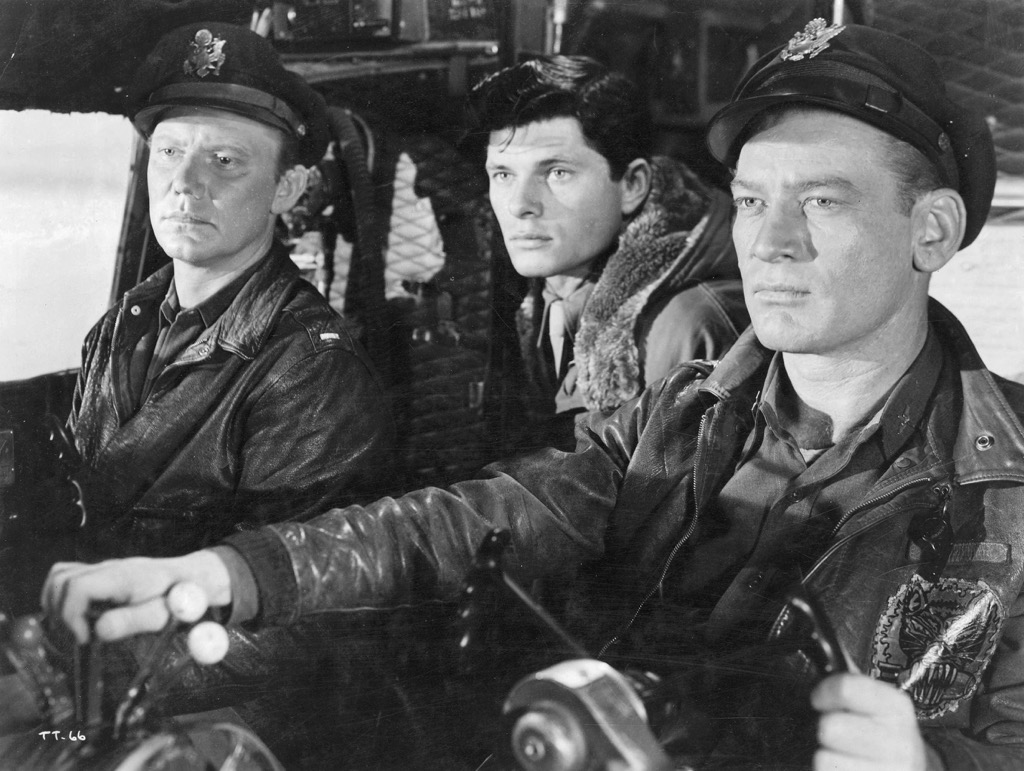
THE THING FROM ANOTHER WORLD opens in an Anchorage, Alaska Air Force lounge as Captain Patrick Hendry (Kenneth Tobey) plays cards with crew members Lt. Eddie Dykes (James Young) and Crew Chief Bob (Dewey Martin). Scotty (Douglas Spencer), a reporter walks into the lounge looking for a story. His wish is soon answered when Hendry and his men are sent up to the North Pole to investigate a report of a plane crash near U.S. Polar Expedition #6.
Hendry and team are greeted at the Research Station by a team of scientists and botanists including Dr. Arthur Carrington (Robert Cornthwaite), Dr. Stern (Eduard Franz), and Carrington's assistant Nikki (Margaret Sheridan), who happens to have had a brief relationship with Hendry on a previous visit. The group flies out the next day to find the crash site. They discover a large circular object buried under the ice. Hendry and his men try to blow up the ice to reach what they suspect is a flying saucer but the ship explodes ruining any chance of studying it. But they do find nearby the passenger of the space ship, frozen in a block of ice. They bring back the frozen visitor to the Research Station to study it. Scotty the reporter wants to file a news story on the discovery but Hendry blocks his request for the time being.
The Thing (GUNSMOKE'S James Arness) thaws out of its frozen bed, attacking the sled dogs as it flees. A dog rips off one of the Thing's arms. Carrington and his fellow scientists study it and discover the Thing has vegetable like qualities. It can regenerate a missing limb and it drops seeds from its prickly hands, seeds that can reproduce into more Things. Carrington wants to communicate and protect it but Hendry realizes if the Thing makes it to a populated area, it could take over the world.
Hendry puts Carrington under house arrest after Carrington is caught feeding stored blood to the Thing's seeds. Using a geiger counter, Hendry and his crew track the Thing. But the Thing is smart and cuts the electricity to the research station. Hendry and crew lures the alien back and this time they electrify the Thing. Scotty the reporter finally gets to call in his story, warning everyone to "Watch the Skies"(which Steven Spielberg would borrow as a temporary title for 1977's CLOSE ENCOUNTERS OF THE THIRD KIND).
Nyby's THE THING is one of the first horror/Science Fiction films to touch upon the Cold War early in the film when General Fogarty (David McMahon) and Hendry discuss the downed aircraft and whether it's American or Russian. It will turn out to be neither. The conflict between the military (Hendry, Dykes, Barnes) versus the scientists (Carrington, Stern, Chapman) as to what to do with the Thing is another nice subtext to the film. Carrington believes it will unlock the mysteries of space but after the Thing kills a couple of scientists, the rest of the science group comes over to the military side.
What's missing from THE THING is the special effects technology to show how adaptable the Thing can be. This film was made in 1951 after all. The Thing is just a big actor (James Arness) in make-up and although Nyby shoot him mostly in darkly lit scenes and keeps the camera off him for the most part, the film eventually has to show the Thing for longer periods during the finale. The Thing's power to reproduce is mostly described in screenwriter Lederer's dialogue. But Nyby builds good suspense with sound effects and the use of the Geiger counter to register when the Thing is near (Ridley Scott's 1979 ALIEN would use the same simple technique). The Thing's first surprise appearance is when Hendry opens a door and the Thing lunges at him from the other side. For the rest of the film, someone opening a door keeps the audience nervously wondering what's on the other side.
Kenneth Tobey as Lt. Hendry is solid as the lead. He's the leader but he's also one of the guys. He's not perfect and even makes a big mistake when he accidentally blows up the spaceship. Tobey would play similar heroes in other horror/science fiction in the 50's including THE BEAST FROM 20,000 FATHOMS (1953) and IT CAME FROM BENEATH THE SEA (1955). Robert Cornthwaite as Dr. Carrington also stands out. Although he's not evil, Carrington's obsession with preserving the Thing regardless of its terrifying abilities blinds his common sense and endangers his fellow scientists. The TV show LOST IN SPACE'S (1965-68) character Dr. Zachary Smith (Jonathan Harris) may owe both his look and personality to THE THING'S Dr. Carrington.
Director John Carpenter is a huge fan of Howard Hawks the filmmaker and of the original film. His remake even copies the original's title sequence. But Carpenter's THE THING (1982) is almost the opposite of the original THE THING FROM ANOTHER WORLD. Instead of the Hawksian band of brothers or in this case band of Air Force men who all get along and would do anything for each other, this group of scientists seem to be isolated and loners. They don't get along. Carpenter's film stays closer to the original short story by Campbell as the space creature can transform and mimic any living creature it comes in contact with instead of the one Thing (James Arness) who was a mixture of Frankenstein and a space carrot in THE THING FROM ANOTHER WORLD.
Written by Bill Lancaster (son of actor Burt Lancaster), Carpenter's THE THING opens in space with an alien spacecraft spinning out of control and crash landing on earth 100,000 years ago. Cut to Winter, 1982 at the U.S. National Science Station #4 in Antarctica. A Siberian Husky, chased by a Norwegian helicopter, dashes into the U.S. station. The Norwegians are trying to kill the dog. The Americans fire back, killing the Norwegian. Why were they after the dog? Helicopter pilot MacReady (Kurt Russell) and Dr. Copper (Richard Dysart) fly over to the Norwegian camp to learn more and discover the station burning. Every one's either dead or missing. They discover a disfigured dead body, videotapes, and a giant block of ice that once held something.
Back at the U.S. station, the videotapes reveal the Norwegians had discovered a large object in the ice. As Dr. Blair (Wilford Brimley) studies the disfigured body, the Thing finally reveals itself in the dog's body and emerges, looking for it's next host body. The rest of the men in the station begin to become paranoid toward one another as no one is sure who may be the alien organism. MacReady goes out again and finds the frozen spaceship. Blair runs simulations on what would happen if the Thing made it to civilization. The results are not promising. Blair sabotages the helicopter and radio room so no one can leave.
Blair locks himself up in his laboratory but MacReady and the others break down the door and tie Blair up, isolating him from the rest of the men. Paranoia runs rampant as Dr. Copper creates a blood serum test to discover which remaining men may be infected. As a storm approaches, the blood test works, revealing the Thing. All hell breaks loose as MacReady, Garry (Donald Moffatt), and Childs (Keith David) try to figure out who they can trust and how can they keep the Thing from reaching civilization.
Carpenter's THE THING is very bleak and dark. From the very first synthesizers beat from composer Ennio Morricone (Sergio Leone's favorite composer), it's evident that MacReady and the rest of the men are in for some trouble. On a small scale, just a U.S. science base in Antarctica, these men are facing Armageddon and possibly, the end of the world if they can't keep the Thing from reaching a larger population. Although it came out three years after ALIEN, THE THING and ALIEN have a lot of similarities. Both involve small groups of people in an isolated location who face an unstoppable creature that could wipe out earth if it ever reaches a mass populace. The haunted house has been replaced by the space ship and arctic research station.
Director Carpenter cleverly casts a bunch of familiar, non-threatening character actors like Wilford Brimley, Richard Masur (as the dog handler), Donald Moffat, and Richard Dysart who seem so benign and friendly that the audience would never believe they could become the Thing. Kurt Russell as MacReady does a variation of his Snake Plissken character from Carpenter's ESCAPE FROM NEW YORK (1981) as the lone wolf helicopter pilot who quickly begins to figure out what they're up against. Toward the end of the film, MacReady begins to resemble Jesus Christ with his long hair and beard, ready to die to save the world from the sins of the scientists who dug up the Thing.
What really distinguishes Carpenter's THING from the original are special make-up effects wizard Rob Bottin's phantasmagorical Thing creatures. Bottin's imagination runs wild as the Thing moves from dog to human to human, able to mimic each host body until revealed. Bottin's creations are haunting and each transformation is unique. CGI was just starting to come into greater use but this THING barely uses any until the very end of the film. This would be John Carpenter's bad alien film. He would follow-up a few years later with a good alien film with STARMAN (1984) starring Jeff Bridges.
I was surprised when I saw that THE THING (2011) was being remade again. But then, I shouldn't have been. Recent reboots of MY BLOODY VALENTINE, FRIDAY THE 13TH, and A NIGHTMARE ON ELM STREET had all popped up recently. Carpenter's THING was so delicious and suspenseful and perfect in my mind what was the point of remaking it again. But as I watched this THING version, it turns out Dutch director Matthijs van Heijningen, Jr and writer Eric Heisserer made a clever choice. This THING is a prequel, set at the Norwegian Camp in Antarctica, 1982, where the Norwegians and other international staff first discovered the Thing before it moved on to the U.S. Research Station to face off against Kurt Russell and group.
The filmmakers also reintroduce women to the story which the original film had with Margaret Sheridan. Carpenter's THE THING was void of women but Heijningen's THING has a strong lead in actress Mary Elizabeth Winstead, an American paleontologist who quickly recognizes this alien is no ET. This third THING will pay homage to both previous films with scenes and situations. The film opens with a Snow Cat rumbling across the arctic tundra with three Norwegian scientists following a signal. As they reach the signal, the ice caves in and the Snow Cat tumbles down a hole resting on top of what looks like a space ship buried in the ice.
Dr. Sander Halvorson (Ulrich Thomsen) recruits Kate Lloyd (Mary Elizabeth Windstead), a paleontologist who specializes in fossils found in the ice to join them, recommended by Halvorson's assistant Adam Finch (Eric Christian Olsen). Halvorsen takes the whole team: Norwegians, Americans, and Brits down to the spaceship. He shows them the survivor of the space crash - a Thing encased in a block of ice. A claw appears to be visible. The block is dug out and brought back to the base. Halvorson wants radio silence until he can learn more about the discovery of the century.
The ice block begins to melt and this Thing springs out of its icy tomb, immediately attacking Lars's (Jorgen Langhelle) dog, injuring others, and killing another scientist Henrik (Jo Adrian Haavind). Kate and the scientists burn the creature and perform an autopsy on the Thing, discovering it was trying to fuse with Henrik. Further study reveals the Thing's cells can imitate human cells. American helicopter pilot Sam Carter (Joel Edgerton) and his co-pilot Derek Jameson (Adewale Akinnuoye-Agbaje) prepare to fly an injured scientist back to McMurdo U.S. arctic base but the Thing is on board and their chopper crash lands a few miles away.
The remainder of this THING follows Carpenter's film somewhat as the survivors battle the Thing while trying to figure out which one of their comrades might be the creature. Kate comes up with a test that may distinguish who is infected but the Thing sabotages it by starting a fire in the lab. Kate and Sam (who's trekked back to camp with Derek after crash landing) chase the Thing back to its spaceship as it tries to take off. Director Heijningen ends the film with scenes that begin Carpenter's film -- the last husky sled dog escaping the compound, carrying the Thing inside and the last two remaining Norwegians chasing after it via helicopter, trying to kill it. Heijningen even uses the Morricone synthesizer beat. Director Heijningen apparently is a huge fan of Carpenter's version as Carpenter was of the Nyby/Hawks film.
I like that a European director made this THING prequel, giving us a different point of view after two American directors had tackled it. A good majority of the cast is Scandinavian with American Winstead and Australian Edgerton thrown in to round it out. Director Heijningen does use elements from both previous films though in this version. Like the Nyby film, he pits the Norwegians against the Americans/English when paranoia sets in similar to the scientists versus the Air Force men in the original. He brings back female characters to the story like paleontologist Kate Lloyd and another woman Juliette (Kim Bubbs), wife of one of the scientists. And Dr. Halvorson is the reincarnate of Dr. Carrington from the original, more interested in studying the lethal alien creature than the welfare of his fellow scientists. Halvorson will get his wish in more ways than one to fully understand the Thing.
From Carpenter's film, Heijningen borrows the tense group test scene to find out which members may be the Thing, taking a different angle on it. Once again, a helicopter pilot in Sam Carter is one of the heroes, like MacReady in Carpenter's film, although spunky Kate is the main protagonist. And Heijningen weaves some of the discoveries that MacReady and Dr. Copper discovered at the Norwegian camp in the 2nd film into the finale of the 3rd film especially the metamorphosis and destruction of the double-faced human/Thing.
Director Heijningen is adroit at throwing red herrings to the audience as to which expedition member is the Thing, keeping the audience on its toes. The CGI and make-up effects for the Thing, although not as incredible as Bottin's, are effective nonetheless. Actress Winstead is Sigourney Weaver-ish as the level-headed and strong woman amongst all the men and Joel Edgerton (looking a lot like talk show host Conan O'Brien) stands out as the friendly pilot Carter. If nothing else, this THING like other horror film reboots has introduced the story to another generation of young horror film fans. Ultimately, this THING lacks some thing. A more recognizable star, some twist on the story. I can't put my finger on it. I still believe Carpenter's THE THING, although not a huge hit when it came out, already told the story very well.
The fact that John W. Campbell's story Who Goes There? has been made into a film three times is proof that THE THING is an entertaining and suspenseful tale that has been scaring audiences for over sixty years. The ALIEN films owe a great debt to THE THING yet are uniquely different in many aspects except that they warn about an indestructible alien that may visit us in the future. So heed the reporter Scotty's words from the first film and "Watch the Skies." And if you like a good scare, watch any version of THE THING on your favorite electronic device.
The original film called THE THING FROM ANOTHER WORLD (1951) was produced by director Howard Hawks (THE BIG SLEEP and RED RIVER) and directed by his longtime editor Christian Nyby (TO HAVE AND HAVE NOT). It's based on the short story by John W. Campbell, Jr called Who Goes There? and was adapted to the screen by Charles Lederer (HIS GIRL FRIDAY). Many people think Howard Hawks actually directed the film but I think because it's a B movie with B actors and actresses, Nyby directed it with some input from Hawks. If John Wayne or Humphrey Bogart had been in it, Hawks probably would have directed it.
But THE THING has a Hawks flavor to it like ONLY ANGELS HAVE WINGS (1939). Instead of a group of mail delivery pilots in South America, it's a group of Air Force pilots and scientists and botanists at the North Pole. The dialogue is fast and snappy, there's a smart, no-nonsense woman among the group who can drink and smoke just like the men, and Nyby/Hawks work in plenty of aerial footage of the Air Force plane landing and taking off in the snow. But THE THING also has a great sense of mystery and suspense once the pilots and scientists discover and bring back the Thing to their research station.
THE THING FROM ANOTHER WORLD opens in an Anchorage, Alaska Air Force lounge as Captain Patrick Hendry (Kenneth Tobey) plays cards with crew members Lt. Eddie Dykes (James Young) and Crew Chief Bob (Dewey Martin). Scotty (Douglas Spencer), a reporter walks into the lounge looking for a story. His wish is soon answered when Hendry and his men are sent up to the North Pole to investigate a report of a plane crash near U.S. Polar Expedition #6.
Hendry and team are greeted at the Research Station by a team of scientists and botanists including Dr. Arthur Carrington (Robert Cornthwaite), Dr. Stern (Eduard Franz), and Carrington's assistant Nikki (Margaret Sheridan), who happens to have had a brief relationship with Hendry on a previous visit. The group flies out the next day to find the crash site. They discover a large circular object buried under the ice. Hendry and his men try to blow up the ice to reach what they suspect is a flying saucer but the ship explodes ruining any chance of studying it. But they do find nearby the passenger of the space ship, frozen in a block of ice. They bring back the frozen visitor to the Research Station to study it. Scotty the reporter wants to file a news story on the discovery but Hendry blocks his request for the time being.
The Thing (GUNSMOKE'S James Arness) thaws out of its frozen bed, attacking the sled dogs as it flees. A dog rips off one of the Thing's arms. Carrington and his fellow scientists study it and discover the Thing has vegetable like qualities. It can regenerate a missing limb and it drops seeds from its prickly hands, seeds that can reproduce into more Things. Carrington wants to communicate and protect it but Hendry realizes if the Thing makes it to a populated area, it could take over the world.
Hendry puts Carrington under house arrest after Carrington is caught feeding stored blood to the Thing's seeds. Using a geiger counter, Hendry and his crew track the Thing. But the Thing is smart and cuts the electricity to the research station. Hendry and crew lures the alien back and this time they electrify the Thing. Scotty the reporter finally gets to call in his story, warning everyone to "Watch the Skies"(which Steven Spielberg would borrow as a temporary title for 1977's CLOSE ENCOUNTERS OF THE THIRD KIND).
Nyby's THE THING is one of the first horror/Science Fiction films to touch upon the Cold War early in the film when General Fogarty (David McMahon) and Hendry discuss the downed aircraft and whether it's American or Russian. It will turn out to be neither. The conflict between the military (Hendry, Dykes, Barnes) versus the scientists (Carrington, Stern, Chapman) as to what to do with the Thing is another nice subtext to the film. Carrington believes it will unlock the mysteries of space but after the Thing kills a couple of scientists, the rest of the science group comes over to the military side.
What's missing from THE THING is the special effects technology to show how adaptable the Thing can be. This film was made in 1951 after all. The Thing is just a big actor (James Arness) in make-up and although Nyby shoot him mostly in darkly lit scenes and keeps the camera off him for the most part, the film eventually has to show the Thing for longer periods during the finale. The Thing's power to reproduce is mostly described in screenwriter Lederer's dialogue. But Nyby builds good suspense with sound effects and the use of the Geiger counter to register when the Thing is near (Ridley Scott's 1979 ALIEN would use the same simple technique). The Thing's first surprise appearance is when Hendry opens a door and the Thing lunges at him from the other side. For the rest of the film, someone opening a door keeps the audience nervously wondering what's on the other side.
Kenneth Tobey as Lt. Hendry is solid as the lead. He's the leader but he's also one of the guys. He's not perfect and even makes a big mistake when he accidentally blows up the spaceship. Tobey would play similar heroes in other horror/science fiction in the 50's including THE BEAST FROM 20,000 FATHOMS (1953) and IT CAME FROM BENEATH THE SEA (1955). Robert Cornthwaite as Dr. Carrington also stands out. Although he's not evil, Carrington's obsession with preserving the Thing regardless of its terrifying abilities blinds his common sense and endangers his fellow scientists. The TV show LOST IN SPACE'S (1965-68) character Dr. Zachary Smith (Jonathan Harris) may owe both his look and personality to THE THING'S Dr. Carrington.
Director John Carpenter is a huge fan of Howard Hawks the filmmaker and of the original film. His remake even copies the original's title sequence. But Carpenter's THE THING (1982) is almost the opposite of the original THE THING FROM ANOTHER WORLD. Instead of the Hawksian band of brothers or in this case band of Air Force men who all get along and would do anything for each other, this group of scientists seem to be isolated and loners. They don't get along. Carpenter's film stays closer to the original short story by Campbell as the space creature can transform and mimic any living creature it comes in contact with instead of the one Thing (James Arness) who was a mixture of Frankenstein and a space carrot in THE THING FROM ANOTHER WORLD.
Written by Bill Lancaster (son of actor Burt Lancaster), Carpenter's THE THING opens in space with an alien spacecraft spinning out of control and crash landing on earth 100,000 years ago. Cut to Winter, 1982 at the U.S. National Science Station #4 in Antarctica. A Siberian Husky, chased by a Norwegian helicopter, dashes into the U.S. station. The Norwegians are trying to kill the dog. The Americans fire back, killing the Norwegian. Why were they after the dog? Helicopter pilot MacReady (Kurt Russell) and Dr. Copper (Richard Dysart) fly over to the Norwegian camp to learn more and discover the station burning. Every one's either dead or missing. They discover a disfigured dead body, videotapes, and a giant block of ice that once held something.
Back at the U.S. station, the videotapes reveal the Norwegians had discovered a large object in the ice. As Dr. Blair (Wilford Brimley) studies the disfigured body, the Thing finally reveals itself in the dog's body and emerges, looking for it's next host body. The rest of the men in the station begin to become paranoid toward one another as no one is sure who may be the alien organism. MacReady goes out again and finds the frozen spaceship. Blair runs simulations on what would happen if the Thing made it to civilization. The results are not promising. Blair sabotages the helicopter and radio room so no one can leave.
Blair locks himself up in his laboratory but MacReady and the others break down the door and tie Blair up, isolating him from the rest of the men. Paranoia runs rampant as Dr. Copper creates a blood serum test to discover which remaining men may be infected. As a storm approaches, the blood test works, revealing the Thing. All hell breaks loose as MacReady, Garry (Donald Moffatt), and Childs (Keith David) try to figure out who they can trust and how can they keep the Thing from reaching civilization.
Carpenter's THE THING is very bleak and dark. From the very first synthesizers beat from composer Ennio Morricone (Sergio Leone's favorite composer), it's evident that MacReady and the rest of the men are in for some trouble. On a small scale, just a U.S. science base in Antarctica, these men are facing Armageddon and possibly, the end of the world if they can't keep the Thing from reaching a larger population. Although it came out three years after ALIEN, THE THING and ALIEN have a lot of similarities. Both involve small groups of people in an isolated location who face an unstoppable creature that could wipe out earth if it ever reaches a mass populace. The haunted house has been replaced by the space ship and arctic research station.
Director Carpenter cleverly casts a bunch of familiar, non-threatening character actors like Wilford Brimley, Richard Masur (as the dog handler), Donald Moffat, and Richard Dysart who seem so benign and friendly that the audience would never believe they could become the Thing. Kurt Russell as MacReady does a variation of his Snake Plissken character from Carpenter's ESCAPE FROM NEW YORK (1981) as the lone wolf helicopter pilot who quickly begins to figure out what they're up against. Toward the end of the film, MacReady begins to resemble Jesus Christ with his long hair and beard, ready to die to save the world from the sins of the scientists who dug up the Thing.
What really distinguishes Carpenter's THING from the original are special make-up effects wizard Rob Bottin's phantasmagorical Thing creatures. Bottin's imagination runs wild as the Thing moves from dog to human to human, able to mimic each host body until revealed. Bottin's creations are haunting and each transformation is unique. CGI was just starting to come into greater use but this THING barely uses any until the very end of the film. This would be John Carpenter's bad alien film. He would follow-up a few years later with a good alien film with STARMAN (1984) starring Jeff Bridges.
I was surprised when I saw that THE THING (2011) was being remade again. But then, I shouldn't have been. Recent reboots of MY BLOODY VALENTINE, FRIDAY THE 13TH, and A NIGHTMARE ON ELM STREET had all popped up recently. Carpenter's THING was so delicious and suspenseful and perfect in my mind what was the point of remaking it again. But as I watched this THING version, it turns out Dutch director Matthijs van Heijningen, Jr and writer Eric Heisserer made a clever choice. This THING is a prequel, set at the Norwegian Camp in Antarctica, 1982, where the Norwegians and other international staff first discovered the Thing before it moved on to the U.S. Research Station to face off against Kurt Russell and group.
The filmmakers also reintroduce women to the story which the original film had with Margaret Sheridan. Carpenter's THE THING was void of women but Heijningen's THING has a strong lead in actress Mary Elizabeth Winstead, an American paleontologist who quickly recognizes this alien is no ET. This third THING will pay homage to both previous films with scenes and situations. The film opens with a Snow Cat rumbling across the arctic tundra with three Norwegian scientists following a signal. As they reach the signal, the ice caves in and the Snow Cat tumbles down a hole resting on top of what looks like a space ship buried in the ice.
Dr. Sander Halvorson (Ulrich Thomsen) recruits Kate Lloyd (Mary Elizabeth Windstead), a paleontologist who specializes in fossils found in the ice to join them, recommended by Halvorson's assistant Adam Finch (Eric Christian Olsen). Halvorsen takes the whole team: Norwegians, Americans, and Brits down to the spaceship. He shows them the survivor of the space crash - a Thing encased in a block of ice. A claw appears to be visible. The block is dug out and brought back to the base. Halvorson wants radio silence until he can learn more about the discovery of the century.
The ice block begins to melt and this Thing springs out of its icy tomb, immediately attacking Lars's (Jorgen Langhelle) dog, injuring others, and killing another scientist Henrik (Jo Adrian Haavind). Kate and the scientists burn the creature and perform an autopsy on the Thing, discovering it was trying to fuse with Henrik. Further study reveals the Thing's cells can imitate human cells. American helicopter pilot Sam Carter (Joel Edgerton) and his co-pilot Derek Jameson (Adewale Akinnuoye-Agbaje) prepare to fly an injured scientist back to McMurdo U.S. arctic base but the Thing is on board and their chopper crash lands a few miles away.
The remainder of this THING follows Carpenter's film somewhat as the survivors battle the Thing while trying to figure out which one of their comrades might be the creature. Kate comes up with a test that may distinguish who is infected but the Thing sabotages it by starting a fire in the lab. Kate and Sam (who's trekked back to camp with Derek after crash landing) chase the Thing back to its spaceship as it tries to take off. Director Heijningen ends the film with scenes that begin Carpenter's film -- the last husky sled dog escaping the compound, carrying the Thing inside and the last two remaining Norwegians chasing after it via helicopter, trying to kill it. Heijningen even uses the Morricone synthesizer beat. Director Heijningen apparently is a huge fan of Carpenter's version as Carpenter was of the Nyby/Hawks film.
I like that a European director made this THING prequel, giving us a different point of view after two American directors had tackled it. A good majority of the cast is Scandinavian with American Winstead and Australian Edgerton thrown in to round it out. Director Heijningen does use elements from both previous films though in this version. Like the Nyby film, he pits the Norwegians against the Americans/English when paranoia sets in similar to the scientists versus the Air Force men in the original. He brings back female characters to the story like paleontologist Kate Lloyd and another woman Juliette (Kim Bubbs), wife of one of the scientists. And Dr. Halvorson is the reincarnate of Dr. Carrington from the original, more interested in studying the lethal alien creature than the welfare of his fellow scientists. Halvorson will get his wish in more ways than one to fully understand the Thing.
From Carpenter's film, Heijningen borrows the tense group test scene to find out which members may be the Thing, taking a different angle on it. Once again, a helicopter pilot in Sam Carter is one of the heroes, like MacReady in Carpenter's film, although spunky Kate is the main protagonist. And Heijningen weaves some of the discoveries that MacReady and Dr. Copper discovered at the Norwegian camp in the 2nd film into the finale of the 3rd film especially the metamorphosis and destruction of the double-faced human/Thing.
Director Heijningen is adroit at throwing red herrings to the audience as to which expedition member is the Thing, keeping the audience on its toes. The CGI and make-up effects for the Thing, although not as incredible as Bottin's, are effective nonetheless. Actress Winstead is Sigourney Weaver-ish as the level-headed and strong woman amongst all the men and Joel Edgerton (looking a lot like talk show host Conan O'Brien) stands out as the friendly pilot Carter. If nothing else, this THING like other horror film reboots has introduced the story to another generation of young horror film fans. Ultimately, this THING lacks some thing. A more recognizable star, some twist on the story. I can't put my finger on it. I still believe Carpenter's THE THING, although not a huge hit when it came out, already told the story very well.
The fact that John W. Campbell's story Who Goes There? has been made into a film three times is proof that THE THING is an entertaining and suspenseful tale that has been scaring audiences for over sixty years. The ALIEN films owe a great debt to THE THING yet are uniquely different in many aspects except that they warn about an indestructible alien that may visit us in the future. So heed the reporter Scotty's words from the first film and "Watch the Skies." And if you like a good scare, watch any version of THE THING on your favorite electronic device.
Wednesday, September 19, 2012
Tomahawk Trail (1957)
When movie lovers (and the CrazyFilmGuy) think of the Western, we usually point toward the classic films of director John Ford like MY DARLING CLEMENTINE (1946) or THE SEARCHERS (1956) or the psychological westerns that director Anthony Mann made with Jimmy Stewart such as THE NAKED SPUR (1953) or THE MAN FROM LARAMIE (1955). Or we get misty-eyed over Sam Peckinpah's code of honor films in RIDE THE HIGH COUNTRY (1962) or THE WILD BUNCH (1969). And let's not forget Mr. Clint Eastwood who has owned the western from his early films with director Sergio Leone as the Man With No Name thru UNFORGIVEN (1992).
But like most genres, not every western ever made is a classic. Many are B films with lesser stars and a smaller budget. Some are good and some downright stinkers. But they still deserve a chance and so when the CrazyFilmGuy saw the title TOMAHAWK TRAIL (1957) on his television recently, he decided to give it a viewing or two since he had never heard of the film before.
As the title hints at, TOMAHAWK TRAIL has Indians in it as well as a U.S. Cavalry patrol. But it is at best a B Western with few notable stars except for the unsung Chuck Conners in the lead and a very young Harry Dean Stanton (going by the name of Dean Stanton early in his career). It does have some production value in its Kanab, Utah locations (which John Ford also liked to shoot in) and a fort that will be used by the Cavalry patrol. But TOMAHAWK cannot hide its budgetary limitations. Although TOMAHAWK TRAIL is a feature film, its running time is a short 60 minutes, about the length of watching an episode (with commercials) of Chuck Conners TV show a year later called THE RIFLEMAN (1958 to 1963).
TOMAHAWK TRAIL'S plot has some familiar elements. A wagon train full of U.S. Cavalry headed for Fort Bowie are attacked by a party of Apache Indians. The wagon train is led by Lieutenant Jonathan Davenport (George Neise), a replacement for a recently fallen commander, fresh from West Point and full of ideas but out of his league in the Wild West. Davenport is at odds with Sergeant Wade McCoy (Chuck Conners), his subordinate but with much more experience in fighting the Indians. McCoy tries to show Davenport the right way to fight the Apaches and survive but Davenport will have none of it. But after the heat takes its toll on the West Point graduate Davenport and then Indians steal the Cavalry's horses, McCoy has to take over as commander, against Davenport's threats of a court martial for McCoy.
Without horses, the patrol come across and surprise the Apache war party and rescue Ellen Carter (Susan Cummings), daughter of an Army officer who was kidnapped a few months earlier from Fort Laramie and Tula (Lisa Montell), daughter of the Apache Chief Victorio (who we only see from afar and never in close up). McCoy manages to keep the lost patrol together despite repeated skirmishes with the Apaches as well as dissension from the insufferable Davenport and his lackey Private Miller (Harry Dean Stanton). There's even an attempted rape of Tula by Private Barrow (Robert Knapp).
McCoy and his ragtag party finally arrive at Fort Bowie. At first, it appears to be abandoned. As they enter the fort, they see the bodies of soldiers, decimated by an earlier Apache attack. McCoy has his men collect weapons from the dead soldiers and strengthen Bowie's fortifications as they prepare for the inevitable raid by the Apaches. But McCoy has an ace up his sleeve -- the Apache leader's daughter Tula. His only hope for the troop to survive is to use her as a bargaining chip. But will Tula be willing to save her captors?
TOMAHAWK TRAIL wants to tread in John Ford territory but veteran Western director Lesley Selander and screenwriter David Chandler are limited by their budget, story, and actors. Whether the budget couldn't afford too many horses or writer Chandler purposefully chose to do this, the Apaches stealing the Cavalry's horses early in the film, causing the Cavalry to now walk to their destination is unintentionally humorous. Story points move quickly in this film too. In one scene, Ellen confides to McCoy she is a peaceful person amongst all the fighting. In the very next scene, Ellen is attacked by Private Macy (Frederick Ford) and accidentally kills him with a hammer defending herself. Talk about a quick change in attitude. We never get to meet the Apache Chief Victorio. He's only shown from a distance. Apparently, the production couldn't afford to pay an actor to play Victorio in close ups or speak a few lines of dialogue. We hear about him and but only see him in a long shot at the film's end.
Chuck Conners is likable as the lead Sgt. McCoy and would appear in countless westerns but he's not John Wayne except maybe in height and collegiate football career. In a Ford film, the Cavalry would be a colorful mix of Irish, Texans, and ex-Confederates but TOMAHAWK'S soldiers are mostly vanilla. John Smith as McCoy's best friend Private Reynolds provides a few dashes of humor and Eddie Little Sky as the Indian scout Johnny Dogwood is a rare positive Native American character even if Eddie's acting range is limited. George Neise's Lt. Davenport is too over the top and almost unbelievable at times in his feverish performance. Susan Cummings as Ellen Carter is neither particularly pretty or memorable. And young Harry Dean Stanton shows his inexperience as Private Miller but it's just the start of a long career for Stanton who would improve over the years in films like ALIEN (1979) and PARIS, TEXAS (1984). TOMAHAWK is Stanton's first talking film role.
But like many B movies, TOMAHAWK TRAIL has its moments. Director Selander makes good use of the Kanab, Utah locations especially the fort (Selander would direct 5 films in 1957 beside TOMAHAWK TRAIL including REVOLT AT FORT LARAMIE, using the same Kanab Fort location and casting actor Stanton again). The troop's discovery of the massacre is well staged and the siege of the fort by the Apaches with flaming arrows is impressive. The production may have skimped on the horses but it makes up for it with some excellent stunts during the attack. TOMAHAWK also shows the seamier side of the army as not one but two different soldiers try to rape the women. These soldiers are not the honorable men from Ford's FORT APACHE (1948) or RIO GRANDE (1950). Underpaid, hungry, hot, forced to walk, and fighting against Indians and bugs, the lure of two pretty women is too much for a few privates. But the film gives the lusty Private Macy his comeuppance and Private Barrow apologizes to McCoy before the finale.
TOMAHAWK TRAIL is a quick appetizer for western film buff''s pallet. It's a standard Cavalry Western that is not glorified or revered by critics or movie fans. But it follows all the basic conventions of the Western and despite it's budget limitations, it offers some interesting riffs on a familiar story.
But like most genres, not every western ever made is a classic. Many are B films with lesser stars and a smaller budget. Some are good and some downright stinkers. But they still deserve a chance and so when the CrazyFilmGuy saw the title TOMAHAWK TRAIL (1957) on his television recently, he decided to give it a viewing or two since he had never heard of the film before.
As the title hints at, TOMAHAWK TRAIL has Indians in it as well as a U.S. Cavalry patrol. But it is at best a B Western with few notable stars except for the unsung Chuck Conners in the lead and a very young Harry Dean Stanton (going by the name of Dean Stanton early in his career). It does have some production value in its Kanab, Utah locations (which John Ford also liked to shoot in) and a fort that will be used by the Cavalry patrol. But TOMAHAWK cannot hide its budgetary limitations. Although TOMAHAWK TRAIL is a feature film, its running time is a short 60 minutes, about the length of watching an episode (with commercials) of Chuck Conners TV show a year later called THE RIFLEMAN (1958 to 1963).
TOMAHAWK TRAIL'S plot has some familiar elements. A wagon train full of U.S. Cavalry headed for Fort Bowie are attacked by a party of Apache Indians. The wagon train is led by Lieutenant Jonathan Davenport (George Neise), a replacement for a recently fallen commander, fresh from West Point and full of ideas but out of his league in the Wild West. Davenport is at odds with Sergeant Wade McCoy (Chuck Conners), his subordinate but with much more experience in fighting the Indians. McCoy tries to show Davenport the right way to fight the Apaches and survive but Davenport will have none of it. But after the heat takes its toll on the West Point graduate Davenport and then Indians steal the Cavalry's horses, McCoy has to take over as commander, against Davenport's threats of a court martial for McCoy.
Without horses, the patrol come across and surprise the Apache war party and rescue Ellen Carter (Susan Cummings), daughter of an Army officer who was kidnapped a few months earlier from Fort Laramie and Tula (Lisa Montell), daughter of the Apache Chief Victorio (who we only see from afar and never in close up). McCoy manages to keep the lost patrol together despite repeated skirmishes with the Apaches as well as dissension from the insufferable Davenport and his lackey Private Miller (Harry Dean Stanton). There's even an attempted rape of Tula by Private Barrow (Robert Knapp).
McCoy and his ragtag party finally arrive at Fort Bowie. At first, it appears to be abandoned. As they enter the fort, they see the bodies of soldiers, decimated by an earlier Apache attack. McCoy has his men collect weapons from the dead soldiers and strengthen Bowie's fortifications as they prepare for the inevitable raid by the Apaches. But McCoy has an ace up his sleeve -- the Apache leader's daughter Tula. His only hope for the troop to survive is to use her as a bargaining chip. But will Tula be willing to save her captors?
TOMAHAWK TRAIL wants to tread in John Ford territory but veteran Western director Lesley Selander and screenwriter David Chandler are limited by their budget, story, and actors. Whether the budget couldn't afford too many horses or writer Chandler purposefully chose to do this, the Apaches stealing the Cavalry's horses early in the film, causing the Cavalry to now walk to their destination is unintentionally humorous. Story points move quickly in this film too. In one scene, Ellen confides to McCoy she is a peaceful person amongst all the fighting. In the very next scene, Ellen is attacked by Private Macy (Frederick Ford) and accidentally kills him with a hammer defending herself. Talk about a quick change in attitude. We never get to meet the Apache Chief Victorio. He's only shown from a distance. Apparently, the production couldn't afford to pay an actor to play Victorio in close ups or speak a few lines of dialogue. We hear about him and but only see him in a long shot at the film's end.
Chuck Conners is likable as the lead Sgt. McCoy and would appear in countless westerns but he's not John Wayne except maybe in height and collegiate football career. In a Ford film, the Cavalry would be a colorful mix of Irish, Texans, and ex-Confederates but TOMAHAWK'S soldiers are mostly vanilla. John Smith as McCoy's best friend Private Reynolds provides a few dashes of humor and Eddie Little Sky as the Indian scout Johnny Dogwood is a rare positive Native American character even if Eddie's acting range is limited. George Neise's Lt. Davenport is too over the top and almost unbelievable at times in his feverish performance. Susan Cummings as Ellen Carter is neither particularly pretty or memorable. And young Harry Dean Stanton shows his inexperience as Private Miller but it's just the start of a long career for Stanton who would improve over the years in films like ALIEN (1979) and PARIS, TEXAS (1984). TOMAHAWK is Stanton's first talking film role.
But like many B movies, TOMAHAWK TRAIL has its moments. Director Selander makes good use of the Kanab, Utah locations especially the fort (Selander would direct 5 films in 1957 beside TOMAHAWK TRAIL including REVOLT AT FORT LARAMIE, using the same Kanab Fort location and casting actor Stanton again). The troop's discovery of the massacre is well staged and the siege of the fort by the Apaches with flaming arrows is impressive. The production may have skimped on the horses but it makes up for it with some excellent stunts during the attack. TOMAHAWK also shows the seamier side of the army as not one but two different soldiers try to rape the women. These soldiers are not the honorable men from Ford's FORT APACHE (1948) or RIO GRANDE (1950). Underpaid, hungry, hot, forced to walk, and fighting against Indians and bugs, the lure of two pretty women is too much for a few privates. But the film gives the lusty Private Macy his comeuppance and Private Barrow apologizes to McCoy before the finale.
TOMAHAWK TRAIL is a quick appetizer for western film buff''s pallet. It's a standard Cavalry Western that is not glorified or revered by critics or movie fans. But it follows all the basic conventions of the Western and despite it's budget limitations, it offers some interesting riffs on a familiar story.
Thursday, September 6, 2012
Out of the Past (1947) and Against All Odds (1984)
One of the delights about watching a remake is discovering the original source. Such is the case of Taylor Hackford's AGAINST ALL ODDS (1984) a remake of the Film Noir classic OUT OF THE PAST (1947). The regular moviegoer probably has no idea that AGAINST ALL ODDS is a remake. I don't think I did when I first saw it in Manhattan Beach, California during college. Give Director Hackford credit for taking on one of the great film noirs ever made. I first watched OUT OF THE PAST the night before I was going to work on a screen test the next day with Robert Redford and Lena Olin for the Sydney Pollack film HAVANA (1990). I was nervous and couldn't sleep so I stayed up and watched OUT OF THE PAST. I don't remember much of the film but I know I enjoyed it.
OUT OF THE PAST was directed by Jacques Tourneur with a screenplay by Daniel Mainwaring (under the pseudonym Geoffrey Homes) based on his own novel Build My Gallows High (with an uncredited polish by noir novelist James M. Cain). PAST is a taut, well-written film noir with juicy roles for everyone involved from the lead actors Robert Mitchum and Jane Greer to the supporting ones who play cab drivers or hotel clerks. The film moves from the Sierra Mountains to Lake Tahoe to Mexico, Los Angeles, and San Francisco with ease. The dialogue is sharp. The femme fatales are beautiful and deadly. Tourneur was good at atmosphere having directed the horror classics THE CAT PEOPLE (1942) and I WALKED WITH A ZOMBIE (1943). But look at Tourneur's resume and film noir doesn't jump out as his specialty yet OUT OF THE PAST is considered one of the best.
The film opens in the Sierra Mountain town of Bridgeport. A man in a black suit named Joe Stefanos (Paul Valentine) stops at a gas station looking for the station's owner Jeff Bailey (Robert Mitchum). Jeff is out fishing with a local girl Ann Miller (Virginia Huston) but the Kid (Dickie Moore), a deaf teenager who works at the gas station finds Bailey up at the lake. Joe works for a gambler named Whit Sterling (Kirk Douglas, in only his second feature film). Jeff has also worked for Whit before, in his previous life as private detective Jeff Markham, his real name. Whit wants Jeff for a new job and needs Jeff to come up to his Lake Tahoe home to discuss it. Jeff confides to Ann that his shady past as a private dick is what drove him to the isolated town of Bridgeport and the quiet profession of gas station owner.
As Ann drives him to Whit's home, Jeff tells her in flashback how Whit hired Jeff to track down Whit's girlfriend Kathie Moffitt (Jane Greer) who not only shot Whit four times but also stole forty thousand dollars from him. Whit doesn't care about the money. He just wants Kathie back. Jeff tracks her down to Acapulco, Mexico. Jeff floats from seedy bar to seedy bar until Kathie walks in one night and Jeff knows why Whit wants Kathie back. She's unbelievably gorgeous. Jeff strikes up a conversation with her and soon they're in love. Kathie knows Whit sent Jeff. They talk about leaving together but then Whit and Joe show up. Jeff lies that he hasn't found her yet. Whit wants Jeff to stay on her trail. After Whit leaves Mexico, Jeff and Kathie take a steamer up to the Bay Area. They're about to disappear for good when Jeff's old detective partner Jack Fisher (Steve Brodie) sees him in San Francisco. Fisher follows them to a mountain cabin. Whit has hired Fisher to follow Jeff. Fisher tries to blackmail them and Kathie shoots Fisher, killing him.
The flashback ends as Ann drops Jeff off at Whit's house. Kathie is back with Whit, catching Jeff off guard. He hasn't seen Kathie since she killed Fisher. Whit is being extorted by an accountant named Leonard Eels (Ken Niles) who helped Whit hide a million dollars from the IRS. Whit wants Jeff to steal his tax books back from Eels. Whit trusts no one but Jeff. Eels secretary Meta Carson (Rhonda Fleming) is in on the plot. Jeff is to meet up with Meta who will get him into Eels office. Jeff smells a set-up. Whit has never forgiven Jeff for taking his girl. Whit not only wants his crooked tax documents back but he wants to frame Jeff for the murder of Fisher and as it turns out, Eels. But Jeff manages to stay one step ahead of Whit, Joe, and the police, hiding the cooked tax books and hiding out back in the Sierras. Kathie begins to creep back into his life and flips sides again, turning against Whit to save Jeff. But who will survive this typically noir-ish relationship -- Jeff, Kathie, or neither?
Film Noir emerged in post-World War II with tales of the dark underbelly of society with amoral men and dangerous, loose women. OUT OF THE PAST exemplifies this style. Jeff Bailey/Markham is a smart man loved by a good honest woman in Ann but mixed up with sinister gangster Whit Sterling and tempted by the seductive femme fatale Kathie Moffitt. Femme Fatale is French for deadly woman. Moffitt isn't the only femme fatale in the movie. Eels secretary Meta Carson is a second femme fatale who helps get her employer killed.
OUT OF THE PAST has a nice noir triangle where the players will betray one another. Robert Mitchum is perfect as the tough former detective Bailey/Markham and he wasn't even the producers first choice. Like typical Film Noir protagonists, Bailey/Markham knows to steer clear of dames like Kathie Moffitt but he succumbs to her black widow charms nonetheless. Jane Greer is dynamite as Katie. Kathie's eyes are her best weapon. She seduces men with her big beautiful eyes but when cornered, her eyes turn wild and unpredictable. Kirk Douglas's Whit isn't a big part but he's memorable with his slicked back hair and strong jawline. What careers Mitchum and Douglas would have for the next forty years after OUT OF THE PAST.
Film Noir usually takes place in rain slicked cities but OUT OF THE PAST mixes urban locales like bars, offices and city apartments with the Lake Tahoe mountain scenery. Director Tourneur has the noir imagery down with lots of shadows and back lighting and contrast between light and dark. Writer Mainwaring's dialogue crackles and the plot twists and turns with some nifty surprises along the way. OUT OF THE PAST is the perfect Film Noir so who would even think of remaking it?
Director Taylor Hackford (WHITE NIGHTS) that's who. Hackford's remake AGAINST ALL ODDS (1984) has three things going for it. One is some fantastic Mexican locations that Hackford uses for dramatic effect at Cozumel, Tulum, and Chichen Itza. Secondly, he cleverly casts film noir legends Richard Widmark of KISS OF DEATH (1947) and Jane Greer, the original femme fatale from OUT OF THE PAST in supporting roles. And lastly, he has the sultry, smoky voiced actress Rachel Ward as this version's femme fatale. Like Greer, Ward is believable as a woman any man would want as his own and would double cross and kill to keep.
AGAINST ALL ODDS definitely modernizes the OUT OF THE PAST storyline and the film starts out strongly. Terry Brogan (Jeff Bridges), ex-football player, is down in Cozumel looking for the girlfriend of nightclub owner/gambler Jake Wise (James Woods). Jessie Wyler (Rachel Ward) stabbed Jake and stole $50,000 from him. Jessie is the daughter of Mrs. Wyler (Jane Greer), wealthy owner of the Los Angeles Outlaws football team that Terry played for until his recent release from the team. An early flashback reveals Terry is in some financial trouble after getting cut from the Outlaws. His former agent Steve Kirsch (Saul Rubinek), now a lawyer for the law firm that represents Mrs. Wyler and the Outlaws can't help him so Terry reluctantly turns to his questionable friend Jake. Jake sends Terry off to Mexico to find Jessie.
Terry wanders around Cozumel showing the locals a picture of Jessie but she's like a ghost. Then, in broad daylight, he sees her at a local market. They don't hit it off very well but Terry's persistent. Like the Mitchum character in the original, Terry falls in love with Jessie. Before long, they're planning on disappearing from Jake and Mrs. Wyler. While sightseeing (and making love) at the Mayan ruin Chitzen Itza, they get caught by Hank Sully (former NFL football player Alex Karras), trainer of the Outlaws now hired by Jake to find Terry and Jessie. Sully and Terry fight and Jessie shoots Sully. She flees and quickly catches a flight out of Mexico.
Still hoping to play football, Terry returns to Los Angeles and eventually visits Jake. Jake and Jessie are together again. Jake seems to forgive Terry for not finding Jessie but he has another job for Terry. Jake wants Terry to get into the lawyer Kirsch's office and steal some files that Kirsch keeps on Jake and many other prominent Los Angeles citizens who gamble on football. Jake holds over Terry the threat of revealing that Terry once helped Jake on a points shaving bet by fumbling on purpose in a game. Terry's backed into a corner. He sneaks into Kirsch's office at night but finds some of the files missing and Kirsch shot dead in his office bathroom.
AGAINST ALL ODDS becomes a bit tangled and convoluted in its final third as writer Eric Hughes tries to tie up all the plots and subplots, not altogether successfully. Terry finds Kirsch's secretary Edie (Swoosie Kurtz) at the corner restaurant bar and she helps him hide Kirsch's body and escape Jake's henchmen. Jessie goes to her mother's lawyer and clean-up man Ben Caxton (Richard Widmark) and spills the beans about Jake's plan to frame Terry. Terry takes some of the files from Kirch's office and arranges a final meeting with Jake, Caxton, Jessie, and Jake's right hand man Tommy (Dorian Harewood) up at Wyler's Canyon, Mrs. Wyler's new real estate development that is interwoven throughout this story of double-crosses, football, and revenge in a final confrontation to clear his name.
So how does AGAINST ALL ODDS hold up to its classic predecessor OUT OF THE PAST? It never tops PAST but it's an interesting remake. ODDS successfully updates the 1947 story. Director Hackford does a nice job taking the audience to real exotic Mexican locations unlike the original which due to budgetary constraints had to use a studio backlot and one beach shot to convey Mexico. Hackford's Los Angeles locales are inspired as well: the Rivera Country Club, Manhattan Beach, Century City skyscrapers, the Hollywood Palace Nightclub, El Segundo, and the canyons above West L.A. all contribute to Hackford's L.A. Noir remake. Hackford and Hughes go for a bit of a CHINATOWN (1974) theme with AGAINST ALL ODDS suggesting corruption permeates all the way from the nightclubs of Hollywood to the law offices in Century City and the country clubs in Brentwood. Everyone from city councilman and environmentalist Bob Somes (Allen Williams) to sweet Mrs. Wyler is rotten to one degree or another.
AGAINST ALL ODDS makes some interesting alterations to most of the characters from OUT OF THE PAST. The secretary Meta Carson who betrays extortionist Eels and helps set up Jeff in PAST is changed into a good character, Kirsch's helpful secretary Edie trying to help Terry stay out of trouble in ODDS. The man gambler Whit/Jake sends to track down the wayward lovers in Mexico changes from Jeff's detective partner Fischer to Terry's football trainer friend Sully. ODDS softens the femme fatale. Jessie is a bad girl from a wealthy family, who moves in with shady Jake to piss off her mother but she's not greedy like Kathie. But like Kathie in PAST, she's incredibly desirable and even smart men like Jeff and Terry succumb to their charms. As Jessie says, "Can't anyone love me without it being life or death?" Not for these suckers it can't. Rachel Ward is a great choice for Jessie with her sexy Kathleen Turner like husky voice and doe eyes. She would play a darker femme fatale again in AFTER DARK, MY SWEET (1990).
The pairing of Jeff Bridges and James Woods won't make anyone forget the dynamic duo of Mitchum and Douglas, but Bridges and Woods pay homage to the original while making their characters different. The biggest departure in character is Bridges Terry Brogan. Mitchum's Jeff was likable and funny but Bridges' Terry Brogan is a bit of an asshole. Brogan is a professional athlete, cocky, egotistical, and very flawed. Brogan's not as smart as he thinks he is. Every time he tries to intimidate someone, he gets knocked down a notch whether by Jake, Caxton, or Mrs. Wyler. Bridges performance is occasionally bipolar as he's a jerk one minute and a nice guy the next, but he does a fantastic job playing a desperate athlete who believes he can still make a team.
Woods' Jake is a bit more oily and rat-like than Douglas' Whit. Woods had portrayed enough psychos early in his career like THE ONION FIELD (1979) but Jake is a new role for him. Jake is a shady character but he has some humor and humanity to him, not too far removed from Terry. For Jake, Jessie coming into his life made him legitimate. No more floozies for him. Here was a rich girl from a respected family dating the gambler Jake. No wonder he wants her back so badly, even if she did stab him and steal $50,000.
The supporting characters in AGAINST ALL ODDS are well cast. Swoosie Kurtz as Edie seems like a small secretary part but she plays a vital role later in the film. Saul Rubinek as Kirsch won't improve the image of lawyers, meaning he's convincing. As mentioned earlier, director Hackford tips his cap to the golden age of film noir using veterans Richard Widmark and Jane Greer in key roles. Hackford even throws in some football realism, using ex-football player Alex Karras as the football trainer Sully, probably the most pessimistic, unhappy, sad person in the film, perfect for film noir.
Some classics should never be remade. CITIZEN KANE, NORTH BY NORTHWEST, or CASABLANCA are only meant to be made once. They're perfect in the era they were made and updating them to 2012 would be pointless. But OUT OF THE PAST was a high grade B movie that became revered later in its life. AGAINST ALL ODDS is a well-intentioned, modern adaptation. Leave out the insufferable Phil Collins song Against All Odds at the end of the film and it might have been even better. Sometimes remakes work. Sometimes it doesn't work as when the 1947 noir classic KISS OF DEATH was remade in 1995 starring Nicholas Cage and David Caruso. I guess depending on the material, it's worth a shot.
OUT OF THE PAST was directed by Jacques Tourneur with a screenplay by Daniel Mainwaring (under the pseudonym Geoffrey Homes) based on his own novel Build My Gallows High (with an uncredited polish by noir novelist James M. Cain). PAST is a taut, well-written film noir with juicy roles for everyone involved from the lead actors Robert Mitchum and Jane Greer to the supporting ones who play cab drivers or hotel clerks. The film moves from the Sierra Mountains to Lake Tahoe to Mexico, Los Angeles, and San Francisco with ease. The dialogue is sharp. The femme fatales are beautiful and deadly. Tourneur was good at atmosphere having directed the horror classics THE CAT PEOPLE (1942) and I WALKED WITH A ZOMBIE (1943). But look at Tourneur's resume and film noir doesn't jump out as his specialty yet OUT OF THE PAST is considered one of the best.
The film opens in the Sierra Mountain town of Bridgeport. A man in a black suit named Joe Stefanos (Paul Valentine) stops at a gas station looking for the station's owner Jeff Bailey (Robert Mitchum). Jeff is out fishing with a local girl Ann Miller (Virginia Huston) but the Kid (Dickie Moore), a deaf teenager who works at the gas station finds Bailey up at the lake. Joe works for a gambler named Whit Sterling (Kirk Douglas, in only his second feature film). Jeff has also worked for Whit before, in his previous life as private detective Jeff Markham, his real name. Whit wants Jeff for a new job and needs Jeff to come up to his Lake Tahoe home to discuss it. Jeff confides to Ann that his shady past as a private dick is what drove him to the isolated town of Bridgeport and the quiet profession of gas station owner.
As Ann drives him to Whit's home, Jeff tells her in flashback how Whit hired Jeff to track down Whit's girlfriend Kathie Moffitt (Jane Greer) who not only shot Whit four times but also stole forty thousand dollars from him. Whit doesn't care about the money. He just wants Kathie back. Jeff tracks her down to Acapulco, Mexico. Jeff floats from seedy bar to seedy bar until Kathie walks in one night and Jeff knows why Whit wants Kathie back. She's unbelievably gorgeous. Jeff strikes up a conversation with her and soon they're in love. Kathie knows Whit sent Jeff. They talk about leaving together but then Whit and Joe show up. Jeff lies that he hasn't found her yet. Whit wants Jeff to stay on her trail. After Whit leaves Mexico, Jeff and Kathie take a steamer up to the Bay Area. They're about to disappear for good when Jeff's old detective partner Jack Fisher (Steve Brodie) sees him in San Francisco. Fisher follows them to a mountain cabin. Whit has hired Fisher to follow Jeff. Fisher tries to blackmail them and Kathie shoots Fisher, killing him.
The flashback ends as Ann drops Jeff off at Whit's house. Kathie is back with Whit, catching Jeff off guard. He hasn't seen Kathie since she killed Fisher. Whit is being extorted by an accountant named Leonard Eels (Ken Niles) who helped Whit hide a million dollars from the IRS. Whit wants Jeff to steal his tax books back from Eels. Whit trusts no one but Jeff. Eels secretary Meta Carson (Rhonda Fleming) is in on the plot. Jeff is to meet up with Meta who will get him into Eels office. Jeff smells a set-up. Whit has never forgiven Jeff for taking his girl. Whit not only wants his crooked tax documents back but he wants to frame Jeff for the murder of Fisher and as it turns out, Eels. But Jeff manages to stay one step ahead of Whit, Joe, and the police, hiding the cooked tax books and hiding out back in the Sierras. Kathie begins to creep back into his life and flips sides again, turning against Whit to save Jeff. But who will survive this typically noir-ish relationship -- Jeff, Kathie, or neither?
Film Noir emerged in post-World War II with tales of the dark underbelly of society with amoral men and dangerous, loose women. OUT OF THE PAST exemplifies this style. Jeff Bailey/Markham is a smart man loved by a good honest woman in Ann but mixed up with sinister gangster Whit Sterling and tempted by the seductive femme fatale Kathie Moffitt. Femme Fatale is French for deadly woman. Moffitt isn't the only femme fatale in the movie. Eels secretary Meta Carson is a second femme fatale who helps get her employer killed.
OUT OF THE PAST has a nice noir triangle where the players will betray one another. Robert Mitchum is perfect as the tough former detective Bailey/Markham and he wasn't even the producers first choice. Like typical Film Noir protagonists, Bailey/Markham knows to steer clear of dames like Kathie Moffitt but he succumbs to her black widow charms nonetheless. Jane Greer is dynamite as Katie. Kathie's eyes are her best weapon. She seduces men with her big beautiful eyes but when cornered, her eyes turn wild and unpredictable. Kirk Douglas's Whit isn't a big part but he's memorable with his slicked back hair and strong jawline. What careers Mitchum and Douglas would have for the next forty years after OUT OF THE PAST.
Director Taylor Hackford (WHITE NIGHTS) that's who. Hackford's remake AGAINST ALL ODDS (1984) has three things going for it. One is some fantastic Mexican locations that Hackford uses for dramatic effect at Cozumel, Tulum, and Chichen Itza. Secondly, he cleverly casts film noir legends Richard Widmark of KISS OF DEATH (1947) and Jane Greer, the original femme fatale from OUT OF THE PAST in supporting roles. And lastly, he has the sultry, smoky voiced actress Rachel Ward as this version's femme fatale. Like Greer, Ward is believable as a woman any man would want as his own and would double cross and kill to keep.
AGAINST ALL ODDS definitely modernizes the OUT OF THE PAST storyline and the film starts out strongly. Terry Brogan (Jeff Bridges), ex-football player, is down in Cozumel looking for the girlfriend of nightclub owner/gambler Jake Wise (James Woods). Jessie Wyler (Rachel Ward) stabbed Jake and stole $50,000 from him. Jessie is the daughter of Mrs. Wyler (Jane Greer), wealthy owner of the Los Angeles Outlaws football team that Terry played for until his recent release from the team. An early flashback reveals Terry is in some financial trouble after getting cut from the Outlaws. His former agent Steve Kirsch (Saul Rubinek), now a lawyer for the law firm that represents Mrs. Wyler and the Outlaws can't help him so Terry reluctantly turns to his questionable friend Jake. Jake sends Terry off to Mexico to find Jessie.
Terry wanders around Cozumel showing the locals a picture of Jessie but she's like a ghost. Then, in broad daylight, he sees her at a local market. They don't hit it off very well but Terry's persistent. Like the Mitchum character in the original, Terry falls in love with Jessie. Before long, they're planning on disappearing from Jake and Mrs. Wyler. While sightseeing (and making love) at the Mayan ruin Chitzen Itza, they get caught by Hank Sully (former NFL football player Alex Karras), trainer of the Outlaws now hired by Jake to find Terry and Jessie. Sully and Terry fight and Jessie shoots Sully. She flees and quickly catches a flight out of Mexico.
Still hoping to play football, Terry returns to Los Angeles and eventually visits Jake. Jake and Jessie are together again. Jake seems to forgive Terry for not finding Jessie but he has another job for Terry. Jake wants Terry to get into the lawyer Kirsch's office and steal some files that Kirsch keeps on Jake and many other prominent Los Angeles citizens who gamble on football. Jake holds over Terry the threat of revealing that Terry once helped Jake on a points shaving bet by fumbling on purpose in a game. Terry's backed into a corner. He sneaks into Kirsch's office at night but finds some of the files missing and Kirsch shot dead in his office bathroom.
AGAINST ALL ODDS becomes a bit tangled and convoluted in its final third as writer Eric Hughes tries to tie up all the plots and subplots, not altogether successfully. Terry finds Kirsch's secretary Edie (Swoosie Kurtz) at the corner restaurant bar and she helps him hide Kirsch's body and escape Jake's henchmen. Jessie goes to her mother's lawyer and clean-up man Ben Caxton (Richard Widmark) and spills the beans about Jake's plan to frame Terry. Terry takes some of the files from Kirch's office and arranges a final meeting with Jake, Caxton, Jessie, and Jake's right hand man Tommy (Dorian Harewood) up at Wyler's Canyon, Mrs. Wyler's new real estate development that is interwoven throughout this story of double-crosses, football, and revenge in a final confrontation to clear his name.
So how does AGAINST ALL ODDS hold up to its classic predecessor OUT OF THE PAST? It never tops PAST but it's an interesting remake. ODDS successfully updates the 1947 story. Director Hackford does a nice job taking the audience to real exotic Mexican locations unlike the original which due to budgetary constraints had to use a studio backlot and one beach shot to convey Mexico. Hackford's Los Angeles locales are inspired as well: the Rivera Country Club, Manhattan Beach, Century City skyscrapers, the Hollywood Palace Nightclub, El Segundo, and the canyons above West L.A. all contribute to Hackford's L.A. Noir remake. Hackford and Hughes go for a bit of a CHINATOWN (1974) theme with AGAINST ALL ODDS suggesting corruption permeates all the way from the nightclubs of Hollywood to the law offices in Century City and the country clubs in Brentwood. Everyone from city councilman and environmentalist Bob Somes (Allen Williams) to sweet Mrs. Wyler is rotten to one degree or another.
AGAINST ALL ODDS makes some interesting alterations to most of the characters from OUT OF THE PAST. The secretary Meta Carson who betrays extortionist Eels and helps set up Jeff in PAST is changed into a good character, Kirsch's helpful secretary Edie trying to help Terry stay out of trouble in ODDS. The man gambler Whit/Jake sends to track down the wayward lovers in Mexico changes from Jeff's detective partner Fischer to Terry's football trainer friend Sully. ODDS softens the femme fatale. Jessie is a bad girl from a wealthy family, who moves in with shady Jake to piss off her mother but she's not greedy like Kathie. But like Kathie in PAST, she's incredibly desirable and even smart men like Jeff and Terry succumb to their charms. As Jessie says, "Can't anyone love me without it being life or death?" Not for these suckers it can't. Rachel Ward is a great choice for Jessie with her sexy Kathleen Turner like husky voice and doe eyes. She would play a darker femme fatale again in AFTER DARK, MY SWEET (1990).
The pairing of Jeff Bridges and James Woods won't make anyone forget the dynamic duo of Mitchum and Douglas, but Bridges and Woods pay homage to the original while making their characters different. The biggest departure in character is Bridges Terry Brogan. Mitchum's Jeff was likable and funny but Bridges' Terry Brogan is a bit of an asshole. Brogan is a professional athlete, cocky, egotistical, and very flawed. Brogan's not as smart as he thinks he is. Every time he tries to intimidate someone, he gets knocked down a notch whether by Jake, Caxton, or Mrs. Wyler. Bridges performance is occasionally bipolar as he's a jerk one minute and a nice guy the next, but he does a fantastic job playing a desperate athlete who believes he can still make a team.
Woods' Jake is a bit more oily and rat-like than Douglas' Whit. Woods had portrayed enough psychos early in his career like THE ONION FIELD (1979) but Jake is a new role for him. Jake is a shady character but he has some humor and humanity to him, not too far removed from Terry. For Jake, Jessie coming into his life made him legitimate. No more floozies for him. Here was a rich girl from a respected family dating the gambler Jake. No wonder he wants her back so badly, even if she did stab him and steal $50,000.
The supporting characters in AGAINST ALL ODDS are well cast. Swoosie Kurtz as Edie seems like a small secretary part but she plays a vital role later in the film. Saul Rubinek as Kirsch won't improve the image of lawyers, meaning he's convincing. As mentioned earlier, director Hackford tips his cap to the golden age of film noir using veterans Richard Widmark and Jane Greer in key roles. Hackford even throws in some football realism, using ex-football player Alex Karras as the football trainer Sully, probably the most pessimistic, unhappy, sad person in the film, perfect for film noir.
Some classics should never be remade. CITIZEN KANE, NORTH BY NORTHWEST, or CASABLANCA are only meant to be made once. They're perfect in the era they were made and updating them to 2012 would be pointless. But OUT OF THE PAST was a high grade B movie that became revered later in its life. AGAINST ALL ODDS is a well-intentioned, modern adaptation. Leave out the insufferable Phil Collins song Against All Odds at the end of the film and it might have been even better. Sometimes remakes work. Sometimes it doesn't work as when the 1947 noir classic KISS OF DEATH was remade in 1995 starring Nicholas Cage and David Caruso. I guess depending on the material, it's worth a shot.
Subscribe to:
Posts (Atom)