Saturday, January 30, 2016

The Man Who Knew Too Much (1934 and 1956)

"The first version is the work of a talented amateur and the second was made by a professional." So said director Alfred Hitchcock in 1962 when interviewed by French New Wave filmmaker Francois Truffaut in his book Hitchcock about THE MAN WHO MAN WHO KNEW TOO MUCH (1934) and its remake 22 years later in 1956. Only Hitchcock would have the audacity to remake one of his own films. Certainly the latter version is slicker and more Hollywood with James Stewart and Doris Day in the lead roles. You would think with Hitchcock having two decades to sharpen his considerable cinematic skills that the 1956 version would be better. Yet, the original 1934 THE MAN WHO KNEW TOO MUCH is in my humble opinion and many others (including HELLBOY director Guillermo del Toro) the better of the two films. The original is Hitchcock starting to find his stride as a young filmmaker, taking chances, and finding his visual and thematic style.

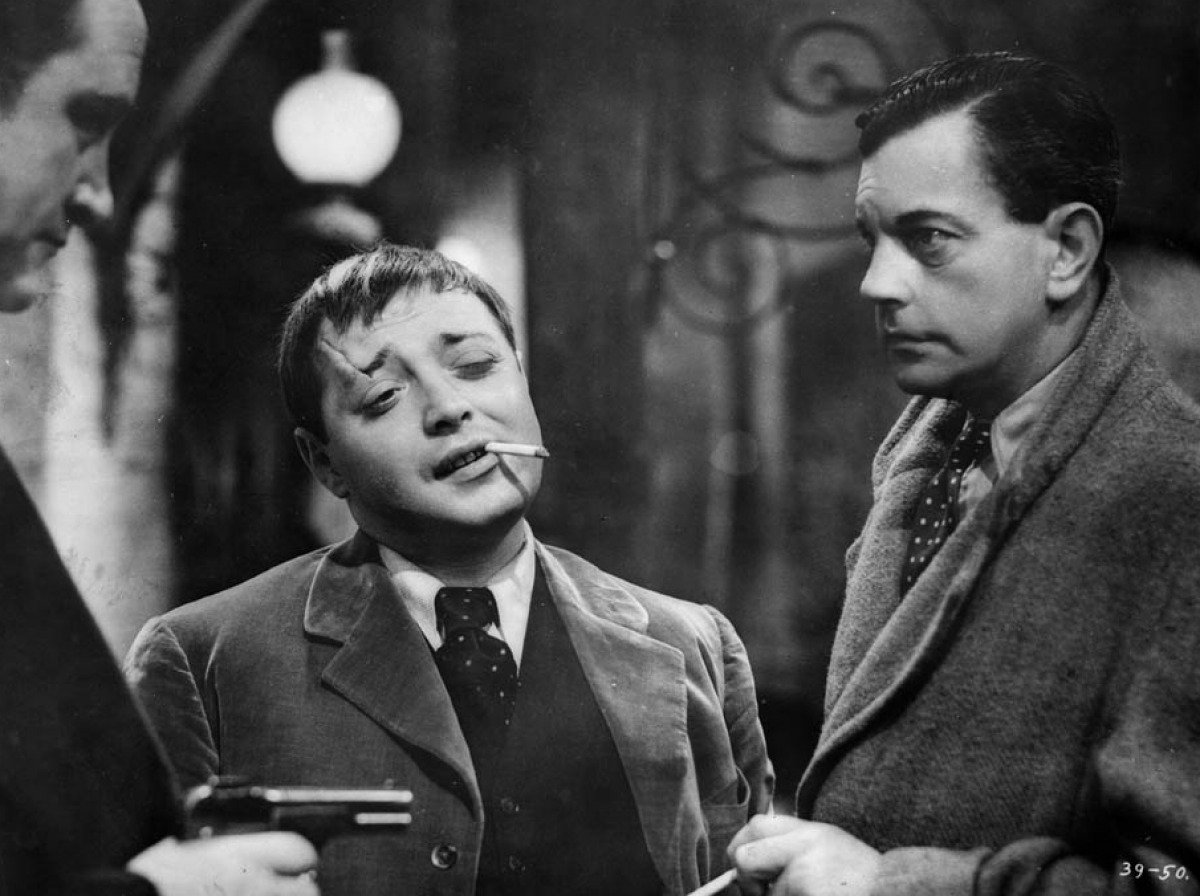
The original THE MAN WHO KNEW TOO MUCH succeeds because it has a better villain (Peter Lorre in his first English speaking film), better chemistry between the husband and wife (although Leslie Banks and Edna Best are not as famous as Stewart and Day), and more sympathy for the kidnapped child. This isn't to say that the 1956 THE MAN WHO KNEW TOO MUCH doesn't have its moments. Hitchcock was at the top of his game in the 1950's. The newer version has some excellent sequences not to mention a more prolonged Royal Albert Hall assassination attempt set piece.

So why would Hitchcock choose to remake THE MAN WHO KNEW TOO MUCH instead of one of his other early films? SABOTAGE (1936) to me is a much more flawed film that could have been updated nicely to the 1950's. THE 39 STEPS (1935) and THE LADY VANISHES (1938) are too perfect so don't mess with them. SABOTEUR (1942) could have been redone with a better leading man than Robert Cummings but Hitchcock perfected that story with a similar cross-country chase, famous landmarks, and the ultimate leading man in Cary Grant in NORTH BY NORTHWEST (1959).

Two reasons that come to mind are the original MAN WHO KNEW TOO MUCH was made in  England and American audiences may not have had a chance to see it (although Truffaut in his book Hitchcock says that it was a hit in America). A more reasonable explanation is that Hitchcock wanted to retry the famous assassination attempt sequence at the Royal Albert Hall a second time, perhaps not happy with his first attempt (it turns out Hitchcock owed Paramount one more movie as well and picked TMWKTM to be that film). The newer MAN WHO KNEW TOO MUCH has a lengthier version of the Albert Hall scene with no dialogue this time, just visuals and stirring music to build the suspense. It is technically better and a bravura piece of filmmaking but I find the 1934 version with some cutting back to the spies listening to the concert on the radio just as suspenseful.

The original 1934 THE MAN WHO KNEW TOO MUCH was written by Charles Bennett and D.B. Wyndham Lewis. The title only comes from a book by G.K Chesterton. The tale begins in St. Moritz, Switzerland where a British family, the Lawrence's, are on holiday. The Lawrence family become embroiled in international intrigue when a Frenchman they befriend named Louis Bernard (Pierre Fresnay) is fatally shot while dancing with Jill Lawrence (Edna Best) at dinner. Louis turns out to be a secret agent. Before Louis dies, he hands Jill a key and whispers to her that a foreign dignitary is to be assassinated in London and to look for a message in his shaving brush to take to the British Consulate. Bob Lawrence (Leslie Banks) retrieves the message before the assassin Ramon (Frank Vosper) can find it. The police detain Bob and question him. Ramon and the leader of the spy ring, the cheerfully creepy Abbott (Peter Lorre) kidnap the Lawrence's daughter Betty (Nova Pilbeam) to keep Bob and Jill silent about the assassination plot.


The Lawrence's return to London. Gibson (George Curzon) with the Foreign Office informs them that Louis was an agent with Special Services who had uncovered a plot to kill Roper, a foreign politician visiting London. With continued phone threats to kill their daughter Betty, the Lawrence's remain steadfast to reveal nothing to the authorities. But that doesn't stop Bob along with family friend "Uncle" Clive (Hugh Wakefield) from tracking down some leads from Louis's secret message starting with a visit to George Barbor (Henry Oscar), a dentist mentioned in the note. Barbor's office is a safe house for the spy ring. Bob catches sight of Abbott and Ramon while fending off the suspicious dentist and his gas mask. Bob and Clive follow the two men to the Tabernacle of the Sun, a sun worshipping chapel whose sun symbol is drawn on Louis's note.

Bob and Clive try to assimilate unnoticed in the chapel, but all the other sun worshippers are women. Agnes (Cicely Oates), Abbott's personal nurse, notices them. Once the women exit, Abbott and Ramon attempt to block the men from leaving. Bob notices a Royal Albert Hall ticket in Ramon's pocket and tells Clive to warn the police. Clive manages to escape but Bob is knocked unconscious. When Clive returns with the police, Abbott calmly explains Clive was the troublemaker and the police take Clive away. Bob is briefly united with Betty before they're separated again. Abbott plays for Ramon a record with the music cue to show Ramon when he must shoot the foreign ambassador at the Royal Albert Hall.

Clive tells Jill to go to Albert Hall per her husband's instructions. Jill sees Ramon in the lobby. Ramon hands her Betty's skier pin, warning her to keep quiet. As the orchestra plays, Abbott and his den of spies listen on the radio. Ramon prepares to shoot the ambassador from a private box on the second level. But Jill screams right before the cymbals clash, and Ramon misses his mark. Ramon races back to the kidnappers hideout followed by Jill and the police. The kidnappers have guns but the police force a local gunsmith to loan them rifles. A climactic gunfight erupts (maybe the only one in a Hitchcock film) between the spies and the police as Bob helps Betty flee to the rooftop to escape Ramon who has been ordered by Abbott to kill young Betty.


The original THE MAN WHO KNEW TOO MUCH is Hitchcock's break through hit, establishing him as the master of suspense. Hitchcock begins to establish his themes, design his visual vocabulary, and create set pieces that would shape and define his cinematic career. Hitchcock preferred to show rather than tell the audience by using symbols or motifs. Giant teeth to establish the sinister dentist office. A chiming watch to identify the spy ringleader Abbott. The skier pin to represent kidnapped Betty. He even uses cymbals as a symbol, winking to the audience as we nervously await the crashing of cymbals at the concert, signifying someone might be murdered.

Hitchcock gives us four good set pieces in MAN WHO KNEW TOO MUCH, the beginning of many more to follow in his career. Obviously, the assassination attempt at the Royal Albert Hall is the penultimate, Hitchcock mixing visuals and music for suspenseful, cinematic effect in a famous location no less. The dentist sequence plays on everyone's fear of dentists which in this film proves to be true. The shootout between the villains and the cops is something rare for Hitchcock (taken from a real-life gun battle called the Sidney Street siege in London in 1911 between Russian anarchists and the London police supervised by Winston Churchill) but it provides a great payoff when mother Jill seizes her chance to repay an earlier St. Moritz target practice challenge she lost to the assassin Ramon and save her daughter from him. But overlooked is the fight scene in the church with Bob Lawrence throwing chairs at his assailants, fighting to rescue his daughter.

Hitchcock's 1956 remake of THE MAN WHO KNEW TOO MUCH is a longer version of the original film with some plot changes, alterations, and enhancements.  Written by one of Hitchcock's favorite screenwriters John Michael Hayes (who would pen four Hitchcock films including 1954's REAR WINDOW and 1955's TO CATCH A THIEF), Hitchcock switches the opening location from Switzerland to Morocco and the family from English to American. All of Hitchcock's collaborators during his golden period of filmmaking in the 1950s are on the picture: composer Bernard Herrmann, Director of Photography Robert Burks, screenwriter Hayes, Editor George Tomasini, Art Directors Henry Bumstead and Hal Peirera, and Costumes by Edith Head.

Dr. Benjamin McKenna (James Stewart), his wife Josephine aka Jo (Doris Day), and their young son Hank (Christopher Olsen) are on vacation in the North Africa country of Morocco. While on a bus to Marrakech, they meet a friendly Frenchman Louis Bernard (Daniel Gelin) who joins them for drinks later that night. The next day at the Marrakech market, police chase a robed man. He's stabbed by an assailant. He stumbles into Ben's arms. It's Louis, disguised as an Arab, his face painted dark. Louis whispers to Ben a foreign statesman will be assassinated in London before dying. Ben jots down Louis's cryptic message. While Ben and Jo are questioned by the police and discover Louis was an intelligence agent, another English couple, Edward Drayton (Bernard Miles) and his wife Lucy Drayton (Brenda de Banzie) offer to watch Hank. But the Drayton's are part of the assassination plot and kidnap Hank to keep the McKenna's quiet about the assassination plot.


Back in London, the McKenna's meet with Inspector Buchanan (Ralph Truman) who wants to help them but the McKenna's stay mum, not wanting to jeopardize Hank's life. Back at their hotel, theater friends of Jo's (including Carolyn Jones who would later play Morticia in TV's THE ADDAMS FAMILY) stop by unexpectedly. Ben goes to check out Ambrose Chappel, a name Louis mentioned in his dying breath. Ben thinks it's a person. After looking him up in the phone book and calling him, Ben goes to visit Ambrose Chappel (George Howe) at his taxidermy shop. Everyone acts suspicious in the shop but it's a red herring that Hitchcock throws us. Jo figures out that Ambrose Chappel is a place not a person. She tells her theater friends to have Ben meet her at a church called Ambrose Chapel when he returns.

The conspirators are hiding out at the chapel. Drayton plays Storm Cloud Cantata on a record for the assassin Rien (Reggie Nalder), pointing out the musical cue where Rien will shoot the Foreign Prime Minister (Alexis Bobrinskoy). Drayton, dressed as a vicar, prepares for a service downstairs. Mrs. Drayton spots the McKenna's hiding amongst the parishioners. Jo sneaks out to call Inspector Buchanan. Ben scuffles with Drayton's men before he's knocked out. The Drayton's flee with Hank, hiding out in the embassy of the man they wish to kill.  Jo can't reach Buchanan who's attending the concert at the Royal Albert Hall. The chapel is locked when Jo and the police return. Ben's unconscious on the altar floor. Jo takes a taxi to the Royal Albert Hall to find Buchanan. She runs into Rien (who Jo recognizes from an encounter earlier at their Morocco hotel room). Rien warns her to do nothing if she wants to see Hank alive again.

Hitchcock recreates his original famous Royal Albert Hall assassination attempt (with a nice cameo by composer Bernard Herrmann as the symphony conductor) but shoots it entirely with music and no dialogue. Ben manages to escape from the chapel and joins Jo at Albert Hall. They spot Rien hiding behind curtains on the second balcony. Jo screams just as Rien shoots, wounding the Prime Minister. Ben tussles with Rien who falls to his death from the balcony (John Wilkes Booth style). Buchanan learns the Drayton's have been spotted at the embassy. Ben and Jo ask to see the Prime Minister (who thanked them earlier in the evening for saving his life). While Jo sings Que Sera Sera, Ben sneaks off and rescues Hank from the Draytons.


I enjoyed the newer version of THE MAN WHO KNEW TOO MUCH more upon a second viewing after watching the original first. The newer version has more layers to it. Hitchcock clearly wants this film to be American and not English. Ben is a doctor from Indianapolis. Jo is a former theater star who put her career on hold when she had Hank. Hitchcock and screenwriter Hayes add more psychological depth to the McKenna's marriage which appears strained at times. Jo giving up her music career. Ben not willing to move his practice to New York. Ben has a bit of a temper. Jo was taking too many pills until recently. Hank's kidnapping will help to strengthen their marriage.

The opening Morocco vacation scene is longer as Hitchcock establishes Louis's role more clearly (Jo doesn't trust Louis in this version) and hides the Drayton's fiendish intent until the right moment. Hitchcock throws out the dentist scene from the original and dazzles with the taxidermy set piece, building suspense in broad daylight. Notice how Hitchcock and cinematographer Robert Burks frame fierce looking stuffed animals like tigers and lions at odd angles, as if the creatures might come alive and leap at them. The before mentioned Royal Albert Hall set piece is lengthier and better than the original, the music acting as another character, representing Jo's psychological state of mind, turbulent, emotional. She's frantic to find her son but now involved with an international murder plot too.


The finale for the 1956 THE MAN WHO KNEW TOO MUCH seems drawn out and far-fetched, the result of Hitchcock already stretching out the story to perhaps its limits. He throws out the original shootout between good and bad guys, going for political intrigue as the Drayton's hide in the very embassy that the wounded Prime Minister represents. It appears the Ambassador (Mogens Wieth) ordered the assassination, but it doesn't matter. We don't really care. At least the original had elements of the 30's political climate, echoes of another World War igniting much like the assassination of Archduke Ferdinand by a Sarajevo assassin started World War I. And Doris Day's singing Que Sera Sera smacks of the studio trying to stuff a hit single into a dramatic film.

I like the 1934 THE MAN WHO KNEW TOO MUCH better for several reasons. Peter Lorre as the charming spy leader Abbott nearly steals the original film.  Lorre was an international star after Fritz Lang's M (1932). This is his first English speaking film and what an introduction playing the charismatic heavy in an Alfred Hitchcock film (with a scar and streak of white in his hair for good measure). Lorre would also make THE SECRET AGENT (1936) with Hitchcock. Hitchcock introduced villains in his films as charming, well dressed, and lethally polite although Lorre's gang is fond of padded doors, the better to muffle screams one presumes. The Drayton's in the newer version are more restrained, less flashy. Mrs. Drayton does have an icy stare and Mr. Drayton shows his ferocity at the end but they don't command the screen like Lorre. Hitchcock does know how to pick villainous faces in both films. The assassin Rien in the 1956 film resembles a vulture.


I also prefer the English Lawrence couple in the original to the American couple the McKenna's in the latter version. The Lawrence's are a bit like Nick and Nora Charles from THE THIN MAN (1934), a 1930's couple, having fun on vacation, teasing each other, even flirting with other people. Leslie Banks is self-deprecating as Bob Lawrence while Jimmy Stewart's Ben McKenna is probably Stewart's least interesting performance in a Hitchcock film. Hitchcock has some fun early in the original when Lawrence ties a string of yarn to Louis as he dances with his wife Jill, tangling up everyone on the dance floor. But both couples are deadly serious about rescuing their stolen children. The McKenna's show much more outward emotion to the kidnapping than their reserved English counterparts. Both versions are fun to watch as married couples involved in international intrigue try to unravel the mystery. The 1934 THE MAN WHO KNEW TOO MUCH introduces two more themes that reappear over and over in Hitchcock films. One is the fear or lack of trust in the police. In this film, the couple cannot go to the police for fear of endangering their child. The other theme is the accidental hero or in this case accidental heroes. Neither couple is extraordinary but circumstances beyond their control will force them to behave heroically.

The last element that makes the original THE MAN WHO KNEW TOO MUCH a better film is we are invested more in the kidnapping of Betty than we are Hank. Both kids are precocious, but Betty is older and more mature. Her love for her parents and theirs for her is more genuine. When Betty is kidnapped, taken away on a horse drawn sleigh by Ramon, Hitchcock opens with a close up of her eyes before pulling back. The terror on her face is palpable. Young English actress Nova Pilbeam is marvelous in the original as Betty. Hank played by American Christopher Olsen in the remake is younger, a typical 1950's child actor, blonde and too cute. We never really identify with Hank. Even his kidnapping happens off screen. We don't care about Hank like we do Betty.


But in no way is the original perfect, making it understandable that Hitchcock would want to remake THE MAN WHO KNEW TOO MUCH. In the first version, Hitchcock introduces the characters fast and furious and it takes us a little time to figure out who's who. Characters appear and then disappear like "Uncle" Clive. An example of Hitchcock as a talented amateur is the scene where Abbott plays the music for Ramon, pointing out when to shoot the ambassador during the performance, right in front of our hero Bob Lawrence. It's too obvious. Hitchcock will tighten up the characters introductions and plot points with his 1956 version.

Hitchcock's use of Rear Projection process shots detracts from THE MAN WHO KNEW TOO MUCH remake. Rear Projection is where a previously filmed background is projected behind actors to make them appear to be driving on the French Rivera or skiing down a mountain when they're really on a soundstage. Filmmakers used it to save money and better control the sound and location. Hitchcock did film in Morocco but his back and forth use of Rear Projection in the Morocco (and some London) scenes is jarring and ruins the believability that the McKenna's are in Marrakech. Rear Projection was used extensively from the 30's through even the 70's (new technology like green screen today has replaced Rear Projection). Rear Projection always looks more realistic in black and white than color. In the 1934 film, Hitchcock uses Rear Projection sparingly during the opening St. Moritz ski sequence and it's fairly believable. But in the 1956 version (shot in color), it just looks fake. Hitchcock used Rear Projection to better effect in TO CATCH A THIEF (1955) and VERTIGO (1958) but horribly in MARNIE (1964) and in the newer THE MAN WHO KNEW TOO MUCH.

One of the things I never put much thought into when watching THE MAN WHO KNEW TOO MUCH is the title. Who is the man who knew too much? Do you know? It's clearly Louis Bernard, the secret agent doomed when recognized by Abbott in the original and Rien in the remake. Louis knows the players, the plot, and the location of their nefarious plan. But when he's murdered, he transfers his knowledge to our protagonists.  Suddenly, Bob Lawrence and Ben McKenna become the man who knew too much. They have the clues but it takes them the rest of the film to piece it together (with their wives participation and ability to scream at the right moment). I think the title is intriguing and one of Hitchcock's most interesting.


Both versions of THE MAN WHO KNEW TOO MUCH play a significant role in director Alfred Hitchcock's career. After a couple of flops early on, Hitchcock started making films for British Gaumont Studio. The 1934 THE MAN WHO KNEW TOO MUCH would kick start his career again and attract the attention of American studios looking for new talent. TMWKTM began a successful run of English thrillers for Hitchcock. Following TMWKTM, Hitchcock would make the 39 STEPS, THE SECRET AGENT, SABOTAGE, and THE LADY VANISHES. Hitchcock's English period is often overlooked by his later American movies but it was one of his most productive stages of his early career as he made a name for himself. Hitchcock would make his first film in the United States in 1940 with REBECCA.

The 1956 THE MAN WHO KNEW TOO MUCH was made at the peak of Hitchcock's career -- the 1950's. It follows after REAR WINDOW and TO CATCH A THIEF but before VERTIGO and NORTH BY NORTHWEST. It's my least favorite of all those films but TMWKTM did provide Hitchcock with his first attempt at a big studio, Technicolor suspense thriller about an innocent man mixed up in international intrigue that he would make again with greater success in 1959 with NORTH BY NORTHWEST. Both films have great leading men, famous landmarks, and the innocent protagonist involved with spies. Hitchcock had made this kind of film before with THE 39 STEPS, FOREIGN CORRESPONDENT, and SABOTEUR but they were in black and white. The newer THE MAN WHO KNEW TOO MUCH was his first color foray into that familiar suspense world.

So judge for yourself which THE MAN WHO KNEW TOO MUCH you want to see. Is it the black and white original with a star turn by villain Peter Lorre. Or is it the Technicolor remake with big Hollywood stars James Stewart and Doris Day. My suggestion is watch the original 1934 version first and the 1956 remake after that. Then, go out to the dinner and discuss the pros and cons of both versions as only Alfred Hitchcock would dare to remake one of his own successful films a second time.


Sunday, December 20, 2015

National Lampoon's Christmas Vacation (1989)

We have all had our Clark Griswold moments during the Christmas season. Driving all over the valley to find the biggest, best Christmas tree.  Having the brightest, most colorful display of Christmas lights in the neighborhood. But who is this Clark Griswold I speak of? Why, Clark Griswold (Chevy Chase) the overly exuberant, cheerfully optimistic father and husband who moviegoers first met in Harold Ramis's NATIONAL LAMPOON'S VACATION (1983). In VACATION, Griswold led his weary family on a cross country summer odyssey to the amusement park Wally World. Clark Griswold, his wife Ellen, and their two children Rusty and Audrey are back to poke fun at the busiest, happiest, most stressful holiday of the year in NATIONAL LAMPOON'S CHRISTMAS VACATION (1989) directed by Canadian Jeremiah Chechik.

VACATION, EUROPEAN VACATION (1985), and CHRISTMAS VACATION were written by John Hughes who started out as a writer for the satirical magazine National Lampoon. Hughes, also a director, was best known for having his finger on the pulse of teenagers. Hughes wrote and directed SIXTEEN CANDLES (1984), THE BREAKFAST CLUB (1985), and FERRIS BUELLER'S DAY OFF (1986), comedies that captured the angst and awkwardness that comes with becoming a teenager. But Hughes also understood adults and with the VACATION films, he found his Universal Dad, the Everyman Father in Clark Griswold as portrayed by SATURDAY NIGHT LIVE veteran Chevy Chase. Griswold loves his wife Ellen (Beverly D'Angelo) and kids Rusty (Johnny Galecki) and Audrey (Juliette Lewis). He works hard. He believes in family values and tradition. A co-worker calls Clark the "last true family man." The family car is a station wagon. Clark sees the sunny side of things. He's a glass half full kind of guy. But he's a klutz. He's not very handy. His epic ideas like putting up Christmas lights (and trying to get them to work) becomes an epic struggle, resorting to using a staple gun to secure all 250 strands of light bulbs around his house.


CHRISTMAS VACATION is actually not another Griswold vacation.  It takes place in their neighborhood, at their house, somewhere in suburban Chicago, Illinois.  As Clark proclaims, "It's a Griswold Family Christmas." But it's a hectic time of the year for the Griswolds. Clark is anxious to receive his Christmas bonus from his miserly boss Frank Shirley (Brian Doyle-Murray) as Clark has already put a down payment on a swimming pool he can't afford. Both Clark's parents Clark, Sr. (John Randolph) and Nora (Diane Ladd) and Ellen's parents Art (E.G. Marshall) and Francis (Doris Roberts) are coming to stay with them over the Christmas holiday. And Clark is determined to have the best Christmas tree (it's way too big for the house) and the best Christmas lights display in the neighborhood (the lights draw so much power he nearly causes a blackout in his town).

But the Griswold family holiday gets even nuttier for Clark when Cousin Eddie (Randy Quaid from the first VACATION film) shows up unannounced in his RV with his wife Catherine (Miriam Flynn) and their two kids Rocky (Cody Burger) and Ruby Sue (Ellen Hamilton Latzen) to also spend Christmas with the Griswolds. Eddie's out of work and they have no money for gifts for their children. Rounding out the family affair are Uncle Lewis (William Hickey) and Aunt Bethany (Mae Questel) who Clark picks up from the airport.

Christmas Eve arrives and all hell breaks loose. Aunt Bethany's cat (who she absent-mindedly wrapped and brought as a gift) bites into the Christmas tree lights and electrocutes itself. Uncle Lewis accidentally burns up the Christmas tree with his cigar. The Christmas turkey is too dry and implodes. And when Clark's bonus check arrives at the last moment, it's not a bonus at all. Clark goes berserk, cursing his boss which sends Cousin Eddie off to kidnap Frank Shirley from his mansion and wife (Natalia Nogulich) and bring him back to face the Griswold family's wrath.


Writer Hughes likes to have fun with the rites of family (summer vacation, Christmas holiday, a European vacation).  CHRISTMAS VACATION is a bit less vulgar than VACATION. It has some funny physical comedy bits especially with Clark trying to put up the lights or a squirrel running loose in the Griswold household. But underneath some of the crude jokes, cousin Eddie's potty mouth, or Uncle Lewis's bad toupee, there is a sweet Christmas story to be found. There's a heartwarming sequence after Clark is accidentally stuck in the family attic as the others go shopping (a precursor to the Hughes scripted 1990 HOME ALONE) where he discovers a box of Super 8 movies including Christmas with his parents back in 1955. It's a wonderful moment amongst the Christmas chaos. And, Clark and Ellen helping out their less fortunate cousins is a very real everyday Christmas moment as millions of people around the world struggle to provide even one gift for their children or loved ones.  CHRISTMAS VACATION does have a heart.

The Christmas film genre has transitioned from classic holiday fare like IT'S A WONDERFUL LIFE (1946) or WHITE CHRISTMAS (1954) to dysfunctional families either celebrating Christmas or avoiding Christmas like the recent CHRISTMAS WITH THE KRANKS (2004) or FOUR CHRISTMASES (2008). The success of CHRISTMAS VACATION may have started the trend. For the Griswolds, it's more their relatives who are dysfunctional than them. But Chechik and Hughes don't entirely bail on the traditional Christmas tales we used to. Clark's miserly boss Frank Shirley hearkens back to another well-known grumpy Christmas character, Charles Dickens' Ebenezer Scrooge in A Christmas Carol.

It's hard to believe there have been four VACATION films. VACATION (1983), EUROPEAN VACATION (1985), CHRISTMAS VACATION (1989), and VEGAS VACATION (1997). The VACATION series owes its longevity to Chevy Chase as Clark Griswold, the perpetually positive patriarch. Chase's facial mannerisms and gift of physical comedy (a bit with tree sap on his hand is priceless) lift the VACATION franchise above similar family type comedies. The beautiful Beverly D'Angelo dutifully presides as wife Ellen, Clark's partner in all things fun. Ellen goes along with Clark's crazy plans, never blowing her top although she occasionally voices her displeasure.


Incredibly, the VACATION series has had four different Rusty's and Audrey's in each VACATION film. While Clark and Ellen grow older, Rusty and Audrey stay eternally young. Johnny Galecki (now on TVs THE BIG BANG THEORY) plays Rusty in CHRISTMAS VACATION but other Rusty's include Anthony Michael Hall, Jason Lively, and Ethan Embry. Juliette Lewis (CAPE FEAR, KALIFORNIA) who plays Audrey Griswold is probably the most well known of the other Audrey's. Dana Barron, Dana Hill, and Marisol Nichols have played the Audrey part in the other VACATION films.

Randy Quaid as Cousin Eddie almost steals the film from Chevy Chase. Chase and Quaid are hilarious in their scenes together. Redneck Eddie is the quintessential relative from hell but Quaid gives Eddie some pathos that I didn't recall in the original VACATION. The grandparents are played by familiar character actors E.G. Marshall (12 ANGRY MEN, CREEPSHOW), Doris Roberts (Ray Romano's Mom on TV'S EVERYBODY LOVES RAYMOND), Diane Ladd (CHINATOWN, mother of actress Laura Dern), and John Randolph (PRIZZI'S HONOR).

Brian Doyle-Murray (Bill Murray's older brother) does a nice turn as the Scrooge like CEO Frank Shirley. Doyle-Murray also made an appearance in the first VACATION. Look for SEINFELD and VEEP'S star Julia Louise-Dreyfus in an early role as one of Hughes' favorite targets, a young Yuppie neighbor Margo Chester who along with her equally annoying husband Todd Chester (Nicholas Guest) fall victim to some of Clark's holiday festivities.


CHRISTMAS VACATION is uneven at times. The mean boss plot disappears and pop up at infrequent times and the yuppie neighbors almost serve no purpose.  A scene with Clark flirting with a buxom department store clerk Mary (Nicolette Scorsese) is a silly attempt to recreate Clark's flirtation with Christie Brinkley as the Girl in the Ferrari in the original VACATION. The CHRISTMAS VACATION flirtation scene is forced and goes on uncomfortably too long.

If director Jeremiah Chechik's names doesn't ring a bell, you're not alone. I had never heard of him either. Chechik had a brief, eclectic run of feature films with CHRISTMAS VACATION followed by BENNY & JOON (1993) with Johnny Depp and the remake of DIABOLIQUE (1996) with Sharon Stone.  But his run ended with the ill-fated movie version of the English spy TV show THE AVENGERS (1998) starring Ralph Fiennes, Uma Thurman, and Sean Connery. Chechik moved to television where he has directed various TV shows including a stint on NBC's CHUCK recently.


You can't keep a good franchise down even with Chevy Chase and Beverly D'Angelo growing older. A new VACATION directed by John Frances Daley and Jonathan M. Goldstein came out in 2015 with Rusty Griswold (now played by Ed Helms) grown up and taking his family on the same cross country road trip to Wally World. Chase and D'Angelo appear as Clark and Ellen. A new generation gets to meet the Griswolds but for CrazyFilmGuy my loyalty lies with the original Griswold family.

I think myself and most adults can relate to Clark Griswold in CHRISTMAS VACATION.  We all build up these amazing traditions that we experienced with our parents to our kids such as drinking egg nog, building a miniature Christmas village, or reading Twas the Night Before Christmas in front of a roaring fire. We think our children will have the same excitement for these traditions that we had but that's not always the case. It takes time. Ultimately, the younger generation learns to embrace tradition while creating new ones as well. CHRISTMAS VACATION makes fun of family and tradition during the holiday season but in the end, that's what's most important. Not fancy gifts or bonuses or the brightest Christmas light.  It's family.

Thursday, December 3, 2015

Ball of Fire (1941)

One of life's greatest treasures is to be surprised. I chose BALL OF FIRE (1941) because I was looking for a Gary Cooper film to watch but some unexpected surprises sprang from this choice. Cooper is an American screen icon from the 1930's thru the 1950's. Kevin Costner always reminds me of a modern day Gary Cooper. I have only seen Cooper in a couple of films in my life time --Frank Capra's MEET JOHN DOE (1941) and Fred Zinnemann's HIGH NOON (1952) and that was back in college. So I chose BALL OF FIRE because it had Gary Cooper as well as Barbara Stanwyck, a good strong leading lady. But as I watched it, three other surprises popped up to make it extra special. 1) I had no idea it was directed by one of my favorites Howard Hawks (THE BIG SLEEP, RIO BRAVO). 2) Its original screenplay is by another of my favorite directors Billy Wilder (SUNSET BOULEVARD, SOME LIKE IT HOT) and his partner Charles Brackett (from a story by Wilder and Thomas Monroe). 3) It has an incredible array of supporting actors, some of them memorable and familiar to film buffs from other classic movies.

BALL OF FIRE is a perfect vehicle for director Howard Hawks who had previously directed some of the best screwball comedies in Hollywood like BRINGING UP BABY (1938) and HIS GIRL FRIDAY (1940).  And with a script co-written by Billy Wilder (who would soon be directing his own scripts), the creative firepower of Hawks and Wilder behind BALL OF FIRE is impressive. Ironically, the lead character of Professor Bertram Potts in BALL OF FIRE seems tailor made for Cary Grant. Grant played the leads in both Hawks' BRINGING UP BABY and HIS GIRL FRIDAY.  But Potts is an introverted, erudite man, perfect for Gary Cooper who's acting style is a bit more reserved than Grant's.


I dare anyone to convince me BALL OF FIRE would be made today. Listen to this synopsis. A group of eight esteemed professors (who also happen to be bachelors) led by the younger Professor of English Bertram Potts (Gary Cooper) have been working nine years on a new encyclopedia funded by the Daniel S. Totten Foundation run by the late Daniel Totten's daughter Miss Totten (Mary Field). The seven other professors include Professor Gurkakoff (Oskar Holmoka), Prof. Jerome (Henry Travers), Prof. Magenbruch (S.K. Sakall), Prof. Robinson (Tully Marshall), Prof. Quintana (Leonid Kinskey), Prof. Oddly (Richard Haydn), and Prof. Peagram (Aubrey Mather). When a Garbage Man (Allen Jenkins) walks into their New York brownstone using all kinds of current slang that none of the professors recognize, Potts realizes his encyclopedia section on slang is outdated. Potts ventures out into New York to learn the latest slang visiting a newspaper stand, a train car, a baseball game, and a pool hall taking notes.

When Potts stumbles upon nightclub singer Sugarpuss O'Shea (Barbara Stanwyck) singing catchy, slang-filled songs (like Drum Boogie), he visits her dressing room after the show to invite her to join his slang research project. Sugarpuss declines. Unbeknown to Potts, Sugarpuss is also gangster Joe Lilac's (Dana Andrews) moll. Lilac is under suspicion for the murder of a rival. Worried that Sugarpuss might tell the cops something about his relationship with the dead man when questioned, Lilac sends his two lieutenants Duke Pastrami (Dan Duryea) and Asthma Anderson (Ralph Peters) to grab Sugarpuss and hide her. With no place to go, Sugarpuss remembers Potts' invitation and business card. She decides to hide out in the brownstone with Potts, seven middle-aged professors, and one unhappy den mother Miss Bragg (Kathleen Howard).


The professors are thrilled to have a young, leggy nightclub singer sleeping over. Their academic world gets turned upside down as Sugarpuss teaches them to dance the conga. Potts conducts his round table on slang with Sugarpuss, the Garbage Man, and the others. Sugarpuss finds herself falling for Potts and Potts for Sugarpuss. Lilac's still nervous that Sugarpuss might testify against him so he sends her a gigantic wedding ring. Both men want to marry her. Hiding out in New Jersey, Lilac calls the house. A conflicted Sugarpuss has Potts talk to Lilac. Potts thinks Lilac is Sugarpuss's father. Potts asks Sugarpuss to marry him, giving her a very small engagement ring. Lilac tricks Potts, asking him to bring Sugarpuss to New Jersey for the wedding. Potts, Sugarpuss, and the seven professors head to New Jersey for the big day. They get in a car accident and end up at a hotel where Lilac and his men show up. Lilac spills the beans that Sugarpuss is his girl. He punches Potts to prove his point.

Typical of a screwball comedy, BALL OF FIRE ends with a frenetic flourish. Sugarpuss realizes she is in love with Potts. But the newspapers have gotten a hold of Sugarpuss's story, bringing scandal to Potts and the encyclopedia project. Miss Totten prepares to shut the project down. But Pastrami and Asthma show up at the house with guns, threatening to kill Potts and the others if Sugarpuss doesn't marry Lilac. But the brainy professors use their brains, borrowing the theory of the Sword of Damocles to overtake the hoods. As Lilac prepares to wed Sugarpuss in New Jersey, Potts and the professors show up for a final funny confrontation.


If the eight professors in BALL OF FIRE reminds you of the seven dwarves from SNOW WHITE AND THE SEVEN DWARVES (1937) it's not a coincidence (Joe Lilac even cracks that Sugapuss is "hiding out with the 7 Dwarves"). If you don't count Potts who's younger than the other seven, the seven professors are a human version of Disney's animated characters. Hawks and Wilder/Brackett ingeniously give each professor a particular specialty.  They're not Sleepy or Grumpy or Happy.  But Prof. Oddly is an expert in botany and Prof. Robinson with law and Prof. Jerome with geography and so on. Hawks casts very specific character actors for each professor to make them unique.  Oskar Holmoka as Prof. Gurkakoff with his unibrow and thick Eastern European accent. S.K. Sakall and his rotund body and bifocals. Henry Travers and his cherubic cheeks. Richard Haydn as Prof. Oddly and his nasally inflection. One could say Sugarpuss is Snow White. She comes into their brownstone like Snow White falling asleep in the seven dwarves cottage and mesmerizing the middle-aged, female deprived scholars.

BALL OF FIRE is in many ways a film about words. Author Damon Runyon would appreciate how good Wilder and Brackett's script is on so many levels weaving slang and grammar throughout the story. Slang plays an integral part to the plot. Major and minor characters talk colorfully throwing out slang like gams (legs), moolah (money), puss (face), bull (police), Loserville (just like it sounds), corn (old fashioned), and yum yum (kiss) to name just a few. The names of characters are word play. Joe Lilac. Duke Pastrami. Asthma Anderson. Benny the Creep. Sugarpuss O'Shea. Professor Oddly. Some match their names; some names are ironic. Gangster Lilac is no flower. But Sugarpuss does have a sweet face.

And, for a film about writing an encyclopedia by eight professors with expertise in geography, history, language, astronomy, etc. BALL OF FIRE writers Wilder and Brackett reference Newton's Law of Gravity, Shakespeare's Richard III, poet William Blake's poem The Tyger ("Tyger Tyger, burning bright"), the Sword of Damocles (a Greek moral about a sword suspended by a single horse hair over a king's throne epitomizing the peril of those in power), Sigmund Freud (and the subconscious) and the thinly veiled comparison of Snow White and the Seven Dwarves to Potter/Sugarpuss and the 7 Professors. It's a masterful screenplay that mixes the academic with the street wise. Wilder liked having fun with gangster characters and would incorporate gangsters and the St. Valentine's Massacre into his comedy SOME LIKE IT HOT (1959).

Gary Cooper was already having quite a year in 1941 appearing in Hawks SERGEANT YORK and Frank Capra's MEET JOHN DOE (where coincidentally his co-star was also Barbara Stanwyck) before finishing up the year with BALL OF FIRE. Hawks liked to cast handsome leading men like Cary Grant or Cooper as introverted, socially awkward scholars. Professor Potts seems right up Cary Grant's alley but he had already played a similar character in BRINGING UP BABY. Cooper handles the role with aplomb and the right bit of Midwestern innocence.
 

I only knew Barbara Stanwyck from her femme fatale role in Billy Wilder's DOUBLE INDEMNITY (1944) and later as the matriarch on TV's THE BIG VALLEY (1965 to 1969). But Stanwyck was already an accomplished comic actress having appeared in Preston Sturges' THE LADY EVE (also 1941) and the before mentioned MEET JOHN DOE. Stanwyck is flat out sexy in BALL OF FIRE as Sugarpuss O'Shea, flashing more leg throughout the film than all the Radio City Rockettes combined. Stanwyck's Sugarpuss is also another example of the Hawksian woman (named after director Howard Hawks). Hawks's female characters are almost like one of the boys only with breasts and shapely legs. Sugarpuss can sing and dance but she talks and drinks and even knocks out Miss Bragg like one of the guys. Stanwyck is right up there with other Hawksian women like Lauren Bacall (TO HAVE AND HAVE NOT) and Angie Dickinson (RIO BRAVO). Stanwyck's Sugarpuss O'Shea is as one character describes her "a ball of fire."

BALL OF FIRE is filled with an array of great supporting actors that compliment the film and story. Many are recognizable faces that film fans will recall from other memorable films. The professor roles are a Who's Who of character actors. There's Henry Travers, most famous as Clarence the Angel from Frank Capra's IT'S A WONDERFUL LIFE (1946), as Prof. Jerome. Oskar Homolka, as Prof. Gurkakoff, played the bomb maker in Alfred Hitchcock's SABOTAGE (1936). S.K. Sakall as Prof. Magenbruch will always be remembered as the kind hearted Carl in Michael Curtiz's CASABLANCA (1942). And Richard Haydn, who excels as the nasal toned Prof. Oddly, played Captain von Trapp's friend Max Detweiler in THE SOUND OF MUSIC (1965).


I came across actor Dana Andrews at the end of his career as the ill-fated small airplane pilot in AIRPORT 1975 (1974). Andrews usually played good guys like the detective in Otto Preminger's LAURA (1944) but in BALL OF FIRE he plays gangster Joe Lilac. It's a nice comic turn by Andrews. And who can forget the obnoxious laugh and whiny voice of Dan Duryea who plays Duke Pastrami. Duryea appeared in everything -- westerns, dramas, film noirs, but he shows he can play comedy as well. Even some of the lesser known supporting actors play their roles to perfection: Allen Jenkins as the Garbage Man, Kathleen Howard as Miss Bragg, and Charles Lane as the lawyer Mr. Larsen. Even the versatile Elisha Cook, Jr. makes a brief appearance as a Waiter at the club where Sugarpuss performs. Cook appeared in hundreds of films and TV shows. Besides working with director Howard Hawks on BALL OF FIRE, Cook worked with many of the great directors including John Huston, Stanley Kubrick, and Roman Polanski.

The talent involved with BALL OF FIRE doesn't end with the director, writer, or actors. The great Director of Photography Gregg Toland lensed BALL OF FIRE, one of the few comedies he ever did. Toland was a master with black and white photography having shot John Ford's THE GRAPES OF WRATH (1940) and Orson Welles' masterpiece CITIZEN KANE (1941). Toland tragically died much too young at the age of 44. And Edith Head's costumes especially for Barbara Stanwyck are glitzy and sexy for 1941, making sure to highlight Stanwyck's gams, er I mean legs.


So why is a film like BALL OF FIRE with the A list talent of Howard Hawks, Billy Wilder, Gary Cooper, and Barbara Stanwyck not mentioned as a classic in the same breath as a BRINGING UP BABY, HIS GIRL FRIDAY, or SOME LIKE IT HOT? It might be that 1941 was a terrific year for films. CITIZEN KANE, THE MALTESE FALCON, and HOW GREEN WAS MY VALLEY were all released in 1941 and those are just the dramas. 1941 was also an exceptional year for comedies including MEET JOHN DOE, SULLIVAN'S TRAVELS, and HERE COMES MR. JORDAN. And it probably hurt that BALL OF FIRE was released toward the end of the year in December of 1941. I had never heard of BALL OF FIRE until I stumbled across it on Turner's Classic Movies but I am so glad I did.  Surprise yourself and watch it if you come across some this screwball comedy some afternoon.

Friday, October 9, 2015

Creepshow (1982)

If I had been born in the 1940's, I have no doubt I would have bought the horror EC comic books that George Romero's CREEPSHOW (1982) so lovingly pays homage to. EC (for Entertaining Comics) were popular from the 1940's thru mid-1950's specializing in crime fiction, science fiction, and most notably horror fiction including the popular Vault of Horror and Tales from the Crypt. Censorship issues would force publisher William Gaines to ultimately concentrate on the humor magazine MAD.

TALES FROM THE CRYPT would become a popular HBO anthology series running from 1989 to 1996 but CREEPSHOW helped usher it in several years earlier. The brainchild of horror titans director George Romero (NIGHT OF THE LIVING DEAD, DAWN OF THE DEAD) and horror novelist Stephen King (Salem's Lot, The Shining), CREEPSHOW is inspired by the horror EC comics. Director Romero's approach to CREEPSHOW is very different than the documentary feel he gave NIGHT OF THE LIVING DEAD (1968). CREEPSHOW is more stylized with scenes taking place in comic panels, scenes flipping from one to another like a comic book, tilted angles, and garish colors (blue, green, red) when a shock or violent act happens on screen. CREEPSHOW is literally a visual comic book.

I actually own this nice companion book to the movie
With original stories by Stephen King, Romero delivers gruesome tales that would feel right at home in an EC horror magazine. Five stories filled with greedy relatives, vengeful corpses, monsters from the North Pole, waterlogged adulterers, things from another planet, and a despicable millionaire who gets his comeuppance. CREEPSHOW has established actors like Hal Holbrook, E.G. Marshall, and Viveca Lindfors providing respectability to this horror film. It also showcases early performances by now famous actors like Ed Harris (THE RIGHT STUFF, APOLLO 13) and Ted Danson (BODY HEAT, TV's CHEERS). Let's take a look at each of the five frightful stories (if you dare!).

FATHER'S DAY - When I first saw this opening segment many years ago, it was one of my favorites but upon recent review, Father's  Day might be the clunkiest of the five creepy tales. Father's Day relates the tale of rich, eccentric great Aunt Bedelia (Viveca Lindfors) who's heading to the Grantham house for an annual dinner in honor of her late father Nathan Grantham (Jon Lormer). Bedelia's bored and restless relatives - Aunt Sylvia (Carrie Nye), nephew Richard (Warner Shook), and niece Cass (Elizabeth Regan) wait and gossip about the rumor that Bedelia murdered the stubborn, cantankerous patriarch with an ash tray as he screamed "Where's my cake!!!"  and pounded his cane on his wheelchair. Overwhelmed with guilt, Bedelia stops to visit her father's grave just outside the house only to have his corpse scratch and claw out of his grave and strangle her.

When Bedelia doesn't show, Cass's boyfriend Hank Blaine (Ed Harris) goes outside to have a smoke. He stumbles (literally) into Nathan's now empty grave, landing next to Bedelia's lifeless body before the headstone crashes onto Hank's head. Father's Day ends with the perfect horror climax as the zombie father Nathan goes on a rampage as the birthday cake is prepared, entering the dining room with Sylvia's severed head on a tray, birthday candles adorning her like a halo, moaning "I got my cake!"


Father's Day has all the ghoulishness a horror fan craves with greedy relatives and a decaying zombie but this opening episode stumbles out of the gate with too many characters at the beginning. The relatives and their relationships to great Aunt Bedelia are confusing. The corpse/zombie makeup by Makeup FX wizard Tom Savini in Father's Day should be the high point in the story but it's Savini's least interesting creation in the film. But the finale is good and an appearance by the young Ed Harris as Cass's boyfriend is noteworthy. Harris also worked with George Romero in KNIGHTRIDERS (1981), a modern day mashing of Camelot and motorcycle gangs.

THE LONESOME DEATH OF JORDY VERILL - Consequently, The Lonesome Death of Jordy Verrill was my least favorite story the first time I saw CREEPSHOW but upon a new viewing, I found Jordy Verrill to be funny and sadly touching at the same time. Stephen King (the author of CREEPSHOW'S screenplay and countless horror novels) plays Jordy, the luckless farmer. Originally, I thought Jordy should have been played by a more experienced actor like Harry Dean Stanton but King's Jordy is sympathetic and King shows a nice comic touch and expressive face (he was probably cheaper to use than Stanton as well). King can actually act.

A meteor crashes behind the Maine farm house of Jordy Verrill (Stephen King) one summer night. With visions of selling the meteor to the local college for $200 dancing in his head, Jordy touches the hot, smoking meteor. When he pours water on it to cool it off, it cracks into two. "You lunkhead," Jordy chides himself, watching his riches fade away. Jordy washes the meteor gunk off his hands but soon develops blisters. The next morning, he awakens to find a thick moss growing on his tongue, fingers, and other parts of his body. In fact, his entire farm and the inside and outside of his home are covered with the extraterrestrial weed.


Jordy is a born loser. His one shot at fame and money turns to grass...literally. It's a good thing The Lonesome Death of Jordy Verrill has a funny performance from King because it's the most depressing story in this anthology. With Jordy's farm and land and house and his entire body covered in space moss spawned from the meteor, Jordy has only one choice : kill himself. Jordy manages to not screw up his own suicide and points the shotgun at his moss covered head, ending his sad existence.

SOMETHING TO TIDE YOU OVER -- Titles are important to a good short horror story and Something to Tide You Over and the last segment They're Creeping Up on You are excellent examples. Something to Tide You Over is a play on words, a seemingly innocent phrase but the key word Tide has a more malevolent meaning.  Leslie Nielsen (AIRPLANE and THE NAKED GUN) is creepy in a non-comedic role as the jealous husband determined to kill his cheating wife and her lover.

Richard Vickers (Leslie Nielsen) is not a happy man. His wife Becky Vickers (Gaylen Ross) is sleeping with Harry Wentworth (Ted Danson). Richard surprises Harry at his home, threatens to harm Becky if Harry doesn't come with him. Richard takes Harry to a secluded Jersey beach where he forces Harry by gunpoint to jump into a hole in the sand near the shoreline. Richard buries Harry up to his neck.  Richard sets up a television monitor and VCR plugged into his running jeep and shows Harry a video of Becky also buried up to her neck with sand as the tide comes in, submerging Becky's head under the incoming waves. Richard has the same terrible fate planned for Harry and drives away as high tide approaches.


Back in his beach house full of video monitors, Richard takes a shower, washing away his sins. But was that a sound outside? Armed with his hand gun, Richard opens the door to find the waterlogged, seaweed covered ghouls Harry and Becky back from the dead. Bullets can't kill them (they're already dead as seawater spills from the bullet wounds). Harry and Becky take Richard back to the beach where another hole in the sand awaits Richard. The segment ends with a hysterical Richard (also buried up to his neck) yelling "I can hold my breath for a long, long time" as the next tide rolls in.

Something to Tide You Over is my 2nd favorite segment in this anthology. It's a simple tale of revenge but with a twist. Leslie Nielsen who audiences are accustomed to seeing play comedic roles is vicious as the murderous husband. Nielsen began his career playing serious roles in films like FORBIDDEN PLANET (1956) and THE POSEIDON ADVENTURE (1972) before he caught the comedy bug in AIRPLANE! (1980). A young Ted Danson is excellent as the lover up to his neck in sand and saltwater. Danson's movie career had just got going with BODY HEAT (1981) and his CREEPSHOW appearance shows he was destined to shine. And Savini's makeup for the waterlogged, seaweed covered drowned lovers is wonderfully detailed, their faces prunish, having been submerged in the ocean for several hours before returning to torment Richard.

THE CRATE -- My favorite story in CREEPSHOW, The Crate gives us our first true monster but not in a setting we're accustomed to finding monsters. The Crate has three fine actors in Fritz Weaver, Hal Holbrook, and Adrienne Barbeau that enhance its appeal. These short horror stories are best told with a triangle of characters. The earlier Something to Tide You Over also succeeds with its three characters.

The Crate opens (so to speak) with custodian Mike Latimer (Don Keefer) discovering a crate under the crawlspace in the basement of Amberson Hall at Horlicks University. Stencilled on the side of the box are the words Arctic Expedition June 19th, 1834. Mike calls Professor of Zoology Dexter Stanley (Fritz Weaver) who's only to happy to escape a boring faculty picnic or watch his friend and colleague Henry Northrup (Hal Holbrook) be embarrassed by Henry's drunken, loud mouth wife Wilma (Adrienne Barbeau).


Dexter and Mike pry open the crate to discover an ape like creature with fangs living inside. The creature kills Mike in front of Dexter. Dexter stumbles upstairs and runs into graduate student Charlie Gereson (Robert Harper). Dexter rambles like a lunatic about a monster downstairs which piques Charlie's curiosity. Charlie the grad student gets too close to the crate where he's eaten by the arctic monkey (no indie rock band pun intended).

Dexter visits Henry and tells him the unbelievable story. Henry believes him and sees a chance to get rid of his abrasive, annoying wife Wilma. After drugging Dexter, Henry lures Wilma to the university basement with a note that Dexter has gotten himself into trouble with a college coed. Wilma shows up at the hall and meets her fate at the hands of the crate creature. There is no happy ending in these terrifying tales except for the cuckold husband Henry, free to play chess with Dexter.


The arctic creature in The Crate can be seen as a metaphor for Henry's id. He wants to get rid of his exasperating wife (she's a monster in her own way) and the creature is the physical representation of that desire. Dexter's irritation that Charlie the grad student wants to see the bloody murder scene leads to Charlie's demise. The Crate seems a playful homage to director John Carpenter and his film THE THING (also 1982). The name of the recipient on the crate is Julia Carpenter (perhaps a sly nod to John Carpenter). Carpenter's THE THING also takes place in the Arctic. And Hal Holbrook and Adrienne Barbeau (Carpenter's wife at the time) had appeared previously in Carpenter's THE FOG (1980). FX master Savini captures the perfect look of the crate creature -- a cross between an ape and the abominable snowman.

THEY'RE CREEPING UP ON YOU -- The final segment They're Creeping Up On You is not for the weak of heart or someone who has a fear of insects especially cockroaches. It preys on that fear and saves one of the biggest gross outs in CREEPSHOW for this final story of man versus insect.

So far the stories in CREEPSHOW have taken place in nice mansions, beach houses, rural farms, and a university basement. They're Creeping Up On You brings us to the city and a high rise building full of security cameras owned by millionaire Upson Pratt (E.G. Marshall). Pratt is a Howard Hughes like recluse with a fear of germs.  Pratt lives and runs his companies from his sterile, insect free penthouse apartment. Or is it bug free? Upton finds a cockroach scuttling across the floor. He steps on it, thinking it's the only one.

It's a crazy night as Pratt's company completes a corporate takeover of Pacific Aerodyne while a power outage threatens the city and Pratt's penthouse. Pratt wants the cockroaches out of his town house but they keep popping up everywhere. Mr. White (David Early), the night superintendent, can't promise Pratt exterminators will come until later that night. Pratt hides in his glass bedroom, all access locked and secure. Then, the power goes out. When power is restored, Pratt lies still on his bed. Is he sleeping? What's that scratching sound coming out of his nose?


Pratt treats people like insects, squashing lives like so many cockroaches. Pacific Aerodyne owner Castonmeyer (who commits suicide), Reynolds the building superintendent, Mrs. Castonmeyer, they're all just bugs to Pratt as he rails and sprays venom with his anger. Wearing a smock, medical mask, white gloves, and armed with a can of bug spray, Pratt's sterile, hermetically sealed world begins to slip away as he pays for his sins with the infiltration of cockroaches in his cereal, his jukebox, the sink, the lights, his bed, and ultimately his body.

There's a prologue and epilogue that begins and ends CREEPSHOW. Young Billy (Joe King, son of Stephen King) likes horror comic books like Creepshow. Stan (Tom Atkins),  Billy's abusive father, thinks their crap and tosses it into the garbage. In the epilogue, two garbage men (Tom Savini and Marty Schiff) find the comic book in the trash.  They notice a page has been ripped out next to the Voodoo Doll advertisement. Stan the father begins to have terrific pains in his neck and chest during breakfast. Upstairs, young Billy sticks needles into the voodoo doll of his father, payback for throwing away his Creepshow comic book.

Horror anthology movies often have a supernatural host to introduce the group of short features/shows just like the EC Comics did. CREEPSHOW has the Creep (originally I thought he was called the Spectre) who appears at the beginning of the film both as an animatronic puppet and an animated comic character. Later, TALES FROM THE CRYPT would have the Crypt Keeper (John Kassir) who opened and closed each CRYPT episode with a bad pun or joke about the title and plot.

Horror anthology movies are nothing new although anthologies tend to be more on television than in theaters (i.e. TV's THE TWILIGHT ZONE, OUTER LIMITS). The first horror anthology I saw was DEAD OF NIGHT (1945). In the 1960's, Roger Corman gave us TALES OF TERROR (1962) based on three Edgar Allen Poe stories starring Vincent Price, Peter Lorre, and Basil Rathbone. One of my favorite horror writers Robert Bloch (Psycho) had four of  his horror short stories made into Freddie Francis's TORTURE GARDEN (1967). Stephen King even got into the act with three of his short stories making up Lewis Teague's CAT'S EYE (1985). Most recently, TRICK 'R TREAT (2007) reintroduced the anthology concept interweaving four different stories on Halloween night. CREEPSHOW would even get a sequel CREEPSHOW 2 (1987) directed by CREEPSHOW
Director of Photography Michael Gornick with a screenplay by George Romero. CREEPSHOW 2 had only three segments based on Stephen King short stories.

There's something satisfying about CREEPSHOW. You get not one but five scary stories told all in the course of one movie. The audience gets a little taste of everything: suspense, monsters, and a little gore. George Romero and Stephen King were the kings of horror in film and books respectively. They love the source material and treat it with respect and admiration. The result is CREEPSHOW, a nifty horror film that makes you smile, cover your eyes, jump out of your seat, and occasionally glance behind you to make sure that creak wasn't a zombie or army of cockroaches coming to get you.

Thursday, September 24, 2015

You Only Live Twice (1967)

"You only live twice. Once when you are born. And once when you look death in the face." (haiku written by James Bond in the Ian Fleming novel You Only Live Twice).

It took the 5th film in the James Bond series YOU ONLY LIVE TWICE (1967) for Bond to finally visit Asia. He had already been to the Caribbean (twice), Turkey, and Switzerland but never to the Far East. As big a James Bond fan as I am, YOU ONLY LIVE TWICE (1967), has never been one of my favorites. I've probably watched the first four Bond films over a dozen times each but YOU ONLY LIVE TWICE just a few times. The Japan locations never bowled me over nor did the Japanese actresses who played the Bond girls. And a plot device that has Bond made up to look like a Japanese fisherman was just plain goofy.  Bond looked like Jerry Lewis pretending to be Japanese (think THE GEISHA BOY).

But like all good things, a film like YOU ONLY LIVE TWICE that I didn't rate as highly when I was young and finicky deserves a second chance now that CrazyFilmGuy is wiser and mellower and more appreciative of films he originally scorned. A new screening of YOU ONLY LIVE TWICE reveals the filmmakers retreading some old Bond devices in new ways. The Japanese scenery and locations are actually very good (shot by David Lean's cinematographer Freddie Young). YOU ONLY LIVE TWICE finally reveals the face of the main villain behind SPECTRE'S diabolical plots, the cat loving, bald headed Dr. Ernst Stavro Blofeld (I'm curious to know where Blofeld got his doctor's degree). And, it's not often you get to say James Bond and Ninjas in the same breath.


After four solid hits, a franchise like James Bond is bound to hit a bump or two. YOU ONLY LIVE TWICE had a new director in Lewis Gilbert (either Terence Young or Guy Hamilton had directed the previous four films) and a new screenwriter in Roald Dahl (yes, the children's book author of Charlie and the Chocolate Factory and James and the Giant Peach.) Sean Connery had announced this was going to be his last James Bond film. Producers Albert "Cubby" Broccoli and Harry Saltzman had wanted to make Ian Fleming's On Her Majesty's Secret Service next but lack of snow forced them to go with Fleming's YOU ONLY LIVE TWICE instead.

YOU ONLY LIVE TWICE begins with the death of James Bond (Sean Connery)...or so it seems. Bond is supposedly murdered in bed (where else) in a Hong Kong hotel by two machine gun toting killers after sleeping with a Chinese girl Ling (Tsai Chin). Bond's death and elaborate funeral (he's buried at sea wrapped like a mummy only for his body to be taken by scuba divers to a waiting British submarine where he's revealed to be alive) is all an elaborate ruse to get Bond's enemies off his back so he can do some  undercover work in peace. A U.S. spaceship has vanished while orbiting the earth. Later, a Russian spacecraft will also disappear, both hijacked and gobbled up by a large mystery silver rocket ship. The Americans and Russians suspect each other. But the British represented by M (Bernard Lee) have detected a faint signal that something landed in Japan. M sends Bond to investigate before the U.S. and Russians start a nuclear war.


Bond meets up with his pretty but mysterious Japanese contact Aki (Akiko Wakabayashi) who brings him to Henderson (Charles Gray), a British agent familiar with Japan. Henderson suggests Bond work with the secretive Tiger Tanaka (Tetsuro Tamba), the head of the Japanese Secret Service. Henderson is stabbed in the back with a dagger before he can tell Bond more. Bond chases down and kills the assassin, grabbing the killer's coat and medical mask to assume his identity and climbs into the waiting getaway car. The car takes  Bond to Osato Chemical and Engineering. Bond steals some documents from Osato's safe and barely escapes, picked up by Aki.

Aki leads Bond to Tanaka. Bond asks Tanaka to look at the papers he stole from Osato Chemical. A microdot is found on one document, a photograph of a freighter called the Ning Po. Bond returns to Osato Chemical impersonating a businessman to learn more. His snooping leads Mr. Osato (Teru Shimada) to order his beautiful assistant Helga Brandt (Karin Dor) to have Bond killed. Once again, Aki races in to rescue Bond. Bond and Aki travel to the Kobe shipyards to check out the Ning Po and its contents -- rocket fuel. More photos of the freighter reveal its cargo disappeared somewhere in the islands of the Japanese archipelago.

With tensions running high between the U.S. and Russia and another U.S. launch imminent, Bond and his cohorts are running out of time as they canvas the islands, looking for a launching pad. A squadron of helicopters almost kill Bond during one reconnaissance flight in his mini-copter called "Little Nellie." Tanaka has Bond to disguise himself as a Japanese fisherman and marry a local girl (and agent for Tanaka) named Kissy (Mie Hama) to infiltrate the fishing village and discover where the rocket might be. Bond and Kissy discover SPECTRE's secret underground volcano base, hiding the rogue SPECTRE rocket. In charge of the global extortion (the Chinese are paying SPECTRE to start World War III between the U.S. and Russia) is none other than Ernst Stavro Blofeld (Donald Pleasence), SPECTRE's top man with Brandt and Osato by his side. Bond calls in Tanaka and his Ninja warriors as good battles evil in the enormous subterranean volcano lair in an impressive finale full of explosions and catapulting stuntmen.


All the James Bond films borrow and steal from previous Bond films but YOU ONLY LIVE TWICE is the first film to attempt it, making variations from the previous four films. In THUNDERBALL (1965), Bond's enemy Colonel Bouvar fakes his death to open the film. In TWICE, Bond fakes his own assassination. Tiger Tanaka, the man in charge of Japan's Secret Service, plays the role of sidekick that CIA Agent Felix Leiter performed in DR. NO (1962) and GOLDFINGER (1964). Bond's Aston Martin (tricked out with weaponry) is replaced by the mini-helicopter "Little Nellie" complete with two machine guns, two rocket launchers, two heat seeking missiles, two flamethrowers, and aerial mines. And when Bond needs help, Felix Leiter usually called in the reinforcements. In the case of TWICE, Tanaka brings an army of Ninjas. Bond trains with the Ninjas at their island training ground in TWICE. The Ninja training sequence is reminiscent to the SPECTRE training facility in FROM RUSSIA WITH LOVE (1963).

Director Lewis Gilbert would even steal his own plot device from YOU ONLY LIVE TWICE and use it not only once in 1977's THE SPY WHO LOVED ME (the first Bond film I saw in a movie theater) but a second time in MOONRAKER (1979) one of the most disappointing films in the 007 series. The device in TWICE is the SPECTRE rocket ship that opens up like a Venus Fly Trap and gobbles up the American and Russian spaceships. In THE SPY WHO LOVED ME, it was a gigantic oil tanker that swallowed both a Russian and American nuclear submarine (and their crews) like Moby Dick. In MOONRAKER, Gilbert would return to space as American and Russian space shuttles (and their crews) were hijacked by a larger space shuttle (almost identical to YOU ONLY LIVE TWICE).


The  Bond films have always done a nice job of playing tour guide for the exotic countries Bond visited, highlighting the scenery and customs of various locations but director Gilbert and writer Dahl make the Japan Tourist Board proud in YOU ONLY LIVE TWICE. A wonderfully staged scene in a jam packed arena has Bond taking in a sumo wrestling match between two behemoth wrestlers. Tanaka introduces Bond to the custom of Japanese women bathing and massaging the man (a bit sexist in today's society). There's a traditional Japanese wedding complete with silk robes that brings together (temporarily) Bond and Kissy. And the scenery is spectacular as the film takes us from Tokyo to the Kobe shipyards to the volcanic islands and coves of Japan.  The only iconic landmark missing in TWICE is Mount Fuji.

Although this is Gilbert and Dahl's first James Bond film, they don't shy away from the ghosts of past Bond success, staging some impressive set pieces in YOU ONLY LIVE TWICE. Second only to the fight scene on the train between Bond and Red Grant in FROM RUSSIA WITH LOVE, TWICE has a brutal duel between Bond and an Osato bodyguard/driver (Samoan wrestler Peter Fanene Maivia) complete with both men throwing each other through Japanese paper screens and Bond fending off the bodyguard with a couch, ramming him repeatedly with the sofa. Another famous set piece involves a sedan full of Osato gunmen chasing Bond and Aki until a helicopter with a large magnet swoops down and picks up the sedan, dropping the sedan and gunmen into a nearby bay.

The attack by Tanaka's Ninja's on Blofeld's underground volcano base is YOU ONLY LIVE TWICE'S best set piece and one of the best in the Bond series. Production Designer Ken Adam's massive set includes a monorail, control room, Blofeld volcanic apartment (complete with stolen art), piranha pool, and rocket launch pad. I didn't even mention the retractable crater that opens up at the top of the volcano. The siege on Blofeld's base is well staged with hundreds of Ninjas repelling down from the top of the faux crater and multiple explosions sending numerous SPECTRE agents flying and somersaulting into the air courtesy of mini-trampolines off screen. TWICE would involve over 100 stuntmen for the finale.


The underground volcano base and epic battle between good and evil help to disguise the fact that YOU ONLY LIVE TWICE'S space special effects leave a lot to be desired. Gilbert, Dahl, Adam and company are ambitious with their intentions for the various lunar modules and rocket ships in TWICE but the technology just wasn't there in 1967. Stanley Kubrick's 2001: A SPACE ODYSSEY just a year later in 1968 makes TWICE'S space special effects look amateurish.  Yet YOU ONLY LIVE TWICE'S space scenes beat Kubrick's 2001 by one year and the first actual landing on the moon by the United States by two years. TWICE even has a scene eerily similar to 2001 when the rogue SPECTRE rocket snaps the spacewalking U.S. astronaut's lifeline cable with its retracting jaws as it swallows the American space ship, the hapless astronaut floating away to his death in space.


Sean Connery as James Bond is his usual charming, lethal self but one might say Connery sort of walks through YOU ONLY LIVE TWICE. In previous films, we always saw a bit of humanity or compassion emerge from Bond in a scene or two. In TWICE, he's a stranger in a strange land when he arrives in Japan. There's no spark between Connery and his female co-stars although I prefer Akiko Wakabayashi as Aki to Mie Hama's Kissy.

Karin Dor who plays Osato's personal assistant and SPECTRE agent Helga Brandt is a knock-off of
Fiona Volpe (she also has red hair), the insatiable assassin from THUNDERBALL played by Luciano Paluzzi. Dor does fine plus she gets to incur one of YOU ONLY LIVE TWICE's most grisly deaths when Blofeld, unhappy that she failed to kill Bond earlier, sacrifices Brandt to his pool of man (and woman) eating piranha fish. The Bond filmmakers would steal this scene again in THE SPY WHO LOVED ME substituting sharks for piranha. Beware the trap floor when crossing the bridge over said piranha or sharks SPECTRE agents. You have been warned.


The star of YOU ONLY LIVE TWICE for me is Donald Pleasence (THE GREAT ESCAPE, HALLOWEEN) as SPECTRE #1 aka Ernest Stavro Blofeld. The filmmakers keep the identity of the villain secret for most of the film so it's a great reveal (and shock) when we meet face to face the bald, facially scarred Blofeld.  Previously, we had only heard Blofeld's sinister voice and seen him petting his Persian cat from the neck down in FROM RUSSIA WITH LOVE and THUNDERBALL. Blofeld's appearance is a highlight of the film but he's only in the last 20 minutes. We are cheated of Pleasence's great, enigmatic characterization of the arch villain. Is Blofeld a leftover from the Nazi regime who's now in the global extortion business? Or is he a Swiss madman, plotting world catastrophe with a watchmaker's precision? Another actor was cast and started filming as Blofeld but director Gilbert felt he wasn't the right fit (and correctly so. Czech actor Jan Werich (the first choice) looked like a meek librarian). Pleasence was a last minute replacement and solidifies himself as one of the all time great Bond bad guys.

If the bald Blofeld character looks familiar to today's audiences, it's because Mike Myers lovingly parodies Blofeld as Dr. Evil in his James Bond spoofs, the AUSTIN POWERS comedies. The AUSTIN POWERS films borrow heavily from many of the Connery Bond films including FROM RUSSIA WITH LOVE, GOLDFINGER, and of course, YOU ONLY LIVE TWICE. The Blofeld character would return in two other Bond films. In 1969's ON HER MAJESTY'S SECRET SERVICE, Telly Savalas (later to play KOJAK) played Blofeld.  And in 1971's DIAMONDS ARE FOREVER, Charles Gray portrays multiple Blofeld's. But Pleasence's Blofeld is the best with his hypnotic voice, bald head, and bad scar across his right eye.

Speaking of Charles Gray, both Gray who plays Henderson and Burt Kwouk who plays Chinese SPECTRE agent # 3 in YOU ONLY LIVE TWICE make appearances in other Bond films. Kwouk also appears in GOLDFINGER (1964) as a Chinese emissary Mr. Ling. Ironically, Gray would play Ernst Stavro Blofeld with white hair in DIAMONDS ARE FOREVER (1971) giving the 2nd best performance as Blofeld after Pleasence (and much more screen time).


But YOU ONLY LIVE TWICE is not without it faults. Besides the mediocre space ship effects, Bond's attempt to impersonate a Chinese fisherman is unintentionally funny and distracts from the story. At least Connery plays it straight. TWICE also has some plausibility issues. As hard as SPECTRE has worked to hide its identity with the space ship hijackings and hidden volcano base, Blofeld is way too casual when he lets the captured Bond hang with him in the control room, casually showing his bodyguard Hans (and Bond and the audience) which key controls the SPECTRE rocket ship.

Some final Bond trivia, tidbits, and thoughts. YOU ONLY LIVE TWICE is the only Bond film in which we never see Bond or M or Miss Moneypenny (Lois Maxwell) in their London headquarters. TWICE takes place entirely in Asia -- either Hong Kong or Japan. TWICE also reveals for the first time Bond in a Royal Navy uniform and that he holds the rank of Commander. Bond never drives a car in this film (he does fly "Little Nellie") and it's only the third film in the series where Bond does not wear a tuxedo. Although World War II had been over for 23 years when TWICE was made and our former enemies were now friends, the Bond filmmakers have villains from the former Axis nations. Helga Brandt and Hans (Ronald Rich) play German bad guys and Mr. Osato is Japanese. I guess you can't have the Russians and Chinese play the heavies in every Bond film. Lastly, a Sinatra sings the theme song to YOU ONLY LIVE TWICE but it's not 'ol Blue Eyes Frank Sinatra but his daughter Nancy. Can you imagine a James Bond theme song sung by Frank Sinatra?  That would have been epic.

YOU ONLY LIVE TWICE caps off a very successful run for Producers Harry Saltzman and Albert "Cubby" Broccoli. From 1962 to 1967, they had produced five of the best James Bond films in the series (some a little better than others) and made James Bond (and Sean Connery) an international phenomenon. Not many film franchises can boast that kind of record. But with YOU ONLY LIVE TWICE, their run of success would hit a brick wall as Sean Connery would leave the franchise (only to return for a curtain call in 1971's DIAMONDS ARE FOREVER). Their answer to replace Connery would be the bizarre choice of Australian George Lazenby for ON HER MAJESTY'S SECRET SERVICE (1969). I tried to watch it once and fell asleep half way through it. Lazenby would be a one film failure. It would be uncharted territory for the Bond filmmakers going forward.