For CrazyFilmGuy's 100th Blog, I thought I would go back and visit the first grown up movie that I recall watching in my half a century of viewing films. I was staying with my grandparents in Fresno, California, sometime in the late 1960's but I did not see this film in a movie theater. It was at a pizza parlor, Straw Hat Pizza if my memory serves me correctly on a 16mm print. The movie was COOL HAND LUKE (1967) starring Paul Newman as rule breaker Lucas "Cool Hand Luke" Jackson. I can't recall if the pizza was any good but I remember I liked parts of the movie and especially Paul Newman's anti-authoritarian hero.
For a young, impressionable kid, COOL HAND LUKE has a couple of memorable scenes that forever burned into my memory. The first scene is when a sexy young woman (Joy Harmon) washes her car while the chain gang convicts watch her as they cut down weeds on the nearby road. I won't try to recreate the scene in words but imagine a bunch of hard up prisoners (not to mention one geeky kid i.e. me) watching this voluptuous young lady splashing water and soap suds all over herself. You get the picture. The other scene is when Luke boasts he can eat fifty peeled eggs in an hour. It's a humorous scene but it almost makes you want to throw up as egg after egg disappears down Luke's mouth. I thought Paul Newman's stomach might explode.
COOL HAND LUKE is an audacious first film by director Stuart Rosenberg who had labored in television previously. With a screenplay by Donn Pearce and Frank R. Pierson based on Donn Pearce's novel, the hot, humid, sweaty world of a road prison's chain gang explodes from the screen thanks to famed cinematographer Conrad Hall's (BUTCH CASSIDY AND THE SUNDANCE KID; TEQUILA SUNRISE) beautiful camerawork. Some critics felt the photography was too gorgeous for a prison film, but Rosenberg said he wanted to have a beautiful look offset the brutal conditions the prisoners inhabited. Lalo Schifrin's eclectic music with a nice guitar motif for Luke is fantastic too.
The film opens with drunk, aimless WWII war hero Lucas Jackson (Paul Newman) cutting the heads off of parking meters (his revenge for parking tickets perhaps?). Luke is arrested and shipped off to a Division of Corrections Road Prison 36 somewhere in the South. Luke along with some other new prisoners including Tramp (Harry Dean Stanton) and Alibi (THE WALTON'S Ralph Waite) are met by the Captain aka warden (Strother Martin) who tells the men to "learn the rules." But Luke is a rule breaker. This isn't going to go well.
Luke is introduced to the other prisoners led by the alpha male Dragline (George Kennedy) who rules the roost and hands out nicknames to the prisoners like Koko, Rabbitt, Loudmouth Steve, and Cool Hand Luke. Luke learns that the prisoners have their own rules just like the correction system has its rules. Director Rosenberg shows us the brutally hot and dusty hard work the bull gang perform each day, cutting weeds along the country roads outside the prison, under the watchful eye of Boss Godfrey (Morgan Woodard), known by the prisoners as "the man with no eyes" because he always wears mirrored sunglasses.
Luke doesn't follow the convict's rules right away to the ire of Dragline so he and Dragline have a sanctioned fight in front of the other prisoners on the weekend. Luke is pummeled by Dragline but keeps getting up. Luke starts to figure things out, endearing himself to his fellow inmates while wearing on the guards. When the Captain makes the prisoners tar a road one day, Luke takes it as a challenge and with the rest of the road crew finish the job two hours ahead of schedule, giving the men more time to rest. Later, Luke accepts a challenge that he can eat fifty eggs in one hour. Luke pulls it off...barely. It was "something to do" is Luke's logic when asked.
When Luke's mother Arletta (Jo Van Fleet) dies (a few months after visiting Luke in prison), the Captain puts Luke in the "box" to keep him from trying to go to the funeral. It doesn't work. The first chance Luke has on the road, he escapes. He's quickly caught. Luke escapes again, this time for a longer period but he's caught again. Boss Paul (Luke Askew) and Boss Shorty (Robert Donner) force Luke to dig and fill and dig a ditch over and over again until Luke breaks down physically and mentally. Luke loses the respect of the other convicts. But Luke's crazy like a fox. He tricks Boss Godfrey and Boss Paul again, stealing the keys to the prison dump truck as he pretends to be their stooge. This time Dragline jumps on board to escape with him. Luke and Dragline try to split up but wind up together in an abandoned church as the Captain, his Boss guards, and the police surround them for a final confrontation.
When I saw COOL HAND LUKE as a kid, all the religious symbolism went right over my head. Luke is a Jesus figure in the film and the other convicts are his apostles. When Luke takes too many punches from Dragline, it's like he's taken the punishment for each prisoner's sins. He won't give in to "the Man." After consuming fifty eggs, Luke lies out on a table in the crucifixion pose with arms stretched out as if he was on a cross. As Luke does these "miracles" like escaping from the chain gang multiple times or the egg eating contest or leading the road crew to pave a road in record time, he becomes a "messiah" or "savior" to the other convicts. He begins to change their routine world. But it comes with a price.
The inmates start to feed off his energy. When Luke does finally come crashing back down to earth, caught a second time and seemingly broken by the Captain and his guards, Luke loses the respect of his disciples. They take his food and look down at him. The Captain is like Pontius Pilate. Luke is a troublemaker, stirring up the masses (inmates). The Captain will have to deal with this problem. The guards are Roman centurions, dishing out punishment to the Christ-like Luke. At one point, Luke collapses into the ditch he's dug over and over again. Tramp watches from the bunkhouse, singing "Ain't no grave going to hold my body down." Luke rises from the grave, resurrected to trick the Captain and Boss guards by escaping a third time. But it doesn't last long. Luke is wounded by a bullet by Boss Godfrey. In one last religious image, Dragline helps Luke up, carrying Luke almost like Jesus carrying the cross to the top of the Mount.
I don't think I'd appreciate COOL HAND LUKE as much if it had been made in today's world of filmmaking say by Scorsese or Tarantino. Yes, there are a few scenes of brutality in LUKE but the filmmakers present a romanticized view of life in a road prison. For the most part, the prisoners get along with each other, if not good naturedly ribbing each other. They're making the best out of a bad situation. There's hardly any four letter swear words (it is 1967 after all). Only one or two inmates have tattoos. The one thing missing are black convicts but since LUKE takes place after WWII, there may have been segregated work prisons at that time which might explain the lack of integration. Watch COOL HAND LUKE and imagine it remade in 2016. There would be four letter words flying around and probably a rape scene with one of the inmates and much more blood and brutality. It would lose its charm. It wouldn't be the same kind of film.
COOL HAND LUKE is Newman and director Rosenberg's first of four collaborations together. They would work together on POCKET MONEY (1972) and THE DROWNING POOL (1975). It's hard to pick a favorite Paul Newman performance. There's "Fast" Eddie Felson from THE HUSTLER (1961), Lew Harper in HARPER (1965), or Butch Cassidy in BUTCH CASSIDY AND THE SUNDANCE KID (1969) to name a few of Newman's best roles but "Cool Hand" Lucas Jackson may be his finest work. Luke is cocky and another Newman anti-hero but he's not perfect. He's an underdog that never quite beats the system. Rosenberg would never top the critical success of COOL HAND LUKE although he would direct notable films like THE AMITYVILLE HORROR (1979) and another film set in prison this time with Robert Redford called BRUBAKER (1980).
The great George Kennedy would solidify his place as one of the best actors to cast as a friend or buddy of a superstar after his performance as Dragline opposite Newman's Luke in COOL HAND LUKE. Kennedy would win the 1967 Academy Award for Best Supporting Actor as Dragline. Dragline is a grizzly bear of a man with the heart of a teddy bear. Besides co-starring with Newman, Kennedy would co-star as Charlton Heston's buddy in EARTHQUAKE (1974) and AIRPORT '75 (1975); Clint Eastwood's pal in THE EIGER SANCTION (1975); and later as Leslie Nielsen's detective partner in THE NAKED GUN series. And I can't forget mentioning the great Strother Martin as the Captain. Martin also worked with Newman on several films like SLAP SHOT (1977). Martin provides us with the signature line of the film, telling Newman's aimless Luke, "What we've got here is ... failure to communicate. Some men you just can't reach."
One of the joys of watching an ensemble film like COOL HAND LUKE is recognizing all the supporting actors who play prisoners and guards who would go on to have interesting and varied careers after LUKE. Wayne Rogers as Gambler would become famous as Trapper John on TV's MASH (1972 to 1975). Ralph Waite as the naïve Alibi would also parlay this role into another television show as the patriarch of the Walton family John Walton, Sr on TV's THE WALTONS (1971 to 1981). J.D. Cannon as the counterfeiter Society Red would play Dennis Weaver's police chief in TV's MCCLOUD (1970 to 1977).
Other actors in COOL HAND LUKE went on to prolific film careers. Dennis Hopper as the child-like Babalugats bummed around in small parts like TRUE GRIT (1969) before making it big in films like APOCALYPSE NOW (1979) and BLUE VELVET (1986). Dog faced Harry Dean Stanton (Dean Stanton in LUKE) as Tramp has acted in countless films since COOL HAND LUKE including ALIEN (1979) and PARIS, TEXAS (1984). Other familiar character actors to spot include Clifton James (LIVE AND LET DIE) as Carr, Joe Don Baker (WALKING TALL) as Fixer, Lou Antonio (countless TV movies and shows including an episode of TV's STAR TREK) as Koko, and Anthony Zerbe (PAPILLON) as Dog Boy.
Having just blogged recently about Newman's contemporary Steve McQueen in THE SAND PEBBLES (1966), it's amazing how similar their careers were in many aspects. They both got into films in the late 1950's although Newman was a star sooner than McQueen. They did westerns, prison films, films about talented, cocky flawed men (billiards for Newman in THE HUSTLER; poker for McQueen in THE CINCINNATI KID). They were going to star together in BUTCH CASSIDY AND THE SUNDANCE KID but McQueen dropped out and Robert Redford got the part of the Sundance Kid instead. Both Newman and McQueen liked to race automobiles and made a film about race car driving (Newman in WINNING; McQueen in LE MANS). Finally, they would star together in Irwin Allen's skyscraper disaster picture THE TOWERING INFERNO (1974). Alas, McQueen would die at the age of 50 while Newman lived to be 83. But both were bona fide stars, the first choice of studios to play the edgy, cocky, anti-authority roles that defined their careers.
I wonder if Straw Hat Pizza showed COOL HAND LUKE since it was filmed around Stockton, California which isn't that far from Fresno where my grandparents lived. Whatever the rationale, I feel fortunate that the first grown up film I remember was such a profound, well-made film. COOL HAND LUKE mixed drama with humor which was unusual for a story about chain gang prisoners. COOL HAND LUKE fit in perfectly with the times of the 1960's as people felt alienated and were fed up with "the Man." COOL HAND LUKE is one cool film.
Sunday, April 24, 2016
Thursday, March 31, 2016
What I Like About A Film
What is it that makes us like a film? Everyone has a favorite genre or actor or location or visual style or director that attracts them to watch that movie. Or watch it over and over again. Here's what I like:
I like James Bond. It doesn't matter who plays him, I like him. Who doesn't like a film with fast cars, beautiful women, and exotic locations. Pretenders will come and go but no one does Bond like Bond. James Bond.
I like werewolf films just a little bit more than vampire films. More films have been made about vampires than werewolves but there's just something about a man or woman transforming into a beast and than back that's just a little bit sexier for me. Most vampire films suck. Not all but most. Werewolf films seem to work for the most part. If they made more mummy films, I'd be happy with that, too. Mummies are underrated.
Starting from the golden age to present, I like actresses Valerie Hobson, Olivia DeHavilland, Ingrid Bergman, Donna Reed, Grace Kelly, Gloria Grahame, Raquel Welch, Dyan Cannon, Rachel Ward, Diane Lane, Helen Bonham-Carter, Kate Winslet, Jessica Alba, and Keira Knightley. Some are great actresses; some supporting actresses; some mediocre actresses. There's just something about them that I find irresistible.
Foreign actresses mesmerize me too. Maybe it's because they speak a language I can't understand (but with subtitles, I can!). Catherine Deneuve and Claudia Cardinale come to mind.
I think I like actors more from the past than the present because I don't know so much about their personal lives. I just know them as actors. From the past I like Errol Flynn, Humphrey Bogart, Bela Lugosi, Cary Grant, Orson Welles, Jimmy Stewart. I'm sure they weren't perfect (I know Flynn wasn't) but my memories of them are from their fantastic performances on screen and not the bad things or personal demons they may have done off-screen.
For actors of the modern era, it's not so easy to pick favorites. I guess I would lean toward Dustin Hoffman, Paul Newman, Peter O'Toole, Tom Hanks, and Harrison Ford. I wanted to be Mel Gibson up until about the LETHAL WEAPON films and now sadly, he's gone off the deep end with his off-screen antics. My latest man crush is Tom Hardy.
I like films that take place in frigid, snowy, blizzard like conditions where the characters are isolated from civilization. THE THING (1982), NEVER CRY WOLF (1983), 30 DAYS OF NIGHT (2007), INSOMNIA (1997 and 2002) even the not very good WHITEOUT (2009) are all set in Alaska or the Arctic. I like films where the protagonists have to deal not only with creatures from another planet or a killer but with the elements as well.
On the flip side, I like films set in an apocalyptic wasteland or desert too. THE ROAD WARRIOR (1981), THE BOOK OF ELI (2010)), and MAD MAX: FURY ROAD (2015) reveal a hellish future full of lone heroes and hellish villains.
If a film is shot in Italy or Ireland, I'll probably watch it. For Ireland, THE QUIET MAN (1952) , THE PLAYBOYS (1992), or WAKING NED DEVINE (1998). For Italy, ROMAN HOLIDAY (1953), UNDER THE TUSCAN SUN (2003), or THE TALENTED MR. RIPLEY (1999) make me crazy for Italy. I don't know if it's the accents, the scenery, a combination of both but if the film's location is in Ireland or Italy, I'll probably watch it. Australia is beginning to catch my attention now too.
I like character actors from old films. Ward Bond, Lionel Atwill, George Sanders, John Carradine, Claude Rains, Alan Hale, and Thomas Mitchell to name but a few. They may not get all the glory as the leading man or woman but they make the stars and the story better because they're in it.
I like films made on Hollywood back lots in the 30's and 40's. The studios could transform a Los Angeles soundstage or back lot into anywhere in the world: Casablanca, Macao, South America, Civil War Atlanta, the Emerald City in Oz, or a European town square near Frankenstein's castle. Eventually, films began to go on location but I love the imagination that production designers and set dressers used to redecorate the major studios back lots.
Film is a director's medium and I love the film auteur: Alfred Hitchcock, David Lean, Stanley Kubrick, John Ford, Sam Peckinpah, Francis Coppola, John Carpenter, David Lynch, Steven Spielberg, John Woo, Quentin Tarantino. When you see one of their films, you know exactly who the director is. The second tier would be Brian DePalma, Martin Scorsese, Christopher Nolan, George Miller, and Walter Hill.
To put it succinctly, I like films.
I like James Bond. It doesn't matter who plays him, I like him. Who doesn't like a film with fast cars, beautiful women, and exotic locations. Pretenders will come and go but no one does Bond like Bond. James Bond.
I like werewolf films just a little bit more than vampire films. More films have been made about vampires than werewolves but there's just something about a man or woman transforming into a beast and than back that's just a little bit sexier for me. Most vampire films suck. Not all but most. Werewolf films seem to work for the most part. If they made more mummy films, I'd be happy with that, too. Mummies are underrated.
Starting from the golden age to present, I like actresses Valerie Hobson, Olivia DeHavilland, Ingrid Bergman, Donna Reed, Grace Kelly, Gloria Grahame, Raquel Welch, Dyan Cannon, Rachel Ward, Diane Lane, Helen Bonham-Carter, Kate Winslet, Jessica Alba, and Keira Knightley. Some are great actresses; some supporting actresses; some mediocre actresses. There's just something about them that I find irresistible.
Foreign actresses mesmerize me too. Maybe it's because they speak a language I can't understand (but with subtitles, I can!). Catherine Deneuve and Claudia Cardinale come to mind.
I think I like actors more from the past than the present because I don't know so much about their personal lives. I just know them as actors. From the past I like Errol Flynn, Humphrey Bogart, Bela Lugosi, Cary Grant, Orson Welles, Jimmy Stewart. I'm sure they weren't perfect (I know Flynn wasn't) but my memories of them are from their fantastic performances on screen and not the bad things or personal demons they may have done off-screen.
For actors of the modern era, it's not so easy to pick favorites. I guess I would lean toward Dustin Hoffman, Paul Newman, Peter O'Toole, Tom Hanks, and Harrison Ford. I wanted to be Mel Gibson up until about the LETHAL WEAPON films and now sadly, he's gone off the deep end with his off-screen antics. My latest man crush is Tom Hardy.
I like films that take place in frigid, snowy, blizzard like conditions where the characters are isolated from civilization. THE THING (1982), NEVER CRY WOLF (1983), 30 DAYS OF NIGHT (2007), INSOMNIA (1997 and 2002) even the not very good WHITEOUT (2009) are all set in Alaska or the Arctic. I like films where the protagonists have to deal not only with creatures from another planet or a killer but with the elements as well.
On the flip side, I like films set in an apocalyptic wasteland or desert too. THE ROAD WARRIOR (1981), THE BOOK OF ELI (2010)), and MAD MAX: FURY ROAD (2015) reveal a hellish future full of lone heroes and hellish villains.
If a film is shot in Italy or Ireland, I'll probably watch it. For Ireland, THE QUIET MAN (1952) , THE PLAYBOYS (1992), or WAKING NED DEVINE (1998). For Italy, ROMAN HOLIDAY (1953), UNDER THE TUSCAN SUN (2003), or THE TALENTED MR. RIPLEY (1999) make me crazy for Italy. I don't know if it's the accents, the scenery, a combination of both but if the film's location is in Ireland or Italy, I'll probably watch it. Australia is beginning to catch my attention now too.
I like character actors from old films. Ward Bond, Lionel Atwill, George Sanders, John Carradine, Claude Rains, Alan Hale, and Thomas Mitchell to name but a few. They may not get all the glory as the leading man or woman but they make the stars and the story better because they're in it.
I like films made on Hollywood back lots in the 30's and 40's. The studios could transform a Los Angeles soundstage or back lot into anywhere in the world: Casablanca, Macao, South America, Civil War Atlanta, the Emerald City in Oz, or a European town square near Frankenstein's castle. Eventually, films began to go on location but I love the imagination that production designers and set dressers used to redecorate the major studios back lots.
Film is a director's medium and I love the film auteur: Alfred Hitchcock, David Lean, Stanley Kubrick, John Ford, Sam Peckinpah, Francis Coppola, John Carpenter, David Lynch, Steven Spielberg, John Woo, Quentin Tarantino. When you see one of their films, you know exactly who the director is. The second tier would be Brian DePalma, Martin Scorsese, Christopher Nolan, George Miller, and Walter Hill.
To put it succinctly, I like films.
Wednesday, March 30, 2016
High Plains Drifter (1973)
Clint Eastwood became an international superstar after appearing in Italian director Sergio Leone's 'The Man With No Name' trilogy in the 1960's. Leone had a very stylistic visual style that has influenced countless Westerns since including Sam Raimi's THE QUICK AND THE DEAD (1995) and Quentin Tarantino's THE HATEFUL EIGHT (2015). In turn, Eastwood has become a successful director in his own right, citing Leone as one of his mentors. But Eastwood would not adopt or emulate Leone's visual style during his career except for one film. HIGH PLAINS DRIFTER (1973), one of Eastwood's early directorial efforts, is probably the closest film you'll find by Eastwood with a visual and production design style that clearly pays homage to the man who kick started Clint's big screen career -- Sergio Leone. And HIGH PLAINS DRIFTER is not just a revenge Western but a ghost story too.
The screenplay for HIGH PLAINS DRIFTER is by Ernest Tidyman who is more well known for writing gritty urban detective films like 1971's SHAFT (based on his novel) and William Friedkin's THE FRENCH CONNECTION (also 1971). But Tidyman is well schooled in the Western genre and Leone's image of the Western. HIGH PLAINS DRIFTER'S story hearkens back to Leone/Eastwood's first collaboration A FISTFUL OF DOLLARS(1964) which is based on Kurosawa's YOJIMBO (1961) which ultimately ripped off the idea from Dashiell Hammett's novel Red Harvest. The protagonist (detective, samurai, gunslinger) pits two sides against one another while pretending to ally with both of them. In A FISTFUL OF DOLLARS, Eastwood plays two rival gangs against each other. DRIFTER twists that plot as Eastwood's the Stranger appears to be a town's savior from some incoming outlaws but the Stranger has ulterior motives toward the town too.
HIGH PLAINS DRIFTER begins like the opening of a Leone film from the first image of the Stranger (Clint Eastwood) appearing like a mirage from the high desert's shimmering heat to composer Dee Barton's eerie score evoking Leone's favorite composer Ennio Morricone. There's no dialogue, just sound as the Stranger rides into the town of Lago. Horse hooves trotting down Main Street, the Stranger's spurs jangling against the boardwalk. The crack of a bullwhip brings the first reaction from the Stranger as a wagon pulls away (more about the bullwhip later). Lago's citizens eye the Stranger wearily. It seems the Stranger just wants a beer. But he's harassed by three menacing gunmen at the bar so he heads over to the barber (William O'Connell) for a shave and bath. The gunmen follow him and try to intimidate him again. The Stranger shoots all three of them dead. For good measure, he beds the town tramp Callie Travers (Mariana Hill) in a nearby barn after she slaps him. Pure Leone in the first 10 minutes.
Lago is hiding a terrible secret. 12 months earlier, Lago hired three outlaws Stacey Bridges (Geoffrey Lewis), Cole Carlin (Anthony James) and his brother Dan Carlin (Dan Vadis) to murder the town's marshal Jim Duncan (Buddy Van Horn). Duncan had discovered something that could destroy Lago's livelihood. The three men bullwhipped Duncan to death before he could tell the government his discovery. Then, the town had the three killers arrested and thrown into the Territorial Penitentiary. But Stacey and his men are about to be paroled. When they get out, they're headed back to Lago for payment for services rendered and revenge.
The Stranger has just killed the three new guns that Lago hired to deal with Stacey and the Carlin Brothers. Sheriff Sam Shaw (Walter Barnes) asks the Stranger if he'll be their new gunslinger. The Stranger agrees to help them but for a price. He wants an open tab for anything he needs. He trains the locals into their own militia, teaching them how to shoot. But town leaders like Morgan Allen (Jack Ging) and Lewis Belding (Ted Hartley), the hotel owner, are tiring of the Stranger's demands.
The Stranger begins to turn the town against one another, staying one step ahead of attempts on his life as Stacey and his gang draw closer. The Stranger has every one paint the town bright red to greet the murderers. He crosses out Lago and paints HELL on the town's sign. The Stranger has a secret of his own, a connection to the dead marshal. The Stranger will exact his own brand of revenge on Lago before he deals with Stacey and the Carlin Brothers.
In only his second directorial effort (and first Western he directed), HIGH PLAINS DRIFTER is a confident effort by Eastwood. He sticks with what got him to this point, creating an American Spaghetti Western that oozes Leone's style and tone. The landscape is stark (Eastwood uses Mono Lake in the California Sierras instead of Leone's Spain). The town of Lago is the archetype Western town with a saloon, hotel, barber shop, graveyard, and mining office, laid out simply like the opening town in Leone's THE GOOD, THE BAD, AND THE UGLY (1966). The Stranger's one ally Mordecai (Billy Curtis) is a midget. Leone often used dwarfs and amputees as minor characters in his Westerns. Missing from HIGH PLAINS DRIFTER are the unique, grotesque faces that Leone lovingly did extreme close ups on. Only actor John Quade as Jake Ross with his bulldog-like mug comes close to resembling a Leone character.
The twist in HIGH PLAINS DRIFTER is that it's a ghost story too. When the Stranger appears out of thin air in the opening shot, we think it's just Eastwood showing off as a new director. But there's meaning to that first image. Eastwood's Stranger may be the ghost of Marshal Jim Duncan, perhaps even Duncan reincarnated. When I first saw the whipping scene, I thought it was Eastwood rolling in the dust, streaks of blood across his face. Director of Photography Bruce Surtees photographs the horrific flashback at night with little light. But Marshal Jim Duncan is played by Eastwood's Stunt Coordinator and Stunt Double Buddy Van Horn, who bears a passing resemblance to Eastwood.
Duncan mutters under his dying breath, "Damn you to hell," as Stacey and his men bullwhip him to death, the whole town watching, accessories to his lynching (except for little Mordecai who recoils in horror underneath the boardwalk). Duncan's body is thrown into an unmarked grave. "The dead don't rest without a marker of some kind," says Sarah Belding (Verna Bloom), one of the few good people in Lago. So the deceased Marshal Duncan, in the guise of the Stranger, exacts his own brand of revenge on Lago. He does damn the town to hell, painting it red and changing it's name from Lago to Hell. When the Stranger's revenge is complete, he rides out of town, passing Mordecai chiseling a name on a gravestone in the cemetery. Marshal Jim Duncan's name. "I never did know your name," Mordecai tells the Stranger. "Yes you do," the Stranger replies, riding off into the high plains before vanishing just as he materialized at the start. A mirage? An apparition? A supernatural gunslinger? You be the judge.
Eastwood as the Stranger is his usual sardonic self in HIGH PLAINS DRIFTER, maybe more annoyed and sarcastic than usual since he's a supernatural soul unable to rest until he extracts his vengeance. Geoffrey Lewis plays the lead heavy Stacey Bridges. Lewis made a career playing eccentric characters and bad guys who aren't as smart as they think they are. Eastwood must've liked Lewis as they starred together in seven films including THUNDERBOLT AND LIGHTFOOT (1974), EVERY WHICH WAY BUT LOOSE (1978), and BRONCO BILLY (1980). In an inspired piece of casting, Billy Curtis plays Mordecai, the town midget and conscience of Lago. Mordecai is one of the few citizens of Lago that the Stranger can trust. Who would have thought we'd see Curtis who first appeared in the all midget Western THE TERROR OF TINY TOWN (1938) alongside the king of Westerns at the time Clint Eastwood. Curtis also had a small role in THE WIZARD OF OZ (1939).
The women of HIGH PLAINS DRIFTER are typical of the female characters in a Leone film - either whores or respectable women. Mariana Hill plays the town harlot Callie Travers. She's basically raped by the Stranger early in the film but somehow Eastwood pulls the scene off like it was just a roll in the hay. Hill would also appear in THE GODFATHER: PART II (1974). Claire Bloom as Sarah Belding is the only sympathetic female character in DRIFTER. She's repulsed by the Stranger at first but comes to respect him (and sleep with him out of spite to her husband Lewis, the hotel manager). Bloom would later co-star in ANIMAL HOUSE (1979) as Dean Wormer's wife.
HIGH PLAINS DRIFTER is peppered with character actors I remember from television and movies in the 70's. John Hillerman as the Bootmaker would appear in CHINATOWN (1974) and TV's MAGNUM P.I. (1980 to 1988). Mitchell Ryan as Dave Drake, manager of the Lago Mining Company, worked with Eastwood in MAGNUM FORCE (1973) and appeared in numerous 70's television shows like BARETTA, BARNABY JONES, and THE ROCKFORD FILES. Richard Bull as undertaker Asa Goodwin would become a household face on TV's LITTLE HOUSE ON THE PRAIRIE (1974 to 1983).
Eastwood would go down a similar supernatural road in PALE RIDER (1985) this time playing the mysterious Preacher who rides in from the mountains to protect Idaho prospectors against a ruthless mining company. Instead of a ghost, Eastwood's Preacher is Death, the rider on a pale horse according to Revelation 6:8. I didn't like PALE RIDER (which Eastwood also directed) when I first saw it in a theater during college but a recent viewing showed more promise to the film than I remember. But HIGH PLAINS DRIFTER is a much more intriguing Western that pays homage to Eastwood's mentor Sergio Leone and provides a supernatural element not often found in a Western.
The screenplay for HIGH PLAINS DRIFTER is by Ernest Tidyman who is more well known for writing gritty urban detective films like 1971's SHAFT (based on his novel) and William Friedkin's THE FRENCH CONNECTION (also 1971). But Tidyman is well schooled in the Western genre and Leone's image of the Western. HIGH PLAINS DRIFTER'S story hearkens back to Leone/Eastwood's first collaboration A FISTFUL OF DOLLARS(1964) which is based on Kurosawa's YOJIMBO (1961) which ultimately ripped off the idea from Dashiell Hammett's novel Red Harvest. The protagonist (detective, samurai, gunslinger) pits two sides against one another while pretending to ally with both of them. In A FISTFUL OF DOLLARS, Eastwood plays two rival gangs against each other. DRIFTER twists that plot as Eastwood's the Stranger appears to be a town's savior from some incoming outlaws but the Stranger has ulterior motives toward the town too.
HIGH PLAINS DRIFTER begins like the opening of a Leone film from the first image of the Stranger (Clint Eastwood) appearing like a mirage from the high desert's shimmering heat to composer Dee Barton's eerie score evoking Leone's favorite composer Ennio Morricone. There's no dialogue, just sound as the Stranger rides into the town of Lago. Horse hooves trotting down Main Street, the Stranger's spurs jangling against the boardwalk. The crack of a bullwhip brings the first reaction from the Stranger as a wagon pulls away (more about the bullwhip later). Lago's citizens eye the Stranger wearily. It seems the Stranger just wants a beer. But he's harassed by three menacing gunmen at the bar so he heads over to the barber (William O'Connell) for a shave and bath. The gunmen follow him and try to intimidate him again. The Stranger shoots all three of them dead. For good measure, he beds the town tramp Callie Travers (Mariana Hill) in a nearby barn after she slaps him. Pure Leone in the first 10 minutes.
Lago is hiding a terrible secret. 12 months earlier, Lago hired three outlaws Stacey Bridges (Geoffrey Lewis), Cole Carlin (Anthony James) and his brother Dan Carlin (Dan Vadis) to murder the town's marshal Jim Duncan (Buddy Van Horn). Duncan had discovered something that could destroy Lago's livelihood. The three men bullwhipped Duncan to death before he could tell the government his discovery. Then, the town had the three killers arrested and thrown into the Territorial Penitentiary. But Stacey and his men are about to be paroled. When they get out, they're headed back to Lago for payment for services rendered and revenge.
The Stranger has just killed the three new guns that Lago hired to deal with Stacey and the Carlin Brothers. Sheriff Sam Shaw (Walter Barnes) asks the Stranger if he'll be their new gunslinger. The Stranger agrees to help them but for a price. He wants an open tab for anything he needs. He trains the locals into their own militia, teaching them how to shoot. But town leaders like Morgan Allen (Jack Ging) and Lewis Belding (Ted Hartley), the hotel owner, are tiring of the Stranger's demands.
The Stranger begins to turn the town against one another, staying one step ahead of attempts on his life as Stacey and his gang draw closer. The Stranger has every one paint the town bright red to greet the murderers. He crosses out Lago and paints HELL on the town's sign. The Stranger has a secret of his own, a connection to the dead marshal. The Stranger will exact his own brand of revenge on Lago before he deals with Stacey and the Carlin Brothers.
In only his second directorial effort (and first Western he directed), HIGH PLAINS DRIFTER is a confident effort by Eastwood. He sticks with what got him to this point, creating an American Spaghetti Western that oozes Leone's style and tone. The landscape is stark (Eastwood uses Mono Lake in the California Sierras instead of Leone's Spain). The town of Lago is the archetype Western town with a saloon, hotel, barber shop, graveyard, and mining office, laid out simply like the opening town in Leone's THE GOOD, THE BAD, AND THE UGLY (1966). The Stranger's one ally Mordecai (Billy Curtis) is a midget. Leone often used dwarfs and amputees as minor characters in his Westerns. Missing from HIGH PLAINS DRIFTER are the unique, grotesque faces that Leone lovingly did extreme close ups on. Only actor John Quade as Jake Ross with his bulldog-like mug comes close to resembling a Leone character.
The twist in HIGH PLAINS DRIFTER is that it's a ghost story too. When the Stranger appears out of thin air in the opening shot, we think it's just Eastwood showing off as a new director. But there's meaning to that first image. Eastwood's Stranger may be the ghost of Marshal Jim Duncan, perhaps even Duncan reincarnated. When I first saw the whipping scene, I thought it was Eastwood rolling in the dust, streaks of blood across his face. Director of Photography Bruce Surtees photographs the horrific flashback at night with little light. But Marshal Jim Duncan is played by Eastwood's Stunt Coordinator and Stunt Double Buddy Van Horn, who bears a passing resemblance to Eastwood.
Duncan mutters under his dying breath, "Damn you to hell," as Stacey and his men bullwhip him to death, the whole town watching, accessories to his lynching (except for little Mordecai who recoils in horror underneath the boardwalk). Duncan's body is thrown into an unmarked grave. "The dead don't rest without a marker of some kind," says Sarah Belding (Verna Bloom), one of the few good people in Lago. So the deceased Marshal Duncan, in the guise of the Stranger, exacts his own brand of revenge on Lago. He does damn the town to hell, painting it red and changing it's name from Lago to Hell. When the Stranger's revenge is complete, he rides out of town, passing Mordecai chiseling a name on a gravestone in the cemetery. Marshal Jim Duncan's name. "I never did know your name," Mordecai tells the Stranger. "Yes you do," the Stranger replies, riding off into the high plains before vanishing just as he materialized at the start. A mirage? An apparition? A supernatural gunslinger? You be the judge.
Eastwood as the Stranger is his usual sardonic self in HIGH PLAINS DRIFTER, maybe more annoyed and sarcastic than usual since he's a supernatural soul unable to rest until he extracts his vengeance. Geoffrey Lewis plays the lead heavy Stacey Bridges. Lewis made a career playing eccentric characters and bad guys who aren't as smart as they think they are. Eastwood must've liked Lewis as they starred together in seven films including THUNDERBOLT AND LIGHTFOOT (1974), EVERY WHICH WAY BUT LOOSE (1978), and BRONCO BILLY (1980). In an inspired piece of casting, Billy Curtis plays Mordecai, the town midget and conscience of Lago. Mordecai is one of the few citizens of Lago that the Stranger can trust. Who would have thought we'd see Curtis who first appeared in the all midget Western THE TERROR OF TINY TOWN (1938) alongside the king of Westerns at the time Clint Eastwood. Curtis also had a small role in THE WIZARD OF OZ (1939).
The women of HIGH PLAINS DRIFTER are typical of the female characters in a Leone film - either whores or respectable women. Mariana Hill plays the town harlot Callie Travers. She's basically raped by the Stranger early in the film but somehow Eastwood pulls the scene off like it was just a roll in the hay. Hill would also appear in THE GODFATHER: PART II (1974). Claire Bloom as Sarah Belding is the only sympathetic female character in DRIFTER. She's repulsed by the Stranger at first but comes to respect him (and sleep with him out of spite to her husband Lewis, the hotel manager). Bloom would later co-star in ANIMAL HOUSE (1979) as Dean Wormer's wife.
HIGH PLAINS DRIFTER is peppered with character actors I remember from television and movies in the 70's. John Hillerman as the Bootmaker would appear in CHINATOWN (1974) and TV's MAGNUM P.I. (1980 to 1988). Mitchell Ryan as Dave Drake, manager of the Lago Mining Company, worked with Eastwood in MAGNUM FORCE (1973) and appeared in numerous 70's television shows like BARETTA, BARNABY JONES, and THE ROCKFORD FILES. Richard Bull as undertaker Asa Goodwin would become a household face on TV's LITTLE HOUSE ON THE PRAIRIE (1974 to 1983).
Eastwood would go down a similar supernatural road in PALE RIDER (1985) this time playing the mysterious Preacher who rides in from the mountains to protect Idaho prospectors against a ruthless mining company. Instead of a ghost, Eastwood's Preacher is Death, the rider on a pale horse according to Revelation 6:8. I didn't like PALE RIDER (which Eastwood also directed) when I first saw it in a theater during college but a recent viewing showed more promise to the film than I remember. But HIGH PLAINS DRIFTER is a much more intriguing Western that pays homage to Eastwood's mentor Sergio Leone and provides a supernatural element not often found in a Western.
Saturday, February 27, 2016
The Sand Pebbles (1966)
Even when I was a kid watching THE GREAT ESCAPE (1963) and didn't know what cool was, I knew Steve McQueen was cool. Wearing a bomber jacket, throwing a baseball against the wall in his cell, or stealing a motorcycle and having Germans chase him through the Bavarian countryside, McQueen leaps from the screen as Hilts the Cooler King in THE GREAT ESCAPE, exuding coolness from every pore of his celluloid face. I wanted to see as many Steve McQueen movies as I could after watching THE GREAT ESCAPE but in reality, I hadn't seen that many until recently. BULLITT (1968) and THE GETAWAY (1972) are two of my other favorite McQueen films. In middle school, I recall they showed one of McQueen's first features, the horror film THE BLOB (1958) on a 16mm projector after school. But whenever I talk about Steve McQueen with friends, someone always brings up THE SAND PEBBLES as their favorite McQueen film.
Naturally, having bragged what a huge Steve McQueen fan I am, I have to admit I had never seen THE SAND PEBBLES (1966) until now. In films like THE MAGNIFICENT SEVEN (1960) or THE GREAT ESCAPE, McQueen had been a part of an ensemble cast but in THE SAND PEBBLES, he is the star. Most would agree that THE SAND PEBBLES is one of McQueen's best performances. Directed by Robert Wise (WEST SIDE STORY, THE SOUND OF MUSIC), THE SAND PEBBLES is an epic film, Wise's attempt to make a David Lean type story like LAWRENCE OF ARABIA (1962) or DR. ZHIVAGO (1965). Like Lean's epic films, THE SAND PEBBLES is set during a period of war in a foreign country, this time civil war in 1926 China.
Based on the novel by Richard McKenna and adapted to the screen by Robert Anderson, THE SAND PEBBLES is the nickname the sailors call their gunboat the U.S.S. San Pablo. The San Pablo is patrolling the tributaries of the Yangtze River looking out for U.S. interests as Chinese warlords and revolutionaries battle for the independence of China. Navy Senior Engineer Jake Holman (Steve McQueen) arrives in Shanghai to join the San Pablo. Jake catches a boat going up river where he meets an American missionary Jameson (Larry Gates) and a young, naïve American school teacher Shirley Eckert (Candice Bergen) who don't care for America's military presence in China.
Jake hooks up with his new gunship and crewmates including Frenchy Burgoyne (Richard Attenborough) who will become his best friend. Jake reports to Captain Collins (Richard Crenna) and Ensign Bordelles (Charles Robinson). Collins mentions to Bordelles that Jake has had seven transfers in nine years with the Navy. Chinese coolies perform most of the work on the gunboat instead of the crew, drawing Jake's ire. When Jake tries to fix a ball bearing in the engine room, the bilge coolie Chien (Tommy Lee) jumps in to help. Chien's injured and later dies. Jake trains a new bilge coolie Po-Han (Mako) and they become friends.
On liberty, the crew hang out a Mama Chunk's (Beulah Quo) bar. Frenchy falls in love with a young hostess Maily (Marayat Andriane) but the sadistic Stawski (Simon Oakland) wants her too. Jake bets Stawski that Po-Han could beat him in a fight. If Po wins, Jake and Frenchy will use the money they win gambling on the fight to buy Maily her freedom from her pimp Victor Shu (James Hong). Po wins the fight but the men are called back to the ship as Chinese tensions toward foreigners increases. The San Pablo run into Jameson and Shirley about to head up river to their mission China Light but they remain steadfast that they're not in danger. Chinese revolutionaries grab Po-Han and torture him in front of the crew. Against orders, Jake grabs a rifle and kills Po-Han to put him out of his misery. This act solidifies the rift between Jake and most of the crew including Captain Collins.
The San Pablo remains on the water as every port greets them with demonstrators with GO HOME signs. All shore leave is cancelled. Collins asks Jake to transfer after the Po-Han incident. Frenchy sneaks off the boat to visit Maily in town during a cold spell. Jake goes to bring Frenchy back but finds he's dead from pneumonia and Maily pregnant with Frenchy's child. The Chinese try to arrest Jake but he escapes. However, the Chinese frame Jake for Maily's murder (she was killed by the warlords). The Chinese army wants Jake but Collins won't give Jake up, despite the crew's near mutiny to hand Jake over. An incident at Nat King with many American deaths gives Collins a cause to take the San Pablo up river to bring back Jameson and Shirley from China Light. The gunboat breaks through a Chinese blockade of junk boats but not before lives are lost between the Navy crew and Chinese revolutionaries in hand to hand combat. Jake, Collins, and two other crew members go on land to try to rescue Jameson and Shirley in the tense finale.
The gunboat's nickname THE SAND PEBBLES is a good metaphor for the film's story. The San Pablo is like a sand pebble, caught in the turbulent maelstrom of political and historical change as revolutionaries and warlords try to wrestle China free from outside influences like the United States. The gunship is tossed and buffeted symbolically as it tries to protect U.S. interests while avoiding international incidents. The tide of change isn't only on land but on the gunboat. The status quo of Chinese coolies performing most of the manual duties on board is turned upside down when Jake arrives. The tension on the ship between Jake and the San Pablo crew equates to the unrest between the U.S. and China.
The character of Jake Holman played by Steve McQueen in THE SAND PEBBLES represents the biblical character Jonah. According to sailors' superstition, a "Jonah" was a person or crew member on board a ship who brought bad luck or was a jinx. After Jake joins the San Pablo, two coolies will die indirectly because of him. Captain Collins points this out to Jake after Po-Han's death. The crew senses Jake's a 'Jonah' as well for the run of bad luck since he transferred to their ship. There's another connection to the Jonah story with Jake. In the Book of Jonah, Jonah is thrown overboard after he's blamed for a terrible storm while at sea. Jonah is swallowed by a whale and the sea calms down. In THE SAND PEBBLES finale, Jake leaves the ship to help rescue Jameson and Shirley. He stays back to hold off the Chinese army while Crosley (Gavin McLeod) and Bronson (Joe Turkel) take Shirley back to the ship. Like Jonah, Jake's sacrifice ultimately saves the ship and crew.
Steve McQueen played cool like nobody's business but like Paul Newman, he was also drawn to anti-authority characters like Jake Holman in THE SAND PEBBLES. Jake's good at his job as a senior engineer for the San Pablo's engine room but he would prefer to give the orders rather than take them. Jake isn't part of the status quo. He'd rather give himself a shave but gives in to the crew's caste system that makes the coolies perform those menial jobs. He tries to be one of the guys but he doesn't conform for long. He clashes with Stanski and eventually Captain Collins. Jake's rebellious, following his own code. There's a reason he's transferred seven times in nine years in the Navy.
Steve McQueen's only Academy Award nomination for Best Actor would be for his performance as Jake Holman in THE SAND PEBBLES and it's very deserved. McQueen digs deep to reveal new layers and emotions as Jake that McQueen fans and critics had never seen. I've been watching several McQueen movies this month including BULLITT, THE GETAWAY, and PAPILLION (1973). He's great in all of them but in THE SAND PEBBLES, Jake is a tragic character that we had not seen McQueen portray before. It's almost too dark but director Wise tosses in enough scenes with Candice Bergen as semi-love interest Shirley for Jake to balance the dramatic tone of most of the film.
Richard Crenna's Captain Collins is another complex character in THE SAND PEBBLES. Frustrated with his inability to act decisively in the name of diplomacy and fearful that his protection of Jake could lead to mutiny, Collins is inwardly weak until he realizes he could become a patriotic martyr by rescuing the missionaries. Crenna would have a long career in movies and television with credits including BODY HEAT (1981) and RAMBO: FIRST BLOOD (1982).
I would not say this is one of Richard Attenborough's best roles as Frenchy Burgoyne, Jake's best friend. I didn't feel Frenchy was developed enough as a character. Attenborough and McQueen also appeared in THE GREAT ESCAPE together. THE SAND PEBBLES was Candice Bergen's second film. As the innocent school teacher Shirley Eckert, Bergen has some nice scenes with McQueen to balance out the drama. Bergen, the daughter of famed ventriloquist Edgar Bergen, would have a nice run of films in the 60's and 70's before moving to television and starring in her own TV show MURPHY BROWN (1988-98). Attenborough would direct Bergen in his 1982 film GANDHI.
THE SAND PEBBLES would be Marayat Andriane who plays Maily only feature film under that name. She would change it to Emmanuelle Arsan and become the inspiration for the soft core R-rated EMMANUELLE films that played in questionable theaters and late night cable channels in the 70's and 80's. Simon Oakland, a favorite of director Robert Wise, supplies the villainy as Stanski, Jake's nemesis on the gunboat. Oakland also appeared in Wise's WEST SIDE STORY. He would end up playing Steve McQueen's police supervisor in BULLITT. And look for Gavin McLeod as Crosley, another San Pablo crew member. Surprisingly, McLeod also co-starred in the WWII adventure film KELLY'S HEROES (1970) which is a far cry from his more lovable roles in TV's THE MARY TYLER MOORE SHOW and THE LOVE BOAT in the 70s and 80s.
Director Robert Wise was no stranger to big films, filling the screen wonderfully with dancing street gangs in WEST SIDE STORY (1958) and the singing Von Trapp family in the Alps in THE SOUND OF MUSIC (1965). THE SAND PEBBLES was his first attempt at the epic genre. Wise was dipping into David Lean territory with this historical drama. Although there aren't any iconic widescreen shots that etch forever in our brains like LAWRENCE OF ARABIA'S desert sunrise or THE BRIDGE OVER THE RIVER KWAI'S jungle bridge collapsing, Wise and Director of Photography Joseph McDonald photography plenty of broad vistas of the San Pablo chugging up and down the Yangtze River (with Taiwan and Hong Kong filling in for China). The shots of THE SAND PEBBLE'S gunboat reminded me of another gunboat on a river in a different Asian conflict, the Vietnam War, in 1979's APOCALYPSE NOW. Wise excelled in other genres besides musicals and the epic such as science fiction (1951's THE DAY THE EARTH STOOD STILL), horror (1963's THE HAUNTING), and even the disaster film (1975's THE HINDENBURG). But THE SAND PEBBLES would be Wise's last big hit.
It's hard to believe that Steve McQueen was only 50 years old when he passed away. Fifty used to seem old to me but since I just turned 51 a few months ago, I now have the knowledge that 50 is just the half way point with plenty of life ahead. But McQueen's passing at the relatively early age of 50 is so sad and a loss for movie fans. THE SAND PEBBLES is McQueen's most dramatic and complex role and he deserved his Academy Award Nomination for Best Actor in 1967 (losing out to Paul Scofield for A MAN FOR ALL SEASONS). THE SAND PEBBLES is another example of the fine work that Steve McQueen did in his relatively brief career in the movie business. Thankfully, his legacy and coolness lives on through his films.
Naturally, having bragged what a huge Steve McQueen fan I am, I have to admit I had never seen THE SAND PEBBLES (1966) until now. In films like THE MAGNIFICENT SEVEN (1960) or THE GREAT ESCAPE, McQueen had been a part of an ensemble cast but in THE SAND PEBBLES, he is the star. Most would agree that THE SAND PEBBLES is one of McQueen's best performances. Directed by Robert Wise (WEST SIDE STORY, THE SOUND OF MUSIC), THE SAND PEBBLES is an epic film, Wise's attempt to make a David Lean type story like LAWRENCE OF ARABIA (1962) or DR. ZHIVAGO (1965). Like Lean's epic films, THE SAND PEBBLES is set during a period of war in a foreign country, this time civil war in 1926 China.
Based on the novel by Richard McKenna and adapted to the screen by Robert Anderson, THE SAND PEBBLES is the nickname the sailors call their gunboat the U.S.S. San Pablo. The San Pablo is patrolling the tributaries of the Yangtze River looking out for U.S. interests as Chinese warlords and revolutionaries battle for the independence of China. Navy Senior Engineer Jake Holman (Steve McQueen) arrives in Shanghai to join the San Pablo. Jake catches a boat going up river where he meets an American missionary Jameson (Larry Gates) and a young, naïve American school teacher Shirley Eckert (Candice Bergen) who don't care for America's military presence in China.
Jake hooks up with his new gunship and crewmates including Frenchy Burgoyne (Richard Attenborough) who will become his best friend. Jake reports to Captain Collins (Richard Crenna) and Ensign Bordelles (Charles Robinson). Collins mentions to Bordelles that Jake has had seven transfers in nine years with the Navy. Chinese coolies perform most of the work on the gunboat instead of the crew, drawing Jake's ire. When Jake tries to fix a ball bearing in the engine room, the bilge coolie Chien (Tommy Lee) jumps in to help. Chien's injured and later dies. Jake trains a new bilge coolie Po-Han (Mako) and they become friends.
On liberty, the crew hang out a Mama Chunk's (Beulah Quo) bar. Frenchy falls in love with a young hostess Maily (Marayat Andriane) but the sadistic Stawski (Simon Oakland) wants her too. Jake bets Stawski that Po-Han could beat him in a fight. If Po wins, Jake and Frenchy will use the money they win gambling on the fight to buy Maily her freedom from her pimp Victor Shu (James Hong). Po wins the fight but the men are called back to the ship as Chinese tensions toward foreigners increases. The San Pablo run into Jameson and Shirley about to head up river to their mission China Light but they remain steadfast that they're not in danger. Chinese revolutionaries grab Po-Han and torture him in front of the crew. Against orders, Jake grabs a rifle and kills Po-Han to put him out of his misery. This act solidifies the rift between Jake and most of the crew including Captain Collins.
The San Pablo remains on the water as every port greets them with demonstrators with GO HOME signs. All shore leave is cancelled. Collins asks Jake to transfer after the Po-Han incident. Frenchy sneaks off the boat to visit Maily in town during a cold spell. Jake goes to bring Frenchy back but finds he's dead from pneumonia and Maily pregnant with Frenchy's child. The Chinese try to arrest Jake but he escapes. However, the Chinese frame Jake for Maily's murder (she was killed by the warlords). The Chinese army wants Jake but Collins won't give Jake up, despite the crew's near mutiny to hand Jake over. An incident at Nat King with many American deaths gives Collins a cause to take the San Pablo up river to bring back Jameson and Shirley from China Light. The gunboat breaks through a Chinese blockade of junk boats but not before lives are lost between the Navy crew and Chinese revolutionaries in hand to hand combat. Jake, Collins, and two other crew members go on land to try to rescue Jameson and Shirley in the tense finale.
The gunboat's nickname THE SAND PEBBLES is a good metaphor for the film's story. The San Pablo is like a sand pebble, caught in the turbulent maelstrom of political and historical change as revolutionaries and warlords try to wrestle China free from outside influences like the United States. The gunship is tossed and buffeted symbolically as it tries to protect U.S. interests while avoiding international incidents. The tide of change isn't only on land but on the gunboat. The status quo of Chinese coolies performing most of the manual duties on board is turned upside down when Jake arrives. The tension on the ship between Jake and the San Pablo crew equates to the unrest between the U.S. and China.
The character of Jake Holman played by Steve McQueen in THE SAND PEBBLES represents the biblical character Jonah. According to sailors' superstition, a "Jonah" was a person or crew member on board a ship who brought bad luck or was a jinx. After Jake joins the San Pablo, two coolies will die indirectly because of him. Captain Collins points this out to Jake after Po-Han's death. The crew senses Jake's a 'Jonah' as well for the run of bad luck since he transferred to their ship. There's another connection to the Jonah story with Jake. In the Book of Jonah, Jonah is thrown overboard after he's blamed for a terrible storm while at sea. Jonah is swallowed by a whale and the sea calms down. In THE SAND PEBBLES finale, Jake leaves the ship to help rescue Jameson and Shirley. He stays back to hold off the Chinese army while Crosley (Gavin McLeod) and Bronson (Joe Turkel) take Shirley back to the ship. Like Jonah, Jake's sacrifice ultimately saves the ship and crew.
Steve McQueen played cool like nobody's business but like Paul Newman, he was also drawn to anti-authority characters like Jake Holman in THE SAND PEBBLES. Jake's good at his job as a senior engineer for the San Pablo's engine room but he would prefer to give the orders rather than take them. Jake isn't part of the status quo. He'd rather give himself a shave but gives in to the crew's caste system that makes the coolies perform those menial jobs. He tries to be one of the guys but he doesn't conform for long. He clashes with Stanski and eventually Captain Collins. Jake's rebellious, following his own code. There's a reason he's transferred seven times in nine years in the Navy.
Steve McQueen's only Academy Award nomination for Best Actor would be for his performance as Jake Holman in THE SAND PEBBLES and it's very deserved. McQueen digs deep to reveal new layers and emotions as Jake that McQueen fans and critics had never seen. I've been watching several McQueen movies this month including BULLITT, THE GETAWAY, and PAPILLION (1973). He's great in all of them but in THE SAND PEBBLES, Jake is a tragic character that we had not seen McQueen portray before. It's almost too dark but director Wise tosses in enough scenes with Candice Bergen as semi-love interest Shirley for Jake to balance the dramatic tone of most of the film.
Richard Crenna's Captain Collins is another complex character in THE SAND PEBBLES. Frustrated with his inability to act decisively in the name of diplomacy and fearful that his protection of Jake could lead to mutiny, Collins is inwardly weak until he realizes he could become a patriotic martyr by rescuing the missionaries. Crenna would have a long career in movies and television with credits including BODY HEAT (1981) and RAMBO: FIRST BLOOD (1982).
I would not say this is one of Richard Attenborough's best roles as Frenchy Burgoyne, Jake's best friend. I didn't feel Frenchy was developed enough as a character. Attenborough and McQueen also appeared in THE GREAT ESCAPE together. THE SAND PEBBLES was Candice Bergen's second film. As the innocent school teacher Shirley Eckert, Bergen has some nice scenes with McQueen to balance out the drama. Bergen, the daughter of famed ventriloquist Edgar Bergen, would have a nice run of films in the 60's and 70's before moving to television and starring in her own TV show MURPHY BROWN (1988-98). Attenborough would direct Bergen in his 1982 film GANDHI.
THE SAND PEBBLES would be Marayat Andriane who plays Maily only feature film under that name. She would change it to Emmanuelle Arsan and become the inspiration for the soft core R-rated EMMANUELLE films that played in questionable theaters and late night cable channels in the 70's and 80's. Simon Oakland, a favorite of director Robert Wise, supplies the villainy as Stanski, Jake's nemesis on the gunboat. Oakland also appeared in Wise's WEST SIDE STORY. He would end up playing Steve McQueen's police supervisor in BULLITT. And look for Gavin McLeod as Crosley, another San Pablo crew member. Surprisingly, McLeod also co-starred in the WWII adventure film KELLY'S HEROES (1970) which is a far cry from his more lovable roles in TV's THE MARY TYLER MOORE SHOW and THE LOVE BOAT in the 70s and 80s.
Director Robert Wise was no stranger to big films, filling the screen wonderfully with dancing street gangs in WEST SIDE STORY (1958) and the singing Von Trapp family in the Alps in THE SOUND OF MUSIC (1965). THE SAND PEBBLES was his first attempt at the epic genre. Wise was dipping into David Lean territory with this historical drama. Although there aren't any iconic widescreen shots that etch forever in our brains like LAWRENCE OF ARABIA'S desert sunrise or THE BRIDGE OVER THE RIVER KWAI'S jungle bridge collapsing, Wise and Director of Photography Joseph McDonald photography plenty of broad vistas of the San Pablo chugging up and down the Yangtze River (with Taiwan and Hong Kong filling in for China). The shots of THE SAND PEBBLE'S gunboat reminded me of another gunboat on a river in a different Asian conflict, the Vietnam War, in 1979's APOCALYPSE NOW. Wise excelled in other genres besides musicals and the epic such as science fiction (1951's THE DAY THE EARTH STOOD STILL), horror (1963's THE HAUNTING), and even the disaster film (1975's THE HINDENBURG). But THE SAND PEBBLES would be Wise's last big hit.
It's hard to believe that Steve McQueen was only 50 years old when he passed away. Fifty used to seem old to me but since I just turned 51 a few months ago, I now have the knowledge that 50 is just the half way point with plenty of life ahead. But McQueen's passing at the relatively early age of 50 is so sad and a loss for movie fans. THE SAND PEBBLES is McQueen's most dramatic and complex role and he deserved his Academy Award Nomination for Best Actor in 1967 (losing out to Paul Scofield for A MAN FOR ALL SEASONS). THE SAND PEBBLES is another example of the fine work that Steve McQueen did in his relatively brief career in the movie business. Thankfully, his legacy and coolness lives on through his films.
Saturday, January 30, 2016
The Man Who Knew Too Much (1934 and 1956)
"The first version is the work of a talented amateur and the second was made by a professional." So said director Alfred Hitchcock in 1962 when interviewed by French New Wave filmmaker Francois Truffaut in his book Hitchcock about THE MAN WHO MAN WHO KNEW TOO MUCH (1934) and its remake 22 years later in 1956. Only Hitchcock would have the audacity to remake one of his own films. Certainly the latter version is slicker and more Hollywood with James Stewart and Doris Day in the lead roles. You would think with Hitchcock having two decades to sharpen his considerable cinematic skills that the 1956 version would be better. Yet, the original 1934 THE MAN WHO KNEW TOO MUCH is in my humble opinion and many others (including HELLBOY director Guillermo del Toro) the better of the two films. The original is Hitchcock starting to find his stride as a young filmmaker, taking chances, and finding his visual and thematic style.
The original THE MAN WHO KNEW TOO MUCH succeeds because it has a better villain (Peter Lorre in his first English speaking film), better chemistry between the husband and wife (although Leslie Banks and Edna Best are not as famous as Stewart and Day), and more sympathy for the kidnapped child. This isn't to say that the 1956 THE MAN WHO KNEW TOO MUCH doesn't have its moments. Hitchcock was at the top of his game in the 1950's. The newer version has some excellent sequences not to mention a more prolonged Royal Albert Hall assassination attempt set piece.
So why would Hitchcock choose to remake THE MAN WHO KNEW TOO MUCH instead of one of his other early films? SABOTAGE (1936) to me is a much more flawed film that could have been updated nicely to the 1950's. THE 39 STEPS (1935) and THE LADY VANISHES (1938) are too perfect so don't mess with them. SABOTEUR (1942) could have been redone with a better leading man than Robert Cummings but Hitchcock perfected that story with a similar cross-country chase, famous landmarks, and the ultimate leading man in Cary Grant in NORTH BY NORTHWEST (1959).
Two reasons that come to mind are the original MAN WHO KNEW TOO MUCH was made in England and American audiences may not have had a chance to see it (although Truffaut in his book Hitchcock says that it was a hit in America). A more reasonable explanation is that Hitchcock wanted to retry the famous assassination attempt sequence at the Royal Albert Hall a second time, perhaps not happy with his first attempt (it turns out Hitchcock owed Paramount one more movie as well and picked TMWKTM to be that film). The newer MAN WHO KNEW TOO MUCH has a lengthier version of the Albert Hall scene with no dialogue this time, just visuals and stirring music to build the suspense. It is technically better and a bravura piece of filmmaking but I find the 1934 version with some cutting back to the spies listening to the concert on the radio just as suspenseful.
The original 1934 THE MAN WHO KNEW TOO MUCH was written by Charles Bennett and D.B. Wyndham Lewis. The title only comes from a book by G.K Chesterton. The tale begins in St. Moritz, Switzerland where a British family, the Lawrence's, are on holiday. The Lawrence family become embroiled in international intrigue when a Frenchman they befriend named Louis Bernard (Pierre Fresnay) is fatally shot while dancing with Jill Lawrence (Edna Best) at dinner. Louis turns out to be a secret agent. Before Louis dies, he hands Jill a key and whispers to her that a foreign dignitary is to be assassinated in London and to look for a message in his shaving brush to take to the British Consulate. Bob Lawrence (Leslie Banks) retrieves the message before the assassin Ramon (Frank Vosper) can find it. The police detain Bob and question him. Ramon and the leader of the spy ring, the cheerfully creepy Abbott (Peter Lorre) kidnap the Lawrence's daughter Betty (Nova Pilbeam) to keep Bob and Jill silent about the assassination plot.
The Lawrence's return to London. Gibson (George Curzon) with the Foreign Office informs them that Louis was an agent with Special Services who had uncovered a plot to kill Roper, a foreign politician visiting London. With continued phone threats to kill their daughter Betty, the Lawrence's remain steadfast to reveal nothing to the authorities. But that doesn't stop Bob along with family friend "Uncle" Clive (Hugh Wakefield) from tracking down some leads from Louis's secret message starting with a visit to George Barbor (Henry Oscar), a dentist mentioned in the note. Barbor's office is a safe house for the spy ring. Bob catches sight of Abbott and Ramon while fending off the suspicious dentist and his gas mask. Bob and Clive follow the two men to the Tabernacle of the Sun, a sun worshipping chapel whose sun symbol is drawn on Louis's note.
Bob and Clive try to assimilate unnoticed in the chapel, but all the other sun worshippers are women. Agnes (Cicely Oates), Abbott's personal nurse, notices them. Once the women exit, Abbott and Ramon attempt to block the men from leaving. Bob notices a Royal Albert Hall ticket in Ramon's pocket and tells Clive to warn the police. Clive manages to escape but Bob is knocked unconscious. When Clive returns with the police, Abbott calmly explains Clive was the troublemaker and the police take Clive away. Bob is briefly united with Betty before they're separated again. Abbott plays for Ramon a record with the music cue to show Ramon when he must shoot the foreign ambassador at the Royal Albert Hall.
Clive tells Jill to go to Albert Hall per her husband's instructions. Jill sees Ramon in the lobby. Ramon hands her Betty's skier pin, warning her to keep quiet. As the orchestra plays, Abbott and his den of spies listen on the radio. Ramon prepares to shoot the ambassador from a private box on the second level. But Jill screams right before the cymbals clash, and Ramon misses his mark. Ramon races back to the kidnappers hideout followed by Jill and the police. The kidnappers have guns but the police force a local gunsmith to loan them rifles. A climactic gunfight erupts (maybe the only one in a Hitchcock film) between the spies and the police as Bob helps Betty flee to the rooftop to escape Ramon who has been ordered by Abbott to kill young Betty.
The original THE MAN WHO KNEW TOO MUCH is Hitchcock's break through hit, establishing him as the master of suspense. Hitchcock begins to establish his themes, design his visual vocabulary, and create set pieces that would shape and define his cinematic career. Hitchcock preferred to show rather than tell the audience by using symbols or motifs. Giant teeth to establish the sinister dentist office. A chiming watch to identify the spy ringleader Abbott. The skier pin to represent kidnapped Betty. He even uses cymbals as a symbol, winking to the audience as we nervously await the crashing of cymbals at the concert, signifying someone might be murdered.
Hitchcock gives us four good set pieces in MAN WHO KNEW TOO MUCH, the beginning of many more to follow in his career. Obviously, the assassination attempt at the Royal Albert Hall is the penultimate, Hitchcock mixing visuals and music for suspenseful, cinematic effect in a famous location no less. The dentist sequence plays on everyone's fear of dentists which in this film proves to be true. The shootout between the villains and the cops is something rare for Hitchcock (taken from a real-life gun battle called the Sidney Street siege in London in 1911 between Russian anarchists and the London police supervised by Winston Churchill) but it provides a great payoff when mother Jill seizes her chance to repay an earlier St. Moritz target practice challenge she lost to the assassin Ramon and save her daughter from him. But overlooked is the fight scene in the church with Bob Lawrence throwing chairs at his assailants, fighting to rescue his daughter.
Hitchcock's 1956 remake of THE MAN WHO KNEW TOO MUCH is a longer version of the original film with some plot changes, alterations, and enhancements. Written by one of Hitchcock's favorite screenwriters John Michael Hayes (who would pen four Hitchcock films including 1954's REAR WINDOW and 1955's TO CATCH A THIEF), Hitchcock switches the opening location from Switzerland to Morocco and the family from English to American. All of Hitchcock's collaborators during his golden period of filmmaking in the 1950s are on the picture: composer Bernard Herrmann, Director of Photography Robert Burks, screenwriter Hayes, Editor George Tomasini, Art Directors Henry Bumstead and Hal Peirera, and Costumes by Edith Head.
Dr. Benjamin McKenna (James Stewart), his wife Josephine aka Jo (Doris Day), and their young son Hank (Christopher Olsen) are on vacation in the North Africa country of Morocco. While on a bus to Marrakech, they meet a friendly Frenchman Louis Bernard (Daniel Gelin) who joins them for drinks later that night. The next day at the Marrakech market, police chase a robed man. He's stabbed by an assailant. He stumbles into Ben's arms. It's Louis, disguised as an Arab, his face painted dark. Louis whispers to Ben a foreign statesman will be assassinated in London before dying. Ben jots down Louis's cryptic message. While Ben and Jo are questioned by the police and discover Louis was an intelligence agent, another English couple, Edward Drayton (Bernard Miles) and his wife Lucy Drayton (Brenda de Banzie) offer to watch Hank. But the Drayton's are part of the assassination plot and kidnap Hank to keep the McKenna's quiet about the assassination plot.
Back in London, the McKenna's meet with Inspector Buchanan (Ralph Truman) who wants to help them but the McKenna's stay mum, not wanting to jeopardize Hank's life. Back at their hotel, theater friends of Jo's (including Carolyn Jones who would later play Morticia in TV's THE ADDAMS FAMILY) stop by unexpectedly. Ben goes to check out Ambrose Chappel, a name Louis mentioned in his dying breath. Ben thinks it's a person. After looking him up in the phone book and calling him, Ben goes to visit Ambrose Chappel (George Howe) at his taxidermy shop. Everyone acts suspicious in the shop but it's a red herring that Hitchcock throws us. Jo figures out that Ambrose Chappel is a place not a person. She tells her theater friends to have Ben meet her at a church called Ambrose Chapel when he returns.
The conspirators are hiding out at the chapel. Drayton plays Storm Cloud Cantata on a record for the assassin Rien (Reggie Nalder), pointing out the musical cue where Rien will shoot the Foreign Prime Minister (Alexis Bobrinskoy). Drayton, dressed as a vicar, prepares for a service downstairs. Mrs. Drayton spots the McKenna's hiding amongst the parishioners. Jo sneaks out to call Inspector Buchanan. Ben scuffles with Drayton's men before he's knocked out. The Drayton's flee with Hank, hiding out in the embassy of the man they wish to kill. Jo can't reach Buchanan who's attending the concert at the Royal Albert Hall. The chapel is locked when Jo and the police return. Ben's unconscious on the altar floor. Jo takes a taxi to the Royal Albert Hall to find Buchanan. She runs into Rien (who Jo recognizes from an encounter earlier at their Morocco hotel room). Rien warns her to do nothing if she wants to see Hank alive again.
Hitchcock recreates his original famous Royal Albert Hall assassination attempt (with a nice cameo by composer Bernard Herrmann as the symphony conductor) but shoots it entirely with music and no dialogue. Ben manages to escape from the chapel and joins Jo at Albert Hall. They spot Rien hiding behind curtains on the second balcony. Jo screams just as Rien shoots, wounding the Prime Minister. Ben tussles with Rien who falls to his death from the balcony (John Wilkes Booth style). Buchanan learns the Drayton's have been spotted at the embassy. Ben and Jo ask to see the Prime Minister (who thanked them earlier in the evening for saving his life). While Jo sings Que Sera Sera, Ben sneaks off and rescues Hank from the Draytons.
I enjoyed the newer version of THE MAN WHO KNEW TOO MUCH more upon a second viewing after watching the original first. The newer version has more layers to it. Hitchcock clearly wants this film to be American and not English. Ben is a doctor from Indianapolis. Jo is a former theater star who put her career on hold when she had Hank. Hitchcock and screenwriter Hayes add more psychological depth to the McKenna's marriage which appears strained at times. Jo giving up her music career. Ben not willing to move his practice to New York. Ben has a bit of a temper. Jo was taking too many pills until recently. Hank's kidnapping will help to strengthen their marriage.
The opening Morocco vacation scene is longer as Hitchcock establishes Louis's role more clearly (Jo doesn't trust Louis in this version) and hides the Drayton's fiendish intent until the right moment. Hitchcock throws out the dentist scene from the original and dazzles with the taxidermy set piece, building suspense in broad daylight. Notice how Hitchcock and cinematographer Robert Burks frame fierce looking stuffed animals like tigers and lions at odd angles, as if the creatures might come alive and leap at them. The before mentioned Royal Albert Hall set piece is lengthier and better than the original, the music acting as another character, representing Jo's psychological state of mind, turbulent, emotional. She's frantic to find her son but now involved with an international murder plot too.
The finale for the 1956 THE MAN WHO KNEW TOO MUCH seems drawn out and far-fetched, the result of Hitchcock already stretching out the story to perhaps its limits. He throws out the original shootout between good and bad guys, going for political intrigue as the Drayton's hide in the very embassy that the wounded Prime Minister represents. It appears the Ambassador (Mogens Wieth) ordered the assassination, but it doesn't matter. We don't really care. At least the original had elements of the 30's political climate, echoes of another World War igniting much like the assassination of Archduke Ferdinand by a Sarajevo assassin started World War I. And Doris Day's singing Que Sera Sera smacks of the studio trying to stuff a hit single into a dramatic film.
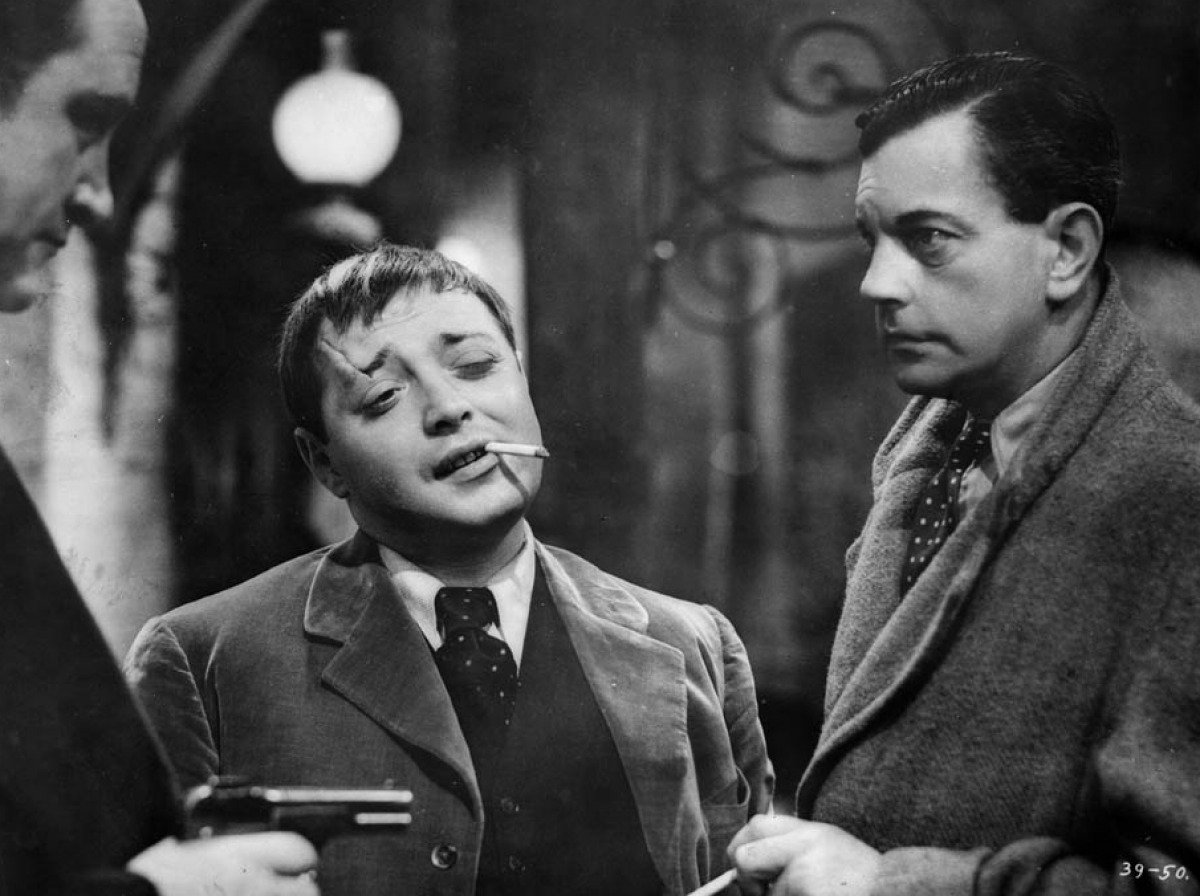
I like the 1934 THE MAN WHO KNEW TOO MUCH better for several reasons. Peter Lorre as the charming spy leader Abbott nearly steals the original film. Lorre was an international star after Fritz Lang's M (1932). This is his first English speaking film and what an introduction playing the charismatic heavy in an Alfred Hitchcock film (with a scar and streak of white in his hair for good measure). Lorre would also make THE SECRET AGENT (1936) with Hitchcock. Hitchcock introduced villains in his films as charming, well dressed, and lethally polite although Lorre's gang is fond of padded doors, the better to muffle screams one presumes. The Drayton's in the newer version are more restrained, less flashy. Mrs. Drayton does have an icy stare and Mr. Drayton shows his ferocity at the end but they don't command the screen like Lorre. Hitchcock does know how to pick villainous faces in both films. The assassin Rien in the 1956 film resembles a vulture.
I also prefer the English Lawrence couple in the original to the American couple the McKenna's in the latter version. The Lawrence's are a bit like Nick and Nora Charles from THE THIN MAN (1934), a 1930's couple, having fun on vacation, teasing each other, even flirting with other people. Leslie Banks is self-deprecating as Bob Lawrence while Jimmy Stewart's Ben McKenna is probably Stewart's least interesting performance in a Hitchcock film. Hitchcock has some fun early in the original when Lawrence ties a string of yarn to Louis as he dances with his wife Jill, tangling up everyone on the dance floor. But both couples are deadly serious about rescuing their stolen children. The McKenna's show much more outward emotion to the kidnapping than their reserved English counterparts. Both versions are fun to watch as married couples involved in international intrigue try to unravel the mystery. The 1934 THE MAN WHO KNEW TOO MUCH introduces two more themes that reappear over and over in Hitchcock films. One is the fear or lack of trust in the police. In this film, the couple cannot go to the police for fear of endangering their child. The other theme is the accidental hero or in this case accidental heroes. Neither couple is extraordinary but circumstances beyond their control will force them to behave heroically.
The last element that makes the original THE MAN WHO KNEW TOO MUCH a better film is we are invested more in the kidnapping of Betty than we are Hank. Both kids are precocious, but Betty is older and more mature. Her love for her parents and theirs for her is more genuine. When Betty is kidnapped, taken away on a horse drawn sleigh by Ramon, Hitchcock opens with a close up of her eyes before pulling back. The terror on her face is palpable. Young English actress Nova Pilbeam is marvelous in the original as Betty. Hank played by American Christopher Olsen in the remake is younger, a typical 1950's child actor, blonde and too cute. We never really identify with Hank. Even his kidnapping happens off screen. We don't care about Hank like we do Betty.
But in no way is the original perfect, making it understandable that Hitchcock would want to remake THE MAN WHO KNEW TOO MUCH. In the first version, Hitchcock introduces the characters fast and furious and it takes us a little time to figure out who's who. Characters appear and then disappear like "Uncle" Clive. An example of Hitchcock as a talented amateur is the scene where Abbott plays the music for Ramon, pointing out when to shoot the ambassador during the performance, right in front of our hero Bob Lawrence. It's too obvious. Hitchcock will tighten up the characters introductions and plot points with his 1956 version.
Hitchcock's use of Rear Projection process shots detracts from THE MAN WHO KNEW TOO MUCH remake. Rear Projection is where a previously filmed background is projected behind actors to make them appear to be driving on the French Rivera or skiing down a mountain when they're really on a soundstage. Filmmakers used it to save money and better control the sound and location. Hitchcock did film in Morocco but his back and forth use of Rear Projection in the Morocco (and some London) scenes is jarring and ruins the believability that the McKenna's are in Marrakech. Rear Projection was used extensively from the 30's through even the 70's (new technology like green screen today has replaced Rear Projection). Rear Projection always looks more realistic in black and white than color. In the 1934 film, Hitchcock uses Rear Projection sparingly during the opening St. Moritz ski sequence and it's fairly believable. But in the 1956 version (shot in color), it just looks fake. Hitchcock used Rear Projection to better effect in TO CATCH A THIEF (1955) and VERTIGO (1958) but horribly in MARNIE (1964) and in the newer THE MAN WHO KNEW TOO MUCH.
One of the things I never put much thought into when watching THE MAN WHO KNEW TOO MUCH is the title. Who is the man who knew too much? Do you know? It's clearly Louis Bernard, the secret agent doomed when recognized by Abbott in the original and Rien in the remake. Louis knows the players, the plot, and the location of their nefarious plan. But when he's murdered, he transfers his knowledge to our protagonists. Suddenly, Bob Lawrence and Ben McKenna become the man who knew too much. They have the clues but it takes them the rest of the film to piece it together (with their wives participation and ability to scream at the right moment). I think the title is intriguing and one of Hitchcock's most interesting.
Both versions of THE MAN WHO KNEW TOO MUCH play a significant role in director Alfred Hitchcock's career. After a couple of flops early on, Hitchcock started making films for British Gaumont Studio. The 1934 THE MAN WHO KNEW TOO MUCH would kick start his career again and attract the attention of American studios looking for new talent. TMWKTM began a successful run of English thrillers for Hitchcock. Following TMWKTM, Hitchcock would make the 39 STEPS, THE SECRET AGENT, SABOTAGE, and THE LADY VANISHES. Hitchcock's English period is often overlooked by his later American movies but it was one of his most productive stages of his early career as he made a name for himself. Hitchcock would make his first film in the United States in 1940 with REBECCA.
The 1956 THE MAN WHO KNEW TOO MUCH was made at the peak of Hitchcock's career -- the 1950's. It follows after REAR WINDOW and TO CATCH A THIEF but before VERTIGO and NORTH BY NORTHWEST. It's my least favorite of all those films but TMWKTM did provide Hitchcock with his first attempt at a big studio, Technicolor suspense thriller about an innocent man mixed up in international intrigue that he would make again with greater success in 1959 with NORTH BY NORTHWEST. Both films have great leading men, famous landmarks, and the innocent protagonist involved with spies. Hitchcock had made this kind of film before with THE 39 STEPS, FOREIGN CORRESPONDENT, and SABOTEUR but they were in black and white. The newer THE MAN WHO KNEW TOO MUCH was his first color foray into that familiar suspense world.
So judge for yourself which THE MAN WHO KNEW TOO MUCH you want to see. Is it the black and white original with a star turn by villain Peter Lorre. Or is it the Technicolor remake with big Hollywood stars James Stewart and Doris Day. My suggestion is watch the original 1934 version first and the 1956 remake after that. Then, go out to the dinner and discuss the pros and cons of both versions as only Alfred Hitchcock would dare to remake one of his own successful films a second time.
The original THE MAN WHO KNEW TOO MUCH succeeds because it has a better villain (Peter Lorre in his first English speaking film), better chemistry between the husband and wife (although Leslie Banks and Edna Best are not as famous as Stewart and Day), and more sympathy for the kidnapped child. This isn't to say that the 1956 THE MAN WHO KNEW TOO MUCH doesn't have its moments. Hitchcock was at the top of his game in the 1950's. The newer version has some excellent sequences not to mention a more prolonged Royal Albert Hall assassination attempt set piece.
Two reasons that come to mind are the original MAN WHO KNEW TOO MUCH was made in England and American audiences may not have had a chance to see it (although Truffaut in his book Hitchcock says that it was a hit in America). A more reasonable explanation is that Hitchcock wanted to retry the famous assassination attempt sequence at the Royal Albert Hall a second time, perhaps not happy with his first attempt (it turns out Hitchcock owed Paramount one more movie as well and picked TMWKTM to be that film). The newer MAN WHO KNEW TOO MUCH has a lengthier version of the Albert Hall scene with no dialogue this time, just visuals and stirring music to build the suspense. It is technically better and a bravura piece of filmmaking but I find the 1934 version with some cutting back to the spies listening to the concert on the radio just as suspenseful.
The original 1934 THE MAN WHO KNEW TOO MUCH was written by Charles Bennett and D.B. Wyndham Lewis. The title only comes from a book by G.K Chesterton. The tale begins in St. Moritz, Switzerland where a British family, the Lawrence's, are on holiday. The Lawrence family become embroiled in international intrigue when a Frenchman they befriend named Louis Bernard (Pierre Fresnay) is fatally shot while dancing with Jill Lawrence (Edna Best) at dinner. Louis turns out to be a secret agent. Before Louis dies, he hands Jill a key and whispers to her that a foreign dignitary is to be assassinated in London and to look for a message in his shaving brush to take to the British Consulate. Bob Lawrence (Leslie Banks) retrieves the message before the assassin Ramon (Frank Vosper) can find it. The police detain Bob and question him. Ramon and the leader of the spy ring, the cheerfully creepy Abbott (Peter Lorre) kidnap the Lawrence's daughter Betty (Nova Pilbeam) to keep Bob and Jill silent about the assassination plot.
The Lawrence's return to London. Gibson (George Curzon) with the Foreign Office informs them that Louis was an agent with Special Services who had uncovered a plot to kill Roper, a foreign politician visiting London. With continued phone threats to kill their daughter Betty, the Lawrence's remain steadfast to reveal nothing to the authorities. But that doesn't stop Bob along with family friend "Uncle" Clive (Hugh Wakefield) from tracking down some leads from Louis's secret message starting with a visit to George Barbor (Henry Oscar), a dentist mentioned in the note. Barbor's office is a safe house for the spy ring. Bob catches sight of Abbott and Ramon while fending off the suspicious dentist and his gas mask. Bob and Clive follow the two men to the Tabernacle of the Sun, a sun worshipping chapel whose sun symbol is drawn on Louis's note.
Bob and Clive try to assimilate unnoticed in the chapel, but all the other sun worshippers are women. Agnes (Cicely Oates), Abbott's personal nurse, notices them. Once the women exit, Abbott and Ramon attempt to block the men from leaving. Bob notices a Royal Albert Hall ticket in Ramon's pocket and tells Clive to warn the police. Clive manages to escape but Bob is knocked unconscious. When Clive returns with the police, Abbott calmly explains Clive was the troublemaker and the police take Clive away. Bob is briefly united with Betty before they're separated again. Abbott plays for Ramon a record with the music cue to show Ramon when he must shoot the foreign ambassador at the Royal Albert Hall.
Clive tells Jill to go to Albert Hall per her husband's instructions. Jill sees Ramon in the lobby. Ramon hands her Betty's skier pin, warning her to keep quiet. As the orchestra plays, Abbott and his den of spies listen on the radio. Ramon prepares to shoot the ambassador from a private box on the second level. But Jill screams right before the cymbals clash, and Ramon misses his mark. Ramon races back to the kidnappers hideout followed by Jill and the police. The kidnappers have guns but the police force a local gunsmith to loan them rifles. A climactic gunfight erupts (maybe the only one in a Hitchcock film) between the spies and the police as Bob helps Betty flee to the rooftop to escape Ramon who has been ordered by Abbott to kill young Betty.
The original THE MAN WHO KNEW TOO MUCH is Hitchcock's break through hit, establishing him as the master of suspense. Hitchcock begins to establish his themes, design his visual vocabulary, and create set pieces that would shape and define his cinematic career. Hitchcock preferred to show rather than tell the audience by using symbols or motifs. Giant teeth to establish the sinister dentist office. A chiming watch to identify the spy ringleader Abbott. The skier pin to represent kidnapped Betty. He even uses cymbals as a symbol, winking to the audience as we nervously await the crashing of cymbals at the concert, signifying someone might be murdered.
Hitchcock gives us four good set pieces in MAN WHO KNEW TOO MUCH, the beginning of many more to follow in his career. Obviously, the assassination attempt at the Royal Albert Hall is the penultimate, Hitchcock mixing visuals and music for suspenseful, cinematic effect in a famous location no less. The dentist sequence plays on everyone's fear of dentists which in this film proves to be true. The shootout between the villains and the cops is something rare for Hitchcock (taken from a real-life gun battle called the Sidney Street siege in London in 1911 between Russian anarchists and the London police supervised by Winston Churchill) but it provides a great payoff when mother Jill seizes her chance to repay an earlier St. Moritz target practice challenge she lost to the assassin Ramon and save her daughter from him. But overlooked is the fight scene in the church with Bob Lawrence throwing chairs at his assailants, fighting to rescue his daughter.
Hitchcock's 1956 remake of THE MAN WHO KNEW TOO MUCH is a longer version of the original film with some plot changes, alterations, and enhancements. Written by one of Hitchcock's favorite screenwriters John Michael Hayes (who would pen four Hitchcock films including 1954's REAR WINDOW and 1955's TO CATCH A THIEF), Hitchcock switches the opening location from Switzerland to Morocco and the family from English to American. All of Hitchcock's collaborators during his golden period of filmmaking in the 1950s are on the picture: composer Bernard Herrmann, Director of Photography Robert Burks, screenwriter Hayes, Editor George Tomasini, Art Directors Henry Bumstead and Hal Peirera, and Costumes by Edith Head.
Dr. Benjamin McKenna (James Stewart), his wife Josephine aka Jo (Doris Day), and their young son Hank (Christopher Olsen) are on vacation in the North Africa country of Morocco. While on a bus to Marrakech, they meet a friendly Frenchman Louis Bernard (Daniel Gelin) who joins them for drinks later that night. The next day at the Marrakech market, police chase a robed man. He's stabbed by an assailant. He stumbles into Ben's arms. It's Louis, disguised as an Arab, his face painted dark. Louis whispers to Ben a foreign statesman will be assassinated in London before dying. Ben jots down Louis's cryptic message. While Ben and Jo are questioned by the police and discover Louis was an intelligence agent, another English couple, Edward Drayton (Bernard Miles) and his wife Lucy Drayton (Brenda de Banzie) offer to watch Hank. But the Drayton's are part of the assassination plot and kidnap Hank to keep the McKenna's quiet about the assassination plot.
Back in London, the McKenna's meet with Inspector Buchanan (Ralph Truman) who wants to help them but the McKenna's stay mum, not wanting to jeopardize Hank's life. Back at their hotel, theater friends of Jo's (including Carolyn Jones who would later play Morticia in TV's THE ADDAMS FAMILY) stop by unexpectedly. Ben goes to check out Ambrose Chappel, a name Louis mentioned in his dying breath. Ben thinks it's a person. After looking him up in the phone book and calling him, Ben goes to visit Ambrose Chappel (George Howe) at his taxidermy shop. Everyone acts suspicious in the shop but it's a red herring that Hitchcock throws us. Jo figures out that Ambrose Chappel is a place not a person. She tells her theater friends to have Ben meet her at a church called Ambrose Chapel when he returns.
The conspirators are hiding out at the chapel. Drayton plays Storm Cloud Cantata on a record for the assassin Rien (Reggie Nalder), pointing out the musical cue where Rien will shoot the Foreign Prime Minister (Alexis Bobrinskoy). Drayton, dressed as a vicar, prepares for a service downstairs. Mrs. Drayton spots the McKenna's hiding amongst the parishioners. Jo sneaks out to call Inspector Buchanan. Ben scuffles with Drayton's men before he's knocked out. The Drayton's flee with Hank, hiding out in the embassy of the man they wish to kill. Jo can't reach Buchanan who's attending the concert at the Royal Albert Hall. The chapel is locked when Jo and the police return. Ben's unconscious on the altar floor. Jo takes a taxi to the Royal Albert Hall to find Buchanan. She runs into Rien (who Jo recognizes from an encounter earlier at their Morocco hotel room). Rien warns her to do nothing if she wants to see Hank alive again.
Hitchcock recreates his original famous Royal Albert Hall assassination attempt (with a nice cameo by composer Bernard Herrmann as the symphony conductor) but shoots it entirely with music and no dialogue. Ben manages to escape from the chapel and joins Jo at Albert Hall. They spot Rien hiding behind curtains on the second balcony. Jo screams just as Rien shoots, wounding the Prime Minister. Ben tussles with Rien who falls to his death from the balcony (John Wilkes Booth style). Buchanan learns the Drayton's have been spotted at the embassy. Ben and Jo ask to see the Prime Minister (who thanked them earlier in the evening for saving his life). While Jo sings Que Sera Sera, Ben sneaks off and rescues Hank from the Draytons.
I enjoyed the newer version of THE MAN WHO KNEW TOO MUCH more upon a second viewing after watching the original first. The newer version has more layers to it. Hitchcock clearly wants this film to be American and not English. Ben is a doctor from Indianapolis. Jo is a former theater star who put her career on hold when she had Hank. Hitchcock and screenwriter Hayes add more psychological depth to the McKenna's marriage which appears strained at times. Jo giving up her music career. Ben not willing to move his practice to New York. Ben has a bit of a temper. Jo was taking too many pills until recently. Hank's kidnapping will help to strengthen their marriage.
The opening Morocco vacation scene is longer as Hitchcock establishes Louis's role more clearly (Jo doesn't trust Louis in this version) and hides the Drayton's fiendish intent until the right moment. Hitchcock throws out the dentist scene from the original and dazzles with the taxidermy set piece, building suspense in broad daylight. Notice how Hitchcock and cinematographer Robert Burks frame fierce looking stuffed animals like tigers and lions at odd angles, as if the creatures might come alive and leap at them. The before mentioned Royal Albert Hall set piece is lengthier and better than the original, the music acting as another character, representing Jo's psychological state of mind, turbulent, emotional. She's frantic to find her son but now involved with an international murder plot too.
The finale for the 1956 THE MAN WHO KNEW TOO MUCH seems drawn out and far-fetched, the result of Hitchcock already stretching out the story to perhaps its limits. He throws out the original shootout between good and bad guys, going for political intrigue as the Drayton's hide in the very embassy that the wounded Prime Minister represents. It appears the Ambassador (Mogens Wieth) ordered the assassination, but it doesn't matter. We don't really care. At least the original had elements of the 30's political climate, echoes of another World War igniting much like the assassination of Archduke Ferdinand by a Sarajevo assassin started World War I. And Doris Day's singing Que Sera Sera smacks of the studio trying to stuff a hit single into a dramatic film.
I like the 1934 THE MAN WHO KNEW TOO MUCH better for several reasons. Peter Lorre as the charming spy leader Abbott nearly steals the original film. Lorre was an international star after Fritz Lang's M (1932). This is his first English speaking film and what an introduction playing the charismatic heavy in an Alfred Hitchcock film (with a scar and streak of white in his hair for good measure). Lorre would also make THE SECRET AGENT (1936) with Hitchcock. Hitchcock introduced villains in his films as charming, well dressed, and lethally polite although Lorre's gang is fond of padded doors, the better to muffle screams one presumes. The Drayton's in the newer version are more restrained, less flashy. Mrs. Drayton does have an icy stare and Mr. Drayton shows his ferocity at the end but they don't command the screen like Lorre. Hitchcock does know how to pick villainous faces in both films. The assassin Rien in the 1956 film resembles a vulture.
I also prefer the English Lawrence couple in the original to the American couple the McKenna's in the latter version. The Lawrence's are a bit like Nick and Nora Charles from THE THIN MAN (1934), a 1930's couple, having fun on vacation, teasing each other, even flirting with other people. Leslie Banks is self-deprecating as Bob Lawrence while Jimmy Stewart's Ben McKenna is probably Stewart's least interesting performance in a Hitchcock film. Hitchcock has some fun early in the original when Lawrence ties a string of yarn to Louis as he dances with his wife Jill, tangling up everyone on the dance floor. But both couples are deadly serious about rescuing their stolen children. The McKenna's show much more outward emotion to the kidnapping than their reserved English counterparts. Both versions are fun to watch as married couples involved in international intrigue try to unravel the mystery. The 1934 THE MAN WHO KNEW TOO MUCH introduces two more themes that reappear over and over in Hitchcock films. One is the fear or lack of trust in the police. In this film, the couple cannot go to the police for fear of endangering their child. The other theme is the accidental hero or in this case accidental heroes. Neither couple is extraordinary but circumstances beyond their control will force them to behave heroically.
The last element that makes the original THE MAN WHO KNEW TOO MUCH a better film is we are invested more in the kidnapping of Betty than we are Hank. Both kids are precocious, but Betty is older and more mature. Her love for her parents and theirs for her is more genuine. When Betty is kidnapped, taken away on a horse drawn sleigh by Ramon, Hitchcock opens with a close up of her eyes before pulling back. The terror on her face is palpable. Young English actress Nova Pilbeam is marvelous in the original as Betty. Hank played by American Christopher Olsen in the remake is younger, a typical 1950's child actor, blonde and too cute. We never really identify with Hank. Even his kidnapping happens off screen. We don't care about Hank like we do Betty.
But in no way is the original perfect, making it understandable that Hitchcock would want to remake THE MAN WHO KNEW TOO MUCH. In the first version, Hitchcock introduces the characters fast and furious and it takes us a little time to figure out who's who. Characters appear and then disappear like "Uncle" Clive. An example of Hitchcock as a talented amateur is the scene where Abbott plays the music for Ramon, pointing out when to shoot the ambassador during the performance, right in front of our hero Bob Lawrence. It's too obvious. Hitchcock will tighten up the characters introductions and plot points with his 1956 version.
Hitchcock's use of Rear Projection process shots detracts from THE MAN WHO KNEW TOO MUCH remake. Rear Projection is where a previously filmed background is projected behind actors to make them appear to be driving on the French Rivera or skiing down a mountain when they're really on a soundstage. Filmmakers used it to save money and better control the sound and location. Hitchcock did film in Morocco but his back and forth use of Rear Projection in the Morocco (and some London) scenes is jarring and ruins the believability that the McKenna's are in Marrakech. Rear Projection was used extensively from the 30's through even the 70's (new technology like green screen today has replaced Rear Projection). Rear Projection always looks more realistic in black and white than color. In the 1934 film, Hitchcock uses Rear Projection sparingly during the opening St. Moritz ski sequence and it's fairly believable. But in the 1956 version (shot in color), it just looks fake. Hitchcock used Rear Projection to better effect in TO CATCH A THIEF (1955) and VERTIGO (1958) but horribly in MARNIE (1964) and in the newer THE MAN WHO KNEW TOO MUCH.
One of the things I never put much thought into when watching THE MAN WHO KNEW TOO MUCH is the title. Who is the man who knew too much? Do you know? It's clearly Louis Bernard, the secret agent doomed when recognized by Abbott in the original and Rien in the remake. Louis knows the players, the plot, and the location of their nefarious plan. But when he's murdered, he transfers his knowledge to our protagonists. Suddenly, Bob Lawrence and Ben McKenna become the man who knew too much. They have the clues but it takes them the rest of the film to piece it together (with their wives participation and ability to scream at the right moment). I think the title is intriguing and one of Hitchcock's most interesting.
Both versions of THE MAN WHO KNEW TOO MUCH play a significant role in director Alfred Hitchcock's career. After a couple of flops early on, Hitchcock started making films for British Gaumont Studio. The 1934 THE MAN WHO KNEW TOO MUCH would kick start his career again and attract the attention of American studios looking for new talent. TMWKTM began a successful run of English thrillers for Hitchcock. Following TMWKTM, Hitchcock would make the 39 STEPS, THE SECRET AGENT, SABOTAGE, and THE LADY VANISHES. Hitchcock's English period is often overlooked by his later American movies but it was one of his most productive stages of his early career as he made a name for himself. Hitchcock would make his first film in the United States in 1940 with REBECCA.
The 1956 THE MAN WHO KNEW TOO MUCH was made at the peak of Hitchcock's career -- the 1950's. It follows after REAR WINDOW and TO CATCH A THIEF but before VERTIGO and NORTH BY NORTHWEST. It's my least favorite of all those films but TMWKTM did provide Hitchcock with his first attempt at a big studio, Technicolor suspense thriller about an innocent man mixed up in international intrigue that he would make again with greater success in 1959 with NORTH BY NORTHWEST. Both films have great leading men, famous landmarks, and the innocent protagonist involved with spies. Hitchcock had made this kind of film before with THE 39 STEPS, FOREIGN CORRESPONDENT, and SABOTEUR but they were in black and white. The newer THE MAN WHO KNEW TOO MUCH was his first color foray into that familiar suspense world.
So judge for yourself which THE MAN WHO KNEW TOO MUCH you want to see. Is it the black and white original with a star turn by villain Peter Lorre. Or is it the Technicolor remake with big Hollywood stars James Stewart and Doris Day. My suggestion is watch the original 1934 version first and the 1956 remake after that. Then, go out to the dinner and discuss the pros and cons of both versions as only Alfred Hitchcock would dare to remake one of his own successful films a second time.
Sunday, December 20, 2015
National Lampoon's Christmas Vacation (1989)
We have all had our Clark Griswold moments during the Christmas season. Driving all over the valley to find the biggest, best Christmas tree. Having the brightest, most colorful display of Christmas lights in the neighborhood. But who is this Clark Griswold I speak of? Why, Clark Griswold (Chevy Chase) the overly exuberant, cheerfully optimistic father and husband who moviegoers first met in Harold Ramis's NATIONAL LAMPOON'S VACATION (1983). In VACATION, Griswold led his weary family on a cross country summer odyssey to the amusement park Wally World. Clark Griswold, his wife Ellen, and their two children Rusty and Audrey are back to poke fun at the busiest, happiest, most stressful holiday of the year in NATIONAL LAMPOON'S CHRISTMAS VACATION (1989) directed by Canadian Jeremiah Chechik.
VACATION, EUROPEAN VACATION (1985), and CHRISTMAS VACATION were written by John Hughes who started out as a writer for the satirical magazine National Lampoon. Hughes, also a director, was best known for having his finger on the pulse of teenagers. Hughes wrote and directed SIXTEEN CANDLES (1984), THE BREAKFAST CLUB (1985), and FERRIS BUELLER'S DAY OFF (1986), comedies that captured the angst and awkwardness that comes with becoming a teenager. But Hughes also understood adults and with the VACATION films, he found his Universal Dad, the Everyman Father in Clark Griswold as portrayed by SATURDAY NIGHT LIVE veteran Chevy Chase. Griswold loves his wife Ellen (Beverly D'Angelo) and kids Rusty (Johnny Galecki) and Audrey (Juliette Lewis). He works hard. He believes in family values and tradition. A co-worker calls Clark the "last true family man." The family car is a station wagon. Clark sees the sunny side of things. He's a glass half full kind of guy. But he's a klutz. He's not very handy. His epic ideas like putting up Christmas lights (and trying to get them to work) becomes an epic struggle, resorting to using a staple gun to secure all 250 strands of light bulbs around his house.
CHRISTMAS VACATION is actually not another Griswold vacation. It takes place in their neighborhood, at their house, somewhere in suburban Chicago, Illinois. As Clark proclaims, "It's a Griswold Family Christmas." But it's a hectic time of the year for the Griswolds. Clark is anxious to receive his Christmas bonus from his miserly boss Frank Shirley (Brian Doyle-Murray) as Clark has already put a down payment on a swimming pool he can't afford. Both Clark's parents Clark, Sr. (John Randolph) and Nora (Diane Ladd) and Ellen's parents Art (E.G. Marshall) and Francis (Doris Roberts) are coming to stay with them over the Christmas holiday. And Clark is determined to have the best Christmas tree (it's way too big for the house) and the best Christmas lights display in the neighborhood (the lights draw so much power he nearly causes a blackout in his town).
But the Griswold family holiday gets even nuttier for Clark when Cousin Eddie (Randy Quaid from the first VACATION film) shows up unannounced in his RV with his wife Catherine (Miriam Flynn) and their two kids Rocky (Cody Burger) and Ruby Sue (Ellen Hamilton Latzen) to also spend Christmas with the Griswolds. Eddie's out of work and they have no money for gifts for their children. Rounding out the family affair are Uncle Lewis (William Hickey) and Aunt Bethany (Mae Questel) who Clark picks up from the airport.
Christmas Eve arrives and all hell breaks loose. Aunt Bethany's cat (who she absent-mindedly wrapped and brought as a gift) bites into the Christmas tree lights and electrocutes itself. Uncle Lewis accidentally burns up the Christmas tree with his cigar. The Christmas turkey is too dry and implodes. And when Clark's bonus check arrives at the last moment, it's not a bonus at all. Clark goes berserk, cursing his boss which sends Cousin Eddie off to kidnap Frank Shirley from his mansion and wife (Natalia Nogulich) and bring him back to face the Griswold family's wrath.
Writer Hughes likes to have fun with the rites of family (summer vacation, Christmas holiday, a European vacation). CHRISTMAS VACATION is a bit less vulgar than VACATION. It has some funny physical comedy bits especially with Clark trying to put up the lights or a squirrel running loose in the Griswold household. But underneath some of the crude jokes, cousin Eddie's potty mouth, or Uncle Lewis's bad toupee, there is a sweet Christmas story to be found. There's a heartwarming sequence after Clark is accidentally stuck in the family attic as the others go shopping (a precursor to the Hughes scripted 1990 HOME ALONE) where he discovers a box of Super 8 movies including Christmas with his parents back in 1955. It's a wonderful moment amongst the Christmas chaos. And, Clark and Ellen helping out their less fortunate cousins is a very real everyday Christmas moment as millions of people around the world struggle to provide even one gift for their children or loved ones. CHRISTMAS VACATION does have a heart.
The Christmas film genre has transitioned from classic holiday fare like IT'S A WONDERFUL LIFE (1946) or WHITE CHRISTMAS (1954) to dysfunctional families either celebrating Christmas or avoiding Christmas like the recent CHRISTMAS WITH THE KRANKS (2004) or FOUR CHRISTMASES (2008). The success of CHRISTMAS VACATION may have started the trend. For the Griswolds, it's more their relatives who are dysfunctional than them. But Chechik and Hughes don't entirely bail on the traditional Christmas tales we used to. Clark's miserly boss Frank Shirley hearkens back to another well-known grumpy Christmas character, Charles Dickens' Ebenezer Scrooge in A Christmas Carol.
It's hard to believe there have been four VACATION films. VACATION (1983), EUROPEAN VACATION (1985), CHRISTMAS VACATION (1989), and VEGAS VACATION (1997). The VACATION series owes its longevity to Chevy Chase as Clark Griswold, the perpetually positive patriarch. Chase's facial mannerisms and gift of physical comedy (a bit with tree sap on his hand is priceless) lift the VACATION franchise above similar family type comedies. The beautiful Beverly D'Angelo dutifully presides as wife Ellen, Clark's partner in all things fun. Ellen goes along with Clark's crazy plans, never blowing her top although she occasionally voices her displeasure.
Incredibly, the VACATION series has had four different Rusty's and Audrey's in each VACATION film. While Clark and Ellen grow older, Rusty and Audrey stay eternally young. Johnny Galecki (now on TVs THE BIG BANG THEORY) plays Rusty in CHRISTMAS VACATION but other Rusty's include Anthony Michael Hall, Jason Lively, and Ethan Embry. Juliette Lewis (CAPE FEAR, KALIFORNIA) who plays Audrey Griswold is probably the most well known of the other Audrey's. Dana Barron, Dana Hill, and Marisol Nichols have played the Audrey part in the other VACATION films.
Randy Quaid as Cousin Eddie almost steals the film from Chevy Chase. Chase and Quaid are hilarious in their scenes together. Redneck Eddie is the quintessential relative from hell but Quaid gives Eddie some pathos that I didn't recall in the original VACATION. The grandparents are played by familiar character actors E.G. Marshall (12 ANGRY MEN, CREEPSHOW), Doris Roberts (Ray Romano's Mom on TV'S EVERYBODY LOVES RAYMOND), Diane Ladd (CHINATOWN, mother of actress Laura Dern), and John Randolph (PRIZZI'S HONOR).
Brian Doyle-Murray (Bill Murray's older brother) does a nice turn as the Scrooge like CEO Frank Shirley. Doyle-Murray also made an appearance in the first VACATION. Look for SEINFELD and VEEP'S star Julia Louise-Dreyfus in an early role as one of Hughes' favorite targets, a young Yuppie neighbor Margo Chester who along with her equally annoying husband Todd Chester (Nicholas Guest) fall victim to some of Clark's holiday festivities.
CHRISTMAS VACATION is uneven at times. The mean boss plot disappears and pop up at infrequent times and the yuppie neighbors almost serve no purpose. A scene with Clark flirting with a buxom department store clerk Mary (Nicolette Scorsese) is a silly attempt to recreate Clark's flirtation with Christie Brinkley as the Girl in the Ferrari in the original VACATION. The CHRISTMAS VACATION flirtation scene is forced and goes on uncomfortably too long.
If director Jeremiah Chechik's names doesn't ring a bell, you're not alone. I had never heard of him either. Chechik had a brief, eclectic run of feature films with CHRISTMAS VACATION followed by BENNY & JOON (1993) with Johnny Depp and the remake of DIABOLIQUE (1996) with Sharon Stone. But his run ended with the ill-fated movie version of the English spy TV show THE AVENGERS (1998) starring Ralph Fiennes, Uma Thurman, and Sean Connery. Chechik moved to television where he has directed various TV shows including a stint on NBC's CHUCK recently.
You can't keep a good franchise down even with Chevy Chase and Beverly D'Angelo growing older. A new VACATION directed by John Frances Daley and Jonathan M. Goldstein came out in 2015 with Rusty Griswold (now played by Ed Helms) grown up and taking his family on the same cross country road trip to Wally World. Chase and D'Angelo appear as Clark and Ellen. A new generation gets to meet the Griswolds but for CrazyFilmGuy my loyalty lies with the original Griswold family.
I think myself and most adults can relate to Clark Griswold in CHRISTMAS VACATION. We all build up these amazing traditions that we experienced with our parents to our kids such as drinking egg nog, building a miniature Christmas village, or reading Twas the Night Before Christmas in front of a roaring fire. We think our children will have the same excitement for these traditions that we had but that's not always the case. It takes time. Ultimately, the younger generation learns to embrace tradition while creating new ones as well. CHRISTMAS VACATION makes fun of family and tradition during the holiday season but in the end, that's what's most important. Not fancy gifts or bonuses or the brightest Christmas light. It's family.
VACATION, EUROPEAN VACATION (1985), and CHRISTMAS VACATION were written by John Hughes who started out as a writer for the satirical magazine National Lampoon. Hughes, also a director, was best known for having his finger on the pulse of teenagers. Hughes wrote and directed SIXTEEN CANDLES (1984), THE BREAKFAST CLUB (1985), and FERRIS BUELLER'S DAY OFF (1986), comedies that captured the angst and awkwardness that comes with becoming a teenager. But Hughes also understood adults and with the VACATION films, he found his Universal Dad, the Everyman Father in Clark Griswold as portrayed by SATURDAY NIGHT LIVE veteran Chevy Chase. Griswold loves his wife Ellen (Beverly D'Angelo) and kids Rusty (Johnny Galecki) and Audrey (Juliette Lewis). He works hard. He believes in family values and tradition. A co-worker calls Clark the "last true family man." The family car is a station wagon. Clark sees the sunny side of things. He's a glass half full kind of guy. But he's a klutz. He's not very handy. His epic ideas like putting up Christmas lights (and trying to get them to work) becomes an epic struggle, resorting to using a staple gun to secure all 250 strands of light bulbs around his house.
CHRISTMAS VACATION is actually not another Griswold vacation. It takes place in their neighborhood, at their house, somewhere in suburban Chicago, Illinois. As Clark proclaims, "It's a Griswold Family Christmas." But it's a hectic time of the year for the Griswolds. Clark is anxious to receive his Christmas bonus from his miserly boss Frank Shirley (Brian Doyle-Murray) as Clark has already put a down payment on a swimming pool he can't afford. Both Clark's parents Clark, Sr. (John Randolph) and Nora (Diane Ladd) and Ellen's parents Art (E.G. Marshall) and Francis (Doris Roberts) are coming to stay with them over the Christmas holiday. And Clark is determined to have the best Christmas tree (it's way too big for the house) and the best Christmas lights display in the neighborhood (the lights draw so much power he nearly causes a blackout in his town).
But the Griswold family holiday gets even nuttier for Clark when Cousin Eddie (Randy Quaid from the first VACATION film) shows up unannounced in his RV with his wife Catherine (Miriam Flynn) and their two kids Rocky (Cody Burger) and Ruby Sue (Ellen Hamilton Latzen) to also spend Christmas with the Griswolds. Eddie's out of work and they have no money for gifts for their children. Rounding out the family affair are Uncle Lewis (William Hickey) and Aunt Bethany (Mae Questel) who Clark picks up from the airport.
Christmas Eve arrives and all hell breaks loose. Aunt Bethany's cat (who she absent-mindedly wrapped and brought as a gift) bites into the Christmas tree lights and electrocutes itself. Uncle Lewis accidentally burns up the Christmas tree with his cigar. The Christmas turkey is too dry and implodes. And when Clark's bonus check arrives at the last moment, it's not a bonus at all. Clark goes berserk, cursing his boss which sends Cousin Eddie off to kidnap Frank Shirley from his mansion and wife (Natalia Nogulich) and bring him back to face the Griswold family's wrath.
Writer Hughes likes to have fun with the rites of family (summer vacation, Christmas holiday, a European vacation). CHRISTMAS VACATION is a bit less vulgar than VACATION. It has some funny physical comedy bits especially with Clark trying to put up the lights or a squirrel running loose in the Griswold household. But underneath some of the crude jokes, cousin Eddie's potty mouth, or Uncle Lewis's bad toupee, there is a sweet Christmas story to be found. There's a heartwarming sequence after Clark is accidentally stuck in the family attic as the others go shopping (a precursor to the Hughes scripted 1990 HOME ALONE) where he discovers a box of Super 8 movies including Christmas with his parents back in 1955. It's a wonderful moment amongst the Christmas chaos. And, Clark and Ellen helping out their less fortunate cousins is a very real everyday Christmas moment as millions of people around the world struggle to provide even one gift for their children or loved ones. CHRISTMAS VACATION does have a heart.
The Christmas film genre has transitioned from classic holiday fare like IT'S A WONDERFUL LIFE (1946) or WHITE CHRISTMAS (1954) to dysfunctional families either celebrating Christmas or avoiding Christmas like the recent CHRISTMAS WITH THE KRANKS (2004) or FOUR CHRISTMASES (2008). The success of CHRISTMAS VACATION may have started the trend. For the Griswolds, it's more their relatives who are dysfunctional than them. But Chechik and Hughes don't entirely bail on the traditional Christmas tales we used to. Clark's miserly boss Frank Shirley hearkens back to another well-known grumpy Christmas character, Charles Dickens' Ebenezer Scrooge in A Christmas Carol.
It's hard to believe there have been four VACATION films. VACATION (1983), EUROPEAN VACATION (1985), CHRISTMAS VACATION (1989), and VEGAS VACATION (1997). The VACATION series owes its longevity to Chevy Chase as Clark Griswold, the perpetually positive patriarch. Chase's facial mannerisms and gift of physical comedy (a bit with tree sap on his hand is priceless) lift the VACATION franchise above similar family type comedies. The beautiful Beverly D'Angelo dutifully presides as wife Ellen, Clark's partner in all things fun. Ellen goes along with Clark's crazy plans, never blowing her top although she occasionally voices her displeasure.
Incredibly, the VACATION series has had four different Rusty's and Audrey's in each VACATION film. While Clark and Ellen grow older, Rusty and Audrey stay eternally young. Johnny Galecki (now on TVs THE BIG BANG THEORY) plays Rusty in CHRISTMAS VACATION but other Rusty's include Anthony Michael Hall, Jason Lively, and Ethan Embry. Juliette Lewis (CAPE FEAR, KALIFORNIA) who plays Audrey Griswold is probably the most well known of the other Audrey's. Dana Barron, Dana Hill, and Marisol Nichols have played the Audrey part in the other VACATION films.
Randy Quaid as Cousin Eddie almost steals the film from Chevy Chase. Chase and Quaid are hilarious in their scenes together. Redneck Eddie is the quintessential relative from hell but Quaid gives Eddie some pathos that I didn't recall in the original VACATION. The grandparents are played by familiar character actors E.G. Marshall (12 ANGRY MEN, CREEPSHOW), Doris Roberts (Ray Romano's Mom on TV'S EVERYBODY LOVES RAYMOND), Diane Ladd (CHINATOWN, mother of actress Laura Dern), and John Randolph (PRIZZI'S HONOR).
Brian Doyle-Murray (Bill Murray's older brother) does a nice turn as the Scrooge like CEO Frank Shirley. Doyle-Murray also made an appearance in the first VACATION. Look for SEINFELD and VEEP'S star Julia Louise-Dreyfus in an early role as one of Hughes' favorite targets, a young Yuppie neighbor Margo Chester who along with her equally annoying husband Todd Chester (Nicholas Guest) fall victim to some of Clark's holiday festivities.
CHRISTMAS VACATION is uneven at times. The mean boss plot disappears and pop up at infrequent times and the yuppie neighbors almost serve no purpose. A scene with Clark flirting with a buxom department store clerk Mary (Nicolette Scorsese) is a silly attempt to recreate Clark's flirtation with Christie Brinkley as the Girl in the Ferrari in the original VACATION. The CHRISTMAS VACATION flirtation scene is forced and goes on uncomfortably too long.
If director Jeremiah Chechik's names doesn't ring a bell, you're not alone. I had never heard of him either. Chechik had a brief, eclectic run of feature films with CHRISTMAS VACATION followed by BENNY & JOON (1993) with Johnny Depp and the remake of DIABOLIQUE (1996) with Sharon Stone. But his run ended with the ill-fated movie version of the English spy TV show THE AVENGERS (1998) starring Ralph Fiennes, Uma Thurman, and Sean Connery. Chechik moved to television where he has directed various TV shows including a stint on NBC's CHUCK recently.
You can't keep a good franchise down even with Chevy Chase and Beverly D'Angelo growing older. A new VACATION directed by John Frances Daley and Jonathan M. Goldstein came out in 2015 with Rusty Griswold (now played by Ed Helms) grown up and taking his family on the same cross country road trip to Wally World. Chase and D'Angelo appear as Clark and Ellen. A new generation gets to meet the Griswolds but for CrazyFilmGuy my loyalty lies with the original Griswold family.
I think myself and most adults can relate to Clark Griswold in CHRISTMAS VACATION. We all build up these amazing traditions that we experienced with our parents to our kids such as drinking egg nog, building a miniature Christmas village, or reading Twas the Night Before Christmas in front of a roaring fire. We think our children will have the same excitement for these traditions that we had but that's not always the case. It takes time. Ultimately, the younger generation learns to embrace tradition while creating new ones as well. CHRISTMAS VACATION makes fun of family and tradition during the holiday season but in the end, that's what's most important. Not fancy gifts or bonuses or the brightest Christmas light. It's family.
Thursday, December 3, 2015
Ball of Fire (1941)
One of life's greatest treasures is to be surprised. I chose BALL OF FIRE (1941) because I was looking for a Gary Cooper film to watch but some unexpected surprises sprang from this choice. Cooper is an American screen icon from the 1930's thru the 1950's. Kevin Costner always reminds me of a modern day Gary Cooper. I have only seen Cooper in a couple of films in my life time --Frank Capra's MEET JOHN DOE (1941) and Fred Zinnemann's HIGH NOON (1952) and that was back in college. So I chose BALL OF FIRE because it had Gary Cooper as well as Barbara Stanwyck, a good strong leading lady. But as I watched it, three other surprises popped up to make it extra special. 1) I had no idea it was directed by one of my favorites Howard Hawks (THE BIG SLEEP, RIO BRAVO). 2) Its original screenplay is by another of my favorite directors Billy Wilder (SUNSET BOULEVARD, SOME LIKE IT HOT) and his partner Charles Brackett (from a story by Wilder and Thomas Monroe). 3) It has an incredible array of supporting actors, some of them memorable and familiar to film buffs from other classic movies.
BALL OF FIRE is a perfect vehicle for director Howard Hawks who had previously directed some of the best screwball comedies in Hollywood like BRINGING UP BABY (1938) and HIS GIRL FRIDAY (1940). And with a script co-written by Billy Wilder (who would soon be directing his own scripts), the creative firepower of Hawks and Wilder behind BALL OF FIRE is impressive. Ironically, the lead character of Professor Bertram Potts in BALL OF FIRE seems tailor made for Cary Grant. Grant played the leads in both Hawks' BRINGING UP BABY and HIS GIRL FRIDAY. But Potts is an introverted, erudite man, perfect for Gary Cooper who's acting style is a bit more reserved than Grant's.
I dare anyone to convince me BALL OF FIRE would be made today. Listen to this synopsis. A group of eight esteemed professors (who also happen to be bachelors) led by the younger Professor of English Bertram Potts (Gary Cooper) have been working nine years on a new encyclopedia funded by the Daniel S. Totten Foundation run by the late Daniel Totten's daughter Miss Totten (Mary Field). The seven other professors include Professor Gurkakoff (Oskar Holmoka), Prof. Jerome (Henry Travers), Prof. Magenbruch (S.K. Sakall), Prof. Robinson (Tully Marshall), Prof. Quintana (Leonid Kinskey), Prof. Oddly (Richard Haydn), and Prof. Peagram (Aubrey Mather). When a Garbage Man (Allen Jenkins) walks into their New York brownstone using all kinds of current slang that none of the professors recognize, Potts realizes his encyclopedia section on slang is outdated. Potts ventures out into New York to learn the latest slang visiting a newspaper stand, a train car, a baseball game, and a pool hall taking notes.
When Potts stumbles upon nightclub singer Sugarpuss O'Shea (Barbara Stanwyck) singing catchy, slang-filled songs (like Drum Boogie), he visits her dressing room after the show to invite her to join his slang research project. Sugarpuss declines. Unbeknown to Potts, Sugarpuss is also gangster Joe Lilac's (Dana Andrews) moll. Lilac is under suspicion for the murder of a rival. Worried that Sugarpuss might tell the cops something about his relationship with the dead man when questioned, Lilac sends his two lieutenants Duke Pastrami (Dan Duryea) and Asthma Anderson (Ralph Peters) to grab Sugarpuss and hide her. With no place to go, Sugarpuss remembers Potts' invitation and business card. She decides to hide out in the brownstone with Potts, seven middle-aged professors, and one unhappy den mother Miss Bragg (Kathleen Howard).
The professors are thrilled to have a young, leggy nightclub singer sleeping over. Their academic world gets turned upside down as Sugarpuss teaches them to dance the conga. Potts conducts his round table on slang with Sugarpuss, the Garbage Man, and the others. Sugarpuss finds herself falling for Potts and Potts for Sugarpuss. Lilac's still nervous that Sugarpuss might testify against him so he sends her a gigantic wedding ring. Both men want to marry her. Hiding out in New Jersey, Lilac calls the house. A conflicted Sugarpuss has Potts talk to Lilac. Potts thinks Lilac is Sugarpuss's father. Potts asks Sugarpuss to marry him, giving her a very small engagement ring. Lilac tricks Potts, asking him to bring Sugarpuss to New Jersey for the wedding. Potts, Sugarpuss, and the seven professors head to New Jersey for the big day. They get in a car accident and end up at a hotel where Lilac and his men show up. Lilac spills the beans that Sugarpuss is his girl. He punches Potts to prove his point.
Typical of a screwball comedy, BALL OF FIRE ends with a frenetic flourish. Sugarpuss realizes she is in love with Potts. But the newspapers have gotten a hold of Sugarpuss's story, bringing scandal to Potts and the encyclopedia project. Miss Totten prepares to shut the project down. But Pastrami and Asthma show up at the house with guns, threatening to kill Potts and the others if Sugarpuss doesn't marry Lilac. But the brainy professors use their brains, borrowing the theory of the Sword of Damocles to overtake the hoods. As Lilac prepares to wed Sugarpuss in New Jersey, Potts and the professors show up for a final funny confrontation.
If the eight professors in BALL OF FIRE reminds you of the seven dwarves from SNOW WHITE AND THE SEVEN DWARVES (1937) it's not a coincidence (Joe Lilac even cracks that Sugapuss is "hiding out with the 7 Dwarves"). If you don't count Potts who's younger than the other seven, the seven professors are a human version of Disney's animated characters. Hawks and Wilder/Brackett ingeniously give each professor a particular specialty. They're not Sleepy or Grumpy or Happy. But Prof. Oddly is an expert in botany and Prof. Robinson with law and Prof. Jerome with geography and so on. Hawks casts very specific character actors for each professor to make them unique. Oskar Holmoka as Prof. Gurkakoff with his unibrow and thick Eastern European accent. S.K. Sakall and his rotund body and bifocals. Henry Travers and his cherubic cheeks. Richard Haydn as Prof. Oddly and his nasally inflection. One could say Sugarpuss is Snow White. She comes into their brownstone like Snow White falling asleep in the seven dwarves cottage and mesmerizing the middle-aged, female deprived scholars.
BALL OF FIRE is in many ways a film about words. Author Damon Runyon would appreciate how good Wilder and Brackett's script is on so many levels weaving slang and grammar throughout the story. Slang plays an integral part to the plot. Major and minor characters talk colorfully throwing out slang like gams (legs), moolah (money), puss (face), bull (police), Loserville (just like it sounds), corn (old fashioned), and yum yum (kiss) to name just a few. The names of characters are word play. Joe Lilac. Duke Pastrami. Asthma Anderson. Benny the Creep. Sugarpuss O'Shea. Professor Oddly. Some match their names; some names are ironic. Gangster Lilac is no flower. But Sugarpuss does have a sweet face.
And, for a film about writing an encyclopedia by eight professors with expertise in geography, history, language, astronomy, etc. BALL OF FIRE writers Wilder and Brackett reference Newton's Law of Gravity, Shakespeare's Richard III, poet William Blake's poem The Tyger ("Tyger Tyger, burning bright"), the Sword of Damocles (a Greek moral about a sword suspended by a single horse hair over a king's throne epitomizing the peril of those in power), Sigmund Freud (and the subconscious) and the thinly veiled comparison of Snow White and the Seven Dwarves to Potter/Sugarpuss and the 7 Professors. It's a masterful screenplay that mixes the academic with the street wise. Wilder liked having fun with gangster characters and would incorporate gangsters and the St. Valentine's Massacre into his comedy SOME LIKE IT HOT (1959).
Gary Cooper was already having quite a year in 1941 appearing in Hawks SERGEANT YORK and Frank Capra's MEET JOHN DOE (where coincidentally his co-star was also Barbara Stanwyck) before finishing up the year with BALL OF FIRE. Hawks liked to cast handsome leading men like Cary Grant or Cooper as introverted, socially awkward scholars. Professor Potts seems right up Cary Grant's alley but he had already played a similar character in BRINGING UP BABY. Cooper handles the role with aplomb and the right bit of Midwestern innocence.
I only knew Barbara Stanwyck from her femme fatale role in Billy Wilder's DOUBLE INDEMNITY (1944) and later as the matriarch on TV's THE BIG VALLEY (1965 to 1969). But Stanwyck was already an accomplished comic actress having appeared in Preston Sturges' THE LADY EVE (also 1941) and the before mentioned MEET JOHN DOE. Stanwyck is flat out sexy in BALL OF FIRE as Sugarpuss O'Shea, flashing more leg throughout the film than all the Radio City Rockettes combined. Stanwyck's Sugarpuss is also another example of the Hawksian woman (named after director Howard Hawks). Hawks's female characters are almost like one of the boys only with breasts and shapely legs. Sugarpuss can sing and dance but she talks and drinks and even knocks out Miss Bragg like one of the guys. Stanwyck is right up there with other Hawksian women like Lauren Bacall (TO HAVE AND HAVE NOT) and Angie Dickinson (RIO BRAVO). Stanwyck's Sugarpuss O'Shea is as one character describes her "a ball of fire."
BALL OF FIRE is filled with an array of great supporting actors that compliment the film and story. Many are recognizable faces that film fans will recall from other memorable films. The professor roles are a Who's Who of character actors. There's Henry Travers, most famous as Clarence the Angel from Frank Capra's IT'S A WONDERFUL LIFE (1946), as Prof. Jerome. Oskar Homolka, as Prof. Gurkakoff, played the bomb maker in Alfred Hitchcock's SABOTAGE (1936). S.K. Sakall as Prof. Magenbruch will always be remembered as the kind hearted Carl in Michael Curtiz's CASABLANCA (1942). And Richard Haydn, who excels as the nasal toned Prof. Oddly, played Captain von Trapp's friend Max Detweiler in THE SOUND OF MUSIC (1965).
I came across actor Dana Andrews at the end of his career as the ill-fated small airplane pilot in AIRPORT 1975 (1974). Andrews usually played good guys like the detective in Otto Preminger's LAURA (1944) but in BALL OF FIRE he plays gangster Joe Lilac. It's a nice comic turn by Andrews. And who can forget the obnoxious laugh and whiny voice of Dan Duryea who plays Duke Pastrami. Duryea appeared in everything -- westerns, dramas, film noirs, but he shows he can play comedy as well. Even some of the lesser known supporting actors play their roles to perfection: Allen Jenkins as the Garbage Man, Kathleen Howard as Miss Bragg, and Charles Lane as the lawyer Mr. Larsen. Even the versatile Elisha Cook, Jr. makes a brief appearance as a Waiter at the club where Sugarpuss performs. Cook appeared in hundreds of films and TV shows. Besides working with director Howard Hawks on BALL OF FIRE, Cook worked with many of the great directors including John Huston, Stanley Kubrick, and Roman Polanski.
The talent involved with BALL OF FIRE doesn't end with the director, writer, or actors. The great Director of Photography Gregg Toland lensed BALL OF FIRE, one of the few comedies he ever did. Toland was a master with black and white photography having shot John Ford's THE GRAPES OF WRATH (1940) and Orson Welles' masterpiece CITIZEN KANE (1941). Toland tragically died much too young at the age of 44. And Edith Head's costumes especially for Barbara Stanwyck are glitzy and sexy for 1941, making sure to highlight Stanwyck's gams, er I mean legs.
So why is a film like BALL OF FIRE with the A list talent of Howard Hawks, Billy Wilder, Gary Cooper, and Barbara Stanwyck not mentioned as a classic in the same breath as a BRINGING UP BABY, HIS GIRL FRIDAY, or SOME LIKE IT HOT? It might be that 1941 was a terrific year for films. CITIZEN KANE, THE MALTESE FALCON, and HOW GREEN WAS MY VALLEY were all released in 1941 and those are just the dramas. 1941 was also an exceptional year for comedies including MEET JOHN DOE, SULLIVAN'S TRAVELS, and HERE COMES MR. JORDAN. And it probably hurt that BALL OF FIRE was released toward the end of the year in December of 1941. I had never heard of BALL OF FIRE until I stumbled across it on Turner's Classic Movies but I am so glad I did. Surprise yourself and watch it if you come across some this screwball comedy some afternoon.
BALL OF FIRE is a perfect vehicle for director Howard Hawks who had previously directed some of the best screwball comedies in Hollywood like BRINGING UP BABY (1938) and HIS GIRL FRIDAY (1940). And with a script co-written by Billy Wilder (who would soon be directing his own scripts), the creative firepower of Hawks and Wilder behind BALL OF FIRE is impressive. Ironically, the lead character of Professor Bertram Potts in BALL OF FIRE seems tailor made for Cary Grant. Grant played the leads in both Hawks' BRINGING UP BABY and HIS GIRL FRIDAY. But Potts is an introverted, erudite man, perfect for Gary Cooper who's acting style is a bit more reserved than Grant's.
I dare anyone to convince me BALL OF FIRE would be made today. Listen to this synopsis. A group of eight esteemed professors (who also happen to be bachelors) led by the younger Professor of English Bertram Potts (Gary Cooper) have been working nine years on a new encyclopedia funded by the Daniel S. Totten Foundation run by the late Daniel Totten's daughter Miss Totten (Mary Field). The seven other professors include Professor Gurkakoff (Oskar Holmoka), Prof. Jerome (Henry Travers), Prof. Magenbruch (S.K. Sakall), Prof. Robinson (Tully Marshall), Prof. Quintana (Leonid Kinskey), Prof. Oddly (Richard Haydn), and Prof. Peagram (Aubrey Mather). When a Garbage Man (Allen Jenkins) walks into their New York brownstone using all kinds of current slang that none of the professors recognize, Potts realizes his encyclopedia section on slang is outdated. Potts ventures out into New York to learn the latest slang visiting a newspaper stand, a train car, a baseball game, and a pool hall taking notes.
When Potts stumbles upon nightclub singer Sugarpuss O'Shea (Barbara Stanwyck) singing catchy, slang-filled songs (like Drum Boogie), he visits her dressing room after the show to invite her to join his slang research project. Sugarpuss declines. Unbeknown to Potts, Sugarpuss is also gangster Joe Lilac's (Dana Andrews) moll. Lilac is under suspicion for the murder of a rival. Worried that Sugarpuss might tell the cops something about his relationship with the dead man when questioned, Lilac sends his two lieutenants Duke Pastrami (Dan Duryea) and Asthma Anderson (Ralph Peters) to grab Sugarpuss and hide her. With no place to go, Sugarpuss remembers Potts' invitation and business card. She decides to hide out in the brownstone with Potts, seven middle-aged professors, and one unhappy den mother Miss Bragg (Kathleen Howard).
The professors are thrilled to have a young, leggy nightclub singer sleeping over. Their academic world gets turned upside down as Sugarpuss teaches them to dance the conga. Potts conducts his round table on slang with Sugarpuss, the Garbage Man, and the others. Sugarpuss finds herself falling for Potts and Potts for Sugarpuss. Lilac's still nervous that Sugarpuss might testify against him so he sends her a gigantic wedding ring. Both men want to marry her. Hiding out in New Jersey, Lilac calls the house. A conflicted Sugarpuss has Potts talk to Lilac. Potts thinks Lilac is Sugarpuss's father. Potts asks Sugarpuss to marry him, giving her a very small engagement ring. Lilac tricks Potts, asking him to bring Sugarpuss to New Jersey for the wedding. Potts, Sugarpuss, and the seven professors head to New Jersey for the big day. They get in a car accident and end up at a hotel where Lilac and his men show up. Lilac spills the beans that Sugarpuss is his girl. He punches Potts to prove his point.
Typical of a screwball comedy, BALL OF FIRE ends with a frenetic flourish. Sugarpuss realizes she is in love with Potts. But the newspapers have gotten a hold of Sugarpuss's story, bringing scandal to Potts and the encyclopedia project. Miss Totten prepares to shut the project down. But Pastrami and Asthma show up at the house with guns, threatening to kill Potts and the others if Sugarpuss doesn't marry Lilac. But the brainy professors use their brains, borrowing the theory of the Sword of Damocles to overtake the hoods. As Lilac prepares to wed Sugarpuss in New Jersey, Potts and the professors show up for a final funny confrontation.
If the eight professors in BALL OF FIRE reminds you of the seven dwarves from SNOW WHITE AND THE SEVEN DWARVES (1937) it's not a coincidence (Joe Lilac even cracks that Sugapuss is "hiding out with the 7 Dwarves"). If you don't count Potts who's younger than the other seven, the seven professors are a human version of Disney's animated characters. Hawks and Wilder/Brackett ingeniously give each professor a particular specialty. They're not Sleepy or Grumpy or Happy. But Prof. Oddly is an expert in botany and Prof. Robinson with law and Prof. Jerome with geography and so on. Hawks casts very specific character actors for each professor to make them unique. Oskar Holmoka as Prof. Gurkakoff with his unibrow and thick Eastern European accent. S.K. Sakall and his rotund body and bifocals. Henry Travers and his cherubic cheeks. Richard Haydn as Prof. Oddly and his nasally inflection. One could say Sugarpuss is Snow White. She comes into their brownstone like Snow White falling asleep in the seven dwarves cottage and mesmerizing the middle-aged, female deprived scholars.
BALL OF FIRE is in many ways a film about words. Author Damon Runyon would appreciate how good Wilder and Brackett's script is on so many levels weaving slang and grammar throughout the story. Slang plays an integral part to the plot. Major and minor characters talk colorfully throwing out slang like gams (legs), moolah (money), puss (face), bull (police), Loserville (just like it sounds), corn (old fashioned), and yum yum (kiss) to name just a few. The names of characters are word play. Joe Lilac. Duke Pastrami. Asthma Anderson. Benny the Creep. Sugarpuss O'Shea. Professor Oddly. Some match their names; some names are ironic. Gangster Lilac is no flower. But Sugarpuss does have a sweet face.
And, for a film about writing an encyclopedia by eight professors with expertise in geography, history, language, astronomy, etc. BALL OF FIRE writers Wilder and Brackett reference Newton's Law of Gravity, Shakespeare's Richard III, poet William Blake's poem The Tyger ("Tyger Tyger, burning bright"), the Sword of Damocles (a Greek moral about a sword suspended by a single horse hair over a king's throne epitomizing the peril of those in power), Sigmund Freud (and the subconscious) and the thinly veiled comparison of Snow White and the Seven Dwarves to Potter/Sugarpuss and the 7 Professors. It's a masterful screenplay that mixes the academic with the street wise. Wilder liked having fun with gangster characters and would incorporate gangsters and the St. Valentine's Massacre into his comedy SOME LIKE IT HOT (1959).
Gary Cooper was already having quite a year in 1941 appearing in Hawks SERGEANT YORK and Frank Capra's MEET JOHN DOE (where coincidentally his co-star was also Barbara Stanwyck) before finishing up the year with BALL OF FIRE. Hawks liked to cast handsome leading men like Cary Grant or Cooper as introverted, socially awkward scholars. Professor Potts seems right up Cary Grant's alley but he had already played a similar character in BRINGING UP BABY. Cooper handles the role with aplomb and the right bit of Midwestern innocence.
I only knew Barbara Stanwyck from her femme fatale role in Billy Wilder's DOUBLE INDEMNITY (1944) and later as the matriarch on TV's THE BIG VALLEY (1965 to 1969). But Stanwyck was already an accomplished comic actress having appeared in Preston Sturges' THE LADY EVE (also 1941) and the before mentioned MEET JOHN DOE. Stanwyck is flat out sexy in BALL OF FIRE as Sugarpuss O'Shea, flashing more leg throughout the film than all the Radio City Rockettes combined. Stanwyck's Sugarpuss is also another example of the Hawksian woman (named after director Howard Hawks). Hawks's female characters are almost like one of the boys only with breasts and shapely legs. Sugarpuss can sing and dance but she talks and drinks and even knocks out Miss Bragg like one of the guys. Stanwyck is right up there with other Hawksian women like Lauren Bacall (TO HAVE AND HAVE NOT) and Angie Dickinson (RIO BRAVO). Stanwyck's Sugarpuss O'Shea is as one character describes her "a ball of fire."
BALL OF FIRE is filled with an array of great supporting actors that compliment the film and story. Many are recognizable faces that film fans will recall from other memorable films. The professor roles are a Who's Who of character actors. There's Henry Travers, most famous as Clarence the Angel from Frank Capra's IT'S A WONDERFUL LIFE (1946), as Prof. Jerome. Oskar Homolka, as Prof. Gurkakoff, played the bomb maker in Alfred Hitchcock's SABOTAGE (1936). S.K. Sakall as Prof. Magenbruch will always be remembered as the kind hearted Carl in Michael Curtiz's CASABLANCA (1942). And Richard Haydn, who excels as the nasal toned Prof. Oddly, played Captain von Trapp's friend Max Detweiler in THE SOUND OF MUSIC (1965).
I came across actor Dana Andrews at the end of his career as the ill-fated small airplane pilot in AIRPORT 1975 (1974). Andrews usually played good guys like the detective in Otto Preminger's LAURA (1944) but in BALL OF FIRE he plays gangster Joe Lilac. It's a nice comic turn by Andrews. And who can forget the obnoxious laugh and whiny voice of Dan Duryea who plays Duke Pastrami. Duryea appeared in everything -- westerns, dramas, film noirs, but he shows he can play comedy as well. Even some of the lesser known supporting actors play their roles to perfection: Allen Jenkins as the Garbage Man, Kathleen Howard as Miss Bragg, and Charles Lane as the lawyer Mr. Larsen. Even the versatile Elisha Cook, Jr. makes a brief appearance as a Waiter at the club where Sugarpuss performs. Cook appeared in hundreds of films and TV shows. Besides working with director Howard Hawks on BALL OF FIRE, Cook worked with many of the great directors including John Huston, Stanley Kubrick, and Roman Polanski.
The talent involved with BALL OF FIRE doesn't end with the director, writer, or actors. The great Director of Photography Gregg Toland lensed BALL OF FIRE, one of the few comedies he ever did. Toland was a master with black and white photography having shot John Ford's THE GRAPES OF WRATH (1940) and Orson Welles' masterpiece CITIZEN KANE (1941). Toland tragically died much too young at the age of 44. And Edith Head's costumes especially for Barbara Stanwyck are glitzy and sexy for 1941, making sure to highlight Stanwyck's gams, er I mean legs.
So why is a film like BALL OF FIRE with the A list talent of Howard Hawks, Billy Wilder, Gary Cooper, and Barbara Stanwyck not mentioned as a classic in the same breath as a BRINGING UP BABY, HIS GIRL FRIDAY, or SOME LIKE IT HOT? It might be that 1941 was a terrific year for films. CITIZEN KANE, THE MALTESE FALCON, and HOW GREEN WAS MY VALLEY were all released in 1941 and those are just the dramas. 1941 was also an exceptional year for comedies including MEET JOHN DOE, SULLIVAN'S TRAVELS, and HERE COMES MR. JORDAN. And it probably hurt that BALL OF FIRE was released toward the end of the year in December of 1941. I had never heard of BALL OF FIRE until I stumbled across it on Turner's Classic Movies but I am so glad I did. Surprise yourself and watch it if you come across some this screwball comedy some afternoon.
Subscribe to:
Posts (Atom)