Monday, May 27, 2019

Beetlejuice (1988)

If you were to assess Tim Burton's career as of 2019, there's no question he's a talented, successful director. His rise from films student at the California Institute of the Arts to A list director has been nothing short of incredible. Burton reignited the superhero craze with BATMAN (1989) and BATMAN RETURNS (1992). He made the deliciously spooky SLEEPY HOLLOW (1998). He's made offbeat films like ED WOOD (1994) and BIG FISH (2003).  He made the glorious misfire MARS ATTACKS! (1996). He's tackled remakes like PLANET OF THE APES (2001) and CHARLIE AND THE CHOCOLATE FACTORY (2005). More recently, he's been a hired gun, directing big budget, live action Disney films like ALICE IN WONDERLAND (2010) and DUMBO (2019). But are bigger and more recognizable subjects necessarily a good thing for Tim Burton? I would argue that Burton's early films are more original and showcase his uniquely dark yet sentimental vision.

Burton's PEE WEE'S BIG ADVENTURE (1985) or EDWARD SCISSORHANDS (1990) were fresh and original. His use of color was bright and vivid which balanced the twisted and macabre undercurrents to those films.  Another early original hit for Burton was a supernatural comedy that I had avoided for no good reason except that I wasn't a huge Michael Keaton fan at the time and the trailers had Caribbean music that seemed strange for a ghost film. That movie was BEETLEJUICE (1988).


All of Burton's visual and thematic motifs that pop up in most of his films can be found in BEETLEJUICE. Gruesome sight gags and gallows humor. Cartoonish colors. A subversive perspective on events. And, a character that represents Burton's alter ego aka the lonely, misunderstood outcast. From Edward Scissorhands and Z movie director Ed Wood to Ichabod Crane and even Batman, Burton films often center around a character that doesn't fit in with the normal crowd, a misfit. BEETLEJUICE was written by Michael McDowell and Warren Skaaren (who co-wrote Burton's BATMAN) based on a story by Michael McDowell and Larry Wilson

Newlyweds Adam (Alec Baldwin) and Barbara Maitland (Geena Davis) live in a giant four story white house in the Rockwell like town of Winter River, Connecticut (actually East Corinth, Vermont). While on their way back from the hardware store they own, the couple swerve to miss hitting a dog and drive off a covered bridge, drowning in the river below. They return to their home to discover their both dead. Unable to leave their house and not sure how to behave as poltergeists, they discover a book called Handbook for the Recently Deceased left conveniently in their attic. They have been dead for three months. An annoying new family from New York is already moving in. Charles Dietz (Jeffrey Jones) wants peace and quiet after a nervous breakdown from his high stress Manhattan job. Delia Dietz (Catherine O'Hara) is his wacky artist wife. Lydia Dietz (Winona Ryder) is their moody Goth daughter. Adding to the chaos is Delia's conceited interior decorator Otho (Glenn Shadix).
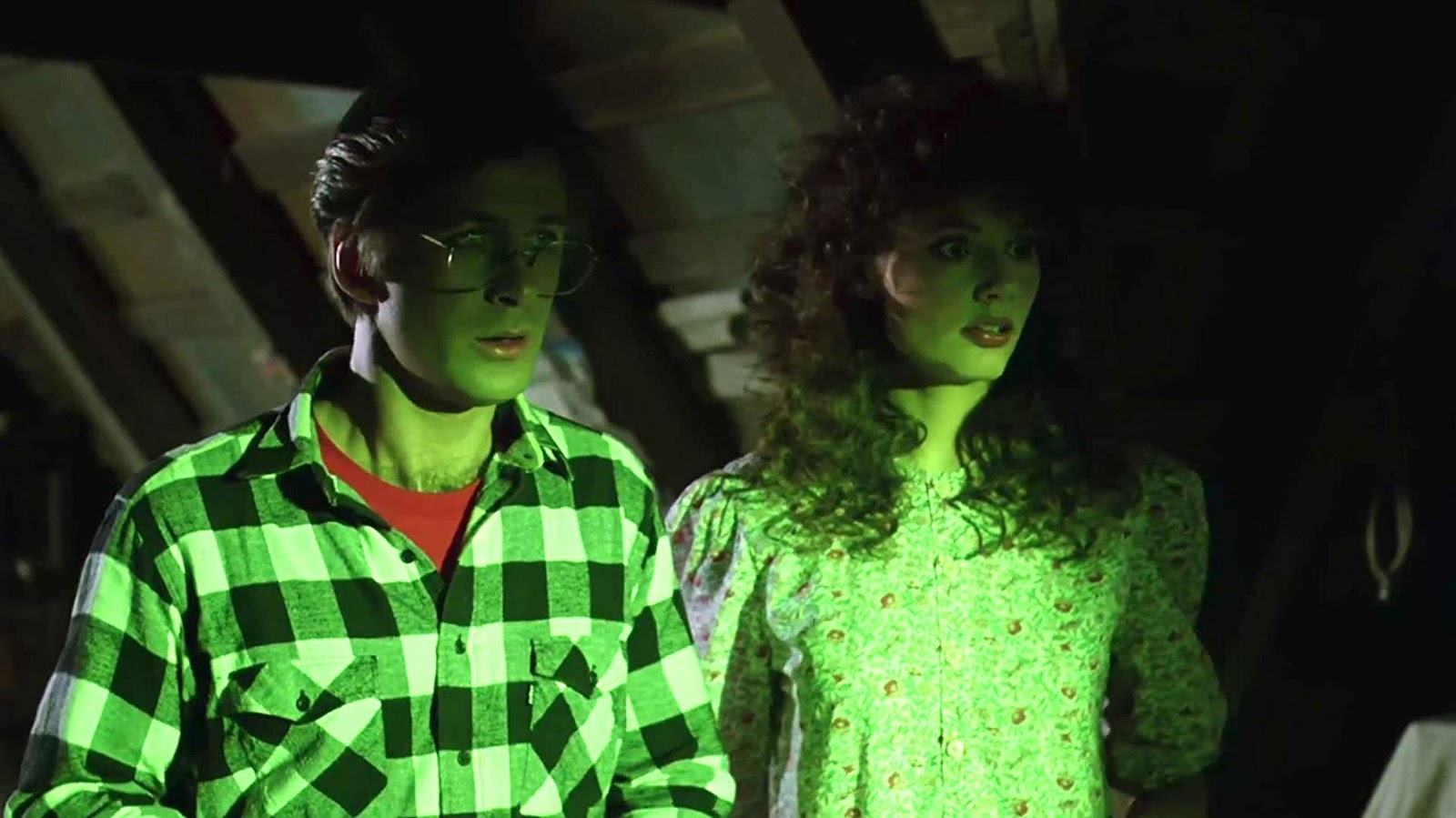

Delia and Otho want to change everything in the house, angering Barbara. She and Adam try to scare the new owners away but they can't see them.  However, Lydia can see the dead couple, spotting them looking out the attic window. Lydia tries to connect with them but she's initially locked out of the attic. In the attic, the television turns on briefly, showing a commercial promoting a bio-exorcist spirit named Betelgeuse (Michael Keaton) who guarantees to get rid of the living. Adam and Barbara discover a portal in the attic, leading to a waiting room for the dead.  They wait amongst a magician's assistant sawed in half and a tourist with a shrunken head. Finally, they meet their case worker Juno (Sylvia Sidney). Juno tells them to follow the handbook to scare the new owners away.  And whatever they do, don't seek troublemaker Betelgeuse (a former assistant of hers) to help them.

Adam and Barbara attempt to scare the Dietz's again and fail. But they finally meet Lydia. Lydia tries to convince her parents the poltergeists are real but they just laugh. The ghosts finally seek out Betelgeuse, repeating his name three times. But Betelgeuse is not what they expect.  He's rude and lecherous. The Dietz's throw a dinner party that night which includes Delia's agent Bernard (Dick Cavett). Adam and Barbara attempt a calypso haunting (using Harry Belafonte's song "Day O") on the party. Instead of scaring everyone, the Dietz's now want to meet the ghosts. Adam and Barbara refuse. The Dietz's invade the attic looking for the ghostly former tenants. They're no where to be found but Otho grabs the Handbook as they leave. Betelgeuse takes his turn at scaring the living, becoming an enormous rattlesnake. He's thwarted by Juno who tricks him into visiting an otherworldly whorehouse where he's temporarily trapped.


Juno gives Adam and Barbara an ultimatum.  Scare the Dietz's out of the house. Charles hosts his former real estate partner Maxie Dean (Robert Goulet) for another dinner party, trying to convince Maxie into developing the New England town and its ghosts. Maxie wants to see the spirits.  Otho summons Adam and Barbara with the Handbook via a séance. They materialize but the spell makes both Adam and Barbara begin to decay. Lydia seeks Betelgeuse to save the Maitland's. But with Betelgeuse back to full power, who will rescue Lydia from the lecherous, scheming Betelgeuse?

With BEETLEJUICE, Burton gets to play with the conventions of the haunted house story, turning that genre on its head. The deceased Matiland's first attempt to frighten their new living owners with traditional scare tactics: a hanging body and a decapitated head held by its owner. But the living can't see them. Later, the Maitland's try the old bed sheets with cut out eyes and moaning trick.  Still nothing. These ghosts aren't very good at scaring people. Their next attempt is more clever yet just as futile. Turning a dinner party into a levitating, body possession calypso party. This is not your standard ghost story. BEETLEJUICE'S wicked black humor hearkens to Edward Gorey's ghoulish The Addams Family cartoons. It's surprising that Burton didn't direct THE ADDAMS FAMILY (Barry Sonnenfeld would in 1991). But Larry Wilson who received a story credit for BEETLEJUICE would co-write THE ADDAMS FAMILY with a favorite Burton writer Caroline Thompson (EDWARD SCISSORHANDS). Burton's shot at another TV horror brand would come with 2012's DARK SHADOWS based on the daytime television soap opera.


Besides the black comedy and macabre imagery, BEETLEJUICE is sentimental at its core. Adam and Barbara Maitland are a sweet, innocent young couple. Their initial death shocks us. Their naiveness towards their mortality touches us. The film hints that Adam and Barbara have been unsuccessful so far conceiving (although Adam suggests they try during their early stay home vacation). But Adam and Barbara find their child in the Dietz's daughter Lydia.  She's the only one initially who can see them. When Lydia contemplates suicide, they talk her out of it. Lydia loathes her step mother Delia. At the film's end, Adam and Barbara have adopted Lydia or they're at least surrogate parents to her.

BEETLEJUICE like Burton's earlier PEE WEE'S BIG ADVENTURE is very organic with its special effects. Neither film had a big budget so Burton uses his imagination and his creative team's ingenuity for some of his wild ideas. That's what makes Burton's early films refreshing and original. The effects are cheesy (and pre-CGI) but fun. Betelgeuse turning into a giant rattlesnake is one of the best scenes. Burton has fun with a scaled down model of the town that resides in the attic. He inverts the model into a full size set for the characters to roam around i.e. Adam and Barbara first meeting Betelgeuse in the cemetery. And the waiting room scene allows Burton to go black humor with its inhabitants: a suicidal beauty queen, a shark attack victim (with the shark still attached to his leg), and a football team whose plane crashed.  Nothing is off limits in BEETLEJUICE.


A running motif in Tim Burton films are characters with eyes bulging out. The female truck driver Large Marge in PEE WEE'S BIG ADVENTURE, the Martians in MARS ATTACKS!, and the witch in SLEEPY HOLLOW all have eyes protruding far out of their eye sockets. Usually, it's a surprising, shocking moment. BEETLEJUICE has its share. When Barbara hangs herself in the closet to scare the new owners to no avail, she goes crazy bug-eyed at her failure. Betelgeuse himself frightens the Maitland's with a gruesome face change (although Burton shoots that bit from behind Betelgeuse).

1988 would be a good year for Michael Keaton.  Besides BEETLEJUICE, Keaton would garner critical acclaim for his role as a recovering drug addict in Glenn Gordon Caron's CLEAN AND SOBER. As Betelgeuse, Keaton seems to be channeling Robin Williams with his manic performance as the demented spirit. But it's a totally original character. With his gruff voice, wild hair, and un-PC comments, Betelgeuse is like a dirty supernatural uncle. Burton would surprise everyone and select Keaton to play Bruce Wayne in BATMAN (and its 1992 sequel BATMAN RETURNS). A daring choice but it paid off for both of them as their careers would soar. It made me a fan of Keaton.


Alec Baldwin's role as Adam in BEETLEJUICE may be one of Baldwin's more understated performances. He's low key throughout the whole film (as opposed to his alpha male part in James Foley's 1992 GLENGARRY GLEN ROSS). Baldwin and Geena Davis as his wife Barbara Maitland are wonderful as unfortunate ghosts who can't seem to get the hang of scaring the living. They have great chemistry and are the nicest people in the entire film to identify with. Now a major film star, BEETLEJUICE was only Baldwin's third feature after starting out on soap operas and TV shows like KNOTS LANDING (1984-85).  Davis was coming off the hit horror film THE FLY (1986) by David Cronenberg. Davis's career would continue to shine in films like Ridley Scott's THELMA AND LOUISE (1991) and Penny Marshall's A LEAGUE OF THEIR OWN (1992).

Another newcomer in BEETLEJUICE is Winona Ryder as the Dietz's troubled daughter Lydia. BEETLJUICE was only Ryder's third feature film. Ryder's Lydia is the prototype Burton character (although a supporting one in BEETLEJUICE). Lydia is a loner, misunderstood, different. These characters (who reflect how Burton felt growing up) can be seen in most Burton films from PEE WEE'S BIG ADVENTURE and EDWARD SCISSORHANDS to the talented orphans in MISS PEREGRINE'S HOME FOR PECULIAR CHILDREN (2016). Ryder can currently be seen as an adult dealing with unusual kids in Netflix's STRANGER THINGS.  Ryder would follow up BEETLEJUICE working with Burton on his next project EDWARD SCISSORHANDS starring Johnny Depp.


Burton has always surprised with casting some of his favorite horror actors in supporting roles. Burton's childhood horror film favorite Vincent Price makes one of his final appearances in EDWARD SCISSORSHANDS as Edward's kindly creator. Burton cast Hammer horror legends Christopher Lee in SLEEPY HOLLOW and DARK SHADOWS and Michael Gough in BATMAN. With BEETLEJUICE, Burton has some eclectic faces.  Silver screen star Sylvia Sidney (who starred in Hitchcock's 1936 thriller SABOTAGE) plays the Maitland's case worker Juno. Burton also gives us talk show host Dick Cavett and Broadway star Robert Goulet in small but enticing roles.

BEETLEJUICE has some nice references and nods to other horror films and even a satire magazine sprinkled throughout the film. There's a joke about an insect that pays homage to the original THE FLY (1958). When Lydia discusses people returning from the dead with the Maitland's she mentions George Romero's NIGHT OF THE LIVING DEAD (1968). There seems to be a nod to David Lynch's DUNE (1986) with some giant sand worms that patrol another dimension just outside the Maitland's house when they attempt to leave.  The craziest homage (and maybe it's just me) is not to a film but a satirical magazine. When Adam and Barbara make their faces into bizarre shapes thanks to Betelgeuse's spell toward the end of the film, they both resemble the crows from Mad Magazine's SPY vs SPY cartoon (and there's those popping eyeballs again).


It's possible that Tim Burton himself is feeling the same way about returning to his roots.  The movie website IMDB recently showed on its Tim Burton profile that BEETLEJUICE 2 was announced to be happening.  However, Tim Burton himself during the recent DUMBO press tour, was less enthusiastic about it. Burton doesn't need to do a BEETLEJUICE sequel.  He just needs to find a small, original idea or screenplay from some new writer to excite him the way BEETLEJUICE excited his creative juices back in 1988. Maybe if I just say "Betelgeuse, Betelgeuse, Betelgeuse" three times, an original script will arrive at Burton's door. Let's hope for something new and never before seen from the wunderkind who has grown up.

Sunday, April 28, 2019

Santiago (1956)

Blame it on Michael Curtiz's CASABLANCA (1943).  Ever since I fell in love with that classic film, I'm always intrigued by any movie that has a title named after an exotic place.  Humphrey Bogart appeared in three such titles.  Of course, there's CASABLANCA (French Morocco).  He then appeared in Zoltan Korda's 1943 SAHARA (North Africa). Lastly, Bogie starred in Curtis Bernhardt's 1951 SIROCCO (Syria). We have Robert Mitchum and Jane Russell tangling with bad guys in Josef von Sternburg's 1952 MACAO (China).  And Rock Hudson and George Peppard battling Germans in the 1967 World War II action film TOBRUK (Libya) directed by Arthur Miller.  More recently, director Oliver Stone showed us an ugly political civil war in the 1986 drama SALVADOR (El Salvador) starring James Woods. So when I saw the title SANTIAGO (1956) recently on Turner Classic Movies, I just had to find out what exotic location (or studio backlot) the film took place in.

SANTIAGO is the name of a city on the island of Cuba. For a country that's only 90 miles from Key West, Florida I can only think of a handful of films set in Cuba. Carol Reed's OUR MAN IN HAVANA (1959) based on the Graham Greene novel was actually filmed in Havana. Both Richard Lester's CUBA (1979) and Sydney Pollack's HAVANA (1990) have plots revolving around the Castro/Batista period in the late 1950s. But Gordon Douglas's SANTIAGO tackles the other big historical event in Cuba's history - the fight to kick the Spanish out of Cuba at the end of the 19th Century right before the Spanish-American War.  Besides the title, SANTIAGO caught my attention due to its leading man -- Alan Ladd.


Alan Ladd started out in the 1940s playing tough guy roles. I recently caught him in the excellent THE GLASS KEY (1942) based on Dashiell Hammett's novel.  Ladd was fantastic. Ladd also appeared in some other notable film noirs like 1942's THIS GUN FOR HIRE (his first substantial role) and THE BLUE DAHLIA (1946) both co-starring Veronica Lake. Ladd's biggest hit would be George Stevens classic western SHANE (1953).  Soon, Ladd expanded from urban tough guy roles and played everything from a knight in THE BLACK KNIGHT (1954) to a Foreign Legionnaire in DESERT LEGION (1953). Ladd was like Humphrey Bogart, a versatile actor able to play gangsters, detectives, or a Royal Canadian Mountie. Ladd actually breaks Bogart's record. Besides SANTIAGO, Ladd appeared in three other exotic one name titles including CHINA (1943), CALCUTTA (India, 1947), and SAIGON (Vietnam, 1948) co-starring yet again with Veronica Lake. Ladd's son Alan Ladd, Jr. would become a studio executive for 20th Century Fox greenlighting such influential films as George Lucas's STAR WARS (1977) and Ridley Scott's ALIEN (979).

Just like CASABLANCA, SANTIAGO was made by Warner Brothers although SANTIAGO'S budget seems a little tighter and leaner.  What it lacks in big production value, it makes up for with crackerjack dialogue, colorful characters, a leading lady who's as tough and brave as the men, and two protagonists who want to kill each other but not until they get paid for their trouble. Directed by Gordon Douglas and co-written by Martin Rackin and John Twist (based on Rackin's novel), SANTIAGO starts out with a bang plus plenty of exposition and history right off the bat.

It's 1898.  Cuba is a reluctant colony of  Spain, itching to break away from it's European master. In Florida, former soldier Caleb "Cash" Adams (Alan Ladd) and his men are running guns via Tampa, Florida to send to Cuba to fight the Spanish. While en route to Tampa with a wagon train of weapons  (in boxes discreetly labeled "sewing machines"), Cash and his partners Trasker (Paul Fix), Lobo (Royal Dano), and Digger (L.Q. Jones) are ambushed by a group of hijackers. Trasker takes a bullet graze but Cash manages to wound one of the hijackers. They reach Tampa. Cash visits a bar called El  Gato Negro (the Black Cat) to meet Cuban agents Lorenzo (Edward Colmans) and Dominguez (Rico Alaniz) and finish the deal. The two Cubans don't have the money with them. Now, Cash must deliver the guns in person to the Cuban revolutionaries to get paid. Cash agrees but doubles the price to $200,000 for the guns.


A sternwheeler called Vicksburg, captained by ex-Confederate and current freedom fighter Sidewheel Jones (Chill Wills) has been hired to ferry Cash and his men first to Haiti and then sneak past the Spanish blockade to Cuba. When they arrive at the dock, Cash runs into an old nemesis Clay Pike (Lloyd Nolan), another soldier of fortune, and his unscrupulous looking band of men. Pike happens to be sporting a recent gun wound (remember that attempted hijack on Cash at the beginning?). There is no love lost between Cash and Pike.  Adding to the tension, they discover a beautiful and mysterious woman on board. Sidewheel Jones calls her "the Cuban Joan of Arc." Her name is Dona Isabella (Rossana Podesta) and she will aid the gun runners to bring the guns to her people.  The Vicksburg reaches Haiti. They take a carriage ride to a plantation where Isabella introduces them to Jose Marti (Ernest Sarracino), an exiled Cuban leader. Marti only has $25,000 to pay each of them.  It turns out Isabella is the cashier as she hand Cash and Pike their first installment. Marti promises the men they will get the remainder of their money when the weapons reach Cuba. Isabella's little brother Johnny (Francisco Ruiz) is also staying with Marti. The two siblings have a brief reunion.

The boat moves on for Cuba.  When they're not trying to woo Isabella, Cash and Pike have a few scuffles with each other. The Vicksburg manages to sneak past the blockade. As they get close to the Cuban shore, drums warn them of a Spanish cannons.  Jones takes the Vicksburg up a river. Led by Isabella, the men swim to the shore and knock out the cannons. For a brief moment, both sides are working as a team. It doesn't last long. Jones and his sidekick Sam (Don Blackman) discover a stowaway on  the ship - Isabella's little brother Johnny. The paddleboat reaches the meeting point. Cuban locals unload the guns but Cash and Pike still don't see any money. They stay with their merchandise as the wagons head out through the jungle to deliver them to a Cuban general named Maseo.


Spanish soldiers arrive and board the Vicksburg.  Sidewinder Jones and Sam have a surprise waiting for them, blowing the soldiers and themselves up with dynamite. Cash, Isabella, Pike and the rest reach the mountain pass at the top of the island only to discover the Spanish have built a fort in the middle of it. After Cash and Trasker rescue little Johnny from some vile Spanish soldiers interrogating the young boy, they tie the dead soldiers to a wagon and send it ablaze into the heart of the fort. As it burns, the convoy makes a run past it.  The Spanish give chase but they're caught in a final shootout with the renegades and the revolutionaries. Cash and Pike have their final showdown. The group reaches the waterfall only to learn General Maseo is trapped by the Spanish further ahead. In the end, Cash still never collects his money but he's now fully committed to the Cuban cause as he, Isabella, and the remaining survivors continue on to join up with General Maseo.

SANTIAGO is a taut, swift film that has touches of John Huston and Sam Peckinpah themes in its story. The tale of men's greed leading to failure and possible death echoes Huston films like THE MALTESE FALCON (1941) or THE TREASURE OF SIERRA MADRE (1948). Cash and Pike both have weapons to sell but when they don't get payment on delivery in Tampa, they actually have to go to Cuba to collect. A dangerous proposition that turns deadly. After someone eulogizes a comrade killed in a skirmish as having principals, another responds "Principals? What did it get him?  A hole in the head and a hole in the ground."

Both protagonists are anti-heroes in the same vein as the characters in Sam Peckinpah's THE WILD BUNCH (1969). Cash Adams and his partner Trasker are dishonorably discharged soldiers. Adams ordered handcuffs removed from an Indian prisoner who later escaped because of Trasker's drunken negligence.  Now, Cash is sticking it to the army that disgraced him by stealing their weapons and selling them. Pike is a southern rebel who sold guns to the Apaches who used them against U.S. soldiers. Cash is a Yankee; Pike a Confederate. The tension between Cash and Pike, the back and forth verbal and physical attacks, make for enticing drama.  "You're everything I hate, " Pike sneers to Cash. Only the lure of a big payoff keeps Pike from trying to kill Cash sooner. But we know it won't end well for one of them.


Throw in an attractive woman between Cash and Pike and you have the perfect storm.  But Isabella isn't just a pretty face.  She's a freedom fighter, willing to die for a cause.  She's not afraid to mix it up, jumping into a river to lead the men to knock out a battery of Spanish cannons. Rossana Podesta who plays Isabella was actually Italian and not Cuban. SANTIAGO isn't a romanticized adventure film. Like Huston and Peckinpah films, it has a fatalistic flavor to it. What begins as a historical adventure film becomes a suicide mission to Cuba. The filmmakers shockingly kill off a couple of characters you would normally expect to survive the film. But their deaths spearhead SANTIAGO forward. There's even a cat fight between two prostitutes in the Black Cat bar that is vicious and funny, setting the tone for SANTIAGO'S occasional brutality.  How many movies can boast that?

SANTIAGO is somewhere between an A and B picture.  The opening attempted hijack scene, the burning of the Spanish fort, and the final battle in the mountains are well delivered action sequences. But the film's limited budget comes into play when Sidewheel blows up the Vicksburg. This big moment happens off screen. We only see a plume of smoke. Even the explosion sound effect is neither powerful or dramatic. Granted, it would have been hard to blow up a large sternwheel paddleboat but couldn't the filmmakers have tried blowing up a model? Watching the convoy trek through the Warner Brothers jungle backlot reminded me of a similar scene from Michael Curtiz's THE SEA HAWK (1940). The scene works but there's a feeling of deja vu. We've seen that jungle location before.


Alan Ladd was no Humphrey Bogart but he's a close second. He didn't have Bogart's mannerisms or distinctive voice. But Ladd had matinee idol looks and a self-assured, sardonic manner. Ladd often played loners. His characters had a rough romantic charm even if he never quite caught the girl. Ladd definitely picked up the mantle from Bogart with his tough guy performances. In SANTIAGO, with his panama hat and white suit, Ladd's Cash Adams is like a white knight, delivering hope to the Cuban revolutionaries. Ladd delivers some classic tough guy lines. "I'd rather be wrong and alive then right and dead," he tells the Cuban agents in Tampa who tried to double cross him. When they present him with Cuban cigars instead of cold hard cash, he tells them, "My bank doesn't cash cigars." For a man who went to West Point and still wears a ring with their motto "Honor. Duty. Country", Ladd's Adams is a man without a country. The military has turned its back on him. But Adams ultimately finds a new country to fight for. Cuba.

Ladd's nemesis is the charismatic Lloyd Nolan who plays Pike.  Nolan nearly steals the movie with his irascible personality. Nolan is a familiar face and voice for me from 1970s television shows, often playing doctors. But in SANTIAGO, Nolan's Pike is an oily, double-crossing, backstabbing Rebel who would sell his sister for a buck. Whereas Cash is smooth and respectful with Isabella, Pike says exactly what's on his mind, unfiltered. I'd never seen Nolan play such an evil character. Nolan appeared in 156 performances in movies and television with a nice turn in one of his final roles in the excellent Woody Allen comedy/drama HANNAH AND HER SISTERS (1986).


There are some other Sam Peckinpah connections to SANTIAGO. L.Q. Jones who plays Digger, one of Cash's comrades, appears as a ghoulish bounty hunter in Peckinpah's classic THE WILD BUNCH. Jones also co-starred in Peckinpah's MAJOR DUNDEE (1965) and THE BALLAD OF CABLE HOGUE (1970).  Coincidentally, Pike was the name of William Holden's character in THE WILD BUNCH. Lloyd Nolan's character Pike would have fit in nicely with the Wild Bunch. Chill Wills who plays Captain "Sidewheel" Jones was a familiar face in Westerns and appeared in several John Wayne films as well as Peckinpah's PAT GARRETT AND BILLY THE KID (1973). Like Cash Adams in SANTIAGO, Sidewheel Jones feels alienated from his country. Having fought for the South in the Civil War and lost, Jones aches to be on the winning side just once. He started smuggling Cubans to the Florida Keys and fell in love with their cause. Jones feels like he's with a winner finally.

SANTIAGO director Gordon Douglas may not be a household name but Douglas had a long and extensive career.  He worked with Alan Ladd in SANTIAGO and an earlier film THE MCCONNELL STORY (1955).  Douglas's most satisfying decade was in the 1950s when he worked at Warner Brothers, home of CASABLANCA.  Ironically, Douglas made two films related to Warner Brother hits for Columbia Pictures.  Douglas directed FORTUNES OF CAPTAIN BLOOD (1950) capitalizing on Michael Curtiz's CAPTAIN BLOOD (1935) and ROGUES OF SHERWOOD (also 1950) about the further escapades of Robin Hood made famous in Curtiz's THE ADVENTURES OF ROBIN HOOD (1938) with Errol Flynn. Douglas's most critically acclaimed film would be THE DETECTIVE (1968) starring Frank Sinatra.

SANTIAGO is one of those films that on the surface appears to be just another action vehicle for its star Alan Ladd. But SANTIAGO has many layers to it. It has characters disenchanted with the United States who find a cause in another country to believe in. It has dishonorable men who still follow a code of honor. It has a heroine in the tradition of Joan of Arc who's strong and inspires her people to stand up to the mighty Spaniards. And it has Alan Ladd, an underrated leading man, following in the footsteps of CASABLANCA'S Rick Blaine (and Humphrey Bogart) in a foreign country. Blaine famously said "I stick my neck out for no one" in CASABLANCA yet Ladd's Cash Adams follows his stolen guns all the way to Santiago, Cuba to help a country he has no connection with to fight for its independence. And I never would have seen this film if it wasn't for that exotic one name title: SANTIAGO.


Saturday, April 6, 2019

Dirty Dancing (1987)

I would never have watched a film called DIRTY DANCING (1987) if I had not been in a relationship. My girlfriend at the time (now my wife) desired to see the film and as her dutiful and loving companion, I acquiesced. Now that may sound like I didn't want to see DIRTY DANCING.  You would be right.  But, as luck and fortune would have it, I enjoyed DIRTY DANCING.  And, it was my first encounter with the Swayze.

It's hard to believe that Patrick Swayze aka the Swayze is no longer with us.  Swayze passed away in 2009 at the age of 57.  Swayze ruled the movie screens in the late 80s and early 90s.  Swayze could dance (DIRTY DANCING).  Swayze could brawl (ROAD HOUSE).  Swayze could surf (POINT BREAK).  Swayze could make an entire theater of women swoon (GHOST). Swayze brought an earnest intensity to every role he played, like he might never get another role after his current one. It may sound like I'm making fun of him but I enjoyed Swayze as an actor even if I wasn't crazy about every movie he made.


DIRTY DANCING is directed by a man you may never heard of named Emile Ardolino.  Sadly, Ardolino died in 1993 at the age of 50 from complications due to AIDS.  Ardolino had made a couple of documentaries about dancing in the 70s which may have helped his chances to direct DIRTY DANCING. Besides DIRTY DANCING, Ardolino also made the hit comedy film SISTER ACT (1992) starring Whoopi Goldberg, Maggie Smith, and Harvey Keitel. DIRTY DANCING screenwriter Eleanor Bergstein based her script on her own Jewish family's summer vacations to the Catskills and her experiences and memories.  Her nickname was Baby and her father was a doctor like Jennifer Grey's character in DIRTY DANCING..

Set in the summer of 1963 in the Catskills of upstate New York (with Virginia and North Carolina standing in for that location), DIRTY DANCING opens with Dr. Jake Houseman (Jerry Orbach), his wife Marjorie Houseman (Kelly Bishop) and their two teenage daughters Lisa Houseman (Jane Brucker) and younger sibling Frances "Baby" Houseman (Jennifer Grey) driving up to Kellerman's Mountain House for a week long vacation.  Run by family friend Max Kellerman (Jack Weston), Kellerman's is the quintessential Catskills resort complete with swimming, golf, volleyball, dance lessons, and the week ending talent show. It's a safe, comfortable, boring place to have a vacation.

Director Ardolino introduces us to all the camp characters right away.  There's rich college kid Robbie Gould (Max Cantor) waitering and picking up women for the summer. There's Neil Kellerman (Lonny Price), Max's nephew who's studying hotel management and busting chops as heir apparent to Max's resort. There's activities director (and future SEINFELD co-star) Stan played by Wayne Knight. And finally there's heartthrob dance instructor Johnny Castle (Patrick Swayze) and his beautiful dance partner Penny Johnson (Cynthia Rhodes). Baby first lays eyes on Johnny when she stumbles into the employees only section of the resort where the summer camp workers bump and grind aka "dirty dance" at an after hours house party.


The drama begins when Penny learns she's pregnant.  Unable to dance at an offsite resort gig due to morning sickness, Baby volunteers to step in and be Johnny's dance partner. It's a crazy idea thinks Johnny...but it just might work. Johnny's nephew Billy Kostecki (Neal Jones) arranges for Penny to visit a less than reputable doctor to take care of her "problem".  Johnny and Baby pull of the dance routine.  Baby starts to fall for bad boy Johnny. They return to Kellerman's to find Billy frantic. Penny has a terrible fever. The operation did not go well.  Baby asks her Dad to help Penny.  Dr. Houseman saves Penny but he's disappointed in Baby and disgusted by Johnny who he thinks got Penny pregnant.

Baby and her father have a fight.  Baby runs back into Johnny's arms and bed. Johnny's from a working class background; Baby's from a liberal middle class Jewish family. With their different backgrounds, Johnny knows their relationship will never work out.  His life begins to spiral down. Johnny beats up Robbie after he catches him putting down Penny. When Johnny turns down card playing guest Moe Pressman's (Garry Goodrow) wife Vivian (Miranda Garrison) for one last night of gigolo passion, Vivian makes up a story that Johnny stole some money from her. Max fires Johnny.  Baby reveals she was with Johnny the night Vivian's money was stolen but Johnny doesn't get his job back. The final summer talent show prepares to go on. It's just another show until Johnny returns to perform the final dance with Baby, bringing the guests out of their seats.


The title DIRTY DANCING conjures up images of an illicit strip tease but dirty dancing, like the recent emergence of rock and roll, is a sign of a changing landscape in the early 60's. As Max Kellerman bemoans, "You think kids want to come with their parents and take fox trot lessons? It feels like it's all just slipping away."  The old norms are slipping away replaced by bumping and grinding with your dance partner.  Dirty Dancing is not the Charleston or the Cha Cha. Dirty Dancing is sweaty and sexual. It's breaking down the old traditions. It's the changing of the old guard.

All though you would think the hero of DIRTY DANCING is Swayze's Johnny Castle, the real hero is Jennifer Grey's Baby Houseman.  She steps in to help Johnny perform a gig when Penny's sick. She's the first one to recognize Penny needs a real doctor after Penny's abortion and rushes to find her father Dr. Houseman. When Johnny's accused of stealing and fired, Penny steps up as his alibi and admits she was in Johnny's room when the crime was supposedly committed.  Baby is in that in-between transition from teenager to woman.  She's in infatuated with Johnny but Johnny knows who the real hero is, telling Baby he admires her for what she's done and who she is. As Johnny says, "Nobody puts Baby in a corner." Baby is a strong female role model for the 80's.


Swayze gives a brave performance as bad boy from the other side of the tracks Johnny Castle. Johnny's secure about his dancing chops.  But Johnny is insecure about his background.  He's barely making ends meet.  "I'm nothing," he tells Baby at one point.  He's emasculated over and over by Max and Neil who can fire him at any moment. He has to play gigolo and sleep with older women like Mrs. Pressman to keep his job. But like all cinematic heroes, Johnny follows his dream. I can only imagine that Johnny will end up like John Travolta's Tony Manero in SATURDAY NIGHT FEVER (1977) and end up dancing on Broadway after the film ends.

Both Swayze and Grey were newcomers when DIRTY DANCING became a huge hit.  Swayze had appeared in Francis Coppola's THE OUTSIDERS (1983) and John Milius's RED DAWN (1984) as well as the Civil War mini-series NORTH AND SOUTH (1985).  But it would be DIRTY DANCING that would propel Swayze into stardom.  Grey, the daughter of actor Joel Grey (CABARET) had already appeared with Swayze in John Milius's RED DAWN and as Ferris Bueller's put upon sister in John Hughes FERRIS BUELLER'S DAY OFF (1986). Like most hit romantic films, Swayze and Grey's chemistry ignites DIRTY DANCING. Ironically, while making DIRTY DANCING, the Swayze and Grey didn't always get along.


Director Ardolino throws in a few familiar actors to counteract the new, fresh faces of Swayze and Grey.  Jack Weston who plays Catskills resort owner Max Kellerman will be familiar to film fans from Norman Jewison's THE THOMAS CROWN AFFAIR (1968) and as a thug terrorizing a blind Audrey Hepburn in Terence Young's WAIT UNTIL DARK (1969).  Jerry Orbach who plays Baby's father Dr. Jake Houseman was a journeyman actor until DIRTY DANCING.  The film's success would take him eventually to a leading role in television's LAW & ORDER in which he appeared in 274 episodes between 1991 until his death in 2004. A special shout out goes to Jane Brucker who played Baby's older sister Lisa. Brucker is hilarious as the sibling who's oblivious to her little sister or anything else that doesn't revolve around her. Brucker's awkward practice performance singing "Hula Hana" (which Brucker co-wrote) for the talent show is cringeworthy and priceless.

Most period films stick with music from that era but DIRTY DANCING uniquely bounces between 60's songs and more modern songs during several montages and the final dance sequence.  We hear the Ronette's "Be My Baby" and "Stay" by Maurice Williams and the Zodiacs that take us back to the early 60s.  But the filmmakers throw in more modern songs including Eric Carmen's "Hungry Eyes", Bill Medley and Jennifer Warnes "(I've Had) The Time of My Life", and even the Swayze providing his voice for "She's Like the Wind" with Wendy Fraser. This smorgasbord of songs works in DIRTY DANCING when it could have been distracting.


I have a soft spot for modern films that wax nostalgic about the past.  They have become their own type of genre.  Some of the good ones include John Landis's ANIMAL HOUSE (1978), Barry Levinson's DINER (1982), and Garry Marshall's THE FLAMINGO KID (1984).  Those three films tend to have a more male slant to their stories which makes DIRTY DANCING unique. It's told from the point of view of Baby Houseman, a young educated woman about to go off to college who discovers during her summer vacation that life isn't fair and fights for what she believes is right even if it means butting heads with the man she loves and respects the most -- her father.

DIRTY DANCING is an example of a little film with no real star power that has a good nostalgic story that captures the imagination of an audience. Following the classic blueprint, the young lovers are from different socio-economic backgrounds yet fall in love despite their differences. DIRTY DANCING revitalized the musical aspect of a movie in a way not seen since FOOTLOOSE (1984). It had a catchy soundtrack that mixed classic 60s tunes with modern ones.  But it had dancing in it as well. The finale where Baby finally does "the Lift" with the Swayze has been immortalized more recently in CRAZY, STUPID, LOVE (2011) with Ryan Gosling and Emma Stone performing "the Lift" to a 2019 Kentucky Fried Chicken commercial where Colonel Sanders catches and lifts the Mrs. Butterworth syrup bottle woman (for KFC's new chicken and waffles) as Bill Medley sings "I've Had the Time of My Life." You know you're an enduring film when commercials are paying homage to you.

So many thanks to my dear wife for introducing me to DIRTY DANCING. Not only was it my first encounter with the Swayze but watching the film revealed I could enjoy films that didn't have explosions and gun fights and laser battles.  Somewhere in my jaded, snobby film soul, there was a softy waiting to reveal himself.  Nowadays, I get teary eyed just watching a commercial or a feel good story on the evening news.  Thanks DIRTY DANCING for bringing my gentler side out into the open.


Saturday, March 2, 2019

Splendor in the Grass (1961)

If you remember your high school days when your hormones were a raging monster and you felt like you were going to explode if you didn't "go all the way" with your boyfriend or girlfriend, SPLENDOR IN THE GRASS (1961) is the film for you.  Or is it? Introducing Warren Beatty in his first feature film and co-starring the rapidly growing up before our eyes Natalie Wood, the two young actors play a high school football star and his sweetheart struggling with their sexual impulses in a repressive small Kansas town in 1928 leading to Wood's mental breakdown.

I first saw a Warren Beatty film during possibly the best decade of his career. After his huge success in Arthur Penn's BONNIE AND CLYDE (1967), Beatty followed up with great roles in Robert Altman's MCCABE AND MRS. MILLER (1971), Alan J. Pakula's THE PARALLAX VIEW (1974), and Hal Ashby's SHAMPOO (1975).  My first Warren Beatty film was the comedy HEAVEN CAN WAIT (1978) co-directed by Beatty and Buck Henry, a remake of Alexander Hall's HERE COMES MR. JORDAN (1941). Beatty was funny and good looking with a self deprecating style. At the time I saw HEAVEN CAN WAIT, I imagined him as a kind of modern Cary Grant. It wasn't until I watched one of his earlier films, John Frankenheimer's ALL FALL DOWN (1962), that I discovered how wrong I was. Beatty was groomed at the start of his career to be the next Paul Newman or James Dean, playing disillusioned, rebellious young men.


So what better director then Elia Kazan for Beatty to have his film debut in SPLENDOR IN THE GRASS. Kazan had previously directed smoldering young actors Marlon Brando in A STREETCAR NAMED DESIRE and James Dean in EAST OF EDEN (1955). Joining Kazan was powerhouse playwright William Inge who wrote the original screenplay for SPLENDOR IN THE GRASS. Inge's plays (which became films) like Joshua Logan's PICNIC (1956) and Logan's BUS STOP (also 1956) had young, restless males characters trying to figure out their lives.  SPLENDOR IN THE GRASS was the right choice at the right time for young Mr. Beatty.

Kazan and Inge show us right away the crux of the story in SPLENDOR IN THE GRASS. High school sweethearts Bud Stamper (Warren Beatty) and Wilma Dean ("Deanie") Loomis (Natalie Wood) necking passionately by a sensuous bubbling waterfall.  Bud wants to go farther but Deanie resists. Bud takes Deanie back home, sexually frustrated yet still in love with her. Mrs. Loomis (Audrey Christie) warns Deanie that she must maintain her virtue, not become one of those bad girls who ruin their reputation. Bud comes from the wealthiest family in town. Bud's father Ace Stamper (Pat Hingle) owns several oil wells. Ace idolizes his only son. Ace wants Bud to go to Yale to be educated and later run one of his businesses. Bud wants to stay closer to home, marry Deanie, and become a farmer. Both families are nervous that Bud and Deanie will consummate their love too soon and bring scandal.

Although many of the stills for SPLENDOR IN THE GRASS are black and white, the film is in color.
Cracks begin to emerge in Bud and Deanie's relationship. After a football game, Bud stops to talk to one of those bad girls Juanita Howard (Jan Norris), making Deanie jealous. Bud brings Deanie home after school one day. Mrs. Loomis isn't home. Bud makes advances again but Deanie's scared they will get caught. Bud's wild, older sister Ginny Stamper (Barbara Loden) returns home from Chicago, bringing tension between her and Ace. When Ace has to leave town for business, he asks Bud to keep an eye on Ginny. Ginny immediately brings a new boyfriend home, Glenn (Sean Garrison), who works at a gas station.

1929 arrives. Bud collapses during a high school basketball game, his illness a mystery. Deanie visits Reverend Whitman (playwright William Inge in a cameo) and prays for his recovery. Bud recovers after several months, asks Doc Smiley (John McGovern) for sex advice which the doctor laughs off. Bud reaches out to Juanita and takes her to the waterfall where they have sex. The high school learns about the tryst before Deanie.  When Deenie realizes Bud has cheated on her, she has an emotional breakdown. Bud and Deanie grow apart as their senior year draws to a close. Bud's teammate Allen "Toots" Tuttle (Gary Lockwood) ask Deenie to the prom. Bud attends the prom with Deanie's friend Kay (Sandy Dennis). Deanie tries to win Bud back, attempts to seduce him but Bud rejects her. Deanie asks Toots to take her to the waterfall. She ditches Toots and attempts to drown herself before park officials rescue her.


Mr. Loomis (Fred Stewart) sends Deanie to Wichita for treatment.  Bud follows his father's wishes and attends Yale, trying to flunk out at every chance he gets. Bud meets and falls in love with an Italian waitress Angelina (Zohra Lampert). Deanie starts occupational therapy, working on art projects.  She begins a relationship with John (Charles Robinson), a former Med student who also had a breakdown.  Bud's father Ace comes to Yale to visit him. The stock market crashes that day. Ace takes Bud out to a New York show hosted by Texas Guinan (Phyllis Diller's first movie role) and tries to get Bud laid by one of the dancers. Later that night, Ace jumps out a window, committing suicide, his fortune gone. Bud returns home with Angelina, begins to raise cattle on one of his father's properties.  Deanie returns home, soon to marry John.  High school friends Hazel (Crystal Field) and June (Marla Adams) come to visit and tell her Bud lives outside of town.  They drive her out to see Bud on his father's ranch.  He's married to Angelina with a child and another one on the way.  Bud and Deanie, the perfect couple, never to be united, crushed by the weight of their parents interference and their own sexual hang-ups, meet for one last time.

I like when a playwright like William Inge writes an original screenplay like SPLENDOR IN THE GRASS. Playwrights have a good feel for symbolism and metaphors. In SPLENDOR IN THE GRASS, the waterfall in the opening scene acts as the sexual tension bubbling between Bud and Deanie.  The water is sensuous, shimmering, frothing like the two teenagers hormones.  It's where the high school kids go to make out, touch, and lose their virginity. But Deanie resists the impulse to go all the way.  Later, Bud will take another girl Juanita to the waterfall where it's implied they do have sexual intercourse. Juanita is the type of girl Deanie's mother doesn't want her to become but the type of girl Bud's father Ace tells Bud he should sow his wild oats with before settling down. Deanie will ask Toots to bring her to the waterfall after the prom. After fighting off Toots advances, Deanie bolts for the waterfall, nearly drowning herself in the torrent of water, her perfect world shattered by her repressed sexuality and Bud's infidelity.


Both Bud and  Deanie's parents are uptight with their sexual morals, in different ways, scarring Bud and Deanie in ways they never imagined. Deanie's mother Mrs. Loomis proudly tells Deanie she never let Mr. Loomis touch her until they were married. Even after the wedding, she only gave herself to her husband to have a baby. The Loomis's lack of intimacy seeps into Deanie's psyche. When Mrs. Loomis asks if Bud has spoiled her, Deanie cries out, "I'm not spoiled mom. I'm just as fresh and virginal like the day I was born, mom!"

Ace Stamper fears scandal if Bud and Deanie were to have sex before getting married. Ace's angst stems from his scandalous daughter Ginny who got knocked up in Chicago the year before. Ace paid for her abortion. Ginny's back home now, stirring up trouble, driving all the single men in town crazy with desire.  The irony is Ace wants Bud to lose his virginity to a bad girl yet his daughter is the epitome of the whore. Even Ace himself has slept with disreputable women like his daughter in his younger, halcyon days before marrying the docile Mrs. Stamper (Joanna Roos). It's sexual hypocrisy. Ace pushes for Bud to sow his wild oats with a bad girl before settling down with Deanie. Bud only wants Deanie. But his desire to make love with Deanie butts up against her resistance. Bud's desire to have sex with Deanie and her rejection makes him physically ill. When he becomes better, he goes straight to Juanita for the intimacy he craves. She's his cure. Things will never be the same for Bud and Deanie after that. When Deanie tries to seduce Bud at the prom, dressed in a sexy red flapper girl dress, it's Bud who flinches. What about your pride, he asks. "My pride? My pride? I don't want my pride," she screams.

Thomas Mallory's The History of King Arthur and His Knights of the Round Table have a connection to A SPLENDOR IN THE GRASS. Deanie's English teacher Miss Metcalf (Martine Bartlett) asks her class about King Arthur and the Knights.  One student says, "they had a high regard for women." Although it might not seem like it, Bud is the shining knight in this town. He stays true to Deanie.  He's polite and a gentleman.  Deanie is Bud's Guinevere.  He holds her to the highest pedestal.  He's willing to marry her right away so they can consummate their relationship. But Ace wants Bud to go to college first, then think about marriage. Bud starts out like King Arthur but he becomes Lancelot, a flawed knight.  After his illness, he gives in to his lust when Juanita provides him the carnal knowledge that Deanie can't.


I'll talk about the young stars Warren Beatty and Natalie Wood momentarily but two of the most interesting performances in SPLENDOR IN THE GRASS come from Pat Hingle as Bud's oil baron father Ace and Barbara Loden as Bud's promiscuous older sister Ginny. My recollections of Pat Hingle are later in his career when he usually played authority figures like judges or as Police Commissioner Gordon in Tim Burton's BATMAN (1989). SPLENDOR is early in Hingle's career and what a role.  Hingle's Ace Stamper is a tragic, flawed patriarch. Injured in his youth from a fall off an oil derrick (Hingle actually fell 54 feet down an elevator shaft in real life before the film), Ace is a cripple physically and in his psyche, hobbling around his family and empire like a force of nature. Ace wants to control everyone especially his two children. Bud is everything that Ace couldn't be. A good athlete, handsome with a bright future. Ace lives vicariously through Bud. Ace has Bud's future laid out but Bud has other ideas. 1929 and the Stock Market Crash loom.  Ace's future will not end well. Ace may be Hingle's finest role until he played sadistic gambler Bobo Justus in Stephen Frears THE GRIFTERS (1990).

The other mesmerizing role is Barbara Loden as Virginia i.e. Ginny, Bud's older sister. If Bud is the future of the Ace Stamper family, Ginny is his disappointment. Ginny scandalously became pregnant in Chicago before Ace had to reluctantly come to the rescue (paying for an abortion and paying off the suitor). She'd tarnish the Stamper name if Ace didn't have so much oil money to almost hide it. Ace's dilemma is that Ginny is the bad girl that Ace feels Bud needs to roll around with before he marries Deanie. It tears Ace up that Ginny is that type of woman that men (like Ace) use and discard.  There's a harrowing scene at the Stamper New Year's Eve party where a pack of tuxedoed men follow a drunk Ginny around the house like dogs in heat.  Ginny's almost raped by one of them until she's rescued by Bud. Actress Loden was a protégé of director Kazan and would marry him in 1967.


But the young stars of SPLENDOR IN THE GRASS are Warren Beatty and Natalie Wood.  As Bud Stamper and Deanie Loomis, the two young love birds are a bit like Romeo and Juliet except their families like each other.  Only Bud comes from a wealthy family and Deanie's family is modestly middle class. Ironically, the Loomis family will sell their stock in Ace's oil company to pay for Deanie's therapy before the stock market crashes.  The Stamper fortune is wiped out. The Loomis family survives the Crash. SPLENDOR is Beatty's first film after appearing on television in shows like THE MANY LOVES OF DOBIE GILLIS (1959-60).  He's perfect as the sexually frustrated but gallant Bud. Beatty would play these conflicted young men roles for the early part of his career before breaking out as bank robber Clyde Darrow in BONNIE AND CLYDE.

Natalie Wood grew up before our eyes first appearing as a child actor in films like MIRACLE ON 34TH STREET (1947) and THE GHOST AND MRS. MUIR (1947).  She would move into young teenager roles in John Ford's THE SEARCHERS (1956) and Nicholas Ray's REBEL WITHOUT A CAUSE (1955). 1961 would be quite a year for Wood appearing in both Robert Wise and Jerome Robbins WEST SIDE STORY and SPLENDOR IN THE GRASS. In SPLENDOR, Wood makes the leap from teenager to young adult.  It's a demanding role as she begins as the perfect girlfriend and descends into a mental meltdown as her knight in shining armor rejects her for maintaining her virtue. Wood is absolutely stunning.  Beatty and Wood would have a brief affair during the making of  SPLENDOR IN THE GRASS.


When you watch SPLENDOR IN THE GRASS, the first thing that might come to mind is "what does that title mean?" The title is from a William Wordsworth poem called Ode: Imitations of Immortality. The poem goes "Though nothing can bring back the hour of splendor of the grass/of glory in the flower/we will grieve not/rather find strength in what remains behind." Deanie is asked by Miss Metcalf at the worst possible moment in her life what the poem means. Deanie replies, "when we're young, we look at things very idealistically I guess. When we're grown up...we have to forget the ideals of youth...and find strength." Bud and Deanie's relationship had its moment of splendor. They were the perfect couple and should have married. But outside forces including pressure from their families to conform a certain way ruined the happy ending they should have had.  Bud and Deanie can never get that feeling back.

Director Elia Kazan was an actor's director and one of the top director's in the late 1940s and 1950s on Broadway and in Hollywood.  Kazan had a string of hits beginning with Marlon Brando in A STREETCAR NAMED DESIRE (1951) and ON THE WATERFRONT (1954). Kazan worked with James Dean in EAST OF EDEN, Carroll Baker in BABY DOLL (1956) and Montgomery Clift in WILD RIVER (1960). But Kazan was also controversial, naming names and causing several of his colleagues to be blacklisted when he testified at Senator Joseph McCarthy's House Committee on Un-American Activities in the early 1950s. Kazan would only make four more films after SPLENDOR IN THE GRASS, his last film an adaptation of F. Scott Fitzgerald's book THE LAST TYCOON (1976) starring Robert De Niro and Tony Curtis.

Playwright William Inge had a string of stage hits in the 50s including Come Back, Little Sheba, Picnic, and The Dark at the Top of the Stairs. He wrote the exceptional screenplay for SPLENDOR IN THE GRASS.  But like Kazan, Inge's career would struggle after SPLENDOR IN THE GRASS.  Taking a page out of SPLENDOR, Inge would commit suicide like his character Ace Stamper, choosing carbon monoxide poisoning rather than jumping out a window in 1973. A sad ending to such a gifted playwright.

Both Kazan and Inge should be proud of SPLENDOR IN THE GRASS, a tragedy in the Midwest about sexual repression and sexual hypocrisy.  Kazan directed a string of meaningful films dealing with social issues that provided us with some of the greatest acting performances in cinema history. Inge wrote some of the finest characters ever portrayed on the stage.  Together, they created a provocative film in SPLENDOR IN THE GRASS that showcases two young actors Warren Beatty and Natalie Wood just emerging into grown up roles in their fledgling careers. The film also provides two excellent supporting roles for Pat Hingle and Barbara Loden as bickering father and daughter in the Stamper family.


Saturday, January 26, 2019

The Adventures of Robin Hood (1938)

Michael Curtiz's THE ADVENTURES OF ROBIN HOOD (1938) will always be entwined with two events during my boyhood.  A pretty young school girl named Judy and a strange instrumental pop song from the 70s called Hot Buttered Popcorn. When I first saw THE ADVENTURES OF ROBIN HOOD on television one afternoon, the character of Maid Marian played by Olivia De Havilland resembled a pretty young girl in my 2nd grade class named Judy. I fell head over heels for both Judy and Maid Marian. They had smooth oval faces, high cheekbones, long lustrous hair, and luminous round eyes. Judy would move away after 2nd grade but the swashbuckling adventure film about the legendary Robin Hood would keep me company for years to come.

After watching THE ADVENTURES OF ROBIN HOOD as a young boy, I would go to my room, close the door, and have imaginary sword fights against Sir Guy of Gisbourne and the Sheriff of Nottingham.  During one of these duels, I must have turned on the radio and Hot Buttered Popcorn was playing.  It seemed to blend perfectly with my antics.  Whenever the synthesizer bop came on the radio, I would immediately jump on my bed and start play fencing. THE ADVENTURES OF ROBIN HOOD is the seminal movie that opened CrazyFilmGuy's eyes to the pleasure of a good old fashioned Technicolor adventure film starring one of literature's first action heroes.


Australian actor Errol Flynn's iconic performance as Sir Robin of Locksley aka Robin Hood in THE ADVENTURES OF ROBIN HOOD is the benchmark for all Robin Hood films. Yes, Douglas Fairbanks, Jr played the swashbuckling hero in the 1922 ROBIN HOOD but it was a silent, black and white film. Kevin Costner, Cary Elwes, Russell Crowe, and even Sean Connery have all played the outlaw leader but Flynn (riffing off Fairbanks' swashbuckling performance) is the one we all remember.

Warner Brothers and MGM were initially going to make two separate Robin Hood movies in the 30s. Warner Brothers film would be adventurous. MGM's film would be a musical opera. MGM never did make their movie. THE ADVENTURES OF ROBIN HOOD has an operatic like feel from Erich Wolfgang Korngold's rousing musical score to the colorful spectacle of Michael Curtiz (and William Keighley's) direction filled with castles, grand feasts, an archery tournament, and hundreds of Merry Men. The decision to film ROBIN HOOD in Technicolor at a time when black and white was still the norm is a monumental decision. Sherwood Forest (actually a state park in Chico, CA) never looked more beautiful.


Borrowing from ancient Robin Hood legends and ballads, Norman Reilly Raine and Seton I. Miller are the credited screenwriters for THE ADVENTURES OF ROBIN HOOD. The film begins with the backstory. King Richard the Lion-Heart (Ian Hunter) has gone off in 1191 to fight in the Crusades.  His evil brother Prince John (Claude Rains) kicks out Richard's temporary guardian Longchamps and assumes the throne.  On his way back from the Crusades, Richard is kidnapped by King Leopold of Austria.  Prince John claims to collect taxes from the Saxons to pay for Richard's ransom but he has no intention of rescuing his brother.

We first meet Sir Robin of Locksley aka Robin Hood (Errol Flynn) on horseback as he and his red attired squire Will Scarlett (Patric Knowles) rescue a Saxon named Much the miller's son (Herbert Mundin) from the clutches of Sir Guy of Gisbourne (Basil Rathbone) and the High Sheriff of Nottingham (Melville Cooper) after Much has killed a deer in the royal forest. When Prince John hears of Robin's impudence, he wants him dead. Robin shows up at Gisbourne's Nottingham Castle with the dead stag, dropping the beast on Prince John's table during a banquet, arousing the curiosity of Prince John's guest the lady Marian Fitzwalter aka Maid Marian (Olivia De Havilland). Prince John tries to trap Robin but the outlaw escapes from the castle with Will and Much's assistance.


Robin begins to add to his band of merry men as he roams the countryside. The gregarious Little John (Alan Hale) and the heavy set Friar Tuck (Eugene Pallette) join Robin's cause after brief bouts of good natured jousting and sword fighting. Robin's declared an outlaw by Prince John.  Robin gathers all his followers at the Gallows Oak and pledges to fight against the oppression of the Saxon people by stealing from Prince John and the wealthy Norman land barons. Robin and his men ambush a caravan led by Sir Guy, the Sheriff of Nottingham, and Maid Marian returning with tax money collected for Prince John. Robin takes their clothes and shares the food with the less fortunate. He shows Marian how poor and hungry the locals are, winning over Marian's heart and mind. Robin keeps the money but lets Sir Guy and the Sheriff return to Prince John.

Furious, Prince John wants Robin Hood hanged. The Sheriff of Nottingham proposes an archery tournament to lure Robin Hood with the prize a golden arrow to be awarded to the champion by the Lady Marian. Robin and his men know its a trap but Robin's accepts the challenge anyway.  Disguised, Robin enters the contest and surprise! He wins the tournament. But, Robin's captured by Sir Guy and his soldiers.  Marian asks her loyal lady in waiting Bess (Una O'Connor) where she can find Robin's Merry Men. Marian takes a clandestine trip to the Kent Road Tavern. She locates the Merry Men and suggests a plan to rescue Robin.

Robin is brought to the town square to be executed. Will, Little John, Friar Tuck, and Much pull off a daring rescue, thwarting Prince John and Sir Guy's hopes of killing Robin Hood. Robin returns to Nottingham Castle that night to thank Maid Marian as the couple profess their love for each other. At the Kent Road Tavern, the Bishop of the Black Canons (Montagu Love) encounters a group of travelers. One of them is King Richard the Lion-Heart (incognito). The Bishop hurries back to the castle to warn Prince John. Maid Marian is imprisoned after she overhears the Bishop and tries to send word to Robin that Richard has returned. Robin and his men capture Richard and his knights as they ride through Sherwood Forest. They receive word that Prince John plans to become king. Robin, King Richard, and the Merry Men disguise themselves as monks and infiltrate the castle to disrupt Prince John's coronation and rescue Maid Marian in a rousing finale.


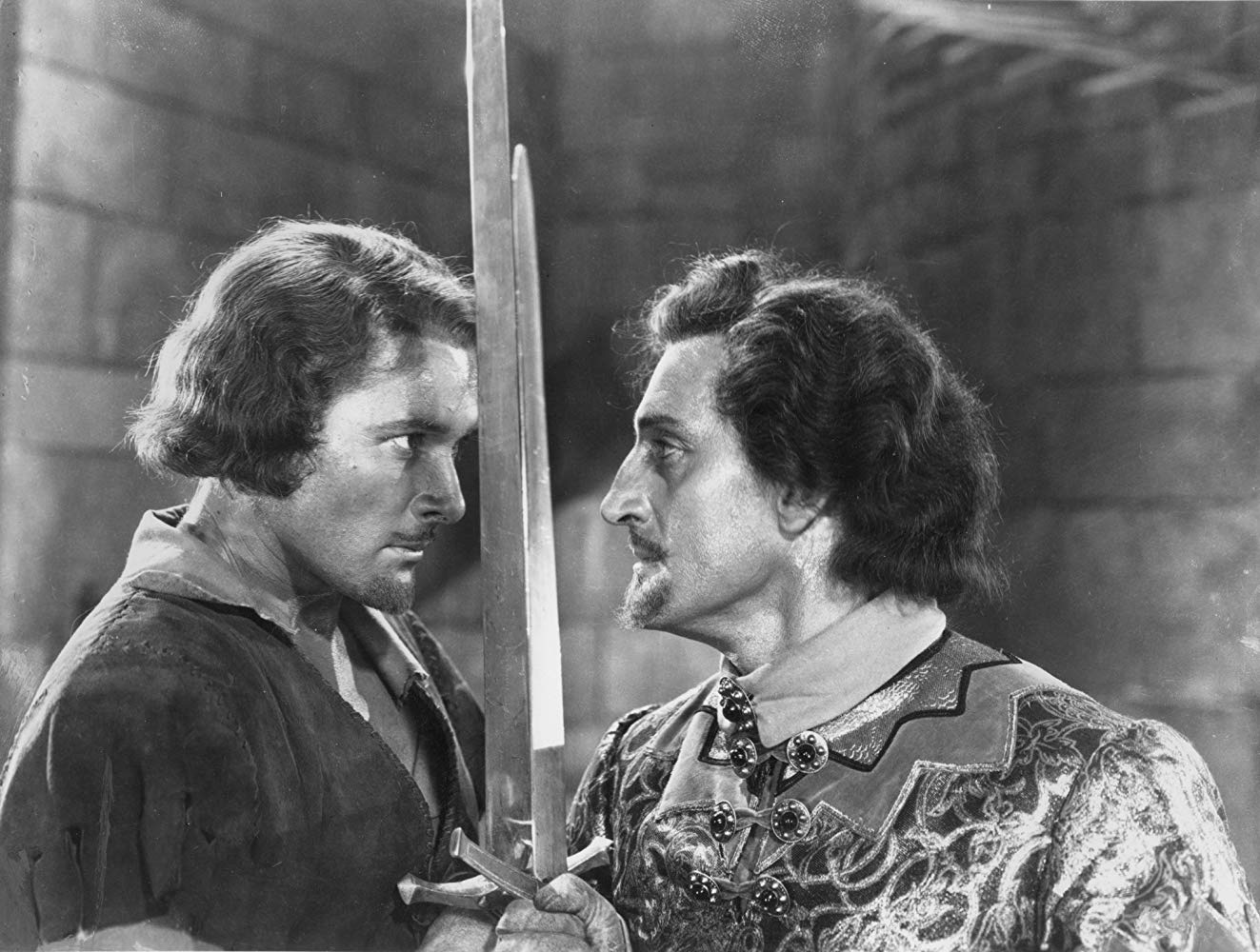
For many years, THE ADVENTURES OF ROBIN HOOD has been in CrazyFilmGuy's Top Five Favorite Films of all time. Only recently had it fallen out of my Top Five only because I had not watched it in a while (I think John Ford's THE SEARCHERS had bumped it). Watching it again, I remember why I fell in love with it. The swashbuckling Robin Hood making his brazen appearance in Prince John's castle, a stag draped over his back.  The first time we see Maid Marian without her head dress, her long braided hair dangling over her shoulders. Robin and Little John's playful quarter staff duel. Robin winning the archery tournament, splitting an arrow no less. Marian's gaze as Bess explains what love feels like (it made a 2nd grade CrazyFilmGuy goosepimply as she spoke), Robin and his merry men ambushing Sir Guy's caravan in Nottingham forest, leaping and falling Merry Men everywhere. Robin's final duel with Sir Guy of Gisbourne, their battling shadows cast upon a castle wall. All in glorious Technicolor with Erich Wolfgang Korngold's stirring "March of the Merry Men" theme playing.

Besides King Arthur and the Three Musketeers, Robin Hood is one of the world's first super heroes. Yes, he's handsome, the best archer in the land, and a born leader. He robs from the rich and gives back to the poor. But he's not invincible. He's human. Little John bests Robin in a three quarter staff duel.  Friar Tuck dunks Robin in a stream. Robin's overconfidence nearly gets him hanged when he's caught by Gisbourne after winning the archery tournament. Like Marvel or DCs comic superheroes, Robin has his mistakes and human weaknesses yet he overcomes them in the end to defeat tyranny and injustice.


Errol Flynn performance in THE ADVENTURES OF ROBIN HOOD is nothing short of marvelous. CAPTAIN BLOOD (1935, also directed by Michael Curtiz) was Flynn's first lead role. It took Flynn awhile in that film to find his feet as the exiled doctor who becomes a pirate.  In ROBIN HOOD, Flynn grabs the screen from his first entrance (Flynn actually has three grand entrances in ROBIN HOOD). As Robin, he's charming, roguish, romantic, and loyal to his king and men. Flynn would be my first film idol from the Golden Era of films (soon followed by Humphrey Bogart and Cary Grant). Flynn's career spanned from playing pirates and Robin Hood to cowboys and even the doomed General George Armstrong Custer in THEY DIED WITH THEIR BOOTS ON (1941).

If Errol Flynn was my first matinee idol, Olivia De Havilland who plays Maid Marian was my first on screen crush. Even today, when I see her in THE ADVENTURES OF ROBIN HOOD, my heart flutters. I was aware of feminine beauty even back in grade school but when De Havilland first appeared in ROBIN HOOD, I became all tingly and goose pimply in love just as Marian's lady in waiting Bess describes that feeling to Marian. De Havilland has a nice arc in ROBIN HOOD as she goes from loathing the green tighted bandit to understanding his fight for the poor and downtrodden to falling in love with him. De Havilland would play the love interest to Flynn and many other leading men in films in the early 30s and early 40s.  Wishing more dramatic, substantial roles, De Havilland would sue Warner Brothers to get out of her contract and pursue stronger parts.  Surprisingly, she won her case. De Havilland would go on to appear as twins, one a murderer in Robert Siodmak's THE DARK MIRROR (1946); as a woman fighting mental health issues in THE SNAKE PIT (1948); and would finally win an Academy Award for Best Actress in William Wyler's THE HEIRESS (1949) co-starring Montgomery Clift and Ralph Richardson.


Robin Hood is an exciting hero but THE ADVENTURES OF ROBIN HOOD would not be as universally loved without a colorful cast of Merry Men and a few dastardly villains. The role of Little John is a crucial component and actor Alan Hale fills the role perfectly.  Little John is the big guy with the kind heart. His rollicking laugh puts strangers at ease but he's Robin's # 1 bodyguard and enforcer. The quarter staff fight between Robin and Little John may be one of the most famous introductions of two friends ever. Apparently, Alan Hale was born to play the role as he appeared as Little John three times spanning three decades.  Hale first played Little John in the Douglas Fairbanks 1922 version of ROBIN HOOD.  Then, in 1938 in THE ADVENTURES OF ROBIN HOOD. Hale would make one more appearance as the jolly giant in ROGUES OF SHERWOOD FOREST (1950), his last film before he died that same year. Fans (like me) of the television show GILLIGAN'S ISLAND will recognize Hale's son Alan Hale, Jr who played the Skipper.

The other key Merry Man role is Friar Tuck.  Tuck needs to be rotund and feisty but with a good heart.  A man of the cloth but willing to spill blood in the name of King Richard.  Eugene Pallette stepped into the role of Friar Tuck in THE ADVENTURES OF ROBIN HOOD and owned that character.  With his bullfrog deep voice and penchant for mutton, Pallette made Friar Tuck both likable and another ally for Robin Hood. Patric Knowles who resembled the dashing Errol Flynn but never quite had his career plays Robin's squire and troubadour Will Scarlett.  It may be Knowles most memorable role. Rounding out the Merry Men is the rubbery faced Herbert Mundin as Much the miller's son. Watching Much and lady in waiting Bess flirt is a hoot.  Sadly, Mundin would die in a car accident in 1940.


Good villains are just as important as good sidekicks. THE ADVENTURES OF ROBIN HOOD provides three excellent, unforgettable bad guys. Claude Rains as Prince John has a field day as the slightly effete brother of Richard the Lion-Heart. With a chip on his shoulder for his brother passing him over as regent in Richard's absence, Prince John exacts his revenge on the Saxon people, in particular Robin Hood. Rains was adept at making his villains or corrupt characters nefarious yet charming in such films as Michael Curtiz's CASABLANCA (1943) and Alfred Hitchcock's NOTORIOUS (1946). Rains is one of my favorite supporting actors to grace the silver screen.

Basil Rathbone had sparred with Errol Flynn in CAPTAIN BLOOD and they face off against each other again in ROBIN HOOD. Rathbone plays Sir Guy of Gisbourne, a Norman supporter of Prince John and suitor for Maid Marian's hand. Gisbourne lacks the charisma or nerve to show his true feelings to her. Robin Hood inflames his jealously when he woos Marian away from him. Rathbone makes a handsome villain and a worthy foe for Flynn.  Rathbone could play both heroes and villains with ease. Usually in the Robin Hood legends, it was the Sheriff of Nottingham who was Robin's main nemesis.  In THE ADVENTURES OF ROBIN HOOD, it's Gisbourne.  The High Sheriff of Nottingham played by Melville Cooper is comic relief in this ROBIN HOOD. In other Robin Hood films and the legends, the Sheriff is Robin's primary antagonist.


There are plenty of connections between actors in THE ADVENTURES OF ROBIN HOOD as many were contracted to Warner Brothers during this period. Errol Flynn and Olivia de Havilland would make eight films together besides ROBIN HOOD including CAPTAIN BLOOD and THE PRIVATE LIVES OF ELIZABETH AND ESSEX (1939). Michael Curtiz directed those two films and many others with the pair. Errol Flynn and Alan Hale (who were good friends offscreen) would make 13 films together (a few were cameos for Hale) including DODGE CITY (1939) and ADVENTURES OF DON JUAN (1948). Errol Flynn and Basil Rathbone also worked (and dueled) together in CAPTAIN BLOOD and co-starred in THE DAWN PATROL (1938).  Flynn and Patric Knowles played brothers in Curtiz's THE CHARGE OF THE LIGHT BRIGADE (1936). Claude Rains and Patric Knowles both appeared together in Universal's THE WOLF MAN (1941). Flynn, Rains, and Una O'Connor all made Curtiz's THE SEA HAWK (1940) together. But for me, Flynn, De Havilland, Rains, Rathbone, Hale, Knowles, and O'Connor are my cinematic family in ROBIN HOOD.

Nobody directed genre films better than Michael Curtiz.  Horror, Swashbucklers, Westerns, War, Melodrama, Musical, Film Noir -- Curtiz did it all, mostly for Warner Brothers. Curtiz was fabulous staging action scenes, filling his screen with hundreds of extras, and making studio backlots look like French Casablanca, a seedy Mexican dive bar, or medieval Nottingham square. For THE ADVENTURES OF ROBIN HOOD, William Keighley began as the director but was replaced by Curtiz after studio heads thought Keighley's footage lacked pizazz.  Several 2nd Unit directors helped film insert and non-essential actor scenes but Curtiz directed the remaining big scenes including the archery tournament and the final battle inside Nottingham Castle. I love the way Curtiz frames certain shots and moves the camera, loading the screen with loads of detail.


THE ADVENTURES OF ROBIN HOOD'S success can be traced to using the best tales from the Robin Hood legends for its movie. Because of its universal success, future Robin Hood films were forced to find different storylines for their films. Kevin Reynolds ROBIN HOOD: PRINCE OF THIEVES (1991) has Robin (a miscast Kevin Costner) just returning to Nottingham from the Crusades not with the Merry Men but a Moorish companion (Morgan Freeman) to find the evil Sheriff of Nottingham (Alan Rickman) in charge. Ridley Scott's ROBIN HOOD (2010), shows us the man before he became a legend. Russell Crowe plays Robin Longstride who returns from the Crusades and assumes the identity of a dying knight named Robert Loxley with a final request. Richard Lester's ROBIN AND MARIAN (1976) gives us Robin (Sean Connery), Marian (Audrey Hepburn), and the Sheriff of Nottingham (Robert Shaw) as older versions of their characters. And what would the Robin Hood film canon be without director Mel Brooks poking fun at the hero and his world in ROBIN HOOD: MEN IN TIGHTS (1993).

A few fun Robin Hood facts.  What is the name of the hat that Robin Hood wears?  Is it a hat?  A bonnet? It's called a bycocket which is a fancy name for a cap.  It has a wide brim turned up in the back and pointed in the front like a beak. Only Errol Flynn and Cary Elwes in ROBIN HOOD: MEN IN TIGHTS wore the bycocket in their films. No one really knows who Robin Hood was. His name first appeared in William Langland's Piers Plowman in the 14th Century. Ballads about Robin Hood emerged in the 15th and early 16th centuries. Some scholars believe Robin Hood may have been many sources that merged into one. As for Maid Marian, she is believed to have been referenced first in a French pastoral play from the 13th Century, later adapted by the English in the late 15th Century in the May Games which paired her with Robin Hood. For all the Robin Hood facts and fiction, check out this website http://www.robinhoodlegend.com/


Errol Flynn will forever be associated with Robin Hood in THE ADVENTURES OF ROBIN HOOD just like Clint Eastwood will always be associated with Dirty Harry or Harrison Ford with Indiana Jones.  Some roles are just meant to be played by one person.  Flynn had the dashing good looks, the athleticism, the roguish smile. He looked good in green tights and wearing a bycocket.  Whether Flynn knew it or not, he made quite an impression on an eight year old kid. Robin Hood was my first super hero. Also making an impression on CrazyFilmKid was the attractive Maid Marian, her allure casting a spell on me that endures to this day. In my estimation, there is no more perfect blending of adventure, romance, humor, and music than THE ADVENTURES OF ROBIN HOOD.