The plight of Captain William Bligh, Fletcher Christian, and crew of the HMS Bounty has tantalized Hollywood for almost fifty years. The true story of a group of English sailors who commit mutiny in the South Pacific to escape their tyrannical captain has inspired four different film versions beginning with Charles Chauvel's IN THE WAKE OF THE BOUNTY (1933) starring a young Erroll Flynn. CRAZYFILMGUY is going to focus on Frank Lloyd's MUTINY ON THE BOUNTY (1935), Lewis Milestone's (with an uncredited assistance by Carol Reed) 1962 remake MUTINY ON THE BOUNTY, and more recently Roger Donaldson's THE BOUNTY (1984). One of the draws to MUTINY ON THE BOUNTY are the two meaty roles of the martinet Captain Bligh and the man who leads the mutiny, Bligh's master's mate Fletcher Christian. They are plum roles, sought after by the best. Some of the most distinguished actors in Hollywood have had their shot at playing Bligh: Charles Laughton, Trevor Howard, and Anthony Hopkins. And some of Hollywood's most dashing leading men have been cast as Fletcher Christian: Clark Gable, Marlon Brando, and Mel Gibson.
Of the two roles, I have found the Fletcher Christian character the harder of the two to figure out. I've watched all three films once and each film (and actor) has a different interpretation of how, when, and why Christian decides to mutiny. There's no denying the dramatic tension between the rigid Captain Bligh and the handsome Christian. The beauty of the South Pacific Islands (and the native women who inhabit them) is another lure to the MUTINY ON THE BOUNTY story. Besides the two main characters, part of the fun of the three BOUNTY films is spotting the young up and coming actors who play the officers and crew of the HMS Bounty. So take a sea sickness pill, pull up the anchors, and let's hit the high seas to explore the three different versions of MUTINY ON THE BOUNTY.
MGM would bankroll the first two versions of MUTINY ON THE BOUNTY beginning with Frank Lloyd's 1935 version. The source material was the novel Mutiny on the Bounty by Charles Nordhoff and James Norman Hall. Three writers (Talbot Jennings, Jules Furthman, and Carey Wilson) would craft the screenplay. MUTINY ON THE BOUNTY (1935) opens in Portsmouth, England in 1787. We find First Lieutenant Fletcher Christian (Clark Gable) bursting into the King George tavern, pressing five men of various degrees of skullduggery (and one innocent man) to join the crew of the Bounty. Its two year mission is to sail from Portsmouth, England to the South Pacific island of Tahiti, pick up breadfruit plants, and transport them to the West Indies to plant as cheap food to feed the slaves working on English plantations. The captain of the Bounty is the brutal Captain William Bligh (Charles Laughton). His officers include Roger Byam (Franchot Tone), a midshipman from a family of sea officers. Bligh's sadistic side is shown early when he orders the flogging of a seaman who's already dead. The ship leaves Portsmouth for the open seas.
Early on, Christian and Bligh butt heads on the treatment of the crew. Bligh wants discipline and punishment if rules and orders are not obeyed. The more compassionate Christian wants to teach and train the new crew. The Bounty barely makes it through some terrible weather. Later, the ship runs into the doldrums (no wind) forcing Bligh to make his crew pull the ship via row boats, rotating the tired men. The crew are close to exploding under Bligh's tyranny when they finally reach Tahiti. The natives paddle out to greet the crew. Bligh meets with the island's chief Hitihiti (William Bambridge) and makes his request for one thousand breadfruit plants. It's paradise for the seamen after their perilous journey. Beautiful women are everywhere, dazzling the sailors like sirens. Hitihiti's granddaughter Tehani (Movita) falls in love with Christian.
The time comes for the Bounty to leave. A few deserters like Burkitt (Donald Crisp) are caught trying to stay on the island. Bligh learns that the breadfruit will need more water than the ship can store. Bligh cuts the crew's water rations in half. As the ship sails, Bligh accuses Christian of stealing coconuts. But the final straw for the crew is when Bligh orders the perennially drunk but now very ill Dr. Bacchus (Dudley Digges) to the top deck. The beloved Bacchus promptly dies. The crew mutinies and Christian begrudgingly becomes their leader. Christian puts Bligh and many officers and crew loyal to the captain in a row boat and sets them adrift. Byam misses the row boat and reluctantly stays on the Bounty. "We can never be friends again," Byam tells Christian. Christian orders the Bounty to turn around and return to Tahiti.
Bligh and his men eventually reaches East Timor in the row boat. Christian and the mutineers celebrate Christmas in Tahiti. Christian weds Tehani. Life is good on the island until a mysterious English ship appears on the horizon months later. Christian and his men gather their families and sneak away on the Bounty. The English ship the Pandora is captained by none other than Captain Bligh, obsessed with catching Christian. Byam and Stewart (Douglas Walton) who remain on the island welcome Bligh back only to be thrown into the irons by the tyrannical captain. Bligh wants Christian but Byam doesn't know Christian's destination. Bligh takes Byam, Stewart, Burkitt, and Ellison (Eddie Quillan) back to England to be court martialed. The men are convicted by Lord Hood (David Torrence). Byam rails against the false charges, condemning Bligh's brutality as a sea captain. Christian and his crew reach Pitcairn Island, evacuate everyone onto the island and scuttle the ship where they remain (supposedly) for the rest of their lives. Byam's conviction is overturned with the help of family friend Sir Joseph Banks (Henry Stephenson). Bligh's honor is maintained but his treatment of his crew places a stain on his reputation.
This first version of MUTINY ON THE BOUNTY paints Bligh clearly as a sadistic villain yet it had the good fortune of casting Charles Laughton as the Captain. As warped as Bligh is in following English maritime rules to the letter, Laughton makes Bligh sympathetic at times. There's no question about Bligh's character. Clark Gable's Fletcher Christian is another story. We first meet Christian basically kidnapping six men (albeit pirates and thieves except for Ellison who's there for a drink with his wife) from a tavern because the Bounty needs more men. But Christian is portrayed as a tough but fair First Lieutenant who cares more about the men he commands than Bligh. Gable (who shaved his famous moustache for the role) plays Christian in that classic 30s hero role -- dashing and roguish with a hearty laugh (imagine Errol Flynn on the high seas). What makes this MUTINY ON THE BOUNTY interesting is there is a second romantic leading man besides Gable. Franchot Tone as Roger Byam. The two men become friends, both pursue different women on Tahiti only to see their friendship torn apart by Christian's decision to join the mutineers. Christian's decision to overthrow Bligh comes back to haunt the idealistic Byam who Bligh turns his hatred toward on Bligh's return voyage to Tahiti.
Of the three BOUNTY films, the first and oldest version is the most explicit in showing Bligh's brutality in keeping discipline with his crew. We see an already dead sailor flogged because Bligh had ordered the punishment before the man died. We see another crew member keel hauled (thrown over the bow of the ship and pulled underneath it before he's pulled back up from the stern). This sailor also dies. Byam is forced to sit up in the crow's nest during a ferocious storm for disobeying one of Bligh's orders. Then, we have the unfortunate situation of crewmen Ellison. Ellison is neither a thief nor a pirate. He's just the wrong person at the wrong time when he's grabbed by Christian and forced to serve on the Bounty. Ellison has a wife and a new child he leaves behind. Forced from his family for two years, Ellison is one of the crew members court martialed for mutiny when Bligh returns and grabs him among others. Ellison had nothing to do with the mutiny. He's an innocent man. The filmmakers soften his situation by allowing him to see his wife and child one last time before he's hung (off screen). Ellison's ordeal is heart wrenching. Officer Byam receives a late pardon but not Ellison or Burkitt.
Clark Gable was on his way to becoming a major movie star, Franchot Tone was an up and coming matinee idol, and Charles Laughton was on an incredible streak of roles including Dr. Moreau in THE ISLAND OF LOST SOULS (1932), Henry VIII in THE PRIVATE LIFE OF HENRY VIII (1933), and Inspector Javert in LES MISERABLES (1935). But MUTINY ON THE BOUNTY provided a kick start for a few of the supporting actors (although not as many as the next two versions). Donald Crisp as the big chested Burkitt would have a long career in film often playing patriarchs in films like John Ford's HOW GREEN WAS MY VALLEY (1941) or Anthony Mann's THE MAN FROM LARAMIE (1955). THE ADVENTURES OF ROBIN HOOD fans will recognize Herbert Mundin (Much the Miller) as the dim witted cook Smith. Mundin is the one comic role in MUTINY ON THE BOUNTY. He ends up with a wife on Tahiti and disappears in the middle of the film, presumably happy to stay on the island. Movita who plays Fletcher Christian's Polynesian love interest Tehani was actually Mexican-Ameican. She would appear in John Ford's FORT APACHE (1948) as a Mexican woman. Ironically, Movita would become Marlon Brando's second wife. Brando would play Fletcher Christian in the 1962 remake and leave Movita for his BOUNTY co-star Tarita. And rumor has it that James Cagney (who was vacationing on Catalina Island when the cast and crew of MUTINY ON THE BOUNTY landed to film the harbor scenes) can be seen in a few opening group shots as one of the crew (I was not able to spot him).
Hollywood's first shot at MUTINY ON THE BOUNTY was a rousing success, garnering six Academy Award nominations and winning one for Best Picture. Made by MGM (the most prestigious studio at the time), MUTINY had great production value, up and coming and established movie stars, and a mixture of drama, action, and some comedic moments typical of big studio films in the 30s. What's unexpected is how vividly director Frank Lloyd depicts Captain Bligh's viciousness toward his crew in the name of English sea law. Neither the 1962 or 1984 versions would be so graphic in showing whippings and keel haulings. One other item worth noting with this first version is there are two romantic leads in Clark Gable and Franchot Tone. Fletcher Christian is the only romantic lead in the latter versions. But in Lloyd's film, Fletcher Christian although played roguishly by Clark Gable is not a choir boy. He kidnaps men to work on his ship. He breaks from his English officers and supports the mutineers against Captain Bligh. He doesn't sail away to a uncharted tropical island but a rocky, desolate patch of land in an inhospitable part of the world. The studio needed a second lead to give the audience some hope (even though Tone's Byam almost hangs).
MGM would roll the dice a second time, remaking MUTINY ON THE BOUNTY in 1962. Based on the same book by Nordhoff and Hall with a new screenplay by Charles Lederer (and several uncredited screenwriters), this MUTINY was an even bigger production as the cast and crew actually filmed in the French Polynesian islands of Tahiti, Bora Bora, and Moorea for all the exterior scenes. Directed by Lewis Milestone (who took over for Carol Reed early during filming), the second MUTINY ON THE BOUNTY would be beset by budget woes, script changes, and the unprofessional behavior of its leading man Marlon Brando who drove cast and director crazy. Yet, MUTINY is a big, beautiful film to watch especially its island scenes. The film is fairly faithful to the first version until its third act where perhaps the offscreen clashes between actor, director, and script rewrites provide an unsatisfactory finale.
Gorgeously photographed in Technicolor by Robert Surtees (THE GRADUATE), the 1962 version of MUTINY ON THE BOUNTY lets us know right away that Fletcher Christian (Marlon Brando) will be more of a romantic hero than Clark Gable's Fletcher. Christian arrives to the Bounty in Portsmouth, England Harbor in 1787 escorted by two beautiful women: one French and one English. He's greeted with contempt by Captain William Bligh (Trevor Howard). Christian was not Bligh's first choice to be his second in command on the Bounty. Bligh welcomes gardener William Brown (Richard Haydn) who will be his expert on whether the breadfruit plant can be transplanted from Tahiti to Jamaica to feed the island's slave population. The Bounty leaves Portsmouth for Tahiti. This MUTINY crew are made up more of volunteers and regular sailors than thieves: Seaman John Mills (Richard Harris), Alexander Smith (Hugh Griffith), Seaman Matthew Quintal (Percy Herbert), Seaman Edward Birkett (Gordon Jackson), and Seaman William McCoy (Noel Purcell) among the crew.
The ship is barely at sea when Bligh's zeal for punishment rears its ugly head. Seaman Mills is flogged for allegedly stealing a block of cheese. Bligh is obsessed with completing his mission successfully. He makes the foolhardy choice (against Christian's reservations) to go West around the Cape of Good Horn (the tip of South America) instead of East and around the Cape of Good Hope (Africa). The Bounty endures four weeks of rough seas and terrible storms, making little head way. Bligh runs the crew ragged. His gamble costs them previous time. In the end, Bligh reluctantly heads East. He takes his frustration out on the crew. For his part, Christian doesn't really side with either Bligh or the crew. Luckily for everyone, the Bounty finally reaches Tahiti.
The ship is met by hundreds of natives. Upon reaching shore, Bligh meets with the island's chief Hitihiti (Matahiarii Tama). Bligh brings a chest full of gifts for the chief and reveals they have come for breadfruit. While Christian and Brown begin collecting breadfruit samples, the men discover the island's other beauty: the local women of the island. At an extravagant feast, Hitihiti's daughter Maimiti (Tarita) flirts with Christian. Bligh orders Christian to stay away from her which insults Hitihiti. If Christian won't sleep with his daughter, Hitihiti declares no breadfruit for the Bounty. Bligh relents. After five months of rest, the breadfruit come out of their dormant period. The Bounty prepares to depart. Mills and Quintal try to desert but they're chased down by Christian and Midshipman Ned Young (Tim Seely). Bligh places the deserters in irons as the Bounty sails for Jamaica.
Brown tells Bligh the breadfruit will need more water if they're to survive the voyage. Bligh cuts the crew's water rations. The men begin to go mad without water, some dying. Mills becomes an instigator, prodding Christian on how many more men have to die under Bligh. When Christian tries to give water to one crazed seaman, Bligh kicks the ladle from him. Christian snaps and hits Bligh. The crew arm themselves and Christian takes command of the Bounty. Christian sends Bligh and some crew members off in a rowboat (they eventually make it to land). The Bounty turns around and returns to Tahiti. Maimiti joins Christian as do other islanders. The Bounty searches for a far off island to evade the inevitable return of a British ship. Christian discovers Pitcairn Island by accident. The English map makers have it wrong on all the maps. The island is a paradise. But when Christian begins to suggest returning to England to regain his honor and face Bligh at a trial, Mills and the crew will make a rash decision that will have irreversible results for Fletcher Christian.
Many critics and movie fans think Marlon Brando is miscast as Fletcher Christian but I disagree. I would pay money to see Marlon Brando play a hotel doorman. Fletcher Christian is a bigger than life historical character and Brando was the bigger than life actor to play him (Brando turned down another big historical character T.E. Lawrence of LAWRENCE OF ARABIA to play Fletcher Christian). Christian is portrayed early on as a playboy, arriving to the docks with two beautiful, fashionable women and wearing a red cape. In another scene, Brando has Christian wearing a lavender scarf. Christian seems to be at a crossroads of his life. Brando plays him like some of Brando's other characters: a loner, a rebel. He's got money, good breeding, but is the British navy the place for him. He seems to want to get the voyage over with and get on with his good life.
Captain Bligh as played by Trevor Howard has a chip on his shoulder. He may have had to work harder to get where he's gotten than Christian. He seems jealous of Christian's high born class. Bligh has no sense of humor. When Midshipman Young laughs at how Bligh walks, Bligh punishes the young cadet. "I'm not a figure of fun," he reminds both Christian and Young. Bligh may also have an inferiority complex. Chief Hitihiti is disappointed it's Bligh and not the more well known Captain Cook who has returned to their island which Bligh notices. Bligh has anti-social tendencies as well. In one of MUTINY'S funniest sequences Bligh is forced to dance with Maimiti much to his dread.
Even though he objects at times, Christian puts up with Bligh's overhanded discipline. He acknowledges Bligh's authority even though Bligh senses contempt from him. But when Bligh emasculates him in front of the men, Christian snaps, striking Captain Bligh and altering his future forever. After his actions, did Christian make the right decision or did Bligh goad him and get under his skin? Bligh was all about the mission and not his men. More sailors may have died unnecessarily if Christian doesn't act. But Christian sulks and hides in his quarters after the mutiny. The crew respect Christian for his decision, not fully realizing the sacrifice he made for them. In the end, when the Court Martial Judge (Henry Dashiell) excuses blame for Bligh for losing his ship, he condones Bligh for his excessive zeal toward his crew. Bligh's career is finished and his chance to pursue Christian done.
Besides Brando and Howard, Richard Harris (CAMELOT) is sneaky good as Seaman John Mills. He starts out the movie as a lazy sailor, trying to avoid any hard work. But when he's flogged for allegedly stealing cheese, Mills changes. He doesn't want to go back to the Bounty and Bligh once he experiences Tahiti. Thrown in irons for trying to desert, Mills will be the provocateur that encourages Christian to mutiny. In a way, Mills is like Judas in that he will betray Christian at the end of the film. Movie fans will recognize some of the other crew members from various films: Percy Lambert (THE BRIDGE OVER THE RIVER KWAI and MYSTERIOUS ISLAND), Gordon Jackson (THE GREAT ESCAPE and TVs UPSTAIRS, DOWNSTAIRS), Hugh Griffith (BEN-HUR and TOM JONES), and Richard Haydn (THE SOUND OF MUSIC). Harris was the first actor of the first two BOUNTY films to receive third billing.
After viewing the first two MUTINY ON THE BOUNTY films, there are some facts and falsehoods to separate. Captain Bligh would not return right away to Tahiti like he did in the first MUTINY film to pursue Christian. It would be several years and Christian long gone before Bligh made it back to the South Pacific and successfully complete his breadfruit mission. Unlike its depiction in the second MUTINY film, Pitcairn Island was not a tropical paradise but a fairly inhospitable island. As to what happened to Fletcher Christian and the mutineers, history does not have a firm decision. Some say Christian was murdered on Pitcairn Island by either the crew or the natives that came with him. Other reports say that Christian returned to England incognito and visited his family. It's a mystery that may never be answered.
THE BOUNTY (1984) directed by New Zealander Roger Donaldson would be the third version of this tale. Produced not by MGM but by Producer Dino De Laurentiis, this version would not be based on the Nordhoff and Hall book but a different book called Captain Bligh and Mr. Christian by Richard Hough. The screenplay is by renowned screenwriter Robert Bolt (LAWRENCE OF ARABIA, A MAN FOR ALL SEASONS) and LAWRENCE OF ARABIA director David Lean was originally attached to direct. One could see how the strong personalities of Captain Bligh and Fletcher Christian would appeal to Lean. But Lean would have to drop out of the project and up and coming director Donaldson would helm the film instead.
THE BOUNTY is unique in that it begins with Bligh's naval hearing upon his return to England from having his ship taken from him and uses flashbacks to tell the story of the HMS Bounty and its mutiny. Bligh appears before Admiral Hood (Laurence Oliver) and the suspicious, inquisitive Captain Greetham (Edward Fox). The first two films had Bligh's hearing near the end of each film. And breadfruit are barely focused on in this version. The other interesting take from THE BOUNTY is that the film begins with Lieutenant William Bligh (Anthony Hopkins) and Fletcher Christian (Mel Gibson) as friends. Christian has dinner at Bligh's home and plays with Bligh's children. Bligh has been assigned this mission to bring breadfruit from Tahiti to Jamaica to feed the West Indies slaves. Bligh wants to make his mark before he becomes too old. He asks Christian to be his Master's Mate. Sailing Master Mr. John Fryer (Daniel Day-Lewis) is Bligh's second command but Bligh wants Christian with him as Christian has connections that Bligh does not.
Early in the voyage, Bligh's portrayed as more lenient, crew friendly. But when the brutish Churchill (Liam Neeson) and Quintal (Neil Morrissey) complain about a dancing exercise ordered by Bligh to stay fit, Bligh has both of them gagged for insubordination until Christian asks for leniency. Bligh's seamanship is questioned by Fryer when Bligh decides to go around Cape Horn instead of the Cape of Good Hope. After 31 days of grueling winds and storms and nearly capsizing and just 85 miles to show for it, Bligh turns around. Bligh loses faith in Fryer and makes Christian his second in command. Morale is low until the Bounty reaches Tahiti. This BOUNTY has no problem showing the native women topless as the islanders paddle out to greet them. Bligh meets with King Tynah (Wi Kuki Kaa) and explains their mission. The Bounty has to wait for the breadfruit to grow allowing the crew and island women to become close. Christian begins a relationship with the King's daughter Mauatua (Tevaite Vernette).
As Christian falls in love with Mauatua and falls under the spell of her and the island, his relationship with Bligh begins to splinter. Christian spends more time on the island than on the ship, angering Bligh who eventually orders Christian to return. As the ship prepares to leave with its cargo of breadfruit, tensions grow on the island. The alcoholic Dr. Huggan (Malcolm Terris) is found dead, tormented by some locals. Churchill tries to desert only to be caught by Bligh and Cole (Bernard Hill). Christian sneaks back to the island to say goodbye only to learn that Mauatua carries his child. Churchill is flogged in front of the crew. As the ship continues its voyage, Bligh begins to go a little mad, complaining that the ship is filthy, having Christian order the men to scrub and scrub again the decks. When Christian takes one of Bligh's coconuts, Bligh puts the crew on half rations. Mr. Young (Philip Davis) suggests to Christian to take the ship. Bligh considers trying to take on Cape Horn again. The crew are at a breaking point. Christian leads the revolt, grabbing Bligh and Fryer.
The crew are ready to kill Bligh, Fryer, and Cole but Christian intervenes. There will be no slaughter of the officers. Bligh feels betrayed by his friend. Christian sends Bligh and his men off in a row boat. For the last third of the film, THE BOUNTY alternates between Bligh and Christian's journeys. Bligh and his men stop on a different island for supplies and barely escape hostile natives. Christian and his mutineers return to Tahiti to pick up food and their women. King Tynah is shamed by Christian's actions. It means King George will send more ships to his island, searching for Christian. Both men have troubles on their respective boats. Bligh's men are dying of thirst and hunger when they crawl into East Timor. Bligh will make it back to England and face his peers. On the Bounty, the crew begin to turn on Christian as he vainly tries to find an island for them to inhabit. Christian puts his trust in his maps and stumbles across Pitcairn Island. Christian, Adams (Philip Martin Brown), Young, Mauatua, and the rest of the crew land on the island and burn the Bounty, ensuring they will never leave.
THE BOUNTY puts a little more emphasis on Bligh than Christian in this version. Bligh is humanized. We see him at dinner with his wife (Sharon Bower) and his kids. We also see that Bligh and Fletcher Christian are friends. Bligh asks Christian to join his mission and later promotes him after Fryer questions Bligh's sailing choices. It's only when Fletcher falls in love with Mauatua and begins to go native in Tahiti, neglecting his second in command duties does Bligh begin to turn on him. Bligh's embracement of discipline and punishment may stem from his Puritan background. Bligh begins to go a little mad from the heat. He may be jealous of Christian's lifestyle and attitude. But in the end, THE BOUNTY does not paint Bligh as responsible for losing his ship. Even with stern questioning from Hood and Greetham, Bligh is exonerated and Christian found guilty of mutiny.
Fletcher Christian as played by the ridiculously handsome young Mel Gibson in THE BOUNTY is portrayed as ambitious but a bit of a novice. He and Bligh get along early on. Christian, as in the other film versions, sees himself as an intermediary between crew and captain. But Christian succumbs to the temptation of the fairer sex on Tahiti. He sleeps with Mauatua. He dresses more like the Tahitians and even gets a tattoo. Like Franchot Tone's Byam in the first version, Gibson's Christian feels more at home with King Tynah and his people than Bligh. Bligh begins to torment Christian, forcing him to wear his naval jacket over his fresh tattoo, a painful order that Christian reluctantly follows. When he leads the mutiny, Christian's motive may be more to return to his beloved Mauatua on Tahiti as it is to protect the crew from Bligh's ego.
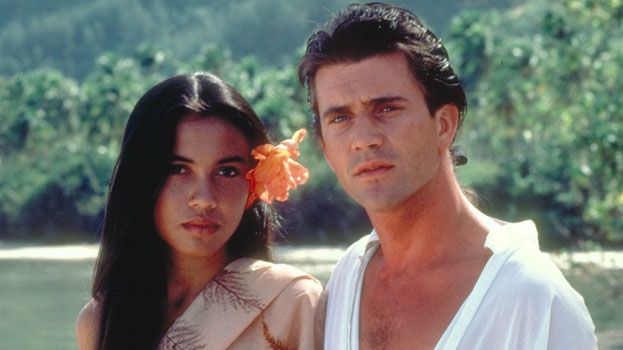
All the BOUNTY films but especially the Brando version and THE BOUNTY contrasts English prudeness versus the open sexuality of the South Pacific natives. Fertility dances and suggestive hip movements especially by the Tahitian women are prevalent in all three versions. The Tahitian women sleep freely with the English sailors. Many become girlfriends and even wives of the seamen. But Bligh represents English morality and a repressed sexuality. In a very funny scene in THE BOUNTY, King Tynah sends one of his wives to sleep with Bligh. The rigid, moralistic Bligh wants nothing to do with her but knows it's expected. He asks Christian to interrupt them before they can consummate. Christian waits longer than he should than bursts into Bligh's quarters. When Bligh demands what requires his attention, Christian answers, "The ship's sinking sir." Bligh replies, "Good."
What are the odds that two of the most recognizable and respected actors (not named Hopkins and Gibson) currently in the business would have supporting roles in THE BOUNTY. Daniel Day-Lewis who plays Master of Sailing John Fryer has gone on to win multiple Oscars for Best Actor in films like Paul Thomas Anderson's THERE WILL BE BLOOD (2007) and Steven Spielberg's LINCOLN (2012). THE BOUNTY was an early role for Day-Lewis and it's not a showy one. Liam Neeson (TAKEN, SCHINDLER'S LIST) plays the thuggish Churchill, maybe one of the scarier crew members in any of the BOUNTY films. Churchill will suffer a severe lashing ordered by Bligh for trying to desert and eventually assist in the mutiny but he will end up staying on Tahiti rather than join Christian. Like Day-Lewis, THE BOUNTY was one of Neeson's first films. Neeson's career would explode beginning in the 90s. Also look for THE LORD OF THE RINGS: TWO TOWERS (2002) actor Bernard Hill who plays Bligh's taskmaster Cole. Hill would become known to millions as King Théoden in the Peter Jackson fantasy films. A quick note about the music. Nothing says 1980s more than an electronic music score. It was all the rage for that decade. THE BOUNTY'S music is by Vangelis whose best works included Hugh Hudson's CHARIOTS OF FIRE (1981) and Ridley Scott's BLADE RUNNER (1982). Vangelis's score is haunting and seems fitting for a film that takes place mostly on the open water.
So as we wrap up our cinematic journey from Portsmouth, England to Tahiti and finally, Pitcairn Island, what have we learned about Captain Bligh and Fletcher Christian from version one and version of two of MUTINY OF THE BOUNTY and THE BOUNTY? In the 1935 version, Christian is portrayed in the Hollywood Golden Era style as a lovable rogue, foreshadowing Clark Gable's ultimate role as Rhett Butler in Victor Fleming's GONE WITH THE WIND (1939). Marlon Brando's take on the Christian role in the 1962 version is as an outsider, a well to do playboy who tries not to take sides until Bligh humiliates him. Mel Gibson's Christian (besides as a heartthrob) is that of a greenhorn who falls hard for a local girl and mutinies as much to rejoin his love as to protect the crew that Bligh so callously treats.
On the Captain Bligh side, Charles Laughton's performance in the first version is pure villainy with just a dash of humanity. Trevor Howard in the second version is an older, crustier Bligh with more of a chip on his shoulder toward Christian and his class and good looks. Anthony Hopkins Lieutenant Bligh is painted as a more human figure with a wife and two small children. He's not perfect but by the film's end, he's cleared by the Admiralty of any wrongdoing. As we know, fact and fiction in films never do quite meet. The real Captain Bligh did seem to have issues when it came to commanding men. Not only was his ship the Bounty taken from him by his crew in 1789 for his treatment of the crew, years later as Governor of New South Wales in Australia in 1808, Bligh was arrested by his own military officer and under house arrest for a year for bad relations with the army.
I was able to forge ahead through MUTINY ON THE BOUNTY (both versions) and THE BOUNTY without receiving a single lashing or keel hauling from my family (who sometimes rolled their eyes when I told them I was watching all three versions). It's always interesting to see how each group of filmmakers (director, screenwriter, and actors) tackle the same basic story. Each film has its own strengths and weaknesses but each version is a worthy and entertaining couple of hours to ride along with history on the voyage of the HMS Bounty and its dramatic conflict between Captain William Bligh and Fletcher Christian.
Saturday, February 1, 2020
Sunday, December 22, 2019
Die Hard (1988)
Within the last few years, an unexpected film has suddenly been designated as a Christmas picture. That film is John McTiernan's DIE HARD (1988). I laughed out loud when I first heard this preposterous notion. DIE HARD? The film with Bruce Willis as a New York cop visiting his wife in Los Angeles over the holidays who stumbles across some German bad guys up to no good in a new gleaming skyscraper. I had never thought of DIE HARD as a Christmas film. Okay, yes it's set during the Christmas season but is that enough to justify it as a Christmas film like MIRACLE ON 34TH STREET or IT'S A WONDERFUL LIFE? Even THE GODFATHER had some scenes set during Christmas and no one calls it a holiday film.
But then I started to analyze the concept a little more closely. Maybe Bruce Willis is Santa Claus, trying to deliver "cheer" to the hostages in the Nakatomi Tower by rescuing them. Perhaps Alan Rickman as Hans Gruber represents the Grinch or Scrooge or Krampus, ruining Christmas for everyone including the city of Los Angeles, the LAPD, and the FBI. Hey, there is a Christmas work party going on at the beginning of DIE HARD. Only instead of the CEO kissing his secretary by mistake or saying something inappropriate, he's shot dead by the terrorists. I think I'm beginning to see the holiday connections.
DIE HARD actually was released in the summer of 1988. I will never forget when I saw the first trailer for DIE HARD in a half full theater a few months before its release. The first trailer (sometimes know as a teaser) gives a general idea of the film and only lasts about ninety seconds compared to the second and third trailer which run about two and a half minutes. Whomever edited the first DIE HARD trailer did a horrible job. It consisted of a few explosions with quips by Bruce Willis that made no sense as they were out of context with a film no one had seen yet. I would surmise that three quarters of the audience including me snickered at the first DIE HARD trailer. Bruce Willis was a successful television star from the hit comedy show MOONLIGHTING (1985-1989). The trailer played up his comedy side. No one saw Willis as an action star. DIE HARD seemed like it might arrive dead on arrival from that first preview. Oh how wrong we would all be.
Based on a novel by Roderick Thorpe (nope, I never read it either) and written by Jeb Stuart and Steven E. DeSouza, DIE HARD stars Bruce Willis as John McClane, a New York cop who lands in Los Angeles on Christmas Eve to visit his estranged wife Holly Gennaro McClane and their two kids. The two have lived on opposite coasts for six months as Holly took a high profile position for Joseph Takagi (James Shigeta), head of the Nakatomi Corporation. McClane is picked up by novice chauffeur Argyle (De'Voreaux White) and taken to the Nakatomi Plaza, a sparkling new high rise skyscraper. The building is virtually empty except on the 30th floor where the employees of the Nakatomi Corporation are having their Christmas party. McClane meets Takagi as well as Holly's unctuous, cocaine sniffing co-worker Harry Ellis (Hart Bochner).
While McClane waits in Holly's office for Holly to finish up some work, a group of slick, well-dressed and coiffed Euro terrorists led by Hans Gruber (the superb Alan Rickman), his trigger man Karl who looks like ballet star Alexander Godunov (wait, it is Alexander Godunov), and security system hacker Theo (Clarence Gilyard, Jr) surreptiously infiltrate the skyscraper and take Mr. Takagi and his employees hostage. Gruber wants Takagi to hand over the key codes to their vault where sixty million in negotiable bonds sit. When Takagi refuses, Gruber shoots him. Hearing gunshots, McClane hides out, moving a few stories higher. He pulls the fire alarm to bring police and fire trucks to the building but Gruber's men cancel the alarm. When Karl's brother Tony (Andreas Wisniewski) goes to investigate, McClane takes him out, obtaining a machine gun and hand radio. He sends the dead Tony down in an elevator to the 30th floor to alert Gruber and his men they have an adversary in the building.
Enraged by the death of his brother, Karl and two others chase McClane to the rooftop where a gun battle ensues. McClane calls 911 for help. A patrolman Sgt. Al Powell (Reginald VelJohnson) investigates, checking the lobby. As Powell pulls away from the building, McClane throws the body of a dead terrorist out the window, hitting his car, grabbing Powell's attention. Gruber's men open fire on Powell's car. He barely survives. Now, the LAPD and a nosy TV reporter Richard Thornburg (William Atherton) head to the Nakatomi tower. Led by the incompetent Deputy Police Chief Dwayne T. Robinson (Paul Gleason), the LAPD attempts an unsuccessful assault on the building, resulting in the LAPD's small tank to be destroyed by a missile launcher. A cat and mouse game ensues between McClane and Gruber as they banter on the radio.
Holly's slimy co-worker Harry Ellis tries to negotiate with Gruber, revealing to the terrorists that McClane's a cop. Gruber repays Harry by killing him. The FBI arrives led by hot shot FBI Special Agent Big Johnson (Robert Davi) and FBI Agent Little Johnson (Grand L. Bush). Theo finally cracks the vault. McClane discovers that Gruber has planted detonators on the upper levels of the building, planning to blow up the building to hide their theft after they depart. McClane manages to disable a few of the bombs (throwing them down an elevator shaft with pyrotechnic results), infuriating Gruber. Gruber figures out that Holly is McClane's wife. With FBI helicopters circling the building and law enforcement waiting below, McClane and Gruber (holding Holly as his hostage) square off for a very entertaining final confrontation.
So is DIE HARD a Christmas movie? I would argue that Richard Donner's LETHAL WEAPON (1987) may have more Christmas vibe than DIE HARD with Bobby Helms' Jingle Bell Rock playing over the opening credits, Mel Gibson undercover at a Christmas tree kiosk, and Hollywood Boulevard decked out in wreaths and Christmas lights. Some films placed in the Christmas film genre are there because of a song. Robert Wise's THE SOUND OF MUSIC (1965) isn't really a Christmas movie but Julie Andrews' rendition of My Favorite Things has propelled it as a holiday favorite. Vincent Minnelli's MEET ME IN ST. LOUIS (1944) is broken into four parts based on the seasons. Judy Garland sings Have Yourself A Merry Little Christmas during the winter section and it falls into the Christmas category. Are we so hard pressed for a new Christmas movie to replace WHITE CHRISTMAS or HOLIDAY INN that we have to conjure up new ones out of an action film?
The new generation of film lovers imagines Bruce Willis in DIE HARD as Santa Claus (or maybe Rudolph the Red Nosed Reindeer or Yukon Cornelius) coming to deliver "the gift" of a Christmas miracle by rescuing the Nakatomi employees from a terrible fate. Hans Gruber is the Grinch or Krampus incarnate, prepared to steal the Nakatomi Corporation's "toys" i.e. negotiable bonds, jewelry, and priceless works of art from its impenetrable vault. The FBI helicopters are Santa's flying reindeer, buzzing around the building. It's far fetched but DIE HARD does take place entirely during Christmas Eve.
More surprising than it's comparison as a Christmas movie, I was struck by DIE HARD'S separation of classes (working class vs the elite). McClane is a blue collar New York cop. His wife makes more money than he does and her boss and co-worker aren't too impressed with him. But McClane can see through the trees. He's not about ego. He's real. Sgt. Powell is just an LAPD foot soldier. He survives the terrorists barrage on his patrol car and connects with McClane, reading the situation they're involved in. But Powell's superior Deputy Police Chief Dwayne T. Robinson ignores every suggestion that Powell provides. Then, the FBI (more arrogant and elitist than Robinson) take over the crisis and make it worse. Director McTiernan clearly roots for the underdog. DIE HARD even hints that bad guy Gruber may have come from humble roots. His previous terrorist group ignored or brushed off his ideas. Gruber has a chip on his shoulder and starts his own terror campaign to show what he's capable of.
What DIE HARD most certainly proves is it's one of the best action films ever made, redefining the genre. It's the classic fish out of water film, only the fish is a New York cop stepping out of the concrete jungle and landing in the bright, palm tree laden City of Angels. The direction, writing, and acting in DIE HARD is superb. Screenwriters Stuart and de Souza give McClane plenty of obstacles to overcome yet create ingenious ways for our hero to overcome them. The villain Gruber is witty and adaptable, even fooling McClane when they accidentally cross paths. Gruber adopts a Texas accent and pretends to be one of the party guests, almost fooling McClane. Director McTiernan intersperses plot and character with great action set pieces.
DIE HARD would spawn four more sequels including 1990's DIE HARD 2 (set in an airport), 1995's DIE HARD WITH A VENGEANCE (New York terrorized by Hans Gruber's brother Simon), 2007's LIVE FREE OR DIE HARD (computer hackers), and 2013's A GOOD DAY TO DIE HARD (McClane in Russia). DIE HARD would spawn countless imitators like Renny Harlin's CLIFFHANGER (1993). Harlin actually directed DIE HARD 2. CLIFFHANGER wants desperately to be DIE HARD right down to Sylvester Stallone's average Joe mountain guide and John Lithgow's over the top villain Qualen. It has its moments but CLIFFHANGER is no DIE HARD.
Bruce Willis was still starring in the TV show MOONLIGHTING when DIE HARD was released. DIE HARD'S success would propel Willis into a bona fide movie star and he would never look back appearing in hit films like Quentin Tarantino's PULP FICTION (1994) and M.Night Shyamalan's THE SIXTH SENSE (1999). Willis's John McClane is like the classic lone wolf western hero. Hans Gruber calls McClane "cowboy" and McClane professes to be a fan of Roy Rogers yelling "Yippee-ki-yay mother*@&#!" as he kicks butt. DIE HARD would also be a breakout film for British actor Alan Rickman as German terrorist leader Hans Gruber. Rickman would play another fascinating villain the Sheriff of Nottingham in Kevin Reynolds ROBIN HOOD: PRINCE OF THIEVES (1991) but will probably be best remembered as the Professor of Dark Arts Severus Snape in the HARRY POTTER film franchise. I always feel sorry for Gruber in DIE HARD. He wears expensive suits and seems to have a full proof plan but he's easily bothered that a common cop has interrupted his grand scheme.
Director McTiernan peppers the rest of DIE HARD with wonderful character actors. Bonnie Bedelia as McClane's wife Holly turns the usually cliché hero's spouse into a tough and smart hostage, having to think on the fly as much as McClane does. Bedelia would also appear in DIE HARD 2. Actors Paul Gleason and William Atherton have both perfected how to play an asshole in films like John Hughes THE BREAKFAST CLUB (1985) where Gleason played the principal overseeing detention and Ivan Reitman's GHOSTBUSTERS (1984) where Atherton's EPA official butted heads with Bill Murray and gang. Gleason as the Deputy Police Chief in over his head and Atherton as a smarmy TV reporter chasing the story of his career are both utterly despicable and hilarious. Special mention to the two equally cocky and horrible FBI Agents played by Robert Davi and Grand L. Bush and Hart Bochner as Holly's sleazy co-worker Harry. The one other human character besides the McClane's is Sgt. Al Powell played by Reginald VelJohnson. VelJohnson seemed destined to play a nice TV sitcom Dad and he would get that chance soon after as patriarch Carl Winslow in TVs FAMILY MATTERS (1989-1998) which was famous for Winslow's nerdy young neighbor Steve Urkel (Jaleel White).
Ultimately, whether DIE HARD belongs in the Christmas movie genre like IT'S A WONDERFUL LIFE or ELF is up to each movie fan to decide. One thing going for DIE HARD like many Christmas movies is the universal theme of family. Like George Bailey realizing how important his family is to his life or Buddy the Elf leaving the North Pole to find his real family, DIE HARD boils down to John McClane flying from the East Coast to the West Coast to reunite with his wife and kids. It just takes McClane about two hours to dispatch of a group of German terrorists before he can be with his family. That's what Christmas movies are about. Family.
But then I started to analyze the concept a little more closely. Maybe Bruce Willis is Santa Claus, trying to deliver "cheer" to the hostages in the Nakatomi Tower by rescuing them. Perhaps Alan Rickman as Hans Gruber represents the Grinch or Scrooge or Krampus, ruining Christmas for everyone including the city of Los Angeles, the LAPD, and the FBI. Hey, there is a Christmas work party going on at the beginning of DIE HARD. Only instead of the CEO kissing his secretary by mistake or saying something inappropriate, he's shot dead by the terrorists. I think I'm beginning to see the holiday connections.
DIE HARD actually was released in the summer of 1988. I will never forget when I saw the first trailer for DIE HARD in a half full theater a few months before its release. The first trailer (sometimes know as a teaser) gives a general idea of the film and only lasts about ninety seconds compared to the second and third trailer which run about two and a half minutes. Whomever edited the first DIE HARD trailer did a horrible job. It consisted of a few explosions with quips by Bruce Willis that made no sense as they were out of context with a film no one had seen yet. I would surmise that three quarters of the audience including me snickered at the first DIE HARD trailer. Bruce Willis was a successful television star from the hit comedy show MOONLIGHTING (1985-1989). The trailer played up his comedy side. No one saw Willis as an action star. DIE HARD seemed like it might arrive dead on arrival from that first preview. Oh how wrong we would all be.
Based on a novel by Roderick Thorpe (nope, I never read it either) and written by Jeb Stuart and Steven E. DeSouza, DIE HARD stars Bruce Willis as John McClane, a New York cop who lands in Los Angeles on Christmas Eve to visit his estranged wife Holly Gennaro McClane and their two kids. The two have lived on opposite coasts for six months as Holly took a high profile position for Joseph Takagi (James Shigeta), head of the Nakatomi Corporation. McClane is picked up by novice chauffeur Argyle (De'Voreaux White) and taken to the Nakatomi Plaza, a sparkling new high rise skyscraper. The building is virtually empty except on the 30th floor where the employees of the Nakatomi Corporation are having their Christmas party. McClane meets Takagi as well as Holly's unctuous, cocaine sniffing co-worker Harry Ellis (Hart Bochner).
While McClane waits in Holly's office for Holly to finish up some work, a group of slick, well-dressed and coiffed Euro terrorists led by Hans Gruber (the superb Alan Rickman), his trigger man Karl who looks like ballet star Alexander Godunov (wait, it is Alexander Godunov), and security system hacker Theo (Clarence Gilyard, Jr) surreptiously infiltrate the skyscraper and take Mr. Takagi and his employees hostage. Gruber wants Takagi to hand over the key codes to their vault where sixty million in negotiable bonds sit. When Takagi refuses, Gruber shoots him. Hearing gunshots, McClane hides out, moving a few stories higher. He pulls the fire alarm to bring police and fire trucks to the building but Gruber's men cancel the alarm. When Karl's brother Tony (Andreas Wisniewski) goes to investigate, McClane takes him out, obtaining a machine gun and hand radio. He sends the dead Tony down in an elevator to the 30th floor to alert Gruber and his men they have an adversary in the building.
Enraged by the death of his brother, Karl and two others chase McClane to the rooftop where a gun battle ensues. McClane calls 911 for help. A patrolman Sgt. Al Powell (Reginald VelJohnson) investigates, checking the lobby. As Powell pulls away from the building, McClane throws the body of a dead terrorist out the window, hitting his car, grabbing Powell's attention. Gruber's men open fire on Powell's car. He barely survives. Now, the LAPD and a nosy TV reporter Richard Thornburg (William Atherton) head to the Nakatomi tower. Led by the incompetent Deputy Police Chief Dwayne T. Robinson (Paul Gleason), the LAPD attempts an unsuccessful assault on the building, resulting in the LAPD's small tank to be destroyed by a missile launcher. A cat and mouse game ensues between McClane and Gruber as they banter on the radio.
Holly's slimy co-worker Harry Ellis tries to negotiate with Gruber, revealing to the terrorists that McClane's a cop. Gruber repays Harry by killing him. The FBI arrives led by hot shot FBI Special Agent Big Johnson (Robert Davi) and FBI Agent Little Johnson (Grand L. Bush). Theo finally cracks the vault. McClane discovers that Gruber has planted detonators on the upper levels of the building, planning to blow up the building to hide their theft after they depart. McClane manages to disable a few of the bombs (throwing them down an elevator shaft with pyrotechnic results), infuriating Gruber. Gruber figures out that Holly is McClane's wife. With FBI helicopters circling the building and law enforcement waiting below, McClane and Gruber (holding Holly as his hostage) square off for a very entertaining final confrontation.
So is DIE HARD a Christmas movie? I would argue that Richard Donner's LETHAL WEAPON (1987) may have more Christmas vibe than DIE HARD with Bobby Helms' Jingle Bell Rock playing over the opening credits, Mel Gibson undercover at a Christmas tree kiosk, and Hollywood Boulevard decked out in wreaths and Christmas lights. Some films placed in the Christmas film genre are there because of a song. Robert Wise's THE SOUND OF MUSIC (1965) isn't really a Christmas movie but Julie Andrews' rendition of My Favorite Things has propelled it as a holiday favorite. Vincent Minnelli's MEET ME IN ST. LOUIS (1944) is broken into four parts based on the seasons. Judy Garland sings Have Yourself A Merry Little Christmas during the winter section and it falls into the Christmas category. Are we so hard pressed for a new Christmas movie to replace WHITE CHRISTMAS or HOLIDAY INN that we have to conjure up new ones out of an action film?
The new generation of film lovers imagines Bruce Willis in DIE HARD as Santa Claus (or maybe Rudolph the Red Nosed Reindeer or Yukon Cornelius) coming to deliver "the gift" of a Christmas miracle by rescuing the Nakatomi employees from a terrible fate. Hans Gruber is the Grinch or Krampus incarnate, prepared to steal the Nakatomi Corporation's "toys" i.e. negotiable bonds, jewelry, and priceless works of art from its impenetrable vault. The FBI helicopters are Santa's flying reindeer, buzzing around the building. It's far fetched but DIE HARD does take place entirely during Christmas Eve.
More surprising than it's comparison as a Christmas movie, I was struck by DIE HARD'S separation of classes (working class vs the elite). McClane is a blue collar New York cop. His wife makes more money than he does and her boss and co-worker aren't too impressed with him. But McClane can see through the trees. He's not about ego. He's real. Sgt. Powell is just an LAPD foot soldier. He survives the terrorists barrage on his patrol car and connects with McClane, reading the situation they're involved in. But Powell's superior Deputy Police Chief Dwayne T. Robinson ignores every suggestion that Powell provides. Then, the FBI (more arrogant and elitist than Robinson) take over the crisis and make it worse. Director McTiernan clearly roots for the underdog. DIE HARD even hints that bad guy Gruber may have come from humble roots. His previous terrorist group ignored or brushed off his ideas. Gruber has a chip on his shoulder and starts his own terror campaign to show what he's capable of.
What DIE HARD most certainly proves is it's one of the best action films ever made, redefining the genre. It's the classic fish out of water film, only the fish is a New York cop stepping out of the concrete jungle and landing in the bright, palm tree laden City of Angels. The direction, writing, and acting in DIE HARD is superb. Screenwriters Stuart and de Souza give McClane plenty of obstacles to overcome yet create ingenious ways for our hero to overcome them. The villain Gruber is witty and adaptable, even fooling McClane when they accidentally cross paths. Gruber adopts a Texas accent and pretends to be one of the party guests, almost fooling McClane. Director McTiernan intersperses plot and character with great action set pieces.
DIE HARD would spawn four more sequels including 1990's DIE HARD 2 (set in an airport), 1995's DIE HARD WITH A VENGEANCE (New York terrorized by Hans Gruber's brother Simon), 2007's LIVE FREE OR DIE HARD (computer hackers), and 2013's A GOOD DAY TO DIE HARD (McClane in Russia). DIE HARD would spawn countless imitators like Renny Harlin's CLIFFHANGER (1993). Harlin actually directed DIE HARD 2. CLIFFHANGER wants desperately to be DIE HARD right down to Sylvester Stallone's average Joe mountain guide and John Lithgow's over the top villain Qualen. It has its moments but CLIFFHANGER is no DIE HARD.
Bruce Willis was still starring in the TV show MOONLIGHTING when DIE HARD was released. DIE HARD'S success would propel Willis into a bona fide movie star and he would never look back appearing in hit films like Quentin Tarantino's PULP FICTION (1994) and M.Night Shyamalan's THE SIXTH SENSE (1999). Willis's John McClane is like the classic lone wolf western hero. Hans Gruber calls McClane "cowboy" and McClane professes to be a fan of Roy Rogers yelling "Yippee-ki-yay mother*@&#!" as he kicks butt. DIE HARD would also be a breakout film for British actor Alan Rickman as German terrorist leader Hans Gruber. Rickman would play another fascinating villain the Sheriff of Nottingham in Kevin Reynolds ROBIN HOOD: PRINCE OF THIEVES (1991) but will probably be best remembered as the Professor of Dark Arts Severus Snape in the HARRY POTTER film franchise. I always feel sorry for Gruber in DIE HARD. He wears expensive suits and seems to have a full proof plan but he's easily bothered that a common cop has interrupted his grand scheme.
Director McTiernan peppers the rest of DIE HARD with wonderful character actors. Bonnie Bedelia as McClane's wife Holly turns the usually cliché hero's spouse into a tough and smart hostage, having to think on the fly as much as McClane does. Bedelia would also appear in DIE HARD 2. Actors Paul Gleason and William Atherton have both perfected how to play an asshole in films like John Hughes THE BREAKFAST CLUB (1985) where Gleason played the principal overseeing detention and Ivan Reitman's GHOSTBUSTERS (1984) where Atherton's EPA official butted heads with Bill Murray and gang. Gleason as the Deputy Police Chief in over his head and Atherton as a smarmy TV reporter chasing the story of his career are both utterly despicable and hilarious. Special mention to the two equally cocky and horrible FBI Agents played by Robert Davi and Grand L. Bush and Hart Bochner as Holly's sleazy co-worker Harry. The one other human character besides the McClane's is Sgt. Al Powell played by Reginald VelJohnson. VelJohnson seemed destined to play a nice TV sitcom Dad and he would get that chance soon after as patriarch Carl Winslow in TVs FAMILY MATTERS (1989-1998) which was famous for Winslow's nerdy young neighbor Steve Urkel (Jaleel White).
Ultimately, whether DIE HARD belongs in the Christmas movie genre like IT'S A WONDERFUL LIFE or ELF is up to each movie fan to decide. One thing going for DIE HARD like many Christmas movies is the universal theme of family. Like George Bailey realizing how important his family is to his life or Buddy the Elf leaving the North Pole to find his real family, DIE HARD boils down to John McClane flying from the East Coast to the West Coast to reunite with his wife and kids. It just takes McClane about two hours to dispatch of a group of German terrorists before he can be with his family. That's what Christmas movies are about. Family.
Sunday, December 1, 2019
The Quiet Man (1952)
My love for Ireland should come from the fact that my grandmother's parents were from Ireland (which makes me part Irish) or that my favorite rock band is the Irish group U2 or that St. Patrick's Day is a fun day to drink Irish beer. The truth is I have never even been to Ireland (yet!). So why do I love Ireland so much? It stems from a John Ford film I saw in my teens called THE QUIET MAN (1952). It was only later I realized that THE QUIET MAN (like many films set in Ireland) is an idealized view of the Emerald Isle and its people. Those beautiful accents and friendly folk with the rosy cheeks are as bewitching as a leprechaun's pot of gold. There are probably some mean and not so friendly people in Ireland but you would never know it watching THE QUIET MAN.
THE QUIET MAN is one of my favorite love stories on film. It reunites John Wayne and Maureen O'Hara who made such an engaging couple in Ford's RIO GRANDE (1950) and appeared in five films altogether. Wayne and O'Hara are one of the penultimate celluloid romantic couples, sparring and kissing with equal measure in THE QUIET MAN. The other interesting thing about THE QUIET MAN is it's one of John Ford's rare films set in modern times (early 20th century) and in another country. John Ford was an American director and although immigrants play a huge part in many of his films (THE GRAPES OF WRATH, THE SEARCHERS), the setting was usually in the United States. THE QUIET MAN takes place entirely in Ireland (although most interiors were shot in Hollywood) although the central plot of the film is an American returning to his ancestral Irish birth place.
A steam train (late as usual) arrives in Castletown, Ireland with a passenger from Massachusetts. American Sean Thornton (John Wayne), an ex-boxer has returned to Ireland to settle down in the tiny village of Inisfree, his birthplace. Sean's picked up by local matchmaker, bookie, and buggy driver Michaleen Oge Flynn (Barry Fitzgerald). On the way to Inisfree, he sees the house he wants to buy, the home he was born in, a white thatched cottage called White of Morn. As Flynn stops to chat with the local Catholic priest and avid fly fisherman Father Peter Lonergan (Ward Bond), Thornton catches sight of a pretty redhead herding sheep through a field. Her name is Mary Kate Danaher (Maureen O'Hara). It's love at first sight for Thornton. Mary Kate's brother Squire "Red" Will Danaher (Victor McLaglen) owns the land around the house. He has eyes for the house and the woman who currently owns it, the Widow Sarah Tillane (Midred Natwick).
Thornton visits the Widow Tillane about buying the house. Danaher storms in, matching every offer Thornton makes. Out of spite for Danaher, the Widow sells the cottage to Thornton, immediately making the Yank Thornton an enemy of Danaher. On Thornton's first night at the cottage, he catches Mary Kate cleaning up the place. As a storm brews outside, Thornton and Mary Kate have their first kiss (in a famous scene later recreated in Steven Spielberg's 1982 film E.T. THE EXTRATERRESTIAL). Thornton sends the matchmaker Flynn to ask Mary Kate for a date. When she agrees, Flynn brings Thornton the next day to court her. But according to custom, Thornton needs his nemesis Will Danaher's permission to court his sister. Not surprisingly, Danaher refuses, breaking Mary Kate's heart.
Father Lonergan, Oge Flynn, the Reverend Cyril Playfair (Arthur Shields), and his wife Mrs. Elizabeth Playfair (Eileen Crowe) spring a plan to help Thornton and Mary Kate become engaged. At the Inisfree Cup, a local horse race, Ogre Flynn and Lonergan convince Danaher that the Widow Tillane will only be interested in him once Mary Kate is out of his house. If Danaher will give his permission for Thornton to court Mary Kate, the Widow Tillane would be more inviting to Danaher's marital wishes. Only no one tells the Widow about the scheme. Thornton wins the horse race that's run partly on the beach and partly across fields. Soon after, Danaher gives his blessing to Thornton and Mary Kate. They get married. Danaher turns to ask the Widow Tillane for her hand in marriage. The Widow says no, walking away in disgust. Danaher figures out he was lied to by Father Lonergan and Oge Flynn. When Thornton professes to know nothing about the deal, Danaher hits Thornton when he's not looking.
Knocked out cold, Thornton has a flashback (economically shown by Ford in less than two minutes) revealing a secret from his past. As heavyweight fighter Trooper Thornton, he accidentally killed another boxer in the ring. Thornton retired from boxing because of the incident, vowing to never fight again. Danaher won't give Mary Kate her dowry out of spite (which includes all her family's heirlooms and 350 gold coins). Mary Kate wants Thornton to fight for her honor, her dowry. Because of his secret, Thornton won't, causing a rift in their very early marriage. Mary Kate confides to Father Lonergan that she and Thornton haven't consummated their marriage yet. Thornton talks to Reverend Playfair who figures out who Thornton is and his secret. Both religious men provide enough advice that Thornton and Mary Kate make up...briefly. The next morning, Mary Kate sneaks off to the train for Dublin, ashamed to love a man who won't fight for her honor. Thornton goes to the train station and pulls Mary Kate off the train, dragging her to her brother Danaher. The two men begin one of cinema's greatest fight scenes that involves the whole town and traverses the countryside to decide the fate of Mary Kate's dowry and each man's honor.
THE QUIET MAN may be one of the most romantic films ever made by a director not known for romance pictures. John Ford is best known for his Westerns like FORT APACHE (1948) or SHE WORE A YELLOW RIBBON (1949) and historical dramas like THE INFORMER (1935) or HOW GREEN WAS MY VALLEY (1941). Many of his films had some kind of romantic subplot but Ford found his perfect romantic protagonists with John Wayne and Maureen O'Hara in RIO GRANDE and reunited them for THE QUIET MAN. Ford equates love and passion with stormy weather, turbulent and mercurial. Thornton and Mary Kate's first physical encounter occurs in his cottage during a windstorm, the wind whistling through the home. Mary Kate's secretly trying to clean it up when Thornton surprises her. Thornton grabs her, she tries to flee, he pulls her back to him for their first kiss. No words, just actions. Later, as they court, the two love birds wander up to the local cemetery where they're caught in a rainstorm. This time it's a rain drenched kiss between Thornton and Mary Kate. I have always found windy days and rainstorms romantic ever since I saw those two scenes from THE QUIET MAN.
Ford doesn't have the lovers talk much about their love for each other. It's all in the gestures, they eyes, the postures of their bodies. A hand on a shoulder. A gentle lean against one another. Ford has fun with the censors in THE QUIET MAN. After a wedding night fight where nothing is consummated and Thornton throws Mary Kate into her big bed before sleeping in another room, Oge Flynn wanders into their room the next morning to see her bed torn apart. "Impetuous!" he mutters. When the two newlyweds do finally consummate the marriage, Thornton has a big grin on his face as he walks out of the bedroom. But his wife has run away to the train station headed for Dublin. When dealing with affairs of the heart in a John Ford film, nothing comes easy.
Religion pops up from time to time in THE QUIET MAN but Ford steers away from any political statements. The Catholics and Protestants get along fine in Inisfree. Both Mary Kate and Thornton even have confessional scenes (done outside the usual confessional) with Father Lonergan and Reverend Playfair respectively as they grapple with some early marriage crisis. A major theme both in THE QUIET MAN and John Ford's personal life is family. Thornton returns to Ireland where his family lived and he was born. Mary Kate and Will Danagher are brother and sister. Will holds her dowry over her head as ransom when he doesn't get what he wants. The entire village is one big family, looking out for each other, helping one another, going to church and celebrating weddings together. But the family ties in THE QUIET MAN are even deeper behind the film.
Director John Ford got started in the film business during the silent era because of his older brother Francis Ford who was an actor and director. Younger brother John repays the debt casting Francis as the white bearded town elder Dan Tobin in THE QUIET MAN. Ford's son in law Ken Curtis has a cameo as an Irish singer. Both Maureen O'Hara's brothers appear in the film: her brother James Lilburn plays Father Paul and other brother Charles Fitzsimons appears as solicitor Hugh Forbes. All of John Wayne's children appear in the horse race sequence (Melinda, Michael, Patrick, and Toni Wayne). Actor Barry Fitzgerald's brother Arthur Shields has a prominent role as Reverend Playfair. Victor McLaglen's son Andrew was the 2nd Assistant Director for THE QUIET MAN (and later became a director himself). Whether it was real family or Ford's family of actors who had worked for him before, Ford surrounded himself with people who knew his style and could work with him.
John Wayne and Maureen O'Hara may be the human stars of THE QUIET MAN but the real star of the film is the countryside of Ireland itself. I'm from the very green state of Oregon but when I first saw THE QUIET MAN, I was stunned by its emerald beauty. Shot beautifully by cinematographer Winton C. Hoch, the film is a travelogue of western Ireland's rolling green hills, stone walls, Irish crosses, bubbling streams, wild bays, rugged beaches, and quaint villages. In the 1950s, movies were beginning to move away from Hollywood sound stages and taking audiences to far away locations. John Huston made 1951's THE AFRICAN QUEEN (another great romantic adventure film) in Africa. Ford's film about a Welsh coal mining community HOW GREEN WAS MY VALLEY was filmed at Malibu State Park in California not Wales. For his dream project THE QUIET MAN, Ford knew he had to make the film on location in Ireland and nowhere else. It paid off.
Screenwriter Frank S. Nugent could be considered responsible (along with director Ford) for two of John Wayne's finest performances. Ford's THE SEARCHERS (1956) is one of the greatest Westerns of all time and Wayne's performance as ex-Confederate, racist Ethan Edwards is one of his most complex. Nugent wrote THE SEARCHERS and probably had a good take on Wayne's range as an actor from THE QUIET MAN (made four years earlier) also written by Nugent based on a story by Maurice Walsh. Wayne is so likable as Sean Thornton, American boy returning home to his Irish roots. It may seem like an easy role to play but Wayne brings depth to Thornton's lighter side with a shocking past (accidentally killing a fellow boxer in the ring). The darkness that comes over Wayne's face when Reverend Playfair almost guesses his former life is all played on Wayne's face. Like director Ford, Wayne knew that words weren't always necessary. Wayne was one of the best actors to convey emotion with face and eyes. Sean Thornton in THE QUIET MAN is one of Wayne's best performances right up there with his Ethan Edwards in THE SEARCHERS, Thomas Dunson in RED RIVER (1948), and Rooster Cogburn in TRUE GRIT (1969).
If John Wayne was Ford's preferred leading man, red haired Maureen O'Hara was the prototype Ford female lead. Feisty and fetching, O'Hara was every bit an equal to Wayne in THE QUIET MAN as Mary Kate Danaher. Her love scenes with Wayne are among the most romantic on film but she's tough and strong willed as well. O'Hara comes off as both beautiful and one of the guys, willing to take a swing at her husband or pull her weight with labor if needed. When Sean drags Mary Kate back from the train station, it's really O'Hara who's dragged through the fields as the town follows them. No stunt woman for her. O'Hara first worked with director Ford in HOW GREEN WAS MY VALLEY and would make four other films with him including RIO GRANDE and THE WINGS OF EAGLES (1957). Like many of my favorite films, I fell in love with Maureen O'Hara watching THE QUIET MAN hence my fondness for the film.
Two of Ford's favorite character actors have meaty parts in THE QUIET MAN. Victor McLaglen as Will Danaher in THE QUIET MAN worked with Ford early in his career appearing in Ford's THE LOST PATROL (1934) and THE INFORMER (in which McLaglen won Best Actor as an Irish informant). Will Danaher is the villain of THE QUIET MAN and yet McLaglen adroitly makes him likable. As tall and stout as John Wayne, the two actors play off each other perfectly culminating in their climactic fist fight in and around Inisfree (a fist fight that is more humorous than vicious). McLaglen actually did some boxing in his youth and fought heavyweight champion Jack Johnson in 1909.
Ward Bond who plays Father Peter Lonergan in THE QUIET MAN is another good luck charm for director Ford. Bond is one of the all time great supporting actors, appearing in hundreds of films and working with some of the best directors in the business besides Ford including John Huston, Howard Hawks, Nicholas Ray, and Frank Capra. Bond played college football with John Wayne at USC. Bond's role as Lonergan in THE QUIET MAN reminds me of Claude Rains' Inspector Dreyfus in CASABLANCA (1943). He plays it against type. In CASABLANCA, Dreyfus is the local authority in Casablanca yet he gambles and womanizes and helps the hero outwit the Nazis. In THE QUIET MAN, Bond's Lonergan is a Catholic priest who performs mass and takes confession but enjoys fishing and gambling. When his counterpart the Protestant Reverend Playfair may be reassigned from the village, Lonergan hides his collar and encourages the town to cheer for Playfair as he drives his visiting bishop out of town. Bond was a pro at playing irascible but decent characters.
Barry Fitzgerald may be the poster boy for what we think all Irishmen look and sound like with his diminutive stature and Irish brogue in THE QUIET MAN. Fitzgerald worked with Ford on HOW GREEN WAS MY VALLEY and won the Academy Award for Best Supporting Actor in Leo McCarey's GOING MY WAY (1944). But Fitzgerald will always be remembered as John Wayne's wingman aka matchmaker in THE QUIET MAN. Ford hired many Irish actors for THE QUIET MAN. One that stands out is Jack MacGowran (who looks like Ray Bolger) memorable in only his second film role as Will Danaher's right hand man Ignatius Feeney. MacGowran would have a long career appearing in everything from Tony Richardson's TOM JONES (1963) to William Friedkin's THE EXORCIST (1973). Mildred Natwick who plays the Widow Sarah Tillane in THE QUIET MAN also had a decades long career. She appeared in two previous Ford films THE LONG VOYAGE HOME (1940) and 3 GODFATHERS (1948). One of Natwick's final roles would be opposite John Malkovich and Uma Thurman in Stephen Frears DANGEROUS LIAISONS (1988).
I just rewatched RIO GRANDE which John Ford had to make before he could make THE QUIET MAN. Both films were made under the Republic Pictures banner, produced by Ford and his partner Merian C. Cooper who gave Ford lots of artistic freedom. RIO GRANDE and THE QUIET MAN couldn't be more night and day yet both films are magnificent examples of Ford's artistry. RIO GRANDE is shot in black and white in the dusty landscape of Moab, Utah. THE QUIET MAN is shot in glorious Technicolor on location in the very verdant west of Ireland. RIO GRANDE is the third and last of Ford's Cavalry trilogy featuring the U.S. Army fighting Indians in the U.S. West. THE QUIET MAN is a one off romantic comedy that every studio turned down before Republic Pictures President Herbert J. Yates said yes. John Wayne and Maureen O'Hara are the leads in both films. In RIO GRANDE, Wayne and O'Hara play an estranged husband and wife trying to reconcile during an Indian War. In THE QUIET MAN, they're two stubborn single adults who fall in love at first sight despite the rules of courting in Ireland. In many films, you'll find actors playing the same type of character over and over. Wayne and O'Hara are completely different in RIO GRANDE than they are in THE QUIET MAN. It's a testament to how good of actors they both were and John Ford's direction.
THE QUIET MAN would lead me on my cinematic Irish odyssey over the years as I sought out other films made in Ireland. Gillies MacKinnon's THE PLAYBOYS (1992), John Sayles THE SECRET OF ROAN INISH (1994), and Neil Jordan's ONDINE (2009) are just a few of the journeys I have taken to Ireland via film (yes I still need to watch David Lean's 1970 RYAN'S DAUGHTER also shot in Ireland). But no film has captured my heart for Ireland like THE QUIET MAN. I will eventually travel to the Emerald Isle and hopefully experience some QUIET MAN wind and rainstorms as I meet the locals and toast a dark Guinness to them. THE QUIET MAN ends with several short two and three shots of the Irish supporting actors in the film, Ford's final ode to Ireland's inhabitants. As Wayne and O'Hara wave goodbye, I feel sad waving goodbye to them...until the next time I sit and enjoy THE QUIET MAN.
THE QUIET MAN is one of my favorite love stories on film. It reunites John Wayne and Maureen O'Hara who made such an engaging couple in Ford's RIO GRANDE (1950) and appeared in five films altogether. Wayne and O'Hara are one of the penultimate celluloid romantic couples, sparring and kissing with equal measure in THE QUIET MAN. The other interesting thing about THE QUIET MAN is it's one of John Ford's rare films set in modern times (early 20th century) and in another country. John Ford was an American director and although immigrants play a huge part in many of his films (THE GRAPES OF WRATH, THE SEARCHERS), the setting was usually in the United States. THE QUIET MAN takes place entirely in Ireland (although most interiors were shot in Hollywood) although the central plot of the film is an American returning to his ancestral Irish birth place.
A steam train (late as usual) arrives in Castletown, Ireland with a passenger from Massachusetts. American Sean Thornton (John Wayne), an ex-boxer has returned to Ireland to settle down in the tiny village of Inisfree, his birthplace. Sean's picked up by local matchmaker, bookie, and buggy driver Michaleen Oge Flynn (Barry Fitzgerald). On the way to Inisfree, he sees the house he wants to buy, the home he was born in, a white thatched cottage called White of Morn. As Flynn stops to chat with the local Catholic priest and avid fly fisherman Father Peter Lonergan (Ward Bond), Thornton catches sight of a pretty redhead herding sheep through a field. Her name is Mary Kate Danaher (Maureen O'Hara). It's love at first sight for Thornton. Mary Kate's brother Squire "Red" Will Danaher (Victor McLaglen) owns the land around the house. He has eyes for the house and the woman who currently owns it, the Widow Sarah Tillane (Midred Natwick).
Thornton visits the Widow Tillane about buying the house. Danaher storms in, matching every offer Thornton makes. Out of spite for Danaher, the Widow sells the cottage to Thornton, immediately making the Yank Thornton an enemy of Danaher. On Thornton's first night at the cottage, he catches Mary Kate cleaning up the place. As a storm brews outside, Thornton and Mary Kate have their first kiss (in a famous scene later recreated in Steven Spielberg's 1982 film E.T. THE EXTRATERRESTIAL). Thornton sends the matchmaker Flynn to ask Mary Kate for a date. When she agrees, Flynn brings Thornton the next day to court her. But according to custom, Thornton needs his nemesis Will Danaher's permission to court his sister. Not surprisingly, Danaher refuses, breaking Mary Kate's heart.
Father Lonergan, Oge Flynn, the Reverend Cyril Playfair (Arthur Shields), and his wife Mrs. Elizabeth Playfair (Eileen Crowe) spring a plan to help Thornton and Mary Kate become engaged. At the Inisfree Cup, a local horse race, Ogre Flynn and Lonergan convince Danaher that the Widow Tillane will only be interested in him once Mary Kate is out of his house. If Danaher will give his permission for Thornton to court Mary Kate, the Widow Tillane would be more inviting to Danaher's marital wishes. Only no one tells the Widow about the scheme. Thornton wins the horse race that's run partly on the beach and partly across fields. Soon after, Danaher gives his blessing to Thornton and Mary Kate. They get married. Danaher turns to ask the Widow Tillane for her hand in marriage. The Widow says no, walking away in disgust. Danaher figures out he was lied to by Father Lonergan and Oge Flynn. When Thornton professes to know nothing about the deal, Danaher hits Thornton when he's not looking.
Knocked out cold, Thornton has a flashback (economically shown by Ford in less than two minutes) revealing a secret from his past. As heavyweight fighter Trooper Thornton, he accidentally killed another boxer in the ring. Thornton retired from boxing because of the incident, vowing to never fight again. Danaher won't give Mary Kate her dowry out of spite (which includes all her family's heirlooms and 350 gold coins). Mary Kate wants Thornton to fight for her honor, her dowry. Because of his secret, Thornton won't, causing a rift in their very early marriage. Mary Kate confides to Father Lonergan that she and Thornton haven't consummated their marriage yet. Thornton talks to Reverend Playfair who figures out who Thornton is and his secret. Both religious men provide enough advice that Thornton and Mary Kate make up...briefly. The next morning, Mary Kate sneaks off to the train for Dublin, ashamed to love a man who won't fight for her honor. Thornton goes to the train station and pulls Mary Kate off the train, dragging her to her brother Danaher. The two men begin one of cinema's greatest fight scenes that involves the whole town and traverses the countryside to decide the fate of Mary Kate's dowry and each man's honor.
THE QUIET MAN may be one of the most romantic films ever made by a director not known for romance pictures. John Ford is best known for his Westerns like FORT APACHE (1948) or SHE WORE A YELLOW RIBBON (1949) and historical dramas like THE INFORMER (1935) or HOW GREEN WAS MY VALLEY (1941). Many of his films had some kind of romantic subplot but Ford found his perfect romantic protagonists with John Wayne and Maureen O'Hara in RIO GRANDE and reunited them for THE QUIET MAN. Ford equates love and passion with stormy weather, turbulent and mercurial. Thornton and Mary Kate's first physical encounter occurs in his cottage during a windstorm, the wind whistling through the home. Mary Kate's secretly trying to clean it up when Thornton surprises her. Thornton grabs her, she tries to flee, he pulls her back to him for their first kiss. No words, just actions. Later, as they court, the two love birds wander up to the local cemetery where they're caught in a rainstorm. This time it's a rain drenched kiss between Thornton and Mary Kate. I have always found windy days and rainstorms romantic ever since I saw those two scenes from THE QUIET MAN.
Ford doesn't have the lovers talk much about their love for each other. It's all in the gestures, they eyes, the postures of their bodies. A hand on a shoulder. A gentle lean against one another. Ford has fun with the censors in THE QUIET MAN. After a wedding night fight where nothing is consummated and Thornton throws Mary Kate into her big bed before sleeping in another room, Oge Flynn wanders into their room the next morning to see her bed torn apart. "Impetuous!" he mutters. When the two newlyweds do finally consummate the marriage, Thornton has a big grin on his face as he walks out of the bedroom. But his wife has run away to the train station headed for Dublin. When dealing with affairs of the heart in a John Ford film, nothing comes easy.
Religion pops up from time to time in THE QUIET MAN but Ford steers away from any political statements. The Catholics and Protestants get along fine in Inisfree. Both Mary Kate and Thornton even have confessional scenes (done outside the usual confessional) with Father Lonergan and Reverend Playfair respectively as they grapple with some early marriage crisis. A major theme both in THE QUIET MAN and John Ford's personal life is family. Thornton returns to Ireland where his family lived and he was born. Mary Kate and Will Danagher are brother and sister. Will holds her dowry over her head as ransom when he doesn't get what he wants. The entire village is one big family, looking out for each other, helping one another, going to church and celebrating weddings together. But the family ties in THE QUIET MAN are even deeper behind the film.
Director John Ford got started in the film business during the silent era because of his older brother Francis Ford who was an actor and director. Younger brother John repays the debt casting Francis as the white bearded town elder Dan Tobin in THE QUIET MAN. Ford's son in law Ken Curtis has a cameo as an Irish singer. Both Maureen O'Hara's brothers appear in the film: her brother James Lilburn plays Father Paul and other brother Charles Fitzsimons appears as solicitor Hugh Forbes. All of John Wayne's children appear in the horse race sequence (Melinda, Michael, Patrick, and Toni Wayne). Actor Barry Fitzgerald's brother Arthur Shields has a prominent role as Reverend Playfair. Victor McLaglen's son Andrew was the 2nd Assistant Director for THE QUIET MAN (and later became a director himself). Whether it was real family or Ford's family of actors who had worked for him before, Ford surrounded himself with people who knew his style and could work with him.
John Wayne and Maureen O'Hara may be the human stars of THE QUIET MAN but the real star of the film is the countryside of Ireland itself. I'm from the very green state of Oregon but when I first saw THE QUIET MAN, I was stunned by its emerald beauty. Shot beautifully by cinematographer Winton C. Hoch, the film is a travelogue of western Ireland's rolling green hills, stone walls, Irish crosses, bubbling streams, wild bays, rugged beaches, and quaint villages. In the 1950s, movies were beginning to move away from Hollywood sound stages and taking audiences to far away locations. John Huston made 1951's THE AFRICAN QUEEN (another great romantic adventure film) in Africa. Ford's film about a Welsh coal mining community HOW GREEN WAS MY VALLEY was filmed at Malibu State Park in California not Wales. For his dream project THE QUIET MAN, Ford knew he had to make the film on location in Ireland and nowhere else. It paid off.
Screenwriter Frank S. Nugent could be considered responsible (along with director Ford) for two of John Wayne's finest performances. Ford's THE SEARCHERS (1956) is one of the greatest Westerns of all time and Wayne's performance as ex-Confederate, racist Ethan Edwards is one of his most complex. Nugent wrote THE SEARCHERS and probably had a good take on Wayne's range as an actor from THE QUIET MAN (made four years earlier) also written by Nugent based on a story by Maurice Walsh. Wayne is so likable as Sean Thornton, American boy returning home to his Irish roots. It may seem like an easy role to play but Wayne brings depth to Thornton's lighter side with a shocking past (accidentally killing a fellow boxer in the ring). The darkness that comes over Wayne's face when Reverend Playfair almost guesses his former life is all played on Wayne's face. Like director Ford, Wayne knew that words weren't always necessary. Wayne was one of the best actors to convey emotion with face and eyes. Sean Thornton in THE QUIET MAN is one of Wayne's best performances right up there with his Ethan Edwards in THE SEARCHERS, Thomas Dunson in RED RIVER (1948), and Rooster Cogburn in TRUE GRIT (1969).
If John Wayne was Ford's preferred leading man, red haired Maureen O'Hara was the prototype Ford female lead. Feisty and fetching, O'Hara was every bit an equal to Wayne in THE QUIET MAN as Mary Kate Danaher. Her love scenes with Wayne are among the most romantic on film but she's tough and strong willed as well. O'Hara comes off as both beautiful and one of the guys, willing to take a swing at her husband or pull her weight with labor if needed. When Sean drags Mary Kate back from the train station, it's really O'Hara who's dragged through the fields as the town follows them. No stunt woman for her. O'Hara first worked with director Ford in HOW GREEN WAS MY VALLEY and would make four other films with him including RIO GRANDE and THE WINGS OF EAGLES (1957). Like many of my favorite films, I fell in love with Maureen O'Hara watching THE QUIET MAN hence my fondness for the film.
Two of Ford's favorite character actors have meaty parts in THE QUIET MAN. Victor McLaglen as Will Danaher in THE QUIET MAN worked with Ford early in his career appearing in Ford's THE LOST PATROL (1934) and THE INFORMER (in which McLaglen won Best Actor as an Irish informant). Will Danaher is the villain of THE QUIET MAN and yet McLaglen adroitly makes him likable. As tall and stout as John Wayne, the two actors play off each other perfectly culminating in their climactic fist fight in and around Inisfree (a fist fight that is more humorous than vicious). McLaglen actually did some boxing in his youth and fought heavyweight champion Jack Johnson in 1909.
Ward Bond who plays Father Peter Lonergan in THE QUIET MAN is another good luck charm for director Ford. Bond is one of the all time great supporting actors, appearing in hundreds of films and working with some of the best directors in the business besides Ford including John Huston, Howard Hawks, Nicholas Ray, and Frank Capra. Bond played college football with John Wayne at USC. Bond's role as Lonergan in THE QUIET MAN reminds me of Claude Rains' Inspector Dreyfus in CASABLANCA (1943). He plays it against type. In CASABLANCA, Dreyfus is the local authority in Casablanca yet he gambles and womanizes and helps the hero outwit the Nazis. In THE QUIET MAN, Bond's Lonergan is a Catholic priest who performs mass and takes confession but enjoys fishing and gambling. When his counterpart the Protestant Reverend Playfair may be reassigned from the village, Lonergan hides his collar and encourages the town to cheer for Playfair as he drives his visiting bishop out of town. Bond was a pro at playing irascible but decent characters.
Barry Fitzgerald may be the poster boy for what we think all Irishmen look and sound like with his diminutive stature and Irish brogue in THE QUIET MAN. Fitzgerald worked with Ford on HOW GREEN WAS MY VALLEY and won the Academy Award for Best Supporting Actor in Leo McCarey's GOING MY WAY (1944). But Fitzgerald will always be remembered as John Wayne's wingman aka matchmaker in THE QUIET MAN. Ford hired many Irish actors for THE QUIET MAN. One that stands out is Jack MacGowran (who looks like Ray Bolger) memorable in only his second film role as Will Danaher's right hand man Ignatius Feeney. MacGowran would have a long career appearing in everything from Tony Richardson's TOM JONES (1963) to William Friedkin's THE EXORCIST (1973). Mildred Natwick who plays the Widow Sarah Tillane in THE QUIET MAN also had a decades long career. She appeared in two previous Ford films THE LONG VOYAGE HOME (1940) and 3 GODFATHERS (1948). One of Natwick's final roles would be opposite John Malkovich and Uma Thurman in Stephen Frears DANGEROUS LIAISONS (1988).
I just rewatched RIO GRANDE which John Ford had to make before he could make THE QUIET MAN. Both films were made under the Republic Pictures banner, produced by Ford and his partner Merian C. Cooper who gave Ford lots of artistic freedom. RIO GRANDE and THE QUIET MAN couldn't be more night and day yet both films are magnificent examples of Ford's artistry. RIO GRANDE is shot in black and white in the dusty landscape of Moab, Utah. THE QUIET MAN is shot in glorious Technicolor on location in the very verdant west of Ireland. RIO GRANDE is the third and last of Ford's Cavalry trilogy featuring the U.S. Army fighting Indians in the U.S. West. THE QUIET MAN is a one off romantic comedy that every studio turned down before Republic Pictures President Herbert J. Yates said yes. John Wayne and Maureen O'Hara are the leads in both films. In RIO GRANDE, Wayne and O'Hara play an estranged husband and wife trying to reconcile during an Indian War. In THE QUIET MAN, they're two stubborn single adults who fall in love at first sight despite the rules of courting in Ireland. In many films, you'll find actors playing the same type of character over and over. Wayne and O'Hara are completely different in RIO GRANDE than they are in THE QUIET MAN. It's a testament to how good of actors they both were and John Ford's direction.
THE QUIET MAN would lead me on my cinematic Irish odyssey over the years as I sought out other films made in Ireland. Gillies MacKinnon's THE PLAYBOYS (1992), John Sayles THE SECRET OF ROAN INISH (1994), and Neil Jordan's ONDINE (2009) are just a few of the journeys I have taken to Ireland via film (yes I still need to watch David Lean's 1970 RYAN'S DAUGHTER also shot in Ireland). But no film has captured my heart for Ireland like THE QUIET MAN. I will eventually travel to the Emerald Isle and hopefully experience some QUIET MAN wind and rainstorms as I meet the locals and toast a dark Guinness to them. THE QUIET MAN ends with several short two and three shots of the Irish supporting actors in the film, Ford's final ode to Ireland's inhabitants. As Wayne and O'Hara wave goodbye, I feel sad waving goodbye to them...until the next time I sit and enjoy THE QUIET MAN.
Sunday, October 20, 2019
Psycho (1960)
There is a brief scene in Alfred Hitchcock's PSYCHO (1960) that sums up the genius of the director. It's one of my favorite moments of a film that has many spectacular set pieces. It's not the infamous shower scene. It's just a simple sequence that captures the mood and tone of PSYCHO. Sam Loomis and Lila Crane are waiting at Sam's hardware store for the return of private detective Arbogast from the Bates Motel. All three are looking for Lila's sister Marion Crane who has uncharacteristically stolen forty thousand dollars and disappeared. When Arbogast does not return, Sam decides to go investigate. Lila follows Sam outside. As Sam exits the shot, Lila stands in the darkness, several garden rakes displayed behind her like giant claws ready to grab her. The camera pushes in. Lila's face becomes visible just as an ominous wind picks up and blows at her hair. That one scene sums up the dread and tension that Alfred Hitchcock has created in PSYCHO.
My first attempt to watch PSYCHO was a Friday night in the basement of my childhood home as a kid. The basement felt a bit like the Bates fruit cellar. I sat in chair just like Mrs. Bates with my back to the stairs although I was lucky to have a black and white television to stare at. I hated my basement. It was scary and dark. Needless to say, I never made it through the entire film. It would be a few years later when I went with my aunt to the Guild Theater in Portland during one of its Alfred Hitchcock Film Festivals that I finally saw PSYCHO with an audience from beginning to end. The power and suspense that PSYCHO held over the audience twenty plus years later was impressive.
The 1950s was Alfred Hitchcock at his most creative. STRANGERS ON A TRAIN (1951) kick started his decade but Hitchcock hit a stretch of critical success with some of the biggest stars appearing in some of his best films all in wonderful Technicolor. REAR WINDOW (1954), TO CATCH A THIEF (1955), a remake of THE MAN WHO KNEW TOO MUCH (1956), VERTIGO (1958), and NORTH BY NORTHWEST (1959). So who would have guessed to start off the 60s Hitchcock would eschew that streak to make PSYCHO as his next film. Hitchcock had a deal with Paramount but they weren't thrilled about the project so Hitch filmed it at Universal. Hitchcock shot it in black and white. He used his television crew from ALFRED HITCHCOCK PRESENTS to make it except for editor George Tomasini and composer Bernard Herrmann. The screenplay was by Joseph Stefano (a television writer) based on the Robert Bloch novel. There were no big stars like Cary Grant or Grace Kelly in it. Just solid actors like Janet Leigh and Martin Balsam, up and coming newcomer Anthony Perkins, and an array of TV character actors in supporting roles. After one of the greatest film runs by a director in many years, had Alfred Hitchcock gone psycho?
The answer is a resounding NO! PSYCHO is a masterpiece, Hitchcock's crowning achievement in a career of achievements. His camera placement and movement, his use of editing in the infamous shower scene montage, Bernard Herrmann's musical score which is a masterpiece in itself, and screenwriter Joseph Stefano's dialogue which reveals subtext and nuance far above most films are stunning. What no one could have predicted is that PSYCHO would be Hitchcock's truly last great film (some might argue THE BIRDS for that honor but I'm sticking with PSYCHO).
PSYCHO begins on a sunny afternoon in Phoenix, Arizona. Marion Crane (Janet Leigh) has a secret lunch time rendezvous with her lover Sam Loomis (John Gavin) at a downtown motel. Loomis is struggling to run his hardware store in the small town of Fairvale while still paying alimony to his ex-wife. Marion is tired of the secret liaisons. They both dream of tying the knot and living happily ever after. Marion returns to her bank job where her boss George Lowery (Vaughn Taylor) has just closed a loan deal with oil businessman Tom Cassidy (Frank Albertson). Mr. Lowery asks Marion to deposit Cassidy's forty thousand dollars in cash at the bank. Marion makes the rash decision to steal the forty thousand. She packs her suitcase and heads out of Phoenix, presumably to visit her down on his luck boyfriend Sam.
Marion falls asleep on the side of the road. She's awakened by a suspicious Highway Patrol Officer (Mort Mills) who follows her for awhile. Marion trades in her car for a used car, buying the vehicle with cash from used car dealer California Charlie (John Anderson). Marion drives on until darkness and rain force her to stop at the out of the way Bates Motel. The motel proprietor, a shy young man named Norman Bates (Anthony Perkins) helps Marion check in. Norman lives in an old Victorian house behind the motel with his invalid mother. After some sandwiches and talk in Norman's motel parlor, Marion realizes she's made a mistake. She excuses herself to go shower and prepare for an early departure back to Phoenix to return the stolen money. But as Marion showers, she is brutally murdered, apparently by Norman's mother.
Norman returns to the motel to find Marion dead. He cleans up the blood and disposes of Marion's body and car in a nearby swamp (never realizing she had forty thousand dollars on her). Lila Crane (Vera Miles), Marion's sister, arrives at Sam's hardware store in Fairvale, looking for Marion. A private detective Milton Arbogast (Martin Balsam) also shows up, looking for her missing sister. Arbogast questions motel owners around town before stopping at the Bates Motel. He talks to Norman who acts a bit suspicious. Arbogast reports back to Lila and Sam that he's discovered Marion did stop at the Bates Motel. Arbogast returns to the motel. Arbogast wanders inside the old house to question Norman's mother. The detective encounters Mrs. Bates at the top of the stairwell and meets a vicious death.
Frustrated when Arbogast doesn't return, Sam and Lila visit Sheriff Al Chambers (John McIntire) and his wife (Lurene Tuttle) with their concerns. When Sam mentions that Arbogast wanted to talk to Norman's mother, the Sheriff reveals that Norman's mother died ten years ago in a murder/suicide. The Sheriff visits Norman (off screen) and returns to report no sign of Arbogast, Marion, or the mother. Sam and Lila decide to investigate, driving out to the Bates Motel posing as newlyweds. While Sam distracts Norman with small talk, Lila sneaks up to the house to question Mrs. Bates. Lila goes upstairs before hiding down in the fruit cellar when Norman comes racing back to the house. Sitting in a chair, her back to Lila is Mrs. Bates. In one of the most terrifying Hitchcock finales ever, the killer is revealed (no spoilers here!) in the cellar. During a brief epilogue at the Fairvale police station, a psychiatrist Dr. Richman (Simon Oakland) reveals the killer's motive after talking to the murderer in their cell.
There is so much more to PSYCHO'S plot that I'd love to reveal but I don't want to spoil the joy of watching the film. PSYCHO is such a different film (especially from Hitchcock) than we had ever seen before. PSYCHO starts out like a film noir with Marion embezzling forty thousand dollars from her employer to start a new life with her hard working but struggling boyfriend Sam. Hitchcock even shows Janet Leigh in a white bra (good girl) early in the film during her afternoon tryst with Sam but when she decides to keep the money herself, she's wearing a black bra (bad girl). PSYCHO switches into a horror film when Marion is murdered halfway through the film seemingly by Norman's sick old mother. PSYCHO throws convention entirely out the window, serving up one red herring after another.
We think the film is about greed. Marion steals the money. Then, she has a change of heart. Before she can drive back to Phoenix and return the money, she's murdered. We just lost our heroine, the character we could relate to in her situation. Norman returns to the motel to find her body. He disposes of the body and the money (Norman never realizes it's wrapped up in a newspaper). When Norman disposes of the body and car in the swamp, the car momentarily stops sinking. Will Norman be caught? The car finally sinks and we're relieved. For a moment, we've switched our alliance to Norman. Then, we have new characters to identify with. Sam, Lila, and Detective Arbogast. PSYCHO becomes a mystery film. Who murdered Marion? Arbogast seems confident and smart. He'll solve it, he's a private detective, confident and direct. But Arbogast is also murdered by Norman's mother. All bets are off. This film is PSYCHO with its different film personalities.
PSYCHO is also the mother of all mother films. Mothers have played important roles in many of Hitchcock's films. NOTORIOUS (1946) had a manipulative Leopoldine Konstantin controlling her son Claude Rains life. In STRANGERS ON A TRAIN, the killer Robert Walker has an overbearing mother (Marion Lorne). Girlfriend Grace Kelly acted like a mother to a disabled James Stewart in REAR WINDOW. And Jessie Royce Landis played humorous mothers in two Hitchcock film TO CATCH A THIEF and NORTH BY NORTHWEST. There is nothing humorous about Norman Bates mother in PSYCHO. We hear Mrs. Bates berate Norman when he asks if Marion can join them for dinner. While eating dinner in Norman's parlor, Marion asks if Norman has any friends. "A boy's best friend is his mother," Norman replies. Norman Bates is a mama's boy (in more ways than one). As we will learn, Norman and his mother had a very unique relationship.
With Hitchcock in total artistic control of PSYCHO, Hitchcock and Stefano go wild with motifs and symbolism and repeating themes. Bird imagery is a very prominent symbol in PSYCHO. The lead character Marion's last name is Crane (a long legged bird). Norman Bates (as played by Anthony Perkins) looks like a bird with his angular body and long neck. Norman's mannerisms are bird-like whether he's picking at candy corn or twisting his neck to read the motel register. Norman's hobby is taxidermy and his parlor boasts several stuffed birds like an owl and a crow that menacingly dominate the room. Bird paintings hang in the motel room (I believe one of the birds shown is a flycatcher which snatches its insect prey out of the air). An English slang word for woman is bird. Norman even comments that Marion "eats like a bird" as they share dinner together. All this bird symbolism may have subconsciously led Hitchcock to choose THE BIRDS (1963) as his next film after PSYCHO.
Mirrors are another motif that Hitchcock utilizes in PSYCHO to represent split personalities, the duality of a person. Marion Crane encounters mirrors numerous times, sometimes side by side, other times looking into them from an angle. At the motel with Sam, in the ladies room at the car dealership, or at the check in desk at the Bates Motel, her dual images reflect her good and dark side. Should she sneak around cheap motels with her boyfriend Sam or come out in the public and get married? Should she steal the oil man Cassidy's money or return it to Mr. Lowery and face the consequences? Marion and Lila Crane are two sides of a coin. Marion's the troubled one; Lila the more practical sister. And we know there's a split personality between Norman Bates and his mother, a love/hate relationship or something more sinister. We hear them argue up in the old house. Yet Norman defends his mother to Marion and ends up cleaning up her mess when Mother murders Marion. "She isn't quite herself today," Norman will tell Marion before Marion finds out for herself.
Voyeurism emerges as a central theme in PSYCHO as well. The film opens with Hitchcock's camera scanning the Phoenix skyline before it moves toward a series of windows of a hotel, choosing to peer into one room which happens to have Sam and Marion in it. The camera could have chosen any room and we would have followed the story of any occupant but we follow Marion's story. Hitchcock has turned us into voyeurs right at the outset of PSYCHO. Later, when Norman peers at Marion undressing before she showers, we again become voyeurs like Norman, watching, staring through the same peep hole Norman uses. Watching movies is a form of voyeurism as we spend two hours observing someone else's life.
PSYCHO was groundbreaking in more ways than audiences might imagine, smashing several taboos when it was released. Yes the shower scene broke new ground with its violence, blood, and partial nudity (Hitchcock's expert editing makes you think you see more than you actually do). The opening scene with the two lovers in bed, Janet Leigh in her bra and panties and John Gavin shirtless, after they've made love during her lunch break is daring, truthful, and realistic. No separate beds for these two lovers. The most surprising and funny taboo broken in PSYCHO would appear to be the most harmless. PSYCHO'S most shocking shot is a flushing toilet. After Janet Leigh writes some numbers on a piece of paper, she rips the paper up and flushes it down the toilet. Never had a movie shown a flushing toilet until Hitchcock pulled it off.
There are very few films I can think of that have so many groundbreaking shots and visuals not to mention set pieces as PSYCHO contains. The best and most famous is the shower scene which took Hitchcock seven days to film and involved 70 camera set ups, shot stunningly by director of photography John L. Russell based on Saul Bass's storyboards. It's the perfect blend of editing, sound, and photography. Highlights include the shot looking directly into the shower head, water falling on either side of the camera and the incredible dissolve from the blood cascading into the bathtub drain to Marion's lifeless eye. Not to be outdone, Arbogast's murder, not as long as Marion's, involves a tracking shot up the stairs that turns into a crane shot, the camera becoming God's view looking down at the detective in his final moments. Arbogast's death is equally brutal and Hitchcock follows his fall down the stairs before Mrs. Bates finishes him off.
Those are the big set pieces but it's even the smaller details that astonish. The side close up of Norman peering at Marion through a makeshift peep hole, a small shaft of light shining into his eye. Lila Crane discovering Mrs. Bates in the fruit cellar, screaming at what she finds, her hand striking a single hanging light bulb, causing it to sway back and forth, the light and shadows swaying back and forth across Mrs. Bates' face. The almost death mask on Marion's face as she imagines Cassidy's anger over her theft as she drives in the rain and darkness.
Two of the best scenes in PSYCHO don't involve intricate cutting or fancy camerawork. They are just dialogue scenes that reveal depth about each character, masterfully written by Stefano. The first one is when Marion and Norman eat sandwiches in his parlor. Hitchcock composes the frame perfectly then lets the two characters talk, revealing little nuggets about each other (with those stuffed birds observing silently). "We all go a little mad sometimes, " Norman tells Marion. "Haven't you?" The other scene is when Arbogast questions Norman if Marion stayed at the hotel. It's a classic cat and mouse game between detective and suspect, acted brilliantly by Perkins and Balsam. "She might have fooled me but she didn't fool my mother," Norman tells Arbogast, sending the detective unknowingly to his doom later.
Anthony Perkins had just broken into film in William Wyler's FRIENDLY PERSUASION (1956) after appearing in several television omnibus dramatic shows. He would play real life baseball player Jim Piersall in Robert Mulligan's FEAR STRIKES OUT (1957). Piersall battled mental illness and Perkins performance may have caught Hitchcock's eye for the mentally questionable Norman Bates in PSYCHO. Bates is the role Perkins will forever be remembered for. It's a tour de force as Perkins bounces between shy young man, mama's boy, and accomplice to his "mother's" vicious attacks on Marion and Arbogast. Perkins appeared in many more films and television projects in his career but he would return as Norman Bates in Richard Franklin's PSYCHO II in 1983 along with Vera Miles reprising her role as Lila Crane. As much as I hate that they made a sequel to PSYCHO, PSYCHO II was a loving extension to the original. Perkins would direct and star in the third in the series PSYCHO III (1988) and appear one last time as Norman Bates in a TV movie PSYCHO IV: THE BEGINNING. Ultimately, there should never have been any sequels but Universal (and perhaps audiences) wanted to see more of Perkins incredible acting as Norman Bates.
Following in the footsteps of Madeleine Carroll, Grace Kelly, Kim Novak, Eve Marie Saint, and Tippy Hedren, Janet Leigh would play another of Hitchcock's blonde heroines as Marion Crane in PSYCHO. I never realized how much I'm in love with Janet Leigh in PSYCHO. Hitchcock makes us fall in love with Leigh's Marion, all her neuroses and frailties, as we follow her descent into darkness before she realizes her error in judgment. Just when we think she's going be alright, Hitchcock snatches Leigh away from us, killing the major star in the middle of the film, breaking our hearts. Leigh was never a huge star but she did work steadily and with some fantastic directors in great films including Anthony Mann's THE NAKED SPUR (1953) with James Stewart, Orson Welles TOUCH OF EVIL (1958) with Charlton Heston, and John Frankenheimer's THE MANCHURIAN CANDIDATE (1963) with Frank Sinatra.
The biggest star of PSYCHO is not the actors or even Hitchcock but the Bates Motel and the gothic Victorian house behind it. Hitchcock makes the structures visually interesting with the motel a horizontal line and the house rising behind it a vertical line. The house is supposed to be California Victorian from the late 19th or early 20th century. The house is a living, breathing character, a domicile of evil, the outer shell of the mostly unseen Mrs. Bates. We do see Mrs. Bates from the motel, either sitting or walking past an upstairs window but only her silhouette. Today, any person just has to see the outline of the house to know it's the PSYCHO house. Tourists can see the PSYCHO house when they take the Universal Studios tour. It's probably the biggest star on the Universal back lot.
PSYCHO'S supporting cast is fantastic as well. Hitchcock liked using Broadway actors for supporting roles in his films and he cast Martin Balsam as the dogged Detective Milton Arbogast, hot on the trail of Marion Crane. Balsam isn't on screen for very long but he makes a lasting impression with his scenes. Other Balsam films include Sidney Lumet's 12 ANGRY MEN (1957) and Alan J. Pakula's ALL THE PRESIDENT'S MEN (1976). Two of the more undervalued actors in PSYCHO who I think are essential to its success are Vera Miles as Marion's sister Lila and John Gavin as Lila's boyfriend Sam Loomis. After Marion is murdered, the audience has no one to root for at first. As Lila and Sam take up the search for Marion, we join their quest and wish them success. Lila is no slouch. She wants answers and pushes both Sam and Arbogast to find her sister. Miles was supposed to star in Hitchcock's VERTIGO but became pregnant before the film. Reports are Hitchcock never forgave her. Check out Miles in John Ford's THE SEARCHERS (1956) and THE MAN WHO SHOT LIBERTY VALANCE (1962).
Handsome John Gavin has the thankless role of Marion's boyfriend Sam. There's something All-American about Gavin as Sam. Yes, he's paying alimony to his ex-wife and living in the back of his hardware store. But he's found the real love of his life this time in Marion. He even flies down to Phoenix from Fairvale for afternoon trysts with her. Like Marion, Sam is a sympathetic character we can relate to. Gavin would also appear as Julius Caesar in Stanley Kubrick's SPARTACUS in 1960. Gavin eventually became Ambassador to Mexico in 1981 serving for five years during the Reagan presidency. As I mentioned, Hitchcock regularly used Broadway actors for supporting roles (think Thelma Ritter in REAR WINDOW). Just as Hitchcock used his television crew to make PSYCHO, Hitch used television actors to play the remaining roles. Vaughn Taylor as Mr. Lowery, Mort Mills as the Highway Patrol Officer, and John McIntire as Sheriff Chambers were familiar faces on television including spots on ALFRED HITCHCOCK PRESENTS. Simon Oakland (WEST SIDE STORY) as the psychiatrist Dr. Richman would be the most recognizable of the smaller roles. And look for Hitchcock's daughter Patricia Hitchcock (STRANGERS ON A TRAIN) who plays Marion's co-worker Caroline.
When horror writer Robert Bloch wrote Psycho inspired by the real life 1957 Wisconsin serial killer Ed Gein, he never would have imagined that his story of a middle-aged, rotund serial killer would be turned into worldwide phenomena that is Alfred Hitchcock's PSYCHO. Those screeching violins from Bernard Herrmann in the infamous shower scene are recognized and used worldwide in movies, television, and commercials today. In a stroke of genius, horror filmmaker John Carpenter would cast Janet Leigh's daughter Jamie Lee Curtis in a rebirth of the slasher thriller HALLOWEEN (1978) that was a homage to PSYCHO but carried the torch for future psychopathic thrillers. Carpenter would even cast mother and daughter together in his horror film THE FOG (1980). Film director Gus Van Sant, more known for his artsy dramatic films, even attempted to remake shot by shot PSYCHO (1998) starring Vince Vaughn and Anne Heche. It's a daring idea but some classics should never be remade and PSYCHO is one of those films for me.
Hitchcock would turn his back on the bright lights and big stars that gave him his greatest success throughout the 50s to make a modest budgeted (for him), black and white thriller. The world of cinema would forever be changed with the release of PSYCHO. Just as 1960 began a new decade, PSYCHO seemed to usher in a new reality for film. Sex and violence would no longer be censored like it was in the past. Hitchcock broke the barrier, showing taboo subjects more realistically but not gratuitously. Copy cat films would soon follow like Robert Aldrich's WHATEVER HAPPENED TO BABY JANE? (1962) and PARANOIAC (1963) but there will always be just one PSYCHO (I'm already not counting Van Sant's effort or the sequels). Hitchcock would make five more films after PSYCHO but he would never quite achieve its success again. But moviegoers like me are thankful that he took a chance on a small, personal project in 1960 and unleashed PSYCHO to the public. Cue the screeching violins.
My first attempt to watch PSYCHO was a Friday night in the basement of my childhood home as a kid. The basement felt a bit like the Bates fruit cellar. I sat in chair just like Mrs. Bates with my back to the stairs although I was lucky to have a black and white television to stare at. I hated my basement. It was scary and dark. Needless to say, I never made it through the entire film. It would be a few years later when I went with my aunt to the Guild Theater in Portland during one of its Alfred Hitchcock Film Festivals that I finally saw PSYCHO with an audience from beginning to end. The power and suspense that PSYCHO held over the audience twenty plus years later was impressive.
The 1950s was Alfred Hitchcock at his most creative. STRANGERS ON A TRAIN (1951) kick started his decade but Hitchcock hit a stretch of critical success with some of the biggest stars appearing in some of his best films all in wonderful Technicolor. REAR WINDOW (1954), TO CATCH A THIEF (1955), a remake of THE MAN WHO KNEW TOO MUCH (1956), VERTIGO (1958), and NORTH BY NORTHWEST (1959). So who would have guessed to start off the 60s Hitchcock would eschew that streak to make PSYCHO as his next film. Hitchcock had a deal with Paramount but they weren't thrilled about the project so Hitch filmed it at Universal. Hitchcock shot it in black and white. He used his television crew from ALFRED HITCHCOCK PRESENTS to make it except for editor George Tomasini and composer Bernard Herrmann. The screenplay was by Joseph Stefano (a television writer) based on the Robert Bloch novel. There were no big stars like Cary Grant or Grace Kelly in it. Just solid actors like Janet Leigh and Martin Balsam, up and coming newcomer Anthony Perkins, and an array of TV character actors in supporting roles. After one of the greatest film runs by a director in many years, had Alfred Hitchcock gone psycho?
The answer is a resounding NO! PSYCHO is a masterpiece, Hitchcock's crowning achievement in a career of achievements. His camera placement and movement, his use of editing in the infamous shower scene montage, Bernard Herrmann's musical score which is a masterpiece in itself, and screenwriter Joseph Stefano's dialogue which reveals subtext and nuance far above most films are stunning. What no one could have predicted is that PSYCHO would be Hitchcock's truly last great film (some might argue THE BIRDS for that honor but I'm sticking with PSYCHO).
PSYCHO begins on a sunny afternoon in Phoenix, Arizona. Marion Crane (Janet Leigh) has a secret lunch time rendezvous with her lover Sam Loomis (John Gavin) at a downtown motel. Loomis is struggling to run his hardware store in the small town of Fairvale while still paying alimony to his ex-wife. Marion is tired of the secret liaisons. They both dream of tying the knot and living happily ever after. Marion returns to her bank job where her boss George Lowery (Vaughn Taylor) has just closed a loan deal with oil businessman Tom Cassidy (Frank Albertson). Mr. Lowery asks Marion to deposit Cassidy's forty thousand dollars in cash at the bank. Marion makes the rash decision to steal the forty thousand. She packs her suitcase and heads out of Phoenix, presumably to visit her down on his luck boyfriend Sam.
Marion falls asleep on the side of the road. She's awakened by a suspicious Highway Patrol Officer (Mort Mills) who follows her for awhile. Marion trades in her car for a used car, buying the vehicle with cash from used car dealer California Charlie (John Anderson). Marion drives on until darkness and rain force her to stop at the out of the way Bates Motel. The motel proprietor, a shy young man named Norman Bates (Anthony Perkins) helps Marion check in. Norman lives in an old Victorian house behind the motel with his invalid mother. After some sandwiches and talk in Norman's motel parlor, Marion realizes she's made a mistake. She excuses herself to go shower and prepare for an early departure back to Phoenix to return the stolen money. But as Marion showers, she is brutally murdered, apparently by Norman's mother.
Norman returns to the motel to find Marion dead. He cleans up the blood and disposes of Marion's body and car in a nearby swamp (never realizing she had forty thousand dollars on her). Lila Crane (Vera Miles), Marion's sister, arrives at Sam's hardware store in Fairvale, looking for Marion. A private detective Milton Arbogast (Martin Balsam) also shows up, looking for her missing sister. Arbogast questions motel owners around town before stopping at the Bates Motel. He talks to Norman who acts a bit suspicious. Arbogast reports back to Lila and Sam that he's discovered Marion did stop at the Bates Motel. Arbogast returns to the motel. Arbogast wanders inside the old house to question Norman's mother. The detective encounters Mrs. Bates at the top of the stairwell and meets a vicious death.
Frustrated when Arbogast doesn't return, Sam and Lila visit Sheriff Al Chambers (John McIntire) and his wife (Lurene Tuttle) with their concerns. When Sam mentions that Arbogast wanted to talk to Norman's mother, the Sheriff reveals that Norman's mother died ten years ago in a murder/suicide. The Sheriff visits Norman (off screen) and returns to report no sign of Arbogast, Marion, or the mother. Sam and Lila decide to investigate, driving out to the Bates Motel posing as newlyweds. While Sam distracts Norman with small talk, Lila sneaks up to the house to question Mrs. Bates. Lila goes upstairs before hiding down in the fruit cellar when Norman comes racing back to the house. Sitting in a chair, her back to Lila is Mrs. Bates. In one of the most terrifying Hitchcock finales ever, the killer is revealed (no spoilers here!) in the cellar. During a brief epilogue at the Fairvale police station, a psychiatrist Dr. Richman (Simon Oakland) reveals the killer's motive after talking to the murderer in their cell.
There is so much more to PSYCHO'S plot that I'd love to reveal but I don't want to spoil the joy of watching the film. PSYCHO is such a different film (especially from Hitchcock) than we had ever seen before. PSYCHO starts out like a film noir with Marion embezzling forty thousand dollars from her employer to start a new life with her hard working but struggling boyfriend Sam. Hitchcock even shows Janet Leigh in a white bra (good girl) early in the film during her afternoon tryst with Sam but when she decides to keep the money herself, she's wearing a black bra (bad girl). PSYCHO switches into a horror film when Marion is murdered halfway through the film seemingly by Norman's sick old mother. PSYCHO throws convention entirely out the window, serving up one red herring after another.
We think the film is about greed. Marion steals the money. Then, she has a change of heart. Before she can drive back to Phoenix and return the money, she's murdered. We just lost our heroine, the character we could relate to in her situation. Norman returns to the motel to find her body. He disposes of the body and the money (Norman never realizes it's wrapped up in a newspaper). When Norman disposes of the body and car in the swamp, the car momentarily stops sinking. Will Norman be caught? The car finally sinks and we're relieved. For a moment, we've switched our alliance to Norman. Then, we have new characters to identify with. Sam, Lila, and Detective Arbogast. PSYCHO becomes a mystery film. Who murdered Marion? Arbogast seems confident and smart. He'll solve it, he's a private detective, confident and direct. But Arbogast is also murdered by Norman's mother. All bets are off. This film is PSYCHO with its different film personalities.
PSYCHO is also the mother of all mother films. Mothers have played important roles in many of Hitchcock's films. NOTORIOUS (1946) had a manipulative Leopoldine Konstantin controlling her son Claude Rains life. In STRANGERS ON A TRAIN, the killer Robert Walker has an overbearing mother (Marion Lorne). Girlfriend Grace Kelly acted like a mother to a disabled James Stewart in REAR WINDOW. And Jessie Royce Landis played humorous mothers in two Hitchcock film TO CATCH A THIEF and NORTH BY NORTHWEST. There is nothing humorous about Norman Bates mother in PSYCHO. We hear Mrs. Bates berate Norman when he asks if Marion can join them for dinner. While eating dinner in Norman's parlor, Marion asks if Norman has any friends. "A boy's best friend is his mother," Norman replies. Norman Bates is a mama's boy (in more ways than one). As we will learn, Norman and his mother had a very unique relationship.
With Hitchcock in total artistic control of PSYCHO, Hitchcock and Stefano go wild with motifs and symbolism and repeating themes. Bird imagery is a very prominent symbol in PSYCHO. The lead character Marion's last name is Crane (a long legged bird). Norman Bates (as played by Anthony Perkins) looks like a bird with his angular body and long neck. Norman's mannerisms are bird-like whether he's picking at candy corn or twisting his neck to read the motel register. Norman's hobby is taxidermy and his parlor boasts several stuffed birds like an owl and a crow that menacingly dominate the room. Bird paintings hang in the motel room (I believe one of the birds shown is a flycatcher which snatches its insect prey out of the air). An English slang word for woman is bird. Norman even comments that Marion "eats like a bird" as they share dinner together. All this bird symbolism may have subconsciously led Hitchcock to choose THE BIRDS (1963) as his next film after PSYCHO.
Mirrors are another motif that Hitchcock utilizes in PSYCHO to represent split personalities, the duality of a person. Marion Crane encounters mirrors numerous times, sometimes side by side, other times looking into them from an angle. At the motel with Sam, in the ladies room at the car dealership, or at the check in desk at the Bates Motel, her dual images reflect her good and dark side. Should she sneak around cheap motels with her boyfriend Sam or come out in the public and get married? Should she steal the oil man Cassidy's money or return it to Mr. Lowery and face the consequences? Marion and Lila Crane are two sides of a coin. Marion's the troubled one; Lila the more practical sister. And we know there's a split personality between Norman Bates and his mother, a love/hate relationship or something more sinister. We hear them argue up in the old house. Yet Norman defends his mother to Marion and ends up cleaning up her mess when Mother murders Marion. "She isn't quite herself today," Norman will tell Marion before Marion finds out for herself.
Voyeurism emerges as a central theme in PSYCHO as well. The film opens with Hitchcock's camera scanning the Phoenix skyline before it moves toward a series of windows of a hotel, choosing to peer into one room which happens to have Sam and Marion in it. The camera could have chosen any room and we would have followed the story of any occupant but we follow Marion's story. Hitchcock has turned us into voyeurs right at the outset of PSYCHO. Later, when Norman peers at Marion undressing before she showers, we again become voyeurs like Norman, watching, staring through the same peep hole Norman uses. Watching movies is a form of voyeurism as we spend two hours observing someone else's life.
PSYCHO was groundbreaking in more ways than audiences might imagine, smashing several taboos when it was released. Yes the shower scene broke new ground with its violence, blood, and partial nudity (Hitchcock's expert editing makes you think you see more than you actually do). The opening scene with the two lovers in bed, Janet Leigh in her bra and panties and John Gavin shirtless, after they've made love during her lunch break is daring, truthful, and realistic. No separate beds for these two lovers. The most surprising and funny taboo broken in PSYCHO would appear to be the most harmless. PSYCHO'S most shocking shot is a flushing toilet. After Janet Leigh writes some numbers on a piece of paper, she rips the paper up and flushes it down the toilet. Never had a movie shown a flushing toilet until Hitchcock pulled it off.
There are very few films I can think of that have so many groundbreaking shots and visuals not to mention set pieces as PSYCHO contains. The best and most famous is the shower scene which took Hitchcock seven days to film and involved 70 camera set ups, shot stunningly by director of photography John L. Russell based on Saul Bass's storyboards. It's the perfect blend of editing, sound, and photography. Highlights include the shot looking directly into the shower head, water falling on either side of the camera and the incredible dissolve from the blood cascading into the bathtub drain to Marion's lifeless eye. Not to be outdone, Arbogast's murder, not as long as Marion's, involves a tracking shot up the stairs that turns into a crane shot, the camera becoming God's view looking down at the detective in his final moments. Arbogast's death is equally brutal and Hitchcock follows his fall down the stairs before Mrs. Bates finishes him off.
Those are the big set pieces but it's even the smaller details that astonish. The side close up of Norman peering at Marion through a makeshift peep hole, a small shaft of light shining into his eye. Lila Crane discovering Mrs. Bates in the fruit cellar, screaming at what she finds, her hand striking a single hanging light bulb, causing it to sway back and forth, the light and shadows swaying back and forth across Mrs. Bates' face. The almost death mask on Marion's face as she imagines Cassidy's anger over her theft as she drives in the rain and darkness.
Two of the best scenes in PSYCHO don't involve intricate cutting or fancy camerawork. They are just dialogue scenes that reveal depth about each character, masterfully written by Stefano. The first one is when Marion and Norman eat sandwiches in his parlor. Hitchcock composes the frame perfectly then lets the two characters talk, revealing little nuggets about each other (with those stuffed birds observing silently). "We all go a little mad sometimes, " Norman tells Marion. "Haven't you?" The other scene is when Arbogast questions Norman if Marion stayed at the hotel. It's a classic cat and mouse game between detective and suspect, acted brilliantly by Perkins and Balsam. "She might have fooled me but she didn't fool my mother," Norman tells Arbogast, sending the detective unknowingly to his doom later.
Anthony Perkins had just broken into film in William Wyler's FRIENDLY PERSUASION (1956) after appearing in several television omnibus dramatic shows. He would play real life baseball player Jim Piersall in Robert Mulligan's FEAR STRIKES OUT (1957). Piersall battled mental illness and Perkins performance may have caught Hitchcock's eye for the mentally questionable Norman Bates in PSYCHO. Bates is the role Perkins will forever be remembered for. It's a tour de force as Perkins bounces between shy young man, mama's boy, and accomplice to his "mother's" vicious attacks on Marion and Arbogast. Perkins appeared in many more films and television projects in his career but he would return as Norman Bates in Richard Franklin's PSYCHO II in 1983 along with Vera Miles reprising her role as Lila Crane. As much as I hate that they made a sequel to PSYCHO, PSYCHO II was a loving extension to the original. Perkins would direct and star in the third in the series PSYCHO III (1988) and appear one last time as Norman Bates in a TV movie PSYCHO IV: THE BEGINNING. Ultimately, there should never have been any sequels but Universal (and perhaps audiences) wanted to see more of Perkins incredible acting as Norman Bates.
Following in the footsteps of Madeleine Carroll, Grace Kelly, Kim Novak, Eve Marie Saint, and Tippy Hedren, Janet Leigh would play another of Hitchcock's blonde heroines as Marion Crane in PSYCHO. I never realized how much I'm in love with Janet Leigh in PSYCHO. Hitchcock makes us fall in love with Leigh's Marion, all her neuroses and frailties, as we follow her descent into darkness before she realizes her error in judgment. Just when we think she's going be alright, Hitchcock snatches Leigh away from us, killing the major star in the middle of the film, breaking our hearts. Leigh was never a huge star but she did work steadily and with some fantastic directors in great films including Anthony Mann's THE NAKED SPUR (1953) with James Stewart, Orson Welles TOUCH OF EVIL (1958) with Charlton Heston, and John Frankenheimer's THE MANCHURIAN CANDIDATE (1963) with Frank Sinatra.
The biggest star of PSYCHO is not the actors or even Hitchcock but the Bates Motel and the gothic Victorian house behind it. Hitchcock makes the structures visually interesting with the motel a horizontal line and the house rising behind it a vertical line. The house is supposed to be California Victorian from the late 19th or early 20th century. The house is a living, breathing character, a domicile of evil, the outer shell of the mostly unseen Mrs. Bates. We do see Mrs. Bates from the motel, either sitting or walking past an upstairs window but only her silhouette. Today, any person just has to see the outline of the house to know it's the PSYCHO house. Tourists can see the PSYCHO house when they take the Universal Studios tour. It's probably the biggest star on the Universal back lot.
PSYCHO'S supporting cast is fantastic as well. Hitchcock liked using Broadway actors for supporting roles in his films and he cast Martin Balsam as the dogged Detective Milton Arbogast, hot on the trail of Marion Crane. Balsam isn't on screen for very long but he makes a lasting impression with his scenes. Other Balsam films include Sidney Lumet's 12 ANGRY MEN (1957) and Alan J. Pakula's ALL THE PRESIDENT'S MEN (1976). Two of the more undervalued actors in PSYCHO who I think are essential to its success are Vera Miles as Marion's sister Lila and John Gavin as Lila's boyfriend Sam Loomis. After Marion is murdered, the audience has no one to root for at first. As Lila and Sam take up the search for Marion, we join their quest and wish them success. Lila is no slouch. She wants answers and pushes both Sam and Arbogast to find her sister. Miles was supposed to star in Hitchcock's VERTIGO but became pregnant before the film. Reports are Hitchcock never forgave her. Check out Miles in John Ford's THE SEARCHERS (1956) and THE MAN WHO SHOT LIBERTY VALANCE (1962).
Handsome John Gavin has the thankless role of Marion's boyfriend Sam. There's something All-American about Gavin as Sam. Yes, he's paying alimony to his ex-wife and living in the back of his hardware store. But he's found the real love of his life this time in Marion. He even flies down to Phoenix from Fairvale for afternoon trysts with her. Like Marion, Sam is a sympathetic character we can relate to. Gavin would also appear as Julius Caesar in Stanley Kubrick's SPARTACUS in 1960. Gavin eventually became Ambassador to Mexico in 1981 serving for five years during the Reagan presidency. As I mentioned, Hitchcock regularly used Broadway actors for supporting roles (think Thelma Ritter in REAR WINDOW). Just as Hitchcock used his television crew to make PSYCHO, Hitch used television actors to play the remaining roles. Vaughn Taylor as Mr. Lowery, Mort Mills as the Highway Patrol Officer, and John McIntire as Sheriff Chambers were familiar faces on television including spots on ALFRED HITCHCOCK PRESENTS. Simon Oakland (WEST SIDE STORY) as the psychiatrist Dr. Richman would be the most recognizable of the smaller roles. And look for Hitchcock's daughter Patricia Hitchcock (STRANGERS ON A TRAIN) who plays Marion's co-worker Caroline.
When horror writer Robert Bloch wrote Psycho inspired by the real life 1957 Wisconsin serial killer Ed Gein, he never would have imagined that his story of a middle-aged, rotund serial killer would be turned into worldwide phenomena that is Alfred Hitchcock's PSYCHO. Those screeching violins from Bernard Herrmann in the infamous shower scene are recognized and used worldwide in movies, television, and commercials today. In a stroke of genius, horror filmmaker John Carpenter would cast Janet Leigh's daughter Jamie Lee Curtis in a rebirth of the slasher thriller HALLOWEEN (1978) that was a homage to PSYCHO but carried the torch for future psychopathic thrillers. Carpenter would even cast mother and daughter together in his horror film THE FOG (1980). Film director Gus Van Sant, more known for his artsy dramatic films, even attempted to remake shot by shot PSYCHO (1998) starring Vince Vaughn and Anne Heche. It's a daring idea but some classics should never be remade and PSYCHO is one of those films for me.
Hitchcock would turn his back on the bright lights and big stars that gave him his greatest success throughout the 50s to make a modest budgeted (for him), black and white thriller. The world of cinema would forever be changed with the release of PSYCHO. Just as 1960 began a new decade, PSYCHO seemed to usher in a new reality for film. Sex and violence would no longer be censored like it was in the past. Hitchcock broke the barrier, showing taboo subjects more realistically but not gratuitously. Copy cat films would soon follow like Robert Aldrich's WHATEVER HAPPENED TO BABY JANE? (1962) and PARANOIAC (1963) but there will always be just one PSYCHO (I'm already not counting Van Sant's effort or the sequels). Hitchcock would make five more films after PSYCHO but he would never quite achieve its success again. But moviegoers like me are thankful that he took a chance on a small, personal project in 1960 and unleashed PSYCHO to the public. Cue the screeching violins.
Subscribe to:
Posts (Atom)