Sunday, June 5, 2022

Ray (2004)

It was a couple of summers ago while on vacation that my friend Dan told me something about the singer and performer Ray Charles that I had never heard before.  I can't remember what the fact was, but it made me realize that I didn't know very much about Ray Charles even though I had seen him perform on television many times in my youth.  I knew he was African American, but I didn't know where he had grown up or how he became a musician.  I knew he was blind, but I had never heard how or when he became blind.  I knew he was famous for singing "Georgia On My Mind" but was Ray Charles from Georgia? Now, it would be easy to go on the Internet and Google Ray Charles but then I remembered that there was a movie biopic about Ray Charles that starred Jamie Foxx (COLLATERAL) as Ray.  In fact, Jamie Foxx won the Academy Award for his portrayal of Ray Charles in RAY (another piece of information I had forgotten). 

CRAZYFILMGUY has had a love/hate relationship with biopics about music entertainers especially rock stars or bands/groups. From Oliver Stone's THE DOORS (1991) to the more recent BOHEMIAN RHAPSODY (2018) about Queen's front man Freddie Mercury or ROCKETMAN (2019) chronicling  Elton John's life, these biopics all begin strongly with the rise from obscurity and overcoming obstacles to become a huge star. But inevitably, the second half of these films show the singer or band begin to succumb to the excesses of fame: drugs, alcohol, sex, and self destructive behavior. The filmmakers seem to revel more in the excess and not enough on the music. Yes, in most cases, the singer or band get a second chance or rebirth or epiphany and rise again in the third act. But as a viewer, I'm worn out by their Bacchanalian behavior. 

Since I don't know Ray Charles's background, it will be interesting to see if his life follows this pattern. I have a feeling it will but how the filmmakers handle Ray's story will be the litmus test.  RAY was directed by Taylor Hackford, better known for AN OFFICER AND A GENTLEMAN (1982) with Richard Gere and Debra Winger and his modern remake of the classic film noir classic OUT OF THE PAST (1947) called AGAINST ALL ODDS (1984) starring Jeff Bridges and Rachel Ward. But when Hackford wasn't making dramas, he dabbled in music-oriented films like THE IDOLMAKER (1980) and the ballet drama WHITE NIGHTS (1985).  Hackford even directed music videos for Phil Collins and Lionel Ritchie and a star studded documentary about Rock and Roll legend Chuck Berry called CHUCK BERRY: HAIL! HAIL! ROCK 'N' ROLL (1987)

With a screenplay by James L. White based on a story by Taylor Hackford and James L. White, RAY tracks Ray Charles's life from northern Florida in 1948 to Atlanta, Georgia in 1979 with many stops in between. Already blind, Ray Charles Robinson (Jamie Foxx) uses his blindness along with his cleverness to get on a bus from Florida to Seattle where he meets the then unknown Quincy Jones (Larenz Tate). Ray plays his first gigs at a local Seattle club. His piano prowess brings in the crowds but Ray's exploited by the bar's owner/manager Marlene (Denise Dowse) and band member Gossie McGee (Terrence Howard). Ray signs a record deal with Jack Lauderdale (Robert Wisdom) who runs Swing Town Records (Jack has Ray drop his last name Robinson and go by Ray Charles instead). Ray travels the country playing for singer Lowell Fulson (Chris Thomas King). It's during this first tour that Ray is introduced to heroin by his bandmates Fathead Newman (Bokeem Woodbine) and Joe Adams (Harry Lennix).

Throughout the film, RAY has flashbacks to Ray Charles's youth, living with his single mother Aretha Robinson (Sharon Warren) and little brother George (Terrone Bell) on a sharecropping farm in Georgia. The flashbacks include Ray losing his brother to a freak drowning accident in a wash basin, becoming blind at the age of 6, and learning to deal with and overcome his blindness. Back in the present, Ray begins scoring with the ladies. After leaving Fulson's group, Ray's contract is picked up by Ahmet Ertegun (Curtis Armstrong), the Turkish founder of Atlantic Records and his partner Jerry Wexler (Richard Schiff). The three of them try to figure out Ray's niche. Ray can play and sound like anyone, but Ahmet wants him to be distinct. Ray records one of Ahmet's songs "The Mess Around" which becomes a hit. Ray strikes up a relationship with a shy choir singer and daughter of a preacher Della Bea (Kerry Washington).

Ray convinces Ahmet and Jerry he can go on the road and tour under his own name. Ray mixes gospel music with rhythm and blues.  Audiences love the sound although Della is not crazy about it.  Ray returns home after the tour and marries Della.  Della becomes pregnant just as Ray gets ready to tour again. Della discovers Ray's heroin kit and begs him to stop. Ray brushes it off.  Ray hires singer Mary Ann Fischer (Anjanue Ellis) to add a female presence to his band.  Ray sleeps with Mary Ann while on the road then returns home as Della gives birth to their first child.  With his growing popularity, Ray hires an all girl trio "the Raylettes" to back him up. Ray begins an affair with the lead singer Margie Hendricks (Regina King) which sends Mary Ann packing her bags to pursue a solo career.

As Ray's musical career continues to soar, his personal life begins to crumble. Ray debuts an original song at a club called "What'd I Say" that no one has ever heard and he's never recorded. It becomes a hit on the Pop charts. Ray's new agent Milt Shaw (David Krumholtz) gets Ray a better deal with ABC Records and Ray leaves Ahmet and Jerry at Atlantic. Ray and Della move to Los Angeles. Margie discovers she's pregnant with Ray's child but Ray won't leave Della.  Ray writes "Hit the Road Jack" which becomes another hit. Margie leaves the trio (and later dies of a drug overdoses). Ray's heroin habit becomes worse and his personal relationships with his original tour manager Jeff Brown (Clifton Powell) and wife Della sour. While returning to the States from a concert in Montreal, Canada, Ray is arrested for drug possession. With the possibility of losing his music and his family, Ray checks into a rehab clinic and kicks his heroin habit. RAY concludes in 1979 with the state of Georgia apologizing for banning him from performing in the state years earlier. State officials make "Georgia On My Mind" the official state song of Georgia. 

Does RAY fall into the pitfalls of many musical biopics and dwell too much on the excesses of fame and not enough on the music?  Surprisingly, it does not.  RAY is an even-handed look at an incredible life with bumps and warts along the way.  The filmmakers make an interesting choice by starting the film not when Ray Charles was a child but in 1948 as he begins his career as a musician.  But director Hackford inserts flashbacks to Ray's childhood throughout the film, revealing Ray's poor upbringing and the demons that lead him to begin abusing drugs as an adult. RAY doesn't gloss over Ray's drug use and womanizing but the film always moves forward, spotlighting Ray's meteoric rise from playing a little jazz bar in Seattle to performing at auditoriums and arenas. 

My concern was RAY might glamorize the dark side of fame as many biopics about entertainers do and gloss over the music.  Not to worry. RAY has plenty of Ray Charles's music.  What's incredible is all the musical genres that he dabbled in.  Jazz, Christian, mixing Christian with R&B, Pop, and even Country & Western. Ray was always changing his style and staying ahead of the curve when it came to his music.  RAY also explores the discrimination that he had to deal with not just with his skin color but with his blindness. His first manager, his fellow musicians, they all tried to take advantage of his lack of sight.  Initially, Ray would use his handicap to smartly shield himself from racism. Ray's blindness leads him into becoming a savvy businessman when dealing with music industry promoters and executives. 

Give credit (and the well-deserved Academy Award for Best Actor) to Jamie Foxx for his portrayal of Ray Charles in RAY.  Most of the film, I thought I was watching the actual Ray Charles.  It's rare where you don't think once or twice during a film "that's Jamie Foxx playing Ray Charles." But Foxx's performance is that impressive. The way he moves his head like Ray did when performing, how naturally Foxx tackles someone who has lost their sight, the way Foxx talks like Ray Charles. It is a chameleon like performance. Sadly, the real Ray Charles would pass away in 2004 from liver failure a few months before his life story was released in theaters. But he gave his blessing to the film project about his life before filming began, requesting only a few minor changes. The real Ray Charles even appeared as himself in John Landis's 1980 comedy THE BLUES BROTHER starring John Belushi and Dan Aykroyd.

Although Jamie Foxx has a musical background, he began his career as a comedian before becoming one of the cast members on the Fox comedy series IN LIVING COLOR (1991-1994). He followed that series with his own TV show THE JAMIE FOXX SHOW (1996-2001) before branching out into serious films like Michael Mann's COLLATERAL (2004) with Tom Cruise, Bill Condon's DREAMGIRLS (2006) with Eddie Murphy and Beyonce, and as the title character Django in Quentin Tarantino's DJANGO UNCHAINED (2012) with Leonardo DiCaprio and Christoph Waltz. 

RAY boasts two strong female performances by actresses who are well known today but were early in their careers when RAY was released.  Kerry Washington has the unenviable role of Ray's wife Della, the quiet unassuming daughter of a preacher who marries Ray and then suffers through his infidelities and drug habit.  Della could be a one-dimensional spouse character, but Washington evolves her from a shy young woman to a strong wife and mother who stands up for herself and their family and makes Ray face the hard truth about his actions including missing his son's baseball games. Washington would become the star of the hit ABC drama SCANDAL (2012-2018).  She and Jamie Foxx would also appear together again in DJANGO UNCHAINED. 

Regina King has the showier role of Margie Hendricks in RAY, one of the Raylettes backup singers who has an affair and becomes pregnant with one of Ray's children. King had been popping up in small roles early in her career including Cameron Crowe's JERRY MCGUIRE (1996) as Cuba Gooding, Jr's wife. Today, she is an Academy Award winning Best Supporting Actress for IF BEALE STREET COULD TALK (2018) and an acclaimed director of ONE NIGHT IN MIAMI ... (2020). King's Margie becomes caught up in the fame and success as Ray's backup singer and lover which leads to a tragic end. One last shout out to a favorite supporting actor of mine with the coolest name: Bokeem Woodbine.  Woodbine appears as fellow band member Fathead Newman in RAY. Woodbine caught my attention in Season 2 of the FX TV Series FARGO as a charismatic contract killer. Fathead and Ray have a love/hate relationship throughout his career as Fathead is like a second brother. 

RAY passes the CrazyFilmGuy test for music biopics. The film doesn't glamorize Ray's drug use and womanizing.  It simply shows that as talented as Ray Charles was, he had his flaws. RAY highlights the incredible tenacity of a young blind, black man to forge his career despite terrible obstacles and become one of our most celebrated entertainers. Making RAY special is Jamie Foxx as Ray Charles, creating a truly life like performance.   


Sunday, May 1, 2022

Paths of Glory (1957)

 "War!  What is it good for?  Absolutely nothing, say it again!"  That anti-war anthem sung by Edwin Starr is as true today with Russia's indiscriminately and unprovoked invasion of Ukraine as it was when Starr sang War in the early 1970s, a Motown protest song to the Vietnam War. Growing up, young boys like myself saw war as a fun game, a chance to play soldiers in an imaginary battle.  I often played with little green soldiers in my room or backyard. When I watched war movies, it was all explosions and make believe, the Nazis always the bad guys, the Americans and English the victors. But the reality is war is hell, plain and simple.  There are no easy winners and losers, just destruction and death and misery. 

Hollywood made plenty of patriotic war films during World War II to keep morale in America high.  But anti-war films have always been around from the dawn of the sound film beginning with Lewis Milestone's ALL QUIET ON THE WESTERN FRONT (1931) and Jean Renoir's GRAND ILLUSION (1937). Like those two films, Stanley Kubrick's PATHS OF GLORY (1957) based on the novel by Humphrey Cobb also takes place during World War I, one of the most futile wars ever fought that caused eight million military deaths. Never had so many men died for so little.  Mostly fought through trench warfare, victory was often determined by gaining a few feet of land which would often be lost the next day. PATHS OF GLORY is based on an actual historical event in World War I where five French soldiers were executed by firing squad by their own superiors for cowardice. This absurdity of war appealed to a young wunderkind director by the name of Stanley Kubrick. 

Kubick, who began his career as a young photographer for LOOK magazine, would kick off his directorial career alternating between film noir films like KILLER'S KISS (1955) and THE KILLING (1956) and war films like FEAR AND DESIRE (1953) and PATHS OF GLORY, his fourth feature film. PATHS OF GLORY would be Kubrick's first film with a major Hollywood star in Kirk Douglas (LUST FOR LIFE, GUNFIGHT AT THE O.K. CORRAL) and would signal to the cinematic world that a new major talent had emerged. 

Directed by Stanley Kubrick with a screenplay by Kubrick, Calder Willingham (THE GRADUATE), and pulp novelist Jim Thompson (who received a Dialogue credit in Kubrick's THE KILLING), PATHS OF GLORY takes place during World War I in France, 1916. The German army has pushed within 15 miles of Paris when the French army rallies and halts the German surge. General George Broulard (Adolphe Menjou) arrives at a sprawling, opulent French chateau to speak with his fellow officer General Paul Mireau (George Macready). Broulard and his superiors want Mireau's division to take the Ant Hill, a German position of high ground a few hundred yards from the French line. Mireau tells Broulard the mission is impossible.  Broulard dangles a promotion to Mireau who takes the bait.

Mireau and his sycophantic right hand man Major Saint-Auban (Richard Anderson) inspect the French soldiers in the trenches as they visit Colonel Dax (Kirk Douglas) a former criminal lawyer turned officer. Mireau orders Dax and his men to take the Ant Hill. Dax like Mireau knows it's a suicide mission. But Dax accepts the mission having no other choice.  That night, Dax sends three men out on a reconnaissance patrol into No Man's Land before the morning's raid: the drunken and cowardly Lieutenant Roget (Wayne Morris), the stoic Corporal Philippe Paris (Ralph Meeker), and Private Lejeune (Kem Dibbs).  The mission goes awry when Roget panics, accidentally killing Lejeune with Cpl. Paris a witness to it.  Before Paris can report Roget's negligence back at camp, Dax walks in and requests Roget's intelligence report. The regiment prepares for the morning assault.

It's supposed to be a surprise attack, but explosions and chaos await the French army. Dax valiantly leads his troops to rush the Ant Hill but it's useless.  One division, led by the craven Roget, hasn't even left the trenches. Furious that the troops are either turning back or never left the trenches, Mireau orders Sergeant Boulanger (Bert Freed) to turn artillery on Roget's division to get them to fight.  Boulanger refuses without written orders.  Back at the chateau after the failed assault, Mireau saves face by requesting a court martial and firing squad for one hundred men for "cowardice in the face of the enemy." Dax defends his regiment and the conditions they faced to no avail. Broulard talks Mireau down to trying three men. One man from each company will be chosen by that company's commanding officer to be tried and if found guilty executed.  Dax requests to represent the accused which Broulard allows.

Lt. Roget selects his nemesis Cpl. Paris to be one of the accused.  The other two men chosen are the decorated Private Pierre Arnaud (Joseph aka Joe Turkel) and the malcontent Private Maurice Ferol (Timothy Carey). The trial takes place at the chateau, presided by an impatient Court Martial Official (Peter Capell). Maj. Saint-Auban leads the prosecution. The trial is Kafka-esque with the three officers obviously not guilty but the court and Mireau's ego are stacked against them. Even with Dax's competent defense, the three soldiers are found guilty. That night, the three men receive their last meal. Father Dupree (Emile Meyer) comes to take their confession. Arnaud attacks the priest and Paris knocks Arnaud unconscious defending Dupree. Dax visits Gen. Broulard at a swanky officer party to tell him he has sworn testimony that Mireau ordered artillery on his own troops.  The next morning, Paris, Arnaud, and Ferol are shot by firing squad.  In the aftermath, Broulard turns on Mireau, informing him there will be an inquiry about his orders to fire on his own company. Mireau storms out. Dax turns down Broulard's invitation to be promoted to Mireau's position.  Dax wanders by a nearby cafe. Inside, a sleazy cafe proprietor (Jerry Hausner) forces a beautiful, naive German singer (Kubrick's future wife Susanne Christian later Christiane Kubrick) to sing in front of a bar full of French soldiers. At first, the soldiers whistle and catcall but her singing bring the war weary soldiers to tears. As Dax listens to the singing, Sgt. Boulanger shows up. They have orders to return to the front. 

Prior to 1957, I don't think a film captured the insanity of war like PATHS OF GLORY does. Kubrick shows us the madness right from the very beginning all the way to the end.  Old French generals and politicians, far from the battle front, need some good press for their stalled killing machine aka war, so they order a suicide mission that is destined to fail. A drunk officer negligently kills one of his own men on a late-night patrol then sends the only witness to his misdeed to the firing squad. A medal seeking general, furious that his soldiers aren't sacrificing their lives for his glory, orders artillery on his own men to make them fight. When the mission is deemed an absolute failure, the only alternative for Gen. Mireau is to have his own men executed as a deterrent for future soldiers who fail to go to battle. 

Kubrick saves the most scathing hypocrisy for the trial and execution. We learn only Pvt. Ferol and one other soldier survived from their company during the attack. Ferol's choice was to go forward to his death or turn back. He retreated yet will now go to his death not by the enemy but his own army for his common sense. Pvt. Arnaud and his company never made it past their own barbed wire, pinned down by gunfire. A decorated soldier, Arnaud's past heroism means nothing to the court. Cpl. Paris was knocked unconscious by a falling comrade and never made it out of the trenches. Despite this fact, Paris is still on trial for cowardice. Col. Dax is never allowed to introduce witnesses or testimony to defend the three soldiers.  There is no written record of the trial. Their fate is preordained by the Court. Just before their execution, after Paris has cracked Arnaud's skull defending Father Meyer, there is hope that Arnaud can't possibly be shot due to his injury.  But Arnaud is tied to a stretcher, a huge bandage around his head, and propped up before the firing squad. Afterward, Gen. Mireau smugly sums up the execution by stating "the men died wonderfully." 

Kubrick would revisit the madness of war a few more times after PATHS OF GLORY.  In DR. STRANGELOVE (1964), Kubrick would take a darkly satiric viewpoint to Nuclear War between the U.S. and Russia. In Kubrick's second to last film FULL METAL JACKET (1987), Kubrick explores the dehumanization of the soldier from boot camp to combat in the Vietnam War.  PATHS OF GLORY and FULL METAL JACKET have similarities that I will explore momentarily. 

With PATHS OF GLORY, Kubrick's visual trademarks begin to materialize that will be repeated throughout his career. In PATHS OF GLORY, Kubrick pulls off long tracking shots in the trenches following Col. Dax and later, following Dax and the soldiers as they try to take the Ant Hill that are breathtaking.  Tracking shots and fluid camera movements will become a signature Kubrick style, popping up in BARRY LYNDON (1975) as the camera follows rows of British and Prussian soldiers marching toward each other to tracking the murderous Jack Nicholson chasing his son through a hotel garden maze in THE SHINING (1980) to Tom Cruise walking down the dark streets of London in EYE WIDE SHUT (1999).  The recent Sam Mendes World War I film 1917 (2019) is a homage to PATHS OF GLORY taking the tracking shot to a whole new level as the whole film consists of one continuous shot (with some clever editing). 

In PATHS OF GLORY, Kubrick films the courtroom trial inside the baroque French chateau like it's a cosmic game of chess, the parquet floor the chess board, the accused chess pieces, pawns about to be sacrificed by their superiors. This scene showcases another Kubrick visual trademark: symmetry.  The accused soldiers are perfectly spaced out, dividing the screen into three sections, the guards watching over them also positioned in perfect symmetry. Visual symmetry will appear again and again in Kubrick films from SPARTACUS (1960) to 2001: A SPACE ODYSSEY (1968)  to A CLOCKWORK ORANGE (1971), a byproduct of Kubrick's photography background and understanding of composition. 

Then, there is the tight Close Up, slightly at a low angle, known as the "Kubrick Stare", depicting the characters descent into some form of madness and dehumanization.  In PATHS OF GLORY, the close up is on Kirk Douglas trying to comprehend the unattainable goal of taking the Ant Hill. More memorable "Kubrick Stare" close ups include Sterling Hayden as General Jack D. Ripper in DR. STRANGELOVE discussing the takeover of his bodily fluids as he initiates World War III or Malcolm McDowell as Alex in A CLOCKWORK ORANGE contemplating his gang's next violent act or Jack Nicholson dealing with writer's block in THE SHINING as the Overlook Hotel he's caretaking for during the winter begins to drive him insane.  Or the dehumanization of Private Pyle (Vincent D'Onofrio) during boot camp in FULL METAL JACKET (1987).

I didn't realize it until this latest viewing how much PATHS OF GLORY has in common with FULL METAL JACKET. Different wars but the same scathing indictment of inhumane treatment of soldiers and recruits by superiors who follow military rules and codes of justice over rationality and human decency.  Kubrick likes the symmetry of soldiers. Both films have Kubrick's tracking shots as the camera floats by soldiers at attention whether at a firing squad in PATHS OF GLORY or in their barracks in FULL METAL JACKET (where Kubrick takes full advantage of a new invention called the Steadicam). Kubrick's camera tracks Dax from in front and behind as he wanders through the trenches before the big battle. In FULL METAL JACKET, the camera tracks a company through the burnt-out buildings of Hue as they hunt for a sniper. 

In PATHS OF GLORY, Gen. Mireau and Maj. Saint-Auban come across a shell-shocked soldier in the trenches.  The soldier begins crying when Mireau asks if he's married. Mireau strikes the private (a similar scene occurs between General George Patton and a wounded soldier in 1970's PATTON) and orders him removed from the regiment, calling him a "baby." This belittling of soldiers will progress to the dehumanization of recruits in FULL METAL JACKET as Gunnery Sergeant Hartman (R. Lee Ermey) turns a group of young men at boot camp into cold-blooded killers headed to Vietnam.

Kirk Douglas as Col. Dax is really the only sympathetic character in PATHS OF GLORY (besides the three accused soldiers). Sympathetic characters are hard to find in Kubrick films. Dax is keenly aware of the ludicrousness of the mission and helpless at the court martial (despite his legal expertise) to prevent the execution of three innocent men as basic human rights are trampled by a prejudiced military jury. Douglas has many of the best lines in the film in the trial scene. "... this Court Martial is such a stain, and such a disgrace. The case made against these men is a mockery of all human justice." Dax does manage to get General Mireau removed as commanding officer but in the end, Dax is recalled to the front lines to lead another charge to secure a few feet of French soil.  Douglas is the first big movie star Kubrick would work with and his clout got the film made.  PATHS OF GLORY would kick off Kubrick's incredible career. Douglas would ask Kubrick to return the favor when Douglas fired director Anthony Mann after a few weeks of shooting the Roman epic SPARTACUS (1960) and replaced him with Kubrick.  SPARTACUS is Kubrick's only big Hollywood studio film. 

Interestingly, Kubrick cast many of the supporting characters in PATHS OF GLORY with film noir actors, some he had worked with previously (even lead Douglas appeared in Jacques Tourneur's film noir classic OUT OF THE PAST). Having played complicated, dark anti-heroes and villains in noir, these actors were well suited to evoke the horror and dark side of World War I in PATHS.  Ralph Meeker who plays the doomed soldier Cpl. Paris was fresh off his searing role as tough private eye Mickey Spillane in Robert Aldrich's KISS ME DEADLY (1955). The tall and manic Timothy Carey as Pvt. Furol made noteworthy appearances in Andre De Toth's CRIME WAVE (1953) and as a racist sniper in Kubrick's THE KILLING. Joseph (Joe) Turkel, the third convicted soldier, also has a brief appearance in THE KILLING.  Kubrick would bring Turkel back later in their careers as the ghostly bartender serving Jack Nicholson drinks in THE SHINING.  Turkel also had a memorable role as the creator of replicants Dr. Eldon Tyrell in Ridley Scott's BLADE RUNNER (1982). Even Emile Meyer who plays the French priest Father Dupree appeared the same year of PATHS OF GLORY as a nasty cop in SWEET SMELL OF SUCCESS (also 1957).

Rounding out the film noir connection is actor George Macready who plays the ambitious General Mireau. Best known as the rich, mysterious smuggler/night club owner Ballin Mundson in Charles Vidor's GILDA (1946) co-starring Glenn Ford and Rita Hayworth, Macready is chilling in PATHS OF GLORY as Mireau's lust for power leads to hundreds of senseless deaths in battle. Macready had a real life crescent scar on his right cheek from a car accident that adds to his menace. Film fans my age will recognize Richard Anderson who played Oscar Goldman on ABC's THE SIX MILLION DOLLAR MAN (1974-78) as Major Saint-Auban, Mireau's obsequious right hand man and the prosecutor at the military trial in PATHS.  Anderson was a fine supporting actor in films like John Sturges ESCAPE FROM FORT BRAVO (1953) and FORBIDDEN PLANET (1956) before moving on to television later in his career. 

Lastly, we cannot forget the performance of the diminutive, suave Adolphe Menjou as the callous, manipulative General George Broulard, who puts in motion the disastrous events that unfold in PATHS OF GLORY.  Menjou had quite a career spanning silent films with Douglas Fairbanks in THE THREE MUSKETEERS (1921) and with Rudolph Valentino THE SHEIK (also 1921) to classics in the 30s like THE FRONT PAGE (1931) and A STAR IS BORN (1937). All you need to know about Menjou's Gen. Broulard is when Col. Dax spews at him "you're a degenerate, sadistic old man!"

With PATHS OF GLORY, Kubrick shows not only his visual and storytelling expertise but also how to get more production value out of limited resources.  Yes, PATHS OF GLORY was financed by MGM but it's not a gigantic production.  Kubrick (and his producing partner James B. Harris) utilize a German castle (standing in for a French chateau) for both expansive outdoor sequences like the military procession leading up to the execution while filming the court martial trial inside the castle with its long staircases and ornate interiors.  The assault on Ant Hill is not a very long sequence but with smoke, sound effects, and enough extras, the battle rivals bigger war epics in the 60's like THE BATTLE OF THE BULGE (1965). PATHS OF GLORY is an economically well made film that moves at a good clip and does not waste one scene to get its message across.

Watching Stanley Kubrick films is a joyous occasion like watching Alfred Hitchcock films.  Both men were auteurs.  Each of their films have themes, patterns, and visual motifs that movie fans will recognize over and over again but in different settings and plots. Kubrick would delve into science fiction with 2001: A SPACE ODYSSEY, historical drama in BARRY LYNDON, and the horror genre in THE SHINING but his unique cinematic signature shows up in each film. PATHS OF GLORY (and even THE KILLING before) is where the brilliance of Stanley Kubrick began.

Every country has committed disgraceful atrocities and behavior in the name of war: the United States, England, Germany, Japan, Turkey, Russia, and in PATHS OF GLORY, the French.  I began with lyrics from Edwin Starr's anti-war song War and it seems appropriate to end with his agonizingly truthful  words again.

War, I despise

'Cause it means the destruction of innocent lives

War means tears to thousands of  mother's eyes

When their sons go off to fight

And lose their lives


Sunday, April 3, 2022

Steel Magnolias (1989)

When I think of ensemble films, it's usually male ensemble films that come to mind. War films are heavy with male characters in films like John Sturges THE GREAT ESCAPE (1963) with Steve McQueen and a cast of American and British actors escaping a German POW camp or Richard Attenborough's A BRIDGE TOO FAR (1977) with count them 13 major male star actors (and Liv Ullmann) about the Allies Operation Market Garden. Sturges did it with a western in THE MAGNIFICENT SEVEN (1960) with seven male leads as hired gunslingers and Eli Wallach as the Mexican villain. More recently there was the Steven Soderbergh ensemble heist film OCEAN'S ELEVEN with George Clooney, Brad Pitt, and Matt Damon among others which is a remake of the original OCEAN'S ELEVEN (1960) with Frank Sinatra, Dean Martin, and Sammy Davis, Jr. among others. But female ensemble films?  Those are harder to come by.  But CrazyFilmGuy remembered STEEL MAGNOLIAS (1989) as one of the first examples of a female ensemble film with six well known actresses in lead roles.  That's about all I knew about the film. 

STEEL MAGNOLIAS is groundbreaking for women in film when you think of it.  It was a first baby step for a studio to realize that there might be an audience (and box office potential) for a film with a predominantly female cast in lead roles. It helped that STEEL MAGNOLIAS had a built-in fan base already as the film is based on the play Steel Magnolias that premiered in 1987.  The play's author Robert Harling would adapt his play for the film. All STEEL MAGNOLIAS would need would be a great female director, right?  Sorry, we're still 30 years behind in that aspect.  Instead, STEEL MAGNOLIAS would be directed by Herbert Ross who may have been known as a woman's director having made FUNNY LADY (1975) with Barbara Streisand and the female dance drama THE TURNING POINT (1977) with Shirley MacLaine and Anne Bancroft. More about Ross and how actresses felt about working with him later. 

Set in the fictional Louisiana parish of Chinquapin in the northwest part of the state, STEEL MAGNOLIAS begins with awkward beauty school graduate Annelle Dupuy (Daryl Hannah) applying for a job at Truvy's Beauty Spot, owned and operated by Truvy Jones (Dolly Parton). Truvy hires Annelle as her newest "glamour technician."  It's an important day as local girl Shelby Eatenton (Julia Roberts) is about to marry Jackson Latcherie (Dylan McDermott). Shelby and her mother M'Lynn Eatenton (Sally Field) come to the salon to have their hair done before the wedding. They are joined at the salon by Clairee Belcher (Olympia Dukakis), the town's former first lady. While gossiping before the wedding, Shelby had a hypoglycemic episode related to her Type 1 diabetes. M'Lynn gives her some juice to recover but it's a scary moment.  The last member of the group arrives at the salon to have her hair done: the independent and cantankerous Louisa "Ouiser" Boudreaux (Shirley MacLaine), good friend to Clairee and neighbor to M'Lynn. Louisa badgers the new stylist Annelle with questions about her past.  Shelby invites Annelle to the wedding to escape Louisa's snooping.

The wedding goes off without a hitch as Shelby is escorted down the aisle by her father Drum Eatenton (Tom Skerritt) and marries Jackson against her mother M'Lynn's concerns that marriage could lead to children which doctors recommend Shelby avoid due to her diabetes. At the reception party, Annelle meets a local bartender Sammy DeSoto (Kevin J. O'Connor) and they begin a relationship.  Shelby and Jackson leave the reception early for their honeymoon. STEEL MAGNOLIAS will follow the lives of these six women for the few years with Shelby's story at the center of the film.  Some side stories include:

  • Truvy's strained relationship with her sporadically employed husband Spud Jones (Sam Shepard).
  • Clairee purchasing a local radio station.
  • Louisa half-heartedly contemplating a relationship with a former beau Owen Jenkins (Bill McCutcheon). Louisa has already been married twice. 
  • Annelle's transformation from wallflower to party girl to religious convert. 

Shelby returns home at Christmas with news she's pregnant. Drum makes the exciting announcement to friends and family at their Christmas party. M'Lynn's worried about Shelby's health and wishes she had considered adopting a baby instead. Shelby's determined to have the baby and wishes M'Lynn would be happy for her. 

We jump ahead to the 4th of July. Shelby and Jackson are proud parents of a healthy baby boy, Jack Jr.  At Truvy's salon, Shelby surprises everyone by having her long hair cut short. Shelby reveals she needs a kidney transplant.  M'Lynn makes the decision to donate her kidney to her daughter. The Steel Magnolia's, Jackson, and Shelby's family wait nervously at the hospital as the transplant is completed.  It's a success. 

Four months later, it's nearing Halloween.  Annelle and Sammy are now expecting a child. Jackson comes home from work to find Shelby collapsed on their back deck due to complications from her kidney transplant. Shelby is rushed to the hospital where family and friends gather again.  SPOILER ALERT!!! It's now Easter. After some time and consultation with the doctors, Jackson, Drum, and M'Lynn make the difficult decision to have Shelby, who's in a coma, taken off life support.  The Steel Magnolias attend the funeral. M'Lynn comes to terms with her daughter's choice to risk her life to bring a child into the world and be a mother. Shelby's death will strengthen the bond in the Steel Magnolias own personal relationships.  Spud builds a second salon for Truvy.  Louisa lets down her irascible guard and accepts trying a new relationship with Owen.  Drum and M'Lynn become more connected as a couple again. And Annelle goes into labor.  As the parish loses one of its daughters, a new life will take her place. 

Shelby's story and the tug of war relationship between Shelby and her mother M'Lynn is central to STEEL MAGNOLIAS as it should be since Shelby is based on playwright/screenwriter Robert Harling's sister Susan who died of complications from her diabetes after giving birth to her only child. But every female character in STEEL MAGNOLIAS has relationship issues whether with men or each other. The men in Truvy's life (her husband and son) are rarely around for Truvy to have someone to talk confide in. Truvy becomes a de facto den mother to her customers/friends at the salon. Annelle has just left a man she thinks she was married to who wrecked her life.  She enters into a relationship with Sammy but she's fragile and doesn't know who she really is.  Clairee and Louisa are the oldest of group.  They're like sisters, yanking each other's chains.  Louisa is the town curmudgeon.  Clairee tries to pull her out of  her ornery, protective shell so she can enjoy life and people again.  

The passing of Shelby will resolve all the other women's relationship issues.  Her yearning to have a child of her own despite the health risks and subsequent premature death will make everyone else's problems pale in comparison.  Shelby's death even shakes Truvy's husband Spud who seems to awaken from his own masculine coma and see his wife in a new light. Drum and M'Lynn who had regressed to two ships passing in their own house reconcile. Louisa decides to give a relationship another chance with Owen.  The word STEEL MAGNOLIAS is never mentioned in the movie but the title suggests that the six women in the film are as delicate as a magnolia flower (the state flower of Louisiana) and as tough as steel.  The title describes the female characters in STEEL MAGNOLIAS to a tee. 

STEEL MAGNOLIAS offers a role reversal not seen often in films. Usually, it's actresses in films who are relegated in minor roles playing the wife or girlfriend of the key male actor with very little to do. STEEL MAGNOLIAS flips that convention. Actors Tom Skerritt (MASH), Dylan McDermott (IN THE LINE OF FIRE), Sam Shepard (BLACK HAWK DOWN), and Kevin J. O'Connor (THE MUMMY) with amazing credits throughout their careers play supporting roles with limited scenes in comparison to the six Steel Magnolia female stars. The women are the stars and the focus of the story. And the men understand their place. Give credit to writer Harling who brings life to the supporting roles of husbands and boyfriends. In Harling's play Steel Magnolias, there are no male characters on stage. It's six women talking in a beauty salon.  The men are only referred to, never seen. 

Although it's based on a play which usually has two or three acts, I found the pacing of the film version of STEEL MAGNOLIAS to be uneven and disjointed even with the great film editor Paul Hirsch (STAR WARS, FOOTLOOSE) at the helm. The transition to film for STEEL MAGNOLIAS opened the story up from one setting inside the beauty salon to multiple locations both interior and exterior but the movie proceeds without a good sense of time passing. Director Ross and screenwriter Harling employ holidays as a framework to signify time change after the wedding (Christmas, 4th of July, Halloween, and Easter). It's not the most original device (see Vincent Minnelli's 1944 MEET ME IN ST. LOUIS). Even with that device, t's hard to tell if time passing is within the same year or a year later. 

Shirley MacLaine, Sally Field, and Olympia Dukakis bring the prestige and Academy Award pedigree (all Oscar winners with Field winning twice) to STEEL MAGNOLIAS but the real surprises are the newer actresses Julia Roberts and Daryl Hannah. For Julia Roberts who earned her first Academy Award nomination as the tragically brave Shelby, STEEL MAGNOLIAS would be her breakout film. Roberts had turned heads with MYSTIC PIZZA (1988) but nothing propels a career for a young actress like playing a vivacious woman dying at an early age (ask Debra Winger who played a similar role in James L. Brooks 1983 TERMS OF ENDEARMENT also starring Shirley MacLaine).  Roberts would follow up the surprise hit STEEL MAGNOLIAS with the even bigger 1990 mega surprise hit PRETTY WOMEN directed by Gerry Marshall and never look back. Roberts would win her own Oscar as Best Actress in Steven Soderbergh's ERIN BROCKOVICH (2000).

Daryl Hannah was best known as a glamorous young actress who briefly dated John F. Kennedy Jr. Hannah had appeared as the punk replicant Pris in Ridley Scott's BLADE RUNNER (1982) and as the beautiful mermaid Madison in Ron Howard's SPLASH.  (1984). Hannah eschews her pretty looks in STEEL MAGNOLIAS going with horn rimmed glasses and a homeliness as Annelle that makes the audience feel empathy for her. Annelle has the most character development of the six female leads in STEEL MAGNOLIA as she goes through three phases in the film: introvert, extrovert, and finally religious nut.  It's a nice change of pace role for Hannah.  Special kudos to Dolly Parton as Truvy. Primarily known as a country/western singer/songwriter, we know Parton can act in films like NINE TO FIVE (1980) or RHINESTONE (1984) but Parton was primarily playing herself.   As Truvy in STEEL MAGNOLIAS, Parton shows some dramatic depth, her salon a refuge for the women to bear their souls and for Truvy to reveal her true self as well. 

Earlier, I mentioned that director Herbert Ross may have been chosen to direct STEEL MAGNOLIAS as he had directed some other strong female centric films like THE TURNING POINT. But actresses who have worked with Ross do not always have fond words for him. In a 60 MINUTES interview I saw with Maggie Smith who worked with Ross on CALIFORNIA SUITE (1978), Smith found Ross very difficult to work with.  Ross is said to have been hard on Dolly Parton in STEEL MAGNOLIAS. Even veteran actresses Shirley McLaine and Sally Field found Ross tough to work with. Yet their performances are wonderful in the end. 

Ross's filmography is eclectic.  He directed five comedies written by Neil Simon (and often produced by Ray  Stark who produced STEEL MAGNOLIAS) including CALIFORNIA SUITE and THE GOODBYE GIRL (1977). He directed musicals like GOODBYE, MR. CHIPS (1969), FUNNY LADY, and believe it or not FOOTLOOSE (1984) starring Kevin Bacon.   Ross even directed one of my favorite whodunit films called THE LAST OF SHEILA (1973) with Richard Benjamin, James Coburn, and Dyan Cannon. 

The play Steel Magnolias would open Off-Broadway in New York in 1987 and go on to a National Tour, play at the West End in London, eventually on Broadway, and then around the world in various productions providing meaty roles for actresses young and old including Nicole Kidman's professional stage debut as Shelby in an Australian production in 1988.  Besides the 1989 version of STEEL MAGNOLIAS we've just looked at, there would be a Lifetime television production of STEEL MAGNOLIAS in 2012 with an African American cast including Alfe Woodard, Queen Latifah, and Phylicia Rashad. Not a bad legacy to a playwright's desire to tell his deceased sister's courageous story.

With the success of STEEL MAGNOLIAS, we would begin to see more female ensemble films from Hollywood like Jon Avnet's FRIED GREEN TOMATOES (1991) with Kathy Bates, Jessica Tandy, Mary Stuart Masterson, and Mary-Louise Parker; DIVINE SECRETS OF THE YA-YA SISTERHOOD (2002) with Sandra Bullock, Ellen Burstyn, Maggie Smith and directed by a woman Callie Khouri (screenwriter of the engaging female driven THELMA  AND LOUISE); and THE SISTERHOOD OF THE TRAVELNG PANTS (2005) with a younger group of actresses Amber Tamblyn, Alexis Bledel, and Blake Lively. Just recently, we even had an OCEAN'S ELEVEN reboot called OCEAN'S EIGHT (2018) with a star studded all-female cast including Sandra Bullock, Cate Blanchett, Annet Hathaway, and Helena Bonham-Carter directed by Gary Ross. If you have a good story, it doesn't matter whether it's an all-female or all male cast.  It will work and audiences will come to see it.

Although not a perfect film, STEEL MAGNOLIAS captures the heart and essence of the play while providing six esteemed actresses with juicy three-dimensional roles. It's a story that won't age and will provide future generations of actresses young and old the opportunity to bond in a story about a young woman's perseverance to be a mother. If that isn't a guarantee to have the audience weeping by the end of the story, I don't know what will. 

Saturday, February 26, 2022

City Lights (1931)

Harold Lloyd. Buster Keaton. Charlie Chaplin. Three of the greatest silent film era comedians of all time.  Charlie Chaplin with his bowler hat, little black moustache, and penguin like waddle is the most recognizable and famous of the three, yet CrazyFilmGuy had never seen a Charlie Chaplin film until I watched Chaplin's MODERN TIMES recently.  Harold Lloyd was my first encounter with solo silent film comedians (not counting the duo of Laurel and Hardy). A friend of mine would introduce me to Buster Keaton films during college. But Charlie Chaplin, as iconic as he was, never piqued my interest.  Lloyd was the All-American guy with glasses hanging from a clock tower. Keaton had the rubbery face and sad eyes and impeccable comic timing.  Lloyd and Keaton always had outrageous stunts and gags in their films.  Chaplin was funny but there was always a seriousness to his characters and stories that turned me off when I was younger. I just wanted non-stop slapstick.  

As I grow older and learn more about Chaplin and his films, I realize he took the silent era comedian to a whole new level. Chaplin was as interested in pathos as he was humor. Lloyd was about madcap comedy. Keaton had incredible comic set pieces.  Chaplin mixed humor with heart. He wanted to make you laugh but he wanted to make you cry as well. Chaplin started out in silent film shorts before writing, directing, and starring in full length hits like THE KID (1921), THE GOLD RUSH (1925), and THE CIRCUS (1928). Where many silent film comedians struggled with the advent of talking pictures like Harold Lloyd and Buster Keaton, Chaplin still made some classic films during the sound era like MODERN TIMES (1936) and THE GREAT DICTATOR (1940).  CrazyFilmGuy has chosen one of Chaplin's great films that straddles the line between the end of the silent era and the beginning of the Golden Age of Talkies.  Written. directed, and starring Charlie Chaplin as one of his most beloved characters the Little Tramp (Chaplin was five feet, four inches tall), let's explore Chaplin's classic CITY LIGHTS (1931) or as a title card tells us "a comedy romance in pantomime."

CITY LIGHTS opens with the unveiling of a new city monument. As the tarp is removed, the Mayor (Henry Bergman) and dignitaries discover the Little Tramp (Charlie Chaplin) sleeping in the arms of one of the new statues. The Tramp is forced to leave by the police and local officials. Later that afternoon, wandering the busy streets of Los Angeles, harassed by two newsboys (Johnny Aber and Ray Erlenborn), the Little Tramp comes across a beautiful Blind Girl (Virginia Cherrill) selling flowers on the street corner. The Tramp is mesmerized by her as she places a single flower in his lapel. The Blind Girl lives with her Grandmother (Florence Lee) who can barely pay their rent. That night, the Little Tramp encounters a suicidal drunk Eccentric Millionaire (Harry Myers) about to throw himself into the harbor, a large rock tied around his waist.  The Tramp rescues the Millionaire. The Millionaire brings the Tramp back to his luxurious home.  The Millionaire drinks some more, becomes depressed again, and tries to shoot himself before the Tramp saves him a second time. The two hit the town, dining and dancing at a fancy club with the Little Tramp involved in various comic escapades with high society. 

When they return to the Millionaire's home the next morning, the Flower Girl strolls by with two bouquets. The Tramp borrows ten dollars from the Millionaire and buys all her flowers. When the Tramp tries to go back inside, the Millionaire's Butler (Allan Garcia) kicks the Tramp out. The Tramp borrows the Millionaire's Rolls Royce and drives the Blind Girl back home. The Blind Girl believes the Tramp is rich (of course, we know he's not). When the Tramp returns the Rolls Royce, the Millionaire has sobered up and doesn't remember his rescuer, his friend the Little Tramp at all.  He kicks the Tramp back out onto the street.  This will become a reoccurring event. The Millionaire becomes drunk again and welcomes the Little Tramp back into his life that afternoon.  The Millionaire throws a party at his home.  Everyone has a good time. But when the Millionaire wakes up the next morning sober and finds the Tramp in his bed, the Tramp is thrown out onto the street again. The Millionaire packs his bags and decides to sail to Europe.

The Little Tramp looks for the Blind Girl but she's not on her usual street corner.  He wanders over to her apartment where he overhears that the Blind Girl has a fever. The Tramp takes a job as a street sweeper to make money so he can to help the Blind Girl. He visits her on his lunch break and brings groceries. While reading the newspaper, he comes across a story about a Vienna doctor who's found a cure for blindness. The Little Tramp decides he's going to pay for the Blind Girl's surgery. But when he returns to his street sweeping job after lunch, he's fired by his supervisor for his tardiness. As the Little Tramp walks away, he passes a boxing gym.  The boxing promoter offers the Little Tramp fifty dollars to fight. So begins one of the classic comic boxing scenes to ever be put on celluloid, choreographed by Chaplin to perfection. 

The Little Tramp and his original opponent Eddie agree to split the fifty dollars prize money. But when Eddie's tipped off the cops are on his trail, he takes off. The Tramp now has to fight a new, tougher opponent (Hank Mann). The Little Tramp holds his own briefly against the larger Prizefighter before he's knocked out. He wanders the city again where he runs into the Drunk Millionaire back from Europe.  The Drunk Millionaire and the Tramp return to his mansion not aware two thieves are lurking. The Little Tramp tells him about the blind girl.  The Drunk Millionaire gives him a thousand dollars to help the girl. The thieves knock out the millionaire and steal some of the money. The Butler calls the police. They question the Tramp who manages to flee the situation temporarily and race over to the Blind Girl's apartment to give her the money for the surgery. The police track him down and arrest the Little Tramp. He spends eight months in jail.  When he's released, the Tramp is back on hard times, his clothes a little more thread bare.  He runs into the Blind Girl who can now see and owns her own flower shop on the corner.  She feels sorry for the Little Tramp but as she holds his hand to give him a flower, she realizes he's the stranger who helped her get her sight back.  CITY LIGHTS ends with the Little Tramp's sublime smile as he gazes at his beloved Flower Girl who can now see.

Chaplin's Little Tramp character is unique in that the Tramp is lovable but also annoying.  His child-like curiosity borders on irritating at times.  Luckily, most of the Little Tramp's escapades involve antagonizing authority figures.  In CITY LIGHTS, the Little Tramp gets under the skin of the mayor, the police, a butler, a maitre'd, rich people, his sanitation supervisor, a prize fighter, and a boxing referee. The Tramp gets the best of them at times but ultimately, he's knocked or pushed down, fired or kicked out, and even arrested and sent to jail for eight months.  The Tramp represents the common man who wasn't born with a silver spoon in his mouth. The little guy sticking his finger in the eye of the Establishment. The Little Tramp's underdog mentality will continue in future comedy films from Jerry Lewis's THE BELLBOY (1960) to Ivan Reitman's GHOSTBUSTERS (1984) to Jay Roach's AUSTIN POWERS: INTERNATIONAL MAN OF MYSTERY (1997).

Chaplin's CITY LIGHTS is a "silent film" but I say that with quotation marks.  CITY LIGHTS has a musical score and sound effects that enhance the film. The 'Talkie" film had emerged with THE JAZZ SINGER starring Al Jolson in 1927. Chaplin is quoted as saying that sound film would last three years (he obviously misjudged).  But hedging his bets, Chaplin composed the musical score and added sound effects for CITY LIGHTS including what sounds like city officials talking at the beginning of the film (it's actually Chaplin talking through a paper reed mouth instrument similar to adults talking in the CHARLIE BROWN animated specials). Chaplin was a silent film actor but he considered himself a pantomimist. Through pantomime, Chaplin's Little Tramp is able to convey all kinds of information through movement, his eyes, even the twitch of his moustache. Chaplin didn't need dialogue to tell his story in CITY LIGHTS even though the "Talkie" was on its way to becoming the new normal for movies.

After plenty of little comic gags and sequences, the comedy masterpiece in CITY LIGHTS is the boxing scene between the Little Tramp and the hulking Prize Fighter. It's as brilliant and funny today as when audiences first saw it in 1931. Chaplin took four days to rehearse the scene and six days to film it. He invited friends to be part of the extras in the audience and around the ringside.  Everyone was so dazzled by the humorous choreography that more extras would show up each day to be a part of this incredible set piece. Besides Chaplin, credit should also go to Hank Mann, a Keystone Studio regular Chaplin had known as the Prize Fighter and Eddie Baker as the boxing referee who make the boxing match almost seem like a well-choreographed dance. 

Besides Chaplin, kudos to his two co-stars who play the Blind Girl and the drunk Eccentric Millionaire. Both roles were almost played by different actors. Virginia Cherrill who plays the lovely Blind Girl was originally cast and wisely so. Cherrill convincingly conveys her character's lack of sight throughout CITY LIGHTS. It's easy to see why the Little Tramp falls so hard for this sweet angel. Behind the scenes, Chaplin and Cherrill were not getting along. One day Cherrill asked if she could leave early for a hair appointment. Chaplin fired her. Chaplin's THE GOLD RUSH co-star Virginia Hale was hired. But Chaplin had already shot so much footage with Cherrill and recognized she was the right performer to play the Blind Girl. Chaplin asked Cherrill to come back to the project.  Cherrill agreed but only if her salary was doubled.  Chaplin agreed to her demand and the rest is history. 

Actor Henry Clive was originally cast as the Eccentric Millionaire. When Clive decided he did not want to fall into the tank of cold water (reportedly he had a cold) for his attempted suicide scene, Chaplin fired Clive and awarded the Eccentric Millionaire role to Harry Myers. Myers is hilarious as the Jekyll and Hyde Millionaire. When he's drunk, the Millionaire and the Little Tramp are the best of friends, the Millionaire giving money to the Tramp and loaning him his Rolls Royce. When the Millionaire sobers up, he has no memory of the Tramp, kicking him out on the street and forgetting any promises he's made to his new friend. Fortunately for the Tramp, the Eccentric Millionaire is more drunk than sober in CITY LIGHTS. 

Charlie Chaplin spent over two years making CITY LIGHTS but his perfectionism would be worth it. CITY LIGHTS would become his most successful movie, a mostly silent film (with music and some sound effects) in a new world of talking motion pictures. Watching CITY LIGHTS, it's like watching a moving time capsule of early 20th Century downtown Los Angeles with the masses of people and cars in the background during the early scenes between the Little Tramp and the Blind Girl on the street corner. CITY LIGHTS would be the last time Chaplin's character was referred to as the Tramp although Chaplin would play almost the same character in MODERN TIMES only this time, he was called a Factory Worker. 

Of the three classic silent era comedians, Chaplin would have the most enduring career.  Harold Lloyd and Buster Keaton struggled with the emergence of talking pictures (Keaton would appear in Chaplin's 1952 LIMELIGHT, their only film together). Chaplin would make fewer films after the death of silent films but when he did make one like his first talkie THE GREAT DICTATOR, he was still at the top of his game.  CITY LIGHTS is Chaplin thumbing his nose at the new technology of sound, showing that all one needs is a great story, the right casting, and a great director to entertain an audience without any words spoken. 

Sunday, January 30, 2022

Funeral in Berlin (1966)

The name Harry Saltzman may not ring a bell to the common person but for fans of James Bond Saltzman along with producing partner Albert "Cubby" Broccoli are film royalty. Saltzman and Broccoli bought the rights to novelist Ian Fleming's James Bond books and brought the sophisticated, sexy secret agent known as 007 to the big screen beginning in 1962 with DR. NO directed by Terence Young and starring a fairly new young Scottish actor named Sean Connery. The character of James Bond was a romantic, sensationalized image of a British secret agent, an inflated playboy version of author Fleming himself who worked for British intelligence during World War II. Saltzman would co-produce nine Bond films with Broccoli before selling his rights off. But many film fans may not be aware that Saltzman bought another spy property solo around the same time based on three novels by British spy author Len Deighton.  The novels which would be turned into films were THE IPCRESS FILE, FUNERAL IN BERLIN, and BILLION DOLLAR BRAIN (directed by Ken Russell). Only this time, the main character was the polar opposite of James Bond, a more working-class antagonist in the Cold War era of spies and espionage named Harry (eventually called Harry Palmer in the films), a former criminal working for British intelligence. 

In 1965, the film adaptation of Deighton's first book THE IPCRESS FILE directed by Sidney J. Furie starring a new young English actor Michael Caine would be released. That same year Martin Ritt's THE SPY WHO CAME IN FROM THE COLD starring Richard Burton and Claire Bloom based on the novel by John Le Carre also came out.  Both Deighton and Le Carre were up and coming spy novelists who wrote more realistic, cynical stories about spies in a morally ambiguous world than Fleming.  In Deighton and Le Carre's spy world, the enemy was often someone on your side as much as the Russian or East German side. Martinis shaken not stirred and Aston Martin cars with ejector seats were nowhere to be found in their stories.  I have chosen the second film in the Harry Palmer series FUNERAL IN BERLIN to discuss because of its catchier title and it was filmed in West Berlin (yes, the Berlin Wall still separated East and West Berlin at that time). THE IPCRESS FILE is a good film, introducing us to the world of Harry Palmer as he tries to figure out who is kidnapping and brainwashing British scientists. THE MILLION DOLLAR BRAIN I know very little about. But FUNERAL IN BERLIN has a plot with some great twists and surprises. Saltzman may have wanted to show us a more down to earth spy than James Bond, but he brought in some of the best technicians from the Bond series for THE IPCRESS FILE hiring Ken Adam as Production Designer, Peter Hunt as Editor, and John Barry to compose the musical score.

For FUNERAL IN BERLIN (1966), Saltzman turned to Guy Hamilton who had just directed the best of the early Bond films with GOLDFINGER (1964). With a screenplay by Evan Jones based on Len Deighton's novel, FUNERAL IN BERLIN begins in (where else?) Berlin. We're shown the bustling, cosmopolitan West Berlin and the stark, barb wired covered East Berlin.  An East German musician makes a daring escape over the Berlin Wall, engineered by West Berlin criminal Otto Kreutzman (Gunter Meisner). Back in London, British secret agent Harry Palmer (Michael Caine) is called to his superior Colonel Ross's (Guy Doleman) home for a new assignment. A Russian Colonel named Stok (Oscar Homolka) stationed in East Berlin wants to defect to the West. Ross wants Palmer to run the mission.

After picking up fake passports from another British agent Hallam (Hugh Burden), Palmer flies to West Berlin where he's picked up by Johnny Vulkan (Paul Hubschmid), a former criminal like Palmer who runs the Berlin sector for British intelligence. Palmer's cover in Berlin is a ladies underwear salesman. Palmer is skeptical about the defection but arranges a meeting with Col. Stok who requests that Kreutzman arrange his escape. Stok demands it be foolproof. Upon returning to the western sector, Palmer meets a model named Samantha Steel (Eva Renzi) at a bar. Samantha's a bit too friendly but Palmer spends the night with her to learn more. Palmer's certain she's a spy and hires a local German thief to ransack her apartment.  It turns out Samantha has several passports of her own.

Vulkan sets up a meeting between Harry and Kreutzman and his operatives. Harry and Kreutzman work out the details.  The plan is to stage a phony funeral and bring Stok across from East Berlin to West Berlin in a coffin. Harry and Kreutzman agree on the terms.  Harry reports back to Ross in London. Harry still has his doubts, but Ross greenlights the plan. Harry visits Hallam and picks up $20,000 in English pounds and a letter with some documents and the name Paul Louis Broum on the envelope. Harry returns to Berlin. He meets Samantha again who reveals she works for the Israeli intelligence agency Mossad. Samantha's mission is to locate Paul Louis Broum, a Nazi war criminal working under an assumed name who stole millions of pounds of gold during the war and has stashed it away in a Swiss bank account. Before initiating the defection plan, Harry hires a German forger named Klaus to do a little job for him. 

The phony funeral begins with two hearses, paid mourners, and a hand off of the casket on a bridge in no man's land. When Harry, Vulkan, and Kreutzman's operatives open up the coffin in an abandoned warehouse, it's not the living Col. Stok they find but the dead body of another key player instead. Vulkan knocks out Harry and grabs the envelope only to have Samantha and her Israeli agents take it from Vulkan. It turns out Vulkan is Paul Louis Broum, a former Nazi who killed the real Vulkan and assumed his name. Ross orders Harry to kill Vulkan who has now become expendable. Instead, Harry tells Vulkan to disappear. Vulkan breaks into Samantha's apartment, kills one of Samantha's Mossad agents, and retrieves the papers that could incriminate him only to discover they are forgeries (remember that forger that Harry hired to do a job for him?). The race is on as Vulkan seeks the real papers so he can get across the wall back to East Berlin while Harry and Samantha try to stop him while avoiding getting killed themselves.

Harry Palmer and James Bond are on different spectrums of the spy game although there are some similarities (and differences) between the two British agents. Both work for men who don't always disclose everything to their agents. M from the James Bond films is older, probably worked for the OSS during War II. He's a cold father figure to Bond who occasionally warns Bond to be careful. Harry reports to the more ruthless Col. Ross. Ross holds Harry's criminal past against him, essentially blackmailing him to serve his queen and country. Ross has the same hold on the Berlin Station chief Vulkan as we find out later in FUNERAL IN BERLIN. Ross doesn't mind sacrificing an agent for the end game, a fact Harry is acutely aware of.

Bond has the beautiful women, the fancy cars, and the gadgets.  Harry wears glasses and has a girlfriend sleeping over who may be a co-worker, a working-class gal like Harry at the beginning of FUNERAL IN BERLIN.  When model Samantha singles him out at a bar in Berlin, it raises Harry's suspicions.  Harry's not accustomed to that style of woman. Harry doesn't drive an Aston Martin. In fact, Harry asks Ross for a loan to buy a car early on. After the mission is complete, Ross offers to buy the car for Harry but Harry declines. He knows Ross will use it as leverage in the future. There are no gadgets for Harry, no secret rooms where Bond's co-worker Q is testing new lethal gadgets.  Harry has to sign on the dotted line for the defection money and the secret envelope from the smarmy Hallam.  Harry's co-workers are just regular people: some old, some bald, no flirting Miss Moneypenny anywhere.

FUNERAL IN BERLIN captures adroitly the shifting alliances and loyalties in the world of spycraft. Governments working with criminals or ex-Nazis or even the enemy if necessary.  Harry Palmer is just a minnow in this sea of sharks.  Harry's trying to stay one step ahead of the Russians and Mossad as well as his own superior Col. Ross who sees his agents merely as pawns in an elaborate chess game. At various times, Harry is with and against Samantha; with and against Vulkan.  For Harry, it's either work for Ross or go back to jail.  Harry puts his criminal past to his advantage.  Harry uses what little clout he has to persuade an exasperated German police official Reinhardt (Thomas Holztmann) to release both a burglar and a forger to assist him with his mission. Both moves pay off for Harry. The burglary tips Harry off that Samantha is more than just a pretty face.  The forged documents buy Harry some time and his life as he begins to unravel the twists and turns of the plot for FUNERAL IN BERLIN. 

Just as the role of James Bond would kick start the career of Sean Connery, the Harry Palmer films would be the launching pad of the versatile Michael Caine's career. Caine plays Harry as an unassuming, self-deprecating spy, trying to survive both his Cold War enemies and his own enigmatic boss. Caine would appear in several other good 1960s British films including Lewis Gilbert's ALFIE (1966), Ronald Neame's GAMBIT (also 1966), and the Peter Collinson's cult caper film THE ITALIAN JOB (1969). Caine would heed the call to Hollywood in the 1970s appearing in Joseph L. Mankiewicz's SLEUTH (1972) with Laurence Olivier; Richard Attenborough's star-studded war film A BRIDGE TOO FAR (1977), and Herbert Ross's comedy CALIFORNIA SUITE (1978) written by Neil Simon.  Caine has worked with celebrated directors including Brian DePalma (DRESSED TO KILL), Woody Allen (HANNAH AND HER SISTERS), and more recently has become director Christopher Nolan's good luck charm in most of Nolan's films including THE DARK KNIGHT (2008) and INTERSTELLAR (2014). Ironically, Caine and Connery would appear together in the excellent adaptation of Rudyard Kipling's THE MAN WHO WOULD BE KING (1975) directed by the legendary John Huston. 

The supporting cast for FUNERAL IN BERLIN is very international, adding to the authenticity of the story.  Oskar Homolka (Austrian) plays the Russian colonel Stok as a gregarious grandfather type with a hint of malice to him.  Homolka appeared in Alfred Hitchcock's SABOTAGE (1936) and Howard Hawks BALL OF FIRE (1941) among many other films. The role of Samantha Steel was originally to be played by American Anjanette Comer but she fell ill before filming began and German actress Eva Renzi was cast instead. Swiss actor Paul Hubschmid plays Johnny Vulkan, the double agent that Harry and Samantha must stop. Hubschmid and Renzi who play adversaries in the film would be married in 1967 after FUNERAL IN BERLIN and get divorced in 1983. Film fans may recognize German actor Gunter Meisner who plays West Berlin criminal Otto Kreutzman from another film made in Germany five years later.  Meisner played Willy Wonka's candy rival Mr. Slugworth in WILLY WONKA AND THE CHOCOLATE FACTORY (1971) starring Gene Wilder as Willie Wonka and filmed in Munich, Germany.

Director Guy Hamilton was no stranger to stories about blurred alliances and shadowy criminals whether it was the Cold War or Post World War II. Hamilton was Assistant Director on one of the greatest post-war noirs of all time Carol Reed's THE THIRD MAN (1948) from an original script by Graham Greene that introduced us to the opportunistic black marketeer Harry Lime (Orson Welles), selling diluted penicillin on the black market, killing innocent victims including children in Vienna after World War II. In THE THIRD MAN, Vienna has been split into four sectors: American, British, Russian, and French. In FUNERAL BERLIN, it's East and West Berlin, divided by an ugly communist wall. Harry Lime is a bit like Otto Kreutzman in FUNERAL IN BERLIN.  Kreutzman will assist people to escape from East Berlin to West Berlin for a price even if it means killing innocent citizens like smothering an elderly man to use for the fake funeral. Director Hamilton himself worked for the Royal Navy during World War II, ferrying secret agents into France and bringing back downed RAF pilots to England.

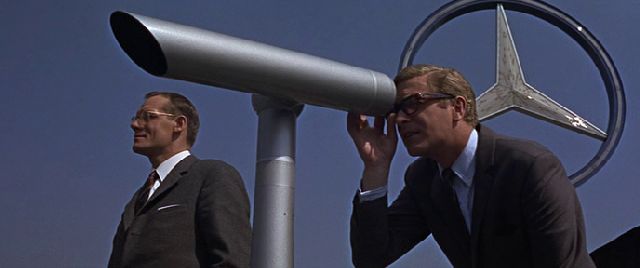
FUNERAL IN BERLIN is one of those classic film time capsules, snapshots of West and East Berlin in the moment in 1966. Hamilton and his crew show the capitalistic and decadent side of West Berlin. Several scenes are shot with the giant Mercedes Benz building and symbol in the background, watching over the city.  Another scene has Harry and Vulkan having dinner at a burlesque club with female impersonators providing the entertainment. The filmmakers did shoot a scene at the actual Checkpoint Charlie with Michael Caine, but they had to film with a long lens as Russian soldiers across the Wall were using mirrors to reflect the sun to disrupt the filming. Berlin during the Cold War still fascinates filmmakers today with recent films like ATOMIC BLONDE (2017) with Charlize Theron in Berlin in 1989 right before the collapse of the Berlin Wall and the Epix TV series BERLIN STATION (2016 - 2019) with a modern take on spying in Berlin in today's present political climate.

A big thanks to the Canadian born Producer Harry Saltzman who brought to us (along with producing partner Albert "Cubby" Broccoli) the greatest secret agent in entertainment history in James Bond but paved the way for more realistic portrayals of intelligence agents with the London based Harry Palmer. Like Sean Connery, Michael Caine would grow weary of the role, not wishing to be typecast, and move on to other projects. FUNERAL IN BERLIN is the apex of the series for me, mixing Cold War politics, a divided city, and Agatha Christie twists for an entertaining, spine-tingling spy film. 


Saturday, January 1, 2022

Au Revoir les Enfants (1987)

When I was in college, I wrote a paper on the French New Wave, a period in the late 50s and early 60s when young French directors like Francois Truffaut, Jean-Luc Godard, and Alain Resnais were pushing the envelope and boundaries with films that played with editing, cinematography and linear storytelling. Truffaut's THE 400 BLOWS (1959) and JULES AND JIM (1962), Godard's BREATHLESS (1960), and Renais's HIROSHIMA, MON AMOUR (1959) and LAST YEAR AT MARIENBAD (1961) were all films made during this French New Wave. Even though I wrote and researched the paper, I think the only film I had actually seen was BREATHLESS.  But there's one French filmmaker who was not considered part of the French New Wave even though he was the same age as Francois Truffaut and his first big hit ELEVATOR TO THE GALLOWS (1958) came out a year before the French New Wave.  That filmmaker was Louis Malle.

Louis Malle was one of those rare foreign film directors who made successful films in France like THE LOVERS (1958) but also was able to break into American cinema.  Malle directed the controversial PRETTY BABY (1978) starring Keith Carradine, Susan Sarandon and Brooke Shields as a teenage prostitute in 1917 New Orleans.  Malle followed that up with the highly acclaimed ATLANTIC CITY (1980) starring Burt Lancaster and Susan Sarandon. Malle would also be married to American actress Candace Bergen. Malle would return to his French roots in 1987 to direct an autobiographical story from his youth at a Catholic boarding school in German occupied France during World War II called AU REVOIR LES ENFANTS (GOODBYE, CHILDREN). I was just rediscovering foreign films around that time.  Wim Wenders German film WINGS OF DESIRE (also 1987) about an angel who wishes to become human was the one that I saw. I remember the posters for AU REVOIR LES ENFANTS but had no idea what the film was about.

Written and directed by Louis Malle based on an actual event he witnessed as a school boy, AU REVOIR LES ENFANTS opens at a train station in Paris in January 1944.  12 year old Julien Quentin (Gaspard Manesse) says goodbye to his mother Madamoiselle Quentin (Francine Racette) as he heads back to boarding school after the Christmas break in the countryside outside of Paris along with his older brother Francois (Stanislas Carre de Malberg). Many affluent Parisian families send their sons to school away from the French capital to avoid bombings. Julien and his classmates return to St. John of the Cross Carmelite Convent, a Catholic all-boys school run by Father Jean (Philippe Morier-Genoud) and Father Michael (Francois Berleand). On the first day of class, Father Jean escorts a new boy to the classroom Jean Bonnet (Raphael Fejto). Since he's the new kid, the other boys tease Jean mercifully.  Julien notices there's something different about Jean but he can't put his finger on it.  Jean doesn't know the Catholic prayers and he doesn't eat pork. 

Julien, who's one of the smarter kids in his class, begins to see Jean as his intellectual adversary. After Julien struggles at his piano lesson with the pretty young French teacher Ms. Davenne (French actress Irene Jacob in her first film), he watches Jean play beautifully for her.  Father Jean asks Julien to be nice to Bonnet. A couple of French collaborators make a surprise inspection of the school. Father Jean quietly whisks Bonnet away. Julien snoops around Jean's belongings. He finds a family photo and a book inscribed to Jean Kippelstein. Although he doesn't know much about them, Julien realizes that Bonnet is Jewish. Julien quizzes Jean about his family. He learns Jean's father is a prisoner and he hasn't heard from his mother in three months.

The school breaks into two teams for an outdoor activity to find a treasure hidden in the woods.  Julien and Jean escape capture from the rival team but get lost in the woods. Julien finds the treasure then reconnects with Jean.  While walking back on a road, the two boys are picked up by a German patrol and taken back to the boarding school. While recovering from exposure in the infirmary, Julien reveals to Jean he knows his secret. Parents Weekend arrives and Julien's mother comes to visit.  She takes her sons Julien and Francois to her favorite restaurant. The Quentin's invite Jean along. While dining, they witness two French collaborators harass a distinguished, older Jewish patron before a table of Germans soldiers intervene, not wishing to have the visiting French families upset. 

The war creeps closer to its end but an event happens at the school that will set in motion a series of terrible consequences.  Joseph (Francois Negret), the lame kitchen helper who buys and sells items from the students on the black market is caught stealing by the cook Madamoiselle Perrin (Jacqueline Paris). Father Jean fires the young man. An air raid sends the teachers and students to shelter but Julien and Jean play hooky. They read a passage from the erotic Arabian Nights and Jean teaches Julien a fun piano piece they play together. A few days later during math class, a Gestapo agent Dr. Muller (Peter Fitz) enters the class looking for Jean Kippelstein.  At first, no one says any thing but Jean gives himself up. The Germans round up two other Jewish students as well as Father Jean for harboring the students. Before Jean is escorted away, he gives his books to Julien. Julien discovers that Joseph is the snitch who gave up the Jewish kids and Father Jean to the Germans as payback for his dismissal. In a voice over as Jean waves goodbye to Julien for the final time (the voice is director Louis Malle), an adult Julien tells the audience that Jean and the other boys died at Auschwitz and Father Jean died in another camp before the war ended. 

AU REVOIR LES ENFANTS is based on an incident director Louis Malle witnessed while attending an all-boys boarding school in Fontainebleau outside of Paris at the end of World War II. The character of Julien represents Malle. Malle's recollections of the school, the priests, and his fellow classmates is perfect. The boys all in their formal Catholic school uniforms with navy blue berets and yellow and blue ties. The horrible conditions with the boys having little to eat at school and no heat or hot water. The tough but compassionate priests and teachers trying to go about their normal duties while their country is occupied by the Germans, often teaching during air raids and blackouts. 

Malle captures perfectly the complicated lives of boys on the verge of becoming young men while dealing with a world war and separation from their families. He shows us the playground politics of bullying, friendship, and competitiveness.  The boys play a game of last man standing on stilts, jousting with each other until only one remains upright. Just outside the view of the teachers, contraband like cigarettes and homemade jars of jam are swapped between the students and the kitchen help Joseph.  It's an all-boys Catholic school but it feels like a prisoner of war camp. The Catholic priests run the school but on the fringes are the German army.  Early in AU REVOIR LES ENFANTS the Germans are just on the periphery. A single German comes to school for confession.  A group of German soldiers leaving a bath house as the students arrive for their first warm bath in weeks.  But gradually, as Jean's identity and freedom becomes riskier and riskier, Germans and French Collaborators become more prevalent, and the noose becomes tighter around young Jean Kippelstein's neck. 

A theme of AU REVOIR LES ENFANTS is Julien's loss of innocence. Julien's a good kid, a bit conceited. In the film's opening scene, he professes to his mother he hates her. But when she comes to visit him weeks later on Parents Weekend, it's evident Julien's a Momma's boy. His bed wetting episodes may be caused by his separation from his parents.  After a rough start with the new student, Julien discovers a kindred spirit in Jean Bonnet aka Kippelstein. They both love the classics like The Three Musketeers. Julien realizes how lucky he is to have a family compared to Jean's situation. In Julien's secluded world, he knows there's a war going on and the Germans are the bad guys but he's not aware of the horrors they can commit like his older brother Francois.  As a Catholic, it seems he's never met a Jewish boy before or knows how dangerous it is to be Jewish during this period. It's only when the Gestapo come to the school and take Jean and Father Jean away that Julien comes face to face with pure evil. An evil punctuated by Julien's discovery that Joseph snitched on the Jewish students and the headmaster, leading to their eventual deaths right before the war ends.

I would argue that AU REVOIR LES ENFANTS is as devastating a film about the Holocaust as Steven Spielberg's SCHINDLER'S LIST (1990) minus the graphic depictions of the Nazis brutality. Director Malle doesn't need the big canvas of the Warsaw ghettos or the Auschwitz concentration camp to show the Nazis malevolence. Their terror seeps even into small towns and boarding schools. Like THE DIARY OF ANNE FRANK (1959), LES ENFANTS is a more intimate look at one young Jewish adolescent trying have a normal life at an all-boys school with death close on his heels. Malle builds the tension slowly, methodically. There are some close calls for young Jean but when their math teacher updates the class on the progress of the Allied armies, it looks like Jean might outlast the Germans.  But the treachery of Joseph to get back at the priests for his expulsion spells doom for the clandestine Jewish students.  The ultimate tragedy is that people like Anne Frank, Jean Kippelstein, and thousands of others needlessly perished when the war was lost for Germany and there was no need to continue this hideous genocide.  

The success of films with young actors is all in the casting. Malle gets it right with Gaspard Manesse as Julien Quentin and Raphael Fejto as Jean Bonnet aka Kippelstein in AU REVOIR LES ENFANTS. At times, the two boys look very similar in their navy blue berets, pale skin, and rosy cheeks. On the LES ENFANTS poster, the boys look like mirror images of one another. But Fejto is much taller than Manesse. Julien's shorter stature doesn't keep him from being mean early in the film. He uses his smarts and his tongue to bully Jean.  But Julien will develop a friendship with Jean that will be tragically cut short. Jean's tallness makes him more awkward physically, but he excels at math and music. We know that Julien representing director Malle will become a filmmaker.  We'll never know what greatness Jean might have become.  He could have become a world-renowned mathematician or an accountant like his father. 

AU REVOIR LES ENFANTS is mostly a male cast, but special mention should go to a couple of female performers. Francine Racette as Julien's doting mother is only in a couple of scenes, but her presence brings out a more sympathetic side to Julien who loves her more than he lets on. For a few brief hours, Mrs. Quentin captivates Jean, reminding him of the important roles that mothers play in shaping their sons.  As the piano teacher Ms. Davenne, French actress Irene Jacob makes her film debut. As the only pretty young woman in this world of male priests, teachers, and students, the innocent Ms. Ravenne is oblivious to all the lovelorn looks and feelings the students have for her.  Jacob would become a favorite of acclaimed Polish director Krzysztof Kieslowski appearing in his films THE DOUBLE LIFE OF VERONIQUE (1991) and RED (1994).

Director Malle would visit this period of 1944 France earlier in his career with the film LACOMBE, LUCIEN (1974) about an 18 year old French boy (Pierre Blaise) who collaborates with the Nazis and falls in love with a Jewish girl (Aurore Clement). It might have been Malle's first stab at trying to get his creative mind around his boarding school memory that had haunted him most of his life. As depressing as AU REVOIR LES ENFANTS may sound, the film has many magical, light moments.  One of my favorites is when the priests and teachers show the students a Charlie Chaplin short film called THE IMMIGRANT (1917). The images of the students and priests and teachers laughing at Chaplin's comic genius are priceless, a brief interlude from the German oppression surrounding the school. 

In the tradition of films about all boys school students like Peter Brook's LORD OF THE FLIES (1963) or Peter Weir's DEAD POETS SOCIETY (1989), AU REVOIR LES ENFANTS captures the world of an all boys boarding school during a time of war.  AU REVOIR LES ENFANTS would win the Golden Lion prize at the Venice Film Festival in 1987 but miss out on the Best Foreign Film at the Academy Awards losing to the Danish film BABETTE'S FEAST.  This French gem is filmmaking at its finest, a tragic real life incident told by a French master named Louis Malle who needed to exorcise this memory that had haunted him. The film world is a rich place because of his personal film.