Monday, September 19, 2011

Mildred Pierce (1945)

My first encounter with actress Joan Crawford were still photos from films late in her career like WHATEVER HAPPENED TO BABY JANE (1962) or STRAIGHT-JACKET (1964) where she looked like a deranged witch with her black arched eyebrows and jet black hair.  Later, Crawford's daughter Christina's none too flattering book Mommie Dearest painted Crawford rather unflatteringly and the film version MOMMIE DEAREST (1981) with Faye Dunaway as Joan Crawford was almost a caricature of the actress and over the top.  Needless to say, I didn't have a good early impression of Joan Crawford or her film career. However, the one Joan Crawford film I had seen was Nicholas Ray's JOHNNY GUITAR (1954), an interesting western with Crawford as the tough owner of a saloon.

But check out the film noir mystery MILDRED PIERCE (1945) based on the novel by hardboiled crime writer James M. Cain and directed by Michael Curtiz and you'll see Joan Crawford was quite beautiful in her heyday and a very good actress, so good that she won the Academy Award for best actress in 1945 for her portrayal of Mildred Pierce Beragon. Crawford had been dropped by film studio MGM as she had just turned 39 years old and Warner Brothers picked up her contract. MILDRED PIERCE was her first film with her new studio.  She must have loved the irony of it all.

Two of author James M. Cain's more famous novels were turned into classics of the film noir genre - DOUBLE INDEMNITY (1944) directed by Billy Wilder and starring Fred MacMurray, Barbara Stanwyck, and Edward G. Robinson and THE POSTMAN ALWAYS RINGS TWICE (1946) starring John Garfield and Lana Turner.  Film noir is a French term (it means "black film") for crime drama and mysteries set after World War II that usually involve a man caught in a moral predicament (murder, adultery, robbery) and a woman who may not be as virtuous as she seems (whore, murderess, femme fatale). The photography is often very stylized, with many scenes taking place at night, shot in a criss cross of black and white shadows like the moon shining through Venetian blinds. MILDRED PIERCE had never interested me primarily because of the title.  It didn't sound very film noirish. Who was this Mildred Pierce? Her name was mundane sounding. Was there murder involved?  There was only one way to find out. I had to watch it.


MILDRED PIERCE begins very film noirish like, with a CITIZEN KANE opening as rich playboy Monte Beragon (Zachary Scott) is shot multiple times by an unknown assailant, falling over and muttering "Mildred" before dying. We next see Mildred Pierce Beragon (Joan Crawford) walking idly at night on the Santa Monica pier. She peers into the water and contemplates jumping before a cop scares her away. On her way back to her car, Mildred passes a club on the pier. The club's owner Wally Fay (Jack Carson) sees her and invites her in for a drink. Wally has recently taken over Mildred's restaurant chains. Mildred invites Wally back to her place, a beach house next to the ocean.  Unbeknownst to Wally, Monte's body lies inside that house. Mildred pretends to go to change, locks Wally in the house, and flees.  The police arrive, find Wally breaking out of the house and Monte's body inside the house. The police show up at Mildred's house (she is the dead Monte's wife after all) and bring her in for questioning. At the police station, we meet all the players in this mystery as Inspector Peterson (Moroni Olsen) questions Mildred.

It's at this point that MILDRED PIERCE turns from film noir mystery to melodrama as director Curtiz turns to flashbacks as Mildred chronicles her climb from pie baking housewife to entrepreneur. Stuck in a sterile marriage to recently unemployed Bert Pierce (Bruce Bennett), Mildred's life revolves around her two girls - younger tomboy Kay (Jo Ann Marlowe) and older sibling Veda Pierce (Ann Blyth). It's Veda that Mildred works so hard for - baking pies so Veda can get new dresses or piano lessons. When Bert begins spending too much time with the widow Mrs. Biederhof (Lee Patrick), Mildred kicks Bert out of the house.

Bert's former insurance partner Wally Fay (Jack Carson) shows up looking for Bert and begins to immediately make a play for Mildred's affections. Knowing she is broke and with bills piling up, Mildred looks for work and lands a waitressing job at a diner run by Ida Corwin (Eve Arden in a nice comedic supporting role). Mildred learns the restaurant business quickly and wishing to make more money so she can buy Veda better things, Mildred turns to Wally to help her start her own restaurant.  Mildred eyes a particular piece of property that happens to be owned by the rich but lazy Monte Beragon (Zachary Scott). Beragon refuses at first but eventually relents and sells her the property.

Mildred's diner (called Mildred's) takes off and she ends up starting up a chain of Mildred's diners. Mildred also begins a relationship with Beragon. After spending a day swimming and cuddling with Monte, Mildred returns to her home to find Bert waiting in the rain. Little Kay has contracted pneumonia and dies. Mildred throws all her energy into her chain of restaurants. But as successful as she becomes, she can't seem to impress her remaining daughter Veda. Veda gets mixed up with a naive young man Ted (John Compton) and they elope only to quickly divorce after Veda pretends to be pregnant.  Veda and Wally force Ted's family to pay a cash settlement to keep her quiet. Fed up with Veda, Mildred throws her beloved daughter out of the house.

Mildred returns from a month long vacation in Mexico to find that Veda is now singing in Wally's nightclub. Mildred wants to reconcile with Veda and decides to marry Monte, who Veda enjoys being around.  Monte agrees to the arranged marriage but only if he gets one third ownership of her restaurant business. Mildred agrees. But Monte and Veda's lavish spending begins to drain Mildred's finances. She has to give up ownership of the business which Wally takes over. Then, Mildred discovers that Monte and Veda may be more than just friends. So Mildred takes a gun and sets out to Monte's beach house to confront him.


MILDRED PIERCE is ground breaking in that the film deals with divorce from the woman's point of view. Mildred is an incredibly resilient, strong female film character.  When she's down on her luck, she doesn't turn to any thing drastic like street walking but takes a menial job as a waitress. As she begins to have success in her job, she does it thru hard work and perseverance and doesn't use her sexuality to climb the ladder of success although she probably could if she wanted to. Her two biggest flaws are her unconditional love toward Veda and her choice in men. The three male leads in MILDRED PIERCE run the gamut of bad masculine tendencies.

Mildred's first husband Bert (Bruce Bennett) is passive and intimidated by Mildred's independence, even turning to another woman for comfort. Bert will grow to admire Mildred as a mother and businesswoman and even become her ally and protector later on.  Wally Fay (Jack Carson) is the wolf-ish former partner of Bert's who tries to bed Mildred almost every time they are together. He's part uncle, part business manager for Mildred, and part horndog. Wally's like a dog in heat, tugging at Mildred's bathrobe belt when he visits her one night. Actor Jack Carson does a nice job making Wally likable when he could have come off as sleazy. Carson may set the world record for biggest smoker ever in a film as well. Monte Beragon (Zachary Scott) is the third cog in Mildred's wheel of men. Monte wastes away his family's fortune drinking and gambling, allergic to working for a living, selling a family piece of property here or there to keep his lavish lifestyle going. He may be enamored with Mildred but it's her money that he's more in love with. Actor Scott played Monte perfectly, self-deprecating one moment then pleasantly sneaky the next.

But there's another triangle in MILDRED PIERCE just as intriguing as the three men and that's the relationship between Mildred and her daughter Veda and Monte. It's a stormy relationship as everything that Mildred does for Veda isn't good enough. Mildred begins to realize Veda is a spoiled brat, a younger version of Monte who Veda begins to spend more and more time with.  Veda lives for money. She figures if she has enough, she can get away from her mother. Beragon seems to drain every one's money - his and Mildred's. Veda wants to live the lifestyle Monte has but she ends up like Monte - spending money that neither of them has. Actress Ann Blyth as Veda is a mother's worst nightmare - a daughter from hell who will blackmail her innocent husband's family for a monetary settlement or steal her mother's husband for herself.

Director Michael Curtiz shows in MILDRED PIERCE why I consider him one of the great chameleons in directing as he can handle any genre just like other great genre directors like Howard Hawks or Stephen Frears.  Curtiz is adept in every style; drama (CASABLANCA), western (DODGE CITY), swashbuckling (THE SEA HAWK or THE ADVENTURES OF ROBIN HOOD), musical (WHITE CHRISTMAS) or horror (THE MYSTERY OF THE WAX MUSEUM). MILDRED is really only film noirish at the beginning and end of the film and Curtiz and screenwriter Ranald MacDougall keep the mystery of who shot Monte Beragon close to their vests until the very end.


MILDRED reminded me of Curtiz's CASABLANCA in a couple of ways.  There is the love triangle of Mildred, Monte, and Veda which CASABLANCA (1943) has with Rick, Ilsa, and Victor.  Also, Curtiz uses Mildred's Restaurant as a character and location just like he did with Rick's Cafe in CASABLANCA and sets many scenes in the diner, often with the hustle and bustle of customers and waitresses in the background for realism.  But where CASABLANCA told Humphrey Bogart Rick's back story in a couple of flashbacks and was mostly set in the present, Curtiz's MILDRED PIERCE has some interesting shifts in time. The film opens dramatically with Monte's murder but when Mildred goes to the police station, she tells her back story in flashbacks to Inspector Pearson. Each time we return briefly to the present, Inspector Pearson reveals a twist to the mystery. Curtiz then returns to the events leading up to Monte's murder at the start of the film.

In DOUBLE INDEMNITY, author Cain uses the insurance clause "double indemnity" where an insurance company will pay double the claim amount if the death is accidental as a motive for Barbara Stanwyck and Fred MacMurray to commit murder.  In MILDRED PIERCE, Wally cautions against Mildred seeking to divorce Bert because of California's "community property" law where both parties would split things evenly 50/50.  Bert could get half of Mildred's share of her business.  Bert turns out not to be interested in Mildred's money, the only one of the three men not after her wealth.  These type of real life claims and laws add to the authenticity of Cain's stories of greed, murder, and revenge.

I am going to make it a point to go to the bookstore and purchase Cain's MILDRED PIERCE.  I'm curious to discover if Mildred was more sexual in the book then the 1945 film was able to show. Both DOUBLE INDEMNITY and THE POSTMAN ALWAYS RINGS TWICE had protagonists who commit adultery yet Mildred seems to refrain from using her sexuality for advantage although she is clearly aware of her sexual freedom. I want to find out if Wally Fay ever made it with Mildred.

HBO recently remade MILDRED PIERCE (2011) as a mini-series starring Kate Winslet and Guy Pearce and directed by Todd Haynes. I'm sure Kate Winslet does a fine job as Mildred but for me, this is Joan Crawford's defining role. At the beginning, I mentioned that Crawford was relegated to acting in horror films toward the end of her career but to see Joan Crawford at her best, pick an afternoon and watch MILDRED PIERCE. I'm glad I did.

Sunday, August 28, 2011

Fright Night (1985 and 2011 versions)

If you wanted to trace the popularity of the vampire in books, television, and movies in the last two decades, I would submit to you that it all started with two modest vampire films that were released in the mid-1980's. Both THE LOST BOYS (1987) and FRIGHT NIGHT (1985) strayed away from the familiar stuffy Victorian Count Dracula plot we had become accustomed to and sexed it up by placing vampires in today's society. I'm not declaring that vampire films set in the modern era hadn't been done already but both LOST BOYS and FRIGHT NIGHT had a great story, above average special effects and make-up, and a sense of humor about the subject matter that paved the way for recent successful vampire franchises like TWILIGHT and television's THE VAMPIRE DIARIES.

I was surprised earlier this year when I read that they were remaking FRIGHT NIGHT with Colin Farrell in the starring role.  All of a sudden, the horror films that came out when I was a teenager or in college are being remade already, as if horror films have become the new Shakespeare play, where a new generation of audience can become familiar with MY BLOODY VALENTINE (1981) or THE THING (1982) or THE HITCHER (1986) instead of OTHELLO or THE TAMING OF THE SHREW or HAMLET.


My love for the original FRIGHT NIGHT comes in three parts. First, I was a big vampires fan as a kid even dressing up as Dracula with my Mom's homemade cape for several Halloweens. The film also resonates to my childhood memories of late night horror television shows like Fright Night which Roddy McDowell's character Peter Vincent hosts in the original film.  For a young kid in Portland, Oregon, my Saturday nights were staying up for Sinister Cinema  hosted by Victor Ives on KATU-TV. Then, there is actor Roddy McDowell who I loved in the PLANET OF THE APES (1968) and subsequent APE sequels.

FRIGHT NIGHT is an extremely simple premise.  What if a vampire moved into the house next door? Writer/Director Tom Holland has said he wanted to do the classic Boy Who Cried Wolf story. The boy is Charlie Brewster (William Ragsdale), a typical high school teenager who lives with his single mother Judy Brewster (Dorothy Fielding) in a modest suburban neighborhood. Charlie is a big fan of the late night horror show Fright Night hosted by famed vampire killer/B horror film actor Peter Vincent (Roddy McDowell).

One night while trying to convince his girl friend Amy Peterson (Amanda Bearse) to have sex with him up in his room, Charlie notices two men carrying a coffin outside his window. Tall, charming, and handsome, Jerry Dandrige (Chris Sarandon) has bought the house next door along with roommate Billy Cole (Jonathan Stark) with intentions of fixing it up. Charlie forgets about what he saw until two separate women he sees go into Dandrige's house turn up dead on the local television news later that week.


Charlie begins snooping around Dandrige's property, even having  a police detective (Art J. Harris) investigate but nothing turns up. Charlie finally meets his new neighbor when Mrs. Brewster invites Dandrige over.  Since a vampire can only enter a house invited, Dandrige returns later that evening to threaten Charlie to mind his own business or else. Since Mrs. Brewster , best friend "Evil" Ed Thompson (Stephen Geoffreys), and girl friend Amy don't believe him, Charlie turns to TV horror film host Peter Vincent (Roddy McDowell) who has killed vampires, at least on TV, to help him.

Vincent, just fired from his TV horror show wants nothing to do with Charlie but reluctantly agrees to visit the so-called vampire Dandrige, after Amy offers to pay him.  Vincent hopes to prove to Charlie that vampires really don't exist except in the movies. At Dandrige's home, Vincent gives Jerry a fake vampire test which he passes. Hoping that Charlie will now believe that Jerry isn't a vampire, Vincent notices as they're leaving that Dandrige doesn't cast any reflection in Vincent's hand mirror.

Dandrige turns Charlie's friend Evil Ed into a vampire and sends him to kill Peter Vincent, who realizes that Dandridge is indeed a vampire. Vincent barely escapes with his life as he fends off Evil Ed with a crucifix.  Vampire Jerry pursues Amy, who reminds him of a former love.  Jerry bites Amy and takes her back to his house. Charlie and Vincent arm themselves with crucifixes and wooden stakes and enter Jerry's home in a final battle to kill the vampire Jerry Dandrige and rescue Amy from the bloodsucker's control.


Director Holland proves that a good vampire film doesn't always have to have an army of vampires to be entertaining. One good scary vampire will do. Jerry is an 80's version of Count Dracula. He dances in nightclubs, wears preppy clothes, and eats an apple a day when he's not drinking the blood of young women. His henchman Billy Cole is the equivalent of Dracula's servant Renfield, a human ally to guard Jerry's coffin during the day and assist with disposing of Jerry's victims. 

FRIGHT NIGHT revels in the vampire lore novelist Bram Stoker created and the Universal and Hammer Dracula films promulgated throughout the years. Crucifixes, bats, wooden stakes, and vampires not casting a reflection or turning into a wolf all play key parts in the film.  FRIGHT NIGHT clearly is a homage to past vampire and horror films and McDowell's character's name Peter Vincent might be a nod to Peter Cushing (who played the vampire killer Van Helsing several times) and horror film star Vincent Price.

FRIGHT NIGHT saves the best for last with some outstanding visual effects by Richard Edlund (GHOSTBUSTERS) that includes Jerry turning into a ferocious over-sized bat and Amy with a grotesque, elongated mouth full of fangs.  But some of the film's best scares are just Jerry and his long fingernails appearing outside a window, ready to grab Vincent. The original FRIGHT NIGHT does what all good horror films should do. It scares you and has fun doing it.

One of the many interesting changes that FRIGHT NIGHT (2011) director Craig Gillespie and writer Marti Noxon alter is the location of the film to the city that plays all night and sleeps during the day - Las Vegas. What better locale for a vampire to live and thrive in then Sin City. Even better, Charlie Brewster (Anton Yelchin) and his mother Jane (Toni Collette), a realtor, live in an island suburb on the desert outskirts of Las Vegas, one of those developments that got hit by the recent bad economic times with many houses foreclosed or empty.

This time, it's not Charlie who notices that a vampire is in their midst but Charlie's former best friend Ed (Christopher Mintz-Plasse). Evil Ed points out to Charlie that many of their classmates are not showing up to class anymore. Ed has noted that it's mostly kids in their neighborhood and has pinpointed the root cause as Charlie's handsome neighbor Jerry (Colin Farrell). Charlie scoffs at Ed's accusations as Charlie is more into his new hot girlfriend Amy (Imogen Poots) then Ed's vampire conspiracy theories. But then Ed vanishes.

Charlie finds Ed's notes and surveillance video on Jerry. He spies on Jerry from his window as Jerry invites the beautiful neighbor Doris (Emily Montague) over for a beer. When Charlie hears a scream later that night and then Jerry drives off, Charlies sneaks into Jerry's house.  He finds Doris locked in a secret room behind Jerry's closet. Jerry returns and Charlie sees with his own eyes that Jerry is a vampire as he takes a bite out of Doris.


Charlie turns to Peter Vincent (David Tennant), a cross between illusionist Criss Angel and British actor Russell Brand, to help him. Vincent is the star of Fright Night, a horror themed illusion show at the Hard Rock Hotel and Casino. Vincent claims to be an expert on vampires, even collecting supernatural weapons. He tells Charlie vampires don't exist and has him thrown out of his lavish suite.

Director Gillespie does a nice job in the beginning setting up the Charlie/Jerry showdown and the second half of the film delivers. Jerry drives Charlie, Mrs. Brewster, and Amy out of their house by pumping gas into their home and lighting a match, blowing up their home. The three flee into the desert at night only to be chased by Jerry in a truck. The three are able to escape temporarily from Jerry. Charlie and Amy return to see Vincent.  Vincent tells them what kind of vampire they're up against.  Evil Ed, now a vampire, shows up to kill Vincent, sent by Jerry. As Charlie and Vincent battle with Ed, Jerry grabs Amy, putting her under his spell and takes her back to his house. Charlie and Vincent arm themselves with Vincent's arsenal of vampire weapons and return to duel with Jerry and his collection of victims underneath Jerry's home.

The new FRIGHT NIGHT does an excellent job of paying homage to the original while adding enough new story points to make it more than just a copy cat remake.  Writer Moxon wrote for the BUFFY THE VAMPIRE SLAYER television show and knows her vampire universe very well.  Fans of the original will appreciate Jerry snacking on an apple or Amy wearing a white dress in Jerry's subterranean lair when Charlie comes to rescue her and she greets him with her elongated set of fangs. The filmmakers even cast actor Chris Sarandon (the original Jerry) in a cameo as a poor driver who comes across the Brewsters and Amy battling Jerry at night on a deserted highway.


Colin Farrell plays Jerry as more of a working class predator and survivalist then Chris Sarandon's seductive Jerry. Farrell's Jerry is feral as he uses his sense of smell and hearing almost like an animal to find his victims or detect intruders. David Tennant's Peter Vincent is a bit sexier than Roddy McDowell's conservative Vincent. The new Vincent collects vampire and other supernatural weapons and we later discover that Vincent and Jerry have a history that goes back to Vincent's childhood when his parents were killed by a vampire.  Mrs. Brewster (Toni Collette) also has a bigger role in the new version. She flirts with Jerry at first but soon discovers that Charlie's fears regarding neighbor Jerry may be true. She's not going to let Jerry hurt her son and plays a big part in their escaping from Jerry during the highway chase.

One thing I realized after watching both FRIGHT NIGHT films is how brave the Charlie Brewster character is. Maybe because Brewster never had his father around to protect him and had to play that role for his mother and girlfriend, Brewster is not afraid to die to protect the women he loves from Jerry. I wasn't sure I was going to like Anton Yelchin as the new Charlie but he does an admirable job of playing a teenager emerging from his geek stage into a cooler guy stage. How many teenagers do you know who would wear a fire retardant suit and light themselves on fire to destroy a vampire ... and maybe himself as well?


Evil Ed, on the other hand, seems destined to become a vampire. Just like Jerry, Ed is an outcast, different.  Ed's teased at school, never really fitting in with the popular crowd. He doesn't have a girlfriend like Charlie. It makes sense that becoming a vampire is Ed's way of becoming cool. Christopher Mintz-Plasse as Ed adds yet another memorable fringe character he has played in films like SUPERBAD (2007) and ROLE MODELS (2008). Thankfully, he didn't imitate the original Evil Ed Stephen Geoffrey's obnoxious laugh.


As I finish this new FRIGHT NIGHT review, the film has been out for two weeks and surprisingly has not done very well at the box office despite getting pretty good reviews from critics. My hypothesis is that not enough parents of my generation have shown their kids the original FRIGHT NIGHT to prepare them for the remake.  I showed the original to my kids a few months ago and they enjoyed it as much as I did the first time. It's hard to believe its been 26 years since FRIGHT NIGHT was first released. The new FRIGHT NIGHT filmmakers may have a cult classic on their hands, they just may have to wait a few years for it to be discovered, much like the original FRIGHT NIGHT.

Monday, August 15, 2011

Sahara (1943)

With the United States fully committed to World War II after December 1941, films promoting the Allies fight against the Axis were not far behind.  John Wayne did his duty cinematically, starring in films like FLYING TIGERS (1942) or BACK TO BATAAN (1945).  Although entertaining, these films were just a more creative form of propaganda, to sell war bonds and stir national support.  With real life villains like Hitler, Mussolini, and Tojo, it wasn't hard to do.  Another film star who made an interesting war film during WWII was Humphrey Bogart.  But it's not CASABLANCA that I'm referring to.  It's a 1943 tank film Bogart starred in called SAHARA.

Although CASABLANCA wasn't a success when it first came out, that didn't stop the studios from finding other exotic one word titles for their films.  SAHARA may sound sexy and mysterious but it's a gritty, well-made war film that doesn't pull any punches in its portrayal of desert warfare as well as the enemy the Allies were fighting.  Directed by Zoltan Korda and co-written by Korda and John Howard Lawson, SAHARA focuses on America's early entry into World War II in North Africa as we joined the British 8th Army to gain desert warfare experience.

The film opens with an American tank crew cut off from its British allies and bombarded by German artillery shells somewhere between Egypt and Libya. Stuck in no man's land and about to be overrun, Sgt Joe Gunn (Humphrey Bogart) and his two man crew Jimmy Doyle (Dan Duryea) and Waco Hoyt (Bruce Bennett) retreat into the Sahara desert hoping to hook up with another British or American tank battalion.  As the tank makes its way over sandy dunes, it becomes a sort of Noah's Ark. First, it picks up five British soldiers led by Captain Jason Halliday (Richard Nugent) with a South African named Stegman (Guy Kingsford) and a French soldier Jean Leroux (Louis T. Mercier) thrown in for good measure.  Further along, the group comes across a British Sudanese soldier Sgt. Major Tambul (Rex Ingram) marching with his Italian prisoner of war Giuseppe (J. Carroll Naish).


Tambul offers to lead the tank group to a well that may be full of water but it's bone dry when they reach it. A German fighter plane on patrol piloted by Captain von Schletow (Kurt Krueger) spots the lone tank and dives at them with guns blazing. Joe lulls the German ace into thinking they're out of ammunition and shoots the plane down with his tank, capturing the arrogant German pilot, adding yet another nationality to his menagerie.  Joe and the group finally reach the ruins of a desert fort where they can settle down and decide their next move.

Director Korda uses the desert outpost as a chance to showcase the collection of soldiers. There's a nice scene where Korda cross cuts between Joe and Giuseppe learning about one other in one part of the fort while Tambul and Waco find they have much in common as well in another section of the ruins. If they are to survive, this group of Americans, British, French, South African, and Italians has to work as a team.  Tambul discovers that the fort's well contains some water and the group work together to bottle as much as they can.

Following behind the ragtag band of brothers, a German battalion led by Major Von Falken (John Wengraf), also lost in the Sahara, makes its way toward the ruins in search of water. Von Falken sends a scout car ahead.  Joe and the others ambush the scout car and take two more Germans prisoner.  After interrogating them, Joe releases the POWs, tricking them into thinking they have more water than they do.  Joe's hope is to hold off the German battalion as long as possible.  He sends Waco off with the scout car in the other direction to find help. The Germans arrive and a series of battles occur as the nine remaining Allies try to hold off an entire German battalion until help arrives.

Bogart's Joe Gunn is an American Everyman, fighting the Germans in the name of freedom and liberty for all. He's not married, has no girlfriend except for his beloved tank which he refers to as Lulubelle. Besides a tank, Bogart will later whisper sweet nothings to a boat the Queen in THE AFRICAN QUEEN (1951). Sgt Joe has a nice speech mid-way through the film, meant to inspire his fellow soldiers to fight the good fight in their last stand but he's also talking to the audience in 1943, urging them to support the Allies at all costs and never surrender to the evil confronting them. It's a brief, powerful speech.


Bogart is steady as Joe, never flashy or over the top. Dan Duryea as Jimmy and Bruce Bennett as Waco have a nice camaraderie going throughout the film. An ongoing gag in SAHARA has Jimmy and Waco wagering on everything from whether Joe will let the Italian POW Giuseppe ride with them on the tank to whether Waco or Jimmy will make it out of the desert alive. Surprisingly, director Korda doesn't romanticize the stand off between Allies and the Germans. Very few of either side will be alive at the end of the film.

Director Korda is a good choice for this desert war film having directed another desert adventure film FOUR FEATHERS in 1939.  The locations out near Palm Springs, California and Yuma, Arizona make SAHARA all the more authentic. The filmmakers even used American soldiers from the U.S. IV Armored Corps who were training in the area as German extras. Like any desert film, the soldiers must deal with the usual cliches like fierce sand storms and lack of water. Korda keeps the film fresh and realistic, but he does throw in the ultimate war cliche when British soldier Fred Clarkson (a young Lloyd Bridges) pulls out a photo of his sweetheart to show his mates. That is the kiss of death for any soldier in a war film.  Clarkson will get shot by the German pilot Schletow soon after.  Of all people, director Oliver Stone would kill off one of his soldiers the same way in PLATOON (1986). Never show a photo of your girl friend to your buddies while in the field of battle. At least not in a war film.

Like many European directors and screenwriters, Korda, born in Austria-Hungary (now Hungary), does not hide his contempt toward the Axis characters whose real life countrymen had invaded his nation. Both Schletow, the handsome blond Aryan pilot and Major Von Falken are shown as cold and sneaky men, completely brainwashed by the Nazi agenda. Von Falken even has his soldiers shoot "Frenchie" Leroux in the back after a brief cease fire, white flag still in Leroux's hand. Not surprisingly, during SAHARA'S final battle, the racist Schletow escapes from his cell only to be chased down and killed by the black Sgt Major Tambul, the symbolism not lost on anyone. Only the Italian Giuseppe is portrayed as sympathetic. He doesn't believe in Mussolini's cause, he's just a man fighting for the wrong side, hoping to return to see his child.

SAHARA caught me by surprise with its LOST PATROL like plot and its many twists and turns.  It's clearly got an agenda, to support the Allies and to defeat the Axis powers, but director Korda does it in an entertaining, engaging manner. Knowing a good plot when they had one, Columbia Pictures would make a western loosely based on SAHARA in 1953 called LAST OF THE COMANCHES.  Ironically, Lloyd Bridges, who had a small part in SAHARA would also co-star in COMANCHES. I just hope he didn't show a picture of his favorite gal to anyone this time.

Sunday, July 31, 2011

Radio Days (1987)

Comedian, writer, actor, film director and auteur Woody Allen has had his ups and downs throughout his prolific career. Success came early with his funny film spoofs like TAKE THE MONEY AND RUN (1969) and SLEEPER (1973), Allen hit his zenith with the Oscar winning ANNIE HALL (1977) and the critically acclaimed MANHATTAN (1979). But since 1990, Allen has had more misses (SHADOWS AND FOG, EVERYONE SAYS I LOVE YOU, and SCOOP) then semi-hits (VICKI CRISTINA BARCELONA or the recent MIDNIGHT IN PARIS).

But in the mid to late 80's, Woody Allen had, in my opinion, a stretch of four films (you could throw in a fifth - BROADWAY DANNY ROSE too) that are some of my favorites in his film resume. Three of them - ZELIG (1983), THE PURPLE ROSE OF CAIRO (1985), and HANNAH AND HER SISTERS (1986) I had seen before.  But RADIO DAYS (1987), Allen's nostalgic revisit to his growing up during the Golden Age of Radio was the one I had not seen.

One reason I enjoyed RADIO DAYS is that Allen does not appear in the film. He's the narrator of the film. I like Woody Allen as an actor but sometimes his shtick gets a tad old. Playing the Allen character as a youth is Seth Green. Having Allen as the voice over is a wonderful device as he is a great storyteller. As Allen regales us with stories of his favorite radio shows early in the film, it reminded me of my father telling me about his favorite radio shows when he was a kid like The Shadow or Sky King or Jack Armstrong, the All-American Boy. In the 30's and 40's, radio was the television, the Internet, MTV, ESPN, CNN, and Entertainment Tonight all rolled into one.


RADIO DAYS is a series of stories, memories, and anecdotes of radio's heyday framed around Allen's growing up in a lower middle class Jewish family in Rockaway, New York just before and during World War II. We meet young Joe (Seth Green) who dreams up ways of buying a replica of the secret decoder ring worn by his radio hero the Masked Avenger. Joe's father (Michael Tucker) has a million get rich schemes while hiding his true profession from Joe. Uncle Abe (Josh Mostel) brings home heaps of fish every day to his exasperated wife Ceil (Renee Lippin) to cook. Cousin Ruthie (Joy Newman) listens to the neighbor's phone calls on the party line ("Mrs. Waldbaum's having her ovaries taken out," she whispers to the family). Aunt Bea (Dianne Wiest) dreams of getting married but always ends up with the wrong man. And Joe's mother (Julie Kavner who would go on to become the voice for Marge Simpson) oversees her sweet but slightly nutty family.

Interwoven through their stories are the stars and shows of Radio: the Masked Avenger (who's really the bald, short Wallace Shawn); Breakfast with Irene and Roger; Guess That Tune; Radio G-Man Biff Baxter; Bill Kern and his Legends of Sports; and plenty of great music by the best big bands and orchestras of that era. Allen weaves in Orson Welles phony broadcast of a Martian invasion on one of Aunt Bea's dates. He also reminds us that not everything on the radio is wonderful.  The first hand account of a young girl who fell down a well in Pennsylvania ends in tragedy when the reporter announces her rescuers have brought her up dead.


 One storyline that Allen uses as the bridge between his family stories and the world of radio is the fall and rise of Sally White (Mia Farrow) from Cigarette Girl at an uptown Manhattan club to gossip queen of the airwaves. Sally dreams of radio stardom but with her squeaky Brooklyn accent, her closest brush with the radio is casual trysts with radio stars like Roger (David Warrilow) from Breakfast with Irene and Roger. Fired from her Cigarette Girl gig, Sally's luck sort of changes when she accidentally witnesses her boss get shot at her new job. Hit man Rocco (Danny Aiello) takes her back to his Mom's house to finish her off but they discover they're both from the same Brooklyn neighborhood. Rocco gets her a part on a radio drama but the attack on Pearl Harbor interrupts that dream. We watch Sally go from singing to the troops to doing radio voice overs for a laxative commercial. Only after she takes diction lessons, does she find her true calling. She becomes a gossip columnist, reporting on all the show business shenanigans she saw when she was a cigarette and coat check girl.


With Sally's story, Allen captures all the different facets of the radio business. Just like when silent films went to sound, the right voice can mean all the difference in a radio performer's success or failure. Radio offered a variety of professions: singer, musician, news reporter, sports commentator, gossip columnist, actor or actress, commercial voice over talent, or host of game shows. Allen brings it all full circle on New Year's Eve 1944 as Sally and many other radio stars (Irene and Roger, the Masked Avenger, Biff Baxter) go on top of the roof to bring in the New Year. They sense the Age of Radio is almost over, lamenting it's imminent demise with the coming new year.

Allen tapped into some magical creative period with RADIO DAYS and the other films. Of the four films, HANNAH AND HER SISTERS is the only modern one. But with ZELIG, PURPLE ROSE, and RADIO DAYS, he seems sentimental, revisiting childhood memories in one sense but also exploring the first half of the 20th Century and its newest diversions -- cinema and the radio. ZELIG is really his only special effects movie with Allen as Zelig inserted into historical newsreel footage and hobnobbing with historical figures, celebrities, and sports figures from the 1920's. In THE PURPLE ROSE OF CAIRO celluloid star Jeff Daniels literally jumps out of the screen and into the real life of Depression-era waitress Mia Farrow. With RADIO DAYS, he's waxing nostalgia for his youth, the music and stars of the radio reminding him of events and stories in his formative years.

Actors from other Woody Allen films make small appearances in RADIO DAYS: Diane Keaton (ANNIE HALL), Tony Roberts (MANHATTAN), and Jeff Daniels (THE PURPLE ROSE OF CAIRO) all appear in bit parts. If you look closely, you will also see William H. Macy and Larry David in brief roles. Woody  Allen dated his leading ladies and RADIO DAYS is the only film that has his previous girlfriend Diane Keaton and his then current girlfriend Mia Farrow in the same film.


Filmmaking is a collaborative process and I think Allen's success during this period can also be attributed to his editor Susan Morse, cinematographer Carlo Di Palma, costume designer Jeffrey Kurland, and casting director Juliet Taylor who were involved in RADIO DAYS as well as some or all of the other three films. There is a synchronicity that happens when a director works with the same actors and crew. Creative sparks happen and everyone does their best work.

If RADIO DAYS was the end of Woody Allen's sentimental phase, his next phase would become a bit darker both artistically and professionally.  CRIMES AND MISDEMEANORS (1989) and HUSBANDS AND WIVES (1992) to name a couple of films made after RADIO DAYS are meaner films about destructive relationships as people cheat on each other.  Allen would eventually leave Mia Farrow for Farrow's adopted daughter Soon-Yi Previn in 1992. And in my opinion, Allen's films got less interesting for a period of time after RADIO DAYS. But it looks like Woody Allen may have refound his magic again with MIDNIGHT IN PARIS (2011) which again has him mixing reality with fantasy. It was a style that he found success with during the mid-80's which RADIO DAYS can be counted as one of those hits.

Sunday, July 17, 2011

Rio Grande (1950)

Some time in the last 10 years, I developed a man crush on the film collaboration between actor John Wayne and film director John Ford. Wayne and Ford's greatest masterpiece would be the 1956 classic western THE SEARCHERS but altogether, the two of them made 13 films together. Recently, actor Robert DeNiro and director Martin Scorsese combined on eight films together.  Johnny Depp and Tim Burton have worked together on seven films to date.

One of my favorite Wayne/Ford collaborations was their 'Cavalry Trilogy' - consisting of FORT APACHE (1948), SHE WORE A YELLOW RIBBON (1949), and RIO GRANDE (1950).  All were shot around Moab, Utah and Monument Valley. All are about life in the U.S. Cavalry, usually set in distant outposts, surrounded by warring Indians. FORT APACHE is probably the most epic of the three. Henry Fonda plays a General Custer-like officer who leads his troops on a doomed raid against the Indians.  SHE WORE A YELLOW RIBBON (the only one in color) is a character study of an aging Captain (John Wayne) counting off his last days in the army while trying to head off an Indian war.  RIO GRANDE is a culmination of many of the themes from the first two films - honor, duty, friendship, and most of all family.


Director Ford created a film family throughout his career, often using the same actors over and over again. In the Cavalry Trilogy, actors John Wayne and Victor McLaglen appear in all three Cavalry films. John Agar, George O'Brien, Ben Johnson, Harry Carey, Jr, and Grant Withers appear in two of the three films. Several other Ford stock actors make uncredited appearances in many of them as well. Actors McLaglen and Johnson even have the same character name in two of the films but different military ranks. In RIO GRANDE, the Yorke family is at the center of the story, screen play by James Kevin McGuinness, based on a Saturday Evening Post story by James Warner Bellah. Bellah also provided the stories for both FORT APACHE and SHE WORE A YELLOW RIBBON.

RIO GRANDE opens with Lieutenant Colonel Kirby Yorke (John Wayne) and his troop returning from another patrol along the Rio Grande, bringing with them a captured Apache chief and some other rebellious Indians. As the Cavalry settles back in to regular Army life, some new recruits show up including Yorke's son Trooper Jefferson Yorke (Claude Jarman, Jr). Jefferson, newly kicked out of West Point Military Academy for poor grades, has barely met or ever known his father. Their reunion is a coincidence. The family dynamics get even more complicated when Jefferson's mother (and Col Yorke's estranged wife) Kathleen Yorke (Maureen O'Hara) arrives from the East Coast to bring her son Jefferson back home.


Within this framework, director Ford introduces the supporting characters and explores subplots, something he does so expertly throughout the Cavalry trilogy. Young Jefferson will bond with new recruits Trooper Travis Tyree (Ben Johnson) and Trooper Daniel "Sandy" Boone (Harry Carey, Jr), a friendship that will come in handy at the film's climax. Tyree harbors a secret (he may have killed a man in self defense in Texas) that the U.S. Deputy Marshal (Grant Withers) wants to arrest him for. The recruits are under the watchful eye of the fatherly Sgt. Major Timothy Quincannon  (Victor McLaglen), who provides the requisite Irish humor that is found in many of Ford's films.

As the three Yorke family members begin to reacquaint themselves with each other, an Apache party swoops in one night and breaks out the captured Indians. Yorke and his men give chase but the renegade Indians make it back across the Rio Grande.  Yorke meets up with a small contingent of the Mexican army on a sand bar in the middle of the river, hoping for permission to cross into Mexico and fight the various tribes that are congregating. The Mexican general politely declines his request. Yorke reports back to his commanding officer, Lieutenant General Philip Sheridan (J. Carroll Naish) who makes a daring decision. Sheridan gives Yorke permission to cross into Mexico. He's tired of the Indians "hit and run" tactics.  Sheridan's decision foreshadows the U.S. Army brass ninety years later giving unauthorized permission to cross into Laos or Cambodia to chase the Viet Cong.


York assigns his son Jeff to escort his mother Kathleen and the rest of the women and children to Fort Bliss, away from harm's way.  But the Indians ambush the wagon train and kidnap all the children. Tyree, now a fugitive but hiding on the outskirts of the outpost, rejoins with Lt. Yorke and his men with vital information. He knows where the Indians are hanging out and volunteers for a rescue mission to rescue the children from an old Mexican church with the help of Jeff and Sandy.  As the three troopers sneak into the dusty Mexican town and secure the church and children, Yorke and his cavalry ride in for a showdown with the warring Indian tribes.

The Rio Grande is a great metaphor, representing the division of many things throughout the film. The river physically divides the U.S. from Mexico and the U.S. Cavalry from the various Indian marauders. But the river also represents the psychological split in Yorke's family. Yorke's separation from his wife Kathleen and his son Jeff. Family life versus the U.S. Cavalry life. Neither mother or son know Kirby very well. "He's a lonely man," Kathleen tells her son. RIO GRANDE also explores the divide of a nation from war and the healing process of the young United States of America. The Civil War is almost a dozen years past and the Cavalry is full of both Yankees and Rebels, living and fighting together under one flag. Once enemies, the men and women are all united again but the wounds are deep. From what I could gather, Kirby, Quincannon, and Sheridan fought for the North in the Civil War and under orders, burned down a southern plantation crop that happened to belong to Kathleen's family. That's how Kirby and Kathleen met. Not exactly the smoothest romance.

Whether in THE QUIET MAN (1952) or RIO GRANDE, actors Wayne and O'Hara are a strong pair of lovers. No one play independent one moment and vulnerable the next better than O'Hara. Ford said he didn't know Wayne could really act until he saw him in Howard Hawks' RED RIVER (1948) but I think Wayne is fantastic in RIO GRANDE and the other Cavalry films.  The shots of Wayne watching his son with pride from afar or his concern for his son's safety at times are touching. At the film's climax, Kirby takes an arrow in the chest. It's son Jefferson who pulls the arrow out, releasing all the years of hostility and resentment built up for his father, bonding them forever. Director Ford makes great use of the Regimental Musicians (Sons of the Pioneers), a quartet that sings throughout the film and seem to express the feelings that Kirby and Kathleen have as they try to reconcile their complicated relationship.

Most of the showdowns that director Ford stages in his films like FORT APACHE or THE SEARCHERS are usually out in the wide open. But in RIO GRANDE, the climax is in a dusty Mexican border town with its lone white church.  It's a nice change and separates GRANDE from the other Cavalry films.  Spaghetti western director Sergio Leone must have liked it to as he definitely borrows the sparse town and white church motif in A FISTFUL OF DOLLARS (1964) and FOR A FEW DOLLARS MORE (1965). Even though the Indians are the bad guys, Ford respects them and never treats them as caricatures or stock characters. At the end of the film, General Sheridan awards medals to the brave Troopers Jeff, Sandy, and Tyree but another medal for bravery is awarded to an Indian scout.


 Ford wants authenticity in his Cavalry films, what life was like on the outpost. He shows the wives washing the soldiers' clothes in the river. If two recruits have a dispute, they settle it by the rules of Soldier's fight (with Quincannon as referee). One of the most amazing sequences is when Quincannon shows the new recruits how the U.S. Cavalry ride horses like the ancient Romans i.e. the Cavalry man stands on two horses (a foot on each horse's back) and rides around a ring, upright, and even jumping over six-foot bars.  It's an unbelievable sight.

Besides Wayne and O'Hara, all the actors in RIO GRANDE are excellent with every one of them having an opportunity to shine. A couple I might single out that might not normally be praised include Harry Carey, Jr as Trooper Sandy Boone. Carey played a rival for Joanna Dru's affections in SHE WORE A YELLOW RIBBON but didn't have many lines but his deadpan quips in GRANDE are funny.  The other unsung standout is Chill Willis as Dr. Wilkins, an unorthodox regimental surgeon who provides Quincannon with his liquor and has no trouble letting Trooper Tyree escape from his doctor's quarters to the chagrin of the U.S. Marshal.

Each of the Cavalry films is unique enough to stand on its own but if you can try to watch all three of them. RIO GRANDE is a nice culmination of themes and images that Ford began with FORT APACHE and SHE WORE A YELLOW RIBBON. Ford and Wayne may have saved the best for last.

Saturday, June 18, 2011

The Lodger (1944)

It probably has to do with his name but Jack the Ripper has always intrigued me. Yes, the name is catchy. The killer actually signed one of his letters to the police as Jack the Ripper. The Ripper was obviously proud of his handiwork which made a bloody mess of his victims. Jack the Ripper was never caught nor was a suspect ever identified which makes his mystique all the more long lasting. My first encounter with Jack the Ripper was through a scary fictional short story by Robert Bloch (the author of PSYCHO) called Yours Truly, Jack the Ripper.

Although he may not be as popular as Dr. Jekyll and Mr. Hyde in the annals of film, Jack the Ripper has appeared in many movies.  In TIME AFTER TIME (1979), novelist H.G. Wells (Malcolm McDowell) chases Jack the Ripper (David Warner) via Wells' time machine from Victorian England to modern day San Francisco. More recently, FROM HELL (2001), based on the popular graphic novel written by Alan Moore starred Johnny Depp as an opium addicted detective tracking Jack the Ripper in 1888, a trail that leads him to the royal family.


THE LODGER (1944) based on Marie Belloc Lowndes novel has Jack the Ripper as a character. It is not the first film version of her novel. Alfred Hitchcock first filmed THE LODGER in 1927, one of his first films and his only silent film. In Hitchcock's THE LODGER, the killer is known as the Avenger.  In the 1944 version, directed by John Brahm and written by Barre Lyndon (who would write another version of THE LODGER titled THE MAN IN THE ATTIC starring Jack Palance in 1953), the killer is referred to mostly as the Ripper. In my vision of Jack the Ripper, he walks the fog shrouded streets of London in a black cloak and top hat, his knife held tightly against his side. THE LODGER upholds that image somewhat, sometimes for better, sometimes not.

THE LODGER is about a lodger, a person who rents out a room in another person's house. Only in this case, the lodger may or may not be Jack the Ripper. The film opens on a foggy night in 1888 in Whitechapel, a district in the poorer part of London. Another Ripper murder occurs (offscreen). A local actress has been savagely murdered. The police quickly converge on the murder scene by foot and horseback but the killer has vanished. Later that night, in an upper class part of London, a tall heavy set man named Slade (Laird Cregar) carrying a doctor's bag, rents a spare room from Robert Bonting (Sir Cedric Hardwicke) and his wife Ellen (Sara Allgood).  Slade is a bit odd, soft spoken for such a big man with a piercing stare. He says he's a pathologist. He works odd hours, often at night. He comes and goes through the back door. He loathes the portraits of Victorian actresses in his room and flips the frames over. Could Slade be ...? But, he pays his rent in advance, winning over Mrs. Bonting.


Also living with the Bonting's is their niece Kitty Langley (Merle Oberon), a famous singer/dancer who performs to big crowds at the Piccadilly Square Theater. Kitty is introduced to the eccentric lodger Mr. Slade. Slade seems to have a disdain for actresses and singers. Kitty invites him to come to one of her performances. When another actress Annie Rowley (Helena Pickard) is murdered, witnesses tell the police the killer carried a small black bag.  Mrs. Bonting catches Slade burning his medical bag the following morning and becomes suspicious.  Leading the Ripper investigation is Inspector John Warwick (George Sanders). Warwick pays a visit to Kitty who knew the victim Annie. Warwick sees a pattern in the Ripper's murders and warns Kitty to be careful. Mrs. Bonting begins to suspect Slade may be the Ripper but Mr. Bonting scoffs at the notion.

Kitty follows Slade one day to see where the eccentric lodger goes. She discovers Slade does work at a university medical office.  A few days later, after yet another Ripper murder, Kitty catches Slade burning some clothes that seem to be stained with blood. He says the blood was from an experiment at his laboratory. Kitty has her suspicions now. When Inspector Warwick pays Kitty another visit and meets Slade, Warwick tells Slade his theories on the Jack the Ripper killings. Slade nervously listens before excusing himself. Now Warwick suspects Slade but he needs proof.


Warwick and Bonting attempt to match Slade's fingerprints from a water glass with fingerprints found at the crime scenes but the prints are inconclusive. It's the night of Kitty's big show.  Slade sneaks out of the house and arrives at the theater to watch Kitty perform, his murderous impulses building in him as Kitty sings and dances to a packed house. Warwick has the police staked out throughout the theater but Slade manages to slip into Kitty's dressing room. This time, Slade wants to take Kitty away with him but Kitty's screams alert Warwick and the police. A chase ensures throughout the theater as Warwick and the police try to capture Slade/the Ripper before he can kill again.

I would have liked to have seen more of the Ripper stalking the streets, hiding in the shadows, his dark shape silhouetted by the fog and gas lamps but director Brahm seemed deadset on barely showing the Ripper when it's obvious that Slade is the Ripper.  Only at the end of the film does Slade/the Ripper actually pull out a knife. But where the film skimps on the physical presence of the Ripper on the streets of London, THE LODGER makes up for it with a chilling psychological profile of Slade.  His hatred for theater actresses stems from the death of his brother, an artist who killed himself over an actress. Slade tells Kitty it was the "beauty of women that led him to his destruction." Slade sees actresses as seducers of men. "Lovely women drive men down," he tells Kitty. His devotion to his dead brother (he carries a small portrait of his dead brother) and the vengeance he seeks against the type of women who destroyed his brother is creepy.


Slade also talks about his love of the river, how he finds it soothing. The water allows Slade to cleanse his hands of blood, to wash his sins from himself. Ironically, when Slade/the Ripper is cornered by Warwick and the police in the film's finale, Slade jumps through a window into the Thames River where he supposedly dies.  But in the final frames, as Slade's body floats by, it appears as though his leg kicks out in the water. Perhaps the water has resurrected the Ripper.

There is also a sexual tone to the Ripper's killings. The murders seem to be a sexual climax for Slade. Inspector Warwick notes that the killings are cyclical - every 10 to 12 days. That's the amount of time it takes for Slade/Ripper to become aroused for his next slaying. Whereas Slade has hatred for most of the actresses he encounters, his glare seem lustful toward Kitty.  She's different. She's nice to him. When he corners her after her performance, he wants to take her with him, not kill her like his previous victims.

One of appealing aspects of THE LODGER are its three leading actors.  Merle Oberon (who I had never seen in a film before) is stunning as Kitty.  With her beautiful, porcelain face, Oberon looks like she could play Marie Antoinette or Catherine the Great. Her Kitty is a strong character. At one point in THE LODGER, she becomes the detective, following Slade to his university medical pathology lab, trying to learn more about this mysterious behemoth.  She's cool under pressure, even when he surprises her in her dressing room. Oberon also gets to show off her musical talents, performing in two musical numbers.


I've become a huge George Sanders fan since starting this blog and this is my third film I've reviewed that he's in. Sanders plays Inspector Warwick in THE LODGER. Sanders seemed to play either cads in films like REBECCA (1940) or THE GHOST AND MRS. MUIR (1947) or charming heroes in FOREIGN CORRESPONDENT (1940) or THE SAINT STRIKES BACK (1939).  Even as a man of the law, Warwick has no problem trying to woo Kitty who he is sworn to protect.  In today's world, that would be considered sexual harassment. In 1944, it was romantic.  Kitty and Warwick have a great scene where he invites her to the Scotland Yard Black Museum for a date and some questions about the lodger. Warwick flirts with her as she asks about murder weapons and nooses that killed numerous famous London killers. It's a nice bit of levity in this gripping tale.

The real revelation of THE LODGER is Laird Cregar as Slade/the Ripper.  Like Oberon, I had never seen Cregar before but his portrayal of the famous killer is haunting. He brings a pathos to his role with his soft voice but hulking exterior. The audience sympathizes with him for the loss of his brother. At times, Slade is charming and almost like an overgrown child. But director Brahm along with cinematographer Lucien Ballard (who would shoot many of Sam Peckinpah's films) know how to make Slade menacing too. Slade is often photographed from a low angle to make him look large and menacing. Ballard uses low key lights to highlight Slade's deathly stare. The deranged look that Slade/the Ripper gives the police when they have him trapped and cornered like an animal in the theater's rafters is unforgettable.

There would be pathos in actor Laird Cregar's life.  An up and coming actor who could play comedy or drama in films like HEAVEN CAN WAIT (1943) and THIS GUN FOR HIRE (1942), Cregar would act in director John Brahm's next film HANGOVER SQUARE (1944), also starring George Sanders.  But to play the role, Cregar would go on a drastic diet without medical supervision to try to slim down his husky frame. He died of a heart attack shortly after HANGOVER SQUARE was completed. Cregar was only thirty-one years old. Cregar's performance in THE LODGER hints at great possibilities that will never be.


The real Jack the Ripper murdered prostitutes. Because of Moral Film Codes at the time, the Ripper's victims couldn't be prostitutes so the filmmakers chose stage actresses instead. Besides this trade off and the lack of suspense when the Ripper does carry out his bloody deeds, director Brahm and cameraman Ballard make THE LODGER very atmospheric and moody with foggy cobblestone sets, nice use of shadows and light both indoors and outdoors, and some wonderful low and high angle shots not usually seen in films of the 1940's. Director Brahms had a nice film career as a director and would move on to a longer career directing television series like TWILIGHT ZONE, THE ALFRED HITCHCOCK HOUR, and toward the end of his career THE MAN FROM U.N.C.L.E.

THE LODGER is a worthy effort to the Jack the Ripper genre.  Thanks to a fantastically sinister portrayal of the murderous fiend by Laird Creger and some fine direction, lighting, and camerawork by the team of Brahm and Ballard, THE LODGER is a nice modern compliment to Hitchcock's first take on the Jack the Ripper character in his 1927 LODGER version.  I have not viewed the earlier version yet but plan on watching it sometime in the future. The modern world has seen many serial killers in the last half century (Ted Bundy, the Green River Killer, the Boston Strangler) but the first serial killer that caught the media's attention and later the world was Jack the Ripper.

Sunday, June 5, 2011

Star Wars (1977)

Once upon a time, in a galaxy, far far away.

I was twelve years old when STAR WARS was first released. The week before it came out, Time Magazine had a review of the film and tantalizing photos. I still have that Time Magazine. I saw STAR WARS only three times so I wasn't as geeky as some who saw it 15 or 20 times. I remember standing in line with my parents at the Westgate Theater in Beaverton, Oregon in May of 1977. STAR WARS only opened at two theaters in Portland (the Westgate on the west side and the Eastgate on the east side) so the lines were long but worth it. We, the audience, were spellbound as the opening scroll began. It was like nothing we had ever seen before. Enormous spaceships and princesses and robots and aliens and a bad guy with a breathing problem and a giant furry sidekick known as a Wookie.  I asked my Dad recently if he remembered seeing STAR WARS with me and he didn't. But for adults in their mid-forties like me, it was a film that changed the movie going experience forever.

Flash forward twenty one years later and I'm trying to find a hobby or something that my son Chris and I can enjoy together. Writer/Director George Lucas re-releases the STAR WARS trilogy for a new new generation with some added special effects and scenes he couldn't pull off when first released. Bingo! My son and I bond over Luke Skywalker and light sabers. He takes to STAR WARS like a duck to water. Suddenly, he wants STAR WARS toys left and right. We found a connection.

In between the first time I saw STAR WARS and the revisiting the film with my son, I remember catching part of STAR WARS on television when I was in college. I saw a scene when the Empire's Tie fighters were attacking Han Solo's Millennium Falcon cargo ship. Suddenly, the spaceships looked like models. The magic I remembered as a teenager was gone. College and girls and homework had clouded my enchanted memories from 1977.


Before George Lucas made STAR WARS, the science fiction film was hit and miss. PLANET OF THE APES (1968) was a clever film but it didn't have space ships or robots in it. Stanley Kubrick's 2001: A SPACE ODYSSEY (1968) is probably the single greatest Sci-Fi film ever made and its influence on STAR WARS is very evident. But STAR WARS is really a space fantasy film.  There's no real science to it. Lucas borrows elements from mythology like King Arthur and Japanese samurais and throws in his own childhood memories of Saturday Matinee cliffhangers, Robin Hood, and Westerns.

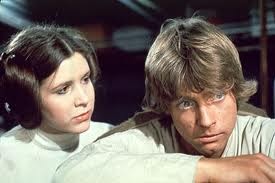
From the very first trumpets from composer John Williams score, STAR WARS announces that it is going to be a special film. A giant Imperial Star Cruiser chases a smaller transport ship carrying Princess Leia (Carrie Fisher). Leia, who is part of the Rebel Alliance, has stolen the plans to the Death Star, a deadly space station the evil Galactic Empire has built which can destroy entire planets.  Leia's ship is overtaken so she secretly places the plans and a message inside a diminutive robot R2D2 (Kenny Baker). R2D2 along with another droid CP30 (Anthony Daniels) hide in an escape pod and are jettisoned to the nearby planet Tatooine. Leia is captured by the menacing Darth Vader (voice provided by James Earl Jones; acted by David Prowse) and sent back to the Death Star where Grand Moff Tarkin (Peter Cushing) plots the Empire's next move to destroy the Rebels. Vader orders Imperial Stormtroopers (the Empire's soldiers) to find those blueprints.

On the arid and desolate desert planet Tatooine, R2D2 and C3PO bicker like Laurel and Hardy. They split up to find help only to both be caught by little robed creatues called Jawas, Tatooine's version of used car salesmen. The Jawas sell the two robots to a farmer named Owen (Phil Brown) and his nephew Luke Skywalker (Mark Hamill).  Luke dreams of being a fighter pilot for the Rebel Alliance. While cleaning R2D2, Luke discovers a holographic message from Leia to Obi-Wan Kenobi seeking his help. Luke knows of an old hermit living in the nearby canyons that goes by Ben Kenobi.  R2D2 sneaks away during the night to find Obi-Wan. Luke and C3PO chase after the small robot the next morning.


While looking for R2D2, Luke and C3PO are attacked by the Sand People. Obi-Wan Kenobi (Alec Guinness) scares the Sand People away and brings Luke and the robots back to his home. After he sees Leia's message asking for help to defeat the Empire, Obi-Wan reveals that he was once a Jedi Knight and knew Luke's father. Obi-Wan asks Luke to join them but Luke's reluctant.  But when the Storm Troopers murder Luke's aunt and uncle, Luke wants to avenge their deaths and his destiny is chosen. They head to the town of Mos Eisley to find a ship that can take them to Alderaan, Leia's home planet.

The group meet up with mercenary and smuggler Han Solo (Harrison Ford) and his tall furry sidekick Chewbacca (Peter Mayhew) who will take them to Alderaan...for a price.  Solo's ship the Millennium Falcon gets them out of Tatooine but when they reach Alderaan, it's gone, destroyed by the Empire.  The Falcon then discovers the Death Star and gets captured by it's tractor beam. Luke, Solo, Obi-Wan, and the rest of the group hide within the massive space station and discover that Princess Leia is on board.  After breaking Leia out of her prison cell, the heroes escape the Death Star but only after Obi-Wan disables the tractor beam and sacrifices his life during a light saber duel with his nemesis and former pupil Darth Vader.

Leia takes Luke and Han back to a nearby moon where the Rebels have a base.  She gives the Rebels the Death Star blueprints and the Rebels prepare for an all out attack on the Death Star. Luke joins the X-Wing Squadron while Han collects his reward.  The films ends with Luke and the Rebels in a space dogfight against Darth Vader and the Empire as the Rebels attempt to destroy the Death Star.


A few months ago, I introduced my niece to STAR WARS while at the beach. It was my first time watching the film in quite some time.  Several things jumped out at me afterward. Harrison Ford as Han Solo steals the film. He chews up every scene he's in and brings much humor to the film, something that was sorely missing in Lucas's reboot of the STAR WARS saga recently. The film's opening third is actually quite slow. After the amazing opening shot of the Imperial Cruiser chasing the smaller spacecraft, the film sort of plods along as the robots C3PO and R2D2 stumble around Tatooine. Not until Luke, Obi-Wan, and the robots meet Han and Chewbacca at the Mos Eisley Cantina does the film take off again.

For as much as STAR WARS special effects astound us, the film at times does show its limited budget (STAR WARS was made for a paltry $13 million dollars).  In interviews, Lucas always talks about not having enough time or money (and technology) to do some of the stuff he wanted to do in STAR WARS. The oversized helmets worn by both the Rebels and the Empire's men are pretty goofy. A dramatic escape into a garbage compactor hints at some scary creature amongst the garbage but Lucas never shows it. Even the various alien creatures in the famous Cantina bar scene are kind of a mish mash of rubber masks and styrofoam appendages.

But where he lacked money, Lucas made up for it with ingenuity and inventiveness. He gave his characters cool names. Han Solo. Luke Skywalker. Darth Vader. Obi-Wan Kenobi. He created non-human characters just as memorable. Chewbacca. C3PO. R2D2. He created his own mythology with the Force, an aura and power that can be used for good or evil and Jedi Knights like Obi-Wan who were protectors of the Old Republic. Lucas used his money wisely, investing it in amazing special effects and incredible space ships that are as distinctive and unique as each character. And to give his space fantasy some legitimacy, he cast distinguished actors like Alec Guinness as Obi-Wan Kenobi and Peter Cushing as Tarkin. How nice to see Peter Cushing, who starred in countless Hammer horror films and other low budget monster pictures, appear in a film that would become one of the all time biggest grossing films.

Because STAR WARS was such a colossal hit, Lucas would never have to worry as much about having the money to make his vision of his films again.  In fact, Lucas would create a company called Industrial Light and Magic (or ILM) which would become the premier special effects company in Hollywood and has since changed film making altogether with computer generated effects today.


Lucas's casting for STAR WARS is a credit to the film's appeal. Yes, Harrison Ford became a huge star after STAR WARS with his performance as Han Solo and steals the film in my opinion but Mark Hamill as Luke Skywalker is really the person that drives the film and who the audience identifies with. Luke is like every teenage boy and girl who first saw the film. He's an innocent, full of dreams and aspirations but stuck doing mundane chores as he helps his uncle and aunt on their farm. Solo and Luke have a fun rivalry going throughout the film whether it be who shot down the most Tie Fighters to who can get more attention from Princess Leia. Solo is big brother to Luke's little brother. Carrie Fischer as Leia is strong and independent and a great role model for girls.  Leia is not a defenseless, cowering princess. She's not afraid to grab a blaster and shoot some Storm Troopers or bark orders to Luke and Solo. I did have a crush on Princess Leia as did many Star Wars geeks after watching STAR WARS.

STAR WARS forever changed Hollywood.  It changed it in both good and bad ways. Every summer now, beginning in May, Hollywood releases its big blockbuster films like THOR or TRANSFORMERS, hoping for another STAR WARS, trying to make as much money as they can with movies that are big on visual and special effects. Sometimes the story and acting gets lost amongst all the action.  The little film, strong on character and situations, got pushed aside when the STAR WARS phenomenon began. That's one of the casualties of STAR WARS.

But George Lucas got it right with his first STAR WARS trilogy.  Yes, he had the big spectacle with unique worlds and space crafts we'd never seen before. But he also told the simple story of a young boy becoming a man and the obstacles he had to overcome and the allies he had to make along the way. When we all saw STAR WARS for the first time or the 20th time, it was the beginning of our journey from adolescence to adulthood. And when we had kids of our own, we took the journey back to adolescence to enjoy STAR WARS all over again with the next generation of geeks.