Tuesday, November 27, 2012

The Fortune Cookie (1966)

One of the underrated comedy teams in cinema might be Jack Lemmon and Walter Matthau.  Although I haven't seen any of the GRUMPY OLD MEN films that Lemmon and Matthau did toward the  twilight of their careers, I knew they had made some successful comedies together beginning in the 1960's. It turns out they made ten films together.  Their most popular film is undoubtedly THE ODD COUPLE (1968). As a kid, I watched the television series of the same name with Tony Randall in the Lemmon role and Jack Klugman playing the Matthau role. But Lemmon and Matthau's first film pairing together is a film directed by the great Billy Wilder called THE FORTUNE COOKIE (1966).

THE FORTUNE COOKIE seems like a film school exercise in filmmaking for director Wilder. Wilder and his writing partner I.A.L. Diamond take something Wilder had seen on TV which was a ball player running into someone on the sidelines and expound on that idea. Wilder had certainly built up some clout after directing classics like DOUBLE INDEMNITY, SUNSET BOULEVARD, STALAG 17, SOME LIKE IT HOT, and THE APARTMENT. But THE FORTUNE COOKIE is not as prestigious as those earlier films.  It's a small film for Wilder that boasts great writing and an Academy Award winning Best Supporting Actor performance by Walter Matthau.


Harry Hinkle (Jack Lemmon) is a cameraman filming the sidelines at a Cleveland Browns football game for CBS Sports.  During a punt return, football player Luther "Boom Boom" Jackson (Ron Rich) plows into Hinkle on the sideline, knocking him unconscious. Hinkle awakens in the hospital to find his conniving brother-in-law and lawyer "Whiplash" Willie Gingrich (Walter Matthau) hovering over him.  Hinkle wants to get out of the hospital but Gingrich sees a lawsuit and a million dollars to be shared between them by suing CBS, the Cleveland Browns, and Cleveland Municipal Stadium. Hinkle wants nothing to do with the scam but Gingrich uses Hinkle's ex-wife Sandy (Judi West) as bait, telling Hinkle that Sandy (an aspiring singer who left Hinkle for a drummer) wants to come see him.  Hinkle, with reservations, agrees to fake his injury. Gingrich meets with the insurance company's law firm of O'Brien (Harry Holcombe), Thompson (Les Tremayne), and Kinkaid (Lauren Gilbert). The three lawyers are dubious of the claim and try to settle for much less with Gingrich. Gingrich balks at the offer.

Hinkle finally gets to go home. The insurance company, suspicious of Gingrich, send their top detective Purkey (Cliff Osmond) to spy on Hinkle, hoping to catch Hinkle running around his apartment. Boom Boom feeling guilty about injuring Hinkle, begins to visit regularly and helps with cooking and cleaning.  Sandy arrives to help Hinkle recuperate. Boom Boom hopes Hinkle and Sandy might get back together. Gingrich discovers that Purkey has planted little microphones throughout Hinkle's apartment, trying to catch Gingrich and Hinkle in their lie. Boom Boom, still wracked with guilt, gets into a fight at a bowling alley he owns and gets kicked off the Cleveland Browns football team. The insurance firm lawyers still want to settle for far less than Gingrich wants so Gingrich pulls out his ultimate scheme: to set up a charitable foundation in Harry Hinkle's name to help handicapped children. Naturally, no disabled child will ever see that money except for Gingrich who's already spending Hinkle's settlement money on cars and a fur coat for his wife even before they've settled.

The law firm settles for $200,000.  Hinkle finds out that Boom Boom has been kicked off the team and decides to end the charade. He stands up in front of the detective Purkey, who's come over to collect his tiny microphones.  Hinkle reveals his injury was a fake and walks out on Gingrich and Sandy. Hinkle drives over to Municipal Stadium to apologize to Boom Boom, the one honest human being who actually cared about Hinkle.


As I said before, THE FORTUNE COOKIE is an odd choice for director Wilder. Maybe he'd run out of big film ideas.  It's not that FORTUNE COOKIE is a bad film. It has a terrific comedy duo, a nice jazzy score by Andre Previn, and every scene seems well thought out although the film drags in its final act. But it may mark the last decent film by Wilder. After COOKIE, Wilder's mostly successful run of great films would end as neither of his next two pictures THE PRIVATE LIFE OF SHERLOCK HOLMES (1970) or AVANTI! (1972) would be hits.

But Wilder and Diamond's writing and script is strong in COOKIE.  The two men break the film into sixteen chapters with titles like The Accident or The Caper which serve as little vignettes as they reveal the story. Wilder always writes great dialogue not just for his leading actors but for his supporting actors as well. Doctors, nurses, and nuns all have some funny lines. And although THE FORTUNE COOKIE is a comedy, COOKIE may be one of Wilder's most cynical films since ACE IN THE HOLE (1951). But he can't let it have a downbeat ending and so Hinkle finally comes to his senses and breaks away from the phonies who have misled him. The fortune in Hinkle's fortune cookie represents Wilder's view of society.  "You can fool all of the people some of the time, you can even fool some of the people all of the time, but you can't fool all of the people all of the time!" Hinkle is Gingrich's fortune cookie, his chance to make a fortune by faking Hinkle's injury. But the cookie will crumble for Gingrich as Hinkle's guilt becomes too big a burden to bear.

Jack Lemmon as Harry Hinkle is solid, a bit more restrained in THE FORTUNE COOKIE than in Wilder's SOME LIKE IT HOT (1957). Perhaps some of Lemmon's restraint comes from having to wear neck braces and leg casts throughout the film. Lemmon handles an electric wheelchair with great skill and flair. But THE FORTUNE COOKIE is really Walter Matthau's coming out party as William Gingrich . One legal eagle says of  Gingrich, "He's so full of twists. He starts to describe a donut and it comes out a pretzel." Wilder and Diamond skewer the lawyer profession and Gingrich is the prototype sleazy lawyer. Gingrich even lets his two children skateboard around the hospital and his home, hoping for a lawsuit if his children were to fall. Matthau not only won the Academy Award for Best Supporting Actor for his performance as Gingrich, he also suffered a heart attack during the filming of THE FORTUNE COOKIE which temporarily halted production. When Matthau returned to filming, he had lost 30 pounds.


Ron Rich as Boom Boom Jackson, the Cleveland Browns running back is the most genuine character in the film. Rich plays Boom Boom as a sensitive, compassionate athlete, not exactly what audiences would expect from a football player. Judi West as Hinkle's ex-wife Sandy is the one weak character.  The role has Marilyn Monroe-ish like qualities but West is not Monroe. Her major acting trait is to smoke like a chimney. Wilder appears to make her a sympathetic character, concerned about Hinkle's injury but abruptly switches her true intentions at the end.  Look for young sports announcer Keith Jackson (famous for covering college football games for ABC) playing a TV sports announcer at the Browns game.  Also, look for William Christopher who would play Father Mulcahy on the TV show MASH making his screen debut in THE FORTUNE COOKIE as a young intern. I also spotted a young Richard Roundtree (SHAFT) as one of the men who beats up Boom Boom at his bowling alley.

THE FORTUNE COOKIE may be a little too clever for today's comedy audiences who expect outrageous, gross out humor from the likes of Will Farrell and John C. Reilly or Ben Stiller and Owen Wilson. But THE FORTUNE COOKIE is the genesis of a Jack Lemmon and Walter Matthau partnership that would last over 10 films and 29 years and show audiences that funny dialogue and good comedy acting can be just as funny as crude language and scatological jokes.

Sunday, October 28, 2012

The Thing (1951, 1982, 2011)

For the first time in CrazyFilmGuy blog history and in honor of Halloween, it's time to visit one horror film that has been made three times in the last 60 years. THE THING has all the elements that the CrazyFilmGuy loves.  It's a horror/science fiction film.  It's set in Antarctica, a remote harsh location. It even has an Agatha Christie whodunit quality to it as any of the scientists, doctors, or pilots could be the Thing.

The original film called THE THING FROM ANOTHER WORLD (1951) was produced by director Howard Hawks (THE BIG SLEEP and RED RIVER) and directed by his longtime editor Christian Nyby (TO HAVE AND HAVE NOT). It's based on the short story by John W. Campbell, Jr called Who Goes There? and was adapted to the screen by Charles Lederer (HIS GIRL FRIDAY). Many people think Howard Hawks actually directed the film but I think because it's a B movie with B actors and actresses, Nyby directed it with some input from Hawks. If John Wayne or Humphrey Bogart had been in it, Hawks probably would have directed it.


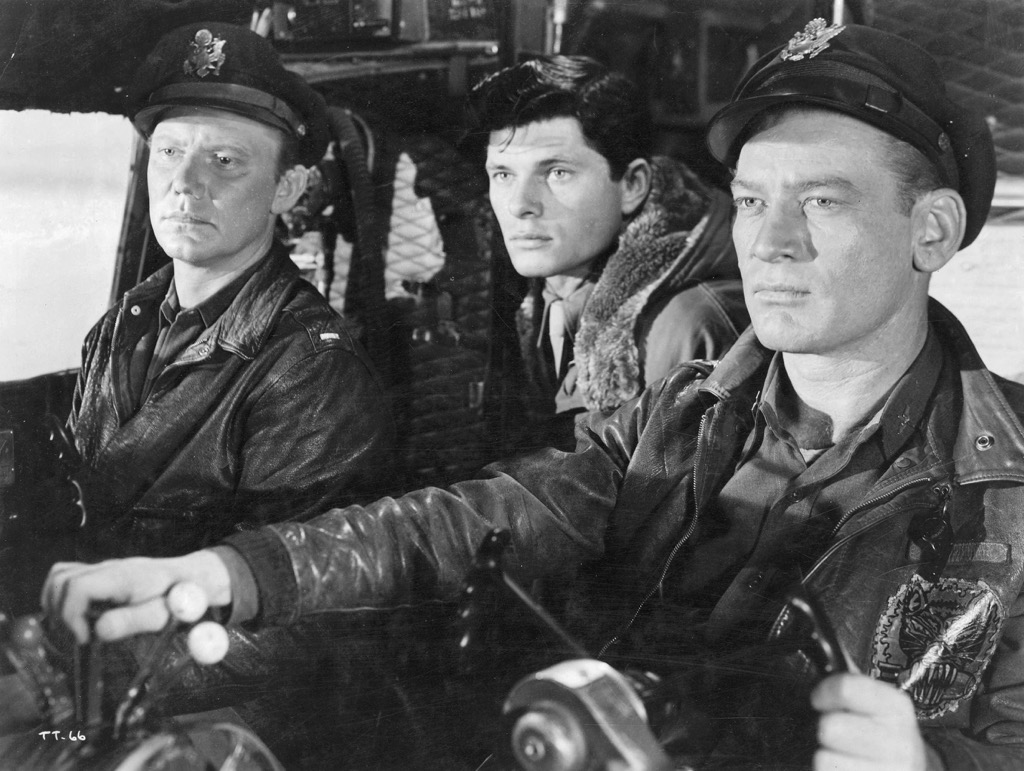
But THE THING has a Hawks flavor to it like ONLY ANGELS HAVE WINGS (1939). Instead of a group of mail delivery pilots in South America, it's a group of Air Force pilots and scientists and botanists at the North Pole. The dialogue is fast and snappy, there's a smart, no-nonsense woman among the group who can drink and smoke just like the men, and Nyby/Hawks work in plenty of aerial footage of the Air Force plane landing and taking off in the snow.  But THE THING also has a great sense of mystery and suspense once the pilots and scientists discover and bring back the Thing to their research station.

 THE THING FROM ANOTHER WORLD opens in an Anchorage, Alaska Air Force lounge as Captain Patrick Hendry (Kenneth Tobey) plays cards with crew members Lt. Eddie Dykes (James Young) and Crew Chief Bob (Dewey Martin). Scotty (Douglas Spencer), a reporter walks into the lounge looking for a story. His wish is soon answered when Hendry and his men are sent up to the North Pole to investigate a report of a plane crash near U.S. Polar Expedition #6.


Hendry and team are greeted at the Research Station by a team of scientists and botanists including Dr. Arthur Carrington (Robert Cornthwaite), Dr. Stern (Eduard Franz), and Carrington's assistant Nikki (Margaret Sheridan), who happens to have had a brief relationship with Hendry on a previous visit. The group flies out the next day to find the crash site.  They discover a large circular object buried under the ice. Hendry and his men try to blow up the ice to reach what they suspect is a flying saucer but the ship explodes ruining any chance of studying it.  But they do find nearby the passenger of the space ship, frozen in a block of ice. They bring back the frozen visitor to the Research Station to study it.  Scotty the reporter wants to file a news story on the discovery but Hendry blocks his request for the time being.

The Thing (GUNSMOKE'S James Arness) thaws out of its frozen bed, attacking the sled dogs as it flees.  A dog rips off one of the Thing's arms. Carrington and his fellow scientists study it and discover the Thing has vegetable like qualities.  It can regenerate a missing limb and it drops seeds from its prickly hands, seeds that can reproduce into more Things.  Carrington wants to communicate and protect it but Hendry realizes if the Thing makes it to a populated area, it could take over the world.


Hendry puts Carrington under house arrest after Carrington is caught feeding stored blood to the Thing's seeds. Using a geiger counter, Hendry and his crew track the Thing.  But the Thing is smart and cuts the electricity to the research station. Hendry and crew lures the alien back and this time they electrify the Thing. Scotty the reporter finally gets to call in his story, warning everyone to "Watch the Skies"(which Steven Spielberg would borrow as a temporary title for 1977's CLOSE ENCOUNTERS OF THE THIRD KIND).

Nyby's THE THING is one of the first horror/Science Fiction films to touch upon the Cold War early in the film when General Fogarty (David McMahon) and Hendry discuss the downed aircraft and whether it's American or Russian. It will turn out to be neither.  The conflict between the military (Hendry, Dykes, Barnes) versus the scientists (Carrington, Stern, Chapman) as to what to do with the Thing is another nice subtext to the film. Carrington believes it will unlock the mysteries of space but after the Thing kills a couple of scientists, the rest of the science group comes over to the military side.

What's missing from THE THING is the special effects technology to show how adaptable the Thing can be. This film was made in 1951 after all. The Thing is just a big actor (James Arness) in make-up and although Nyby shoot him mostly in darkly lit scenes and keeps the camera off him for the most part, the film eventually has to show the Thing for longer periods during the finale. The Thing's power to reproduce is mostly described  in screenwriter Lederer's dialogue. But Nyby builds good suspense with sound effects and the use of the Geiger counter to register when the Thing is near (Ridley Scott's 1979 ALIEN would use the same simple technique). The Thing's first surprise appearance is when Hendry opens a door and the Thing lunges at him from the other side.  For the rest of the film, someone opening a door keeps the audience nervously wondering what's on the other side.

Kenneth Tobey as Lt. Hendry is solid as the lead. He's the leader but he's also one of the guys. He's not perfect and even makes a big mistake when he accidentally blows up the spaceship. Tobey would play similar heroes in other horror/science fiction in the 50's including THE BEAST FROM 20,000 FATHOMS (1953) and IT CAME FROM BENEATH THE SEA (1955). Robert Cornthwaite as Dr. Carrington also stands out.  Although he's not evil, Carrington's obsession with preserving the Thing regardless of its terrifying abilities blinds his common sense and endangers his fellow scientists. The TV show LOST IN SPACE'S (1965-68) character Dr. Zachary Smith (Jonathan Harris) may owe both his look and personality to THE THING'S Dr. Carrington.


Director John Carpenter is a huge fan of Howard Hawks the filmmaker and of the original film. His remake even copies the original's title sequence. But Carpenter's THE THING (1982) is almost the opposite of the original THE THING FROM ANOTHER WORLD. Instead of the Hawksian band of brothers or in this case band of Air Force men who all get along and would do anything for each other, this group of scientists seem to be isolated and loners. They don't get along. Carpenter's film stays closer to the original short story by Campbell as the space creature can transform and mimic any living creature it comes in contact with instead of the one Thing (James Arness) who was a mixture of  Frankenstein and a space carrot in THE THING FROM ANOTHER WORLD.

Written by Bill Lancaster (son of actor Burt Lancaster), Carpenter's THE THING opens in space with an alien spacecraft spinning out of control and crash landing on earth 100,000 years ago. Cut to Winter, 1982 at the U.S. National Science Station #4 in Antarctica.  A Siberian Husky, chased by a Norwegian helicopter, dashes into the U.S. station. The Norwegians are trying to kill the dog. The Americans fire back, killing the Norwegian.  Why were they after the dog? Helicopter pilot MacReady (Kurt Russell) and Dr. Copper (Richard Dysart) fly over to the Norwegian camp to learn more and discover the station burning. Every one's either dead or missing. They discover a disfigured dead body, videotapes, and a giant block of ice that once held something.


Back at the U.S. station, the videotapes reveal the Norwegians had discovered a large object in the ice. As Dr. Blair (Wilford Brimley) studies the disfigured body, the Thing finally reveals itself in the dog's body and emerges, looking for it's next host body. The rest of the men in the station begin to become paranoid toward one another as no one is sure who may be the alien organism. MacReady goes out again and finds the frozen spaceship. Blair runs simulations on what would happen if the Thing made it to civilization. The results are not promising. Blair sabotages the helicopter and radio room so no one can leave.

Blair locks himself up in his laboratory but MacReady and the others break down the door and tie Blair up, isolating him from the rest of the men. Paranoia runs rampant as Dr. Copper creates a blood serum test to discover which remaining men may be infected. As a storm approaches, the blood test works, revealing the Thing. All hell breaks loose as MacReady, Garry (Donald Moffatt), and Childs (Keith David) try to figure out who they can trust and how can they keep the Thing from reaching civilization.

Carpenter's THE THING is very bleak and dark.  From the very first synthesizers beat from composer Ennio Morricone (Sergio Leone's favorite composer), it's evident that MacReady and the rest of the men are in for some trouble.  On a small scale, just a U.S. science base in Antarctica, these men are facing Armageddon and possibly, the end of the world if they can't keep the Thing from reaching a larger population. Although it came out three years after ALIEN, THE THING and ALIEN have a lot of similarities. Both involve small groups of people in an isolated location who face an unstoppable creature that could wipe out earth if it ever reaches a mass populace. The haunted house has been replaced by the space ship and arctic research station.


Director Carpenter cleverly casts  a bunch of familiar, non-threatening character actors like Wilford Brimley, Richard Masur (as the dog handler), Donald Moffat, and Richard Dysart who seem so benign and friendly that the audience would never believe they could become the Thing. Kurt Russell as MacReady does a variation of his Snake Plissken character from Carpenter's ESCAPE FROM NEW YORK (1981) as the lone wolf helicopter pilot who quickly begins to figure out what they're up against.  Toward the end of the film, MacReady begins to resemble Jesus Christ with his long hair and beard, ready to die to save the world from the sins of the scientists who dug up the Thing.

What really distinguishes Carpenter's THING from the original are special make-up effects wizard Rob Bottin's phantasmagorical Thing creatures. Bottin's imagination runs wild as the Thing moves from dog to human to human, able to mimic each host body until revealed. Bottin's creations are haunting and each transformation is unique.  CGI was just starting to come into greater use but this THING barely uses any until the very end of the film.  This would be John Carpenter's bad alien film. He would follow-up a few years later with a good alien film with STARMAN (1984) starring Jeff Bridges.

I was surprised when I saw that THE THING (2011) was being remade again.  But then, I shouldn't have been. Recent reboots of MY BLOODY VALENTINE, FRIDAY THE 13TH, and A NIGHTMARE ON ELM STREET had all popped up recently. Carpenter's THING was so delicious and suspenseful and perfect in my mind what was the point of remaking it again. But as I watched this THING version, it turns out Dutch director Matthijs van Heijningen, Jr and writer Eric Heisserer made a clever choice. This THING is a prequel, set at the Norwegian Camp in Antarctica, 1982, where the Norwegians and other international staff first discovered the Thing before it moved on to the U.S. Research Station to face off against Kurt Russell and group.


The filmmakers also reintroduce women to the story which the original film had with Margaret Sheridan.  Carpenter's THE THING was void of women but Heijningen's THING has a strong lead in actress Mary Elizabeth Winstead, an American paleontologist who quickly recognizes this alien is no ET. This third THING will pay homage to both previous films with scenes and situations. The film opens with a Snow Cat rumbling across the arctic tundra with three Norwegian scientists following a signal. As they reach the signal, the ice caves in and the Snow Cat tumbles down a hole resting on top of what looks like a space ship buried in the ice.

Dr. Sander Halvorson (Ulrich Thomsen) recruits Kate Lloyd (Mary Elizabeth  Windstead), a paleontologist who specializes in fossils found in the ice to join them, recommended by Halvorson's assistant Adam Finch (Eric Christian Olsen). Halvorsen takes the whole team: Norwegians, Americans, and Brits down to the spaceship.  He shows them the survivor of the space crash - a Thing encased in a block of ice. A claw appears to be visible. The block is dug out and brought back to the base. Halvorson wants radio silence until he can learn more about the discovery of the century.

The ice block begins to melt and this Thing springs out of its icy tomb, immediately attacking Lars's (Jorgen Langhelle) dog, injuring others, and killing another scientist Henrik (Jo Adrian Haavind). Kate and the scientists burn the creature and perform an autopsy on the Thing, discovering it was trying to fuse with Henrik.  Further study reveals the Thing's cells can imitate human cells.  American helicopter pilot Sam Carter (Joel  Edgerton) and his co-pilot Derek Jameson (Adewale Akinnuoye-Agbaje) prepare to fly an injured scientist back to McMurdo U.S. arctic base but the Thing is on board and their chopper crash lands a few miles away.


The remainder of this THING follows Carpenter's film somewhat as the survivors battle the Thing while trying to figure out which one of their comrades might be the creature. Kate comes up with a test that may distinguish who is infected but the Thing sabotages it by starting a fire in the lab. Kate and Sam (who's trekked back to camp with Derek after crash landing) chase the Thing back to its spaceship as it tries to take off. Director Heijningen ends the film with scenes that begin Carpenter's film -- the last husky sled dog escaping the compound, carrying the Thing inside and the last two remaining Norwegians chasing after it via helicopter, trying to kill it. Heijningen even uses the Morricone synthesizer beat. Director Heijningen apparently is a huge fan of Carpenter's version as Carpenter was of the Nyby/Hawks film.

I like that a European director made this THING prequel, giving us a different point of view after two American directors had tackled it.  A good majority of the cast is Scandinavian with American Winstead and Australian Edgerton thrown in to round it out.  Director Heijningen does use elements from both previous films though in this version. Like the Nyby film, he pits the Norwegians against the Americans/English when paranoia sets in similar to the scientists versus the Air Force men in the original.  He brings back female characters to the story like paleontologist Kate Lloyd and another woman Juliette (Kim Bubbs), wife of one of the scientists. And Dr. Halvorson is the reincarnate of Dr. Carrington from the original, more interested in studying the lethal alien creature than the welfare of his fellow scientists.  Halvorson will get his wish in more ways than one to fully understand the Thing.

From Carpenter's film, Heijningen borrows the tense group test scene to find out which members may be the Thing, taking a different angle on it. Once again, a helicopter pilot in Sam Carter is one of the heroes, like MacReady in Carpenter's film, although spunky Kate is the main protagonist.  And Heijningen weaves some of the discoveries that MacReady and Dr. Copper discovered at the Norwegian camp in the 2nd film into the finale of the 3rd film especially the metamorphosis and destruction of the double-faced human/Thing.


Director Heijningen is adroit at throwing red herrings to the audience as to which expedition member is the Thing, keeping the audience on its toes. The CGI and make-up effects for the Thing, although not as incredible as Bottin's, are effective nonetheless.  Actress Winstead is Sigourney Weaver-ish as the level-headed and strong woman amongst all the men and Joel Edgerton (looking a lot like talk show host Conan O'Brien) stands out as the friendly pilot Carter.  If nothing else, this THING like other horror film reboots has introduced the story to another generation of young horror film fans. Ultimately, this THING lacks some thing.  A more recognizable star, some twist on the story. I can't put my finger on it. I still believe Carpenter's THE THING, although not a huge hit when it came out, already told the story very well.

The fact that John  W. Campbell's story Who Goes There? has been made into a film three times is proof that THE THING is an entertaining and suspenseful tale that has been scaring audiences for over sixty years. The ALIEN films owe a great debt to THE THING yet are uniquely different in many aspects except that they warn about an indestructible alien that may visit us in the future.  So heed the reporter Scotty's words from the first film and "Watch the Skies."  And if you like a good scare, watch any version of THE THING on your favorite electronic device.


Wednesday, September 19, 2012

Tomahawk Trail (1957)

When movie lovers (and the CrazyFilmGuy) think of the Western, we usually point toward the classic films of director John Ford like MY DARLING CLEMENTINE (1946) or THE SEARCHERS (1956) or the psychological westerns that director Anthony Mann made with Jimmy Stewart such as THE NAKED SPUR (1953) or THE MAN FROM LARAMIE (1955).  Or we get misty-eyed over Sam Peckinpah's code of honor films in RIDE THE HIGH COUNTRY (1962) or THE WILD BUNCH (1969).  And let's not forget Mr. Clint Eastwood who has owned the western from his early films with director Sergio Leone as the Man With No Name thru UNFORGIVEN (1992).

But like most genres, not every western ever made is a classic. Many are B films with lesser stars and a smaller budget. Some are good and some downright stinkers. But they still deserve a chance and so when the CrazyFilmGuy saw the title TOMAHAWK TRAIL (1957) on his television recently, he decided to give it a viewing or two since he had never heard of the film before.


As the title hints at, TOMAHAWK TRAIL has Indians in it as well as a U.S. Cavalry patrol. But it is at best a B Western with few notable stars except for the unsung Chuck Conners in the lead and a very young Harry Dean Stanton (going by the name of Dean Stanton early in his career). It does have some production value in its Kanab, Utah locations (which John Ford also liked to shoot in) and a fort that will be used by the Cavalry patrol. But TOMAHAWK cannot hide its budgetary limitations.  Although TOMAHAWK TRAIL is a feature film, its running time is a short 60 minutes, about the length of watching an episode (with commercials) of Chuck Conners TV show a year later called THE RIFLEMAN (1958 to 1963).

TOMAHAWK TRAIL'S plot has some familiar elements. A wagon train full of U.S. Cavalry headed for Fort Bowie are attacked by a party of Apache Indians. The wagon train is led by Lieutenant Jonathan Davenport (George Neise), a replacement for a recently fallen commander, fresh from West Point and full of ideas but out of his league in the Wild West. Davenport is at odds with Sergeant Wade McCoy (Chuck Conners), his subordinate but with much more experience in fighting the Indians. McCoy tries to show Davenport the right way to fight the Apaches and survive but Davenport will have none of it. But after the heat takes its toll on the West Point graduate Davenport and then Indians steal the Cavalry's horses, McCoy has to take over as commander, against Davenport's threats of a court martial for McCoy.


Without horses, the patrol come across and surprise the Apache war party and rescue Ellen Carter (Susan Cummings), daughter of an Army officer who was kidnapped a few months earlier from Fort Laramie and Tula (Lisa Montell), daughter of the Apache Chief Victorio (who we only see from afar and never in close up). McCoy manages to keep the lost patrol together despite repeated skirmishes with the Apaches as well as dissension from the insufferable Davenport and his lackey Private Miller (Harry Dean Stanton). There's even an attempted rape of Tula by Private Barrow (Robert Knapp).

McCoy and his ragtag party finally arrive at Fort Bowie. At first, it appears to be abandoned.  As they enter the fort, they see the bodies of soldiers, decimated by an earlier Apache attack. McCoy has his men collect weapons from the dead soldiers and strengthen Bowie's fortifications as they prepare for the inevitable raid by the Apaches.  But McCoy has an ace up his sleeve -- the Apache leader's daughter Tula.  His only hope for the troop to survive is to use her as a bargaining chip. But will Tula be willing to save her captors?


TOMAHAWK TRAIL wants to tread in John Ford territory but veteran Western director Lesley Selander and screenwriter David Chandler are limited by their budget, story, and actors. Whether the budget couldn't afford too many horses or writer Chandler purposefully chose to do this, the Apaches stealing the Cavalry's horses early in the film, causing the Cavalry to now walk to their destination is unintentionally humorous. Story points move quickly in this film too.  In one scene, Ellen confides to McCoy she is a peaceful person amongst all the fighting. In the very next scene, Ellen is attacked by Private Macy (Frederick Ford) and accidentally kills him with a hammer defending herself. Talk about a quick change in attitude. We never get to meet the Apache Chief Victorio. He's only shown from a distance. Apparently, the production couldn't afford to pay an actor to play Victorio in close ups or speak a few lines of dialogue. We hear about him and but only see him in a long shot at the film's end.

Chuck Conners is likable as the lead Sgt. McCoy and would appear in countless westerns but he's not John Wayne except maybe in height and collegiate football career. In a Ford film, the Cavalry would be a colorful mix of Irish, Texans, and ex-Confederates but TOMAHAWK'S soldiers are mostly vanilla.  John Smith as McCoy's best friend Private Reynolds provides a few dashes of humor and Eddie Little Sky as the Indian scout Johnny Dogwood is a rare positive Native American character even if Eddie's acting range is limited. George Neise's Lt. Davenport is too over the top and almost unbelievable at times in his feverish performance.  Susan Cummings as Ellen Carter is neither particularly pretty or memorable. And young Harry Dean Stanton shows his inexperience as Private Miller but it's just the start of a long career for Stanton who would improve over the years in films like ALIEN (1979) and PARIS, TEXAS (1984). TOMAHAWK is Stanton's first talking film role.


But like many B movies, TOMAHAWK TRAIL has its moments. Director Selander makes good use of the Kanab, Utah locations especially the fort (Selander would direct 5 films in 1957 beside TOMAHAWK TRAIL including REVOLT AT FORT LARAMIE, using the same Kanab Fort location and casting actor Stanton again). The troop's discovery of the massacre is well staged and the siege of the fort by the Apaches with flaming arrows is impressive. The production may have skimped on the horses but it makes up for it with some excellent stunts during the attack.  TOMAHAWK also shows the seamier side of the army as not one but two different soldiers try to rape the women. These soldiers are not the honorable men from Ford's FORT APACHE (1948) or RIO GRANDE (1950). Underpaid, hungry, hot, forced to walk, and fighting against Indians and bugs, the lure of two pretty women is too much for a few privates.  But the film gives the lusty Private Macy his comeuppance and Private Barrow apologizes to McCoy before the finale.

TOMAHAWK TRAIL is a quick appetizer for western film buff''s pallet. It's a standard Cavalry Western that is not glorified or revered by critics or movie fans.  But it follows all the basic conventions of the Western and despite it's budget limitations, it offers some interesting riffs on a familiar story. 

Thursday, September 6, 2012

Out of the Past (1947) and Against All Odds (1984)

One of the delights about watching a remake is discovering the original source.  Such is the case of Taylor Hackford's AGAINST ALL ODDS (1984) a remake of the Film Noir classic OUT OF THE PAST (1947). The regular moviegoer probably has no idea that AGAINST ALL ODDS is a remake.  I don't think I did when I first saw it in Manhattan Beach, California during college. Give Director Hackford credit for taking on one of the great film noirs ever made. I first watched OUT OF THE PAST the night before I was going to work on a screen test the next day with Robert Redford and Lena Olin for the Sydney Pollack film HAVANA (1990). I was nervous and couldn't sleep so I stayed up and watched OUT OF THE PAST.  I don't remember much of  the film but I know I enjoyed it.

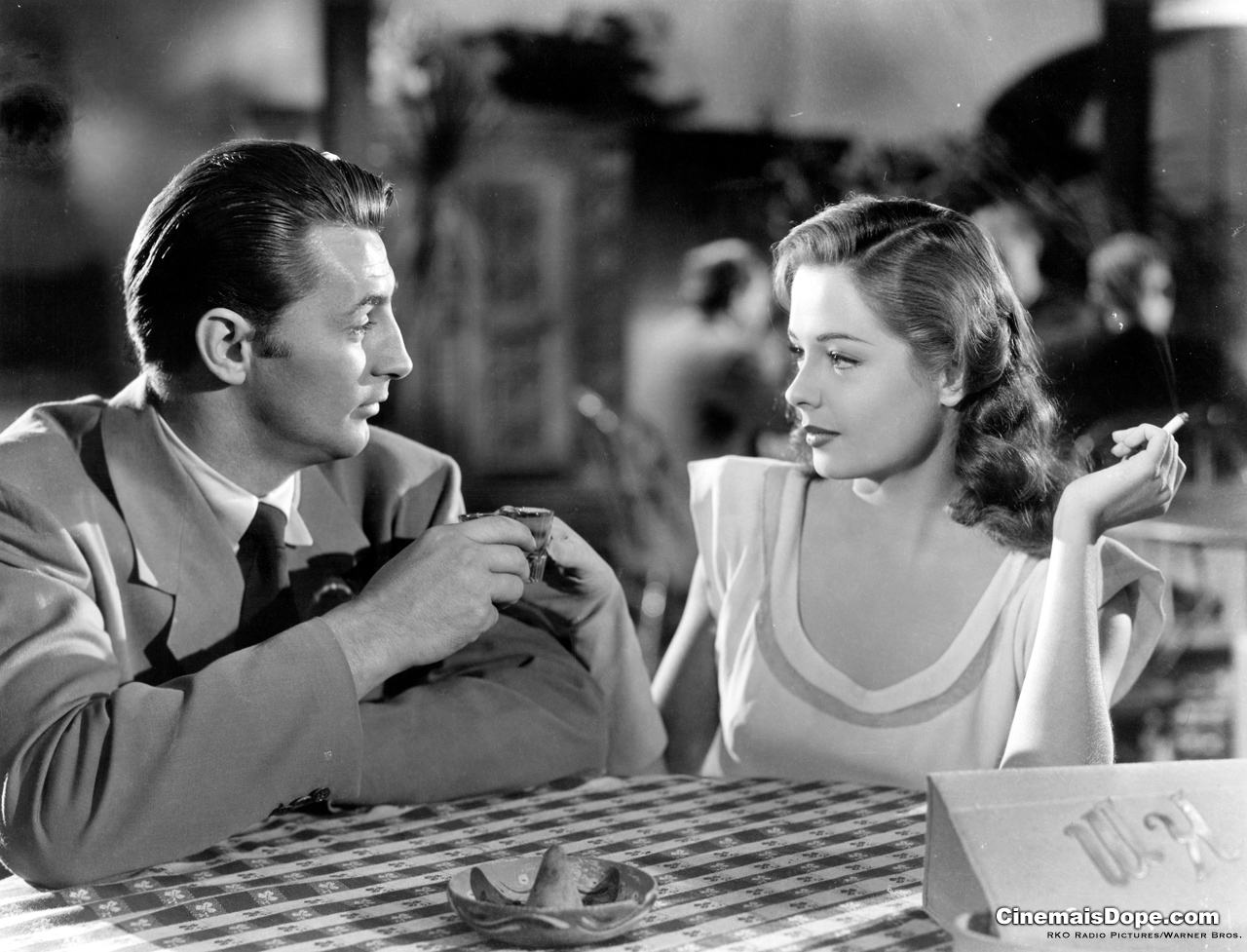
OUT OF THE PAST was directed by Jacques Tourneur with a screenplay by Daniel Mainwaring (under the pseudonym Geoffrey Homes) based on his own novel Build My Gallows High (with an uncredited polish by noir novelist James M. Cain). PAST is a taut, well-written film noir with juicy roles for everyone involved from the lead actors Robert Mitchum and Jane Greer to the supporting ones who play cab drivers or hotel clerks. The film moves from the Sierra Mountains to Lake Tahoe to Mexico, Los Angeles, and San Francisco  with ease. The dialogue is sharp. The femme fatales are beautiful and deadly. Tourneur was good at atmosphere having directed the horror classics THE CAT PEOPLE (1942) and I WALKED WITH A ZOMBIE (1943). But look at Tourneur's resume and film noir doesn't jump out as his specialty yet OUT OF THE PAST is considered one of the best.


The film opens in the Sierra Mountain town of Bridgeport. A man in a black suit named Joe Stefanos (Paul Valentine) stops at a gas station looking for the station's owner Jeff Bailey (Robert Mitchum). Jeff is out fishing with a local girl Ann Miller (Virginia Huston) but the Kid (Dickie Moore), a deaf teenager who works at the gas station finds Bailey up at the lake.  Joe works for a gambler named Whit Sterling (Kirk Douglas, in only his second feature film). Jeff has also worked for Whit before, in his previous life as private detective Jeff Markham, his real name. Whit wants Jeff for a new job and needs Jeff to come up to his Lake Tahoe home to discuss it. Jeff confides to Ann that his shady past as a private dick is what drove him to the isolated town of Bridgeport and the quiet profession of gas station owner.

As Ann drives him to Whit's home, Jeff tells her in flashback how Whit hired Jeff to track down Whit's girlfriend Kathie Moffitt (Jane Greer) who not only shot Whit four times but also stole forty thousand dollars from him. Whit doesn't care about the money. He just wants Kathie back. Jeff tracks her down to Acapulco, Mexico. Jeff floats from seedy bar to seedy bar until Kathie walks in one night and Jeff knows why Whit wants Kathie back.  She's unbelievably gorgeous. Jeff strikes up a conversation with her and soon they're in love. Kathie knows Whit sent Jeff. They talk about leaving together but then Whit and Joe show up. Jeff lies that he hasn't found her yet. Whit wants Jeff to stay on her trail. After Whit leaves Mexico, Jeff and Kathie take a steamer up to the Bay Area. They're about to disappear for good when Jeff's old detective partner Jack Fisher (Steve Brodie) sees him in San Francisco. Fisher follows them to a mountain cabin. Whit has hired Fisher to follow Jeff. Fisher tries to blackmail them and Kathie shoots Fisher, killing him.


The flashback ends as Ann drops Jeff off at Whit's house.  Kathie is back with Whit, catching Jeff off guard. He hasn't seen Kathie since she killed Fisher. Whit is being extorted by an accountant named Leonard Eels (Ken Niles) who helped Whit hide a million dollars from the IRS. Whit wants Jeff to steal his tax books back from Eels.  Whit trusts no one but Jeff. Eels secretary Meta Carson (Rhonda Fleming) is in on the plot. Jeff is to meet up with Meta who will get him into Eels office.  Jeff smells a set-up. Whit has never forgiven Jeff for taking his girl. Whit not only wants his crooked tax documents back but he wants to frame Jeff for the murder of Fisher and as it turns out, Eels. But Jeff manages to stay one step ahead of Whit, Joe, and the police, hiding the cooked tax books and hiding out back in the Sierras.  Kathie begins to creep back into his life and flips sides again, turning against Whit to save Jeff. But who will survive this typically noir-ish relationship -- Jeff, Kathie, or neither?

Film Noir emerged in post-World War II with tales of the dark underbelly of society with amoral men and dangerous, loose women. OUT OF THE PAST exemplifies this style. Jeff Bailey/Markham is a smart man loved by a good honest woman in Ann but mixed up with sinister gangster Whit Sterling and tempted by the seductive femme fatale Kathie Moffitt. Femme Fatale is French for deadly woman. Moffitt isn't the only femme fatale in the movie. Eels secretary Meta Carson is a second femme fatale who helps get her employer killed.

OUT OF THE PAST has a nice noir triangle where the players will betray one another. Robert Mitchum is perfect as the tough former detective Bailey/Markham and he wasn't even the producers first choice. Like typical Film Noir protagonists, Bailey/Markham knows to steer clear of dames like Kathie Moffitt but he succumbs to her black widow charms nonetheless. Jane Greer is dynamite as Katie.  Kathie's eyes are her best weapon. She seduces men with her big beautiful eyes but when cornered, her eyes turn wild and unpredictable. Kirk Douglas's Whit isn't a big part but he's memorable with his slicked back hair and strong jawline. What careers Mitchum and Douglas would have for the next forty years after OUT OF THE PAST.


Film Noir usually takes place in rain slicked cities but OUT OF THE PAST mixes urban locales like bars, offices and city apartments with the Lake Tahoe mountain scenery. Director Tourneur has the noir imagery down with lots of shadows and back lighting and contrast between light and dark. Writer Mainwaring's dialogue crackles and the plot twists and turns with some nifty surprises along the way.  OUT OF THE PAST is the perfect Film Noir so who would even think of remaking it?

Director Taylor Hackford (WHITE NIGHTS) that's who.  Hackford's remake AGAINST ALL ODDS (1984) has three things going for it.  One is some fantastic Mexican locations that Hackford uses for dramatic effect at Cozumel, Tulum, and Chichen Itza. Secondly, he cleverly casts film noir legends Richard Widmark of KISS OF DEATH (1947) and Jane Greer, the original femme fatale from OUT OF THE PAST in supporting roles.  And lastly, he has the sultry, smoky voiced actress Rachel Ward as this version's femme fatale.  Like Greer, Ward is believable as a woman any man would want as his own and would double cross and kill to keep.

AGAINST ALL ODDS definitely modernizes the OUT OF THE PAST storyline and the film starts out strongly. Terry Brogan (Jeff Bridges), ex-football player, is down in Cozumel looking for the girlfriend of nightclub owner/gambler Jake Wise (James Woods). Jessie Wyler (Rachel Ward) stabbed Jake and stole $50,000 from him. Jessie is the daughter of Mrs. Wyler (Jane Greer), wealthy owner of the Los Angeles Outlaws football team that Terry played for until his recent release from the team. An early flashback reveals Terry is in some financial trouble after getting cut from the Outlaws. His former agent Steve Kirsch (Saul Rubinek), now a lawyer for the law firm that represents Mrs. Wyler and the Outlaws can't help him so Terry reluctantly turns to his questionable friend Jake. Jake sends Terry off to Mexico to find Jessie.


Terry wanders around Cozumel showing the locals a picture of Jessie but she's like a ghost. Then, in broad daylight, he sees her at a local market. They don't hit it off very well but Terry's persistent. Like the Mitchum character in the original, Terry falls in love with Jessie. Before long, they're planning on disappearing from Jake and Mrs. Wyler. While sightseeing (and making love) at the Mayan ruin Chitzen Itza, they get caught by Hank Sully (former NFL football player Alex Karras), trainer of the Outlaws now hired by Jake to find Terry and Jessie.  Sully and Terry fight and Jessie shoots Sully. She flees and quickly catches a flight out of Mexico.

Still hoping to play football, Terry returns to Los Angeles and eventually visits Jake. Jake and Jessie are together again. Jake seems to forgive Terry for not finding Jessie but he has another job for Terry. Jake wants Terry to get into the lawyer Kirsch's office and steal some files that Kirsch keeps on Jake and many other prominent Los Angeles citizens who gamble on football. Jake holds over Terry the threat of revealing that Terry once helped Jake on a points shaving bet by fumbling on purpose in a game. Terry's backed into a corner. He sneaks into Kirsch's office at night but finds some of the files missing and Kirsch shot dead in his office bathroom.

AGAINST ALL ODDS becomes a bit tangled and convoluted in its final third as writer Eric Hughes tries to tie up all the plots and subplots, not altogether successfully. Terry finds Kirsch's secretary Edie (Swoosie Kurtz) at the corner restaurant bar and she helps him hide Kirsch's body and escape Jake's henchmen. Jessie goes to her mother's lawyer and clean-up man Ben Caxton (Richard Widmark) and spills the beans about Jake's plan to frame Terry. Terry takes some of the files from Kirch's office and arranges a final meeting with Jake, Caxton, Jessie, and Jake's right hand man Tommy (Dorian Harewood) up at Wyler's Canyon, Mrs. Wyler's new real estate development that is interwoven throughout this story of double-crosses, football, and revenge in a final confrontation to clear his name.


So how does AGAINST ALL ODDS hold up to its classic predecessor OUT OF THE PAST? It never tops PAST but it's an interesting remake. ODDS successfully updates the 1947 story. Director Hackford does a nice job taking the audience to real exotic Mexican locations unlike the original which due to budgetary constraints had to use a studio backlot and one beach shot to convey Mexico.  Hackford's Los Angeles locales are inspired as well: the Rivera Country Club, Manhattan Beach, Century City skyscrapers, the Hollywood Palace Nightclub, El Segundo, and the canyons above West L.A. all contribute to Hackford's L.A. Noir remake. Hackford and Hughes go for a bit of a CHINATOWN (1974) theme with AGAINST ALL ODDS suggesting corruption permeates all the way from the nightclubs of Hollywood to the law offices in Century City and the country clubs in Brentwood. Everyone from city councilman and environmentalist Bob Somes (Allen Williams) to sweet Mrs. Wyler is rotten to one degree or another.

AGAINST ALL ODDS makes some interesting alterations to most of the characters from OUT OF THE PAST. The secretary Meta Carson who betrays extortionist Eels and helps set up Jeff in PAST is changed into a good character, Kirsch's helpful secretary Edie trying to help Terry stay out of trouble in ODDS. The man gambler Whit/Jake sends to track down the wayward lovers in Mexico changes from Jeff's detective partner Fischer to Terry's football trainer friend Sully. ODDS softens the femme fatale. Jessie is a bad girl from a wealthy family, who moves in with shady Jake to piss off her mother but she's not greedy like Kathie. But like Kathie in PAST, she's incredibly desirable and even smart men like Jeff and Terry succumb to their charms. As Jessie says, "Can't anyone love me without it being life or death?" Not for these suckers it can't. Rachel Ward is a great choice for Jessie with her sexy Kathleen Turner like husky voice and doe eyes. She would play a darker femme fatale again in AFTER DARK, MY SWEET (1990).

The pairing of Jeff Bridges and James Woods won't make anyone forget the dynamic duo of Mitchum and Douglas, but Bridges and Woods pay homage to the original while making their characters different. The biggest departure in character is Bridges Terry Brogan.  Mitchum's Jeff was likable and funny but Bridges' Terry Brogan is a bit of an asshole. Brogan is a professional athlete, cocky, egotistical, and very flawed.  Brogan's not as smart as he thinks he is. Every time he tries to intimidate someone, he gets knocked down a notch whether by Jake, Caxton, or Mrs. Wyler. Bridges performance is occasionally bipolar as he's a jerk one minute and a nice guy the next, but he does a fantastic job playing a desperate athlete who believes he can still make a team.


Woods' Jake is a bit more oily and rat-like than Douglas' Whit. Woods had portrayed enough psychos early in his career like THE ONION FIELD (1979) but Jake is a new role for him. Jake is a shady character but he has some humor and humanity to him, not too far removed from Terry. For Jake, Jessie coming into his life made him legitimate.  No more floozies for him. Here was a rich girl from a respected family dating the gambler Jake. No wonder he wants her back so badly, even if she did stab him and steal $50,000.

The supporting characters in AGAINST ALL ODDS are well cast. Swoosie Kurtz as Edie seems like a small secretary part but she plays a vital role later in the film. Saul Rubinek as Kirsch won't improve the image of lawyers, meaning he's convincing. As mentioned earlier, director Hackford tips his cap to the golden age of film noir using veterans Richard Widmark and Jane Greer in key roles. Hackford even throws in some football realism, using ex-football player Alex Karras as the football trainer Sully, probably the most pessimistic, unhappy, sad person in the film, perfect for film noir.

Some classics should never be remade. CITIZEN KANE, NORTH BY NORTHWEST, or CASABLANCA are only meant to be made once.  They're perfect in the era they were made and updating them to 2012 would be pointless. But OUT OF THE PAST was a high grade B movie that became revered later in its life. AGAINST ALL ODDS is a well-intentioned, modern adaptation.  Leave out the insufferable Phil Collins song Against All Odds at the end of the film and it might have been even better. Sometimes remakes work.  Sometimes it doesn't work as when the 1947 noir classic KISS OF DEATH was remade in 1995 starring Nicholas Cage and David Caruso.  I guess depending on the material, it's worth a shot.

Friday, August 17, 2012

Mamma Mia! (2008)

I believe it was Christmas 1977 when I got my first stereo. I was just discovering music through friends at Meadow Park Middle School although I had already been exposed to some of my parents albums like Loggins and Messina, Peter Frampton, and Jim Croce. The stereo had AM/FM radio and I turned the knobs to some Top 40 station. That December, I recall the DJ playing C.W. McCall's Convoy, the Theme from SWAT, and a haunting love song SOS by the Swedish band ABBA made up of four performers: Agnetha Faltstog, Benny Andersson, Bjorn Ulvaeus, and Anni Frid-Lyngstad. ABBA's anthem Dancing Queen would be the only other song of theirs I can recall back then but never in my wildest dreams would I imagine 30 years later after listening to SOS that MAMMA MIA! (2008), a film adapted from the smash musical based on Benny Anderson and Bjorn Ulvaeus's ABBA's songs would be made.

MAMMA MIA! takes its cue from another recent successful stage to film adaptation CHICAGO (2002). In the 50's and 60's, musicals usually went with the prettiest face and then dubbed in a better singer's voice (see 1961's WEST SIDE STORY). But in CHICAGO'S case, director Rob Marshall chose movie stars over established Broadway performers. And, he let the movie stars dance and sing. So we got Catherine Zeta Jones and Renee Zwelleger hoofing it and Richard Gere doing a song and dance.  And it worked. Film can get away with movie stars doing musicals because film can edit and reshoot and cut out the bad stuff.  It's not live theater. MAMMA MIA! went with the same formula and cast movie stars like Meryl Streep (who did musical theater in college), Pierce Brosnan, and Colin Firth. Bigger names attract a bigger audience.  It's fun to see movie stars trying something a little out of their comfort zone.  It may not always work (bless Pierce Brosnan for trying to sing and director Phyllida Lloyd for letting him) but MAMMA MIA! succeeds most of the time. The one Broadway musical to film adaptation that I wish had stuck with its original Broadway star is THE PHANTOM OF THE OPERA (2004).  Michael Crawford owned that role but my guess is the producers wanted a younger Phantom i.e. Gerard Butler.


With a title like MAMMA MIA!, the setting has to be in Italy right? Mamma Mia refers to another ABBA song but the film is set in Greece, on a beautiful Greek island.  Sophie Sheridan (Amanda Seyfried) lives on the island of Kalokairi with her former hippie, free-spirited mother Donna Sheridan (Meryl Streep) and helps run her mother's hotel Villa Donna. Sophie is about to marry Sky (Dominic Cooper). Sophie has found Donna's diary which hints that three different men could be Sophie's father. Sophie has never known her father let alone who he might be so she invites all three men to the wedding. So arriving at the port on the same day are Sam Carmichael (Pierce Brosnan), an architect; Bill Anderson (Stellen Skarsgard), a travel writer; and Harry Bright (Colin Firth), a finance executive. The three men are all drawn by the mysterious invitation and the chance to see their old flame Donna.

Also arriving on the island for the wedding are Donna's old friends from her Donna and the Dynamos Girl Power Band singing days Tanya (Christine Baranski) and Rosie (Julie Walters) as well as Sophie's girlfriends/bridesmaids  Lisa (Rachel McDowall) and Ali (Ashley Lilley). Sophie is surprised when her three possible fathers actually do show up.  Fearful of how Donna will react, Sophie whisks them up to the Goat Room, a dilapidated attic above the hotel. But Donna discovers her three former lovers which throws her into a panic as she thinks Sam, Bill, and Harry are here to spoil Sophie's wedding.  MAMMA MIA! tries to jam as many ABBA songs from the musical as it can between Sophie's bachelorette party and the wedding the next day in an amazing church perched on a cliff.


As Sophie begins to have second thoughts about inviting her mother's former boyfriends to the wedding, Sam, Bill, and Harry begin to realize that each of them could be Sophie's father.  They all vow to walk Sophie down the aisle. Sophie and Donna have a fight as Sophie thinks Donna wants to cancel the wedding. Sophie and Sky argue as well about whether they should get married or not. The pressure builds for Sophie as the day arrives. Sophie decides to have Donna give her away at the wedding and not her three possible fathers. The wedding party all arrive at the church on the tip of the cliff where the wedding will take a surprising turn for everyone involved.

If you're not a fan or have never heard of ABBA, MAMMA MIA! will introduce you to their music. Voulez-Vous and Money, Money, Money are two numbers that I enjoyed in the film and had never heard before.  Even Take A Chance on Me is performed which I actually just sang via Karaoke at a co-worker's 60th Birthday party recently (ABBA has nothing to fear from me). Director Lloyd does a decent job of staging the musical numbers and MAMMA MIA! has a touch of 30's screwball comedy in its plot and frenetic pacing.


MAMMA MIA! references Greek mythology a few times which is a nice touch since the film is set in Greece. Donna's hotel is said to be the site of Aphrodite's Fountain and we all know Aphrodite was the Goddess of Love. At times, the locals who work in the town where Villa Donna is located act as a Greek Chorus, usually singing back-up during the ABBA musical numbers. Sophie is like a siren in a way, calling Sam, Bill, and Harry from New York, Morocco, and London via her letter, luring them to the island. And, Sophie's bachelorette party becomes a Greek Bacchanalia with the hypnotic Voulez-Vous sung as Sky and his friends crash the party wearing horned masks.

Amanda Seyfried as Sophie and Dominic Cooper as Sky are a fetching  young couple. Newcomer Seyfried holds her own with old pros Streep, Brosnan, and Firth.  Cooper I would have liked to have seen a bit more in the film but it is really Sophie and Donna's story. Both young actors have used MAMMA MIA! to springboard their careers. Seyfried has appeared in JENNIFER'S BODY (2009), RED RIDING HOOD (2011), and the upcoming LOVELACE (2012) where Seyfried will shake her sweet girl image to play porn star Linda Lovelace. Dominic Cooper has become one of my favorite young actors, playing interesting self-centered characters in AN EDUCATION (2009) and TAMARA DREWE (2010).


It's interesting to see Meryl Streep in an ensemble film as we're accustomed to her lately as the lead, portraying real life people like Julia Child or Margaret Thatcher. MAMMA MIA! won't be known as her greatest role but she's clearly having fun singing and dancing. The three would-be fathers in Brosnan, Skarsgard, and Firth are solid. Skarsgard upstages the others early in the film but then disappears until the wedding. Brosnan and Firth do a nice job conveying the paternalistic feelings each discovers as they get to know Sophie. Director Phyllida Lloyd who also directed the Broadway stage version adapted by Catherine Johnson (who also wrote the musical) trusts her material enough to let the actors do their own singing. Christine Baranski as Tanya and Julie Walters as Rosie are a hoot and display some nice comedic moments in their numbers. Kudos to Brosnan for giving it his best shot and director Lloyd for letting him.

If a musical can be made from the songs of ABBA, I can only hope that there may be a future musical in the works inspired by the songs of Hall and Oates, Donna Summer, or better yet, Journey. 2012's ROCK OF AGES (also based on a Broadway musical) just brought back heavy metal. Congratulations to the filmmakers and ABBA for coming up with a fun story and using all their different songs to tell an enjoyable story that the Greek gods might even enjoy.

Tuesday, July 31, 2012

Mysterious Island (1961)

What a thrill to look back at one of my guilty film pleasures MYSTERIOUS ISLAND (1961) for my 50th CrazyFilmGuy blog. I became enchanted by this adaptation of the Jules Verne's novel back in the day when some enterprising programming person for the local Portland KPTV Channel 12 came up with the idea of showing the same film each night for five nights in a row.  The only problem was I was in 3rd grade and my bedtime was eight thirty.  MYSTERIOUS ISLAND would start at eight o'clock.  So from Monday thru Thursday, I watched the three Union prisoners escape from the same Confederate prison, steal the same Confederate balloon, and fly away into the stormy night.  I'd watch as they lost altitude and descended toward the ocean, glimpsing a nearby island. A few of them even fell into the surf as the others were dragged by the balloon onto the beach. But after they found an unconscious Captain Harding (Michael Craig) on the beach beside a mysterious fire, I'd have to go to bed. Only on Friday night, with no school the next day, was I finally able to stay up and watch MYSTERIOUS ISLAND in its entirety to find out who made the fire and what surprises awaited the castaways on the island.

I was so captivated by the observation balloon and the men jumping from the basket into the water that I would recreate this scene in my basement.  I would take two soft giant bean bag chairs and tumble off my sofa clutching them, imagining myself jumping into that turbulent ocean as it tossed me around like a piece of flotsam. But finally watching MYSTERIOUS ISLAND from start to finish, the fantasy film had all kinds of elements that caught my fancy: a strange prehistoric island, volcanoes, strange giant creatures, a sweet love story between the two young leads, and the enigmatic Captain Nemo (Herbert Lom), mariner of the world's first submarine the Nautilus.


At the time, I had no idea that MYSTERIOUS ISLAND was considered a B movie at best. When I watched it as a young boy, it was the GREATEST movie I had ever seen. Little did I know that Verne's (and probably the screenwriters) inventions like underwater electric guns and conch shell breathing apparatuses was hooey.  I believed an observation balloon could be blown from Virginia to the South Pacific. I didn't question the stop motion animation or some of the obvious matte paintings and rear projection shots. It was all fantastic and real to me as a young boy. As I prepared to watch MYSTERIOUS ISLAND again as an adult, I wondered why someone decided to make this delightful adventure film.  I happened to turn on the TV and JOURNEY TO THE CENTER OF THE EARTH (1959) , another Jules Verne novel made into a movie was playing, and it hit me.  JOURNEY and its box office success probably sent producers scurrying for more adventurous tales from Verne.

Based on Jules Verne's 1875 novel, MYSTERIOUS ISLAND was written by John Prebble, Daniel Ullman, and Crane Wilbur and directed by Cy Endfield (ZULU).  Two contributors who elevate MYSTERIOUS ISLAND to a higher grade of B film are noted Hitchcock film composer Bernard Herrmann (VERTIGO, PSYCHO) and visual effects wizard  Ray Harryhausen (JASON AND THE ARGONAUTS). More about their contributions later.  MYSTERIOUS ISLAND begins with a spectacular opening sequence. Set during the Civil War at the Siege of Richmond, Virginia in 1865, three Union prisoners Captain Cyrus Harding (Michael Craig), Herbert Brown (Michael Callan), and Corporal Neb Nugent (Dan Jackson) escape from the Libby Military Prison in a giant Confederate Observation balloon. They also take with them newly captured Union War Correspondent Gideon Spilitt (Gary Merrill) and one unfortunate Confederate soldier guarding the massive balloon, Sgt Pencroft (Percy Herbert).  The balloon rises into the sky and is swept into the atmosphere by the winds of the greatest storm in American history.

Harding's plan was just to escape the prison but they soon find themselves over the Pacific Ocean. The balloon begins to tear, bringing them down toward the water.  Through the clouds, they glimpse a nearby island. As they descend, some jump into the water while others hang onto what's left of the balloon as it drags them onto the beach. The next day, everyone is accounted for except Captain Harding. But smoke nearby leads them to an unconscious Harding lying next to a small campfire.  But who built the fire? Mr. Spilitt discovers some giant clams to feed the hungry balloonists.


Harding and his band of men begin to explore the prehistoric-like island. Harding wants to climb to the top of the island's main volcano to get their bearings.  Along the way, they come across a monstrous crab that nearly kills Neb in its pincers. The men defeat the crab but are stunned by the size of the creatures on this island.  After finally reaching the highest part of the island, they see a small boat drifting near shore. They race to the beach to discover the shipwrecked Lady Ann Fairchild (Joan Greenwood) and her beautiful niece Elena Fairchild (Beth Rogan).  The captain of their small vessel is dead. As they continue to investigate the island, the group discover a cave up in a cliff. Harding climbs up to investigate. Inside, he discovers the skeleton of a a pirate left for dead by his shipmates.  The group moves into the cave, calling it the Granite House.

The marooned adventurers will encounter a giant chicken and pirates as they rush to build a boat to get off the island. Herbert and Elena discover a giant honeycomb (and some angry giant bees). They escape from the terrifying insects and stumble upon an underwater grotto, finding the submarine Nautilus. Meanwhile, the pirate ship mysteriously blows up. Captain Nemo (Herbert Lom) emerges from the water wearing a conch shell breathing apparatus. Thought to have died eight years earlier off the coast of Mexico in his submarine, Nemo has lived on this island ever since, creating these giant creatures with the hope of defeating famine throughout the world (how he's created these behemoths is conveniently never explained). With the island's volcano about to erupt, Nemo rushes to assist the castaways to raise the pirate ship from the bottom of the ocean and patch it up so they can sail away before the island explodes.

So why my love affair with MYSTERIOUS ISLAND? Is it just childhood sentimentality toward one of my first cinematic memories? Having watched the film a couple of times as an adult and looking at it from a more knowledgeable film point of view, I'm still surprise by MYSTERIOUS ISLAND'S fun factor. It might be a B film but everyone involved seems to be treating it like it's much more prestigious. The hook for me is the Union prisoners stealing the Confederate Observation balloon. The balloon is such a strong visual, offering endless choices for where the escaped Union soldiers could be blown to. AROUND THE WORLD IN EIGHTY DAYS (1956) based on yet another Jules Verne novel would incorporate a hot air balloon in its story as well. Director Enfield stages the scene suspensefully and visual effects wizard Harryhausen fooled me with the clever use of miniatures for most of the wide shots of the enormous balloon tied down outside the prison.


FX Wizard Ray Harryhausen checking out his observation balloon set.

Without a doubt, composer Bernard Herrmann's exciting, epic musical score makes MYSTERIOUS ISLAND a notch better than most B movie adventures.  Clashing cymbals, thunderous drums, and towering horns kicks the film into another gear. Listen carefully and you can hear bits of Hermann's NORTH BY NORTHWEST score in MYSTERIOUS ISLAND.  Visual effects wizard Ray Harryhausen gives the fantasy part of the film vibrancy with his larger than life creatures as well as some subtle effects like the Observation balloon or the underwater city. Matte paintings bring the volcanos and the Granite House to life. Harryhausen is clearly inspired by Skull Island from KING KONG (1933) and this strange island has some winks and nods to that great film. MYSTERIOUS ISLAND doesn't over do it with the giant creatures either. The scenes involving the giant crab and later some enormous bees are extremely well done by Harryhausen. The giant chicken scene stretches the special effects a little bit but it's both a frightening and comical sequence. I had totally forgotten about one more creature the castaways face: a giant octopus like creature referred to as a cephlapod lurking in the deep as they try to raise the sunken pirate ship. The filmmakers even put some production value into the locations by shooting the island sequences in warm Spain.

MYSTERIOUS ISLAND also has some interesting depth in its story and character development not always found in B movies. The character Herbert is revealed early on to be a coward. I wonder if Herbert hadn't been caught by the Confederates if he would have been thrown in jail by his own Union army for desertion. He's hesitant during the prison break out and nearly misses catching the balloon as he freezes up, gripped by fear. But when he falls in love with Elena on the island and she's threatened by the giant chicken, Herbert overcomes his cowardice and rises to the occasion, jumping onto the chicken's back and stabbing it with a knife. Although set during the Civil War, MYSTERIOUS avoids the root causes of the war and doesn't choose sides. Interestingly, the one black character in the film, Nugent, is actually a corporal in the Union army and not a slave. The Confederate Pencroft has no problem with Nugent. His only beef is taking orders from the Union Captain Harding. But once they're all in the same predicament race, color, and rank go out the window as they bond together to survive.


Although none of the actors in MYSTERIOUS ISLAND was a superstar, each actor makes their character memorable.  Michael Callan as Herbert is the heartthrob of film. Callan's career was suppose to mirror bad boy James Dean but he ended up playing more romantic leads in films like GIDGET GOES HAWAIIAN (1961) and CAT BALLOU (1965). I enjoyed the love story between Herbert and Elena (Beth Rogan). I still have fond memories of Elena's goat skin swimsuit (not so much for Herbert's). Joan Greenwood who played Lady Anne is both sexy and motherly. Her husky English voice is memorable.  Greenwood hit her stride in the early 1950's in British comedies like KIND HEARTS AND CORONETS (1949) and THE MAN IN THE WHITE SUIT (1951). Gary Merrill as Spilitt has a familiar face and voice and like Greenwood, brings some class to the film. Merrill was in ALL ABOUT EVE (1950) and was married to EVE star Bette Davis for ten years.  Even Percy Herbert as the Confederate Pencroft had been in David Lean's THE BRIDGE OVER THE RIVER KWAI (1957). No  huge stars but all very competent.

But for a couple of actors, MYSTERIOUS ISLAND appears to be their fifteen minutes of fame. Michael Craig, who is perfect as the authoritative Captain Harding, leader of the escaped POWs, performed on TV and theater but never had another notable film role. My wife thought Craig looked a lot like actor Matthew Fox who would be the leader of another band of castaways who survived a plane crash on a strange island in the ABC TV show LOST. And Beth Rogan as Elena, the pretty shipwreck survivor made only one other film before seeming to retire.  The biggest name from MYSTERIOUS ISLAND now is Herbert Lom as Captain Nemo. James Mason had already played Nemo in Disney's 20,000 LEAGUES UNDER THE SEA (1954). MYSTERIOUS ISLAND is a sequel of sorts to 20,000 LEAGUES. Lom's Nemo is older with white hair and beard. Nemo is more sympathetic and slightly less quirky in ISLAND. He's still against war but also seeking to become more of a humanitarian by creating giant food sources (clams, chickens, crab, honey). Although his submarine the Nautilus is out of commission for sinking war ships, Nemo still resides in the vessel in its underground lair. And Nemo still has ways of disposing of enemies as he demonstrates by blowing a hole in a pirate ship that threatens the islanders. Actor Lom would gain renown a few years later as the exasperated Commissioner Dreyfus who must deal with Peter Sellers' Inspector Clouseau in THE PINK PANTHER films. In a bit of cinematic trivia, Lom's Nemo plays Bach's Toccata and Fugue in D Minor  on the organ on the Nautilus. Many years later, in THE PINK PANTHER STRIKES AGAIN (1976), Lom as Commissioner Dreyfus, now turned criminal mastermind, will also play Toccata in his Austrian castle as he plots to destroy the world and Clouseau.


MYSTERIOUS ISLAND seems to have survived the test of time.  Although its effects might be a tad outdated, the cast, director, composer, screenwriters, and visual effects supervisor give it their best effort and it shows. It's no coincidence that MYSTERIOUS ISLAND has been remade several times and in different countries.  The story of war prisoners escaping in a balloon blown off course onto an isolated island is a universal adventure. We all dream about escaping to a deserted island to escape our everyday problems.  I'd rather face a giant crab than a deadline at times, wouldn't you?  The influence of MYSTERIOUS ISLAND might even be seen in the television show GILLIGAN'S ISLAND and as my wife pointed out to me, the recent ABC hit LOST.  Not bad for a film that has no famous actors or even a well known director.


Tuesday, July 17, 2012

Thunderbolt and Lightfoot (1974)

Besides legendary Orson Welles, director Michael Cimino may be the next talented director who got in the way of his own fleeting success due to ego and creative megalomania. Welles wrote, directed, and starred in one of the greatest films of all time in CITIZEN KANE (1941). But with his next effort THE MAGNIFICENT AMBERSONS (1942), Welles went over budget and clashed with the studio over creative differences. The studio ended up truncating Welles' original version. Welles' director cut of AMBERSONS is famously lost so we'll never know if it was a worthy follow-up to CITIZEN KANE. Welles directed a few other interesting films during his career like THE LADY FROM SHANGHAI (1947) and TOUCH OF EVIL (1958) but the cinematic world never knew the true potential of Welles because he kept tripping over his ego.

Michael Cimino directed THE DEER HUNTER (1978) about a bunch of Pennsylvania steelworkers who fight in the Vietnam War. THE DEER HUNTER went on to win five Academy Awards including Best Picture and Best Director and promised a new visionary auteur in Cimino.  Cimino's infamous follow-up HEAVEN'S GATE (1981), a western that went way over budget, nearly destroyed the studio United Artists and began Cimino's undoing. He's made a few films since like YEAR OF THE DRAGON (1985) and THE SUNCHASER (1996) but nothing that ever achieved the level of THE DEER HUNTER.

Cimino's promise as a director can be seen in his first directing opportunity, the robbery film THUNDERBOLT AND LIGHTFOOT (1974) starring Clint Eastwood and Jeff Bridges.  Cimino began as a writer and co-wrote with John Milius MAGNUM FORCE (1973), the second film in Eastwood's Dirty Harry Callahan series and one of my favorites. Eastwood must have liked Cimino's writing as he hired him to direct this offbeat film. I remember as a kid THUNDERBOLT AND LIGHTFOOT shown on ABC's SUNDAY NIGHT MOVIE.  The one clip that burned into my memory is Eastwood wearing protective goggles firing an enormous mini-cannon at a bank vault door. I had never seen a gun that big before and had no idea what the context of it was about.


THUNDERBOLT AND LIGHTFOOT is part robbery film, part buddy film, part road movie, and part western only set in the modern era. The characters Thunderbolt (Clint Eastwood) and Lightfoot (Jeff Bridges) are sort of like Butch Cassidy and the Sundance Kid only less romantic and a bit quirkier.  Like Butch and Sundance, Thunderbolt and Lightfoot discover that the encroachment of better technology is beginning to hamper their simple pursuit of robbing banks and armories. But one piece of technology (a 20mm cannon with armor piercing shells) will help Thunderbolt and Lightfoot bust into a bank vault.

The film opens with a car pulling up next to a rural white church with a single steeple beside a wheat field. Inside, Thunderbolt (Eastwood), posing as a preacher, speaks to a small congregation. The driver of the car Dunlop (Roy Jenson) plans on killing Thunderbolt, his former heist partner. He begins firing at the pulpit and Thunderbolt bolts out the back of the church, racing for his life across the wheat field with Dunlop chasing after him. Nearby, Lightfoot (Bridges), a young good looking drifter in leather pants tries out a Camaro at a used car lot and decides to drive off without paying for it. Thunderbolt and Lightfoot's path will cross as Thunderbolt flags down the passing Camaro and Lightfoot briefly loses control, hitting the shooter Dunlop, accidentally killing him. Thunderbolt grabs onto the car as Lightfoot races away.

Both men are drifters, nowhere near living the American dream. Lightfoot wants a friend but Thunderbolt is weary. After robbing a husband and wife at a gas station, Thunderbolt breaks from Lightfoot, heading to the bus station for destination unknown when he sees his former Korean war buddy and ex-bank robbery partner Red Leary (George Kennedy). Thunderbolt quickly rejoins Lightfoot. They spend the night in a motel and Lightfoot picks up two pretty women for entertainment: Melody (TV DUKES OF HAZZARD'S Catherine Bach) and Gloria (June Fairchild). The next morning, as they leave a diner, Red and another member of the crew, driver Eddie Goody (Geoffrey Lewis), ambush Thunderbolt and Lightfoot.  A chase ensues with Thunderbolt and Lightfoot managing to escape from Red and Goody. Lightfoot is curious about his new friend Thunderbolt and manages to get him to reveal that Thunderbolt, Red, Goody, Dunlop and the leader Billy Lamb robbed the Montana Armory two years earlier.  They hid the money in an old school house that Lamb attended as a child. Lamb died, Thunderbolt laid low, and Red believed he was double-crossed. Thunderbolt and Lightfoot return to Warsaw, Montana to locate the old school house but it's gone, replaced by a newer modern school. As they get back into their car, Red and Goody are waiting in the backseat.


Red and Goody force them to drive at gunpoint to a secluded spot. Thunderbolt explains that no one has the money, not even the police. They hid it in the school house which has now disappeared. Red takes an immediate dislike to Lightfoot. Red wants to kill them both but he wants that money too bad. Lightfoot suggests they hit the Montana Armory again. All four men are almost penniless. So they all take regular menial jobs to fund their venture. Thunderbolt does welding. Lightfoot works construction. Goody has an ice cream scooter route. And Red, begrudgingly, works janitorial at a department store. During their off time, the men work out the plan, plot their escape route, buy the enormous vault busting rifle, and try not to drive each other crazy.

Like most robberies, the plan starts out fine with Thunderbolt and Red tying up the Vault Manager (Jack Dodson) and his family and getting the combination to the vault from him. Lightfoot, disguised as a woman, distracts the lecherous Fat Man (Cliff Emmich) who monitors all the alarms at the local Western Union office. Thunderbolt and Red get into the armory, set up the bazooka looking rifle, and blow the vault open. But the plan starts to fall apart during the getaway and Red double-crosses Thunderbolt and brutally beats up Lightfoot.  The film ends with a satisfying but bittersweet ending.

Writer/director Cimino shows great control with camera and story in his directorial debut. He lays out the plot in an easy, straight-forward manner pausing to reveal quirks and back story to each character to make them more three dimensional. Cimino also has a great visual eye and uses the Montana locations to great effect. He often shoots big landscapes with humans as puny and insignificant in the foreground: Thunderbolt running across the immense wheat field as Dunlop chases him or Thunderbolt and Lightfoot riding the Idaho Dream river boat up a canyon.

At times, THUNDERBOLT AND LIGHTFOOT even gets a little surreal. I can't explain the Crazy Driver (Bill McKinney) who picks up a hitchhiking Thunderbolt and Lightfoot on a desolate Montana highway. He's got a caged raccoon in the passenger seat.  He's pumping the exhaust from his muscle car back inside so he can get high.  After he rolls the car with Thunderbolt and Lightfoot in it, he walks behind it to reveal a trunk full of rabbits. Thunderbolt and Lightfoot are indeed like Alice, headed down the rabbit hole. Another nice surreal image is a garage door opening and a fleet of ice cream scooter trucks emerging from the garage like war planes on a flight deck, Goody driving one of them.


THUNDERBOLT AND LIGHTFOOT is a perfect example of the films of the 1970's that probably couldn't get made today even with the star power of a Clint Eastwood. It's just a little too strange for today's audiences spoon fed on sequels and CGI special effects. THUNDERBOLT AND LIGHTFOOT has many influences besides BUTCH CASSIDY AND THE SUNDANCE KID.  The doomed robbery in a small town with a gang of four echoes of Sam Peckinpah's THE GETAWAY (1972). The unlikely duo of Thunderbolt and Lightfoot brings to mind Jon Voight and Dustin Hoffman in MIDNIGHT COWBOY (1969) especially with Bridges Lightfoot a younger, sexier version of Hoffman's Ratso Rizzo.  Red Leary, Goody, and Dunlop in their black suits and dress pants and white shirts with ties may be where Quentin Tarantino got the inspiration for his bunch of criminal miscreants in RESERVOIR DOGS (1990). And what would a 70's film be without some car chases that were all the rage with VANISHING POINT (1971) and DIRTY MARY AND CRAZY LARRY (1974).  Cimino borrows from all these sources yet turns out a film that is still original and entertaining.

Clint Eastwood's  Thunderbolt is another of his Man With No Name roles he portrayed in Sergio Leone's western films.  Thunderbolt is a criminal but Eastwood makes him likable. Red occasionally calls him John but his nickname from the Korean War was Thunderbolt. We don't know much about him except that he won the Silver Star in Korea.  Both Thunderbolt and Red tell Lightfoot that the other man saved his life in the war. It's a sad statement that these two veterans who gave their service to the United States have become criminals. It may be a subtle jab at America's cold shoulder to returning Vietnam veterans. Korea was the first unpopular war where the mission wasn't crystal clear.

Even more enigmatic than Thunderbolt is Jeff Bridges' Lightfoot. He's a drifter, perhaps even a gigolo with no permanent family or male role model.  His goal in life seems to be to earn someone's respect. Throughout the film, he tries to win Red's respect without success. When they pull off the Armory robbery, Lightfoot feels vindicated. "I feel we accomplished something. A good job. I feel proud of myself, man. I feel like a hero." Lightfoot's sexual orientation is a bit of a mystery. He flirts and cat calls to women, tells Thunderbolt he'll never pay for sex yet it's Thunderbolt not the younger, good looking Lightfoot we see consummate with one of the girls Lightfoot picks up. Lightfoot kisses Red on the mouth (albeit with his hand over Red's mouth) and dresses like a sleazy hooker to distract the Fat Man. It's a bold, daring performance by the young Bridges (son of actor Lloyd Bridges in case you didn't know).

Nearly stealing the film is George Kennedy as Red Leary. Leary is a multitude of things. He's sadistic yet child-like. He may be a sexual deviant yet he's loyal to a degree to Thunderbolt who may have saved his life in Korea. Kennedy and Geoffrey Lewis as Goody have a nice rapport, at times resembling the Laurel and Hardy of criminals.  Just like Eastwood liked and hired Cimino after his work on MAGNUM FORCE, Eastwood would work again with Kennedy the next year in the spy action film THE EIGER SANCTION (1975). Both Lewis and Bridges would also have roles in  Cimino's HEAVEN'S GATE.  But don't get too attached to these characters.  Like the Christopher Walken character Nick in THE DEER HUNTER, Cimino has a fatalistic view toward some of his characters.


The women of THUNDERBOLT AND LIGHTFOOT seem to be just eye candy in the film. Melody and Gloria, the waitress at the diner, the secretary at the welding shop, the girl on the motorcycle, even the exhibitionist housewife just titillate but play no major role in forwarding the story.  The most important female role is played by Lightfoot when he dresses up as a woman to distract and take out the Fat Man before he can sound the alarm. Look for brief appearances in the film from a young Gary Busey (as Garey Busey) and Vic Tayback (from the TV show ALICE).

THUNDERBOLT AND LIGHTFOOT is a refreshing robbery film. It's not a super technological heist film like we see in many of today's films like TOWER HEIST (2011) or MAN ON A LEDGE (2012).  THUNDERBOLT AND LIGHTFOOT is a swan song to the good old days of bank robbery when just some muscle and a few guns (or a small cannon) was all it took to break open a safe. Just as Butch and the Sundance Kid begin to see the writing on the wall as the railroad built bigger safes and hired mercenaries to hunt them, Thunderbolt and Red realize their days as bank robbers are numbered.

CITIZEN KANE was Orson Welles first picture and his greatest triumph. His sophomore effort THE MAGNIFICENT AMBERSONS sealed his fate as a difficult, out of control wunderkind. THUNDERBOLT AND LIGHTFOOT was Cimino's first effort and showed great promise. He would follow up with a bigger and grander THE DEER HUNTER as his sophomore effort and the world seemed his oyster.  It took his third effort HEAVEN'S GATE (which isn't nearly as bad as critics make it out to be) to send Cimino tumbling back to earth. The cinema gods are not kind to visionaries. But at least we have these two directors early, best efforts to remind us of what could have been.