Sunday, January 30, 2022

Funeral in Berlin (1966)

The name Harry Saltzman may not ring a bell to the common person but for fans of James Bond Saltzman along with producing partner Albert "Cubby" Broccoli are film royalty. Saltzman and Broccoli bought the rights to novelist Ian Fleming's James Bond books and brought the sophisticated, sexy secret agent known as 007 to the big screen beginning in 1962 with DR. NO directed by Terence Young and starring a fairly new young Scottish actor named Sean Connery. The character of James Bond was a romantic, sensationalized image of a British secret agent, an inflated playboy version of author Fleming himself who worked for British intelligence during World War II. Saltzman would co-produce nine Bond films with Broccoli before selling his rights off. But many film fans may not be aware that Saltzman bought another spy property solo around the same time based on three novels by British spy author Len Deighton.  The novels which would be turned into films were THE IPCRESS FILE, FUNERAL IN BERLIN, and BILLION DOLLAR BRAIN (directed by Ken Russell). Only this time, the main character was the polar opposite of James Bond, a more working-class antagonist in the Cold War era of spies and espionage named Harry (eventually called Harry Palmer in the films), a former criminal working for British intelligence. 

In 1965, the film adaptation of Deighton's first book THE IPCRESS FILE directed by Sidney J. Furie starring a new young English actor Michael Caine would be released. That same year Martin Ritt's THE SPY WHO CAME IN FROM THE COLD starring Richard Burton and Claire Bloom based on the novel by John Le Carre also came out.  Both Deighton and Le Carre were up and coming spy novelists who wrote more realistic, cynical stories about spies in a morally ambiguous world than Fleming.  In Deighton and Le Carre's spy world, the enemy was often someone on your side as much as the Russian or East German side. Martinis shaken not stirred and Aston Martin cars with ejector seats were nowhere to be found in their stories.  I have chosen the second film in the Harry Palmer series FUNERAL IN BERLIN to discuss because of its catchier title and it was filmed in West Berlin (yes, the Berlin Wall still separated East and West Berlin at that time). THE IPCRESS FILE is a good film, introducing us to the world of Harry Palmer as he tries to figure out who is kidnapping and brainwashing British scientists. THE MILLION DOLLAR BRAIN I know very little about. But FUNERAL IN BERLIN has a plot with some great twists and surprises. Saltzman may have wanted to show us a more down to earth spy than James Bond, but he brought in some of the best technicians from the Bond series for THE IPCRESS FILE hiring Ken Adam as Production Designer, Peter Hunt as Editor, and John Barry to compose the musical score.

For FUNERAL IN BERLIN (1966), Saltzman turned to Guy Hamilton who had just directed the best of the early Bond films with GOLDFINGER (1964). With a screenplay by Evan Jones based on Len Deighton's novel, FUNERAL IN BERLIN begins in (where else?) Berlin. We're shown the bustling, cosmopolitan West Berlin and the stark, barb wired covered East Berlin.  An East German musician makes a daring escape over the Berlin Wall, engineered by West Berlin criminal Otto Kreutzman (Gunter Meisner). Back in London, British secret agent Harry Palmer (Michael Caine) is called to his superior Colonel Ross's (Guy Doleman) home for a new assignment. A Russian Colonel named Stok (Oscar Homolka) stationed in East Berlin wants to defect to the West. Ross wants Palmer to run the mission.

After picking up fake passports from another British agent Hallam (Hugh Burden), Palmer flies to West Berlin where he's picked up by Johnny Vulkan (Paul Hubschmid), a former criminal like Palmer who runs the Berlin sector for British intelligence. Palmer's cover in Berlin is a ladies underwear salesman. Palmer is skeptical about the defection but arranges a meeting with Col. Stok who requests that Kreutzman arrange his escape. Stok demands it be foolproof. Upon returning to the western sector, Palmer meets a model named Samantha Steel (Eva Renzi) at a bar. Samantha's a bit too friendly but Palmer spends the night with her to learn more. Palmer's certain she's a spy and hires a local German thief to ransack her apartment.  It turns out Samantha has several passports of her own.

Vulkan sets up a meeting between Harry and Kreutzman and his operatives. Harry and Kreutzman work out the details.  The plan is to stage a phony funeral and bring Stok across from East Berlin to West Berlin in a coffin. Harry and Kreutzman agree on the terms.  Harry reports back to Ross in London. Harry still has his doubts, but Ross greenlights the plan. Harry visits Hallam and picks up $20,000 in English pounds and a letter with some documents and the name Paul Louis Broum on the envelope. Harry returns to Berlin. He meets Samantha again who reveals she works for the Israeli intelligence agency Mossad. Samantha's mission is to locate Paul Louis Broum, a Nazi war criminal working under an assumed name who stole millions of pounds of gold during the war and has stashed it away in a Swiss bank account. Before initiating the defection plan, Harry hires a German forger named Klaus to do a little job for him. 

The phony funeral begins with two hearses, paid mourners, and a hand off of the casket on a bridge in no man's land. When Harry, Vulkan, and Kreutzman's operatives open up the coffin in an abandoned warehouse, it's not the living Col. Stok they find but the dead body of another key player instead. Vulkan knocks out Harry and grabs the envelope only to have Samantha and her Israeli agents take it from Vulkan. It turns out Vulkan is Paul Louis Broum, a former Nazi who killed the real Vulkan and assumed his name. Ross orders Harry to kill Vulkan who has now become expendable. Instead, Harry tells Vulkan to disappear. Vulkan breaks into Samantha's apartment, kills one of Samantha's Mossad agents, and retrieves the papers that could incriminate him only to discover they are forgeries (remember that forger that Harry hired to do a job for him?). The race is on as Vulkan seeks the real papers so he can get across the wall back to East Berlin while Harry and Samantha try to stop him while avoiding getting killed themselves.

Harry Palmer and James Bond are on different spectrums of the spy game although there are some similarities (and differences) between the two British agents. Both work for men who don't always disclose everything to their agents. M from the James Bond films is older, probably worked for the OSS during War II. He's a cold father figure to Bond who occasionally warns Bond to be careful. Harry reports to the more ruthless Col. Ross. Ross holds Harry's criminal past against him, essentially blackmailing him to serve his queen and country. Ross has the same hold on the Berlin Station chief Vulkan as we find out later in FUNERAL IN BERLIN. Ross doesn't mind sacrificing an agent for the end game, a fact Harry is acutely aware of.

Bond has the beautiful women, the fancy cars, and the gadgets.  Harry wears glasses and has a girlfriend sleeping over who may be a co-worker, a working-class gal like Harry at the beginning of FUNERAL IN BERLIN.  When model Samantha singles him out at a bar in Berlin, it raises Harry's suspicions.  Harry's not accustomed to that style of woman. Harry doesn't drive an Aston Martin. In fact, Harry asks Ross for a loan to buy a car early on. After the mission is complete, Ross offers to buy the car for Harry but Harry declines. He knows Ross will use it as leverage in the future. There are no gadgets for Harry, no secret rooms where Bond's co-worker Q is testing new lethal gadgets.  Harry has to sign on the dotted line for the defection money and the secret envelope from the smarmy Hallam.  Harry's co-workers are just regular people: some old, some bald, no flirting Miss Moneypenny anywhere.

FUNERAL IN BERLIN captures adroitly the shifting alliances and loyalties in the world of spycraft. Governments working with criminals or ex-Nazis or even the enemy if necessary.  Harry Palmer is just a minnow in this sea of sharks.  Harry's trying to stay one step ahead of the Russians and Mossad as well as his own superior Col. Ross who sees his agents merely as pawns in an elaborate chess game. At various times, Harry is with and against Samantha; with and against Vulkan.  For Harry, it's either work for Ross or go back to jail.  Harry puts his criminal past to his advantage.  Harry uses what little clout he has to persuade an exasperated German police official Reinhardt (Thomas Holztmann) to release both a burglar and a forger to assist him with his mission. Both moves pay off for Harry. The burglary tips Harry off that Samantha is more than just a pretty face.  The forged documents buy Harry some time and his life as he begins to unravel the twists and turns of the plot for FUNERAL IN BERLIN. 

Just as the role of James Bond would kick start the career of Sean Connery, the Harry Palmer films would be the launching pad of the versatile Michael Caine's career. Caine plays Harry as an unassuming, self-deprecating spy, trying to survive both his Cold War enemies and his own enigmatic boss. Caine would appear in several other good 1960s British films including Lewis Gilbert's ALFIE (1966), Ronald Neame's GAMBIT (also 1966), and the Peter Collinson's cult caper film THE ITALIAN JOB (1969). Caine would heed the call to Hollywood in the 1970s appearing in Joseph L. Mankiewicz's SLEUTH (1972) with Laurence Olivier; Richard Attenborough's star-studded war film A BRIDGE TOO FAR (1977), and Herbert Ross's comedy CALIFORNIA SUITE (1978) written by Neil Simon.  Caine has worked with celebrated directors including Brian DePalma (DRESSED TO KILL), Woody Allen (HANNAH AND HER SISTERS), and more recently has become director Christopher Nolan's good luck charm in most of Nolan's films including THE DARK KNIGHT (2008) and INTERSTELLAR (2014). Ironically, Caine and Connery would appear together in the excellent adaptation of Rudyard Kipling's THE MAN WHO WOULD BE KING (1975) directed by the legendary John Huston. 

The supporting cast for FUNERAL IN BERLIN is very international, adding to the authenticity of the story.  Oskar Homolka (Austrian) plays the Russian colonel Stok as a gregarious grandfather type with a hint of malice to him.  Homolka appeared in Alfred Hitchcock's SABOTAGE (1936) and Howard Hawks BALL OF FIRE (1941) among many other films. The role of Samantha Steel was originally to be played by American Anjanette Comer but she fell ill before filming began and German actress Eva Renzi was cast instead. Swiss actor Paul Hubschmid plays Johnny Vulkan, the double agent that Harry and Samantha must stop. Hubschmid and Renzi who play adversaries in the film would be married in 1967 after FUNERAL IN BERLIN and get divorced in 1983. Film fans may recognize German actor Gunter Meisner who plays West Berlin criminal Otto Kreutzman from another film made in Germany five years later.  Meisner played Willy Wonka's candy rival Mr. Slugworth in WILLY WONKA AND THE CHOCOLATE FACTORY (1971) starring Gene Wilder as Willie Wonka and filmed in Munich, Germany.

Director Guy Hamilton was no stranger to stories about blurred alliances and shadowy criminals whether it was the Cold War or Post World War II. Hamilton was Assistant Director on one of the greatest post-war noirs of all time Carol Reed's THE THIRD MAN (1948) from an original script by Graham Greene that introduced us to the opportunistic black marketeer Harry Lime (Orson Welles), selling diluted penicillin on the black market, killing innocent victims including children in Vienna after World War II. In THE THIRD MAN, Vienna has been split into four sectors: American, British, Russian, and French. In FUNERAL BERLIN, it's East and West Berlin, divided by an ugly communist wall. Harry Lime is a bit like Otto Kreutzman in FUNERAL IN BERLIN.  Kreutzman will assist people to escape from East Berlin to West Berlin for a price even if it means killing innocent citizens like smothering an elderly man to use for the fake funeral. Director Hamilton himself worked for the Royal Navy during World War II, ferrying secret agents into France and bringing back downed RAF pilots to England.
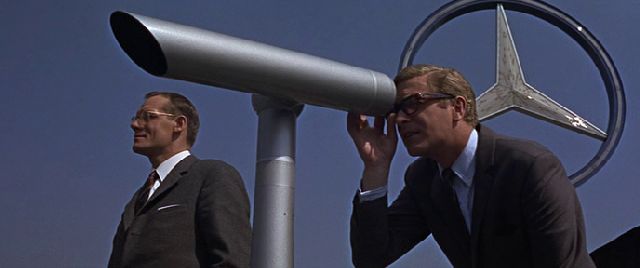
FUNERAL IN BERLIN is one of those classic film time capsules, snapshots of West and East Berlin in the moment in 1966. Hamilton and his crew show the capitalistic and decadent side of West Berlin. Several scenes are shot with the giant Mercedes Benz building and symbol in the background, watching over the city.  Another scene has Harry and Vulkan having dinner at a burlesque club with female impersonators providing the entertainment. The filmmakers did shoot a scene at the actual Checkpoint Charlie with Michael Caine, but they had to film with a long lens as Russian soldiers across the Wall were using mirrors to reflect the sun to disrupt the filming. Berlin during the Cold War still fascinates filmmakers today with recent films like ATOMIC BLONDE (2017) with Charlize Theron in Berlin in 1989 right before the collapse of the Berlin Wall and the Epix TV series BERLIN STATION (2016 - 2019) with a modern take on spying in Berlin in today's present political climate.

A big thanks to the Canadian born Producer Harry Saltzman who brought to us (along with producing partner Albert "Cubby" Broccoli) the greatest secret agent in entertainment history in James Bond but paved the way for more realistic portrayals of intelligence agents with the London based Harry Palmer. Like Sean Connery, Michael Caine would grow weary of the role, not wishing to be typecast, and move on to other projects. FUNERAL IN BERLIN is the apex of the series for me, mixing Cold War politics, a divided city, and Agatha Christie twists for an entertaining, spine-tingling spy film. 


Saturday, January 1, 2022

Au Revoir les Enfants (1987)

When I was in college, I wrote a paper on the French New Wave, a period in the late 50s and early 60s when young French directors like Francois Truffaut, Jean-Luc Godard, and Alain Resnais were pushing the envelope and boundaries with films that played with editing, cinematography and linear storytelling. Truffaut's THE 400 BLOWS (1959) and JULES AND JIM (1962), Godard's BREATHLESS (1960), and Renais's HIROSHIMA, MON AMOUR (1959) and LAST YEAR AT MARIENBAD (1961) were all films made during this French New Wave. Even though I wrote and researched the paper, I think the only film I had actually seen was BREATHLESS.  But there's one French filmmaker who was not considered part of the French New Wave even though he was the same age as Francois Truffaut and his first big hit ELEVATOR TO THE GALLOWS (1958) came out a year before the French New Wave.  That filmmaker was Louis Malle.

Louis Malle was one of those rare foreign film directors who made successful films in France like THE LOVERS (1958) but also was able to break into American cinema.  Malle directed the controversial PRETTY BABY (1978) starring Keith Carradine, Susan Sarandon and Brooke Shields as a teenage prostitute in 1917 New Orleans.  Malle followed that up with the highly acclaimed ATLANTIC CITY (1980) starring Burt Lancaster and Susan Sarandon. Malle would also be married to American actress Candace Bergen. Malle would return to his French roots in 1987 to direct an autobiographical story from his youth at a Catholic boarding school in German occupied France during World War II called AU REVOIR LES ENFANTS (GOODBYE, CHILDREN). I was just rediscovering foreign films around that time.  Wim Wenders German film WINGS OF DESIRE (also 1987) about an angel who wishes to become human was the one that I saw. I remember the posters for AU REVOIR LES ENFANTS but had no idea what the film was about.

Written and directed by Louis Malle based on an actual event he witnessed as a school boy, AU REVOIR LES ENFANTS opens at a train station in Paris in January 1944.  12 year old Julien Quentin (Gaspard Manesse) says goodbye to his mother Madamoiselle Quentin (Francine Racette) as he heads back to boarding school after the Christmas break in the countryside outside of Paris along with his older brother Francois (Stanislas Carre de Malberg). Many affluent Parisian families send their sons to school away from the French capital to avoid bombings. Julien and his classmates return to St. John of the Cross Carmelite Convent, a Catholic all-boys school run by Father Jean (Philippe Morier-Genoud) and Father Michael (Francois Berleand). On the first day of class, Father Jean escorts a new boy to the classroom Jean Bonnet (Raphael Fejto). Since he's the new kid, the other boys tease Jean mercifully.  Julien notices there's something different about Jean but he can't put his finger on it.  Jean doesn't know the Catholic prayers and he doesn't eat pork. 

Julien, who's one of the smarter kids in his class, begins to see Jean as his intellectual adversary. After Julien struggles at his piano lesson with the pretty young French teacher Ms. Davenne (French actress Irene Jacob in her first film), he watches Jean play beautifully for her.  Father Jean asks Julien to be nice to Bonnet. A couple of French collaborators make a surprise inspection of the school. Father Jean quietly whisks Bonnet away. Julien snoops around Jean's belongings. He finds a family photo and a book inscribed to Jean Kippelstein. Although he doesn't know much about them, Julien realizes that Bonnet is Jewish. Julien quizzes Jean about his family. He learns Jean's father is a prisoner and he hasn't heard from his mother in three months.

The school breaks into two teams for an outdoor activity to find a treasure hidden in the woods.  Julien and Jean escape capture from the rival team but get lost in the woods. Julien finds the treasure then reconnects with Jean.  While walking back on a road, the two boys are picked up by a German patrol and taken back to the boarding school. While recovering from exposure in the infirmary, Julien reveals to Jean he knows his secret. Parents Weekend arrives and Julien's mother comes to visit.  She takes her sons Julien and Francois to her favorite restaurant. The Quentin's invite Jean along. While dining, they witness two French collaborators harass a distinguished, older Jewish patron before a table of Germans soldiers intervene, not wishing to have the visiting French families upset. 

The war creeps closer to its end but an event happens at the school that will set in motion a series of terrible consequences.  Joseph (Francois Negret), the lame kitchen helper who buys and sells items from the students on the black market is caught stealing by the cook Madamoiselle Perrin (Jacqueline Paris). Father Jean fires the young man. An air raid sends the teachers and students to shelter but Julien and Jean play hooky. They read a passage from the erotic Arabian Nights and Jean teaches Julien a fun piano piece they play together. A few days later during math class, a Gestapo agent Dr. Muller (Peter Fitz) enters the class looking for Jean Kippelstein.  At first, no one says any thing but Jean gives himself up. The Germans round up two other Jewish students as well as Father Jean for harboring the students. Before Jean is escorted away, he gives his books to Julien. Julien discovers that Joseph is the snitch who gave up the Jewish kids and Father Jean to the Germans as payback for his dismissal. In a voice over as Jean waves goodbye to Julien for the final time (the voice is director Louis Malle), an adult Julien tells the audience that Jean and the other boys died at Auschwitz and Father Jean died in another camp before the war ended. 

AU REVOIR LES ENFANTS is based on an incident director Louis Malle witnessed while attending an all-boys boarding school in Fontainebleau outside of Paris at the end of World War II. The character of Julien represents Malle. Malle's recollections of the school, the priests, and his fellow classmates is perfect. The boys all in their formal Catholic school uniforms with navy blue berets and yellow and blue ties. The horrible conditions with the boys having little to eat at school and no heat or hot water. The tough but compassionate priests and teachers trying to go about their normal duties while their country is occupied by the Germans, often teaching during air raids and blackouts. 

Malle captures perfectly the complicated lives of boys on the verge of becoming young men while dealing with a world war and separation from their families. He shows us the playground politics of bullying, friendship, and competitiveness.  The boys play a game of last man standing on stilts, jousting with each other until only one remains upright. Just outside the view of the teachers, contraband like cigarettes and homemade jars of jam are swapped between the students and the kitchen help Joseph.  It's an all-boys Catholic school but it feels like a prisoner of war camp. The Catholic priests run the school but on the fringes are the German army.  Early in AU REVOIR LES ENFANTS the Germans are just on the periphery. A single German comes to school for confession.  A group of German soldiers leaving a bath house as the students arrive for their first warm bath in weeks.  But gradually, as Jean's identity and freedom becomes riskier and riskier, Germans and French Collaborators become more prevalent, and the noose becomes tighter around young Jean Kippelstein's neck. 

A theme of AU REVOIR LES ENFANTS is Julien's loss of innocence. Julien's a good kid, a bit conceited. In the film's opening scene, he professes to his mother he hates her. But when she comes to visit him weeks later on Parents Weekend, it's evident Julien's a Momma's boy. His bed wetting episodes may be caused by his separation from his parents.  After a rough start with the new student, Julien discovers a kindred spirit in Jean Bonnet aka Kippelstein. They both love the classics like The Three Musketeers. Julien realizes how lucky he is to have a family compared to Jean's situation. In Julien's secluded world, he knows there's a war going on and the Germans are the bad guys but he's not aware of the horrors they can commit like his older brother Francois.  As a Catholic, it seems he's never met a Jewish boy before or knows how dangerous it is to be Jewish during this period. It's only when the Gestapo come to the school and take Jean and Father Jean away that Julien comes face to face with pure evil. An evil punctuated by Julien's discovery that Joseph snitched on the Jewish students and the headmaster, leading to their eventual deaths right before the war ends.

I would argue that AU REVOIR LES ENFANTS is as devastating a film about the Holocaust as Steven Spielberg's SCHINDLER'S LIST (1990) minus the graphic depictions of the Nazis brutality. Director Malle doesn't need the big canvas of the Warsaw ghettos or the Auschwitz concentration camp to show the Nazis malevolence. Their terror seeps even into small towns and boarding schools. Like THE DIARY OF ANNE FRANK (1959), LES ENFANTS is a more intimate look at one young Jewish adolescent trying have a normal life at an all-boys school with death close on his heels. Malle builds the tension slowly, methodically. There are some close calls for young Jean but when their math teacher updates the class on the progress of the Allied armies, it looks like Jean might outlast the Germans.  But the treachery of Joseph to get back at the priests for his expulsion spells doom for the clandestine Jewish students.  The ultimate tragedy is that people like Anne Frank, Jean Kippelstein, and thousands of others needlessly perished when the war was lost for Germany and there was no need to continue this hideous genocide.  

The success of films with young actors is all in the casting. Malle gets it right with Gaspard Manesse as Julien Quentin and Raphael Fejto as Jean Bonnet aka Kippelstein in AU REVOIR LES ENFANTS. At times, the two boys look very similar in their navy blue berets, pale skin, and rosy cheeks. On the LES ENFANTS poster, the boys look like mirror images of one another. But Fejto is much taller than Manesse. Julien's shorter stature doesn't keep him from being mean early in the film. He uses his smarts and his tongue to bully Jean.  But Julien will develop a friendship with Jean that will be tragically cut short. Jean's tallness makes him more awkward physically, but he excels at math and music. We know that Julien representing director Malle will become a filmmaker.  We'll never know what greatness Jean might have become.  He could have become a world-renowned mathematician or an accountant like his father. 

AU REVOIR LES ENFANTS is mostly a male cast, but special mention should go to a couple of female performers. Francine Racette as Julien's doting mother is only in a couple of scenes, but her presence brings out a more sympathetic side to Julien who loves her more than he lets on. For a few brief hours, Mrs. Quentin captivates Jean, reminding him of the important roles that mothers play in shaping their sons.  As the piano teacher Ms. Davenne, French actress Irene Jacob makes her film debut. As the only pretty young woman in this world of male priests, teachers, and students, the innocent Ms. Ravenne is oblivious to all the lovelorn looks and feelings the students have for her.  Jacob would become a favorite of acclaimed Polish director Krzysztof Kieslowski appearing in his films THE DOUBLE LIFE OF VERONIQUE (1991) and RED (1994).

Director Malle would visit this period of 1944 France earlier in his career with the film LACOMBE, LUCIEN (1974) about an 18 year old French boy (Pierre Blaise) who collaborates with the Nazis and falls in love with a Jewish girl (Aurore Clement). It might have been Malle's first stab at trying to get his creative mind around his boarding school memory that had haunted him most of his life. As depressing as AU REVOIR LES ENFANTS may sound, the film has many magical, light moments.  One of my favorites is when the priests and teachers show the students a Charlie Chaplin short film called THE IMMIGRANT (1917). The images of the students and priests and teachers laughing at Chaplin's comic genius are priceless, a brief interlude from the German oppression surrounding the school. 

In the tradition of films about all boys school students like Peter Brook's LORD OF THE FLIES (1963) or Peter Weir's DEAD POETS SOCIETY (1989), AU REVOIR LES ENFANTS captures the world of an all boys boarding school during a time of war.  AU REVOIR LES ENFANTS would win the Golden Lion prize at the Venice Film Festival in 1987 but miss out on the Best Foreign Film at the Academy Awards losing to the Danish film BABETTE'S FEAST.  This French gem is filmmaking at its finest, a tragic real life incident told by a French master named Louis Malle who needed to exorcise this memory that had haunted him. The film world is a rich place because of his personal film. 

Saturday, December 4, 2021

It's A Wonderful Life (1946)

I have put off blogging about Frank Capra's IT'S A WONDERFUL LIFE (1946) for my Christmas edition of CRAZYFILMGUY for many years now for one simple reason. I cry every time I watch the film. I had never even heard of IT'S A WONDERFUL LIFE until college when my film criticism professor and screenwriter Peter Krikes (who wrote I think the best of the early STAR TREK movies called STAR TREK IV: THE VOYAGE HOME) showed the movie to our film class before Christmas break back in 1985. Upon viewing the now classic film, I discovered 1) I am extremely sentimental and 2) I developed a crush on actress Donna Reed who plays James Stewart's wife Mary. Nowadays, you can't turn on the television around the holidays (in fact it's on tonight on NBC) and not stumble across IT'S A WONDERFUL LIFE.  But until that pivotal moment in college, I had no clue that such a heart-warming film existed. It turns out this year is the 75th anniversary of the release of IT'S A WONDERFUL LIFE. I've got a box of tissue right next to me.  Let's do this! 

Yet, as beloved as IT'S A WONDERFUL LIFE is today, it was not appreciated when it was released back in 1946 which is incredible. It was a box office flop.  How can that be? The title is uplifting. It's a holiday film.  It stars All American movie stars James Stewart and Donna Reed.  It has a lovable angel in it. But dig a little deeper into IT'S A WONDERFUL LIFE and the film's story and the time the film came out is darker than you would imagine. World War II had just ended. Although jubilant, the U.S. had a hangover from a war that killed millions. A film about a man who teeters on the brink of suicide, leaving his wife and young kids behind when he believes he's lost everything was a bit too bleak for audiences a year after the war ended. But like the main character George Bailey, IT'S A WONDERFUL LIFE would be saved and rediscovered by later generations who found deeper meaning and laughs in this black and white holiday movie. 

An Italian immigrant from Sicily who came to America with his family in 1903, Writer/Director Frank Capra was at the top of his game between 1934 to 1941 creating classic films like IT HAPPENED ONE NIGHT (1934) with Clark Gable and Claudette Colbert; MR. SMITH GOES TO WASHINGTON (1939) with James Stewart and Jean Arthur; and MEET JOHN DOE (1941) with Gary Cooper and Barbara Stanwyck.  But World War II would put a break on the careers of both Frank Capra and James Stewart's.   Both men would become involved in the war effort.  Stewart would fly bombing missions over Europe, forever altering his life and view of the world.  Capra would continue filmmaking but for the U.S. Government, making propaganda films during the war. When World War II ended, Capra and Stewart would reunite for their first project since the war with IT'S A WONDERFUL LIFE.

With a screenplay by Frances Goodrich, Albert Hackett, and Frank Capra and some additional scenes by Jo Swerling based on a story by Philip Van Doren Stern and directed by Frank Capra, IT'S A WONDERFUL LIFE opens on Christmas Eve with the sleepy, snowy New England town of Bedford Falls praying for a man named George Bailey. The Celestial Beings above hear their prayers and request Clarence Oddbody (Henry Travers) an angel, second class to help George. They begin by having Clarence study young George Bailey (Bobbie Anderson) in two pivotal moments of his youth. First, in 1919, George saves his younger brother Harry Bailey (Georgie Nokes) from drowning in an icy pond. Later, young George prevents his pharmacist boss Mr. Gower (H.B. Warner) from accidentally dispensing poison to a customer. We flash forward to adventurous, young adult George Bailey (James Stewart) in 1928 about to travel around the world before returning to finish college.  On his final night before leaving, George joins his younger adult brother Harry (Todd Karns) at Harry's high school graduation party where he runs into childhood friends Sam Wainwright (Frank Albertson), Violet Bick (Gloria Grahame) the sexiest girl in Bedford Falls, and Mary Hatch (Donna Reed) who has secretly loved George since they were kids. George and Mary dance the Charleston, fall into a swimming pool underneath the dance floor, and later walk home together but their romance and George's trip are cut short when George's father Peter Bailey (Samuel S. Hinds) has a stroke that night and dies. 

George delays his Around the World trip to help settle the affairs of his father and Uncle Billy's (Thomas Mitchell) Bailey Brothers Building & Loan bank that they own.  The richest and meanest man in Bedford Falls Henry Potter (Lionel Barrymore) wants to liquidate the Building & Loan but the Board of Directors votes to keep it open but only if George manages it.  George cancels his trip around the world and finishing college, letting Harry go to college first.  But when Harry returns after graduating to trade places with George, he's secretly married to Ruth Dakin (Virginia Patton) and her father has a job lined up for Harry. George is stuck in Bedford Falls. George's mother Mrs. Bailey (Beulah Bondi) tells George Mary is back in town from college. George is in a bad mood but wanders around town eventually ending up in front of Mary's house. After initially fighting, George realizes he's in love with Mary.  George and Mary get married.

George and Mary prepare to leave on an extensive honeymoon when they notice a crowd of people heading for the Building & Loan. There's been a run on the Building & Loan as Potter's bank has called its loan.   The citizens of Bedford Falls want their money. George and Mary use the two thousand dollars put away for their honeymoon to keep the bank open until closing time at six o'clock. The Building & Loan has survived. George is relieved but realizes Mary has disappeared. George's policeman friend Bert (Ward Bond) and taxi cab buddy Ernie (Frank Faylen) bring George over to the dilapidated old Granville house Mary has spruced up and renamed for one night the Waldorf to celebrate their honeymoon. George and Mary move into that old house, start a family and open Bailey Park, a community of affordable homes for residents to compete against Potter's slums. Potter tries to buy out George but George holds firm to his principles. Christmas Eve arrives. A big party is set for the Bailey house that night to celebrate the return of George's brother Harry who has just received the Congressional Medal of Honor for heroism during World War II.

The absent-minded Uncle Billy goes to make a deposit of eight thousand dollars at Potter's Bank but accidentally loses it (placing the envelope with the money in Potter's newspaper as Billy razzes Potter). George and Uncle Billy retrace his steps but the money is gone. The Building & Loan will be ruined. George goes to Potter for help but Potter just laughs at him. At his wit's end, George drives to a bridge, prepared to jump into the river to commit suicide when Clarence the Angel jumps into the river first.  George rescues Clarence.  As they dry off in the tollhouse keeper's shack, George wishes he'd never been born. With that wish, Clarence shows George what life would be like without him. Bedford Falls would become the dark and dangerous Pottersville. Mr. Gower would go to jail for poisoning a customer and become a drunk when released. George's brother Harry would drown because George wasn't there to save him. George's wife Mary would become an old maid and never be married. Clarence shows George that one man, one life can touch so many others. George wants to live again and Clarence returns George to his life as snow falls again in Bedford Falls.  George races home to see his family and discovers all of Bedford Falls has turned out to help George with his financial situation.

I have to give credit to my wife for pointing out to me that IT'S A WONDERFUL LIFE has deep connections to Charles Dickens A Christmas Carol. Now George Bailey is no Ebeneezer Scrooge but George does become distraught and cranky to his family on Christmas Eve after Uncle Billy loses the bank deposit. Henry Potter is the Scrooge character, showing not an ounce of humanity as he seeks profit over the welfare of the citizens of Bedford Falls. Instead of Christmas ghosts, George's Guardian Angel (and director Capra) take George to a Christmas Past or Future (depending on how you look at it) where a George Bailey doesn't exist, revealing a dismal outcome for everyone George cares about. Bedford Falls never looked so eerie and ghostly (thanks to cinematographers Joseph Biroc and Joseph Walker and music by Dimtri Tiomkin). The black and white photography makes the Norman Rockwell like Bedford Falls (or Potterville in the George Bailey-less world) look positively Dickens like from the white snow falling on the black and white town to George and Clarence visiting a windy, sinister cemetery to view Harry's grave. 

As uplifting as the finale of IT'S A WONDERFUL LIFE is, I always came away at the end of the film with the feeling that mean, old Mr. Potter (and his Lurch like silent bodyguard played by Frank Hagney) still won.  Potter never gives back the money and he's never caught. Not that he needs it but he's eight thousand dollars richer. But upon my recent viewing, I realize that George will be the richest man in Bedford Falls, both figuratively with the love and generosity of his family and friends and realistically, with the financial support of childhood friend and wealthy industrialist Sam Wainwright who wires George twenty-five thousand dollars. Sam could steer any of his businesses to open accounts at George's Building & Loan. Potter may have momentarily shaken George to his core but the Bedford Falls community will rise together to ultimately put Henry Potter out of business. At least, that's how I imagine it once the film ends.

There are plenty of good Christmas themed films that came out around the same time as IT'S A WONDERFUL LIFE like Leo McCarey's THE BELLS OF ST. MARY (1945) and Henry Koster's THE BISHOP'S WIFE (1947) but what makes IT'S A WONDERFUL LIFE memorable and enduring are the little things like the pet raven named Jimmy that Uncle Billy keeps at the Building & Loan or the railing knob that George keeps pulling off and putting back when he goes upstairs in his house. There's George's friends Bert the cop and Ernie the taxi driver whose names will become synonymous with two muppets named Bert and Ernie on Jim Henson's television show for children called SEASAME STREET (1969). There's Uncle Billy who ties a string around his finger so he doesn't forget things (it still doesn't help). Or the sound of a bell ringing which means "an angel just got their wings." There's George and Mary singing "Buffalo Girls Won't You Come Out Tonight" and a jitterbug dance contest that winds up with the dancers all falling Busby Berkley style into a pool that opens up underneath the dance floor. There's Sam Wainwright and his signature donkey noise and gesture that always reminds us who he is. There's George's daughter Zuzu's (Karolyn Grimes) flower petals. None of these are vital to the plot of IT'S A WONDERFUL LIFE but they are little flourishes that make the film more personal and stay with us long after the movie is over.

Before World War II broke out, James aka Jimmy Stewart was just coming into his own as both a romantic and comedic lead in films like George Marshall's DESTRY RIDES AGAIN (1939) with Marlene Dietrich and George Cukor's THE PHILADELPHIA STORY (1940) with Cary Grant and Katherine Hepburn. Stewart would put his career on pause to join the war effort, becoming a distinguished bomber pilot in Europe during World War II. But Stewart would return a changed man, even contemplating retirement from acting. Unbeknownst to his friends and family, the horrors of bombing innocent civilians in France and Germany and witnessing the death of up to 130 comrades during bombing missions left Stewart with what we now call PTSD (post-traumatic stress syndrome). IT'S A WONDERFUL LIFE would be Stewart's first post-war film. As George Bailey, Stewart shows off his familiar comedic and romantic skills but he reveals to us a new, dramatic intensity borne from his war experiences. Faced with eight thousand dollars missing from his bank, the possibility of arrest and jail time, and the disgrace he and his family would face, Stewart's George Bailey goes from pathetically begging his nemesis Potter to save him to emotional desperation and the real act of suicide. Stewart would continue to display his new found dramatic chops in films ranging from Alfred Hitchcock's REAR WINDOW (1954) and VERTIGO (1958), Anthony Mann's THE MAN FROM LARAMIE (1955), Otto Preminger's ANATOMY OF A MURDER (1959), and John Ford's THE MAN WHO SHOT LIBERTY VALANCE (1962). 

IT'S A WONDERFUL LIFE would be the only pairing of James Stewart with Donna Reed. I would have loved more films with the two of them as a romantic couple but how lucky we are to have at least one.  My crush on Donna Reed might have something to do in that she looks like another film crush of mine Olivia De Havilland (THE ADVENTURES OF ROBIN HOOD). Doe eyes, round cheeks, brunette. Reed was just becoming a leading lady when she landed the plum role of Mary Hatch in IT'S A WONDERFUL LIFE. Mary is the All-American girl next door but she has a small town sexiness about her. When George steps on her robe on the way home from the dance, Mary darts into some bushes, naked.  Capra and Stewart have some fun with that scene. Mary's a resourceful woman, coming up with the idea to use their honeymoon money to save the Building & Loan. Later, it's Mary who goes around town asking for help for George and calls Sam Wainwright to rescue George from financial ruin. Reed would move on from her squeaky-clean roles, playing a prostitute and winning the Academy Award for Best Supporting Actress in Fred Zinneman's FROM HERE TO ETERNITY (1953) and as the Native American Sacajawea in THE FAR HORIZONS (1955) with Fred MacMurray as Meriwether Lewis and Charleton Heston as William Clark. 

Capra found the perfect romantic leads for IT'S A WONDERFUL LIFE but his best casting were the supporting roles. Lionel Barrymore (YOU CAN'T TAKE IT WITH YOU) as the Scrooge like Mr. Potter, the meanest man in Bedford Falls is the perfect villain opposite Stewart's Everyman George Bailey. Ebeneezer Scrooge would grow to love people but Capra never lets Henry F. Potter ever become sympathetic.  Barrymore's Potter has a lump of coal for a heart. Henry Travers as Clarence Oddbody, the second-class angel trying to earn his wings is inspired casting.  With his slight Irish accent and grandfatherly demeanor, Travers' Clarence is the perfect foil and companion to help George learn to love life again. Travers retired from film a few years after IT'S A WONDERFUL LIFE but check out this great character actor in other classics like Raoul Walsh's HIGH SIERRA (1941) and Alfred Hitchcock's SHADOW OF A DOUBT (1942). Lastly, the hardest working supporting actor in Hollywood in the 30s and 40s Thomas Mitchell plays George's forgetful Uncle Billy. Besides George, Billy Bailey may be the saddest character in IT'S A WONDERFUL LIFE. He probably only kept his job because of his brother Peter and then George. But Billy loves animals (he has a pet crow and squirrel) and he has a big heart. 1939 would be Mitchell's finest year, appearing in John Ford's STAGECOACH, Frank Capra's MR. SMITH GOES TO WASHINGTON, Howard Hawks' ONLY ANGELS HAVE WINGS, and Victor Fleming's GONE WITH THE WIND. 

Capra rounds out the cast of IT'S A WONDERFUL LIFE with some familiar as well as fresh faces. Ward Bond as Bert the Cop and Frank Faylen as Ernie the cabbie would become universally loved as George's loyal Beford Falls friends. Bond had been appearing in small roles in films like Howard Hawks BRINGING UP BABY (1938) and John Huston's THE MALTESE FALCON (1941) but would really make his mark after WONDERFUL LIFE in John Ford westerns like FORT APACHE (1948) and THE SEARCHERS (1956). Frank Faylen I'm not as familiar with but he proved to be a fine supporting actor appearing in Billy Wilder's THE LOST WEEKEND (1945). For Gloria Grahame who plays Violet Bick, the supposed bad girl of Bedford Falls, IT'S A WONDERFUL LIFE would kick start her career. Grahame would become the femme fatale in film noir classics like Nicholas Ray's IN A LONELY PLACE (1952) with Humphrey Bogart and Fritz Lang's THE BIG HEAT (1956). Look for the Little Rascal "Alfalfa" aka young adult Carl Switzer as Mary Hatch's date Freddie Othello at the graduation party who opens up the swimming pool underneath the dance floor to get back at George Bailey stealing his gal. Grandma Walton Ellen Corby has an uncredited appearance as Ms. Davis, one of George's customers. And Sheldon Leonard as Nick the bartender at Martini's would play tough cops and tough guys in films like Howard Hawks TO HAVE AND HAVE NOT (1944) and Joseph Mankiewicz's GUYS AND DOLLS (1955) before becoming a successful TV producer of comedies like GOMER PYLE USMC (1964) and THE ANDY GRIFFITH SHOW (1960).

Some wonderful last IT'S A WONDERFUL LIFE trivia. Most films in the 30s and 40s used city streets located on the backlot of studios like Warner Bros or Universal. But the town of Bedford Falls and its city blocks looked so authentic to me I always imagined Capra filmed on location somewhere in upstate New York. It turns out Capra had a real three block set (covering four acres) built on RKOs Encino Ranch in southern California. Main Street was 300 yards long and the set had 75 stores and buildings. If they filmed in southern California (during a heatwave in June of 1946 no less), how did they make the snow looks so real and not melt? Before IT'S A WONDERFUL LIFE, film snow was accomplished with cornflakes painted white.  Director Capra needed lots of snow, snow that would crunch when characters walked on it and leave tire tracks. Capra turned to RKO special effects head Russell Shearman who devised a mixture of Foamite (found in fire extinguishers) along with soap, sugar, and water that could be sprayed out of cannisters and have that gentle, soft falling effect. The snow is a major character in IT'S A WONDERFUL LIFE. There is a colorized version of IT'S A WONDERFUL LIFE but I have fought off the urge to watch it.  I would think color would change the tone of the film especially when George and Clarence revisit if George had never been born. 

Frank Capra's pet project IT'S A WONDERFUL LIFE, the first and only project he made under his Liberty Films banner, would fade from the public's mind after 1946 and seem just a footnote in James Stewart's career.  But with the advent of television and television stations needing product to show, IT'S A WONDERFUL LIFE was rediscovered. Its copyright had not been renewed and the film fell into public domain allowing anyone to broadcast it for free. Suddenly, a new generation got to know and fall in love with George Bailey and Bedford Falls and the true spirit of people helping people.  

I have made it through this blog without crying although I have fought off a tear every now and then. Yes, IT'S A WONDERFUL LIFE has its dark moments but they are woven carefully within this magical, slice of small town America version of A CHRISTMAS CAROL.  How audiences back in 1946 couldn't embrace this film after nearly a decade of war is beyond me. If you or I ever become as desperate and disillusioned as George Bailey, just remember these words from his guardian angel Clarence who now has earned his wings. "Remember no man is a failure who has friends!" Merry Christmas and Happy Hanukkah everyone!

Sunday, October 31, 2021

For Your Eyes Only (1981)

After the tepid MOONRAKER (1979), I think I wanted less Roger Moore as James Bond than more Roger Moore. Moore was beginning to show his age as were the Bond filmmakers.  They seemed to be running out of ideas. MOONRAKER was a retread of THE SPY WHO LOVED ME (1977) only in outer space.  The next 007 film to follow would be FOR YOUR EYES ONLY (1981) which for me is the end of the Roger Moore era.  Moore would make two more films after FOR YOUR EYES ONLY with the catchy title but boring OCTOPUSSY (1983) and his final appearance in the violent and awful A VIEW TO A KILL (1985) which wastes a good Duran Duran theme song. In my humble opinion, FOR YOUR EYES ONLY is Moore's last good Bond film which may be giving it more praise than it deserves.

Number 12 in the Bond series, FOR YOUR EYES ONLY is a return to the original Bond films with the British and the Russians racing against one another to find a missing device that can control a fleet of English nuclear submarines and its missiles. The film has some great locations, bringing Bond back to some ski action and stunts in the Dolomites region of Italy.  Greece is also used extensively including an amazing Greek monastery (in which the actual monks protested the filming by placing bed sheets over the monastery to disrupt production) sitting precariously atop rocky spires. Tired of aging European cinema icons of yesteryear playing the main villains (German Curt Jurgens in THE SPY WHO LOVED ME and Frenchman Michael Lonsdale in MOONRAKER), FOR YOUR EYES ONLY goes with a handsome yet boring villain (with a fantastic goatee) in English actor Julian Glover (INDIANA JONES AND THE LAST CRUSADE) playing a sinister Greek smuggler working for the Russians. 

The main Bond girl French actress Carole Bouquet (THAT OBSCURE OBJECT OF DESIRE) is pretty but underwhelming (although she's grown on me with each viewing). The filmmakers throw a curveball with a second Bond girl casting Lynn Holly-Johnson, an actress and ice skater (see ICE CASTLES) trying to shed her wholesome image by portraying a sexually insatiable Olympic ice skating hopeful.  Singer Sheena Easton delivers with the slow but catchy theme song of the same name For Your Eyes Only. FOR YOUR EYES ONLY feels like it should be an earlier Bond film with Sean Connery but here it is nineteen years after the debut of DR. NO (1962).

With a screenplay by Bond veteran Richard Maibaum and Michael G. Wilson (based on two James Bond short stories by Ian Fleming For Your Eyes Only and Riscio) and directed by former Bond 2nd Unit  Director and film editor John Glen (more about Glen later), FOR YOUR EYES ONLY begins with an interesting, unorthodox opening sequence.  After visiting the grave of his deceased wife Teresa (killed in ON HER MAJESTY'S SECRET SERVICE), James Bond (Roger Moore) is picked up by helicopter for urgent business. But the helicopter is hijacked by a wheelchair bound, bald, cat-loving SPECTRE baddie (representing the various incarnations of Ernst Stavros Blofeld) who controls the copter by remote control. Bond manages to disrupt the takeover and dispatches the villain. Off the coast of Albania, a seemingly typical Maltese fishing trawler the St. Georges hides inside a secret British intelligence operation that houses ATAC, a sophisticated device that communicates to Britain's nuclear submarines. The trawler strikes a mine and sinks.  Immediately, British intelligence and Russia's KGB led by General Gogol (Bond veteran Walter Gotell) race to recover the top secret machine. 

Off the coast of Greece on the island of Corfu, Melina Havelock (French actress/model Carole Bouquet) visits her parents including her ocean archaeologist father Professor Havelock (Jack Hedley) who besides excavating an underwater Greek temple, works for the British government to locate the sunken fishing vessel and the ATAC encryption machine.  Melina barely escapes with her life as her father Havelock and mother are gunned down by Cuban hitman Hector Gonzalez (Stefan Kalipha). The British Minister of Defense (Geoffrey Keen) sends Bond to Spain to interrogate Gonzalez. Bond sneaks into Gonzalez's villa where he spies a man with glasses paying off Gonzalez for the hit. Before Bond can capture the hitman, Gonzalez is shot with a crossbow arrow by the revenge minded Melina. Bond and Melina escape through the olive groves in Melina's clunky Citroen 2CV evading would be killers. 

Back in London, Bond meets with Q (Desmond Llewelyn) at his gadget laboratory. Q uses the Identigraph to help Bond determine that the man with the glasses was Belgian Emile Locque (Michael Gothard) he saw at the Spanish villa. Locque's last known location is Cortina, Italy.  Bond flies to Cortina where he's introduced by his Italian contact Luigi Ferrara (John Moreno) to the mysterious Greek smuggler Aristotle Kristatos (Julian Glover) who's watching his Olympic protege ice skater Bibi Dahl (Lynn Holly-Johnson) train. Kristatos believes Greek shipping magnate and pistachio munching Milos "the Dove" Columbo (Topol) may be trying to salvage the ATAC. Bond is pursued by killers Claus (Charles Dance) and Erich Kriegler (John Wyman) who chase Bond through various winter Olympic courses including the bobsled run on skis and motorcycles. Bond evades his attackers. When he returns to his Italian contact Luigi Ferrara (John Moreno), he finds Ferrara dead, garroted, with a white dove pin attached to his jacket.

On the trail of Columbo, Bond returns to Corfu where Melina is continuing her father's work. Bond seduces Columbo's mistress the Countess Lisl (Cassandra Harris) only to see her killed by Locque and Claus on the beach. Columbo and his men spring from the water in scuba suits and save Bond. Columbo reveals Kristatos is a double agent, working for the Russians. After Bond and Columbo raid one of Kristatos's heroin factories looking for the smuggler, Bond and Melina use her father's mini-sub Neptune to explore the St. Georges wreck and grab the ATAC. But when Bond and Melina return to their boat, Kristatos awaits to snatch the ATAC from them. Kristatos drags Bond and Melina behind his yacht over reefs and hungry sharks before the two manage to escape.  Kristatos sets up the exchange with Gogol for the ATAC at St. Cyril's, a Greek monastery atop soaring needle like rocks. Bond, Melina, Columbo, and his men begin a final assault on the monastery to stop Kristatos and keep the encryption machine out of the Russians hands.

Director John Glen who started out in the Bond universe as a 2nd Unit Director for ON HER MAJESTY'S SECRET SERVICE and promoted to editor on THE SPY WHO LOVED ME and MOONRAKER has initially been my fall guy for the decline of the James Bond series. But upon further review of Glen's first effort with FOR YOUR EYES ONLY after many years, Glen's appreciation for the character and franchise is to be commended. After having Bond up in space in MOONRAKER, Glen had stated he wanted to bring Bond back to earth for his next film. FOR YOUR EYES ONLY is a throwback to the older classic Bond movies. After the disappointment of MOONRAKER, FOR YOUR EYES ONLY was a jolt of fresh air to my teenage eyes, taking me back to the good old Bond films like DR. NO and GOLDFINGER (1964).

Glen pays homage to the first Bond film he worked on in ON HER MAJESTY'S SECRET SERVICE by having Bond place flowers on his wife's grave (played by Diana Rigg in ON HER MAJESTY'S SECRET SERVICE) to begin FOR YOUR EYES ONLY and then tussle with a crippled but still maniacal Blofeld like villain (Blofeld killed Bond's wife but broke his neck at the finale of ON HER MAJESTY'S SECRET SERVICE). Glen reminds us there are demons in Bond's past that he can never completely be rid of. 

One thing that stuck with me when I saw FOR YOUR EYES ONLY in high school were the set pieces. They are excellent and never completely topped in Moore's remaining Bond films or the two Timothy Dalton Bond films that Glen also directed. The car chase in the hills and small towns of Spain (actually Corfu, Greece) with Bond and Melina is both exciting and humorous (courtesy of famed stunt driver Remy Julien). The ski chase sequences in Cortina, Italy are breathtaking and well photographed (courtesy of famed ski cameraman Willy Bogner) with Bond chased by motorcycles with studded tires while skiing off chalet roofs, tables,  and even down a bobsled run. The assault on Kristatos's heroin factory reminds me of Bond's invasion of a gypsy camp in FROM RUSSIA WITH LOVE (1963) and capped off by a beautiful, cinematic explosion on the dock.

Greek villain Kristatos's sadistically dragging the bound Bond and Melina through the Mediterranean waters is a scene borrowed from Ian Fleming's novel Live and Let Die complete with sharks nipping at our hero and heroine. Finally, the assault on the towering monastery in Meteora, Greece showcases some exciting rock climbing (and falling) by Bond stuntman Rick Sylvester (who skied of a cliff and parachuted to safety as Bond at the beginning of 1977's THE SPY WHO LOVED ME). 

Family has always been an important part of the Bond franchise. Producer Albert Broccoli, his wife Barbara, and son-in-law Michael G. Wilson (who co-wrote FOR YOUR EYES ONLY) have managed the series since 1962 (Broccoli's producing partner Harry Saltzman departed after THE MAN WITH THE GOLDEN GUN).  Crew like director John Glen or production designer Peter Lamont both started out as editor and art director previously and moved up through the Bond films to more prestigious positions.  Interestingly, in the FOR YOUR EYES ONLY plot, Bond and the people he encounters unite to become a sort of family.

Bond himself, we learn from SKYFALL (2012) is an orphan. Melina loses her parents early in FOR YOUR EYES ONLY, killed by the hitman Gonzalez. Olympic hopeful Bibi Dahl doesn't seem to have any parents, just a stern ice skating coach Brink (Jill Bennett) and her wealthy but sinister patron Kristatos who may have slightly lascivious reasons for supporting Bibi. Columbo becomes a father figure to Bond after rescuing him from Lochte and Claus and setting him straight about Kristatos. Bond, Melina, Bibi, and Columbo are misfits who join together as a unit (or family) to stop Kristatos who has hurt each of them in some profound way. 

It's only fitting that since part of FOR YOUR EYES ONLY takes place in Greece, there be some references to Greek mythology and the ancient Greeks.  Melina Havelock's choice of weapon to extract revenge on hitman Gonzalez is a crossbow.  The image of Melina with a crossbow hearkens to the Greek goddess Diana who was the patroness of hunters and was often painted with a quiver of arrows slung over her shoulder. There's a nice underwater sequence where Melina oversees her father's men excavating a submerged Greek temple (it's a set but still a tribute to the ancient structures still found all around Greece). The finale takes place high in the clouds (the soaring monastery) where in Greek mythology, the Gods and Goddesses lived and played. The only reference the filmmakers got wrong was the name of Melina's underwater submarine Neptune.  Neptune is the Roman name for Poseidon, the Greek God of the Sea.

Today's James Bond films have Oscar winning actors left and right (Javier Bardem, Judi Dench, Christophe Waltz, and Remi Malek to name a few) but back in 1981, FOR YOUR EYES ONLY'S cast was an eclectic group.  As the pistachio popping Columbo, Israeli actor Topol was more famous as Tevye in Norman Jewison's FIDDLER ON THE ROOF (1971) but EYES ONLY would introduce him to a new generation of filmgoers.  Lynn-Holly Johnson who plays Bibi Dahl was better known as an ice skater then as an actress. Her only two credits before EYES ONLY were ICE CASTLES (1978) with Robby Benson and the Disney suspense film THE WATCHER IN THE WOODS (1980) with Bette Davis. But Johnson brings a spark to FOR YOUR EYES ONLY with her bubbly personality. In a sign of the times, Bond has to fight Bibi off as he feels he's too old for the teenage Olympic hopeful, a harbinger that Moore was beginning to feel too old for some of his leading ladies. 

As in previous Bond films, the filmmakers went the route of models and international beauty pageant queens casting French actress/model Carole Bouquet as Melina Havelock. Bouquet was more famous as the face for Chanel perfumes but after FOR YOUR EYES ONLY, Bouquet has had a long acting career appearing in mostly French films.  When I first saw EYES ONLY, Bouquet didn't seem like the typical Bond girl but repeated viewings have won me over to Bouquet and her famously luxurious long hair. Cassandra Harris who plays Bond's brief one night stand Countess Lisl has an interesting connection to the Bond franchise.  At the time she appeared in FOR YOUR EYES ONLY, she was married to Pierce Brosnan who would one day take over the role of James Bond beginning with GOLDENEYE (1995). Sadly, Harris passed away while married to Brosnan from cancer in 1991. Both Julian Glover who plays the sinisterly suave Aristotle Kristatos and Charles Dance (in his first film role and no dialogue) as the killer Claus in FOR YOUR EYES ONLY would appear later in their careers in the HBO megahit GAME OF THRONES (2011 - 2019). Dance as Tywin Lannister and Glover as Grand Master Pycelle.

A few final FOR YOUR EYES ONLY tidbits.  This would be the first film that the great Bernard Lee (THE THIRD MAN) who played Bond's superior M did not appear in.  Lee was too ill for filming and would pass away in 1981 when FOR YOUR EYES ONLY was released.  Lee appeared in the first 11 Bond films. Singer Sheena Easton is the first and only performer to sing the Bond theme song and appear in Maurice Binder's opening credit sequence. James Bond films always had sexy posters but FOR YOUR EYES ONLY'S poster may have been the most provocative yet. The poster featured the backside of a long legged woman in the foreground and Roger Moore as Bond facing the unknown woman framed between her legs. A crossbow hangs from her side, implying it might be Carole Bouquet (it's not. It was New York model Joyce Bartle) and sticking with the Greek goddess Diana motif. Some groups protested the  sexy poster and adjustments were made on some posters. 

Director John Glen may have resurrected the classic Bond themes and action in FOR YOUR EYES ONLY but that momentum would not carry over in Moore's last two Bond films as Moore had become too old for the role in my opinion. But give Moore credit for carrying the torch from Sean Connery and giving us four good Bond films out of the seven he would appear in. FOR YOUR EYES ONLY was a memorable film for CrazyFilmGuy when I saw it in the summer of 1981. Little did I know that the Bond franchise was about to take some bumps and bruises for the next 14 years as Roger Moore would eventually retire from the role and producers Albert Broccoli and his wife Barbara Broccoli would have to find new actors to play the most recognizable character in film history -- James Bond. 


Friday, October 1, 2021

The Haunting (1963)

When I was a kid, I liked stories about things that went bump in the night i.e. ghost stories.  I wanted to believe that when a human being died, they might return to their loved ones from the after world to either haunt or watch over them.  I had an English relative I visited in Kent, England after college.  Aunt Margaret swore that ghosts were real. She told me she had seen both her deceased neighbor and her dead cat buried in her garden both come back from beyond the grave to visit her.  She believed that where ghosts are often reported (castles, towers, abbeys), some terrible act of violence occurred. Her theory was that violent act became like a photographic imprint at that location, replaying their demise and anguish repeatedly all over Great Britain for those people with the knack to see it.  But like UFOs, Bigfoot, and the Loch Ness Monster, proof of supernatural apparitions have been hard to come by. 

My love of ghost stories in my youth did not carry over to films.  I prefer vampires and werewolves to wraiths and phantasms.  There have been some ghost themed films that I have enjoyed. Peter Medak's THE CHANGELING (1981) had some scary moments including a deceased child's possessed wheel chair. Tobe Hooper's POLTERGEIST (1982) produced by Steven Spielberg was probably one of the most fun, ghostly thrill rides of recent memory.  I have a fondness for movies about mortals falling in love with a ghost in films like Joseph Mankiewicz's THE GHOST AND MRS. MUIR (1948) or Jerry Zucker's aptly titled GHOST (1990) with the spirit of Patrick Swayze trying to protect his human lover Demi Moore.  Cable television has developed a cottage industry of paranormal detectives and ghost whisperers who try to convince us that spirits from beyond the grave do exist and talk to us.  Moviegoers still like to be frightened by dark presences in recent film like PARANORMAL ACTIVITY (2007) and James Wan's THE CONJURING (2013) with both films spawning multiple sequels. 

Two artistic films in the early 1960s, both made by quality directors, revitalized the ghost and haunted house genre.  Both were filmed in England, perhaps the birthplace of ghost and haunted tales (like the ones my Aunt Margaret told me). Recently, I saw THE INNOCENTS (1961) directed by Jack Clayton (a cinematographer turned director) and based on the Henry James story The Turn of the Screw starring Deborah Kerr as a governess to two young children in a seemingly haunted mansion. But THE HAUNTING (1963) directed by Robert Wise (better know for musicals like WEST SIDE STORY and THE SOUND OF MUSIC) I had not seen yet.  Wise, who started as an editor working on Orson Welles CITIZEN KANE (1941) began his directing career with psychological horror films for producer Val Lewton in the 1940s including THE CURSE OF THE CAT PEOPLE (1944) and THE BODY SNATCHER (1945) with Boris Karloff and Bela Lugosi.   THE HAUNTING is well known for Wise's mastery with using sound, editing, and innovative camerawork to invoke suspense and horror without showing the audience much. 

Based on the novel The Haunting of Hill House by Shirley Jackson, adapted for the screen by Nelson Gidding, and directed by Wise, THE HAUNTING tells the haunted house story of Hill House, an estate built in New England 90 years earlier in the 19th Century surrounded by scandal, insanity, suicide, and mysterious deaths.  The original builder and owner Hugh Crain hated people. Crain's first and second wives both died of strange circumstances (a carriage accident outside the estate for Wife # 1 and a fall down some stairs for Wife # 2).  The last owner, a woman who had cared for Crain's daughter Abigail, hanged herself.  Hill House was inherited by Mrs. Sanderson (Fay Compton) who allows Dr. John Markway (Richard Johnson) to investigate its supernatural tendencies and possibly disprove Hill House's bad reputation. Markway plans to bring several assistants to aid with his research but most drop out when they learn its Hill House they'll be studying. Only three join Markway for his ghost hunt: Eleanor Lance (Julie Harris), a fragile young woman who has had a previous poltergeist encounter; Theodora aka Theo (Claire Bloom) who's gifted with ESP (extra sensory perception); and Luke Sanderson (Russ Tamblyn), Mrs. Sanderson's nephew and possible heir to the massive Hill House property. 

Eleanor arrives first to the massive estate, having to deal with Hill House's creepy caretakers Mr. Dudley (Valentine Dyall) and Mrs. Dudley (Rosalie Crutchley). Theodora shows up next followed by Dr. Markway and Luke. Eleanor and Theo share a room the first night and hear loud banging at the end of the hall and a sudden drop in temperature in their room. The next morning, Luke shows the group a message written in chalk on the house's wall: 'Help Eleanor, come home." The team take a tour of the eccentric Hill House, discovering sculptures and busts and cherubs as well as quirky doorways all over the expansive house. They visit the library with its dangerously rickety iron spiral staircase leading to the top balcony where Hill House's previous owner hung herself. Eleanor feels the house speaking to her. Markway's concerned she may be headed for a mental breakdown.

Markway discovers a cold spot in the middle of the house, "the heart of Hill House." Another night arrives and the haunted house turns up the terror. Eleanor hears a man mumbling, a woman laughing, and a baby crying outside their room.  Eleanor's terrified and believes Theo's squeezing her hand for comfort in the dark.  But when she awakens, Eleanor finds Theodore asleep on a couch across from her.  Who was squeezing her hand so tightly? Markway shows Eleanor a harp that he's heard playing by itself. Eleanor becomes more and more unsettled. Markway tries to comfort her and they have a brief moment but the harp intervenes with a twang.

Dr. Markway's wife Grace Markway (Lois Maxwell) shows up, adding an uneasy dynamic to the team. She's arrived to protect her husband's reputation, warning him a reporter is snooping around about his investigation. Grace does not approve of his scientific studies nor does she believe in ghosts. The only place to put Grace up is the nursery but it's locked. But when the group returns inside, the nursery door is wide open. Grace takes the room. The rest of the team move into the parlor to sleep. The loud banging begins again. Markway shuts the parlor door but the door expands inward as Hill House grows malevolent toward the ghost hunters.  Eleanor fears the spirits want her. The team goes to the nursery to check on Grace but she's vanished. Eleanor flees to the library, climbing the treacherous staircase. The last night at Hill House, on the anniversary of the death of Crain's first wife, will come to a head with one of the group meeting an unfortunate demise. 

THE HAUNTING is a psychological horror film but one of its strengths is the depth of character of the four paranormal investigators. Dr. Markway is the father figure, nurturing and protective of the three younger members. But the film suggests that all is not perfect with the good doctor. He tells Mrs. Sanderson his wife Grace disapproves of his interest in the supernatural.  This comment reveals itself literally when Grace shows up at Hill House on the last night, pleading for Markway to give up his ghost hunt.  Grace also shows disdain for the two young female assistants that are working with her husband.  Has Dr. Markway strayed from his wife with previous female assistants? Markway and Eleanor almost had a romantic moment when Eleanor was at her most vulnerable. The haunted house will unexpectedly play a part in strengthening the Markway's marriage when Grace goes missing on the team's final night in the house. 

The fragile Eleanor is the key character in THE HAUNTING.  Despondent and guilt stricken after the recent death of her mother, Markway's invitation to join his team gives her a new purpose, a chance to escape her oppressive sister in Boston.  But her delicate mental state will be taken advantage of as Hill House preys upon her psyche.  At times, she feels the house wants her to leave and other times that the spirits want her to join them. We hear Eleanor's psychological state thru inner monologues she has with herself. Because of Eleanor's unbalanced nature, director Wise makes us question whether the things Eleanor is hearing, seeing, and feeling are real ghostly phenomena or all in her head. Eleanor will become more unstable as the film proceeds to its terrifying conclusion.

Maybe I would have figured it out but the Turner Classic Movie hosts Dave Krager and horror film author David J. Skal pointed it out for me that the character of Theodora in THE HAUNTING is one of the first fully developed lesbian characters in film history.  The best dresser of the group (think London Mod), Theo is confident and a little aggressive around  Eleanor.  She promises to protect her fellow "sister" and later refers to Eleanor as her "new companion" as they hunt for ghosts but with her ESP, Theo also pokes and prods at Eleanor's state of mind at times, leading Eleanor to call Theo one of "nature's mistakes."  Theodora and Eleanor share a bed for protection from the unseen supernatural forces but does Theo have an alterior motive?  THE HAUNTING only suggests. Luke Sanderson is the comic relief of THE HAUNTING.  He doesn't believe in ghosts.  He just wants to make sure his possible future investment/inheritance can shed its bad reputation.  But by the film's conclusion, Luke has been converted, suggesting the best thing is for Hill House "to be burned down...and the ground sowed with salt." 

THE HAUNTING is psychological horror at its finest. Robert Wise began his directing career with psychological horror films for producer Val Lewton in the 1940s.  Lewton's films suggested horrific possibilities but never really showed anything outright, leaving it to the moviegoer's mind if they saw something or not. Filmmakers today would show much more and audiences would expect it. With psychological horror, we wonder if the images and sounds are really happening or made up in a character's head.  Eleanor played by Julie Harris in THE HAUNTING is that character.  Eleanor's already a mess with her personal life. The events that happen to her in Hill House could be caused by actual ghosts or it could be all happening in her unstable mind.  What's unusual is Dr. Markway, Theodora, and Luke all encounter unexplained supernatural phenomena.  They are more stable than Eleanor. But Wise leaves it a little more ambiguous with Eleanor.   Is she really connecting with the spirits or is it just her overworked imagination?

Director Wise pays homage to both Alfred Hitchcock and Orson Welles in THE HAUNTING. A scene with Julie Harris driving to Hill House is shot similarly to Janet Leigh's drive to the Bates Motel in Hitchcock's PSYCHO (1960). Composer Humphrey Searle's score even turns Bernard Herrmann PSYCHO like with screeching violins briefly on Harris's drive, an ominous introduction for her to Hill House. Hill House is a character itself in THE HAUNTING like the Bates's Victorian house in PSYCHO or Charles Foster Kane's mysterious Xanadu compound in CITIZEN KANE. It's large, imposing, and foreboding. Wise's shots of the exterior of Hill House's were done with infrared film to give it a more sinister quality with white clouds behind it.  Wise and cinematographer Davis Boulton also shoot interesting low angle close ups of the actors during the parlor haunting sequence that reminded me of Welles low angle shots in CITIZEN KANE and Hitchcock's low angle close ups during the house siege in THE BIRDS (1963). In all those films, the ceilings are visible, giving an impression of claustrophobia. Lastly, like CITIZEN KANE and PSYCHO, Wise chose to film THE HAUNTING in black and white, possibly a homage to his black and white Val Lewton horror films as well. 

THE HAUNTING is the first film I can recall to create the blueprint that would be passed on to future ghost hunting teams in television and movies.  In THE HAUNTING, we have Markway the scientist, Theodora the mind reader, Eleanor who may be able to commune with spirits, and Luke the skeptic.  THE HAUNTING will pave the way for future ghost hunting teams from Hanna and Barbera's classic Saturday cartoon series SCOOBY DOO, WHERE ARE YOU? (Scooby, Shaggy, Fred, Daphne, and Velma as the ghost sleuths) to Ivan Reitman's GHOSTBUSTERS (1984) with Bill Murray, Dan Ackroyd, Harold Ramis, and Ernie Hudson to most recently THE CONJURING about real life paranormal investigators Ed and Lorraine Warren played by Patrick Wilson and Vera Farmiga.  

Wise's THE HAUNTING would be remade in 1999 directed by cinematographer turned director Jan De Bont with a stellar cast including Liam Neeson, Catherine Zeta-Jones, and Owen Wilson but by all accounts, it does not live up to the original.  In 2018 a ten episode horror series for Netflix called THE HAUNTING OF HILL HOUSE based on Jackson's novel expands her ghost story focusing on a modern day Crain Family. Russ Tamblyn who plays Luke in the original has a cameo in this series.

A strong actress was needed for the role of Eleanor and the filmmakers wisely cast Julie Harris, a titan on the theater stage (Harris won five Tony Awards) to play the psychologically distressed young woman.  Harris displays a rollercoaster of emotions in the film as she battles not only Hill House's other worldly forces but her fellow researchers perceptions of her. Besides THE HAUNTING, Harris's most famous film role would be as James Dean's girlfriend Abra in Elia Kazan's EAST OF EDEN (1955) based on the John Steinbeck novel. Not to be outdone is Claire Bloom who plays the bohemian and ESP gifted Theodora. I had forgotten what a beautiful and talented actress Bloom was in the late 50s and 60s. Bloom can be found in some excellent films like Laurence Oliver's RICHARD III (1955), Richard Brooks' THE BROTHERS KARAMAZOV (1958), Tony Richardson's LOOK BACK IN ANGER (1959) and Martin Ritt's THE SPY WHO CAME IN FROM THE COLD (1965) the last two films Bloom co-starring with her former lover Richard Burton.

Richard Johnson who plays anthropologist Dr. John Markway is the one actor in THE HAUNTING I was not familiar with. With his eloquent diction, good looks, and scholarly/scientific curiosity, Johnson's Markway is the archetype for future film ghost hunters. Johnson would go on to appear in Jack Clayton's THE PUMPKIN EATER (1964) with Anne Bancroft and Peter Finch; the historical epic KHARTOUM (1966) with Charleton Heston and Laurence Olivier; and later play another doctor in the Italian horror cult classic ZOMBIE (1979). Russ Tamblyn who plays Luke Sanderson, possible heir to Hill House, had worked with Robert Wise in WEST SIDE STORY (1961) as Riff, leader of the Jets gang.  I much prefer Tamblyn in SEVEN BRIDES FOR SEVEN BROTHERS (1954) and as Luke in THE HAUNTING where Tamblyn displays his boyish charm.  Tamblyn's Luke brings some lightness to the dark story but it's also his transformation from cynic to believer that brings a chill to the film.  And for those of you who thought actress Lois Maxwell only played Miss Moneypenny in the JAMES BOND films, Maxwell shows us a more dramatic side as Markway's wife Grace, who's arrival at Hill House plays a pivotal role in THE HAUNTING'S third act. 

Robert Wise may be one of the more acclaimed directors you've never heard of.  He was not idolized by French critics like Alfred Hitchcock or Howard Hawks.  He wasn't secretive like Stanley Kubrick or distant like Woody Allen. Wise was well respected by Hollywood and made quality films, tipping his toes in every genre. Besides exploring psychological horror in THE CURSE OF THE CAT PEOPLE and THE HAUNTING, Wise directed the western BLOOD ON THE MOON (1948) with Robert Mitchum; the boxing film noir THE SET-UP (1949) with Robert Ryan; the science fiction classic THE DAY THE EARTH STOOD STILL (1951) and later THE ANDROMEDA STRAIN (1971) based on Michael Crichton's novel; two of the best musicals ever put on film in WEST SIDE STORY (co-directed with Jerome Robbins) and THE SOUND OF MUSIC; the war film THE DESERT RATS (1953) with Richard Burton and James Mason; the historical epic  THE SAND PEBBLES (1966) with Steve McQueen; and even a disaster film I saw as a teenager THE HINDENBURG (1975) with George C. Scott based on the actual event.

A few final HAUNTING trivia tidbits.  The actual building used for Hill House was not a set but the Ettington Park Hotel located in Warwickshire, England (birthplace of William Shakespeare). Some of the cast and crew even stayed in the spooky looking hotel during filming.  Director Wise and cinematographer Davis Boulton shot most of THE HAUNTING with various wide angle lenses to give the film an eerie quality and make the house seem larger .  They even used a special 30mm anamorphic wide-angle lens that Panavision hadn't perfected yet because Wise liked the distorted quality the lens provided.  Wise uses it in several scenes that give the audience a jolt as if ghosts are rushing down the hallway or at characters. 

For today's audiences, THE HAUNTING might not seem like such a big deal.  We expect big special effects and gore in the modern horror film.  But THE HAUNTING is a big deal.  It is artistically well crafted with a successful director and top notch actors. It takes itself seriously but in a good way.  THE HAUNTING just wants to haunt you for a couple of hours.  And it will.