Sunday, April 30, 2023

Forbidden Planet (1956)

Science fiction films began to emerge in the 1950s, initially spawned by the Atomic Age and the advent of advances in special effects. Films like Gordon Douglas's THEM! (1954), Jack Arnold's TARANTULA (1955), and Nathan Juran's THE DEADLY MANTIS (1957) had the nuclear bomb or its radioactive residue turning insects like ants and praying mantises into gigantic monsters. There was a tad of science to mostly fiction. Robert Wise's THE DAY THAT THE EARTH STOOD STILL (1951) was the first mainstream science fiction film to bring an alien (in the human guise of Michael Rennie) from outer space to earth. This would be quickly followed by Byron Haskins THE WAR OF THE WORLDS (1953) based on H.G. Wells novel with Martians invading Earth. But the first science fiction film to set its story outside of our galaxy, on a distant, unknown planet somewhere in the future inhabited by a stocky robot and filmed in bright Metrocolor not black and white was Fred M. Wilcox's FORBIDDEN PLANET (1956).

I have to admit that the thought of watching filmmakers in the 1950s try to tackle an outer space film with the limited special effects technology at their disposal at the time never really appealed to me.  But as I prepared to watch FORBIDDEN PLANET and read up about it, it's evident that this seminal film shaped future television show mavericks and filmmakers from Gene Roddenberry (creator of STAR TREK) to George Lucas (he wrote and directed a little film called STAR WARS) and its influence can be seen in films from Stanley Kubrick's 2001: A SPACE ODYSSEY (1968) to Ridley Scott's ALIEN (1979). 
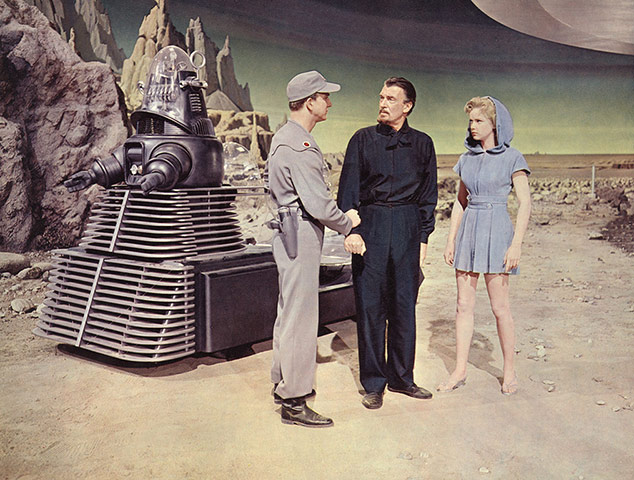
Loosely based on William Shakespeare's play The Tempest (more about that later), FORBIDDEN PLANET'S screenplay is by Cyril Hume based on a story by Irving Block and Allen Adler.  Directed by Fred M. Wilcox, FORBIDDEN PLANET begins with a crew representing the United Planet Federation in the 23rd century arriving in a classic shaped space saucer C57D on the outskirts of the planet Altair IV after a one-year flight. Their mission is to search for survivors from a previous expedition to Altair IV twenty years earlier. Just before the saucer lands, they receive a transmission from a voice warning them to stay away.  Commander John J. Adams (Leslie Nielsen) disregards the admonition.  The saucer lands on the rocky planet.  A shuttle car comes toward them driven by Robby the Robot (Frank Darro inside; voiced by Marvin Miller). Robby takes Adams along with Lt. "Doc" Ostrow (Warren Stevens) and Lt. Jerry Farman (Jack Kelly) to the compound of Dr. Edward Morbius (Walter Pidgeon) and his daughter Altaira Morbius (Anne Francis). Although she's never seen another man before except her father, Altaira greets the men dressed in a daring mini skirt. 

Dr. Morbius tells Adams that after their expedition landed on Altair IV, an unseen force killed off his crew one by one.  Only Morbius, his wife, and daughter survived (his wife eventually passing away of natural causes). Morbius offers to help their spaceship return to Earth but Adams needs to receive his next orders from Earth. Lt. Farman falls for Altaira and teaches her how to kiss but Altaira's not impressed. Adams catches Farman and Altaira and admonishes both of them.  Back at the spaceship, an invisible entity enters the ship and sabotages some of its equipment. Adams and Doc Ostrow return to visit Morbius the next day. Adams comes across Altaira swimming.  He apologizes to her for his outburst.  They kiss and Altaira is more receptive. Morbius appears and tells Adams and Ostrow about a civilization called the Krell he's been studying that lived on Altair IV 200,000 years before Morbius and his starship landed. Morbius has discovered a Krell device that has enhanced his intellect and an underground power source of shafts and ventilators powered by 9,200 thermonuclear reactors. Adams believes this power source should be brought back to Earth. Morbius is hesitant to share his discovery with humanity. 

The crew members put up an electric perimeter with sensors around the ship to ward of the invisible monster. When the ship's cook (Earl Holliman) asks to go beyond the perimeter to secretly meet with Robby the Robot (who's created 480 bottles of Kansas City bourbon for the cook), the invisible creature sneaks on board again, killing Chief Engineer Quinn (Richard Anderson). Morbius shows up at the ship and warns Adams and the crew they are in mortal danger. Adams sets up a stronger defense with a pair of giant ray guns.  Radar picks up a large blip approaching. The invisible creature strikes the electrified perimeter, revealing its frightening outline. The monster is barely phased by the fence's electric volts. Lt. Farman and two more crew members are killed trying to stop the entity. At the same time, Altaira has a nightmare that awakens Morbius. Strangely, the creature stops attacking.

Adams and Doc return to Morbius's residence to evacuate him and Altaira. Robby the Robot blocks their way until Altaira allows them safe passage. Doc tries the brain booster to unlock the secrets of the Krell.  The apparatus reveals to Doc that the Krell destroyed their own civilization.  Doc's brain is overwhelmed by the apparatus and he dies.  Morbius refuses to leave but Altaira makes up her mind to depart with Adams. The ethereal monster shows up at the compound. Adams figures out that Morbius's enhanced brain from the Krell technology has created an alter ego for Morbius - the invisible monster. The monster tries to burn through the locked doors. Morbius faces off against his Id entity, destroying the monster but dying in the process. Adams takes Ataira and Robby back to the ship.  Back in space, they watch as the planet Altair IV self-destructs, taking 200,000 years of Krell technology with it.

Even with the leaps and bounds the science fiction film genre has made in the last forty plus years, FORBIDDEN PLANET is truly a groundbreaking film if you can get past some of the antiquated wardrobe (miniskirts in space, really?) and lack of scientific knowledge when the film was released in 1956. Cinema's first robot is unveiled with Robby the Robot, created by Dr. Morbius himself. We would become much more familiar with robots i.e., droids in George Lucas's STAR WARS (1977) and Irving Kerschner's THE EMPIRE STRIKES BACK (1980) introducing us to C-3PO and R2D2, the great grandchildren of Robby. Robby even seems like a distant cousin to the computer H.A.L. 9000 from 2001: A SPACE ODYSSEY minus the murderous streak. The bright green color of Altair IV's horizon and rocky, pinnacle landscape are the first interstellar world moviegoers had ever seen. Although there is plenty of scientific gibberish spoken by the crew members, I did hear words like "hyperspace" and "blasters" spoken that would become the norm in the STAR WARS universe and countless other sci-fi movies. 

You can clearly see the importance FORBIDDEN PLANET had on the creation of the television series STAR TREK (1966-1969) created by Gene Roddenberry. FORBIDDEN'S Commander Adams (Leslie  Nielsen) brings the ship's medical officer Doc Ostrow and Lt. Farman with him to meet the planet's only resident Dr. Morbius. In STAR TREK, Captain Kirk (William Shatner) routinely investigated planets with the Enterprise's physician "Bones" McCoy (DeForest Kelly) and science officer Spock (Leonard Nimoy). FORBIDDEN'S ship C57D has teleporter pods similar (but used differently) to the teleporters that STAR TREK'S crew would use to beam down to a planet's surface. The set and backdrop for the landscape of FORBIDDEN PLANET with its bright colorful horizon would be the standard for many STAR TREK episodes (unless they filmed on location or a studio backlot). 

Commander Adams uses a blaster in FORBIDDEN PLANET.  Captain Kirk had a phaser (basically the same weapon).  The creature created from Morbius's subconscious Id kills several random crew members in FORBIDDEN PLANET.  In STAR TREK, it was a badge of honor for the nameless Enterprise crew member wearing the red shirt to be killed first on a new planet they were investigating. Altaira's (Anne Francis) miniskirt in FORBIDDEN PLANET, as unusual for a planet wardrobe as could be, was the official ship norm for the female crew members in STAR TREK.  And many of the alien women the Enterprise crew would encounter would often be scantily clad (as much as one could in the 1960s). Although Lt. Farman kisses Altaira first, it is Commander Adams who wins over her heart and mind in FORBIDDEN PLANET.  Just like Commander Adams, STAR TREK'S Captain James T. Kirk was always scoring with the ladies of the universe.  Commanding a spaceship has its privileges. 

I touched upon that FORBIDDEN PLANET is described as "loosely" based on William Shakespeare's play The Tempest. That might be an understatement.  For those of you (myself included) who don't know the plot of The Tempest, it's about a magician named Prospero who is shipwrecked on an island with his daughter Miranda and his two servants: a beast named Calibran and a sprightly spirit named Ariel. Sound vaguely familiar? The screenwriters for FORBIDDEN PLANET have Dr. Morbius exiled on the planet Altair IV with his daughter Altaira and a robot he's built that's like a servant/bodyguard to him called Robby.  How Shakespeare didn't receive a credit (at least an Executive Producer credit) for FORBIDDEN PLANET is beyond comprehension. What borrowing from the Bard does prove is that his stories could be transformed into any movie genre from Anthony Mann's THE MAN FROM LARAMIE (1955) King Lear plot for a western to turning Romeo and Juliet's story of two star crossed lovers from warring Italian families into two rival New York gangs for Robert Wise and Jerome Robbins's musical WEST SIDE STORY (1961). Science fiction was no different in handling Shakespeare's universal stories.

The pivotal role of Dr. Morbius played by Walter Pidgeon in FORBIDDEN PLANET is a God-like character that we will see in future science fiction films and TV shows. Morbius led the first colony to  Altair IV. After nearly every one of his crew mysteriously dies (except his daughter), Morbius discovers the power of the Krell technology, the previous inhabitants. Using their devices, he increases his brain power one hundred-fold. He builds the perfect servant in Robby the Robot. He is master of his kingdom until Commander Adams and his crew show up.  Their arrival unleashes the darker side of Morbius. An invisible monster, a manifestation of Morbius's Id or subconscious, is waiting. When Morbius feels threatened, either by Lt. Farman kissing his daughter or Adams wanting to take the Krell technology back to Earth, Morbiu's alter ego comes to life, causing havoc and death to Adams crew and spaceship.

Several STAR TREK episodes had similar beings who landed on unknown or uninhabited planets and became self-proclaimed rulers of the planet (check out the 1967 STAR TREK episode THE SQUIRE OF GOTHOS starring William Campbell as one example).  Another space television show LOST IN SPACE (1965 - 1968) had a Dr. Morbius like antagonist in Dr. Zachary Smith (Jonathan Harris) who had a goatee like Morbius.  LOST IN SPACE also had a robot that talked and looked similar to Robby the Robot from FORBIDDEN PLANET, but LOST IN SPACE'S robot had no name. In the end, as the English poet John Donne wrote, "no man is an island." Morbius's isolation on Altair IV leads him down the wrong path.  Morbius might have used his newfound powers more wisely had more of his colony survived. 

One of the most suspenseful set pieces in FORBIDDEN PLANET is when Commander Adams spaceship picks up Morbius's subconscious Id, the invisible monster, on its radar heading toward them. An electric perimeter has been set up around the ship to catch the being. The crew waits tensely, blasters drawn, as the radar blips draw closer and closer. But there's nothing to see until the monster strikes the electric force field revealing its terrifying silhouette. The monster flings crew members around like rag dolls. To create the Id monster, MGM "borrowed" from Walt Disney Animation (with their approval) one of their best animators Joshua Meador to bring the space monster to life. Meador basically drew the monster with pencil rather than cel animation than added some optical effects to enhance the creature.  If you look closely, the Id monster resembles Dr. Morbius. Ridley Scott's ALIEN and James Cameron's ALIENS (1986) would have similar suspenseful scenes with the unseen alien or aliens approaching as blips on a tracking device, ratcheting up the suspense, not revealing the alien until the terrifying last moment. 

Walter Pidgeon is perfect as the erudite Dr. Morbius with his deep, baritone voice and commanding presence.  The tall, distinguished actor was a leading man in the 1940s in films like Fritz Lang's MAN HUNT (1941), John Ford's HOW GREEN WAS MY VALLEY (1941), and William Wyler's MRS. MINIVER (1942). Fans of Leslie Nielsen who thought he only performed in comedies thanks to the Zucker Brothers and Jim Abrahams AIRPLANE! (1980) and THE NAKED GUN series will be surprised by Nielsen's non-comic role as Commander John J. Adams in FORBIDDEN PLANET.  There are times though when Nielsen speaks that he's almost channeling Lt. Drebin from THE NAKED GUN to crack a joke with his deadpan delivery. But Nielsen is all seriousness in FORBIDDEN PLANET. 

Anne Francis as Morbius's daughter Altaira was not an actress I was very familiar with. Despite landing some decent roles in films like John Sturges BAD DAY AT BLACK ROCK (1955) and Richard Brooks THE BLACKBOARD JUNGLE (also 1955) besides FORBIDDEN PLANET, Francis could never rise above her pretty looks to play more meaningful roles.  But she's a nice addition to FORBIDDEN PLANET as she's the only female role in the film. FORBIDDEN PLANET supporting cast would be filled with character actors that I would become more familiar with on television shows I watched in the 70s.  Earl Holliman who supplies comic relief as the cook in FORBIDDEN PLANET would be Angie Dickinson's police partner on NBC's POLICE WOMAN (1974 -1978). Richard Anderson as Chief Science Officer Quinn in FORBIDDEN PLANET would become better known as the Bionic Man Steve Austin's (Lee Majors) boss Oscar Goldman in the ABC series THE SIX MILLION DOLLAR MAN (1974 -1978).  And James Drury who has a minor role as Crewman Strong (I don't think I even noticed him) would find more success in westerns including Sam Peckinpah's RIDE THE HIGH COUNTY (1962) and on the NBC western series THE VIRGINIAN (1962-1971) where Drury played the title role of the Virginian. 

Some final FORBIDDEN PLANET tidbits. The musical score by Louis and Bebe Barron is credited as electronic tonalities, the first ever electronic soundtrack in a film. Since no musical instruments were used, the musicians' union blocked the Barrons from receiving a credit as composers hence the credit "electronic tonalities" for the Barrons. As mentioned, FORBIDDEN PLANET had a huge influence on the seminal science fiction television show STAR TREK.  Coincidentally, Warren Stevens who plays Doc Ostrow in FORBIDDEN PLANET would be a guest star on a 1968 episode of STAR TREK called BY ANY OTHER NAME. It's ironic that the choice of the shape of C57D that lands on Altair IV is a flying saucer.  The flying saucer usually represents menacing aliens from Ed Wood's PLAN NINE FROM OUTER SPACE (1957) to Tim Burton's MARS ATTACKS! (1996).  In FORBIDDEN PLANET, it's the mode of transportation for the United Planet Federation in the 23rd century.  Cylindrical space rockets that we're all accustomed to now were just a few years from our consciousness as the United States and Russia would race to put a man in space. 

When we think of directors of great science fiction films, names like George Lucas, Stanley Kubrick, or Ridley Scott come to mind. Director Fred M. Wilcox name is not among that list. Wilcox is the man who directed FORBIDDEN PLANET, the film that would ignite future filmmakers to take us to new worlds beyond Earth. Wilcox's only previous hit was LASSIE COME HOME (1943) which wouldn't seem to indicate that he was the man to direct FORBIDDEN PLANET.  Wilcox wouldn't do much more after the pioneering science fiction film but his contributions to FORBIDDEN PLANET and his handling of the material will forever be remembered. 

I was pleasantly surprised by how enjoyable FORBIDDEN PLANET was. A distant planet, a giant robot, an invisible Id monster, and a dying civilization with technology beyond anything Earth could do were all science fiction staples that I was familiar with but never knew their cinematic origins. Taking a page from Shakespeare but expanding on his story was a nice touch as well. FORBIDDEN PLANET'S legacy lives on from television shows STAR TREK and LOST IN SPACE to the STAR WARS film universe, directed by a man who first brought us Lassie.  Throughout the galaxy, only on the planet Earth and a town called Hollywood could this tale come to be told.  


Sunday, April 2, 2023

Capricorn One (1977)

Black helicopters. I did not know the significance of the term "black helicopters" when I saw Peter Hyams CAPRICORN ONE at my local movie theater in 1977. But director Hyams certainly had an idea or inspiration of what "black helicopters" represented in relation to his film. Black helicopters is a symbol for a conspiracy theory related to a military takeover of the United States. Black helicopters (and men in black) are also what UFO enthusiasts like to believe are the culprits in hiding the existence of aliens from the public. All I know is that I fell in love with helicopters in movies after watching CAPRICORN ONE and subsequently Francis Coppola's APOCALPSE NOW (1979). Whether the helicopter was black or green or rainbow colored didn't matter. In CAPRICORN ONE, two helicopters at the film's climax become another character. The helicopters are like the great white shark in JAWS (1975), relentlessly pursuing investigative TV reporter Elliott Gould who has the story of the century if he can outrun them in the rented crop duster he's flying in. 

Although I had fallen in love with films that featured helicopters (don't worry I would discover girls around the same time) like CAPRICORN ONE and APOCALYPSE NOW (and let's not forget John Badham's 1982 BLUE THUNDER which I saw as well), that passion wasn't enough to make me want to fly in an actual helicopter. I've been on vacations where helicopter rides are offered to fly over the Grand Canyon or around Maui, but I have always decided to keep my feet on good old Mother Earth. I lived my helicopter obsession vicariously by going to see films with helicopters in them. 


Besides having no knowledge of what black helicopters symbolized, I didn't realize at the time that CAPRICORN ONE was another addition to the conspiracy film genre. Conspiracy films were all the rage in the 1970s after JFK's assassination and Watergate in films like David Miller's EXECUTIVE ACTION (1973), Francis Coppola's THE CONVERSATON (1974), Alan J. Pakula's THE PARALLAX VIEW (also 1974), Pakula's ALL THE PRESIDENT'S MEN (1975), and William Richert's WINTER KILLS (1979).  CAPRICORN ONE takes itself a little less seriously and tackles a far flung but interesting conspiracy theory that the Apollo moon landings was fake. For me, it didn't hurt that CAPRICORN ONE also had an out of control car flying off a bridge and a wild helicopter/crop duster aerial chase finale. 

Written and directed by Peter Hyams, CAPRICORN ONE begins on the launch pad at Cape Canaveral as the rocket Capricorn One prepares to lift off into space with the first manned flight to Mars.  Dignitaries like Vice President Price (James Karen) and Senator Hollis Peaker (David Huddleston), a key proponent of the Mars program, watch from the grandstands. The three astronauts that will be flying to Mars enter the capsule for final checks: Colonel Charles Brubaker (James Brolin), Lieutenant Colonel Peter Willis (Sam Waterston), and John Walker (O.J. Simpson). Seconds before liftoff, the three astronauts are surreptiously escorted out of the capsule and whisked away by private jet to an undisclosed desert location. 

Waiting in a windowless conference room, they are met by the director of Capricorn One project Dr. James Kelloway (Hal Holbrook). Kelloway briefs the three men that a few months earlier it was discovered that the life support system to keep the astronauts breathing during their long flight to Mars didn't work.  The men would have died.  Congress wants to scrap the program.  Failure is not an option if the program wants to continue.  Kelloway takes the men to an empty hangar that has been turned into a Mars movie set with a mock space capsule and Landing Module with a fake Mars horizon. Kelloway's plan is to film a few televised transmissions to deceive the public and Congress. The astronauts balk at the idea. Kelloway hints that their families are currently on a plane back to Houston.  An accident could happen to them if they don't agree.  "There are people out there, forces out there, who have a lot to lose," Kelloway tells them. "It's gotten too big." The astronauts reluctantly agree to the charade.


Covering the historic space flight are TV reporters Robert Caulfield (Elliot Gould) and Judy Drinkwater (Karen Black).  They interview Brubaker's wife Kay (Brenda Vaccaro) outside her home. She's very proud of her husband. Two months later at Mission Control, one of the technicians on the project Elliot Whitter (Robert Webber) notices the transmissions seem to be coming not millions of miles away but closer to home. Capricorn One lands on Mars. Whitter still notices the anomaly and brings it up with Kelloway who brushes it off as a malfunction of his equipment. Reporter Caulfield meets his friend Whitter for a game of pool at a bar where Whitter tells him his weird finding and Kelloway's blasé reaction.  Caulfield's called away for a phone call.  When he returns, Whitter is gone.  Caulfield goes to check on Whitter at Mission Control.  Whitter and his workstation are gone. Meanwhile, the astronauts fake their first steps onto Mars, filmed at the remote facility.  Capricorn One begins its return back to earth after completing its mission.  The astronauts give one last transmission from the fake capsule, talking to their wives. Brubaker makes a strange reference about returning to a vacation spot that his wife doesn't quite understand. Caufield notices her bewilderment. Caulfield goes to Whitter's apartment.  A strange lady now lives there. 

The astronauts begin to fly back to the rendezvous location for the staged splash down. At Mission Control, the heat shield for the space capsule fails upon reentry. Kelloway announces to the world the three astronauts are dead. The jet detours back to the secret desert facility. Brubaker, Willis, and Walker figure out that they're now supposed to be dead. Caulfield visits Kay Brubaker and asks about her husband's cryptic promise. She says Brubaker got the vacation spot mixed up.  They went to a fake western movie set called Flat Rock and not Yosemite. As Caulfield begins to search for the truth, his car is sabotaged, he's shot at, and arrested on a fake drug possession charge. Brubaker, Willis, and Walker break out of their confinement, steal and then crash land the Lear jet somewhere in the desert, and split up to survive. They will be pursued by two ominous green military helicopters trying to stop them from revealing to the world what really happened.  Caufield discovers the fake Mars movie set. He hires a nearby crop duster pilot named Albain (Telly Savalas) to help him find the astronauts resulting in a terrific chase through canyons and over mesas after they rescue Brubaker in the film's tense, action packed finale.

CAPRICORN ONE was one of those surprise summer hits that movie fans were looking for after the success of Steven Spielberg's JAWS a few years earlier in 1975, a fun rollercoaster ride film that had a good hook (NASA faked a Mars landing), recognizable actors but no big movie stars, and some thrilling set pieces. I always thought CAPRICORN ONE was a Warner Brothers production but the studio only helped release it. CAPRICORN was actually an independent film financed by British impresario Sir Lew Grade and his ITC Entertainment who had produced other action films in the 70s with slightly over the hill actors like Richard Harris and Sophia Loren in THE CASSANDRA CROSSING (1976). CAPRICORN ONE had Elliott Gould (who had just reached his peak a few years earlier), James Brolin (solid but no Robert Redford), Hal Holbrook (distinguished actor), O.J. Simpson (former athlete turned actor) and Telly Savalas (no longer playing iconic TV detective KOJAK).


What sets CAPRICORN ONE apart from some other star-studded thrillers of the 70s is it's plausible plot and setting and some excellent writing by director Hyams.  From the omnipresent narration by one of the flight control engineers telling us what's happening at each moment of the mission to the Houston Mission Control set, it all feels real.  There are two very long, spectacular speeches in CAPRICORN ONE, one given by Hal Holbrook as Kelloway as he reveals the genesis of the Capricorn One dream to the now grounded astronauts and the reality of the program's bleak future and the other speech by David Doyle (TV's CHARLIE'S ANGELS Bosley) as Caufield's television editor Walter Loughlin fed up with bailing Caulfield out of jail for his fanciful pursuit of hair brained stories are unheard of in a thriller film.  

Jerry Goldsmith's tense, suspenseful music underscores the dire predicament the astronauts are in, how high the stakes are to give a false impression that the first flight to Mars succeeded. Caufield's sabotaged car, brakeless, racing through busy streets (and even up onto crowded curbsides) with its numerous point of view shots making the audience feel like the helpless driver is hair raising.  And the finale with Brubaker busting out of a broken down desert gas station to be picked up by Caulfield and Albain in a crop duster, pursued by two helicopters will literally take your breath away as the crop duster (with Brubaker hanging on the wing) dives and weaves through canyons to escape the menacing helicopter.

Conspiracy films began to emerge in the early 1970s. Some were related to the assassination of John Kennedy on November 22nd, 1963.  It was a touchy subject that even caused Frank Sinatra to have his film THE MANCHURIAN CANDIDATE (1962) directed by John Frankenheimer pulled from distribution after JFK's death as it was deemed to close to the real thing.  But enough time had passed for filmmakers to begin exploring JFK conspiracies again. Then, Watergate happened with secret break-ins, taped conversations, and rogue members of the White House that brought down Richard Nixon's presidency. I watched the Watergate hearings as a kid. I had also watched the Apollo launches and walks on the moon. I had never heard of any conspiracy theories that the moon landings were faked. CAPRICORN ONE creatively takes the theory a step further injecting Mars for the moon. 


In recent years, conspiracy theorists began floating the idea around that famed director Stanley Kubrick (2001: A SPACE ODYSSEY) had been the creative person hired by the U.S. government to film a fake moon landing. A documentary called ROOM 237 (2012) points to Kubrick's 1980 horror film THE SHINING where it's proposed Kubrick leaves hidden clues in the film that he was responsible like the young boy Danny wearing an Apollo 11 knitted sweater or the carpet pattern resembling the Apollo launching pad. In a chilling irony, the main reason in CAPRICORN ONE for NASA to fake the Mars landing and walk on the surface was the discovery that the life support system built to keep the astronauts breathing during the long journey was faulty. They would have died within three weeks.  In real life, NASA engineers had warned about flaws in the Space Shuttle Challenger's joints. NASA brass ignored their warnings.  On January 28, 1986, the Challenger exploded 73 seconds into its flight, killing all seven crew members aboard, due in part to those joints.

Director Peter Hyams would have a nice little run of films with an interesting hook to them. With CAPRICORN ONE, it was what if NASA faked a Mars landing.  In Hyams OUTLAND (1981) starring Sean Connery, Hyams borrows the plot of the western HIGH NOON (1952) and sets it in outer space with Connery as a federal marshal dealing with intergalactic drug smugglers with no help from authorities or his superiors. THE STAR CHAMBER (1983) starring Michael Douglas about a secret cabal of modern-day judges borrowing the methods of a 15th century English law court known as the "star chamber" to dish out their own form of justice when criminals get off on technicalities. Hyams would even tackle the unthinkable -- a sequel to Kubrick's 2001: A SPACE ODYSSEY called 2010: THE YEAR WE MAKE CONTACT (1984) starring Roy Scheider, John Lithgow, and Helen Mirren about a joint U.S./Russian mission sent to find out what happened to the spaceship Discovery and its on-board computer HAL-9000. 

For an audience to buy into a slightly far-fetched plot like CAPRICORN ONE, it needed actors with some cache that they can trust.  Director Hyams was smart to cast Elliott Gould and Hal Holbrook in the two most important leading roles. Gould who had been so good in Robert Altman's early 1970s films like MASH (1970) and THE LONG GOODBYE (1974) plays reporter Robert Caulfield, a less successful Woodward and Bernstein type reporter, cynical and bored, who stumbles across the conspiracy of the century and doggedly pursues the story while almost drowning, getting shot at, and falsely arrested. Hal Holbrook, best known for his portrayals of humorist Mark Twain on stage and Abraham Lincoln in several TV films, was sneaky good at playing mild-mannered villains. With his Midwest charm and even temperament, Holbrook's Mission director James Kelloway seems the antithesis of unscrupulous until he hints that the astronaut's families could perish if they don't follow his orders. Check out Holbrook as Dirty Harry's supervisor Lieutenant Briggs in MAGNUM FORCE (1973) in another villainous role. Holbrook also played (mostly in shadow) Woodward and Bernstein's anonymous source Deep Throat in ALL THE PRESIDENT'S MEN. 

The three Capricorn One astronauts are played by James Brolin, Sam Waterston, and O.J. Simpson. Brolin plays Col. Charles Brubaker, the lead astronaut. Brubaker's a stoic hero who must grapple with the dilemma to preserve the Mars program he's invested so much of his life to or deal with his legacy when the lie finally comes to light. Brolin was never an A list actor but when he landed a good role in a good film he was solid whether it be in Michael Crichton's WESTWORLD (1973) or CAPRICORN ONE. Sam Waterston (THE KILLING FIELDS) as Lt. Col. Peter Willis brings some needed humor with some of the film's best one liners and jokes as they deal with their dire situation. And before he became the most famous accused celebrity murderer in history, O.J. Simpson was a decent actor after his football career. Check out Simpson in John Guillermin's THE TOWERING INFERNO (1974) or David Zucker's THE NAKED GUN (1988) and its sequels.  CAPRICORN ONE is probably Simpson's best performance (until his murder trial in 1995) as astronaut John Walker. 

Other familiar faces in CAPRICORN ONE include Brenda Vaccaro (MIDNIGHT COWBOY) as Brubaker's wife Kay, David Huddleston (THE BIG LEBOWSKI) as Senator Hollis Peaker, Robert Walden (TVs LOU GRANT) as the unfortunate NASA technician Elliot Whitter, and Karen Black (FIVE EASY PIECES) as Caulfield's rival TV reporter and friend Judy Drinkwater. Two actors nearly steal CAPRICORN ONE from the main stars in their brief scenes: David Doyle as Caufield's exasperated editor Walter Loughlin and Telly Savalas as the crop duster pilot Albain who sees "perverts" everywhere. A favorite character actor that Hyams would use in several of his films is James B. Sikking. In CAPRICORN ONE, Sikking is the Control Room Man at the clandestine Mars set, directing the phony Mars lunar walk, puffing on a pipe. Sikking appears in Hyams OUTLAND and THE STAR CHAMBER. Sikking would use the pipe prop extensively as SWAT leader Lt. Howard Hunter on TV's HILL STREET BLUES (1981 to 1987).  

Some final CAPRICORN ONE trivia tidbits. The fictional corporation Con Amalgamate who made the faulty life support system for NASA in CAPRICORN ONE plays a big part in Hyams next film, the science fiction western OUTLAND.  In OUTLAND, Con Amalgamate is the evil company represented by Peter Boyle that Sean Connery must go up against on the Jupiter moon of Io and its mining colony. And although NASA comes off as the bad guys in CAPRICORN ONE, NASA gave its full support to the making of the film, supplying the production with all kinds of equipment and expertise.  

Today, summer films with their big budgets and incredible special effects are the norm for movie going audiences. Back in the mid to late 70s, Hollywood was just starting to figure out that summer was a window to release your best high concept films. Yes, audiences were on summer vacations but there were also millions of teenagers with nothing to do during the summer except to go to the movies.  JAWS would be the first film to capitalize on this. CAPRICORN ONE was an anomaly, a plot driven, well written thriller that became the biggest grossing independent film of 1977.  The fact that CAPRICORN ONE didn't get lost behind two other giant summer blockbusters of 1977 called STAR WARS and CLOSE ENCOUNTERS OF THE THIRD KIND is a nice testament to CAPRICORN ONE, the little conspiracy thriller that could. 


Saturday, March 4, 2023

Dial M for Murder (1954)

As huge an Alfred Hitchcock fan as I am, I have been a snob to some of his films, not giving them the attention and scrutiny and multiple viewings that they deserve as I have some of Hitch's more famous works like THE LADY VANISHES (1940), VERTIGO (1958), or PSYCHO (1960). In the case of LIFEBOAT (1944), I was turned off by Hitchcock's limiting himself to a single set like a lifeboat afloat in the Atlantic Ocean.  For ROPE (1948), it was the continuous ten-minute shots with no cuts.  THE TROUBLE WITH HARRY (1955) had a single premise with a dead body popping up all over a small Vermont town.  No major set pieces or big Hollywood stars (Shirley MacLaine was just a newcomer) to be found at all. Having watched all three of these films recently, I've come to the conclusion that even though they are not Hitchcock at his finest, they're pretty damn good.  The Master of Suspense had grown bored periodically and was trying to challenge himself creatively. It just took me awhile to come around.

Add DIAL M FOR MURDER (1954) as another Hitchcock film that I have neglected and scarcely watched. Like those other three films, there were red flags initially that kept me away.  As much as Hitchcock was all about innovation, DIAL M FOR MURDER was his first foray with 3-D which was all the rage at that time with films like Andre DeToth's HOUSE OF WAX (1953) and Jack Arnold's THE CREATURE FROM THE BLACK LAGOON (1954). DIAL M FOR MURDER was based on a play and the stills I had seen for the film made it look stagey.  Lastly, the lead Ray Milland wasn't up to the caliber of major stars appearing in Hitchcock films that I admired like Cary Grant and James Stewart. I have since warmed up to Mr. Milland after watching him in the Hitchcock like thriller MINISTRY OF FEAR (1944) directed by Friz Lang.  What I forgot about DIAL M FOR MURDER was that it's the first of three appearances in a Hitchcock film by the director's definitive blonde heroine -- Grace Kelly.


We sometimes forget that before she became the Princess of Monaco and left Hollywood for the south of France, Grace Kelly was one of the most beautiful and sought after actresses in the 1950s. Before Kelly made DIAL M FOR MURDER, she had previously appeared in only a couple of major films including Fred Zinnemann's HIGH NOON (1952) opposite Gary Cooper and John Ford's MOGAMBO (1953) starring Clark Gable and Ava Gardner. Hitchcock would turn Kelly into a major star beginning with DIAL M FOR MURDER and culminating in two of her best performances for Hitchcock in REAR WINDOW (also 1954) and TO CATCH A THIEF (1955).  

Hitchcock owed Warner Brothers one more film and DIAL M FOR MURDER came ready to make.  Based on the hit play by Frederick Knott who adapted his play for the screen, DIAL M FOR MURDER is about a former tennis player named TonyWendice (Ray Milland) living in London who's married to wealthy American Margot Wendice (Grace Kelly). They appear to be a happy couple except Margot is having an affair with an American television mystery writer Mark Halliday (Robert Cummings) and Tony has discovered one of her love letters to him.  Mark has just arrived in London from America and visits the married couple.  Tony has decided to have Margot murdered for her infidelity.  When Mark and Margot go out to catch a play (with Tony's blessing), Tony invites a former college classmate Charles Swann (Anthony Dawson) to the flat with the intention of buying Swann's car. Instead, Tony unveils his plan to murder his cheating wife and offers Swann a thousand pounds to kill Margo for him. 

One would expect Swann to resist the offer. But Swann has a shady past, one that Tony's keenly aware.  If Swann doesn't agree, Tony will blackmail him.  Swann accepts the murderous proposal and takes the money. Tony's plan involves secretly taking Margot's latch key from her purse and leaving it for Swann on the nearby stairwell so Swann can let himself into the flat after Margot goes to bed.  Tony and Mark attend a dinner party that night.  Tony calls Margot late from the party pretending he needs his boss's phone number. As Margot picks up the phone from the study, Swann springs from the curtains behind her, strangling her with a scarf. Margot falls on the desk, fighting for her life. She grabs a nearby pair of scissors and stabs Swann in the back. Swann falls back on the scissors and dies.  Tony races home from the dinner, leaving Mark behind, covering up the attempted crime while comforting the woman he just tried to have murdered. 


Chief Inspector Hubbard (John Williams) arrives at the murder scene. Tony tells Hubbard the police have already come and gone but Hubbard still has some lingering questions. He begins to probe Tony about the mysterious Swann. Tony reluctantly reveals he did know Swann casually from college.  Hubbard believes Swann was able to let himself into the Wendice's home. Both Tony and Margot swear they have the only keys. Hubbard's most damning evidence is that a love letter between Margot and Mark was found on Swann's body.  Everyone goes down to the police station. Margot is charged for the murder of her apparent blackmailer Swann.  In one amazing and economical shot, Hitchcock films Margot's trial with a single close up on her face, the light changing behind her to show time passing as the court finds her guilty of murder and sentenced to be executed.

Mark visits Tony a few weeks later and begs Tony to cook up a story to save Margot. Mark proposes a theory that's exactly what Tony tried to do. Tony's alarmed but doesn't take the bait. Chief Inspector Hubbard does not seem satisfied with Margot's conviction either.  He returns to the flat pretending he left something there.  While Tony's distracted, Hubbard switches a coat he's carrying with a similar one Tony wears.  Hubbard wants to test a theory about Tony's latch key and he needs to "borrow" it. Hubbard tells Tony Margot's belongings can be picked up at the police station.  After Tony leaves to run an errand, Hubbard lets himself back into Tony's flat.  Mark returns as well and Hubbard shares his suspicions about Tony.  The police bring Margot back to the flat. From inside, they watch as Tony returns and realizes he can't find his key.  He goes down to the station and picks up Margot's stuff including her purse with Margot's key.  When he tries her key, it doesn't open the door. Hubbard's theory is correct. Tony mistakenly put Swann's key back in Margot's purse after frisking his body not realizing that Swann put Margot's stolen key back on the stairwell.  Tony finds the right key on the stairs and lets himself in to a waiting Inspector Hubbard, Mark, and Margot. 

Like LIFEBOAT and ROPE, DIAL M FOR MURDER primarily takes place on a single set, Tony and Margo's London flat (Hitchcock has a couple of scenes at other locations but very few). To make the play more cinematic, Hitchcock uses a tilted angle to make Swann more menacing as he enters the apartment, preparing to murder Margot. When Tony lays out his murderous plan to Swann, the camera angle looks down on them from above as if God is judging their sinful actions.  Shooting DIAL M FOR MURDER in 3-D allows for the apartment to have more dimension. CrazyFilmGuy did not watch this film in 3-D. You can tell Hitchcock is playing with space especially with the placement of lamps and chairs in the foreground in many shots. His most effective 3-D shot is when Margo holds the scissors high in the air before thrusting them down into Swann's back. 

In a Hitchcock film, it's usually the innocent man wrongly accused who figures out who the killer is like Jon Finch in FRENZY (1972).  Or regular people like photographer James Stewart and his fiancée Grace Kelly in REAR WINDOW suspecting Stewart's neighbor Raymond Burr might have murdered his wife.  The police are shown as skeptical, or they catch the wrong man at first. DIAL M FOR MURDER might be the first Hitchcock film I can recall where a police detective (or in this case Chief Inspector) solves the crime.  Chief Inspector Hubbard becomes Hitch's first cinematic crime solver in the tradition of Agatha Christie's Hercule Poirot and Miss Marple or Sir Arthur Conan Doyle's Sherlock Holmes.  At first, Hubbard has it all wrong as he focuses on the attempted victim Margot, believing she murdered her blackmailer Swann who had the love letter found on his body. Even Margot's hack mystery writer lover Halliday can't unravel the type of mystery he writes himself.


But Hitchcock is throwing us a red herring.  Hubbard knows more than he initially lets on.  Hubbard sets his sights on Margot's slick, ever helpful husband Tony.  Tony's admission that he went to college with Swann many years ago and had recently seen him at a railway station nags on Hubbard.  That connection is not a coincidence. Hubbard later learns Tony's spending an awful lot of Margot's money. Hubbard doesn't tip off Margot about his hunches, putting her through the ringer as she goes through a trial, conviction, and near execution before Hubbard sets his trap to catch Tony. 

Although based on a hit play that he had no association with, Hitchcock weaves many of his familiar themes into DIAL M FOR MURDER.  There's blackmail with Tony extorting his former college classmate Swann into murdering his adulterous wife. We talked earlier about the wrongly accused protagonist only this time it's a woman (Grace Kelly) instead of a man in many Hitchcock films like THE 39 STEPS (Robert Donat) or the aptly titled THE WRONG MAN (Henry Fonda). There's a love triangle between Tony, Margot, and Mark that Hitchcock has used from time to time for instance in NOTORIOUS (1946) with Cary Grant, Ingrid Bergman, and Claude Rains.  

With the advent of color film becoming more popular, color will become a useful thematic tool for Hitchcock. He uses it to great effect with Margot's wardrobe in DIAL M FOR MURDER. In the very first scene, we see Margot in an angelic white nightgown, having breakfast with her husband Tony, the seemingly happy married couple.  In the very next shot, Hitchcock shows Margot and Mark in a passionate embrace before Tony comes home. Margot's wardrobe has changed to a sexy red ensemble, the dress almost screaming "adultery!" to the audience. As Margot's fortune turns after escaping death but accused of murder, her wardrobe becomes more subdued and grayer, representing her state of mind. Hitchcock would utilize color to greater degrees with Kim Novak's character in VERTIGO (1958).  DIAL M FOR MURDER would only be Hitchcock's second color film after ROPE. He would continue with vivid color for most of the 1950s in films like THE TROUBLE WITH HARRY and NORTH BY NORTHWEST (1959).


The Welsh born Ray Milland was one of the reasons I didn't want to watch DIAL M FOR MURDER initially.  I first came across Milland on television in his later years playing old men on television shows like ELLERY QUEEN (1975-76).  I hadn't seen any of his films when he was younger. He wasn't the prototype Hitchcock leading man like Cary Grant or James Stewart back in the day. But watching DIAL M FOR MURDER, young Milland grows on you. He's not quite as handsome and suave as Grant because he's trying to murder his wife.  In Hitchcock's SUSPICION (1941) Grant was supposed to be the one trying to kill his wife Joan Fontaine, but the studio chickened out at the end with Grant as the murderer. Hitchcock learned his lesson and sticks with Milland all the way through DIAL M FOR MURDER. 

Milland's Tony is urbane, a smooth talker, and oh yes, a sociopath. Even when he's finally caught, Milland pours himself a drink and offers one to the Chief Inspector for good measure.  The perfect charming Hitchcock villain like Godfrey Tearle in THE 39 STEPS (1935) or James Mason in NORTH BY NORTHWEST. Milland's furtive looks when his plans almost seem to unravel make him the perfect choice for Tony. Milland is best known for his role as an alcoholic writer in Billy Wilder's THE LOST WEEKEND (1945).  His other hit films include the ghost tale THE UNINVITED (1944) and John Farrow's film noir THE BIG CLOCK (1948) with Charles Laughton. 

For Grace Kelly, DIAL M FOR MURDER would be her indoctrination to the world of Hitchcock in which she would shine and become a major movie star.  Of the three films she did for Hitchcock including REAR WINDOW and TO CATCH A THIEF, her role as the adulterous Margot Wendice in DIAL M FOR MURDER is Kelly's least interesting. Yet there are moments where you can't take your eyes off her. Early in the film, wearing a stunning red dress, buzzing between Tony and Mark, she's absolutely radiant.  Hitchcock throws Kelly into one of his most brutal, suspenseful set pieces when Swann tries to strangle her. She pulls off the physical sequence like a pro.  Even though Kelly as Margot disappears for a good part of the second half of DIAL M FOR MURDER, she's won the audiences hearts despite cheating on her husband (it doesn't hurt he's despicable).  The one fault of Margot is she doesn't have good taste in men. Tony is manipulative and greedy, marrying her partially for her money.  Mark is bland and dull and can't even come up with a way to get her out of jail. 

1954 would be a good year for Grace Kelly. She would receive a BAFTA Best Foreign Actress nomination for DIAL M FOR MURDER and begin her association with Alfred Hitchcock which would continue with her next film REAR WINDOW. She would win the Best Actress Academy Award and Best Actress Golden Globe Award for her role as Georgie Elgin in THE COUNTRY GIRL co-starring Bing Crosby and William Holden, directed by George Seaton and based on the play by Clifford Odets. Kelly would even have two more films released in 1954 - Mark Robson's THE BRIDGES AT TOKO-RI with William Holden and Andrew Marton's GREEN FIRE starring Stewart Granger.  The world was Grace Kelly's oyster.  In 1955, Hitchcock would team Kelly with Cary Grant in TO CATCH A THIEF, filming in the south of France, the ultimate Hollywood movie pairing.  Kelly would meet Prince Rainier of Monaco, they would fall in love, and Kelly would finish her brief but illuminating film career with HIGH SOCIETY (1956), never to appear in another motion picture.  Monaco's gain was Hollywood and Hitchcock's loss.


Robert Cummings as Margot's lover, the TV mystery writer Mark Halliday was the All-American actor who also appeared in Hitchcock's earlier SABOTEUR (1942). Cummings never quite had the gravitas like Grant or Stewart either in my opinion. As Halliday, Cummings is pretty boring in the role for most of the film. Tony uses him as an alibi for his murderous plot.  It's only when Halliday begins to suspect that Tony may have more to do with the attempted murder than he's letting on does Cummings come alive.  Cummings would have a popular television show aptly titled THE BOB CUMMINGS SHOW (1955-59) in which he played a single womanizing photographer. 

The more showier supporting role in DIAL M FOR MURDER is John Williams (not the composer) who plays the resourceful Chief Inspector Hubbard. Willaims played the Hubbard role for the Broadway production of DIAL M FOR MURDER as well. Tall and distinguished, Williams has a field day as the detective who at first has the wrong person in jail but slowly starts to put together the puzzle. Williams would rejoin Hitchcock and Kelly for TO CATCH A THIEF.  He would also have nice roles in Billy Wilder's SABRINA (also 1954) as Humphrey Bogart's chauffeur and Wilder's WITNESS FOR THE PROSECUTION (1957). 

The most interesting character in DIAL M FOR MURDER is the would-be killer Charles Swann played by Anthony Dawson. A petty criminal, Swann goes to Tony's flat assuming he's going to sell him his girlfriend's car for more than it's worth. But Swann is a just a fly to Tony's murderous spider, snared in a web of blackmail he can't escape. I almost felt sorry for the blue-collar Swann as the well to do Tony whittles him down from confident con man to pathetic cretin willing to kill a man's wife for one thousand pounds.  Dawson's best performances like Swann are as villains in films including Terence Fisher's THE CURSE OF THE WEREWOLF (1961) as a depraved marquis and in the first James Bond film DR. NO (1962) playing a professor working for SPECTRE who finds himself on the wrong end of a tarantula courtesy of Sean Connery's 007. For fans looking for Hitchcock's cameo, he can be found in the photo that Ray Milland pulls off his wall.  Hitch is sitting at a table with Milland and Dawson at a college reunion. 

For Hitchcock, DIAL M FOR MURDER was a nice little diversion, a ready to make play into film that took only 36 days to shoot, giving him time to recharge his batteries for his next more intense, psychological thriller REAR WINDOW.  DIAL M FOR MURDER is not perfect. Why doesn't Swann just go to the police when Tony blackmails him? Shouldn't Margot be a little more suspicious of Tony? Should Margot really be executed for self-defense in killing her blackmailer? Following whose latch key is whose becomes complicated at times. Hitchcock keeps DIAL M moving at a fast enough clip that we don't have time to dwell on these inconsistencies. 

I can see why DIAL M FOR MURDER didn't immediately grab me at first like other Hitchcock films.  No big-name Hollywood stars. A mostly single static set. No incredible chase scenes.  But as I grow older, I can appreciate things in movies that I didn't as a young viewer. The dialogue.  Milland's sublime performance as the murderous husband. The rising star that would become Grace Kelly.  Hitchcock's masterful use of the camera (filmed by Robert Burks who would work on many of Hitchcock's best 50s films) and 3-D to make the play become cinema. It's not the best of Alfred Hitchcock but it's great Hitchcock nonetheless.  


Saturday, February 4, 2023

"10" (1979)

Everyone has probably had this family moviegoing moment.  Your parents take you to a movie expecting the film to be funny or romantic or adventurous but with no gratuitous sex or nudity.  The reality is the film has a sex scene or full-frontal nudity.  We've all had this experience with our parents or an aunt or grandmother when we were younger, right? This happened to my sister and I when our parents took us to see Blake Edwards "10" in 1979.  I was in 9th grade and my sister 7th grade.  If I recall, the commercials and previews for "10" had Dudley Moore somersaulting down hills and falling off sail boats as he chased beautiful newcomer Bo Derek. My family and I were big fans of Edwards and his Inspector Clouseau/THE PINK PANTHER films starring Peter Sellers with its slapstick and pratfalls. We all thought "10" was going to be funny in that sense.

Within the first twenty minutes, Moore is looking through a telescope on his Beverly Hills back deck at his free-living neighbor's house.  The neighbor and his girlfriend are playing pool.  The girlfriend is naked.  My sister and I begin sinking into our seats.  I sense my parents' uncomfortableness.  My sister stifles a giggle.  Each of us is thinking, "Whose idea was it to see this movie?" Did my sister and I convince Mom and Dad to take us to it or did they mistakenly not do their homework on this film like they had when denying me to see JAWS (1975) or THE MARATHON MAN (1976). It was an awkward moviegoing experience that would get better as "10" turned out to be a great comedy with one caveat: it was an R-rated adult comedy with a decent amount of physical humor.


With "10", director Blake Edwards would return to more adult themed movies that began his career with films like BREAKFAST AT TIFFANY'S (1961) starring Audrey Hepburn and George Peppard or DAYS OF WINE AND ROSES (1962) with Jack Lemmon and Lee Remick. In the 1970s, Edwards would kickstart the return of Inspector Clouseau in three consecutive and successful THE PINK PANTHER movies with his comedic partner in crime Peter Sellers that began in 1964 with A SHOT IN THE DARK (you could count 1963's THE PINK PANTHER as the first Clouseau film but Edwards and Sellers remolded the character for A SHOT IN THE DARK). Edwards and Sellers would not collaborate again after THE REVENGE OF THE PINK PANTHER (1978). Sellers would pass away in 1980 from a heart attack at the relatively young age of 54. Edwards would find his new comedic muse for "10" with another slightly obscure British comedy actor who may have crossed paths with Sellers in the 1960s by the name of Dudley Moore. 

Written and directed by Blake Edwards, "10" begins with Hollywood composer George Webber (Dudley Moore) walking into his Beverly Hills home at night where he's given a surprise 42nd birthday party thrown by his Broadway star girlfriend Samantha "Sam" Taylor (Julie Andrews, married to director Blake Edwards in real life) and his musical lyricist partner Hugh Fallon (Robert Webber). George is going through a mid-life malaise.  He feels old age creeping up on him.  George wants to be young again. His relationship with Sam seems tired and they keep fighting. He teases Hugh about his young boyfriend Larry (Walter George Alton). George envies his hedonistic neighbor (Don Calfa) who he spies on with his telescope having threesomes with young, naked women and throwing orgy parties around his swimming pool.  While waiting at a stop light in Beverly Hills, a Mercedes pulls up next to him.  A young bride Jenny Miles (Bo Derek) and groom David Hanley (Sam Jones) are headed to a nearby church to be married. George and Jenny make brief eye contact and George falls head over heels for the young, mysterious Jenny.

George visits his psychiatrist Dr. Croce (John Hancock). He tells his shrink that on a scale of 1 to 10, Jenny's an 11. George's infatuation leads him to the church where the musically challenged Reverend (Max Showalter) tells George who the newlyweds were. That clue takes George to Beverly Hills dentist Dr. Miles (James Noble), the mystery bride's father. Besides performing emergency fillings on six cavities in George's mouth, Dr. Miles reveals his daughter and new husband are honeymooning in Mexico. High on painkillers, George returns home and stumbles into one of his neighbor's naked pool parties.  Sam, looking to make amends with George, shows up at his house and spies George through his telescope frolicking with nude women at the pool. She drives off furious before George can return to his house to explain he's not himself due to the drugs he's on from the dentist. 


With his girlfriend and best friend furious with him, George (still in a stupor from novocaine) flies off to Mexico to find his mystery woman or maybe himself.  George hits it off with the hotel bartender Donald (a boyish Brian Dennehy) at the bar.  He begins to regret coming down to Mexico. He calls Sam from the bar, attempting to apologize to her when newlyweds Jenny and David show up. Sam won't take him back and hangs up. A pretty, slightly older than Jenny woman named Mary Lewis (Dee Wallace) hits on George at the bar.  They go back to his room for a one-night stand but discover they don't have the right chemistry. 

The next day George stumbles down to the beach, burning his feet on the hot sand, watching Jenny from a distance as she sunbathes.  Her new husband David rents a surfboard and paddles out into the ocean.  George fantasizes about rolling around in the surf, kissing Jenny. George gazes out at the ocean and notices David asleep on the surfboard, drifting out further to sea. George rents a Hobie Cat (sailboat) and manages to rescue David as a nearby shark circles. George becomes a hero, the news story even reaching Sam and Hugh back in Los Angeles.  George's heroics encourage him to knock on Jenny's hotel room.  Fresh out of the shower in only her towel, Jenny thanks George for rescuing her husband.  They have dinner together, dance, and then return to her room. Jenny admits she's attracted to older men.  She suggests they make love to Ravel's Bolero.  Will George's dream girl be everything he imagines or will their differences in age and sexual morals get in the way?

With "10", director Edwards playfully and realistically skewers the stereotypical male fantasy of chasing the beautiful younger woman. It begins with George's spying on his sexually open neighbor with his telescope from his Beverly Hills back deck.  George's neighbor represents what George thinks his middle-aged life should be. Stuck in his own male menopause, George's voyeurism leads him to believe life would be better and more exciting with threesomes and orgies with younger women than his steady, loving girlfriend Sam. When Sam catches George at one of Larry's orgies, George learns it's not as fun as it appears be on the other end of the telescope. 


On the Mexican beach, Edwards shows us Geroge's daydreams as Jenny runs in slow motion toward the camera, every bounce and jiggle captured. Or George and Jenny rolling around in the sand and surf ala Burt Lancaster and Deborah Kerr in FROM HERE TO ETERNITY (1954) kissing and embracing as waves lap over them. That's George's fantasy. But the reality comes in the bedroom. After initially thrilled to be sleeping with his "11", George is mortified when Jenny in the middle of lovemaking takes a call from David in the hospital.  He's aghast that Jenny shows no remorse committing adultery a week into her marriage and while on her honeymoon. Suddenly, the gap between their ages, their generations, and their morals smashes George's adult figments of fancy. George is more old fashioned than he realizes.

To counter George's male mid-life crisis, Edwards provides us with a female version of George when he encounters Mary Lewis (Dee Wallace) in Mexico.  Although younger than George, she's around ten years older than Jenny. Mary confesses she met George at a New York Truman Capote party a few years earlier. Mary seems like the perfect antidote for George's mid-life crisis. But there's no spark or fireworks in George and Mary's one night stand.  George can't even perform.  Mary blurts out her life story that she was married previously and wanted kids, but her ex-husband had no interest in creating a family with her.  When the ex-husband remarries, he and his new wife have three kids. Mary's at a crossroads in her relationships just like George.

The success of "10" would propel director Blake Edwards into the third act of his directorial career. He would find new life taking on sex and sexuality in all its forms while still throwing in a nice dose of slapstick.  SOB (1981) would be a skewering of Hollywood in which Edwards even convinces his wife Julie Andrews who plays a wholesome TV star in a film flop to go topless to save the project and find a bigger audience.  In VICTOR/VICTORIA (1982), Andrews plays a struggling singer in 1934 Paris who pretends to be a man so she can play a female impersonator at a night club causing several gender conflicting issues for both sexes.  Edwards would return to the men obsessed with beautiful women theme in THE MAN WHO LOVED WOMEN (1983) with Burt Reynolds and Kim Basinger and SKIN DEEP (1989) starring John Ritter as a womanizing writer. 


The character of George Webber would seem like the perfect role for Peter Sellers who was Blake Edwards good luck charm throughout the PINK PANTHER films and a master at physical comedy. Sellers even played a concert pianist in George Roy Hill's THE WORLD OF HENRY ORIENT (1964). But Sellers was slightly too old to play the mid-fortyish Hollywood composer George Webber and turned down the offer. Edwards would tap another British actor/comedian by the name of Dudley Moore. Moore was not a household name although comedy fans would recognize Moore from the satirical comedy revue known as Beyond the Fringe where Moore would team up with his eventual comic partner Peter Cook. The only film before "10" that Moore was known for was Stanley Donen's BEDAZZLED (1967) in which Moore starred with another up and coming young voluptuous actress by the name of Raquel Welch. Moore not only was adept at handling physical comedy but he was a trained pianist (and a former child prodigy) as he demonstrates in a couple of piano scenes in "10." Moore's career would be revitalized with "10" leading to an even bigger hit two years later in Steve Gordon's ARTHUR (1981) co-starring John Gielgud and Liza Minnelli. "10" is still my favorite Dudley Moore film.  Moore would work with Edwards one more time in MICKEY AND MAUDE (1984) in which Moore plays a bigamist married to both Amy Irving and Ann Reinking. Ironically, a cameo with Peter Sellers was shot for "10" in which he plays a jazz drummer in a band but the scene never made the final cut. 

Surprisingly, when filming began for "10" the role of George Webber was played by George Segal (WHO'S AFRAID OF VIRGINIA WOOLF?) not Dudley Moore.  Segel would walk off the film after a few days when he realized that director Edwards was expanding his wife Julie Andrews role.  Luckily for us, Segel did leave.  Moore is perfect as George and Julie Andrews as George's girlfriend Samantha is a nice breakthrough performance that nearly makes us forget Andrews squeaky clean image in THE SOUND OF MUSIC or MARY POPPINS.  Andrews plays a contemporary adult with feelings.  Edwards would continue to cast his wife Andrews in many of his films in the 80s including SOB where Andrews has her one and only topless scene, the critically acclaimed VICTOR/VICTORIA where Andrews got to reunite with her THE AMERICANIZATION OF EMILY (1964) co-star James Garner, and THAT'S LIFE (1986) with Jack Lemmon. One of the best parts of "10" is that Moore (composer), Andrews (Broadway star), and Robert Webber (lyricist) all play people in the entertainment industry. It's a nice angle to the film and shows that even famous, successful people have the same hang ups as regular, everyday folks. 


The discovery of newcomer Bo Derek who plays the object of Dudley Moore's obsession in "10" would make her a worldwide sensation. Not since Marilyn Monroe had the media and public gone so gaga over a new beautiful young actress.  Add CrazyFilmGuy to the list who joined the Bo Derek Fan Club after watching "10", enamored by Ms. Derek with those long legs, tan body, and Mexican cornrows. To her credit, Derek's not just a pretty face as Jenny although for two thirds of the film that's all she's used for.  But in her big scenes at the end with George, Derek shows she can act. Jenny becomes human.  She turns out to be the anti-fantasy girl for George.  She smokes pot.  She's liberated. She has no inhibitions about sleeping with an older man right after her wedding and during her honeymoon. She makes George feel his age and realize Samantha is the right woman for him.  If only Sam will take him back.

Bo Derek would capitalize on her stardom (pushed by her Svengali like husband John Derek, a former actor) and follow up "10" with photo spreads in Playboy and films like TARZAN THE APE MAN (1981) starring Richard Harris and Miles O'Keefe as Tarzan and BOLERO (1984) both directed by her husband Derek.  Both films would be flops and faster than you could say "overnight sensation", Bo Derek had vanished from Hollywood's consciousness.  Leave it to another comedy to resurrect Bo Derek's comeback. Of all films, TOMMY BOY (1995) with Saturday Night Live alums Chris Farley and David Spade would remind us, casting Derek as the woman marrying Farley's rich auto parts magnate father Big Tom played by fellow "10" co-star Brian Dennehy. Derek would make guest appearances in various TV shows like THE DREW CAREY SHOW among others. 


Besides neophyte Bo Derek, two other young actors would receive good notices in "10" and go on to successful careers. Brian Dennehy who plays the friendly hotel bartender Donald would have bigger roles (often as the heavy) to come in films like Ted Kotcheff's FIRST BLOOD (1982) opposite Sylvester Stallone's first time as Rambo, Lawrence Kasdan's western SILVERADO (1985), Ron Howard's COCOON (1985), and Peter Segal's TOMMY BOY where Bo Derek plays Dennehy's bride-to-be.  The pretty Dee Wallace who steals her scenes with Moore in "10" would forever be remembered as the struggling suburban single Mom with an alien in her house in Steven Spielberg's E.T. THE EXTRATERRESTIAL (1982).  More fine Wallace performances can be found in Joe Dante's werewolf film THE HOWLING (1981) and Lewis Teague's CUJO (1983).

One of Edwards favorite actors Robert Webber (HARPER, THE DIRTY DOZEN) plays George's writing partner Hugh Fallon. It's one of the first gay characters I recall treated as a regular human being with the same neuroses and insecurities as the straight characters in "10." Webber would also appear in Edwards THE REVENGE OF THE PINK PANTHER and SOB. And I should mention Sam Jones who plays David Hanley, Bo Derek's fiance. Jones has no lines in "10" but his good looks were good enough to earn him the title role in Mike Hodges FLASH GORDON (1980) the following year. 

Edwards had a fondness for small supporting roles. He even made an entire film starring (who else?) Peter Sellers as a hapless Indian extra who causes chaos on a film set and later a Hollywood party in THE PARTY (1968).  "10" has several nice turns by bit players who are only in a scene or two but stand out.  Max Showalter as the organ playing Reverend, Nedra Volz as the Reverend's ancient, flatulating assistant, James Noble as Dr. Miles, Jenny's dentist father, and Deborah Rush as Miles' enthusiastic dental assistant are all familiar faces from TV and commercials who give "10" that little extra with their small but important performances.


Some final "10" trivia tidbits.  Blake Edwards and his wife Julie Andrews first worked together on the musical DARLING LILI (1970).  All together, Edwards and Andrews would make seven films together with THAT'S LIFE the last one in 1986.  Edwards longtime collaborators producer Tony Adams and composer Henry Mancini are with him again for "10."  Mancini first worked with Edwards officially on BREAKFAST AT TIFFANY'S with its famous theme score.  Mancini also created the popular theme for THE PINK PANTHER.  And did you notice that Dudley Moore's character George Webber has the same last name as actor Robert Webber?  Probably a nice compliment from Edwards to his actor friend. 

The success of "10" would reinvigorate comedies, showing they didn't just have to be raunchy like John Landis's ANIMAL HOUSE (1978) or Ivan Reitman's STRIPES (1980). Comedies could be about sex.  Comedies could have drama in them. Rob Reiner would make a "10" for the younger crowd called THE SURE THING (1985) starring John Cusack and Nicolette Sheridan.  Later, Reiner's WHEN HARRY MET SALLY (1989) would be all the comedy rate ten years after "10." James Brooks would move from his classic TV show THE MARY TYLER MOORE SHOW to explore comedy and drama in films like TERMS OF ENDEARMENT (1983) with Jack Nicholson and Shirley MacLaine and BROADCAST NEWS (1987) starring Holly Hunter and William Hurt. Even teenage comedies could be smart and sophisticated and sexy like Paul Brickman's RISKY BUSINESS (1983) starring Tom Cruise and Rebecca DeMornay.  But none of them had the slapstick, physical comedy element that Blake Edwards was a master at. With Dudley Moore in a breakout role, the return of Julie Andrews as a modern woman, and the introduction of a new screen siren in Bo Derek, "10" still holds up as a fantastic grown-up comedy about sex and mid-life predicaments both for men and women.


Saturday, January 7, 2023

Vera Cruz (1954)

Before World War II, most American films were made in Hollywood, on studio lots or ranches just on the outskirts of Los Angeles. When World War II ended, Hollywood began to take its show on the road aka making films on location whether on the streets of New York or the bombed ruins of post war Vienna, Austria. John Huston's THE TREASURE OF SIERRA MADRE (1948) starring Humphrey Bogart was one of the first films I recall shot on location in Mexico. Robert Aldrich's VERA CRUZ (1954) would be an even bigger production to film in Mexico with not one but two movie stars: the veteran Gary Cooper and the rising star Burt Lancaster.

Besides one of the first big Hollywood productions made outside of the United States, VERA CRUZ is an early film uniting an aging movie legend in Cooper with an up-and-coming star (whose production company produced the action western) in Burt Lancaster.  The passing of the baton from the veteran actor to the newcomer is nothing new in Hollywood.  Sometimes it works in films like Barry Levinson's RAIN MAN (1988) with Dustin Hoffman and Tom Cruise. Sometimes it doesn't work out like in Ron Shelton's HOLLYWOOD HOMICIDE (2003) with Harrison Ford and Josh Hartnett.  Although only 12 years apart in age, the older Gary Cooper and the younger Burt Lancaster make a good team in VERA CRUZ with the script providing a father/son dynamic but also a hero/anti-hero rivalry. 

The man at the helm of VERA CRUZ is director Robert Aldrich, often described as a maverick or outsider in the Hollywood system even though he made many Hollywood backed films for all the major studios. One of Aldrich's fortes was handling largely male dominated casts. From VERA CRUZ to THE FLIGHT OF THE PHOENIX (1966) to THE DIRTY DOZEN (1967), Aldrich was adept at managing large groups of men whether it be a western, adventure, or World War II film. But Aldrich could also handle films with strong female characters or themes including HUSH, HUSH, SWEET CHARLOTTE (1964) with Bette Davis and Olivia DeHavilland or ALL THE MARBLES (1981) about female wrestlers. Aldrich films often had anti-heroes like gumshoe Mike Hammer in the classic film noir KISS ME DEADLY (1955) or anti-establishment characters like the criminals and rapists sent on a secret WWII mission in THE DIRTY DOZEN.

Directed by Aldrich with a screenplay by Roland Kibbee and James R. Webb based on a story by western screenwriter legend Borden Chase (RED RIVER), the filmmakers lay out the scenario for VERA CRUZ right from the start. With the American Civil War over, ex-Rebels, mercenaries, and criminals head to Mexico during the Mexican Rebellion of 1866 to seek fortune or take up the cause against foreign Emperor Maximilian (George Macready), unloved by the Mexican people. In a nice ten-minute opening sequence, Aldrich introduces us to our two main protagonists: Benjamin Trane (Gary Cooper), a lone ex-Rebel colonel and Joe Erin (Burt Lancaster) a sly larcenous outlaw.  Trane's horse comes up lame after the long journey He stops at a rundown mission where he encounters Joe.  Joe has an extra horse. He sells Trane the horse for $100 in gold. Maximilian's lancers show up, chasing both men.  Joe has sold Trane a horse he just stole from one of the soldiers.  But when Trane is seemingly shot by the troops, Joe approaches to fleece Trane.  Only Trane's not dead. He knocks out Joe and takes his horse and gun.  Thus begins the cat and mouse, father/son relationship between the wily veteran and the young cocky upstart.

Ben rides up to a nearby cantina where he encounters Joe's band of cutthroats including Tex (Jack Elam), Donnegan (Ernest Borgnine), Abilene (James Seay), and Pittsburgh (Charles Buchinsky soon to be Bronson). They think Trane has killed Joe since he's riding his horse. Joe arrives in the nick of time and saves Ben's neck. Ben joins Joe's gang and they ride into another town where a rival American gang led by Charlie (Jack Lambert), Little-Bit (James McCallion), and Ballard (Archie Savage) are tormenting a local girl Nina (Sara Montiel). Ben rescues Nina who repays Ben by stealing his wallet. The Americans are approached by both the Marquis Henri de Labordere (Cesar Romero) representing Maximilian who offers them a commission to side with them and General Ramirez (Morris Ankrum) representing the peasants or Juaristas proposing a chance to fight for a cause against Maximilian. The peasants surround the village. Only Joe's quick thinking to grab the local children as collateral allows his gang to stay alive.  Ben, Joe, and the rest choose to follow the Marquis back to Mexico City to meet Maximilian.

The men are mesmerized by the excess of wealth and luxury at Maximilian's palace, gorging themselves on food and drink. The Marquis introduces Ben and Joe to Emperor Maximilian who requests they escort the beautiful French Countess Marie Duvarre (Denise Darcel) to the coastal town of Vera Cruz where she will take a ship back to Paris. The men agree for a price of $50,000 in gold.  Maximilian and the Marquis plan to have the mercenaries killed once they reach their destination of Vera Cruz. The convoy moves out. Ben notices during a river crossing that the Countess's stagecoach seems weighted down. Upon investigation, Ben and Joe discover six cases of gold worth $3 million hidden in the base boards. The Countess reveals the gold is headed for Europe to pay for reinforcements for Maximilian. Ben, Joe, and the Countess form an uneasy alliance to steal the gold.  But hiding in the shadows of the stable, the Marquis overhears their plan.

The next day, as the convoy moves through a village, they are ambushed by the Juaristas. Joe hops on the stagecoach and takes a detour from the blockade. The local girl Nina (working for the Juaristas) hijacks another wagon and follows the convoy out of town.  Nina reunites Ben with his wallet minus his twelve dollars. So begins double and triple crosses as no one trusts each other. The envoy arrives at Las Palmas. The Countess makes a deal with a different ship captain to only take her and the gold on board. Distracted by the Countess and Nina, Ben and Joe lose track of the stagecoach and the gold. The Marquis whisks both away to Vera Cruz. Joe's outlaws lose faith in him. Ben proposes they team up with the Juaristas to grab the gold back from the Marquis.  The climactic finale has Joe, Ben, and the remaining Americans storming a heavily fortified fort to get the gold back for the people of Mexico and their own fortune. 

VERA CRUZ is a seminal film in the western canon, introducing audiences to amoral, anti-hero characters and a sadistic view toward violence, both trademarks of director Aldrich.  Cooper's character Ben Trane was meant to be less heroic, but Cooper fought against it. I think it's the right choice as Ben Trane and Joe Erin balance each other well, sometimes fighting for the same thing, sometimes at odds with each other.  Cooper's Ben wears light shades of gray, the color of good.  Lancaster's Joe is in black, the symbolic color for bad. Most of the remaining characters in VERA CRUZ are no good, violent types or elitist, crooked types including Countess Duvarre.  VERA CRUZ shocks with its attitude toward violence.  Joe's not bashful about using children in the village as shields to protect him and his gang from the Juaristas bullets.  The treatment of Nina by Pittsburgh is close to rape until she breaks away from him.  Joe slaps the Countess around when he suspects she's setting him up. And a captured Juarista is tormented by Maximilian's lancers like a wild animal before they kill him to the glee of the lancers commanding officer Captain Danette (Henry Brandon)

The relationship between Ben Trane and Joe Erin in VERA CRUZ is an intriguing one that adds to the film's flavor.  Ben is a loner, showing up in Mexico by himself.  Joe's the leader of a band of killers yet he seems a bit of an outsider even in his group.  Joe gets the upper hand early on Ben, selling him a stolen horse that nearly gets Ben killed by Maximilian's lancers.  But Ben will use his experience and guile to get the upper hand (briefly) on Joe. As Ben and Joe get to know each other better, they begin to compete for everything from the showing off their marksman ability to Maximilian to stealing the gold coins hidden in the stagecoach to the women they encounter like Countess Duvarre and the peasant girl Nina. 

A father/son relationship begins to develop between Ben and Joe although not in the traditional sense. Ben is older than Joe but he's also wiser, less impetuous or quick triggered. Joe actually tells Ben his life story, how he was orphaned early in his life and raised by a man named Ace who he would later kill.  It's a story that Ben will heed when he and Joe face off the finale of VERA CRUZ after Joe turns on Ben one final time. Even though both Ben and Joe are interested in the gold coins, so are both the Countess Duvarre and Nina.  Everyone has larceny in their heart in VERA CRUZ.  

VERA CRUZ would influence future westerns like John Sturges THE MAGNIFICENT SEVEN (1960), the spaghetti western films of Sergio Leone, and especially Sam Peckinpah's THE WILD BUNCH (1969). Like THE WILD BUNCH, VERA CRUZ is set in Mexico. In VERA CRUZ, it's American mercenaries coming down to fight for whomever will pay them the most.  In THE WILD BUNCH, it's a gang of outlaws hiding out south of the border from American authorities. In both films, a group of men get involved with Mexico's military, more interested in a pay day then to help the common man. Ultimately, both sets of men will revert back to their code of honor even if it means dying.  Some of the stunts in VERA CRUZ with soldiers and Juaristas falling from the top of buildings and walls reminded me of similar stunts from THE WILD BUNCH. The editing style of VERA CRUZ in its climactic battle scene may have inspired Sam Peckinpah's "ballet of death" editing style in THE WILD BUNCH.  Both films even have a gatling machine gun that the protagonists use against the corrupt regimes they formally aligned with.  Ernest Borgnine who appears in a minor role as the vicious Donnegan in VERA CRUZ would have a starring role in THE WILD BUNCH as Dutch Engstrom.

The title VERA CRUZ is an alluring romantic destination like El Dorado or Shangri-La.  Vera Cruz is where Ben and Joe believe their dreams will come true as they escape with three million in gold coins from the Emperor and the Marquis.  But it's a fever dream.  Most of the American outlaws and mercenaries will never make it as far as Vera Cruz, dying in dusty villages and well defended forts before they ever set eyes on any gold or the ocean. They believe Vera Cruz will bring them fortune but it's only misery that awaits them. 

Burt Lancaster has played some villainous characters before including Broadway columnist J.J. Hudsecker in Alexander Mackendrick's SWEET SMELL OF SUCCESS (1957) and General James Mattoon Scott in John Frankenheimer's SEVEN DAYS IN MAY (1964) but his role as Joe Erin in VERA CRUZ may be his most cold blooded.  At times, Lancaster seems like he's channeling his inner pirate only with a pistol instead of a sword from his THE CRIMSON PIRATE (1952) days.  But Joe is obsessed with stealing the emperor's gold for himself and no one else. He'll kill Ben Trane, the Countess, a group of children, or his whole gang if they get in his way.  He's charming one moment and a cold-hearted killer the next.  Lancaster and Aldrich first worked together in APACHE (also 1954) before VERA CRUZ and would reunite later in their careers with another western ULZANA'S RAID (1972) and the thriller TWILIGHT'S LAST GLEAMING (1977) with Richard Widmark.

As mentioned earlier, Gary Cooper's ex-Civil War veteran Benjamin Trane was meant to be less chivalrous, much like most of the characters in VERA CRUZ but Cooper fought against it.  Ben Trane is the most sympathetic character in the film when you put him up against Lancaster's Joe Erin and his band of rogues or the elitist Maximilian and the Marquis. Even local girl Nina who steals Ben's wallet and the Countess Duvarre are as greedy if not more than Ben.  Ben wins our heart when he tells Joe that he plans to use his cut of the gold to restore his burned down plantation back in Louisiana.  VERA CRUZ would be Cooper and director Aldrich's only teaming together. Cooper appeared in many westerns including William Wyler's THE WESTERNER (1940) and Fred Zinnemann's classic HIGH NOON (1952) with Grace Kelly. VERA CRUZ is probably his most rousing, rugged western he ever made

Fans of television's BATMAN (1966-68) will recognize Cesar Romero as the Marquis Henri de Labordere, Maximilian's puppet master pulling the strings to convince the American mercenaries to escort the emperor's gold to Vera Cruz under the guise of protecting the countess.  Long before Romero played the Joker opposite Adam West's Batman, Romero played the Latin lover in musicals and romantic comedies 1930s and 40s. George Macready who plays Maximilian seems underutilized in VERA CRUZ.  Like his performances in Charles Vidor's GILDA (1946) and Stanley Kubrick's THE PATHS OF GLORY (1957), Macready oozes manipulation as the emperor in VERA CRUZ but only in one scene.  It's more a cameo than a supporting role.

Although only minor characters as part of Joe Erin's gang in VERA CRUZ, actors Ernest Borgnine and Charles Bronson must have rubbed off on director Robert Aldrich.  Bronson would work with Aldrich on APACHE, VERA CRUZ, 4 FOR TEXAS (1963) with Frank Sinatra and Dean Martin, and THE DIRTY DOZEN.  Borgnine would top Bronson appearing in Aldrich's VERA CRUZ, THE FLIGHT OF THE PHOENIX, THE DIRTY DOZEN with Lee Marvin, THE LEGEND OF LYLAH CLARE (1968) with Peter Finch and Kim Novak, EMPEROR OF THE NORTH (1973) reuniting with Marvin, and HUSTLE (1975) with Burt Reynolds and Catherine Deneuve.  The allure of VERA CRUZ on future western filmmakers cannot be ignored.   Ernest Borgnine would appear in Sam Peckinpah's THE WILD BUNCH which owes more than a nod to VERA CRUZ.  Both Bronson and CRUZ actor Jack Elam (with the crazy one eye) would have roles in Sergio Leone's ONCE UPON A TIME IN THE WEST (1968), another western influenced by VERA CRUZ.  

At the end of VERA CRUZ, the credits include a large thank you to the Mexican government for their support in the making of the film.  Reports came out later that the Mexican government was not happy with the portrayal of Mexicans in the film (personally, I think the Mexicans are depicted just fine).  When THE MAGNIFICENT SEVEN came to Mexico to film six years later, a technical advisor from the Mexican government was assigned to that film.  The Mexican townsmen who hire the seven gunslingers are definitely depicted as noble, hardworking people.  

Director Robert Aldrich was a jack of all genres.  Westerns, film noir, disaster/adventure, thrillers, Grand Guignol horror, World War II, cop dramas - Aldrich could do it all.  He seemed drawn to anti-heroes and characters who bucked authority.  Whether he knew it or not, VERA CRUZ would set a new standard for westerns, the polar opposite of John Ford's romantic Calvary trilogy films.  VERA CRUZ is a buddy film but not in the usual manner. It has one of the great teaming's of lead actors with Gary Cooper and Burt Lancaster.  Lastly, VERA CRUZ is made on location in Mexico with its sleepy villages, wide open vistas, and even the Aztec Pyramid of the Sun at Teotihuacan is incorporated into the film.  VERA CRUZ is a glorious, wide screen epic that opened Hollywood's eyes to the prospect of making films in exotic locations.