Monday, June 29, 2015

Raiders of the Lost Ark (1981)

One of the greatest movie going experiences I ever had occurred one fine summer day in June of 1981 when my sister Leslie and I drove to the Washington Square cinema in our orange Volkswagen Super Beetle to see a movie called RAIDERS OF THE LOST ARK (1981). Time Magazine had raved about it and provided tantalizing photos from the film. But a TV commercial I had seen for RAIDERS was less informative. We knew the movie had adventure, Nazis, and a globetrotting archaeologist but little did we know what we were in for. As Leslie and I sat in the dark theater, I think we screamed and laughed and shrieked as if we were on a rollercoaster ride which is literally what RAIDERS OF THE LOST ARK is like the first time you watch it. We came out of the movie theater into the bright hot sun with big grins on our faces.

Mad Max has always been my favorite movie character but recently Indiana Jones has moved into a tie with the futuristic leather clad ex-policeman. I credit the great performance of Harrison Ford as the intrepid professor/archaeologist and my new passion for history as keys for my fondness for Indiana Jones. In recent years, I've become a fanatic about historical discoveries around the world: a purported Alexander the Great's tomb, Richard the III's body, medieval coins in an English field, or a new Mayan pyramid in Central America. RAIDERS OF THE LOST ARK and its subsequent sequels have generated a cottage industry of television programming with male and female Indiana Jones type hosts (often wearing leather jackets and fedoras) looking for the next Holy Grail or Hope diamond. And the Indiana Jones series has spawned cable channels like the History Channel, the Smithsonian Channel, and the National Geographic Channel. All thanks to Harrison Ford's performance as the intrepid Dr. Indiana Jones and his quest for real life if not legendary antiquities like the Ark of the Covenant in RAIDERS OF THE LOST ARK.

RAIDERS OF THE LOST ARK is also significant for resurrecting director Steven Spielberg's career. Spielberg had made two successful blockbusters with JAWS (1975) and CLOSE ENCOUNTERS OF THE THIRD KIND (1978) but had gone over budget in both. His next film, the bloated WWII comedy 1941 about a supposed Japanese invasion off the coast of northern California was critically and financially a disaster. Other distinguished filmmakers like Francis Coppola with ONE FROM THE HEART (1981) and Michael Cimino with HEAVEN'S GATE (1980) had also made expensive, over budget flops. Studios were now wary of these wunderkind directors. Rescuing Spielberg was fellow wunderkind George Lucas, fresh off his success with STAR WARS (1977) and THE EMPIRE STRIKES BACK (1980). Under Lucas's guidance, Spielberg would direct one of the greatest adventure films of all time while learning how to stay within budget yet still showcase his masterful cinematic vision.

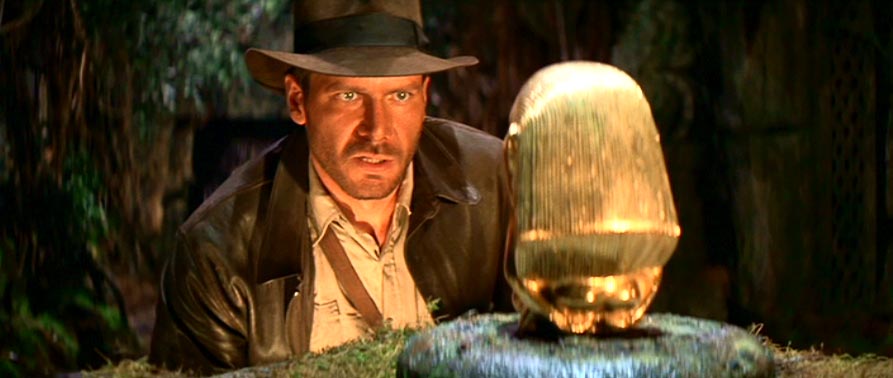
RAIDERS OF THE LOST ARK is a throwback to the short Republic film serials of the 1930's and 40's like SPY SMASHER or FLYING DISC MAN FROM MARS that proceeded the main feature (way before CrazyFilmGuy's time). With a screenplay by Lawrence Kasdan (BODY HEAT, THE BIG CHILL) based on a story by George Lucas and fellow filmmaker Philip Kaufman (THE RIGHT STUFF), director Spielberg begins the fun from the moment the Paramount mountain logo dissolves into a real mountain. RAIDERS opens in the jungles of South America in 1936 as Professor Indiana Jones (Harrison Ford) is on a quest for a small golden statue. Led by local guide Satipo (played by a young Alfred Molina), Jones enters a booby trapped temple where the statue resides. Chased by a giant boulder and dodging poison darts, Indy just barely escapes with his life and the idol only to have it snatched from him by his French archaeological adversary Rene Belloq (Paul Freeman). Indiana loses the relic but escapes Belloq and his spear throwing Novitos Indians.

Indy returns to the States where he's a college professor of archaeology. Waiting for him are two government agents. They want Indy to find the Ark of the Covenant, a chest that supposedly contains the original Ten Commandments, before the Nazis find it. The Ark is rumored to have the Power of  God, the ability to level whole civilizations (hence occult fanatic Hitler's interest). An intercepted dispatch mentions Indy's old teacher Abner Ravenwood. With his friend and museum curator  Dr. Marcus Brody (Denholm Elliott) blessing, Indy flies to Nepal to search for Ravenwood's daughter and former flame of Indy's Marion Ravenwood (Karen Allen) and locate the headpiece to the Staff of Ra that will help pinpoint the ancient city of Tanis and the location of the Ark. Marion owns a bar in the Himalayas. She tells Indy that her father is dead but she might know where the headpiece resides. Sadistic Nazi S.S. Major Arnold Toht (Ronald Lacey) shows up at the bar to make a similar offer for the headpiece. A gunfight erupts between Indy and the Nazis. Marion's mountain tavern burns down but she had the headpiece on her. She and Indy reluctantly become partners.


Indy and Marion journey to Cairo next to meet up with Indy's friend Sallah (John Rhys-Davies), the best digger in Egypt. Sallah's been keeping tabs on the dig for the Ark led by none other than Indy's adversary Belloq. Belloq has located the Map Room. Belloq tries to have Indy killed again in an open Cairo market square by sword wielding assassins and Nazis in business suits with machine guns. Indy narrowly escapes yet again. He and Sallah learn that Belloq has part of the headpiece's information but he's digging in the wrong place. Indy secretly descends into the Map Room and using the real headpiece locates the coordinates to the Well of Souls where the Ark rests. Indy, Sallah, and a team of diggers begin digging in the correct location and find the entrance. Indy and  Sallah repel down and secure the Ark. But Belloq along with Toht and Colonel Dietrich (Wolf Kahler) stumble upon their plot. Toht throws Marion into the Well of Souls to join Indy as the tomb is sealed up.

And so begins the epic second half of RAIDERS as Indy and Marion manage to escape the Well of Souls (and deal with Indy's fear of snakes), blow up a German cargo plane fueling up to fly the Ark to Berlin, and chase down on horseback and hijack a truck convoy carrying the Ark. "I'm making this up as I go," Indy confides to Sallah. RAIDERS OF THE LOST ARK has more action in this 20 minute sequence than most full length films. When Indy gets to Cairo, Sallah has a freighter helmed by Captain Katanga (George Harris) waiting to take Indy, Marion, and the Ark. But Belloq and Dietrich catch them again on the high seas with a U-boat and take them to a secret Mediterranean submarine base on a Greek island. Belloq wants to open the Ark and examine it before sending it to Hitler. Belloq opens the Ark, releasing phantasms and wraiths that obliterate Belloq, Toht, Dietrich, and the remaining German soldiers. Indy and Marion, tied up, close their eyes and escape the Ark's supernatural fury.


The fun of RAIDERS OF THE LOST ARK is it's loving reverence for the cheap Republic Serials and B movie westerns that it pays homage to. Only RAIDERS is made with a talented A list director and a budget 100 times larger. In the tradition of the old time serials, RAIDERS sends Indiana Jones from one cliffhanger to another but all within one movie instead of a 10 minute episode to be continued next week. With the leather jacket, fedora, and bullwhip, Indiana Jones embodies the classic B-movie hero. Spielberg and Lucas show their love for these 1930's and 40's serials from the start, superimposing the Pan Am sea plane flying across a map of the Pacific Ocean, a line detailing its route and final destination -- Nepal. The dashing hero and dastardly villains, the plucky heroine, the sidekicks - they're all stock characters from a Republic cliffhanger serial but with greater depth and characterization for modern audiences.

Like my previous film blog on THE ROAD WARRIOR (1981), RAIDERS OF THE LOST ARK is another of my all time favorite film that satisfies with the big action sequences as well as the little moments or visuals. One of my favorite big scenes is the opening jungle temple set piece. We see Indy's resourcefulness as he evades traps, traitorous guides, and a giant boulder. I love the little squatting golden idol he risks life and limb for ((based on a real life Chachapoyan Fertility idol that turned out to be fake). My other two favorite set pieces are the bar fight in the Himalayas and Indy and Marion's escape from the Wells of Souls. But great films have small, detailed pleasures too. I love Indy's silhouette (with fedora) against the wall as he enters the Himalayan tavern. The mummified corpses that surround Marion in the Well of Souls. A lone snake that slithers through a hole in Marion's dislodged shoe. The capuchin monkey giving the "Heil Hitler" salute to other Nazis in Cairo. The dust coming off Indy's jacket as he runs away from the Hovitos tribe. Small details that spice up the bigger story and action pieces.


RAIDERS OF THE LOST ARK is Spielberg at his most playful, a young filmmaker growing with confidence. I never realized how many gags Spielberg put in RAIDERS. The gags all poke fun and reinvent the clichés from the cheap serials RAIDERS is based on. Toht pulling out a torture weapon only to turn it into a hangar for his coat or Indy settling for just shooting a sword wielding assassin rather than dueling with him stand out. Spielberg shows off his film history knowledge borrowing from two of my favorite directors in a couple of RAIDERS scenes. He borrows a device from Alfred Hitchcock's NORTH BY NORTHWEST (1959) when Indy searches for a large basket containing a kidnapped Marion and enters a bazaar full of men carrying similarly large baskets. In NORTHWEST, Cary Grant disguised himself as a train porter to avoid bad guys and steps onto a train platform teeming with similarly dressed train porters. For the finale of RAIDERS, Spielberg borrows from the great Orson Welles. The giant warehouse where the Ark of the Covenant is finally stored resembles the infinite warehouse that contains the contents of Charles Foster Kane's life in CITIZEN KANE (1939).

The filmmakers also tip their cap to the James Bond films. The opening scenes of RAIDERS and the other Indiana Jones films are almost a separate little movie unto themselves, much like the opening scene for a Bond movie like GOLDFINGER or DIAMONDS ARE FOREVER. And the secret Nazi submarine base hidden on a rocky island in the Mediterranean is something Bond's enemy organization SPECTRE would build. In RAIDERS and later INDIANA JONES AND THE LAST CRUSADE (1989), Spielberg portrays the Nazis as cartoonish bad guys. But as Spielberg grew as a filmmaker and an adult, he would grow more serious with the true evil nature of the Nazis regime, displayed in his powerful WWII films SCHINDLER'S LIST (1993) and SAVING PRIVATE RYAN (1998).


Sometimes lost in all the praise for Spielberg, Lucas, Kasdan, and Ford are a couple of key contributors to RAIDERS OF THE LOST ARK'S success.  The sound design and effects by Ben Burtt for RAIDERS are amazing.  It's not often that you notice sound in a film but I remember the punches and bullets sounds used in RAIDERS as unique and unlike any I had heard in previous films. Every punch is bone jarring. The bullet sounds whizzing past Indy were not the stock sound effects from TV westerns. They sounded powerful and dangerous. Burtt's sound effects are exaggerated like the punches but it fits perfectly with the look and feel of this modern version of an old fashioned cheapie serial. And I think the score for RAIDERS OF THE LOST ARK by composer John Williams is one of his best (yes better than STAR WARS or the HARRY POTTER films). Williams captures the mood of the cliffhanger serials with appropriate villain music when the bad guys show up and a rousing RAIDERS theme song when Indy escapes yet another harrowing predicament.

Many film fans will point to the roguish intergalactic mercenary Han Solo from the STAR WARS series as Harrison Ford's best role but for CrazyFilmGuy, Ford's Indiana Jones is his greatest performance. In fact, I think Indiana Jones is one of the best action characters in film history (along with my other fave Mad Max). Ford is fantastic as Dr. Indiana Jones juggling humor (both physical and non-physical), action, romance, and serious moments where he has to reveal historical and plot exposition with ease. Ford was 39 when RAIDERS came out. He had been a journeyman actor, appearing in small roles in George Lucas's AMERICAN GRAFFITI (1973) and Francis Coppola's THE CONVERSATION (1974). But Ford hung in there and became a star with STAR WARS (1977) followed by RAIDERS OF THE LOST ARK. And to imagine that the role of Indiana Jones was first offered to Tom Selleck. The producers of Selleck's hit TV series MAGNUM P.I. wouldn't release Selleck from his duties to make RAIDERS and so Ford was offered the part. The rest is film history.


Spielberg and Lucas round out the RAIDERS cast with familiar but unfamous actors who play their parts to perfection. Karen Allen is tomboy pretty as Indy's old flame Marion Ravenwood, a heroine who reminds us of the drinking, carousing women from a Howard Hawks like ONLY ANGELS HAVE WINGS (1939). Allen looks like a 1940's heroine and her combination of tough sexiness and strength make her the best heroine of the first three Indiana Jones films. Allen would make a triumphant return as an older but still feisty Marion in the 4th installment of the series INDIANA JONES AND THE KINGDOM OF THE CRYSTAL SKULL (2008). She would also appear in John Landis's ANIMAL HOUSE (1978) and John Carpenter's STARMAN (1984).

John Rhys-Davies who plays Indy's friend Sallah may have the most interesting film career arc of all time. His first big breakout film was RAIDERS and Rhys-Davies also appeared in INDIANA JONES AND THE LAST CRUSADE. His Sallah brings an exotic quality to series. He's acted in countless films and television series as well as provide his voice for many animated shows but nothing as big as RAIDERS until the deep baritone Welshman was cast as the dwarf warrior Gimli in Peter Jackson's THE LORD OF THE RINGS trilogy. A nice way to book end his career with two classic movie franchises. Rhys-Davies is still going strong today in films and television.


Watching RAIDERS again makes me think that the casting of English actor Paul Freeman as Indy's nemesis French archaeologist Rene Belloq (with his bad French accent) is on purpose. It would go along with the filmmakers poking fun at the B movie cliffhanger serials and the stock villains in them. Freeman makes Belloq likable and despicable at the same time. Apparently, Freeman is very good at accents but I think he plays Belloq's accent to be funny. Freeman popped up recently in Edgar Wright's HOT FUZZ (2007) and has worked steadily since RAIDERS. He is a key contributor to the film's success. Ronald Lacey who plays SS Major Toht passed away far too early (in 1991). His sniveling, sweaty toad of a Nazi was another good foil for the do-gooder Indiana Jones to battle. Lacey had a small part in LAST CRUSADE as, what else, another Gestapo officer.

With any successful film concept, imitators will follow and there have been many. Robert Zemeckis's ROMANCING THE STONE (1984) with Michael Douglas and Kathleen Turner was a more modern fortune hunter tale set in Mexico that was a hit and spawned a sequel JEWEL OF THE NILE (1985). More recently, we've seen Ron Howard's THE DA VINCI CODE (2006) with Tom Hanks as a cryptographer chasing down a religious mystery and Jon Turtletaub's NATIONAL TREASURE (2004) with Nicholas Cage as a historian involved with a Templar Knights treasure.  Rumor has it that today's version of Harrison Ford, actor Chris Pratt (GUARDIANS OF THE GALAXY) will take over the fedora and bullwhip in a reboot of the Indiana Jones character. And let's not forget one of the best rides at the Disney Parks -- INDIANA JONES AND THE TEMPLE OF THE FORBIDDEN EYE. All inspired by Professor Indiana Jones and his adventures.

But if you think CrazyFilmGuy has gone loco about his love for RAIDERS OF THE LOST ARK, you haven't seen anything yet. Take for example, three 12 year olds from Mississippi who made a shot by shot video version of RAIDERS called RAIDERS OF THE LOST ARK: THE ADAPTATION also in 1981. It took 7 years to complete (and they didn't even film the flying wing fight scene). A few years ago, the three grown up men toured the country showing their fan version at film festivals and local theaters  to great enthusiasm (Spielberg even met them and saw the film). RAIDERS: ADAPTATION filmmakers Chris Strompolos and Eric Zala finally finished their RAIDERS fan film and a documentary about finishing their film is coming soon. Filmmaker Steven Soderbergh recently presented RAIDERS OF THE LOST ARK on his website in black and white (and no sound) to show how beautifully RAIDERS cinematographer Douglas Slocombe shot the film in high contrast lighting (it's just as good to watch in black and white as color) and to make viewers explore why Spielberg and editor Michael Kahn chose the edits and cut they did. Seeing RAIDERS in black and white is a nice way to take yourself back to the 1940's and imagine what if RAIDERS came out in that era.


Back in 1987, I was backpacking through Europe after college. As I walked around the streets of Florence, Italy I came upon an archaeological dig next to the Uffizi Gallery.  It was the remains of a house from the 13th or 14th century perhaps belonging to the Houses of Nobility of the Ghibelline Party. Standing in the middle of the excavation stood a man in a leather jacket smoking a pipe. All I could think of as I snapped a photo was "that's Indiana Jones." RAIDERS OF THE LOST ARK is a timeless film that entertains, delights, and surprises with each viewing. But RAIDERS also got the world excited about history and archaeology again. For CrazyFilmGuy, RAIDERS made me appreciate the history and art history classes I took in high school and college. It gives me inspiration when I travel to Europe and view castles and ruins and artifacts that previous archaeologists have discovered from our past. I can run around ramparts and through Roman arches or Greek temples and for a brief moment, pretend I'm Indiana Jones discovering these artifacts for the first time. Thankfully, in most cases, the real archaeologists of today don't need to fend off Nazis or headhunters to do their jobs. Their efforts are important and thanks to RAIDERS OF THE LOST ARK, we're paying a little more attention to what they're doing and finding from our past than we used to.


Saturday, May 23, 2015

The Road Warrior (1981) and Mad Max: Fury Road (2015)

Everybody has a Top 10 List of their favorite films. Whether you're a movie critic or just a film aficionado, a List emerges from all those films you've watched. Several years ago, CrazyFilmGuy decided to come up with a List. It's really a Top 5 favorite film List (plus an additional three or four more for good measure). I've never written it down and I stopped it at about 1999. The List has to be films that I want to see over and over again. One of my future blogs I will reveal the whole List. But Number One on my list (and perhaps a surprise to many) is George Miller's post-apocalyptic action film THE ROAD WARRIOR (1981), the sequel to his film debut MAD MAX (1979). From the first time I sat in a movie theater and watched THE ROAD WARRIOR (it actually came out in the U.S. in the summer of 1982 along with BLADE RUNNER and E.T. but was released first in Australia the winter of 1981), I was captivated by its sheer visual brilliance in action, editing, cinematography, wardrobe, and storytelling.

With director George Miller rebooting his leather clad hero Max Rockatanksy (and actor Tom Hardy taking over for original Max Mel Gibson) in the new MAD MAX: FURY ROAD (2015), I thought this would be a good time to compare the best of the three MAD MAX films THE ROAD WARRIOR with the new film as FURY ROAD will be compared to THE ROAD WARRIOR, even if the timeline, according to Miller, is a couple of decades apart. For those unfamiliar with the series, the MAD MAX trilogy is made up of the original, low budget MAD MAX, Miller's first feature film that introduced us to Police Officer Max Rockatansky (Mel Gibson) who loses his family to a motorcycle gang and chases them down for revenge in his V-9 Interceptor (actually a Ford Falcon). Then, came THE ROAD WARRIOR which is set about 25 years after MAD MAX. The third and least satisfying film although very different is MAD MAX BEYOND THUNDERDOME (1985), set farther in the future for our wandering hero.


In MAD MAX, society was on the verge of anarchy. In THE ROAD WARRIOR (written by George Miller, Terry Hayes, and Brian Hannant), nuclear war between nations has destroyed cities and sent survivors out into the Australian wastelands to fend for themselves. Max Rockatansky (Mel Gibson), former policeman, is now a burnt out shell of himself, driving the endless white line highways in search of food and gas while trying to evade the scavengers that prey on the weak. After coming across the crazy Gyro Captain (Bruce Spence) and his Rube Goldberg gyrocopter, the Gyro Captain takes Max (and his loyal Australian cattle dog) to a rocky outcrop. He shows him a ragtag group of survivors led by the swaggering Pappagallo (Mike Preston) defending an oil refinery from a horde of marauders commanded by the muscular Lord Humungus (Kjell Nilsson), "the Warrior of the Wasteland, the Ayatollah of Rock and Rollah" and his blood thirsty henchman, the red mohawked Wez (Vernon Wells).

After an ill-fated attempt from some of the survivors to hunt for a rig that can haul their prized oil tanker to a new paradise, Max brings a wounded man back to the compound with the hope of receiving some gas for his good deed. But the man dies. Before Pappagallo can discard Max, Humungus and his gang return, promising the survivors safe passage if they give up the oil refinery. The Feral Kid (Emil Minty), a young wild boy, kills Wez's boyfriend the Golden Youth (Jimmy Brown) with his boomerang, enraging Wez. Humungus takes out his rage on his captives at night, torturing and killing his prisoners while Max, Pappagallo, and the others watch in horror.

Max tells Pappagallo that he saw a truck a few days away that could haul their tanker full of fuel. He makes a deal to bring back the truck. Max sneaks out at night beneath the vigilant eyes of Wez and Humungus. On his way to the truck, Max comes across the Gyro Captain again. Working together, Max and the Gyro Captain run the gauntlet of vehicles, bullets, and murderous outlaws camped out and bring the truck cab back to the compound. The survivors are ecstatic and see Max as their savior for getting out alive. But Max is a loner. He passes on a new deal to drive the tanker away to a new home, choosing to take his chances on his own against Humungus. At dawn, Max speeds off into the outback, chased by Wez and his thugs.


Wez along with the Toadie (Max Phipps) cause Max to have a terrible crash down a ravine. Max barely crawls to safety before his car explodes, booby-trapped, killing Toadie trying to siphon his gas. Wez takes off, thinking Max is dead. Seeing the smoke from the compound, the Gyro Captain flies off to investigate. He finds Max half dead and flies him back to the oil refinery. Pappagallo and his people are ready to leave. Max has no choice but to drive the tanker. He has nothing else to live for as his car and dog are both gone. Pappagallo balks at first but Max insists. And so begins one of the great finales (and chase scenes) in film history as Max, Pappagallo, the Warrior Woman (Virginia Hey) and a few others break out with the oil tanker chased by Humungus, Wez, and a bunch of hot rods, tow trucks, motorcycles, dune buggies, and police cars in hot pursuit.

When THE ROAD WARRIOR first came out, I remember critics calling it a post-apocalyptic western, comparing it to SHANE (1953) with Mel Gibson's Max the equivalent to Alan Ladd's lone western hero Shane. It wasn't until I began watching a lot of westerns that I saw that THE ROAD WARRIOR was a futuristic western. Max is the lone gunslinger, devastated by the loss of his wife and son, trying to live on his own and not get attached to any one person, group, or cause. But circumstances pull him into a hero role he tries to avoid. The band of marauders on motorcycles and souped up cars are the Indians, exemplified by the mohawked Wez and his war paint. When they chase Max and the tanker at the film's climax, it's like the Indians pursuing the stagecoach. And the group of survivors behind their fort, guarding and protecting the gasoline are the homesteaders or wagon train fighting off the Indians. Besides the Warrior Woman and Pappagallo, the settlers are not very strong. They're mostly made up of women, old men, and children. Most of the younger men are either meek or crippled. Only Max can lead them to safety.


So why is THE ROAD WARRIOR my favorite film of all time? Let me count the reasons. First, never had cars crashing and windows smashing, metal grinding against metal, and bodies somersaulting through the air or tumbling like rag dolls looked so beautiful on film. Director Miller and Cinematographer Dean Semler's every camera angle and movement is perfect from high angle and aerial shots to up close with the scorched highways and burning rubber hitting the pavement. Some films are glorious to look at but lack a story. Not the case with THE ROAD WARRIOR.

Then, there was my man crush on Mel Gibson who plays Max. THE ROAD WARRIOR would turn Gibson into an international star. He's a baby faced boy in MAD MAX but in THE ROAD WARRIOR, Gibson's the embodiment of cool, decked out head to toe in black leather with that cool Australian accent and spiky hair. I wanted to look and be Mel Gibson as Mad Max. I tried to catch every film that Mel made after ROAD WARRIOR including THE YEAR OF LIVING DANGEROUSLY (1983), THE BOUNTY (1985), and AIR AMERICA (1988). I develop these man crushes from time to time. Mel was my first. Harrison Ford, Ray Liotta, and Ralph Fiennes in their early years come to mind as other crushes. Ironically, my latest man crush is on Tom Hardy, the actor who replaces Mel Gibson as Max in FURY ROAD. Ever since I saw Hardy in Christopher Nolan's INCEPTION (2010), I'm his biggest fan.


When we choose our favorite films, there are reasons why we love this film or that film. It might be the actors in it or the story or the genre. Those are the big things that make us love a film. But it's also the little things, small visuals that resonate for me in my favorite films. In THE ROAD WARRIOR, it's Max's cattle dog sniffing a dead kangaroo lying next to the rig or low angle shots of the automobiles or the white lines on the highway racing by or a cobra snake insignia on the side of a tow truck chasing Max. Max's loyal dog almost steals the film in the first half of the film, its reactions so human like. And the end of THE ROAD WARRIOR with Max standing alone in the middle of the endless highway as the Feral Kid and the other survivors caravan away, the camera pulling away on the lone hero as he grows smaller and smaller, is priceless and perfect. It's the visual equivalent of the little boy Joey (Brandon De Wilde) in SHANE calling "Shane! Come back!" as Shane rides off only without any dialogue.

Mel Gibson's performance as Max in THE ROAD WARRIOR is more mature, nuanced as he's grown more comfortable in the role. For THE ROAD WARRIOR, director Miller drew inspiration from author Joseph Campbell's book The Hero With a Thousand Faces (more on that later). In the first MAD MAX, Max became a vigilante only after his wife and son are run down by the Toecutter and his motorcycle gang. But by the time of THE ROAD WARRIOR, Max is a loner, a survivor, his loved ones but a distant memory. When Max finds a toy musical box that plays Happy Birthday, a shadow of humanity returns to his face. The song reminds him of his child, a happier time. The Feral Kid will also remind Max of his son, his family. Max will give the music box to the Feral Kid, the most poignant moment in THE ROAD WARRIOR. But Max has no time for love or a relationship anymore. The closest Max gets to a woman is when the Warrior Woman apologizes to him.


The villains in THE ROAD WARRIOR are key ingredients to the film's appeal. The Lord Humungus is mysterious and a bit disappointing as the main heavy. Played by Swedish weight lifter Kjell Nilsson, Humungus looks like a WWE wrestler with a hockey mask that hides scars that may have been caused by a fire or radioactive fallout (we never know). He pontificates a lot to the survivors but his main weapon besides an antique pistol is a sleeper hold that he uses on Wez when the mohawked madman disobeys him. Like Max, Pappagallo, and the others, the Humungus is aware that everyone has lost someone. He tries to be humane, offering Pappagallo and his people safe passage if they'll just give up the oil refinery. But circumstances won't let peace happen, not with a dog of war like Wez around. When Pappagallo refuses the offer and disobeys the Humungus's orders, the real Humungus is revealed, a Humungus that takes no prisoners and intimidates with shock and awe.

But Wez, played by Vernon Wells makes up for the Humungus's shortcomings. Wez is terrifying, relentless, and fearless (he even wears cheekless leather chaps). His weapon of choice is a metal crossbow attached to his wrist. He's Geronimo or Crazy Horse to Max's Shane. Wez, Humungus, and the other scavengers stand out in their quirky wardrobe that's one part Hell's Angels, one part S&M, and one part Nazi storm trooper thanks to costume designer Norma Moriceau. Actor Wells would also appear as a bad guy in John McTiernan's PREDATOR (1985) and spoof his ROAD WARRIOR Wez character in John Hughes's comedy WEIRD SCIENCE (1985).


Director Miller wisely throws in a comic character with the Gyro Captain played by Bruce Spence to give THE ROAD WARRIOR some humor during all the action and chase scenes. Spence is a tall, gangly actor, his appearance resembling a tall bird like a crane or heron. No wonder he likes to fly. He's the closest thing that Max will have to a friend (or "partner" as the Gyro Captain keeps telling Max) since Max and his police buddy Jim Goose from the original MAD MAX. The Gyro Captain waxes nostalgia for the good old days. "Remember lingerie?" he asks Max as he carries gas cans for Max. Spence would make another appearance as a different, shadier pilot in MAD MAX BEYOND THUNDERDOME. More recently, Spence (almost unrecognizable) played an alien in George Lucas's STAR WARS: EPISODE III - REVENGE OF THE SITH (2005).

After THE ROAD WARRIOR, George Miller would make the final Mad Max movie MAD MAX BEYOND THUNDERDOME (co-directed with George Ogilvie) in 1985 and then completely switch gears. Not many people might know it but Miller would move into children's films and create two very popular children's film franchises about a pig (BABE and BABE: PIG IN THE CITY) and penguins (HAPPY FEET). As for CrazyFilmGuy, I would take a hiatus from my all time favorite film. I decided I wouldn't watch it again until Warner Brothers released a DVD version of THE ROAD WARRIOR jam packed with extras and special features (I'm still waiting Warner Brothers).


In 2001, word leaked that George Miller had a new Mad Max script called MAD MAX: FURY ROAD. But the journey from script to finished film would have as many obstacles as one of Max's incredible adventures. Miller would endure delays due to 9/11 and then the 2006 U.S. invasion of Iraq halting any chance of making the film in the African desert country of Namibia due to safety reasons. Then, plans to film in Australia were halted by Mother Nature who turned Miller's dusty landscape into a green oasis. Lastly, original star (and my former man crush) Mel Gibson would have a career meltdown. By the time the world had calmed down and Miller and company were finally ready to try again in Namibia, Gibson was too old to play the part of Max.

Thank the movie gods for George Miller's perseverance. 34 years since THE ROAD WARRIOR and 30 years since THUNDERDOME, director Miller along with co-writers Brendan McCarthy and Nick Lathouris have given us a new Mad Max tale titled MAD MAX: FURY ROAD. Set several years after THE ROAD WARRIOR but a brand new story, Miller had a bigger budget ($150 million dollars), new technology, and a new Mad Max (Tom Hardy) to throw his creative energy at. FURY ROAD is not a remake but a reimagining of Max Rockatansky to entice a new generation and please us old die hard MAD MAX fans. Although a different story, FURY ROAD has elements, motifs, actors, and scenes that hearken back to the earlier MAD MAX films while taking us on an adrenaline charged new journey of the lone hero, the road warrior known as Max.  Welcome back Max. We missed you.


Director Miller steps on the gas pedal right from the beginning in MAD MAX: FURY ROAD and never stops. Immortan Joe (Hugh Keys-Byrne) is a warlord who rules over the Citadel in this toxic, arid dystopian wasteland. Joe controls the water, the gasoline, and the people. His War Boys, painted white young soldiers, idolize Joe like a god. Immortan Joe keeps five wives ("my property") as prisoners and to produce healthy offspring through rape. Into this maelstrom comes Max (Tom Hardy), living out in the fringes, haunted by the deaths of his wife and daughter. He's hunted down and caught by a War Boys scout party and brought back to Immortan Joe's kingdom where he's hung upside down and hooked up to War Boy mechanic Nux (Nicholas Hoult) as a human blood bag, providing strength to the poisoned, sickly youth.

But Imperator Furiosa (Charlene Theron), a War Rig operator with a mechanical left arm, enslaved by Joe, plots revenge against the evil tyrant, liberating Immortan Joe's five wives and hiding them in her war rig as she makes a run across a hostile environment to bring these girls back to her homeland called the Green Place where she was stolen away as a child. Immortan Joe discovers her treachery and with his gargantuan son Rictus Erectus (Nathan Jones) and his army of War Boy warriors including Slit (Josh Helman) by his side, they pursue Furiosa's vehicle with an armada of monster trucks and supercharged machines. Nux, wishing to gain Immortan Joe's favor, rides with the armada, bringing his blood donor Max with him, stuck on the front of Nux's roadster like a Roman shield.


Immortan Joe and his War Boys race to catch Furiosa while fending off other tribes in the region with just as crazy vehicles (like a dune buggy resembling a porcupine) as them. Furiosa drives into a gigantic sand storm, momentarily losing her pursuers. Nux and Max get separated from Joe's war party. Max attempts to free himself from Nux's chains and finds himself near Furiosa's war rig.  Furiosa and Max square off with each, almost killing one another before they realize they both have a common goal - to escape Immortan Joe's tyrannical reign. Max joins their righteous cause as Furiosa brings her war rig into a canyon ruled by a Rasta-looking Rock Rider tribe. She tries to cut a deal with the bikers as Immortan Joe's fleet draws closer but the deal backfires.

With Max's help, Furiosa and Immorten Joe's stolen harem of Toast the Knowing (Zoe Kravitz), Capable (Riley Keough), the Dag (Abbey Lee), Cheedo the Fragile (Courtney Eaton), and the pregnant Splendid Angharad (Rosie Huntington-Whiteley) outduel not only Immortan Joe's army of tricked out trucks and cars but a two other baddies who have joined Joe: the Bullet Farmer (Richard Carter) and the People Eater (John Howard). Nux, left for dead, stowaways on the oil rig and becomes an ally with Max and Furiosa. Furiosa reaches a band of mostly older women called the Vuvalini or Many Mothers from where she was born. This matriarchal motorcycle tribe led by the Keeper of the Seeds (Melissa Jaffer) and the imposing Valkyrie (Megan Gale) have dire news for Furiosa. It's up to Max to rally this ragtag band of mothers, daughters, wives, and outcasts and take the offensive against Immorten Joe.


With 20 plus years to contemplate a new story for his Lone Wolf, anti-hero Max, Miller delivers, conjuring up a hallucinatory, over the top, crazy post-apocalyptic new world for Max to inhabit. FURY ROAD introduces us to the War Boys, kamikaze-like warriors slavishly devoted to the god-like father figure Immorten Joe, willing to sacrifice their lives for the warlord in hopes of reaching Valhalla. But the War Boys and War Pups are sickly, poisoned by their environment, many with tumors on their bodies, destined for short life spans. Blood transfusions from prisoners like Max and pumped mother's milk from Joe's pool of obese wet nurses help keep the pale young men strong and ready for battle.

We're introduced to the villainous Immorten Joe who governs the Citadel with an iron fist, branding all his human property with his death's head insignia on the back of their necks. Five beautiful wives are kept in captivity, iron chastity belts attached to them. They are sex slaves to Immorten Joe, fertile women he will rape so he can breed a stronger brood and one day, a healthy heir.


Miller gives us our first female road warrior in the series in Imperator Furiosa (Charlize Theron). With her head shaved and a bionic left arm, Furiosa proves herself to be every bit an equal to Max. Even Furiosa's cargo, the five young maidens are more than just Victoria Secret eye candy (even if a couple of the actresses actually were Victoria Secret models previously in real life). Each young lady plays a part in their race to freedom, fighting off Immorten Joe's War Boys, reloading Max's shotgun, or aiding Furiosa as she drives.

MAD MAX movies are always about the cars and car crashes and Miller goes steroid in both instances in FURY ROAD. THE ROAD WARRIOR had a small army of vehicles but FURY ROAD brings an armada of war machines with monstrous tankers and rigs, hybrid hot rods and muscle cars, Immortan Joe's Gigahorse (two Cadillac Coupe de Ville's welded on top of each other), killers on giant bending poles called Pole Cats, and even a trailer pulling a death metal guitar player spewing flames from his double necked instrument known as the Doof Warrior (Iota) and four behemoth drummers pounding away on their enormous war drums.  FURY ROAD is an assault on your senses.


Although MAD MAX: FURY ROAD is a reboot of the MAD MAX trilogy, Miller draws inspiration from the first three films, filtering past ideas and images into FURY ROAD. The War Boys with their ghostly white skin and black, hollow eyes seem a homage to a minor character from MAD MAX BEYOND THUNDERDOME called Scrooloose, a mute, eccentric boy who was part of the tribe of kids Max stumbles upon. Scrooloose had the same chalky skin and raccoon eyes as the War Boys.

THE ROAD WARRIOR'S Warrior Woman hinted at the possibility of a strong female character and THUNDERDOME'S Aunty Entity (Tina Turner) had her moments. In FURY ROAD, Miller unleashes a full feminine fury starting with Furiosa, the bad ass War Rig driver for Immortan Joe's empire who betrays him. There are other empowered female protagonists in FURY ROAD like the raven haired Valkyrie. Both women could be offspring of the original Warrior Woman from ROAD WARRIOR.

The music box that Max finds on a dead body in THE ROAD WARRIOR makes an appearance in FURY ROAD as Toast, one of the wives, plays with a similar music box. The musical toy reminds them of a simpler, less violent past and hope for the future. Max's V-8 Interceptor makes a brief appearance in FURY ROAD but the car figured more prominently in both MAD MAX and THE ROAD WARRIOR. Unfortunately, there's no Australian cattle dog or much of any animal to be found in FURY ROAD unless you want to count the two headed lizard that Max munches on at the start of the picture.


The most significant nod to the old MAD MAX films is the return of actor Hugh Keays-Byrne as the evil Immortan Joe. Keays-Byrne started it all in 1979's MAD MAX as Toecutter, head honcho of the motorcycle gang that maims Max's friend Goose and murders Max's wife and son. As the aging Immortan Joe, Keays-Byrne still has a crazy head of hair and scary eyes but he's almost Darth Vader-ish  with his breast plate adorned with war medals and a gruesome breathing apparatus and horse teeth mask. Keays-Byrne has come full circle in the MAD MAX pantheon of bad guys. Both Toecutter and Immortan Joe belong in the Mad Max Villain Hall of Fame.

Tom Hardy as the new incarnation of Mad Max in FURY ROAD doesn't make us forget Mel Gibson's Max but Hardy puts his own stamp on the MAD MAX franchise, showing he's the right guy to take over the role. Gibson's Max may have been ever so slightly more vulnerable and humorous. Hardy's Max is indeed a little mad, tormented by nightmares of his dead daughter. Hardy's Max is on the brink of insanity, wrestling with demons inside his head even before he becomes Immortan Joe's captive. But just like Gibson, Hardy looks kick ass in leather as the stoic wasteland wanderer. And his humanity will slowly return over the course of FURY ROAD.


In Imperator Furiosa as played by Charlize Theron, Miller has created one of the strongest female action characters since Ripley (Sigourney Weaver) in ALIENS (1986) or Sarah Connor (Linda Hamilton) in TERMINATOR II: JUDGMENT DAY (1991). Stolen possibly by Immortan Joe as a child and imprisoned, then discarded when she may have been infertile and unable to bear children, Furiosa has plotted for countless years to get back at Joe.  Theron plays her as empowered mother figure to the five young women. Max reluctantly becomes the big brother to Furiosa and the brides. Even though FURY ROAD is a sci-fi action film, the film's theme of oppressed women, white slavery, rape, and human trafficking are taken from today's headlines and atrocities occurring in the Middle East, Asia, Africa, and by a terrorist group known as ISIS.

Just like THE ROAD WARRIOR had humor with the Gyro Captain, comic relief in MAD MAX: FURY ROAD is provided by Nicholas Hoult as the War Boy Nux. Enamored by his idol Immortan Joe, Nux aches to impress Joe. But Nux is a failure. He starts out as a bad guy but turns good when surrounded by all the women of FURY ROAD. Nux is like a teenager hitting puberty. Hoult gets all the best bits of what dialogue there is in FURY ROAD and he makes Nux very sympathetic and ultimately heroic.


The MAD MAX films are not necessarily known for their music but music has played a role in all the films. In MAD MAX, the Night Rider quotes from AC/DC's song Rocker. It might just be me but in THE ROAD WARRIOR, I always thought the Mechanic looked like the lead singer from Air Supply and the Gyro Captain's Girl with her headband and ponytail sort of looked like Australian singer Olivia Newton-John. MAD MAX BEYOND THUNDERDOME cast singer Tina Turner as Aunty Entity and featured two great songs on the soundtrack by Turner. But MAD MAX: FURY ROAD goes full throttle with a traveling rock guitarist and drummers following the chase, providing musical inspiration. FURY ROAD is a rock opera during the almost full length chase with Immortan Joe the mad rock star. Miller even casts the offspring of rock legends in key roles. Zoe Kravitz who plays Toast is the daughter of rock musician Lenny Kravitz. Riley Keough who plays Capable is the granddaughter of none other than the King -- Elvis Presley. And kudos to FURY ROAD'S composer Junkie XL whose music adds to the film's tension and action immensely.

Besides director Miller, compliments to the entire producing and production team behind MAD MAX:FURY ROAD.  Miller coaxed veteran Australian cinematographer John Seale (THE ENGLISH PATIENT) out of retirement and the results are stunning. Seale's color palette of burnt orange for day scenes and cold blue for night scenes are magnificent. Editor Margaret Sixel's cutting of FURY ROAD is impressive and may win her an Oscar. And let's not forget production designer Colin Gibson who's insane array of cars and trucks lives up to the MAD MAX tradition.


I've always been surprised that there weren't more post apocalyptic films after THE ROAD WARRIOR and THUNDERDOME.  I think ROAD WARRIOR definitely influenced some of the crazy characters in the Coen Brothers RAISING ARIZONA (1987). THE FAST AND THE FURIOUS franchise owes its car chases (no matter how unbelievable) to the MAX films. Kevin Reynold's WATERWORLD (1995) was a water version of THE ROAD WARRIOR (and even had the same cinematographer Dean Semler). Neil Marshall's DOOMSDAY (2008) mixed zombie plague, King Arthur, and a ROAD WARRIOR like car chase finale. The closest film to the MAD MAX series I've seen and liked was the Hughes Brothers THE BOOK OF ELI (2010) with Denzel Washington. But Miller's MAD MAX films are tough to top.  And Miller has added to the series with maybe his masterpiece in MAD MAX: FURY ROAD. I dare another filmmaker to top FURY ROAD (and if they do, then it will be a good thing for moviegoers).


Director George Miller (center) surrounded by Mad Max both past and present: Mel Gibson on the left and Tom Hardy on the right.
With the character of Mad Max Rockatansky, as played by both Mel Gibson in THE ROAD WARRIOR and now Tom Hardy in MAD MAX: FURY ROAD, George Miller has created maybe one of the greatest anti-hero characters in film and an incredible mythology around Max and his world that has no limits. Miller explained the hero mythology influenced by Joseph Campbell's book The Hero With a Thousand Faces in an interview in the 1982 July/August issue of Film Comment.  "The hero in all these classic stories is always a lone, fairly amoral seeker wandering a dark wasteland. Most of the time he's not aware of his purpose. There's no real hope for him but, because of some particular talent he's got - like Max's skill on the highway - he's able to give to a new order. Life goes on." THE ROAD WARRIOR has a new bigger brother to join it in the film universe and that big brother's name is MAD MAX: FURY ROAD. Long live Mad Max!


Sunday, April 26, 2015

Three Days of the Condor (1975)

The impeachment and resignation of President Richard Nixon in 1974 were dark days in American history. Watergate, secret audio tapes, and other nefarious activities by Nixon's Administration all fed into the public's psyche that our government could and would lie to the American people. But the United States government's misfortunes became a small cottage industry for Hollywood who began to produce political conspiracy thrillers involving the U.S. government and its intelligence agencies. The king of the paranoia film was director Alan J. Pakula who started it all with his paranoia mystery KLUTE (1971). He followed that up with THE PARALLAX VIEW (1974) and ALL THE PRESIDENT'S MEN (1976) based on Washington Post reporters Bob Woodward and Carl Bernstein's uncovering the real story of the Watergate break-in that torpedoed Nixon's presidency. But before Robert Redford starred in ALL THE PRESIDENT'S MEN, he did a fictional CIA conspiracy film called THREE DAYS OF THE CONDOR (1975) directed by Sydney Pollack.

THREE DAYS OF THE CONDOR is based on the novel Six Days of the Condor by James Grady. Apparently, screenwriters Lorenzo Semple, Jr and David Rayfiel were able to lop off three days for budgetary purposes (joke). I was talking to a friend recently who said he had applied for a job at the CIA (Central Intelligence Agency) out of college but had backed out before the interview. Perhaps he had seen CONDOR where it's hard to trust anyone and assassins might be waiting just around the corner. THREE DAYS OF THE CONDOR is one of seven films that Robert Redford and director Sydney Pollack worked on together. Except for a bad music score choice and a very unromantic love scene, CONDOR is one of Pollack's best films, one of the few thrillers he made besides THE FIRM (1993). The film fits perfectly into the conspiracy thriller genre that rose from the fall of Nixon.


Robert Redford stars as Joseph Turner, a low level CIA researcher at a phony CIA non-profit called the American Literary Historical Society located in a quiet brownstone building in New York City. Turner and his colleagues are bookworms.  They read books, analyzing them for codes, trends, new ideas, and leaks. It's boring stuff and 99% of what they find and report back to Langley (the CIA's headquarters) is rejected. Turner sneaks out to grab lunch for his co-workers including his girlfriend Janice Chong (Tina Chen). While he's gone, three assassins led by the mysterious Joubert (Max von Sydow) enter the building and slaughter everyone.

Turner returns to find his friends dead. Afraid and confused, Turner grabs a gun and flees the building. Everyone on the street looks suspicious. He finds a phone booth and calls in to the nearest Panic Office (CIA station), identifying himself by his code name Condor. He's transferred to Deputy Director for New York J. Higgins (Cliff Robertson) who orders Turner's Section Chief Wicks (Michael Kane) to set up a rendezvous point and bring Turner in. Wicks brings a friend of Turner's, a statistician Sam Barber (Walter McGinn), to join him so Turner can be at ease. But at the alley meeting, Wicks tries to kill Turner. Turner wounds Wicks who manages to shoot Sam dead. Now paranoid that the CIA might be in on the hit, Turner kidnaps an unsuspecting photographer Katherine Hale (Faye Dunaway) as she leaves an outdoor clothing store. He wants to get off the grid and has her take him back to her apartment in Brooklyn Heights. Higgins reports to his superiors including Mr. Wabash, an Ivy League Director type. Wabash and the other directors wonder if Turner has turned or gone rogue. They want Turner found at all costs.

Turner attempts to convince Katherine that he's not a nut. Unable to convince her initially, he ties Kathy to the toilet and borrows her van. Turner visits Sam's apartment looking for clues. He runs into Joubert who's hunting for Turner. The two men play a game of cat and mouse in the elevator and apartment building. Joubert tries to shoot Turner when he leaves the apartment building but Turner surrounds himself with a group of young people. Turner takes off in Kathy's van but not before Joubert writes down the license plate number. The next morning, a hit man disguised as a mailman (Hank Garrett) shows up at Kathy's apartment. Turner and the mailman battle and Turner shoots the killer. Kathy now believes his story.


Turner has Kathy help him kidnap Higgins at gunpoint and bring him to a site where Turner and Higgins can converse. Higgins reveals that Turner accidentally uncovered a separate intelligence group within the CIA. There's another CIA within the CIA, a clandestine network. When Turner sent notes about a mystery that didn't sell and was only translated into certain languages, a sanction (kill order) was put on the entire research house. Still not totally trusting Higgins, Turner does a little more digging which leads him to a high level CIA  Deputy Director of Operations Leonard Atwood (Addison Powell). Atwood is the mastermind behind this rogue group. Turner confronts Atwood inside his house but Joubert shows up as well. The climax is surprising and fits entirely with the paranoia/conspiracy plot.

Robert Redford's Joseph Turner character in THREE DAYS OF THE CONDOR is very much a Hitchcock like protagonist. He's not necessarily the wrong or innocent man in the wrong place like Robert Donat in THE 39 STEPS (1935) or Cary Grant in NORTH BY NORTHWEST (1959). After all, it's Turner's analysis of a book that catches the attention of the wrong people in the CIA that leads to his co-worker's deaths. But Turner is an unlikely hero in the Hitchcock hero manner. He's not a spy trained in weaponry or fighting skills. He's a researcher, a low level analyst who reads and interprets books. Yes, he has a code name Condor but that's about as spyish as he gets. Yet Turner's smart enough to use his wits to stay alive. He takes a gun from the murder scene which saves him when his Section Chief Wicks tries to kill him. He finds a vulnerable, innocent woman Kathy to hide from the agency's killers. And Turner avoids a second time getting knocked off by Joubert at Sam's apartment by sticking with a crowd of people. Maybe Turner has read a couple of Ian Fleming or Robert Ludlum novels in between his research to learn enough to survive.

CONDOR may be the first spy film that indoctrinated audiences into the jargon and world of the CIA that seems commonplace in later films like LA FEMME NAKITA , THE BOURNE IDENTITY (and its sequels), or the MISSION IMPOSSIBLE series.  The James Bond films had CIA agent Felix Leiter but he was on the periphery, mostly Bond's chauffeur. Terminology like the Company (referring to the CIA) or cleaners/contractors (hit men) are used for the first time that I can recall. After the hit on Turner's coworkers, the CIA sends in janitors (agents) to clean up the mess. Turner scoffs when Higgins calls the Intelligence Agency a Community. Nothing Turner has seen from the killers or his bosses make him feel part of a community. No one or U.S. Agency can be trusted not even the U.S. Postal Service. One of the assassins is dressed as a U.S. Postal carrier.


Director Sydney Pollack is not known for directing thrillers but THREE DAYS OF THE CONDOR is one of his best films. I was lucky enough to work on a film with Pollack, CONDOR supervising editor Frederic (Fritz) Steinkamp, and Director of Photography Owen Roizman (THE FRENCH CONNECTION) called HAVANA in 1990. All three were consummate professionals and good at their craft. But in a couple of instances with CONDOR, Pollack makes some bad choices. The jazzy funk score by longtime music collaborator Dave Grusin doesn't work for this spy thriller. Grusin's score would be better suited for a heist film.  Luckily, Pollack doesn't use much of Grusin's music. And for a director like Pollack who made two of the greatest love stories in cinema in THE WAY WE WERE (1973) and OUT OF AFRICA (1985), the love scene between Redford and Dunaway is just terrible. What could have been an erotic and kinky scene between kidnapper Turner and hostage Kathy is awkward with Pollack cutting between the couple rolling around in bed and Kathy's bleak black and white photographs. Redford and Dunaway, two of the 70's hottest actors look uncomfortable, unsure what to do and how to look sexy.

But Pollack captures the paranoia and distrust by Turner as he digs into the secret he accidentally uncovered that led to his friends deaths. As Turner begins to uncover the truth, he becomes bolder and more confident. Like a Hitchcock film, the MacGuffin or secret is about oil and perhaps an attempted invasion or coup to secure oil fields in the Middle East. But that's really not the point of the story, just a hook to move forward the story.  Not known as an action director either, Pollack stages an incredibly believable fight in Kathy's apartment between Turner and the mailman assassin. Turner is way out of his league but he manages to use rugs and couches and the smallness of the room to even out the disadvantage between him and a paid killer. It's a terrific fight scene that would make James Bond or Jason Bourne proud, expertly edited by Fritz Steinkamp.


Robert Redford is perfectly cast as the unlikely hero Joseph Turner in THREE DAYS OF THE CONDOR. Redford makes us like Turner immediately as  he's goofy and nerdy (yes, a very good looking nerd), gently poking fun at his stuffy boss Dr. Lappe (Don McHenry) or the curmudgeon security guard before all hell breaks loose.  He's a regular guy who becomes a kidnapper and killer when his spy bosses try to terminate him. Ironically, later in his career, Redford would play the spy masters and bureaucrats that he fought against in CONDOR in Tony Scott's SPY GAME (2001) and the Russo Brothers CAPTAIN AMERICA: THE WINTER SOLDIER (2014).  WINTER SOLDIER owes a lot in tone and plot to CONDOR with the good organization SHIELD infiltrated by its nemesis organization HYDRA just like CONDOR'S secret CIA within the CIA.

Faye Dunaway's role as Kathy Hale is a bit more tricky and perplexing. I wanted to see sparks fly between Redford and Dunaway in THREE DAYS OF THE CONDOR. After all, Dunaway had played opposite most of the great actors of the late 60s and 70s -- Steve McQueen, Warren Beatty, Jack Nicholson, and Paul Newman. Redford would be the final feather in her cap. But Dunaway's performance is a bit muted and enigmatic. Kathy seems like a damaged woman already when Turner kidnaps her. Her photographs in her apartment depict lonely and empty images, hinting at something dark from her past. Director Pollack struggles with their love scene. Since Turner's holding her hostage, is it consensual or is it rape when they sleep together? The actors lack of chemistry in their sex scene hints that they're unsure themselves.


The CONDOR supporting cast is uniformly good. Max von Sydow plays the hired contract killer Joubert. I don't think it is a coincidence that the name Joubert is similar to the dogged Police Inspector Javert pursuing Valjean from LES MISERABLES (1935). When Joubert learns that he and his hit team only killed six of the seven targets, it's a personal failure for him. It's professional pride that sends Joubert or one of his minions to hunt and find Turner and finish the job. Joubert is as meticulous as the miniature toy soldiers he paints as a hobby. Joubert is the real life toy soldier in this game of spies. He's also the most loyal person in THREE DAYS OF THE CONDOR, loyal to each contract that he's given, following its instructions to the letter. Von Sydow plays Joubert with a reserved calm. He's the intellectual equivalent of the researchers, only he's a killer.

I always liked actor Cliff Robertson who plays Bureau Chief J. Higgins. Something about his voice, his demeanor I've always found soothing. He usually played good guys in films like the title character in CHARLY (1968) or a young John F. Kennedy in PT 109 (1963). Robertson even testified against a corrupt studio executive in the 1970's that nearly got him blacklisted from the industry. But in THREE DAYS OF THE CONDOR, you're never quite sure which side Higgins is on which makes his character unsettling and compelling. Pollack plays off Robertson's good guy image.


And once again, John Houseman parlays his popularity in the 1970's. Whether he was guest starring as a mad scientist in the TV show THE SIX MILLION DOLLAR MAN or appearing in those Smith Barney commercials, the elder Houseman had a resurgence as an actor after a long stint as a producer and writer earlier in his career (JANE EYRE). Like his role in ROLLERBALL (1975), Houseman's Mr. Wabash is an executive type only this time he's at the top of the CIA, trying to manage a potential crisis. Like Higgins, the audience is never quite sure whose strings Wabash is pulling, adding to CONDOR'S suspense and paranoia. Houseman brings instant class to the role.

For those people nostalgic for the 1970's, THREE DAYS OF THE CONDOR is a time capsule to the wardrobe and hair of the 70's. Big lapels and glasses, sweater vests, ascots and scarves, thick sideburns and hair. All the bad guys even wear fedoras. But THREE DAYS OF THE CONDOR ultimately reminds us of the beginning of the political conspiracy film, a paranoia of black helicopters and black sedans, men in suits with black sunglasses, seemingly on the U.S.'s side, all born from a real life National embarrassment known as Watergate. Luckily, our government has learned from these mistakes, right? Well, since Watergate, we've had Iran-Contra, Weapons of Mass Destruction, and leaks from the NSA (National Security Agency). All lies and deception and misdirection from the truth. Fact will continue to support fiction as long as these misdeeds continue.

Monday, March 30, 2015

The Hustler (1961) and The Color of Money (1986)

No one will ever accuse CrazyFilmGuy of imitating a pool hustler. Having played several games of pool over the recent holiday on a friend's new pool table, I was reminded that one has to practice and practice and play consistently to be a good pool player. Yes, I can occasionally hit a good shot or even consecutive shots but then I evolve back to the terrible pool player that I am. One time at a San Fernando Valley Cowboy bar, I became a pool hustler by accident for about an hour. It was a quarter to play the previous winner. He knocked the eight ball into the side pocket during the match. That's a scratch and he lost. I took over the table and won three more matches because each challenger hit the eight ball into the pocket prematurely. Skill had nothing to do with my pool hustling at the Cowboy Saloon. It was all luck that night.

But actor Paul Newman did practice and practice to play pool hustler "Fast" Eddie Felson in THE HUSTLER (1961). It adds to the believability for his character. Director Robert Rossen makes sure to shoot the billiard game in wide shots so we can see that Newman, Jackie Gleason,  and the other actors are really playing pool and playing pretty darned well. My first encounter with "Fast" Eddie Felson was the sequel to THE HUSTLER called THE COLOR OF MONEY (1986) directed by Martin Scorsese with Paul Newman back as the older and maybe wiser Eddie Felson and Tom Cruise as the young hotshot pool phenom who reminds Felson of himself. It had some nice camerawork by Scorsese and a good soundtrack but I probably should have watched THE HUSTLER first to learn Eddie's backstory. Now that I'm older and wiser (but still a terrible pool player), CrazyFilmGuy is going to do just that and watch the definitive story THE HUSTLER (which I've never seen) first and then revisit THE COLOR OF MONEY.


Directed by Robert Rossen (ALL THE KING'S MEN) with a screenplay by Sydney Carroll and Rossen based on the novel by Walter S. Tevis, THE HUSTLER open with "Fast" Eddie Felson (Paul Newman) and his partner Charlie Burns (Myron McCormick) pulling up to a local bar/pool hall outside of Pittsburgh. Eddie and Charlie are pool hustlers. The opening sequence quickly introduces the audience to the pool hustle as Eddie and Charlie hustle the local patrons and even the bartender (a young Vincent Gardenia) out of a couple hundred dollars.

Eddie may be a pool hustler but he's also a very good pool player. His ultimate goal is to beat the legendary Minnesota Fats (Jackie Gleason). Eddie and Charlie arrive at Ames Hall in New York where Fats frequents. Fats hasn't lost in 15 years according to one of the locals Big John (Michael Constantine). Eddie gets his chance when Fats arrives at his usual 8pm. Eddie and Fats play an epic game spanning over 24 hours, drawing a large crowd at times including gambler Bert Gordon (George C. Scott) who bankrolls Fats. Both men are up and down with the money. At one point, Eddie has won $11,400 dollars. But he can't walk away and Fats crushes him. Eddie and Charlie end up at a fleabag hotel and Eddie ditches Charlie, taking a bus to another town, hoping for a fresh start.


Eddie encounters Sarah Packard (Piper Laurie), an young alcoholic woman, at the bus station then again in a nearby bar. Eddie moves in with Sarah and they become lovers. Charlie tracks Eddie down to Sarah's apartment. Charlie wants to get back out and hustle pool with Eddie. For Eddie, their partnership is over. Eddie runs into the gambler Bert at a poker game. Bert offers to put up some money for Eddie to hustle pool again but Bert's cut is too steep and Eddie spurns him. Eddie tries to hustle some local toughs at a bar near the docks. The thugs, led by the Turk (Cliff Pellow) break both of Eddie's thumbs because he's a "pool shark." Did Bert put out the word to hurt Eddie?

Eddie stumbles back into the Sarah's arms.  Sarah nurses him back to health. Eddie becomes human again. Sarah falls in love with him. When Eddie recovers, he hooks back up with Bert and his 75/25 split. Bert has a mark in Louisville that he wants Eddie to play. Eddie brings Sarah with them. Bert and Sarah don't like each other. Bert sees her as a distraction for Eddie. Sarah believes Bert is using Eddie. Eddie plays a southern gentleman named Findley (Murray Hamilton). Findley wants to play billiards not straight pool. In typical Eddie Felson fashion, he falls behind in the money but then rallies to beat Findley. But in beating Findley, he loses Sarah who commits suicide by pills.

Eddie returns to Ames Hall for one final match against Minnesota Fats. Eddie brings the remaining $3000 that he won for Bert but cost him Sarah's life. Eddie's a different person in this game. He beats Fats but he beats him with character. Bert still wants his cut but Eddie reminds him, "I loved her Bert. I traded her in on a pool game." Eddie walks out of the Ames Hall a changed man.

THE HUSTLER examines the human condition. Director Rossen is more interested in a story about losers than winners. Eddie, Charlie, Sarah, even Bert and Minnesota Fats to some degree are losers in life. Bert calls Eddie "a born loser." He tells Eddie that he doesn't have "character" like Minnesota Fats. Rossen uses cripples as a metaphor for these self-destructive souls and their struggles. Sarah has a lame leg, weakened from polio when she was a child. Eddie has both his thumbs broken, making him a cripple, keeping him away from pool briefly. Even the black pool hall attendant Henry (Blue Washington) has a deformity that makes him limp when he walks. Life is hard for the people of THE HUSTLER.


The dynamics between all the characters is fascinating. Early in THE HUSTLER, there is the father/son relationship between Charlie and Eddie. Eddie breaks it off. The relationship between Eddie and Minnesota Fats is like a father/son relationship too. The young Eddie (son) trying to topple the older Fats (father) in straight pool. What son hasn't felt the elation when he finally beats his father at a game of basketball or a sprint. Gambler Bert takes a fatherly interest in Eddie even if it's for purely financial reasons. Eddie asks why Bert suddenly wants to "adopt" him. Bert may think Eddie's a "born loser" but he does recognize Eddie has "talent" meaning he can make Bert some money. Eddie doesn't recognize Bert will use him. But Sarah does.

Eddie and Sarah hustle each other in their relationship. Sarah tries to build Eddie up. She tells him he's a "winner" and that she loves him. Eddie supports Sarah's drinking habit and provides physical comfort for her. But they are using each other to get by. Sarah will make the ultimate sacrifice to save Eddie's soul from Bert. She scrawls with lipstick on a hotel bathroom mirror the words PERVERTED. TWISTED. CRIPPLED. This is her vision of her and Eddie's relationship. Earlier, she had written that she and Eddie had a "contract of depravity." They drink and make love but never show their true feelings or behave like normal human beings.

Bert is the devil and Eddie is willing to sell his soul to Bert to get back into the pool game. Bert tells Eddie that "character overcomes talent." Eddie had Fats on the ropes in their first encounter but Eddie gets overwhelmed by the moment, getting drunk and losing his cool while he was ahead. Fats just puts baby powder on his hands and calmly waits for Eddie to crumble. Sarah will become the angel who saves  Eddie's soul from Bert but at a terrible price. And Minnesota Fats is neither devil nor angel. He's a well-dressed, dapper Buddha, a Zen Master of Pool, unshakable whether he's winning or losing. He's cool and calm. He never raises his voice, never puts his opponent down. He just plays pool and he plays it very well. He is God in the pool hall, almost mythical. When Fats and Eddie play pool it's like two knights jousting with pool sticks and chalk.


THE HUSTLER would solidify Paul Newman as a movie superstar. Newman's portrayal of Eddie Felson would also define the type of characters Newman would play for the next 10 years - the antihero. He's not bad but he's not a good person either. HUD (1963), HARPER (1966), COOL HAND LUKE (1967), and BUTCH CASSIDY AND THE SUNDANCE KID (1969) are all antihero roles that Newman would excel in. Newman was nominated for a Best Actor Academy Award as Eddie Felson and he should have won but he didn't (he lost to Maximilian Schell for JUDGMENT AT NUREMBERG). Newman's performance is nothing short of magnificent. But the movie gods would reward Newman for that oversight by awarding Newman the Best Actor Academy Award for THE HUSTLER sequel THE COLOR OF MONEY. But don't be fooled. His 1986 Oscar is an apology for Newman's not winning in 1961 as Felson in THE HUSTLER.

Newman excels because he has three incredible costars to feed off. The scenes between Newman and Jackie Gleason, Newman and George C. Scott, and Newman and Piper Laurie are Oscar worthy, every one of them. There is not a wasted scene in THE HUSTLER. Jackie Gleason as Minnesota Fats is only in two scenes but he dominates those two scenes. Gleason was famous for his comedic character Ralph Cramden in the TV comedy show THE HONEYMOONERS but he demonstrates he could play dramatic parts equally as well. George C. Scott as gambler Bert Gordon reminds me why Scott's early film career was so electric. Watch Scott in THE HUSTLER or DR. STRANGELOVE (1964) and be awe struck by his intensity and delivery. Scott would win the Best Actor Academy Award in 1970 for his role as General George S. Patton in PATTON.  Piper Laurie may not be a household name or star which makes her character Sarah Packard all the more real and tragic. We don't have any preconceived opinions of her. Laurie would gain more fame as Sissy Spacek's fanatically religious mother in Brian DePalma's CARRIE (1976) and later costarred on the cult TV show TWIN PEAKS.

Even the smaller supporting cast in THE HUSTLER is uniformly good. Myron McCormick as Charlie Burns, Eddie's surrogate father and partner in pool hustling and Murray Hamilton as the salaciously pleasant Southern gentleman and billiard player Findley stand out. Other familiar faces to look for in THE HUSTLER include Michael Constantine (TV's ROOM 222) as Big John, another pool hustler/gambler; the real boxer Jake LaMotta (for which Martin Scorsese's 1980 film RAGING BULL is about) as a bartender, and World Champion pool player Willie Mosconi (who trained Newman and did some of the film's trick shots) as a pool hall regular.


Director Robert Rossen may be one of the most talented filmmakers you never heard of. I thought he was a French director (but he's not). Rossen started out as an accomplished screenwriter (THE SEA WOLF). Then, Rossen directed BODY AND SOUL (1947) and ALL THE KING'S MEN (1949) which won the Academy Award for Best Picture. But between 1949 and 1961 when he directed THE HUSTLER, Rossen was dogged by the House Committee for Un-American Activities (HUAC). Rossen ended up naming Communists to save his career and then went to Europe where he made a few mediocre films until he returned to New York to make his masterpiece THE HUSTLER. His next film LILITH (1964) with Warren Beatty would not do well and Rossen died in 1966, much too soon.

But what a masterpiece he left us with THE HUSTLER. Story, acting, photography, set design, and editing (the great Dede Allen) all come together. The film is about winners and losers not pool but Rossen spreads the story out over 5 different pool games, each match serving as a chapter or act for the story. Eddie is a loner and Rossen often frames Eddie by himself in doorways and windows, isolating him. Before I watched THE HUSTLER, I figured Eddie and Fats would play at the finale of the movie, the big match between the two best pool players. But Rossen has Eddie and Fats play early in the movie when Eddie loses and then again in the finale as he climbs from the lowest depths to transform into a wiser Eddie Felson.

Rossen wanted authenticity for THE HUSTLER. Most of the film was shot in New York in real pool halls, bus stations, and diners. THE HUSTLER oozes smoke and booze and sweat. Look at the characters seated around the fringe of the pool table when Eddie and Fats play with their slicked back hair, cigarettes, and dark glasses. They all look like hustlers and gamblers.


Martin Scorsese's sequel to THE HUSTLER called THE COLOR OF MONEY (1986) attempts to stand on its own while showing reverence for the original. The easiest distinction is THE COLOR OF MONEY is shot in color and not black and white like THE HUSTLER. Scorsese makes this clear at the very beginning with gaudy red title credits and deep, thick colors for the pool halls. THE COLOR OF MONEY'S music is more blues oriented with music by Willie Dixon, Eric Clapton, Muddy Waters. THE HUSTLER had a jazzy score. 9 ball is the game in THE COLOR OF MONEY. It was straight pool in THE HUSTLER.

I had seen THE COLOR OF MONEY first back in college but I had not seen THE HUSTLER so I didn't have any context about Eddie's past. Now that I've seen the two films in chronological order, how does THE COLOR OF MONEY stand up to THE HUSTLER? COLOR is a worthy sequel to THE HUSTLER. It's not as dark or as powerful as the first film but it's exciting to watch Paul Newman resume the "Fast" Eddie Felson character as a middle-aged man and show us what Felson has been up to since he walked out of Ames Hall after beating Minnesota Fats. Scorsese and screenwriter Richard Price adroitly focus on the older Felson's relationship with a young hotshot pool player played by the hottest young actor in the 80's Tom Cruise. Eddie has become a combination of Bert Gordon and Minnesota Fats and Cruise's Vincent is now the young Eddie Felson we saw in THE HUSTLER.


The film opens with an older "Fast" Eddie Felson (Paul Newman), white haired and with a moustache sitting at a bar chatting with his bartender/owner girlfriend Janelle (Helen Shaver). Felson is a liquor salesman now. Behind him, a young, naïve hotshot pool player Vincent Lauria (Tom Cruise) is taking Eddie's protégé Julian (John Turturro) to the cleaners while Vincent's girlfriend/manager Carmen (Mary Elizabeth Mastrantonio) keeps an ever watchful eye. Eddie likes what he sees in Vincent, reminding Eddie of himself. Eddie tells Vincent "you are a natural character; you're an incredible flake. But I'll tell you something kiddo. You couldn't find Big Time if you had a road map."  Eddie takes the two of them under his wing. Eddie wants to take Vincent to a 9 ball tournament in Atlantic City. But he wants to take five or six weeks to get there, show Vincent and Carmen how to hustle in smaller pool halls and college bars (the film was also shot in Chicago). He wants Vincent to sometimes lose on purpose so when they get to Atlantic City, they can take everyone to the cleaners.

The trip starts out badly at first. Eddie's a little rusty getting back into the pool hustle. But Vincent's potential lights a fire in Eddie that has been extinct for some time. Vincent and Carmen test Eddie's patience. Eddie has a hard time controlling Vincent. Eddie needs Carmen to work with him not against him. It's tough for Vincent to "lay down" and lose on purpose. Eddie runs one hustle with Vincent in which Eddie and Carmen play boyfriend/girlfriend which makes Vincent jealous. When Vincent goes out after hours and beats a good local player named Moselle (Bruce A. Young) against Eddie's wishes, Eddie cuts his ties with Vincent and Carmen, giving them their stake (money) and wishing them the best in Atlantic City.

Eddie decides to compete again. But he gets schooled by another young hustler Amos (Forrest Whittaker) and begins to doubt his skills. Eddie gets his eyes checked and begins to wear glasses.  He plays again and starts to have some success even beating Moselle. Eddie enters the Atlantic City 9 ball tournament. He runs into Vincent and Carmen. Eddie and Vincent meet in the semi-finals where Eddie beats Vincent. But later, Eddie finds out that Vincent lost on purpose, winning a lot of money on a side wager. The next day, Eddie forfeits his championship match. He waits for Vincent. He wants Vincent's "best game." They rack them up to face each other as the film ends.


The fun of THE COLOR OF MONEY is watching how Eddie Felson has evolved. Eddie is part Bert Gordon, the gambler that almost destroyed Eddie in THE HUSTLER and forced him to retire. Eddie sees potential (and money) in Vincent just like Bert saw an opportunity to make money with Eddie. But Eddie is also part Minnesota Fats. Eddie's the wily veteran who wants to show the young Vincent he's still king of the pool table. Watching Eddie and Vincent square off in the finale is a little deja vu when the younger, cockier Eddie competed against the best in Minnesota Fats in THE HUSTLER.

Paul Newman doesn't miss a beat as he picks up his Eddie Felson character 25 years later. But THE COLOR OF MONEY'S Eddie Felson priorities have changed since THE HUSTLER. He doesn't play pool, instead bankrolling younger players like Julian and Vincent. The game has passed him by. It's 9 ball that they're playing not straight pool. Eddie chides Julian for taking drugs like cocaine and amphetamines. In Eddie's day, it was just alcohol. But as Eddie deals with Vincent and Carmen, he realizes it's like taking care of kids, kids that Eddie never had. When Vincent fails to follow Eddie's advice, Eddie finds that desire to win, to dominate in pool again. He gets his fire to be the best back.

The passing of the mantle from Eddie to Vincent is also the case of Paul Newman passing the baton to a young Tom Cruise. Newman made a career out of playing anti-heroes, cocky guys bucking the system. Cruise's early career was definitely playing cocky characters although I never thought of Cruise as an anti-hero. I have to admit Cruise is better in THE COLOR OF MONEY than I remember. Yes he's cocky but not in his annoying TOP GUN or DAYS OF THUNDER way. His Vincent displays a conscience and a heart. Vincent doesn't know how good he is like young Eddie Felson did. But older Eddie will harden Vincent, teach him the ropes.


The other revelation in THE COLOR OF MONEY is rediscovering one of the better actresses of the 1980's in Mary Elizabeth Mastrantonio. I forgot how good she was.  She's not a crippled, damaged soul like Piper Laurie in THE HUSTLER. In fact, Mastrantonio's Carmen is a female version of Bert and Eddie. She sees Vincent's talent but just isn't sure how to utilize it until Eddie teaches her the ropes. She's slightly older than Vincent, more mature, nurturing. Mastrantonio had a good run in the 80's besides MONEY with SCARFACE (1983), THE ABYSS (1989), and ROBIN HOOD: PRINCE OF THIEVES (1991). Forrest Whittaker also stands out as the young pool hustler Amos who catches Eddie off guard, taking Eddie's money and sending Eddie into a deep funk. And look for 80's professional pool players in the film including Steve Mizerak (you might remember him from a few Miller Lite Beer commercials) and Keith McCready who plays the vulgar player Grady Seasons.

Although Rossen moved his camera at times in THE HUSTLER, Scorsese uses his usual bag of cinematic tricks, having the camera swirl around Eddie or Vincent or the pool table or using fast pans as the players break, making the game more visually interesting. THE COLOR OF MONEY even uses some trick photography like an extreme close up as the camera follows a giant pool ball into a pocket. One of Vincent's matches set against Warren Zevon's Werewolves of London is Scorsese at his best, Vincent strutting around the table like a rooster. Long time Scorsese collaborators Michael Ballhaus (Director of Photography) and Thelma Schoonmaker (Editor) make it all look so effortless. Besides this sequel to THE HUSTLER, Scorsese would also remake the 1962 thriller CAPE FEAR in 1991. My only real knock on THE COLOR OF MONEY is the cheesy poster. It just seems a film with Paul Newman and Tom Cruise should have a classier poster than what Touchstone came up with.


In anyone else's hands THE COLOR OF MONEY could have been a disaster and ruined the legacy of THE HUSTLER. But Scorsese, knowing that he can't top the classic THE HUSTLER, chooses to make a more character driven sequel, showing the audience what has happened to Eddie Felson 25 years later. And having Paul Newman return to play the pivotal "Fast" Eddie is key. THE COLOR OF MONEY has talent but it's THE HUSTLER that has the character that still resounds even today. What a great double bill those two films would be.