Saturday, January 26, 2019

The Adventures of Robin Hood (1938)

Michael Curtiz's THE ADVENTURES OF ROBIN HOOD (1938) will always be entwined with two events during my boyhood.  A pretty young school girl named Judy and a strange instrumental pop song from the 70s called Hot Buttered Popcorn. When I first saw THE ADVENTURES OF ROBIN HOOD on television one afternoon, the character of Maid Marian played by Olivia De Havilland resembled a pretty young girl in my 2nd grade class named Judy. I fell head over heels for both Judy and Maid Marian. They had smooth oval faces, high cheekbones, long lustrous hair, and luminous round eyes. Judy would move away after 2nd grade but the swashbuckling adventure film about the legendary Robin Hood would keep me company for years to come.

After watching THE ADVENTURES OF ROBIN HOOD as a young boy, I would go to my room, close the door, and have imaginary sword fights against Sir Guy of Gisbourne and the Sheriff of Nottingham.  During one of these duels, I must have turned on the radio and Hot Buttered Popcorn was playing.  It seemed to blend perfectly with my antics.  Whenever the synthesizer bop came on the radio, I would immediately jump on my bed and start play fencing. THE ADVENTURES OF ROBIN HOOD is the seminal movie that opened CrazyFilmGuy's eyes to the pleasure of a good old fashioned Technicolor adventure film starring one of literature's first action heroes.


Australian actor Errol Flynn's iconic performance as Sir Robin of Locksley aka Robin Hood in THE ADVENTURES OF ROBIN HOOD is the benchmark for all Robin Hood films. Yes, Douglas Fairbanks, Jr played the swashbuckling hero in the 1922 ROBIN HOOD but it was a silent, black and white film. Kevin Costner, Cary Elwes, Russell Crowe, and even Sean Connery have all played the outlaw leader but Flynn (riffing off Fairbanks' swashbuckling performance) is the one we all remember.

Warner Brothers and MGM were initially going to make two separate Robin Hood movies in the 30s. Warner Brothers film would be adventurous. MGM's film would be a musical opera. MGM never did make their movie. THE ADVENTURES OF ROBIN HOOD has an operatic like feel from Erich Wolfgang Korngold's rousing musical score to the colorful spectacle of Michael Curtiz (and William Keighley's) direction filled with castles, grand feasts, an archery tournament, and hundreds of Merry Men. The decision to film ROBIN HOOD in Technicolor at a time when black and white was still the norm is a monumental decision. Sherwood Forest (actually a state park in Chico, CA) never looked more beautiful.


Borrowing from ancient Robin Hood legends and ballads, Norman Reilly Raine and Seton I. Miller are the credited screenwriters for THE ADVENTURES OF ROBIN HOOD. The film begins with the backstory. King Richard the Lion-Heart (Ian Hunter) has gone off in 1191 to fight in the Crusades.  His evil brother Prince John (Claude Rains) kicks out Richard's temporary guardian Longchamps and assumes the throne.  On his way back from the Crusades, Richard is kidnapped by King Leopold of Austria.  Prince John claims to collect taxes from the Saxons to pay for Richard's ransom but he has no intention of rescuing his brother.

We first meet Sir Robin of Locksley aka Robin Hood (Errol Flynn) on horseback as he and his red attired squire Will Scarlett (Patric Knowles) rescue a Saxon named Much the miller's son (Herbert Mundin) from the clutches of Sir Guy of Gisbourne (Basil Rathbone) and the High Sheriff of Nottingham (Melville Cooper) after Much has killed a deer in the royal forest. When Prince John hears of Robin's impudence, he wants him dead. Robin shows up at Gisbourne's Nottingham Castle with the dead stag, dropping the beast on Prince John's table during a banquet, arousing the curiosity of Prince John's guest the lady Marian Fitzwalter aka Maid Marian (Olivia De Havilland). Prince John tries to trap Robin but the outlaw escapes from the castle with Will and Much's assistance.


Robin begins to add to his band of merry men as he roams the countryside. The gregarious Little John (Alan Hale) and the heavy set Friar Tuck (Eugene Pallette) join Robin's cause after brief bouts of good natured jousting and sword fighting. Robin's declared an outlaw by Prince John.  Robin gathers all his followers at the Gallows Oak and pledges to fight against the oppression of the Saxon people by stealing from Prince John and the wealthy Norman land barons. Robin and his men ambush a caravan led by Sir Guy, the Sheriff of Nottingham, and Maid Marian returning with tax money collected for Prince John. Robin takes their clothes and shares the food with the less fortunate. He shows Marian how poor and hungry the locals are, winning over Marian's heart and mind. Robin keeps the money but lets Sir Guy and the Sheriff return to Prince John.

Furious, Prince John wants Robin Hood hanged. The Sheriff of Nottingham proposes an archery tournament to lure Robin Hood with the prize a golden arrow to be awarded to the champion by the Lady Marian. Robin and his men know its a trap but Robin's accepts the challenge anyway.  Disguised, Robin enters the contest and surprise! He wins the tournament. But, Robin's captured by Sir Guy and his soldiers.  Marian asks her loyal lady in waiting Bess (Una O'Connor) where she can find Robin's Merry Men. Marian takes a clandestine trip to the Kent Road Tavern. She locates the Merry Men and suggests a plan to rescue Robin.

Robin is brought to the town square to be executed. Will, Little John, Friar Tuck, and Much pull off a daring rescue, thwarting Prince John and Sir Guy's hopes of killing Robin Hood. Robin returns to Nottingham Castle that night to thank Maid Marian as the couple profess their love for each other. At the Kent Road Tavern, the Bishop of the Black Canons (Montagu Love) encounters a group of travelers. One of them is King Richard the Lion-Heart (incognito). The Bishop hurries back to the castle to warn Prince John. Maid Marian is imprisoned after she overhears the Bishop and tries to send word to Robin that Richard has returned. Robin and his men capture Richard and his knights as they ride through Sherwood Forest. They receive word that Prince John plans to become king. Robin, King Richard, and the Merry Men disguise themselves as monks and infiltrate the castle to disrupt Prince John's coronation and rescue Maid Marian in a rousing finale.


For many years, THE ADVENTURES OF ROBIN HOOD has been in CrazyFilmGuy's Top Five Favorite Films of all time. Only recently had it fallen out of my Top Five only because I had not watched it in a while (I think John Ford's THE SEARCHERS had bumped it). Watching it again, I remember why I fell in love with it. The swashbuckling Robin Hood making his brazen appearance in Prince John's castle, a stag draped over his back.  The first time we see Maid Marian without her head dress, her long braided hair dangling over her shoulders. Robin and Little John's playful quarter staff duel. Robin winning the archery tournament, splitting an arrow no less. Marian's gaze as Bess explains what love feels like (it made a 2nd grade CrazyFilmGuy goosepimply as she spoke), Robin and his merry men ambushing Sir Guy's caravan in Nottingham forest, leaping and falling Merry Men everywhere. Robin's final duel with Sir Guy of Gisbourne, their battling shadows cast upon a castle wall. All in glorious Technicolor with Erich Wolfgang Korngold's stirring "March of the Merry Men" theme playing.

Besides King Arthur and the Three Musketeers, Robin Hood is one of the world's first super heroes. Yes, he's handsome, the best archer in the land, and a born leader. He robs from the rich and gives back to the poor. But he's not invincible. He's human. Little John bests Robin in a three quarter staff duel.  Friar Tuck dunks Robin in a stream. Robin's overconfidence nearly gets him hanged when he's caught by Gisbourne after winning the archery tournament. Like Marvel or DCs comic superheroes, Robin has his mistakes and human weaknesses yet he overcomes them in the end to defeat tyranny and injustice.


Errol Flynn performance in THE ADVENTURES OF ROBIN HOOD is nothing short of marvelous. CAPTAIN BLOOD (1935, also directed by Michael Curtiz) was Flynn's first lead role. It took Flynn awhile in that film to find his feet as the exiled doctor who becomes a pirate.  In ROBIN HOOD, Flynn grabs the screen from his first entrance (Flynn actually has three grand entrances in ROBIN HOOD). As Robin, he's charming, roguish, romantic, and loyal to his king and men. Flynn would be my first film idol from the Golden Era of films (soon followed by Humphrey Bogart and Cary Grant). Flynn's career spanned from playing pirates and Robin Hood to cowboys and even the doomed General George Armstrong Custer in THEY DIED WITH THEIR BOOTS ON (1941).

If Errol Flynn was my first matinee idol, Olivia De Havilland who plays Maid Marian was my first on screen crush. Even today, when I see her in THE ADVENTURES OF ROBIN HOOD, my heart flutters. I was aware of feminine beauty even back in grade school but when De Havilland first appeared in ROBIN HOOD, I became all tingly and goose pimply in love just as Marian's lady in waiting Bess describes that feeling to Marian. De Havilland has a nice arc in ROBIN HOOD as she goes from loathing the green tighted bandit to understanding his fight for the poor and downtrodden to falling in love with him. De Havilland would play the love interest to Flynn and many other leading men in films in the early 30s and early 40s.  Wishing more dramatic, substantial roles, De Havilland would sue Warner Brothers to get out of her contract and pursue stronger parts.  Surprisingly, she won her case. De Havilland would go on to appear as twins, one a murderer in Robert Siodmak's THE DARK MIRROR (1946); as a woman fighting mental health issues in THE SNAKE PIT (1948); and would finally win an Academy Award for Best Actress in William Wyler's THE HEIRESS (1949) co-starring Montgomery Clift and Ralph Richardson.


Robin Hood is an exciting hero but THE ADVENTURES OF ROBIN HOOD would not be as universally loved without a colorful cast of Merry Men and a few dastardly villains. The role of Little John is a crucial component and actor Alan Hale fills the role perfectly.  Little John is the big guy with the kind heart. His rollicking laugh puts strangers at ease but he's Robin's # 1 bodyguard and enforcer. The quarter staff fight between Robin and Little John may be one of the most famous introductions of two friends ever. Apparently, Alan Hale was born to play the role as he appeared as Little John three times spanning three decades.  Hale first played Little John in the Douglas Fairbanks 1922 version of ROBIN HOOD.  Then, in 1938 in THE ADVENTURES OF ROBIN HOOD. Hale would make one more appearance as the jolly giant in ROGUES OF SHERWOOD FOREST (1950), his last film before he died that same year. Fans (like me) of the television show GILLIGAN'S ISLAND will recognize Hale's son Alan Hale, Jr who played the Skipper.

The other key Merry Man role is Friar Tuck.  Tuck needs to be rotund and feisty but with a good heart.  A man of the cloth but willing to spill blood in the name of King Richard.  Eugene Pallette stepped into the role of Friar Tuck in THE ADVENTURES OF ROBIN HOOD and owned that character.  With his bullfrog deep voice and penchant for mutton, Pallette made Friar Tuck both likable and another ally for Robin Hood. Patric Knowles who resembled the dashing Errol Flynn but never quite had his career plays Robin's squire and troubadour Will Scarlett.  It may be Knowles most memorable role. Rounding out the Merry Men is the rubbery faced Herbert Mundin as Much the miller's son. Watching Much and lady in waiting Bess flirt is a hoot.  Sadly, Mundin would die in a car accident in 1940.
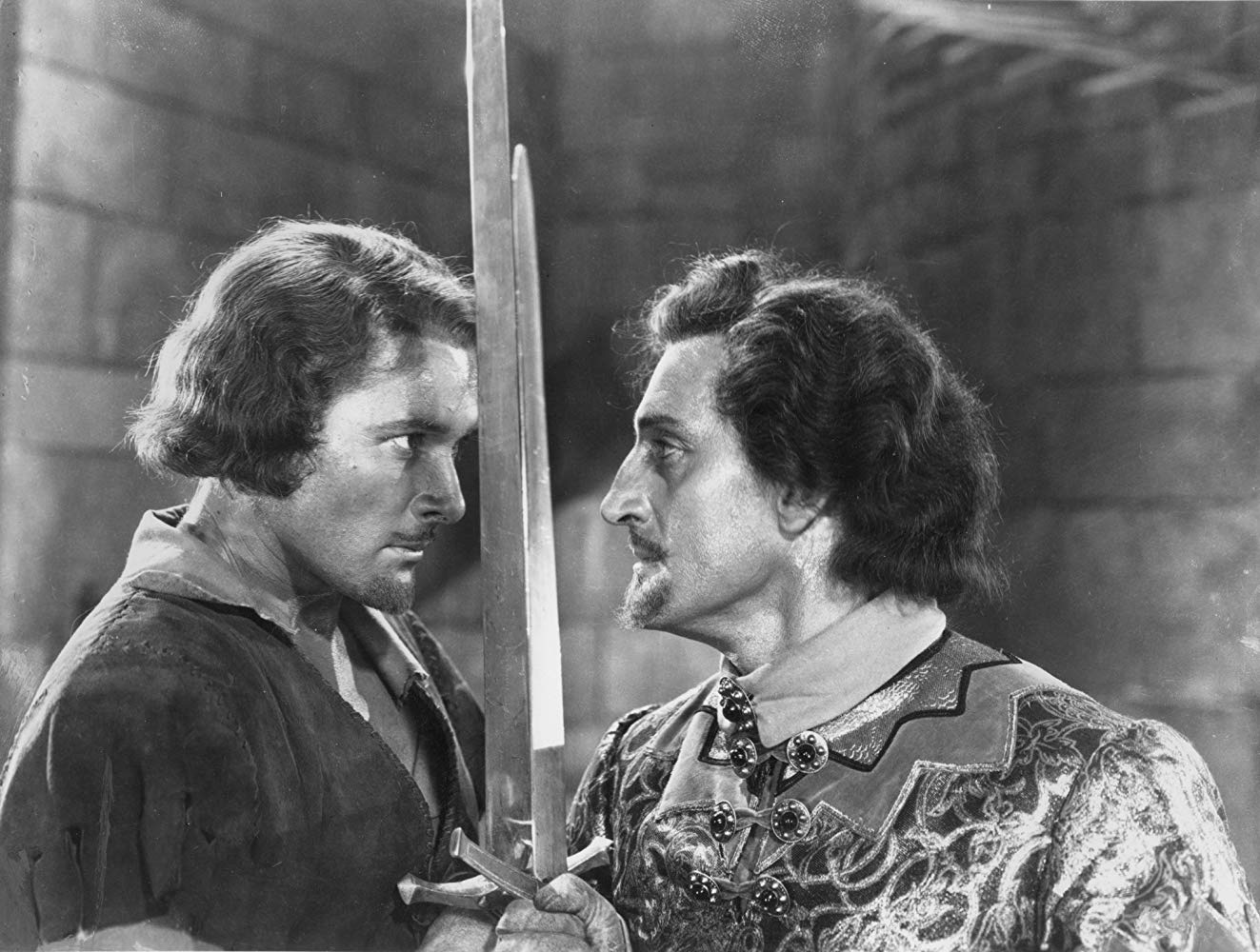

Good villains are just as important as good sidekicks. THE ADVENTURES OF ROBIN HOOD provides three excellent, unforgettable bad guys. Claude Rains as Prince John has a field day as the slightly effete brother of Richard the Lion-Heart. With a chip on his shoulder for his brother passing him over as regent in Richard's absence, Prince John exacts his revenge on the Saxon people, in particular Robin Hood. Rains was adept at making his villains or corrupt characters nefarious yet charming in such films as Michael Curtiz's CASABLANCA (1943) and Alfred Hitchcock's NOTORIOUS (1946). Rains is one of my favorite supporting actors to grace the silver screen.

Basil Rathbone had sparred with Errol Flynn in CAPTAIN BLOOD and they face off against each other again in ROBIN HOOD. Rathbone plays Sir Guy of Gisbourne, a Norman supporter of Prince John and suitor for Maid Marian's hand. Gisbourne lacks the charisma or nerve to show his true feelings to her. Robin Hood inflames his jealously when he woos Marian away from him. Rathbone makes a handsome villain and a worthy foe for Flynn.  Rathbone could play both heroes and villains with ease. Usually in the Robin Hood legends, it was the Sheriff of Nottingham who was Robin's main nemesis.  In THE ADVENTURES OF ROBIN HOOD, it's Gisbourne.  The High Sheriff of Nottingham played by Melville Cooper is comic relief in this ROBIN HOOD. In other Robin Hood films and the legends, the Sheriff is Robin's primary antagonist.


There are plenty of connections between actors in THE ADVENTURES OF ROBIN HOOD as many were contracted to Warner Brothers during this period. Errol Flynn and Olivia de Havilland would make eight films together besides ROBIN HOOD including CAPTAIN BLOOD and THE PRIVATE LIVES OF ELIZABETH AND ESSEX (1939). Michael Curtiz directed those two films and many others with the pair. Errol Flynn and Alan Hale (who were good friends offscreen) would make 13 films together (a few were cameos for Hale) including DODGE CITY (1939) and ADVENTURES OF DON JUAN (1948). Errol Flynn and Basil Rathbone also worked (and dueled) together in CAPTAIN BLOOD and co-starred in THE DAWN PATROL (1938).  Flynn and Patric Knowles played brothers in Curtiz's THE CHARGE OF THE LIGHT BRIGADE (1936). Claude Rains and Patric Knowles both appeared together in Universal's THE WOLF MAN (1941). Flynn, Rains, and Una O'Connor all made Curtiz's THE SEA HAWK (1940) together. But for me, Flynn, De Havilland, Rains, Rathbone, Hale, Knowles, and O'Connor are my cinematic family in ROBIN HOOD.

Nobody directed genre films better than Michael Curtiz.  Horror, Swashbucklers, Westerns, War, Melodrama, Musical, Film Noir -- Curtiz did it all, mostly for Warner Brothers. Curtiz was fabulous staging action scenes, filling his screen with hundreds of extras, and making studio backlots look like French Casablanca, a seedy Mexican dive bar, or medieval Nottingham square. For THE ADVENTURES OF ROBIN HOOD, William Keighley began as the director but was replaced by Curtiz after studio heads thought Keighley's footage lacked pizazz.  Several 2nd Unit directors helped film insert and non-essential actor scenes but Curtiz directed the remaining big scenes including the archery tournament and the final battle inside Nottingham Castle. I love the way Curtiz frames certain shots and moves the camera, loading the screen with loads of detail.


THE ADVENTURES OF ROBIN HOOD'S success can be traced to using the best tales from the Robin Hood legends for its movie. Because of its universal success, future Robin Hood films were forced to find different storylines for their films. Kevin Reynolds ROBIN HOOD: PRINCE OF THIEVES (1991) has Robin (a miscast Kevin Costner) just returning to Nottingham from the Crusades not with the Merry Men but a Moorish companion (Morgan Freeman) to find the evil Sheriff of Nottingham (Alan Rickman) in charge. Ridley Scott's ROBIN HOOD (2010), shows us the man before he became a legend. Russell Crowe plays Robin Longstride who returns from the Crusades and assumes the identity of a dying knight named Robert Loxley with a final request. Richard Lester's ROBIN AND MARIAN (1976) gives us Robin (Sean Connery), Marian (Audrey Hepburn), and the Sheriff of Nottingham (Robert Shaw) as older versions of their characters. And what would the Robin Hood film canon be without director Mel Brooks poking fun at the hero and his world in ROBIN HOOD: MEN IN TIGHTS (1993).

A few fun Robin Hood facts.  What is the name of the hat that Robin Hood wears?  Is it a hat?  A bonnet? It's called a bycocket which is a fancy name for a cap.  It has a wide brim turned up in the back and pointed in the front like a beak. Only Errol Flynn and Cary Elwes in ROBIN HOOD: MEN IN TIGHTS wore the bycocket in their films. No one really knows who Robin Hood was. His name first appeared in William Langland's Piers Plowman in the 14th Century. Ballads about Robin Hood emerged in the 15th and early 16th centuries. Some scholars believe Robin Hood may have been many sources that merged into one. As for Maid Marian, she is believed to have been referenced first in a French pastoral play from the 13th Century, later adapted by the English in the late 15th Century in the May Games which paired her with Robin Hood. For all the Robin Hood facts and fiction, check out this website http://www.robinhoodlegend.com/


Errol Flynn will forever be associated with Robin Hood in THE ADVENTURES OF ROBIN HOOD just like Clint Eastwood will always be associated with Dirty Harry or Harrison Ford with Indiana Jones.  Some roles are just meant to be played by one person.  Flynn had the dashing good looks, the athleticism, the roguish smile. He looked good in green tights and wearing a bycocket.  Whether Flynn knew it or not, he made quite an impression on an eight year old kid. Robin Hood was my first super hero. Also making an impression on CrazyFilmKid was the attractive Maid Marian, her allure casting a spell on me that endures to this day. In my estimation, there is no more perfect blending of adventure, romance, humor, and music than THE ADVENTURES OF ROBIN HOOD.


Saturday, December 22, 2018

Elf (2003)

What are the odds that someone would finally come up with a script about an elf (or at least a human raised by elves) at the same time that an up and coming comedy actor was looking for a breakout feature film role. Those two entities collided in the surprise hit comedy ELF (2003).  The one Christmas character that had received the short end (no pun intended) in the Christmas film genre was Santa's elves. Santa Claus, his reindeer, and even snowmen had received more screen time in movies and television specials than the blue collar workers who make all the toys for the good boys and girls of the world. TVs RUDOLPH THE RED NOSED REINDEER (1964) was the first program to give Santa's elves a little love in the guise of Hermey, an elf who wanted to become a dentist. But no one had made an elf the centerpiece of a film.

Will Farrell was already a comedy star on NBCs SATURDAY NIGHT LIVE creating a plethora of comic characters during his stint from 1995 to 2002. He had appeared briefly as a minor character Mustafa in a couple of AUSTIN POWERS films and co-starred in A NIGHT AT THE ROXBURY (1997) with Chris Kattan as the Butabi brothers which they played in skits on SATURDAY NIGHT LIVE. But Farrell wanted to break into films like previous SATURDAY NIGHT LIVE alums like Chevy Chase, Bill Murray, and Eddie Murphy.  Farrell needed the right project to utilize his comic talents and improvisational skills. And along came director Jon Favreau with ELF.


At the time, Favreau was better known as an actor (SWINGERS, THE REPLACEMENTS) than a director.  Favreau had directed a couple of TV movies but nobody could have predicted his success directing ELF.  From the opening scenes with homages to RUDOLPH THE RED NOSED REINDEER to some inspired casting of James Caan, Bob Newhart, and Ed Asner in key roles, Favreau has total control of this modern holiday classic.  And, he had the good fortune of having Will Farrell in the lead role as Buddy the Elf.

Directed by Favreau with a screenplay by David Berenbaum, ELF opens with a quick flashback on how the human Buddy ended up in the North Pole. Santa Claus (Ed Asner) stops at an orphanage in New York City during Christmas Eve.  As he munches on a cookie, a small baby climbs into his toy sack. When Santa returns to the North Pole, he discovers the stowaway.  The elves name the human baby Buddy (after his diaper brand Little Buddy Diaper). Buddy is raised by Papa Elf (Bob Newhart). Buddy outgrows his bed, his school desk, and his work station in the toy shop.  He doesn't quite fit in. Buddy overhears a couple of elves gossip that Buddy's not an elf but human. This forces Papa Elf to reveal to Buddy that he's adopted. Buddy's a human and his real father lives in New York and doesn't know he exists.


With Santa and Papa Elf's blessing, Buddy leaps onto a piece of ice (another nod to RUDOLPH) and floats south until he reaches the Big Apple. Buddy begins searching for his father Walter Hobbs (James Caan), a grumpy executive for a struggling children's book publisher located in the Empire State Building. Buddy finds Walter (where Buddy's mistaken for a singing elf messenger) who promptly throws Buddy out of his office (but not before revealing to Walter Buddy's mother's name). Buddy wanders over to Gimbel's, a giant toy store where he meets and falls in love with Jovie (Zooey Deschanel), who works in the store's Christmas section (dressed as an elf no less). Buddy improves the decorations in the Santa area and sleeps in a display window.

The naïve Buddy discovers the big city as he plays in revolving doors, samples discarded chewing gum on subway bannisters, and acts like a giant kid. But when he starts a fight with a fake Gimbel's store Santa (Artie Lange), Buddy is arrested and thrown in jail.  He's bailed out by his real father Walter who brings him home to meet his wife Emily (Mary Steenburgen) and teenage son Michael (Daniel Tay). Walter's a workaholic who's neglecting his family during the holidays. But Walter begins to wonder if Buddy might be his son.


Buddy proceeds to drive Walter crazy with his infinite energy. Walter brings Buddy back to the office only this time in a suit.  Walter puts Buddy to work in the downstairs mailroom. Buddy begins to gain confidence with his new surroundings.  He bonds with new step brother Michael during a snowball fight against some bigger kids. Buddy takes Jovie out on an ice skating date and they have their first kiss. It's all going so well until Buddy interrupts a book pitch meeting to Walter by famed children's book author Miles Finch (Peter Dinklage) to save Walter's job.  Buddy thinks Miles's is an elf and insults the diminutive Miles. Walter kicks Buddy out of the office and tells him he never wants to see Buddy again.  This time, Buddy runs away from home (after leaving his family an Etch-A-Sketch goodbye note).

Michael barges into a board meeting to tell Walter that Buddy is missing.  Despite threats to be fired by Walter's boss Mr. Fulton (Michael Lerner), Walter walks out on the board meeting with Michael to find Buddy.  Buddy wanders aimlessly near Central Park when he sees Santa emergency land in Central Park. The device that powers Santa's sleigh, the Clausometer, is malfunctioning.  As four Central Park Rangers (on horses no less) chase after the elusive Santa, Buddy, Michael, and Jovie are able to get several onlookers including Walter to show some Christmas spirit.  Powered by true believers, Santa's sleigh lifts off from Central Park to finish delivering toys around the world.  Buddy and Walter patch up their relationship and everyone lives happily ever after.


Cognizant that ELF is a Christmas movie competing with dozens of Christmas classics, director Favreau peppers ELF with many references to other Christmas film favorites. As mentioned, the opening sequences of Buddy in the North Pole are mixed with stop animation that resembles RUDOLPH THE RED NOSED REINDEER.   There's a talking snowman (voiced by musician Leon Redbone) in the spirit of Burl Ives Sam the Snowman. Buddy even waves good bye to three misfit toys as he begins his journey to New York. When a despondent Buddy is kicked out of his father's office, Buddy walks along a snowy bridge that parallels Jimmy Stewart's George Bailey standing on a snowy bridge in IT'S A WONDERFUL LIFE (1946). But rather than an angel intervening, Buddy encounters Santa and his sleigh making an unexpected landing in Central Park.

Buddy's encounter with the department store Santa Claus at Gimbel's echoes Ralphie's department store Santa Claus moment in A CHRISTMAS STORY (1983). In comedies, department store Santas are played for laughs and do not represent the true spirit of old St. Nicholas. ELF'S best modern take on a Christmas character is with Buddy's real father Walter Hobbs. Walter is the Scrooge in ELF.  Consumed by his work, he's barely a husband and father to his wife and son. He's on Santa's naughty list. "He's lost sight of what's important in life," Santa tells Buddy. Walter has lost the Christmas spirit until Buddy enters his life. Like the three ghosts of A CHRISTMAS CAROL (1951), Buddy shows Walter the true meaning of both family and Christmas.


I enjoyed that the filmmakers did give the real elves some screen and story time in ELF.  Papa Elf played drolly by Bob Newhart narrates the beginning and end of the film, sharing "elf-isms" as he relates how Buddy came to the North Pole. Director Favreau chooses not to use dwarfs or midgets to play the elves, incorporating sleight of hand scale to show the larger human Buddy living and working alongside his smaller elf brothers and sisters. We get an inside view of Santa's Workshop where the elves make shoes, bake cookies, and build toys including modern toys like Etch-A-Sketches. Refreshingly, it's all real sets and costumes in the North Pole with very little CGI involved.

Ten years earlier, Jim Carrey almost played Buddy the Elf (when the ELF script first appeared and Carrey was at the height of his career). But ELF seems tailor made for Will Farrell.  Farrell's height and expertise at physical comedy fits in perfectly with Buddy's awkwardness assimilating into elf society. Farrell also thrives at playing grown men who act like children (see STEP BROTHERS, TALLEDEGA NIGHTS, or ANCHORMAN). In ELF, it works to perfection. Buddy's fish out of water journey to New York City makes sense.  He comes from an insulated, safe home in the North Pole to the wild, big city. Buddy's a kid let loose in a candy store aka the Big Apple.

Although Farrell is the reason for ELF'S success, it's the supporting cast that surprises. Director Favreau's casting decisions are both unexpected and bold. Perhaps revealing his love for classic 1970s television sitcoms, Favreau gives us Bob Newhart (from TVs BOB NEWHART SHOW) as Papa Elf and Ed Asner (from TVs THE MARY TYLER MOORE SHOW) as Santa Claus. Both play their parts to perfection. And casting against type, Favreau has tough guy James Caan (best known from films like THE GODFATHER and THIEF) as Buddy's biological father Walter Hobbs. It's funny to see Caan trying to stay calm as Farrell does childish like things around him. I kept waiting for Caan to punch Farrell.  But Farrell and Caan's entirely different acting methods complement each other.


Zooey Deschanel is perfect as Buddy's love interest Jovie.  Deschanel has an elfish like quality herself and an ethereal innocence. Besides working in film and an accomplished singer, Deschanel has her own successful TV series NEW GIRL (2011 - 2018). The lovely Mary Steenburgen plays Walter's understanding wife Emily Hobbs. Steenburgen is eternally youthful. She must be a fan of Will Farrell's humor as she would play his mother in STEP BROTHERS (2008). Faizon Love steals his few scenes in ELF as Jovie's Gimbel's manager. His exasperation as Buddy wreaks havoc with the store's commercial interpretation of Christmas is priceless. Amy Sedaris brings some cheer to the sour Walter Hobbs as his secretary Deb.  And Favreau gives us another Christmas movie Easter Egg with Peter Billingsley who played the bespectacled young Ralphie in A CHRISTMAS STORY cast as Ming Ming, Buddy's exasperated elf shift boss in Santa's toyshop.

As much as I enjoy ELF, the third act is a let down after the first two thirds of the movie.  It just seems rushed with Buddy finding Santa in Central Park, trying to fix his Clausometer so the sleigh can fly again while four Central Park rangers on horseback (acting like either the Four Horsemen of the Apocalypse or the wraith riders of THE FELLOWSHIP OF THE RING) race around trying to catch Santa.  Farrell disappears in this section which is devoted to Walter finding his Christmas spirit and regaining the love of his son Michael.


But it's not enough to sour my thoughts on ELF as one of the better modern day Christmas movies. ELF maintains its charm throughout the film thanks to the breakout comedy performance from Will Farrell surrounded by a cast of veteran and new actors who keep the story focused on Buddy's journey to find his real father. ELF'S humor never strays into today's gross out style, its laughs sticking with the film's concept and Christmas spirit. ELF is the gift that keeps on giving each Christmas season. 

Saturday, December 1, 2018

Heaven Knows, Mr. Allison (1957)

It's not surprising for studios to entice directors to recapture the magic of a previous hit film by making another film using a similar formula or in the same genre or with the same actors. Director George Roy Hill paired Paul Newman with Robert Redford and had a smash hit film BUTCH CASSIDY AND THE SUNDANCE KID (1969). Newman and Redford's chemistry was electric. Hill would cast Newman and Redford together again in the Depression era caper film THE STING (1973). After Francis Coppola made his massive twin hit gangster films THE GODFATHER (1972) and THE GODFATHER PART II (1974), he mostly misfired on his next few projects. So what did Coppola return to make? Another gangster film called THE COTTON CLUB (1984). But the one film director I never expected to reuse one of his own formula's was John Huston.

Now Huston had made several classic films about men and women's greed ending with catastrophic results in THE MALTESE FALCON (1941), THE TREASURE OF SIERRA MADRE (1948), THE ASPHALT JUNGLE (1950), and THE MAN WHO WOULD BE KING (1975). But one of Huston's most endearing films and an outright classic is THE AFRICAN QUEEN (1951) starring Humphrey Bogart and Katherine Hepburn as two polar opposites who become attracted to each other in the heart of Africa during World War I.  It's a different kind of John Huston movie, the closest to a romantic film that he would do.  I thought it was the only one Huston made. That is until I watched Huston's 1957 film HEAVEN KNOWS, MR. ALLISON.


Whether a studio convinced Huston to try the formula again or if Huston himself read the Charles Shaw novel and saw the similarities, HEAVEN KNOWS, MR. ALLISON is a reworking of THE AFRICAN QUEEN formula. The setting is similar. HEAVEN KNOWS, MR. ALLISON takes place at the end of World War II in the South Pacific. THE AFRICAN QUEEN takes place during World War I in German East Africa around 1914. The characters from both films are similar as well.  Two completely different people thrust together in a time of upheaval who find comfort in each other despite coming from different worlds.

Co-written by John Lee Mahin and John Huston and directed by Huston, HEAVEN KNOWS, MR. ALLISON has no dialogue for the first ten minutes as U.S. Marine Corporal Allison (Robert Mitchum) drifts unconscious in a rubber raft before washing ashore on a seemingly deserted South Pacific island during 1944 World War II. On the beach, Allison comes across a few bungalows and a church before stumbling across Sister Angela (Deborah Kerr), a Roman Catholic nun and the only other inhabitant of the island (if you don't count rats and wild pigs). Allison was on a reconnaissance mission when the Japanese attacked his submarine. Floundering in the water, Allison found a raft and jumped in. Sister Angela came to the island with Father Phillips to find another priest Father Ryan and evacuate to Fiji before the Japanese could conscript him. But Ryan had already been taken and Phillips became sick and died leaving Angela alone. Allison and Angela must work together to survive and figure out how to get off the island.


The soldier and the nun manage to catch a sea turtle and cook it for food.  They prepare to build a raft to get off the island when a Japanese reconnaissance plane flies overhead.  Allison takes Angela to a cave he discovered not far from their beach huts. The Japanese bomb the beach before coming ashore and setting up a makeshift camp. Allison sneaks down into the camp one night to steal some food from the camp. He becomes trapped in the kitchen when two cooks show up. Sister Angela wakes up to find Allison missing.  She hears gunshots and fears Allison has been shot. But it's just the Japanese shooting at a wild pig.  Allison returns with his booty. Angela's happy he's alive but upset he left without telling her.

Allison begins to fall for Sister Angela. Angela confesses she's hasn't completed all her vows which gives Allison hope. The two of them watch a sea battle between the Japanese and the Allies on the horizon. The next morning, they wake up to find the Japanese have left the island. Allison picks this moment to confess his love to Sister Angela.  But Angela won't give up her love to God. Scrounging for supplies that the Japanese left behind, Angela finds a bottle of Saki.  Allison becomes drunk on Saki and upsets Angela with his rants.  Angela runs out into a storm and falls asleep in the outdoors wet and cold. Allison eventually finds Angela among the tall grasses, shivering and feverish.  He brings her back to the cave.


Allison sees naval ships off in the distance. At first, he thinks it's the U.S. Navy but soon realizes the Japanese are returning to the island. With Sister Angela near death, Allison sneaks into the camp again to grab some blankets. A Japanese soldier catches him in the hut. They struggle and Allison kills the soldier. Allison returns Angela back to health but at a price.  The Japanese begin burning the bamboo and grasses on the island to find the castaways.  As the two of them prepare to become prisoners, Angela says a prayer. Suddenly, explosions fill the air and U.S. planes fly over, bombing the Japanese. Allison feels God telling him to take out the Japanese cannons so the U.S. landing will be safer.   Can Marine Corporal Allison pull off this divine suicide mission?

Just as the alcohol loving riverboat captain Charlie Allnut (Humphrey Bogard) and the prim missionary Rose Sayer (Katherine Hepburn) made THE AFRICAN QUEEN so endearing, we have the same archetypes with Corporal Allison and Sister Angela in HEAVEN KNOWS, MR. ALLISON. Two completely different people. A marine and a nun.  The military and the Catholic church. But Allison and Angela's vocations, although seemingly polar opposite, have a lot in common.  Cpl. Allison was raised an orphan.  The marines are his family.  The Marine Corps are his religion just like Catholicism is Angela's.  They both wear clothing connected to their employer. Marine green for Allison. Angelic white for Angela. Both were raised by tough teachers. Allison by a DI (Drill Instructor). Angela reveals she had her own type of drill instructor: a nun she and the other sisters called "the holy terror."


I've always liked movies about unrequited love.  They can be frustrating but you keep watching hoping the two people will kiss and/or fall in love. HEAVEN KNOWS, MR. ALLISON is that kind of film. Allison begins falling for Sister Angela.  They get along well. It appears as if they're going to be on the island for some time. When Allison proposes to Angela, she turns him down. It's not that she doesn't have feelings for Allison. She's fond of him. But Angela has promised her love to a higher power. Jesus Christ. But the filmmakers come up with a plot device that is the closest to intimacy they will have. When Allison finds Angela feverish outside the cave after he scared her with his "drunk talk", he undresses her (off camera) and wraps her in warm blankets so she doesn't die of exposure. He tells Angela what he had to do. Angela approves of the act. It's the two characters way of consummating their relationship without making love. Allison and Angela are a modern day Adam and Eve on this island. Only there's no snake to tempt them. Just the Japanese army to hide from. The film's ending hints that there still could be hope for the two. As Allison is taken by a stretcher to a nearby ship, Angela follows holding both the comb Allison made for her and a cross from the church.  The camera lingers on both as if to suggest Angela's mind is not completely made up whether she will choose God or Allison.  Maybe that's why the title suggests only "heaven knows" Angela's decision.

Who wouldn't fall in love with the lovely Deborah Kerr as Sister Angela? Kerr has a wonderful porcelain face that shines throughout the film as that's all we really see of her.  Just as we ache to see Kerr and Mitchum kiss, we yearn to see a glimpse of Kerr's hair.  For almost the entire film, she wears her habit.  Only her face is seen. But Huston does provide one scene in which Angela is out of her nun's clothing and we see her short cropped red hair. My first encounter with Kerr was in Fred Zinnemann's FROM HERE TO ETERNITY (1953) as the unfaithful wife to an army captain.  Sister Angela is a far cry from ETERNITY'S cheating wife. But Kerr had the versatility to bounce between demure characters like the English teacher in THE KING AND I (1956) to another philandering wife in THE END OF THE AFFAIR (1955) as well as classical performances like Portia in Joseph L. Mankiewicz's JULIUS CAESAR (1953).


Robert Mitchum began his career playing tough guys and cowboys in films like Don Siegel's THE BIG STEAL (1949) or Raoul Walsh's PURSUED (1947). But Mitchum would break out from being typecast when he played the malevolent preacher Harry Powell in Charles Laughton's THE NIGHT OF THE HUNTER (1955).  Mitchum would work with many great directors throughout his career including Howard Hawks (EL DORADO), David Lean (RYAN'S DAUGHTER), and Sydney Pollack (THE YAKUZA). Corporal Allison is one of Mitchum's finest roles.  He brings both a gritty toughness yet boyish tenderness to Allison as he protects and falls in love with Sister Angela. One moment, Allison's a love struck teenager bringing Sister Angela a comb he made by hand as a gift.  He's in love for the first time in his life. "I've never even lived before," he tells Angela. "Never really..lived...inside" as he taps his heart. The next moment, he kills a Japanese soldier with his bare hands to protect their presence on the island. It's a daring performance by Mitchum.

When I think of Hollywood on screen couples, I usually think of Fred Astaire and Ginger Rogers, Humphrey Bogart and Lauren Bacall, or Spencer Tracy and Katherine Hepburn.  HEAVEN KNOWS, MR. ALLISON would be the first of four films (one a television movie) that Robert Mitchum and Debora Kerr would appear in together.  After watching their chemistry in HEAVEN KNOWS, MR. ALLISON, it's not surprising. Mitchum and Kerr would also star in Fred Zinnemann's THE SUNDOWNERS (1960) set in early 20th Century Australia and Stanley Donen's THE GRASS IS GREENER (1960) co-starring Cary Grant and Jean Simmons.


When I first saw HEAVEN KNOWS, MR. ALLISON, the island location struck me as unique.  The island looked dense with palm trees.  I wondered did they really film HEAVEN KNOWS somewhere in the South Pacific?  Director Huston was known for filming in far away locations like Mexico for THE TREASURE OF SIERRE MADRE or the Belgian Congo in Africa for THE AFRICAN QUEEN. It turns out the location for HEAVEN KNOWS, MR. ALLISON is Tobago, one of the two island in the Caribbean known as Trinidad-Tobago.  Tobago has an incredibly lush look and most likely resembles the hundreds of small islands in the South Pacific.  Ironically, Mitchum had just made a film the year before called THE FIRE DOWN BELOW (1957) in Tobago co-starring Rita Hayworth and Jack Lemmon. Fans of Disney's 1960 adventure THE SWISS FAMILY ROBINSON will recognize Tobago as the location for that film too.

Kerr and Mitchum are the only two stars of the film.   They have almost all the screen time.  But Huston does give a few scenes to the Japanese actors who portray the Japanese army in HEAVEN KNOWS, MR. ALLISON.  Huston shows them as human beings just like anyone else. Shining boots, dancing to music, engaging in some physical athletic games. Two cooks exemplify the universal grunt in war.  They both show their disdain for a superior (after he leaves the kitchen). The battle boredom by playing a board game and drinking Saki that was meant for the officer. They seem like nice enough men.  Allison watches them, trapped in the kitchen until they go to bed.  As normal as the two cooks appear, Allison would kill them in a heartbeat if they were to discover him. It's nice to see Huston show the human side of the enemy.

The opposites attract film went to great lengths in the 80s to be vastly different in movies like Ron Howard's SPLASH (1984) where a man falls in love with a mermaid or John Carpenter's STARMAN (also 1984) that has a woman falling in love with an extraterrestrial who can resemble her dead husband.  But John Huston perfected the formula with his classic film THE AFRICAN QUEEN. But Huston's lesser known HEAVEN KNOWS, MR. ALLISON might be even more true to the formula than THE AFRICAN QUEEN. HEAVEN'S two protagonists are almost fated to never be together due to Angela's vows.  But it's worth watching and hoping that they might become a couple.


Tuesday, October 23, 2018

The Brides of Dracula (1960)

It was Universal Studios that introduced the world to Dracula, Frankenstein, the Wolf Man, the Mummy, and the Invisible Man back in the 1930s. The Universal monsters reign of terror lasted until the 1940s when the real horror of World War II replaced the cinematic horror of vampires, werewolves, and the undead.  It would take a British film company known as Hammer Film Studios to revive the horror film in the late 1950s. Hammer would resurrect Frankenstein, the Wolf Man, the Mummy, and yes, Dracula. Hammer had two things going for it that Universal Studios did not back in the 30s.  Hammer's horror films were in color and Hammer's films could amp up the sex and blood.

One of  Hammer's earliest hits was THE HORROR OF DRACULA (1958) starring a young Christopher Lee (today's audiences know Lee from THE LORD OF THE RINGS films) as Count Dracula. It was another retelling of Bram Stoker's novel Dracula. Hammer had a hit and commissioned another Dracula film.  But Christopher Lee didn't want to be typecast as Dracula (he would play the part again in 1966's DRACULA HAS RISEN FROM HIS GRAVE and 8 more times afterward). So Director Terence Fisher (who directed THE HORROR OF DRACULA) and three writers (Jimmy Sangster, Peter Bryan, and Edward Percy) moved forward with a vampire film without showing Dracula that would be called THE BRIDES OF DRACULA (1960) in which one of Dracula's disciples terrorizes an all-girl's school.


I first came across THE BRIDES OF DRACULA like I came across a few Hammer horror films while playing at a friend's house when I was a young boy.  My best friend Richard's mother always had the television on at noon.  A local channel seemed to be showing Hammer horror films at that time.  I recall watching BLOOD OF THE VAMPIRE (1958) also written by Jimmy Sangster and THE CURSE OF THE WEREWOLF (1961) which was also directed by BRIDES Terence Fisher while at his house.  But I will never forget when THE BRIDES OF DRACULA came on in my friend's living room.  The two scenes that etched in my mind were a dead girl's hands clawing out of the earth as she rose for the first time as a vampire and the giant windmill climax in which the hero destroys the vampire. I would not see THE BRIDES OF DRACULA again for more than twenty years until I rented bad video copy of the film in the early 90s.

THE BRIDES OF DRACULA opens with a narrator telling us Dracula is dead but his disciples live on as the 19th century comes to a close.  Marianne Danielle (Yvonne Monlaur) rides a carriage from Paris to Badstein where she's to be a French student teacher at an All-Girls Academy.  While stopping at the Running Boar tavern for food, one of those disciples (Michael Mulcaster) pays the coachman (the aptly named Michael Ripper) to take off without Marianne.  Seemingly stranded at the inn, a late night visit for wine by the Baroness Meinster (Martita Hunt) turns into an invitation to spend the night with her at the nearby Meinster Castle. The Baroness says she lives alone except for her servant Greta (Freda Jackson). But from her bedroom balcony, Marianne sees a man in the courtyard below. The man is Baron Meinster (David Peel), the Baroness's son.


Marianne sneaks down to meet the Baron and discovers he's chained by the leg to the wall. Meinster begs her to steal the key from his mother's room and free him.  The naïve Marianne obliges not realizing that Meinster is a vampire.  No longer shackled, Meinster turns on his mother the Baroness then flees. When Marianne discovers the hysterical Greta grieving over the dead Baroness, she runs from the castle into the nearby forest.  She's discovered the next morning by a coach carrying Doctor Van Helsing (Peter Cushing). Stopping at the Running Boar again, Van Helsing learns a young village woman (Marie Devereux) has died from mysterious circumstances. Before investigating the death, Van Helsing escorts Marianne to the Ladies Academy in Badstein.

At the Academy, Marianne meets the stern headmaster Herr Otto Lang (Henry Oscar) and his more warm hearted wife Frau Helga Lang (Mona  Washbourne). Marianne meets the girls and hits it off with another student teacher Gina (Andree Melly). Van Helsing returns to the village to check on the dead girl but she's already been buried. When he goes to inspect her grave in the church yard, he witnesses Meinster's servant Greta urging the village girl to scratch her way out of the ground. Van Helsing tries to stake her but the village vampire girl escapes.  Van Helsing wanders up to Meinster Castle and discovers Baroness Meinster inhabiting the grounds.  She's also a vampire.  The Baron is hiding out there as well. He escapes in his coach. Van Helsing waits until sunrise before hammering a stake through the Baroness's heart to give her peace.


Back at the Academy, Baron Meinster shows up to woo Marianne.  He proposes to her and she accepts. Later that night, Meinster bites Gina.  When Van Helsing returns to the Running Boar, he finds a Dr. Tobler (Miles Mallson) has arrived.  He's been called to look into a death at the Girl's Academy. Tobler invites Van Helsing to join him.  Van Helsing discovers that Marianne's engaged to Meinster. Gina's body lies in rest in a barn next to the school. When Gina rises and almost bites Marianne, Van Helsing arrives to intervene.  He tracks Gina to an old windmill where Meinster is hiding out. Meinster battles Van Helsing and bites him. Van Helsing takes a hot iron and cauterizes the bite. Meinster returns to the Academy and grabs Marianne, taking her back to the old mill to join his other brides. He's surprised to find Van Helsing still alive. Good versus evil ensues as Van Helsing and Meinster duel with holy water and fire underneath the massive wind mill while Meinster's vampire brides watch with delight.

Hammer films were an exciting new interpretation of the Universal horror films. Hammer brought good production value to the stories (although you recognize some of the same sets and forests in their films). Early films like THE CURSE OF FRANKENSTEIN (1957) and THE HORROR OF DRACULA are well made if a bit over the top at times.  THE BRIDES OF DRACULA is no exception. But there's something about BRIDES that raises it to a higher level than some of Hammer's other hit films. What seems unlucky in having Christopher Lee bow out as the tall, elegant Dracula provides an opportunity for the shorter but well coiffed David Peel to step in as a new vampire Baron Meinster. The film's location at an All Girl's School promises some sexual tension between the Baron and the young women he preys on. The relationship between Baron Meinster and his mother feels like Greek tragedy. And set pieces like the young vampire girl digging out of her coffin or the finale at the giant windmill (resembling a humongous holy cross) are memorable and will be copied by future filmmakers. But the key to THE BRIDES OF DRACULA popularity are those vampire babes...I mean brides.


Dracula's brides have always titillated audiences.  The King of Vampires has three beautiful undead wives fawning over him.  Do they all sleep together in one coffin?  What do the brides do when he's gone? Iron his cape and dust the abbey? In Tod Browning's DRACULA (1931), we only get glimpses of the brides, dressed in flowing white gowns. They're beautiful and mysterious but Browning leaves us wanting to know more about them. He doesn't play up their sexuality. The Spanish version of DRACULA (also 1931) utilized Dracula's brides sensuality better than the English version. It wasn't until more recent films like Francis Coppola's DRACULA (1993) and Stephen Sommers' VAN HELSING (2003) put Dracula's brides front and center, emphasizing their sexiness and blood lust. But it was THE BRIDES OF DRACULA that first put a spotlight on the feminine side of vampirism.

There's always been something sensual about a vampire biting the neck of a young woman and drinking her blood. It's the supernatural equivalent to sexual intercourse. Whether the vampire is  Dracula or Baron Meinster in THE BRIDES OF DRACULA, the men are usually handsome and aristocratic. The women they pursue are often virgins or soon to be married young ladies. Although DRACULA had the Count pursuing mainly one woman (Mina), BRIDES finally focuses on a multitude of women that Meinster wants to add to his flock. He's like a bloodsucking Warren Beatty. DRACULA and VAN HELSING showed the brides already dead and serving Dracula. THE BRIDES OF DRACULA is the first film to show a vampire like Meinster trying to create his trio of terror.


I would consider THE BRIDES OF DRACULA a cult film. I knew there was something unique about BRIDES but apparently so did some of Hollywood's best filmmakers.  In the THE MATRIX RELOADED (2003), the Wachowski Brothers sequel to THE MATRIX (1999), THE BRIDES OF DRACULA can be seen playing on a television during a scene. In Tom Holland's FRIGHT NIGHT (1985), Roddy McDowell's character Peter Vincent is a homage to Peter Cushing and Vincent Price. McDowell definitely channels Cushing's Van Helsing and dresses like him too. But the biggest homage to THE BRIDES OF DRACULA is from director Tim Burton (BEETLEJUICE, BATMAN).  In Burton's SLEEPY HOLLOW (1999), the finale takes place in a huge windmill that clearly is a nod to THE BRIDES OF DRACULA (and with a better budget).  Burton even uses Hammer film stars Christopher Lee and Michael Gough (HORROR OF DRACULA, THE PHANTOM OF THE OPERA) in supporting roles for SLEEPY HOLLOW.

THE BRIDES OF DRACULA doesn't miss a beat with virtually unknown English actor David Peel as the main vampire Baron Meinster replacing Christopher Lee who chose not to return as the Count after THE HORROR OF DRACULA. Even though Dracula is mentioned in the title, Peel's Baron is one of his disciples, perhaps bitten by Dracula. The Baron comes off as a spoiled brat, a petulant son, and when cornered, a snarling vampire. We feel sorry for Meinster early when we learn his overbearing mother, the Baroness Meinster keeps him chained up. The Baroness sees her son as an embarrassment to the family name and a danger to the community. Mother knows best right? She still loves her son, even worships him. She later confesses she encouraged his partying with a bad crowd. Filled with guilt for what he's become, the Baroness lures Marianne to their castle, a sacrifice to her son to keep him happy. But the Baroness's plan backfires. Meinster tricks Marianne into setting him free. The first person Meinster turns on?  His loving mother. Whereas Christopher Lee would return as Dracula in 1966, David Peel would give up acting and become a successful art dealer.


It's a sad moment when Van Helsing stumbles across the Baroness, now herself a vampire. She's embarrassed to be a member of the undead instead of the ruling elite. She gladly accepts Van Helsing's wooden stake through the heart to bring her peace. Peter Cushing as Dr. Van Helsing brings his usual class and gusto to the role of vampire killer. Cushing is a master at incorporating props with his acting. Watch him in BRIDES as he's always washing his hands, opening his medical bag, or in the finale, branding himself with a hot iron to rid himself of Meinster's curse. Cushing would play everything from Sherlock Holmes to a pirate captain for Hammer but he would mostly play either Van Helsing or Dr. Victor Frankenstein. After a distinguished career mostly appearing in the horror genre, Cushing would be rewarded with his most famous role as the evil Grand Moff Tarkin in George Lucas's STAR WARS (1977). Well done Mr. Cushing.

Sprinkled throughout THE BRIDES OF DRACULA are character actors whose performances also help make BRIDES so memorable.  There's the alluring Yvonne Monlaur as the French student teacher Marianne and focus of Baron Meinster (Monlaur was actually French). Martita Hunt brings elegance as Baroness Meinster, the over protective mother of her vampire son. You will never hear a more bloodcurdling cackle than from Freda Jackson as the Meinster's loyal servant Greta. For comic relief, we have Miles Malleson as Dr. Tobler, the eccentric local doctor and a bit of a hypochondriac himself. Both Cushing and Malleson appeared in THE HORROR OF DRACULA although Malleson played a different, smaller role in HORROR.


Budget limitations hinder THE BRIDES OF DRACULA at times.  Both Meinster Castle and the giant windmill are clearly models instead of the real thing.  The large vampire bat that Meinster turns into is slow and not very realistic or scary. Yet THE BRIDES OF DRACULA has an operatic style to it. To hell that the production can't afford a real castle and windmill.  Dramatic organ music played over the insert shots make the castle and wind mill seem big and real. Director Fisher uses lots of garish colors - velvety purples and burgundy reds to make BRIDES more flamboyant, vibrant. THE BRIDES OF DRACULA is a feast for the eyes with its sets, wardrobe, and overall visual look.

Hammer Films would ignite a new generation in the late 50s and 60s to discover the Universal monsters that gave audiences chills back in the 30s. Hammer would update these classic tales with lurid color, more blood, and a little bit of sex. THE BRIDES OF DRACULA would be one of Hammer's early successes. BRIDES has all the classic vampire motifs: caskets and graveyards, holy water and crosses, wooden stakes and giant bats, and blood thirsty vampires and oh, those wonderful, beautiful vampire brides.  Dracula, Frankenstein's monster, and the Mummy would be in good hands with Hammer Films for the next decade.

Sunday, September 30, 2018

The Spy Who Loved Me (1977)

So far, I've blogged about the James Bond films chronologically from DR. NO (1962) thru DIAMONDS ARE FOREVER (1971).  The next film in the series LIVE AND LET DIE (1973) would be Roger Moore's debut as James Bond 007.  But CrazyFilmGuy is going to jump out of order to visit the third entry in the Roger Moore era which holds a special place in my heart. THE SPY WHO LOVED ME (1977) directed by Lewis Gilbert with a screenplay by Christopher Wood and Bond veteran Richard Maibaum was the first James Bond film that CrazyFilmGuy saw in a real movie theater.  Up until 1977, all the James Bond films I had seen had been on television. THE SPY WHO LOVED ME did not let me down. It was a huge hit and might have been the top grossing film in 1977 if not for a little space fantasy that came out that same year called STAR WARS.

THE SPY WHO LOVED ME captured all the things I loved about James Bond films from watching them on television except this was on the big screen.  Maybe it was my imagination but everything seemed better in THE SPY WHO LOVED ME: the beautiful Bond women, the main villain, his henchmen, exotic locations, large action sequences and a hit theme song.  Special effects were becoming a bigger part of movies in the mid to late 1970s.  THE SPY WHO LOVED ME was no exception. I do love the early Roger Moore films like LIVE AND LET DIE (1973) and THE MAN WITH THE GOLDEN GUN (1974) but they were smaller, character driven Bond films.  The world wasn't in global jeopardy. Bond was up against a drug kingpin and an assassin in those two films.  The nefarious organization SPECTRE was no where to be found or a silent partner. THE SPY WHO LOVED ME would bring back the megalomaniac who wants to destroy the planet and start a new world order...underwater.


An English submarine and a Russian submarine, both carrying nuclear warheads, go missing as THE SPY WHO LOVED ME begins. KGB chief General Anatol Gogol (Walter Gotell) calls in their best spy Major Anya Amasova aka Agent XXX (Barbara Bach) to investigate while British spy chief M (Bernard Lee) recalls James Bond (Roger Moore) from a mission in Austria.  Chased by Russian killers on skis, Bond kills Sergei Barsov (Michael Billington) who happens to be Anya's lover. Both spies return home to pick up their assignment. They learn someone in Cairo, Egypt is trying to sell microfilm with plans for a submarine tracking system to the highest bidder.  Bond and Anya head to Cairo separately to investigate.

The hijacker of both the submarines and nuclear warheads is Karl Stromberg (Curt Jurgens), a shipping magnate with a fondness for the ocean (he even has webbed hands). Stromberg sends his two henchmen, the human bowling ball Sandor (Milton Reid) and the indestructible, gargantuan Jaws (Richard Kiel) to Cairo to retrieve the microfilm. After tracking a lead at the Pyramids of Giza, Bond and Anya both pursue nightclub owner Max Kalba (Vernon Dobtcheff) to bid on the microfilm. But Jaws manages to snare the microfilm and kill Max. Bond and Anya jump into Jaws's van as he makes his getaway. Jaws takes them to an archaeological site out in the desert. The two agents battle Jaws and get the microfilm back. Then, Anya drugs Bond and steals the microfilm from him. When Bond reports to M at the Abu Simbel Temple, he discovers M and Gogol have teamed in Anglo/Russian cooperation to find the hijacker. Anya and Bond will team up as well.


The microfilm reveals very little except the dimensions of a tanker ship and the insignia of Stromberg's shipping company. Bond and Anya head to Sardinia to interview Stromberg.  Posing as a marine biologist (which never fools the villain), Bond and Anya are picked up by Stromberg's assistant Naomi (Caroline Munro) and taken to his octopus like submersible lair the Aquapolis out in the Mediterranean. The meeting is uneventful except for Bond noticing the unusual bow on one of Stromberg's tanker models. Stromberg orders Naomi to kill Bond and Anya when they return to the mainland. Q (Desmond Llewelyn) provides Bond with an underwater car which comes in handy as they escape Stromberg's team of hit men and women.

Bond learns Stromberg's tanker Liparus has not come into port in 9 months. Bond and Anya are dropped onto an American submarine the USS Wayne to help Commander Carter (Shane Rimmer)track the Liparus but the tanker finds them and swallows up the U.S. submarine, joining the other two missing subs in its enormous hull. Stromberg plans to use the British and Russian submarines to fire nuclear warheads at New York and Moscow, igniting Armageddon. In its wake, Stromberg's underwater city will begin, a new Atlantis.  Bond with the assistance of the captured submarine crews break out and fight back. Bond reprograms the warheads to target the other submarine instead.  Then, Bond races to battle Jaws one last time and rescue Anya from Stromberg's webby clutches. But will Anya forgive Bond for killing her lover?


All the familiar elements we've come to expect in a James Bond film are prevalent in THE SPY WHO LOVED ME. But in previous Bond films, the villain was better than the Bond girl or the locations were better than the theme song. Except for GOLDFINGER, all the pieces weren't always perfect. With THE SPY WHO LOVED ME, the stars aligned and every category of SPY is excellent.  Barbara Bach's natural beauty (and cleavage) captures our attention immediately as the Bond Girl. She's just as wily and tough as Bond.  The locations in SPY are almost movie stars themselves. The temples and pyramids of Egypt and the breathtaking scenery of Sardinia are vividly captured by Director of Photography Claude Renoir. Bond films always had a clever introductory set piece. THE SPY WHO LOVED ME outdoes them all with a jaw dropping ski jump by Bond (actually ski jumper Rick Sylvester) off a snowy sheer cliff into a seemingly bottomless abyss until Bond's Union Jack parachute opens up while the first piano keys to Carly Simon's fantastic theme song Nobody Does It Better play over the image. Composer Marvin Hamlisch's score is eclectic. Sometimes orchestral, other times electronic, Hamlisch even borrows the theme from LAWRENCE OF ARABIA with Bond in the desert.

The Bond films always provide 007 a physical adversary besides the evil, urbane megalomaniac. Past Bond adversaries include Red Grant (Robert Shaw) and the lethal shoes of Rosa Klebb (Lotta Lenya) from 1963's FROM RUSSIA WITH LOVE or the juggernaut Oddjob (Harold Sakata) and his deadly bowler hat from 1964's GOLDFINGER.  THE SPY WHO LOVED ME tops them all with Richard Kiel as the towering Jaws. Perhaps a playful nod to Steven Spielberg's 1975 film JAWS, this Jaws has a bite courtesy of his metal fangs.  Jaws is nearly indestructible. Jaws has buildings fall on him, Jaws is thrown from a train, and Jaws goes off a cliff in a car. Jaws wrestles with a man-eating shark. Each time, Jaws survives, smoothing out his suit, straightening his tie, and like a Great White Shark, continuing the hunt for Bond and Anya.


Every assassin has to have a boss.  THE SPY WHO LOVED ME brings back the tradition of the well dressed, older supervillain in Karl Stromberg played by German actor Curt Jurgens. We had seen these type of sophisticated bad guys with previous Bond baddies Dr. No, Auric Goldfinger, and Ernst Stavros Blofeld. But the Bond filmmakers had switched it up with younger villains in the previous two Bond films with Kananga (Yaphet Kotto) in LIVE AND LET DIE and Francisco Scaramanga (Christopher Lee) in THE MAN WITH THE GOLDEN GUN. Stromberg is a return to the good old Bond days. With his webbed hands and German accent, Stromberg might be a Nazi scientist who escaped Germany after the war to start his shipping empire. Stromberg wants to demolish what he considers the current, decadent world and start a new one under the ocean.  Stromberg loves sea life more than human life.  When Bond does shoot Stromberg, the white haired villain dies like a fish out water, gasping for air in his death throes.

One interesting facet abut THE SPY WHO LOVED ME is it might be the only film where Bond has an equal partner throughout the entire film, in this case, rival Russian spy Major Anya Amasova. Bond always teamed up with a Bond girl in all his films but many of the ladies appear later in the film or sporadically.  CIA Agent Felix Leiter shows up in many Bond films as a Bond ally but only for a few scenes. Barbara Bach as Anya has almost as much screen time as Roger Moore. Their chemistry and rivalry as spies draws us to them. The fact Bond unknowingly killed Anya's lover is an added twist to the relationship. The Bond filmmakers have always recycled ideas throughout the series but they never did pair Bond with a full time partner like Anya again. Spy novelist Robert Ludlum had a great novel The Matarese Circle in 1979 that teamed an American assassin with a Russian assassin but both were men. Surprisingly, the Bond filmmakers never tried that idea. Thankfully, they gave us Bond and Anya.


The action scenes in THE SPY WHO LOVED ME are epic and hearken back to the finale of YOU ONLY LIVE TWICE (1967) with gun play, beautiful explosions, and somersaulting stuntmen.  It makes sense as Lewis Gilbert directed both films. Production designer and frequent Bond collaborator Ken Adam's enormous submarine set is beautifully used for the big finale as Bond and the submarine crews take on Stromberg's army. Adam recently revealed that famed director Stanley Kubrick helped him figure out how to light the gigantic set when Kubrick visited the set after hours. Adam worked with Kubrick on DR. STRANGELOVE (1964). THE SPY WHO LOVED ME uses a lot of miniatures and models for numerous shots of the tanker, the submarines, and Stromberg's Octopus like headquarters. Between STAR WARS and THE SPY WHO LOVED ME, 1977 may have been the dawn of special effects.

Roger Moore says that THE SPY WHO LOVED ME was his favorite Bond film he made.  Moore gives a great deal of credit to director Lewis Gilbert. Gilbert's resume is a mixture of romantic comedies like ALFIE (1966) and EDUCATING RITA (1983) and historical action films such as SINK THE BISMARCK ! (1960) and DAMN THE DEFIANT! (1962). THE SPY WHO LOVED ME  would be one of three Bond films Gilbert would direct and probably his best contribution to the Bond series.  Perhaps because of his work with actors like Michael Caine and William Holden, Gilbert brings some human dimension to the picture.  Bond doesn't seem quite so cold hearted.  Anya reveals there's some warmth inside her Siberian exterior.  Even Stromberg and Jaws have their human moments. But Gilbert throws in large doses of humor to break up the drama and action as well.


Whatever magic Gilbert used for THE SPY WHO LOVED ME, it disappeared with the next installment MOONRAKER (1979). Originally, FOR YOUR EYES ONLY (1981) was supposed to be the next Bond film (per the end credits of SPY).  It appears the Bond filmmakers wanted to capitalize on the growing interest in space films thanks to STAR WARS.   MOONRAKER is basically the same plot as THE SPY WHO LOVED ME except in space.  Only this time, a giant space rocket gobbles up orbiting American and Russian astronauts instead of the ocean tanker swallowing submarines in THE SPY WHO LOVED ME. Richard Kiel as Jaws also returns but his shtick had run its course and he's not nearly as much fun as he was in SPY.

Bond films always have some interesting connections and THE SPY WHO LOVED ME is no different. Barbara Bach and Richard Kiel would work together the following year in FORCE 10 FROM NAVARONE (1978) directed by Bond veteran Guy Hamilton (GOLDFINGER, LIVE AND LET DIE). Bad guy Curt Jurgens who plays Stromberg worked with SPY director Lewis Gilbert back in 1959 as the anti-hero in FERRY TO HONG KONG (1959) co-starring Orson Welles. Shane Rimmer who plays American submarine Captain Carter (Rimmer was born in Canada and lived in England) had a small part in DIAMONDS ARE FOREVER (1971). Walter Gotell who plays KGB Chief Gogol played a different character in FROM RUSSIA WITH LOVE but would play Gogol in six other Bond films including THE SPY WHO LOVED ME and THE LIVING DAYLIGHTS (1987).


A word about Roger Moore as James Bond. THE SPY WHO LOVED ME was Moore's third time as the famed British secret agent.  It feels like he had found his footing in SPY.  He moves from fight scene to love scene, from Egypt to Sardinia, effortlessly. One liners and sexual innuendos are uttered in Moore's smooth British accent.  After THE SPY WHO LOVED ME, I would enjoy only one more Roger Moore Bond film FOR YOUR EYES ONLY. After that, Moore and the Bond series would go through a painful period where both seemed old and outdated, reaching their nadir with 1985's A VIEW TO A KILL, probably the worst film in the whole Bond canon.  Moore would make seven Bond films altogether.  Four out of his first five Bond films are entertaining and proved he was a worthy successor to Sean Connery.

If I had one regret when I watched THE SPY WHO LOVED ME in the movie theater, it would be that I wish I had seen it with a packed audience.  As I recall, I saw it on a summer afternoon and the cavernous Tanasbourne Theater was mostly empty. It was almost like sitting in the submarine bay of Stromberg's colossal tanker only without Major Anya Amasova next to me. But it was the beginning of my cinematic journey to see the latest James Bond release in a movie theater rather than my living room.  I would have memorable viewings like GOLDENEYE (1995) and SKYFALL (2012) and some dismal ones like A VIEW TO A KILL and THE WORLD IS NOT ENOUGH (1999).  But producer Albert Broccoli's first solo production (after co-producing with Harry Saltzman previously) THE SPY WHO LOVED ME is one movie memory I will always cherish.


Sunday, September 9, 2018

Rope (1948)

Alfred Hitchcock is my favorite film director of all time.  His list of bona fide hits is a Who's Who of the best films in cinema history (THE THIRTY NINE STEPS, SHADOW OF A DOUBT, VERTIGO, PSYCHO). But even the Master of Suspense got a little bored with the filmmaking process during his fifty plus year career.  Hitchcock said that once the script is done, "the picture's over. Now I have to go and put it on film." There are four films that Hitchcock made where he experimented with the filmmaking process.  In LIFEBOAT (1944), the entire film takes place on a lifeboat after a ship is sunk by a German sub and the survivors manage to reach a lifeboat.  1954's DIAL M FOR MURDER Hitchcock tried his hand at 3-D. In REAR WINDOW (also 1954), Hitchcock uses one large set for the entire film. His last experiment is the suspense film ROPE (1948).  ROPE is unique in that it's shot in continuous sequences ranging from 5 and a half to ten minutes. In each sequence, there are very few edits or cuts (a total of nine in all).

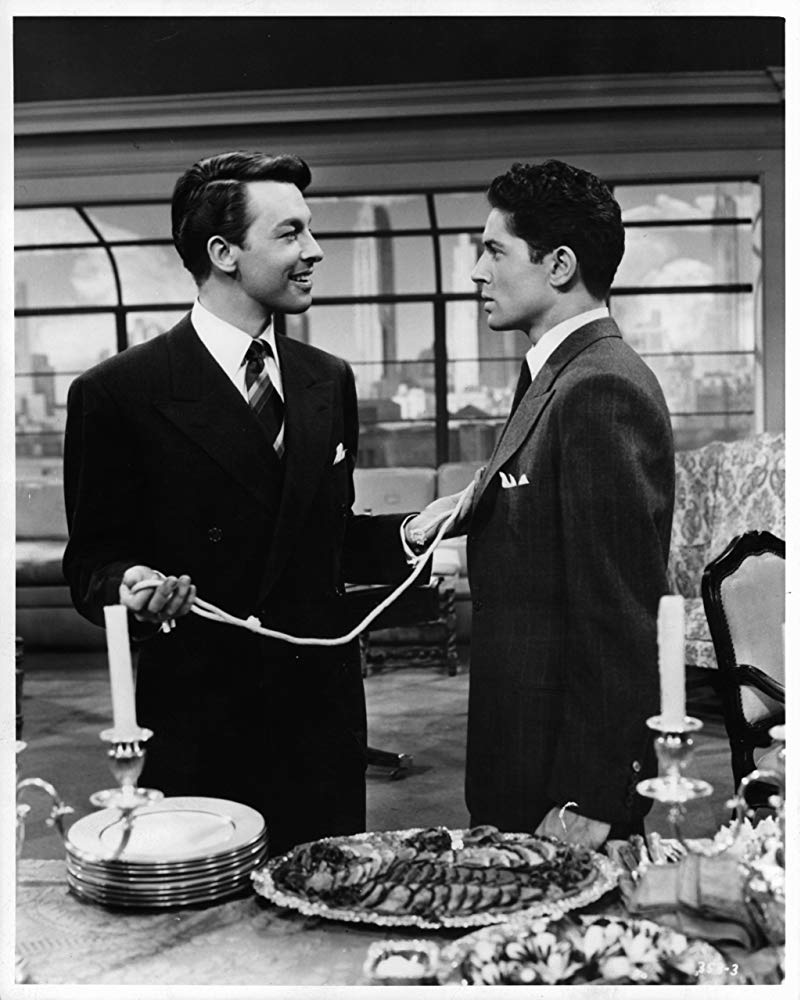
ROPE feels like a stage play which isn't surprising as it is based on a play by Patrick Hamilton called Rope's End about a real life murder committed by two University of Chicago students Nathan Leopold and Richard Loeb in 1924. But Hitchcock moves the camera, following characters down a hallway or pushing in on them during a dramatic moment or focusing on a key prop.  Hitchcock called making ROPE a "stunt." When I first saw ROPE, I wasn't that impressed but upon further review, ROPE is engaging, suspenseful, and a bit morbid.  ROPE was one of five Hitchcock films that was lost temporarily to moviegoers until 1984 when Hitchcock's daughter Patricia along with Universal Studios re-released them after a thirty year absence. ROPE is the first Hitchcock film that James Stewart would appear in (it turns out it was Stewart's least favorite of the four films he did with Hitchcock). ROPE is also the first color film that Alfred Hitchcock would make.

Despite the black and white stills, ROPE was Alfred Hitchcock's first color film. 

Actor/screenwriter Hume Cronyn adapted ROPE from the Hamilton play with Arthur Laurents writing the final screenplay.  Ironically, Cronyn had a supporting part in Hitchcock's SHADOW OF A DOUBT (1943) as a neighbor who theorizes with Teresa Wright's father about different murder cases and who the culprit might be. In reality, Cronyn adapted ROPE from a play about two murderers trying to hide their crime. Hitchcock opens ROPE with a shock. A tight close up on David Kentley (Dick Hogan) with a rope around his neck as he's strangled by two of his former classmates Brandon Shaw (John Dall) and Phillip Morgan (Farley Granger) in the middle of the afternoon in their apartment.  Brandon and Phillip should dispose of the body immediately but they hide it in an unlocked trunk in the living room. Brandon and Phillip are throwing a party later that evening. Brandon insists the trunk be used as a serving table.

Their unsuspecting house servant Mrs. Wilson (Edith Evanson) arrives soon after to prepare for the party.  The guests begin to arrive including Janet (Joan Chandler), the dead David's fiancée and her ex-boyfriend Kenneth Lawrence (Douglas Dick); David's father Mr. Kentley (Sir Cedric Hardwicke) and David's aunt Mrs. Atwater (Constance Collier), and the most important guest of all Rupert Cadell (James Stewart), a former prep school housemaster to all the young men including Brandon and Phillip. Sociopath Brandon considers the murder a work of art and the party a diabolical way to get away with it under everyone's nose.


When the guests start to wonder where David is, the tension in ROPE begins to build. The topic of murder comes up which Mr. Kentley finds morbid.  Phillip begins to show signs of cracking. This only emboldens Brandon.  He repeatedly tries to reconnect Janet with her old flame Kenneth since David has failed to show.  Mrs. Wilson reveals to Rupert that the two men have been acting strange all afternoon which arouses Rupert's curiosity. Rupert probes the two men.  It's only when Rupert accidentally discovers a hat in the closet with David's initials that he truly realizes what his two former pupils have done.

The guests all leave for the evening.  Brandon and Phillip believe they have gotten away with their perfect crime.  They plan to drive up to Connecticut that night where they will dispose of David's body. But then Rupert calls.  He has forgotten his cigarette case and asks if he can come back up to the apartment to look for it. Phillip doesn't want Rupert to come back up but Brandon relishes the opportunity.  Rupert reveals he knows what Brandon and Phillip have done.  Brandon tells Rupert the two men were inspired by Rupert's thesis about intellectual superiority and getting away with the murder of an inferior. Rupert wrestles a gun away from Phillip and calls the police. Phillip finds solace playing the piano as the three of them wait for the authorities.


ROPE is one of many Hitchcock films that has a handsome, well educated psychopath (or sociopath) committing murder. In ROPE's case, two handsome young men trying to get away with the perfect murder. From Ivor Novello in THE LODGER (1927) to Joseph Cotton in SHADOW OF A DOUBT to Robert Walker in STRANGERS ON A TRAIN (1951) and Anthony Perkins in PSYCHO (1960), these villains don't have scars or a missing eye or bad teeth. What's different with ROPE is that the two killers are homosexual (or it's implied).  I couldn't find any evidence that the real killers Leopold and Loeb were gay but Hamilton's play has a homosexual subtext with even a subplot that Rupert had an affair with one of the boys.  In 1948, the topic of homosexuality would have been too controversial to address yet Hitchcock doesn't shy away from it.  John Dall as Brandon is the more confident, brazen partner.  Farley Granger as Phillip is the weaker, more feminine one. The film doesn't imply that the two men murdered their classmate because they were gay (although their reactions after killing David are sexually charged).  The murder was to impress their former teacher Rupert.  They wanted to see if they could get away with murder, based in part on a thesis the young men had debated with Rupert on how a person with intellectual superiority could commit the perfect murder and get away with it.  Only Brandon and Phillip have twisted Rupert's hypothetical idea into a terrifying reality.

Rupert's hypothetical argument was that the privileged can murder and get away with it because they are superior.  The victims are the inferior. Rupert begins to unravel the mystery of David's absence from the party. When he confronts Brandon and Phillip and hears their rationale for the murder, Rupert realizes he's an unwitting third accomplice.  It was Rupert's musings about superiority and inferiority that sparked Brandon and Phillip to kill. The two men warped Rupert's theory, choosing to play God. In a way,  Rupert is as guilty as Brandon and Phillip. Only Rupert has a moral compass. He knows what's right and wrong.


If you are a fan of James Stewart, you remember he mostly appeared in comedies in the 30s and early 40s like DESTRY RIDES AGAIN (1939) and George Cukor's THE PHILADELPHIA STORY (1940). But when Stewart returned from World War II, he began to seek more serious roles.  Even his first film after the war Frank Capra's IT'S A WONDERFUL LIFE (1946), Stewart mixes dramatic intensity with comedy as George Bailey. In ROPE, Stewart plays his first of four conflicted characters in Hitchcock films, his best troubled performance in his last with Hitchcock VERTIGO (1958). Stewart would play psychologically challenged roles in several Westerns for director Anthony Mann as well.

Stewart does a good job early in ROPE playing curious but not too suspicious. We the audience root for Rupert since we know who the murderers already are. We need Rupert to solve it. But Rupert's uncovering the murder reveals he may have inadvertently instigated it. Early in the party, Rupert jokes that murder should be an art. "And, as such, the privilege of committing it should be reserved for those few who are really superior individuals." He's had this lively conversation with Brandon and Phillip before. In the end, he realizes they put his hypothesis to the test.  Brandon and Phillip may die in a gas chamber but Rupert will carry his role in a young man's death for the rest of his life.

The young handsome killers are played by John Dall and Farley Granger. Dall as the charismatic Brandon is the flashier role, the Alpha of the two men, a thrill seeker.  He orchestrates the murder and party with equal aplomb. He has taken Rupert's hypothetical theory about "superiority" to a grisly level. He wants to prove he can get away with murder. "Murder can be an art, too. The power to kill can be just as satisfying as the power to create," Brandon boasts to Phillip. I'd never seen Dall in a film before.  He nearly steals ROPE with his icy performance. Unfortunately, after a Best Supporting Actor Oscar nomination for THE CORN IS GREEN (1945), Dall's first film, his career never kicked off after ROPE even though he appeared in the film noir cult classic GUN CRAZY (1950) and in Stanley Kubrick's SPARTACUS (1960).


Farley Granger who plays Phillip, the weaker, more nervous of the pair would have a much more successful career after ROPE although mostly in television.  Granger would play the wronged hero Guy Haines in Hitchcock's STRANGERS ON A TRAIN (1951). Granger's Phillip is the conscience of the two killers yet he's the one who strangled their friend David. Phillip's a nervous wreck as the guests arrive and begin to wonder where's David. Phillip calms himself by playing the piano.  When Brandon recalls a story about Phillip strangling chickens on a farm, Phillip shouts, "I never strangled a chicken in my life!"  It's almost a confession from Phillip, a plea to find the body and rid him of his guilt.

Sir Cedric Hardwicke as David's father is the only well known supporting cast member. Hardwicke also appeared in Hitchcock's SUSPICION (1941) and played Ludwig Frankenstein in THE GHOST OF FRANKENSTEIN (1942). Hardwicke was knighted in 1934 (hence the Sir) and had a successful stage and film career.  Joan Chandler as Janet and Douglas Dick as ex-boyfriend Kenneth are fresh faces. Kenneth keeps joking how he's not very smart.  He's lucky he didn't end up with the rope around his neck. Constance Collier as Mrs. Atwater, David's aunt, provides the comic relief.  She provides some in-jokes when trying to remember the title of a film starring Cary Grant and Ingrid Bergman (it's Hitchcock's NOTORIOUS) or proclaiming her admiration for Cary Grant as she stands next to James Stewart (Grant's co-star in THE PHILADELPHIA STORY). Collier began acting in the silent era but her last film would be two years later with the 1950 film noir WHIRLPOOL directed by Otto Preminger. She would retire from film after that.

ROPE is Hitchcock at his most macabre.  The murder weapon, a piece of rope, is almost a character of its own. First, we see it wrapped around David's throat. After he's disposed of in the trunk, Phillip finds it hanging from the side.  Brandon twirls it as he hides it in the kitchen. But then, Brandon uses the murder weapon to tie some rare books together for Mr. Kentley, David's father. Finally, Rupert brings the rope back in view (having removed it offscreen from Mr. Kentley's books) when he accuses the two men of their crime.  Whether it be a knife, a neck tie, scissors, or rope, Hitchcock often made the murder weapon a supporting character. The dialogue by Cronyn and Laurents is very ghoulish. Rupert goes on a hypothetical rant about how murdering people will free up a table at a good restaurant or better seats at the theater. Later, Mrs. Atwater (an amateur palm reader) tells Phillip that his hands will bring him great fame. Phillip yearns to be a pianist but it's his hands that killed David. It's funny, dark stuff from the Master of Suspense.


Besides Hitchcock taking on yet another technical challenge, the real heroes of ROPE are the Operators of the Camera Movement (four in all) as well as the production design team who had to move walls silently as the camera moved during the continuous long takes. ROPE is supposed to take place in real time (80 minutes in all). Except for a few straight cuts at dramatic junctures of the film, most of the cuts happen as the camera is blocked momentarily by a character's back. It's noticeable but the technique doesn't distract the audience from the plot.

The real life murderers Leopold and Loeb would go to court in the Trial of the Century. They were represented by the legendary attorney Clarence Darrow but even he couldn't save them. Leopold and Loeb would be convicted of the kidnapping and murder of 14 year old Bobby Franks and sentenced to life in prison. The killers and murder have spawned several plays and movies besides ROPE including Richard Fleischer's COMPULSION (1959) starring Orson Welles, Dean Stockwell, and Bradford Dillman.

ROPE would not be the first film that Hitchcock made based on real life events and people.  THE WRONG MAN (1956) starring Henry Fonda is based on the real life story of an innocent man mistaken as an armed robber.  And Hitchcock's PSYCHO based on the novel by Robert Bloch, some of the events are taken from the real life serial killer Ed Gein. As interesting an exercise and engaging a film as ROPE is, it would be a failure for Hitchcock at the box office.  But like many films that failed initially with the public, ROPE'S reputation has grown over the years. It's not at the pantheon of great Hitchcock films but the second tier of entertaining near misses for the Master of Suspense.