My love for Ireland should come from the fact that my grandmother's parents were from Ireland (which makes me part Irish) or that my favorite rock band is the Irish group U2 or that St. Patrick's Day is a fun day to drink Irish beer. The truth is I have never even been to Ireland (yet!). So why do I love Ireland so much? It stems from a John Ford film I saw in my teens called THE QUIET MAN (1952). It was only later I realized that THE QUIET MAN (like many films set in Ireland) is an idealized view of the Emerald Isle and its people. Those beautiful accents and friendly folk with the rosy cheeks are as bewitching as a leprechaun's pot of gold. There are probably some mean and not so friendly people in Ireland but you would never know it watching THE QUIET MAN.
THE QUIET MAN is one of my favorite love stories on film. It reunites John Wayne and Maureen O'Hara who made such an engaging couple in Ford's RIO GRANDE (1950) and appeared in five films altogether. Wayne and O'Hara are one of the penultimate celluloid romantic couples, sparring and kissing with equal measure in THE QUIET MAN. The other interesting thing about THE QUIET MAN is it's one of John Ford's rare films set in modern times (early 20th century) and in another country. John Ford was an American director and although immigrants play a huge part in many of his films (THE GRAPES OF WRATH, THE SEARCHERS), the setting was usually in the United States. THE QUIET MAN takes place entirely in Ireland (although most interiors were shot in Hollywood) although the central plot of the film is an American returning to his ancestral Irish birth place.
A steam train (late as usual) arrives in Castletown, Ireland with a passenger from Massachusetts. American Sean Thornton (John Wayne), an ex-boxer has returned to Ireland to settle down in the tiny village of Inisfree, his birthplace. Sean's picked up by local matchmaker, bookie, and buggy driver Michaleen Oge Flynn (Barry Fitzgerald). On the way to Inisfree, he sees the house he wants to buy, the home he was born in, a white thatched cottage called White of Morn. As Flynn stops to chat with the local Catholic priest and avid fly fisherman Father Peter Lonergan (Ward Bond), Thornton catches sight of a pretty redhead herding sheep through a field. Her name is Mary Kate Danaher (Maureen O'Hara). It's love at first sight for Thornton. Mary Kate's brother Squire "Red" Will Danaher (Victor McLaglen) owns the land around the house. He has eyes for the house and the woman who currently owns it, the Widow Sarah Tillane (Midred Natwick).
Thornton visits the Widow Tillane about buying the house. Danaher storms in, matching every offer Thornton makes. Out of spite for Danaher, the Widow sells the cottage to Thornton, immediately making the Yank Thornton an enemy of Danaher. On Thornton's first night at the cottage, he catches Mary Kate cleaning up the place. As a storm brews outside, Thornton and Mary Kate have their first kiss (in a famous scene later recreated in Steven Spielberg's 1982 film E.T. THE EXTRATERRESTIAL). Thornton sends the matchmaker Flynn to ask Mary Kate for a date. When she agrees, Flynn brings Thornton the next day to court her. But according to custom, Thornton needs his nemesis Will Danaher's permission to court his sister. Not surprisingly, Danaher refuses, breaking Mary Kate's heart.
Father Lonergan, Oge Flynn, the Reverend Cyril Playfair (Arthur Shields), and his wife Mrs. Elizabeth Playfair (Eileen Crowe) spring a plan to help Thornton and Mary Kate become engaged. At the Inisfree Cup, a local horse race, Ogre Flynn and Lonergan convince Danaher that the Widow Tillane will only be interested in him once Mary Kate is out of his house. If Danaher will give his permission for Thornton to court Mary Kate, the Widow Tillane would be more inviting to Danaher's marital wishes. Only no one tells the Widow about the scheme. Thornton wins the horse race that's run partly on the beach and partly across fields. Soon after, Danaher gives his blessing to Thornton and Mary Kate. They get married. Danaher turns to ask the Widow Tillane for her hand in marriage. The Widow says no, walking away in disgust. Danaher figures out he was lied to by Father Lonergan and Oge Flynn. When Thornton professes to know nothing about the deal, Danaher hits Thornton when he's not looking.
Knocked out cold, Thornton has a flashback (economically shown by Ford in less than two minutes) revealing a secret from his past. As heavyweight fighter Trooper Thornton, he accidentally killed another boxer in the ring. Thornton retired from boxing because of the incident, vowing to never fight again. Danaher won't give Mary Kate her dowry out of spite (which includes all her family's heirlooms and 350 gold coins). Mary Kate wants Thornton to fight for her honor, her dowry. Because of his secret, Thornton won't, causing a rift in their very early marriage. Mary Kate confides to Father Lonergan that she and Thornton haven't consummated their marriage yet. Thornton talks to Reverend Playfair who figures out who Thornton is and his secret. Both religious men provide enough advice that Thornton and Mary Kate make up...briefly. The next morning, Mary Kate sneaks off to the train for Dublin, ashamed to love a man who won't fight for her honor. Thornton goes to the train station and pulls Mary Kate off the train, dragging her to her brother Danaher. The two men begin one of cinema's greatest fight scenes that involves the whole town and traverses the countryside to decide the fate of Mary Kate's dowry and each man's honor.
THE QUIET MAN may be one of the most romantic films ever made by a director not known for romance pictures. John Ford is best known for his Westerns like FORT APACHE (1948) or SHE WORE A YELLOW RIBBON (1949) and historical dramas like THE INFORMER (1935) or HOW GREEN WAS MY VALLEY (1941). Many of his films had some kind of romantic subplot but Ford found his perfect romantic protagonists with John Wayne and Maureen O'Hara in RIO GRANDE and reunited them for THE QUIET MAN. Ford equates love and passion with stormy weather, turbulent and mercurial. Thornton and Mary Kate's first physical encounter occurs in his cottage during a windstorm, the wind whistling through the home. Mary Kate's secretly trying to clean it up when Thornton surprises her. Thornton grabs her, she tries to flee, he pulls her back to him for their first kiss. No words, just actions. Later, as they court, the two love birds wander up to the local cemetery where they're caught in a rainstorm. This time it's a rain drenched kiss between Thornton and Mary Kate. I have always found windy days and rainstorms romantic ever since I saw those two scenes from THE QUIET MAN.
Ford doesn't have the lovers talk much about their love for each other. It's all in the gestures, they eyes, the postures of their bodies. A hand on a shoulder. A gentle lean against one another. Ford has fun with the censors in THE QUIET MAN. After a wedding night fight where nothing is consummated and Thornton throws Mary Kate into her big bed before sleeping in another room, Oge Flynn wanders into their room the next morning to see her bed torn apart. "Impetuous!" he mutters. When the two newlyweds do finally consummate the marriage, Thornton has a big grin on his face as he walks out of the bedroom. But his wife has run away to the train station headed for Dublin. When dealing with affairs of the heart in a John Ford film, nothing comes easy.
Religion pops up from time to time in THE QUIET MAN but Ford steers away from any political statements. The Catholics and Protestants get along fine in Inisfree. Both Mary Kate and Thornton even have confessional scenes (done outside the usual confessional) with Father Lonergan and Reverend Playfair respectively as they grapple with some early marriage crisis. A major theme both in THE QUIET MAN and John Ford's personal life is family. Thornton returns to Ireland where his family lived and he was born. Mary Kate and Will Danagher are brother and sister. Will holds her dowry over her head as ransom when he doesn't get what he wants. The entire village is one big family, looking out for each other, helping one another, going to church and celebrating weddings together. But the family ties in THE QUIET MAN are even deeper behind the film.
Director John Ford got started in the film business during the silent era because of his older brother Francis Ford who was an actor and director. Younger brother John repays the debt casting Francis as the white bearded town elder Dan Tobin in THE QUIET MAN. Ford's son in law Ken Curtis has a cameo as an Irish singer. Both Maureen O'Hara's brothers appear in the film: her brother James Lilburn plays Father Paul and other brother Charles Fitzsimons appears as solicitor Hugh Forbes. All of John Wayne's children appear in the horse race sequence (Melinda, Michael, Patrick, and Toni Wayne). Actor Barry Fitzgerald's brother Arthur Shields has a prominent role as Reverend Playfair. Victor McLaglen's son Andrew was the 2nd Assistant Director for THE QUIET MAN (and later became a director himself). Whether it was real family or Ford's family of actors who had worked for him before, Ford surrounded himself with people who knew his style and could work with him.
John Wayne and Maureen O'Hara may be the human stars of THE QUIET MAN but the real star of the film is the countryside of Ireland itself. I'm from the very green state of Oregon but when I first saw THE QUIET MAN, I was stunned by its emerald beauty. Shot beautifully by cinematographer Winton C. Hoch, the film is a travelogue of western Ireland's rolling green hills, stone walls, Irish crosses, bubbling streams, wild bays, rugged beaches, and quaint villages. In the 1950s, movies were beginning to move away from Hollywood sound stages and taking audiences to far away locations. John Huston made 1951's THE AFRICAN QUEEN (another great romantic adventure film) in Africa. Ford's film about a Welsh coal mining community HOW GREEN WAS MY VALLEY was filmed at Malibu State Park in California not Wales. For his dream project THE QUIET MAN, Ford knew he had to make the film on location in Ireland and nowhere else. It paid off.
Screenwriter Frank S. Nugent could be considered responsible (along with director Ford) for two of John Wayne's finest performances. Ford's THE SEARCHERS (1956) is one of the greatest Westerns of all time and Wayne's performance as ex-Confederate, racist Ethan Edwards is one of his most complex. Nugent wrote THE SEARCHERS and probably had a good take on Wayne's range as an actor from THE QUIET MAN (made four years earlier) also written by Nugent based on a story by Maurice Walsh. Wayne is so likable as Sean Thornton, American boy returning home to his Irish roots. It may seem like an easy role to play but Wayne brings depth to Thornton's lighter side with a shocking past (accidentally killing a fellow boxer in the ring). The darkness that comes over Wayne's face when Reverend Playfair almost guesses his former life is all played on Wayne's face. Like director Ford, Wayne knew that words weren't always necessary. Wayne was one of the best actors to convey emotion with face and eyes. Sean Thornton in THE QUIET MAN is one of Wayne's best performances right up there with his Ethan Edwards in THE SEARCHERS, Thomas Dunson in RED RIVER (1948), and Rooster Cogburn in TRUE GRIT (1969).
If John Wayne was Ford's preferred leading man, red haired Maureen O'Hara was the prototype Ford female lead. Feisty and fetching, O'Hara was every bit an equal to Wayne in THE QUIET MAN as Mary Kate Danaher. Her love scenes with Wayne are among the most romantic on film but she's tough and strong willed as well. O'Hara comes off as both beautiful and one of the guys, willing to take a swing at her husband or pull her weight with labor if needed. When Sean drags Mary Kate back from the train station, it's really O'Hara who's dragged through the fields as the town follows them. No stunt woman for her. O'Hara first worked with director Ford in HOW GREEN WAS MY VALLEY and would make four other films with him including RIO GRANDE and THE WINGS OF EAGLES (1957). Like many of my favorite films, I fell in love with Maureen O'Hara watching THE QUIET MAN hence my fondness for the film.
Two of Ford's favorite character actors have meaty parts in THE QUIET MAN. Victor McLaglen as Will Danaher in THE QUIET MAN worked with Ford early in his career appearing in Ford's THE LOST PATROL (1934) and THE INFORMER (in which McLaglen won Best Actor as an Irish informant). Will Danaher is the villain of THE QUIET MAN and yet McLaglen adroitly makes him likable. As tall and stout as John Wayne, the two actors play off each other perfectly culminating in their climactic fist fight in and around Inisfree (a fist fight that is more humorous than vicious). McLaglen actually did some boxing in his youth and fought heavyweight champion Jack Johnson in 1909.
Ward Bond who plays Father Peter Lonergan in THE QUIET MAN is another good luck charm for director Ford. Bond is one of the all time great supporting actors, appearing in hundreds of films and working with some of the best directors in the business besides Ford including John Huston, Howard Hawks, Nicholas Ray, and Frank Capra. Bond played college football with John Wayne at USC. Bond's role as Lonergan in THE QUIET MAN reminds me of Claude Rains' Inspector Dreyfus in CASABLANCA (1943). He plays it against type. In CASABLANCA, Dreyfus is the local authority in Casablanca yet he gambles and womanizes and helps the hero outwit the Nazis. In THE QUIET MAN, Bond's Lonergan is a Catholic priest who performs mass and takes confession but enjoys fishing and gambling. When his counterpart the Protestant Reverend Playfair may be reassigned from the village, Lonergan hides his collar and encourages the town to cheer for Playfair as he drives his visiting bishop out of town. Bond was a pro at playing irascible but decent characters.
Barry Fitzgerald may be the poster boy for what we think all Irishmen look and sound like with his diminutive stature and Irish brogue in THE QUIET MAN. Fitzgerald worked with Ford on HOW GREEN WAS MY VALLEY and won the Academy Award for Best Supporting Actor in Leo McCarey's GOING MY WAY (1944). But Fitzgerald will always be remembered as John Wayne's wingman aka matchmaker in THE QUIET MAN. Ford hired many Irish actors for THE QUIET MAN. One that stands out is Jack MacGowran (who looks like Ray Bolger) memorable in only his second film role as Will Danaher's right hand man Ignatius Feeney. MacGowran would have a long career appearing in everything from Tony Richardson's TOM JONES (1963) to William Friedkin's THE EXORCIST (1973). Mildred Natwick who plays the Widow Sarah Tillane in THE QUIET MAN also had a decades long career. She appeared in two previous Ford films THE LONG VOYAGE HOME (1940) and 3 GODFATHERS (1948). One of Natwick's final roles would be opposite John Malkovich and Uma Thurman in Stephen Frears DANGEROUS LIAISONS (1988).
I just rewatched RIO GRANDE which John Ford had to make before he could make THE QUIET MAN. Both films were made under the Republic Pictures banner, produced by Ford and his partner Merian C. Cooper who gave Ford lots of artistic freedom. RIO GRANDE and THE QUIET MAN couldn't be more night and day yet both films are magnificent examples of Ford's artistry. RIO GRANDE is shot in black and white in the dusty landscape of Moab, Utah. THE QUIET MAN is shot in glorious Technicolor on location in the very verdant west of Ireland. RIO GRANDE is the third and last of Ford's Cavalry trilogy featuring the U.S. Army fighting Indians in the U.S. West. THE QUIET MAN is a one off romantic comedy that every studio turned down before Republic Pictures President Herbert J. Yates said yes. John Wayne and Maureen O'Hara are the leads in both films. In RIO GRANDE, Wayne and O'Hara play an estranged husband and wife trying to reconcile during an Indian War. In THE QUIET MAN, they're two stubborn single adults who fall in love at first sight despite the rules of courting in Ireland. In many films, you'll find actors playing the same type of character over and over. Wayne and O'Hara are completely different in RIO GRANDE than they are in THE QUIET MAN. It's a testament to how good of actors they both were and John Ford's direction.
THE QUIET MAN would lead me on my cinematic Irish odyssey over the years as I sought out other films made in Ireland. Gillies MacKinnon's THE PLAYBOYS (1992), John Sayles THE SECRET OF ROAN INISH (1994), and Neil Jordan's ONDINE (2009) are just a few of the journeys I have taken to Ireland via film (yes I still need to watch David Lean's 1970 RYAN'S DAUGHTER also shot in Ireland). But no film has captured my heart for Ireland like THE QUIET MAN. I will eventually travel to the Emerald Isle and hopefully experience some QUIET MAN wind and rainstorms as I meet the locals and toast a dark Guinness to them. THE QUIET MAN ends with several short two and three shots of the Irish supporting actors in the film, Ford's final ode to Ireland's inhabitants. As Wayne and O'Hara wave goodbye, I feel sad waving goodbye to them...until the next time I sit and enjoy THE QUIET MAN.
Sunday, December 1, 2019
Sunday, October 20, 2019
Psycho (1960)
There is a brief scene in Alfred Hitchcock's PSYCHO (1960) that sums up the genius of the director. It's one of my favorite moments of a film that has many spectacular set pieces. It's not the infamous shower scene. It's just a simple sequence that captures the mood and tone of PSYCHO. Sam Loomis and Lila Crane are waiting at Sam's hardware store for the return of private detective Arbogast from the Bates Motel. All three are looking for Lila's sister Marion Crane who has uncharacteristically stolen forty thousand dollars and disappeared. When Arbogast does not return, Sam decides to go investigate. Lila follows Sam outside. As Sam exits the shot, Lila stands in the darkness, several garden rakes displayed behind her like giant claws ready to grab her. The camera pushes in. Lila's face becomes visible just as an ominous wind picks up and blows at her hair. That one scene sums up the dread and tension that Alfred Hitchcock has created in PSYCHO.
My first attempt to watch PSYCHO was a Friday night in the basement of my childhood home as a kid. The basement felt a bit like the Bates fruit cellar. I sat in chair just like Mrs. Bates with my back to the stairs although I was lucky to have a black and white television to stare at. I hated my basement. It was scary and dark. Needless to say, I never made it through the entire film. It would be a few years later when I went with my aunt to the Guild Theater in Portland during one of its Alfred Hitchcock Film Festivals that I finally saw PSYCHO with an audience from beginning to end. The power and suspense that PSYCHO held over the audience twenty plus years later was impressive.
The 1950s was Alfred Hitchcock at his most creative. STRANGERS ON A TRAIN (1951) kick started his decade but Hitchcock hit a stretch of critical success with some of the biggest stars appearing in some of his best films all in wonderful Technicolor. REAR WINDOW (1954), TO CATCH A THIEF (1955), a remake of THE MAN WHO KNEW TOO MUCH (1956), VERTIGO (1958), and NORTH BY NORTHWEST (1959). So who would have guessed to start off the 60s Hitchcock would eschew that streak to make PSYCHO as his next film. Hitchcock had a deal with Paramount but they weren't thrilled about the project so Hitch filmed it at Universal. Hitchcock shot it in black and white. He used his television crew from ALFRED HITCHCOCK PRESENTS to make it except for editor George Tomasini and composer Bernard Herrmann. The screenplay was by Joseph Stefano (a television writer) based on the Robert Bloch novel. There were no big stars like Cary Grant or Grace Kelly in it. Just solid actors like Janet Leigh and Martin Balsam, up and coming newcomer Anthony Perkins, and an array of TV character actors in supporting roles. After one of the greatest film runs by a director in many years, had Alfred Hitchcock gone psycho?
The answer is a resounding NO! PSYCHO is a masterpiece, Hitchcock's crowning achievement in a career of achievements. His camera placement and movement, his use of editing in the infamous shower scene montage, Bernard Herrmann's musical score which is a masterpiece in itself, and screenwriter Joseph Stefano's dialogue which reveals subtext and nuance far above most films are stunning. What no one could have predicted is that PSYCHO would be Hitchcock's truly last great film (some might argue THE BIRDS for that honor but I'm sticking with PSYCHO).
PSYCHO begins on a sunny afternoon in Phoenix, Arizona. Marion Crane (Janet Leigh) has a secret lunch time rendezvous with her lover Sam Loomis (John Gavin) at a downtown motel. Loomis is struggling to run his hardware store in the small town of Fairvale while still paying alimony to his ex-wife. Marion is tired of the secret liaisons. They both dream of tying the knot and living happily ever after. Marion returns to her bank job where her boss George Lowery (Vaughn Taylor) has just closed a loan deal with oil businessman Tom Cassidy (Frank Albertson). Mr. Lowery asks Marion to deposit Cassidy's forty thousand dollars in cash at the bank. Marion makes the rash decision to steal the forty thousand. She packs her suitcase and heads out of Phoenix, presumably to visit her down on his luck boyfriend Sam.
Marion falls asleep on the side of the road. She's awakened by a suspicious Highway Patrol Officer (Mort Mills) who follows her for awhile. Marion trades in her car for a used car, buying the vehicle with cash from used car dealer California Charlie (John Anderson). Marion drives on until darkness and rain force her to stop at the out of the way Bates Motel. The motel proprietor, a shy young man named Norman Bates (Anthony Perkins) helps Marion check in. Norman lives in an old Victorian house behind the motel with his invalid mother. After some sandwiches and talk in Norman's motel parlor, Marion realizes she's made a mistake. She excuses herself to go shower and prepare for an early departure back to Phoenix to return the stolen money. But as Marion showers, she is brutally murdered, apparently by Norman's mother.
Norman returns to the motel to find Marion dead. He cleans up the blood and disposes of Marion's body and car in a nearby swamp (never realizing she had forty thousand dollars on her). Lila Crane (Vera Miles), Marion's sister, arrives at Sam's hardware store in Fairvale, looking for Marion. A private detective Milton Arbogast (Martin Balsam) also shows up, looking for her missing sister. Arbogast questions motel owners around town before stopping at the Bates Motel. He talks to Norman who acts a bit suspicious. Arbogast reports back to Lila and Sam that he's discovered Marion did stop at the Bates Motel. Arbogast returns to the motel. Arbogast wanders inside the old house to question Norman's mother. The detective encounters Mrs. Bates at the top of the stairwell and meets a vicious death.
Frustrated when Arbogast doesn't return, Sam and Lila visit Sheriff Al Chambers (John McIntire) and his wife (Lurene Tuttle) with their concerns. When Sam mentions that Arbogast wanted to talk to Norman's mother, the Sheriff reveals that Norman's mother died ten years ago in a murder/suicide. The Sheriff visits Norman (off screen) and returns to report no sign of Arbogast, Marion, or the mother. Sam and Lila decide to investigate, driving out to the Bates Motel posing as newlyweds. While Sam distracts Norman with small talk, Lila sneaks up to the house to question Mrs. Bates. Lila goes upstairs before hiding down in the fruit cellar when Norman comes racing back to the house. Sitting in a chair, her back to Lila is Mrs. Bates. In one of the most terrifying Hitchcock finales ever, the killer is revealed (no spoilers here!) in the cellar. During a brief epilogue at the Fairvale police station, a psychiatrist Dr. Richman (Simon Oakland) reveals the killer's motive after talking to the murderer in their cell.
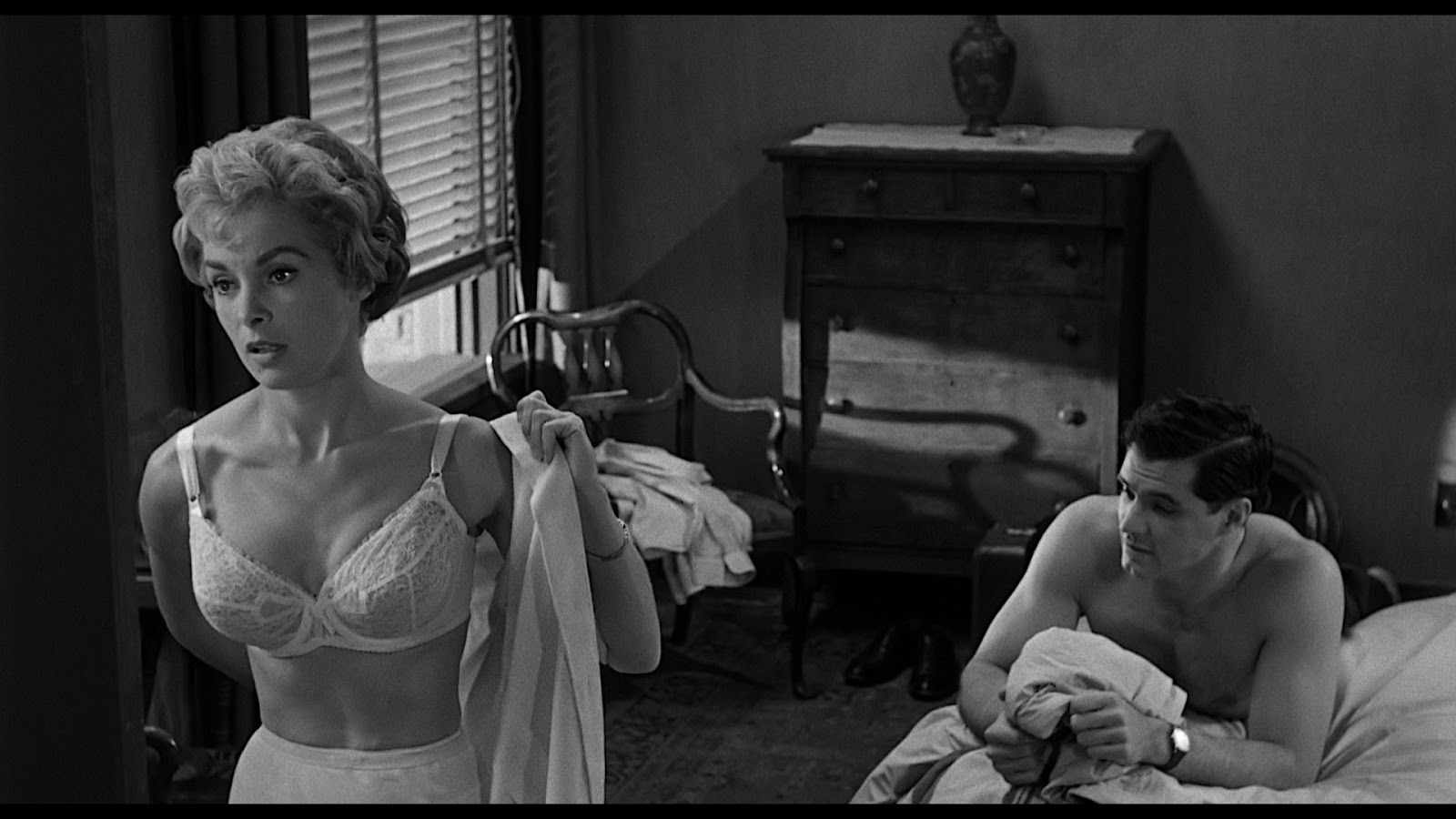
There is so much more to PSYCHO'S plot that I'd love to reveal but I don't want to spoil the joy of watching the film. PSYCHO is such a different film (especially from Hitchcock) than we had ever seen before. PSYCHO starts out like a film noir with Marion embezzling forty thousand dollars from her employer to start a new life with her hard working but struggling boyfriend Sam. Hitchcock even shows Janet Leigh in a white bra (good girl) early in the film during her afternoon tryst with Sam but when she decides to keep the money herself, she's wearing a black bra (bad girl). PSYCHO switches into a horror film when Marion is murdered halfway through the film seemingly by Norman's sick old mother. PSYCHO throws convention entirely out the window, serving up one red herring after another.
We think the film is about greed. Marion steals the money. Then, she has a change of heart. Before she can drive back to Phoenix and return the money, she's murdered. We just lost our heroine, the character we could relate to in her situation. Norman returns to the motel to find her body. He disposes of the body and the money (Norman never realizes it's wrapped up in a newspaper). When Norman disposes of the body and car in the swamp, the car momentarily stops sinking. Will Norman be caught? The car finally sinks and we're relieved. For a moment, we've switched our alliance to Norman. Then, we have new characters to identify with. Sam, Lila, and Detective Arbogast. PSYCHO becomes a mystery film. Who murdered Marion? Arbogast seems confident and smart. He'll solve it, he's a private detective, confident and direct. But Arbogast is also murdered by Norman's mother. All bets are off. This film is PSYCHO with its different film personalities.
PSYCHO is also the mother of all mother films. Mothers have played important roles in many of Hitchcock's films. NOTORIOUS (1946) had a manipulative Leopoldine Konstantin controlling her son Claude Rains life. In STRANGERS ON A TRAIN, the killer Robert Walker has an overbearing mother (Marion Lorne). Girlfriend Grace Kelly acted like a mother to a disabled James Stewart in REAR WINDOW. And Jessie Royce Landis played humorous mothers in two Hitchcock film TO CATCH A THIEF and NORTH BY NORTHWEST. There is nothing humorous about Norman Bates mother in PSYCHO. We hear Mrs. Bates berate Norman when he asks if Marion can join them for dinner. While eating dinner in Norman's parlor, Marion asks if Norman has any friends. "A boy's best friend is his mother," Norman replies. Norman Bates is a mama's boy (in more ways than one). As we will learn, Norman and his mother had a very unique relationship.
With Hitchcock in total artistic control of PSYCHO, Hitchcock and Stefano go wild with motifs and symbolism and repeating themes. Bird imagery is a very prominent symbol in PSYCHO. The lead character Marion's last name is Crane (a long legged bird). Norman Bates (as played by Anthony Perkins) looks like a bird with his angular body and long neck. Norman's mannerisms are bird-like whether he's picking at candy corn or twisting his neck to read the motel register. Norman's hobby is taxidermy and his parlor boasts several stuffed birds like an owl and a crow that menacingly dominate the room. Bird paintings hang in the motel room (I believe one of the birds shown is a flycatcher which snatches its insect prey out of the air). An English slang word for woman is bird. Norman even comments that Marion "eats like a bird" as they share dinner together. All this bird symbolism may have subconsciously led Hitchcock to choose THE BIRDS (1963) as his next film after PSYCHO.
Mirrors are another motif that Hitchcock utilizes in PSYCHO to represent split personalities, the duality of a person. Marion Crane encounters mirrors numerous times, sometimes side by side, other times looking into them from an angle. At the motel with Sam, in the ladies room at the car dealership, or at the check in desk at the Bates Motel, her dual images reflect her good and dark side. Should she sneak around cheap motels with her boyfriend Sam or come out in the public and get married? Should she steal the oil man Cassidy's money or return it to Mr. Lowery and face the consequences? Marion and Lila Crane are two sides of a coin. Marion's the troubled one; Lila the more practical sister. And we know there's a split personality between Norman Bates and his mother, a love/hate relationship or something more sinister. We hear them argue up in the old house. Yet Norman defends his mother to Marion and ends up cleaning up her mess when Mother murders Marion. "She isn't quite herself today," Norman will tell Marion before Marion finds out for herself.
Voyeurism emerges as a central theme in PSYCHO as well. The film opens with Hitchcock's camera scanning the Phoenix skyline before it moves toward a series of windows of a hotel, choosing to peer into one room which happens to have Sam and Marion in it. The camera could have chosen any room and we would have followed the story of any occupant but we follow Marion's story. Hitchcock has turned us into voyeurs right at the outset of PSYCHO. Later, when Norman peers at Marion undressing before she showers, we again become voyeurs like Norman, watching, staring through the same peep hole Norman uses. Watching movies is a form of voyeurism as we spend two hours observing someone else's life.
PSYCHO was groundbreaking in more ways than audiences might imagine, smashing several taboos when it was released. Yes the shower scene broke new ground with its violence, blood, and partial nudity (Hitchcock's expert editing makes you think you see more than you actually do). The opening scene with the two lovers in bed, Janet Leigh in her bra and panties and John Gavin shirtless, after they've made love during her lunch break is daring, truthful, and realistic. No separate beds for these two lovers. The most surprising and funny taboo broken in PSYCHO would appear to be the most harmless. PSYCHO'S most shocking shot is a flushing toilet. After Janet Leigh writes some numbers on a piece of paper, she rips the paper up and flushes it down the toilet. Never had a movie shown a flushing toilet until Hitchcock pulled it off.
There are very few films I can think of that have so many groundbreaking shots and visuals not to mention set pieces as PSYCHO contains. The best and most famous is the shower scene which took Hitchcock seven days to film and involved 70 camera set ups, shot stunningly by director of photography John L. Russell based on Saul Bass's storyboards. It's the perfect blend of editing, sound, and photography. Highlights include the shot looking directly into the shower head, water falling on either side of the camera and the incredible dissolve from the blood cascading into the bathtub drain to Marion's lifeless eye. Not to be outdone, Arbogast's murder, not as long as Marion's, involves a tracking shot up the stairs that turns into a crane shot, the camera becoming God's view looking down at the detective in his final moments. Arbogast's death is equally brutal and Hitchcock follows his fall down the stairs before Mrs. Bates finishes him off.
Those are the big set pieces but it's even the smaller details that astonish. The side close up of Norman peering at Marion through a makeshift peep hole, a small shaft of light shining into his eye. Lila Crane discovering Mrs. Bates in the fruit cellar, screaming at what she finds, her hand striking a single hanging light bulb, causing it to sway back and forth, the light and shadows swaying back and forth across Mrs. Bates' face. The almost death mask on Marion's face as she imagines Cassidy's anger over her theft as she drives in the rain and darkness.
Two of the best scenes in PSYCHO don't involve intricate cutting or fancy camerawork. They are just dialogue scenes that reveal depth about each character, masterfully written by Stefano. The first one is when Marion and Norman eat sandwiches in his parlor. Hitchcock composes the frame perfectly then lets the two characters talk, revealing little nuggets about each other (with those stuffed birds observing silently). "We all go a little mad sometimes, " Norman tells Marion. "Haven't you?" The other scene is when Arbogast questions Norman if Marion stayed at the hotel. It's a classic cat and mouse game between detective and suspect, acted brilliantly by Perkins and Balsam. "She might have fooled me but she didn't fool my mother," Norman tells Arbogast, sending the detective unknowingly to his doom later.
Anthony Perkins had just broken into film in William Wyler's FRIENDLY PERSUASION (1956) after appearing in several television omnibus dramatic shows. He would play real life baseball player Jim Piersall in Robert Mulligan's FEAR STRIKES OUT (1957). Piersall battled mental illness and Perkins performance may have caught Hitchcock's eye for the mentally questionable Norman Bates in PSYCHO. Bates is the role Perkins will forever be remembered for. It's a tour de force as Perkins bounces between shy young man, mama's boy, and accomplice to his "mother's" vicious attacks on Marion and Arbogast. Perkins appeared in many more films and television projects in his career but he would return as Norman Bates in Richard Franklin's PSYCHO II in 1983 along with Vera Miles reprising her role as Lila Crane. As much as I hate that they made a sequel to PSYCHO, PSYCHO II was a loving extension to the original. Perkins would direct and star in the third in the series PSYCHO III (1988) and appear one last time as Norman Bates in a TV movie PSYCHO IV: THE BEGINNING. Ultimately, there should never have been any sequels but Universal (and perhaps audiences) wanted to see more of Perkins incredible acting as Norman Bates.
Following in the footsteps of Madeleine Carroll, Grace Kelly, Kim Novak, Eve Marie Saint, and Tippy Hedren, Janet Leigh would play another of Hitchcock's blonde heroines as Marion Crane in PSYCHO. I never realized how much I'm in love with Janet Leigh in PSYCHO. Hitchcock makes us fall in love with Leigh's Marion, all her neuroses and frailties, as we follow her descent into darkness before she realizes her error in judgment. Just when we think she's going be alright, Hitchcock snatches Leigh away from us, killing the major star in the middle of the film, breaking our hearts. Leigh was never a huge star but she did work steadily and with some fantastic directors in great films including Anthony Mann's THE NAKED SPUR (1953) with James Stewart, Orson Welles TOUCH OF EVIL (1958) with Charlton Heston, and John Frankenheimer's THE MANCHURIAN CANDIDATE (1963) with Frank Sinatra.
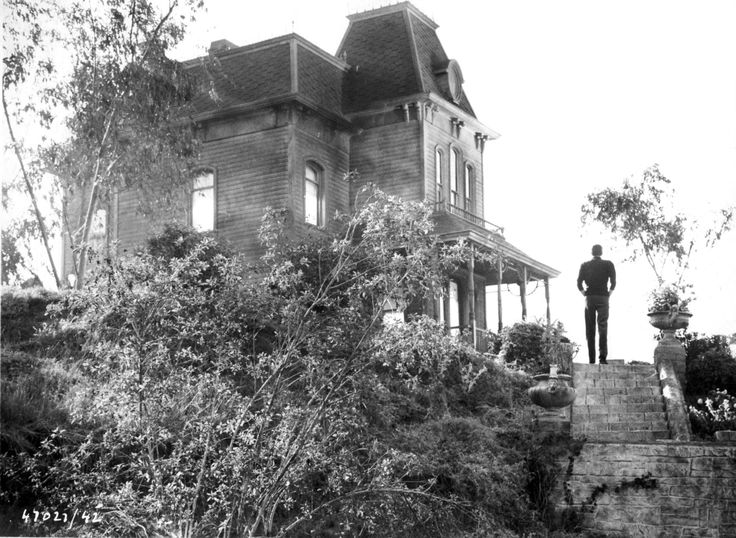
The biggest star of PSYCHO is not the actors or even Hitchcock but the Bates Motel and the gothic Victorian house behind it. Hitchcock makes the structures visually interesting with the motel a horizontal line and the house rising behind it a vertical line. The house is supposed to be California Victorian from the late 19th or early 20th century. The house is a living, breathing character, a domicile of evil, the outer shell of the mostly unseen Mrs. Bates. We do see Mrs. Bates from the motel, either sitting or walking past an upstairs window but only her silhouette. Today, any person just has to see the outline of the house to know it's the PSYCHO house. Tourists can see the PSYCHO house when they take the Universal Studios tour. It's probably the biggest star on the Universal back lot.
PSYCHO'S supporting cast is fantastic as well. Hitchcock liked using Broadway actors for supporting roles in his films and he cast Martin Balsam as the dogged Detective Milton Arbogast, hot on the trail of Marion Crane. Balsam isn't on screen for very long but he makes a lasting impression with his scenes. Other Balsam films include Sidney Lumet's 12 ANGRY MEN (1957) and Alan J. Pakula's ALL THE PRESIDENT'S MEN (1976). Two of the more undervalued actors in PSYCHO who I think are essential to its success are Vera Miles as Marion's sister Lila and John Gavin as Lila's boyfriend Sam Loomis. After Marion is murdered, the audience has no one to root for at first. As Lila and Sam take up the search for Marion, we join their quest and wish them success. Lila is no slouch. She wants answers and pushes both Sam and Arbogast to find her sister. Miles was supposed to star in Hitchcock's VERTIGO but became pregnant before the film. Reports are Hitchcock never forgave her. Check out Miles in John Ford's THE SEARCHERS (1956) and THE MAN WHO SHOT LIBERTY VALANCE (1962).
Handsome John Gavin has the thankless role of Marion's boyfriend Sam. There's something All-American about Gavin as Sam. Yes, he's paying alimony to his ex-wife and living in the back of his hardware store. But he's found the real love of his life this time in Marion. He even flies down to Phoenix from Fairvale for afternoon trysts with her. Like Marion, Sam is a sympathetic character we can relate to. Gavin would also appear as Julius Caesar in Stanley Kubrick's SPARTACUS in 1960. Gavin eventually became Ambassador to Mexico in 1981 serving for five years during the Reagan presidency. As I mentioned, Hitchcock regularly used Broadway actors for supporting roles (think Thelma Ritter in REAR WINDOW). Just as Hitchcock used his television crew to make PSYCHO, Hitch used television actors to play the remaining roles. Vaughn Taylor as Mr. Lowery, Mort Mills as the Highway Patrol Officer, and John McIntire as Sheriff Chambers were familiar faces on television including spots on ALFRED HITCHCOCK PRESENTS. Simon Oakland (WEST SIDE STORY) as the psychiatrist Dr. Richman would be the most recognizable of the smaller roles. And look for Hitchcock's daughter Patricia Hitchcock (STRANGERS ON A TRAIN) who plays Marion's co-worker Caroline.
When horror writer Robert Bloch wrote Psycho inspired by the real life 1957 Wisconsin serial killer Ed Gein, he never would have imagined that his story of a middle-aged, rotund serial killer would be turned into worldwide phenomena that is Alfred Hitchcock's PSYCHO. Those screeching violins from Bernard Herrmann in the infamous shower scene are recognized and used worldwide in movies, television, and commercials today. In a stroke of genius, horror filmmaker John Carpenter would cast Janet Leigh's daughter Jamie Lee Curtis in a rebirth of the slasher thriller HALLOWEEN (1978) that was a homage to PSYCHO but carried the torch for future psychopathic thrillers. Carpenter would even cast mother and daughter together in his horror film THE FOG (1980). Film director Gus Van Sant, more known for his artsy dramatic films, even attempted to remake shot by shot PSYCHO (1998) starring Vince Vaughn and Anne Heche. It's a daring idea but some classics should never be remade and PSYCHO is one of those films for me.
Hitchcock would turn his back on the bright lights and big stars that gave him his greatest success throughout the 50s to make a modest budgeted (for him), black and white thriller. The world of cinema would forever be changed with the release of PSYCHO. Just as 1960 began a new decade, PSYCHO seemed to usher in a new reality for film. Sex and violence would no longer be censored like it was in the past. Hitchcock broke the barrier, showing taboo subjects more realistically but not gratuitously. Copy cat films would soon follow like Robert Aldrich's WHATEVER HAPPENED TO BABY JANE? (1962) and PARANOIAC (1963) but there will always be just one PSYCHO (I'm already not counting Van Sant's effort or the sequels). Hitchcock would make five more films after PSYCHO but he would never quite achieve its success again. But moviegoers like me are thankful that he took a chance on a small, personal project in 1960 and unleashed PSYCHO to the public. Cue the screeching violins.
My first attempt to watch PSYCHO was a Friday night in the basement of my childhood home as a kid. The basement felt a bit like the Bates fruit cellar. I sat in chair just like Mrs. Bates with my back to the stairs although I was lucky to have a black and white television to stare at. I hated my basement. It was scary and dark. Needless to say, I never made it through the entire film. It would be a few years later when I went with my aunt to the Guild Theater in Portland during one of its Alfred Hitchcock Film Festivals that I finally saw PSYCHO with an audience from beginning to end. The power and suspense that PSYCHO held over the audience twenty plus years later was impressive.
The 1950s was Alfred Hitchcock at his most creative. STRANGERS ON A TRAIN (1951) kick started his decade but Hitchcock hit a stretch of critical success with some of the biggest stars appearing in some of his best films all in wonderful Technicolor. REAR WINDOW (1954), TO CATCH A THIEF (1955), a remake of THE MAN WHO KNEW TOO MUCH (1956), VERTIGO (1958), and NORTH BY NORTHWEST (1959). So who would have guessed to start off the 60s Hitchcock would eschew that streak to make PSYCHO as his next film. Hitchcock had a deal with Paramount but they weren't thrilled about the project so Hitch filmed it at Universal. Hitchcock shot it in black and white. He used his television crew from ALFRED HITCHCOCK PRESENTS to make it except for editor George Tomasini and composer Bernard Herrmann. The screenplay was by Joseph Stefano (a television writer) based on the Robert Bloch novel. There were no big stars like Cary Grant or Grace Kelly in it. Just solid actors like Janet Leigh and Martin Balsam, up and coming newcomer Anthony Perkins, and an array of TV character actors in supporting roles. After one of the greatest film runs by a director in many years, had Alfred Hitchcock gone psycho?
The answer is a resounding NO! PSYCHO is a masterpiece, Hitchcock's crowning achievement in a career of achievements. His camera placement and movement, his use of editing in the infamous shower scene montage, Bernard Herrmann's musical score which is a masterpiece in itself, and screenwriter Joseph Stefano's dialogue which reveals subtext and nuance far above most films are stunning. What no one could have predicted is that PSYCHO would be Hitchcock's truly last great film (some might argue THE BIRDS for that honor but I'm sticking with PSYCHO).
PSYCHO begins on a sunny afternoon in Phoenix, Arizona. Marion Crane (Janet Leigh) has a secret lunch time rendezvous with her lover Sam Loomis (John Gavin) at a downtown motel. Loomis is struggling to run his hardware store in the small town of Fairvale while still paying alimony to his ex-wife. Marion is tired of the secret liaisons. They both dream of tying the knot and living happily ever after. Marion returns to her bank job where her boss George Lowery (Vaughn Taylor) has just closed a loan deal with oil businessman Tom Cassidy (Frank Albertson). Mr. Lowery asks Marion to deposit Cassidy's forty thousand dollars in cash at the bank. Marion makes the rash decision to steal the forty thousand. She packs her suitcase and heads out of Phoenix, presumably to visit her down on his luck boyfriend Sam.
Marion falls asleep on the side of the road. She's awakened by a suspicious Highway Patrol Officer (Mort Mills) who follows her for awhile. Marion trades in her car for a used car, buying the vehicle with cash from used car dealer California Charlie (John Anderson). Marion drives on until darkness and rain force her to stop at the out of the way Bates Motel. The motel proprietor, a shy young man named Norman Bates (Anthony Perkins) helps Marion check in. Norman lives in an old Victorian house behind the motel with his invalid mother. After some sandwiches and talk in Norman's motel parlor, Marion realizes she's made a mistake. She excuses herself to go shower and prepare for an early departure back to Phoenix to return the stolen money. But as Marion showers, she is brutally murdered, apparently by Norman's mother.
Norman returns to the motel to find Marion dead. He cleans up the blood and disposes of Marion's body and car in a nearby swamp (never realizing she had forty thousand dollars on her). Lila Crane (Vera Miles), Marion's sister, arrives at Sam's hardware store in Fairvale, looking for Marion. A private detective Milton Arbogast (Martin Balsam) also shows up, looking for her missing sister. Arbogast questions motel owners around town before stopping at the Bates Motel. He talks to Norman who acts a bit suspicious. Arbogast reports back to Lila and Sam that he's discovered Marion did stop at the Bates Motel. Arbogast returns to the motel. Arbogast wanders inside the old house to question Norman's mother. The detective encounters Mrs. Bates at the top of the stairwell and meets a vicious death.
Frustrated when Arbogast doesn't return, Sam and Lila visit Sheriff Al Chambers (John McIntire) and his wife (Lurene Tuttle) with their concerns. When Sam mentions that Arbogast wanted to talk to Norman's mother, the Sheriff reveals that Norman's mother died ten years ago in a murder/suicide. The Sheriff visits Norman (off screen) and returns to report no sign of Arbogast, Marion, or the mother. Sam and Lila decide to investigate, driving out to the Bates Motel posing as newlyweds. While Sam distracts Norman with small talk, Lila sneaks up to the house to question Mrs. Bates. Lila goes upstairs before hiding down in the fruit cellar when Norman comes racing back to the house. Sitting in a chair, her back to Lila is Mrs. Bates. In one of the most terrifying Hitchcock finales ever, the killer is revealed (no spoilers here!) in the cellar. During a brief epilogue at the Fairvale police station, a psychiatrist Dr. Richman (Simon Oakland) reveals the killer's motive after talking to the murderer in their cell.
There is so much more to PSYCHO'S plot that I'd love to reveal but I don't want to spoil the joy of watching the film. PSYCHO is such a different film (especially from Hitchcock) than we had ever seen before. PSYCHO starts out like a film noir with Marion embezzling forty thousand dollars from her employer to start a new life with her hard working but struggling boyfriend Sam. Hitchcock even shows Janet Leigh in a white bra (good girl) early in the film during her afternoon tryst with Sam but when she decides to keep the money herself, she's wearing a black bra (bad girl). PSYCHO switches into a horror film when Marion is murdered halfway through the film seemingly by Norman's sick old mother. PSYCHO throws convention entirely out the window, serving up one red herring after another.
We think the film is about greed. Marion steals the money. Then, she has a change of heart. Before she can drive back to Phoenix and return the money, she's murdered. We just lost our heroine, the character we could relate to in her situation. Norman returns to the motel to find her body. He disposes of the body and the money (Norman never realizes it's wrapped up in a newspaper). When Norman disposes of the body and car in the swamp, the car momentarily stops sinking. Will Norman be caught? The car finally sinks and we're relieved. For a moment, we've switched our alliance to Norman. Then, we have new characters to identify with. Sam, Lila, and Detective Arbogast. PSYCHO becomes a mystery film. Who murdered Marion? Arbogast seems confident and smart. He'll solve it, he's a private detective, confident and direct. But Arbogast is also murdered by Norman's mother. All bets are off. This film is PSYCHO with its different film personalities.
PSYCHO is also the mother of all mother films. Mothers have played important roles in many of Hitchcock's films. NOTORIOUS (1946) had a manipulative Leopoldine Konstantin controlling her son Claude Rains life. In STRANGERS ON A TRAIN, the killer Robert Walker has an overbearing mother (Marion Lorne). Girlfriend Grace Kelly acted like a mother to a disabled James Stewart in REAR WINDOW. And Jessie Royce Landis played humorous mothers in two Hitchcock film TO CATCH A THIEF and NORTH BY NORTHWEST. There is nothing humorous about Norman Bates mother in PSYCHO. We hear Mrs. Bates berate Norman when he asks if Marion can join them for dinner. While eating dinner in Norman's parlor, Marion asks if Norman has any friends. "A boy's best friend is his mother," Norman replies. Norman Bates is a mama's boy (in more ways than one). As we will learn, Norman and his mother had a very unique relationship.
With Hitchcock in total artistic control of PSYCHO, Hitchcock and Stefano go wild with motifs and symbolism and repeating themes. Bird imagery is a very prominent symbol in PSYCHO. The lead character Marion's last name is Crane (a long legged bird). Norman Bates (as played by Anthony Perkins) looks like a bird with his angular body and long neck. Norman's mannerisms are bird-like whether he's picking at candy corn or twisting his neck to read the motel register. Norman's hobby is taxidermy and his parlor boasts several stuffed birds like an owl and a crow that menacingly dominate the room. Bird paintings hang in the motel room (I believe one of the birds shown is a flycatcher which snatches its insect prey out of the air). An English slang word for woman is bird. Norman even comments that Marion "eats like a bird" as they share dinner together. All this bird symbolism may have subconsciously led Hitchcock to choose THE BIRDS (1963) as his next film after PSYCHO.
Mirrors are another motif that Hitchcock utilizes in PSYCHO to represent split personalities, the duality of a person. Marion Crane encounters mirrors numerous times, sometimes side by side, other times looking into them from an angle. At the motel with Sam, in the ladies room at the car dealership, or at the check in desk at the Bates Motel, her dual images reflect her good and dark side. Should she sneak around cheap motels with her boyfriend Sam or come out in the public and get married? Should she steal the oil man Cassidy's money or return it to Mr. Lowery and face the consequences? Marion and Lila Crane are two sides of a coin. Marion's the troubled one; Lila the more practical sister. And we know there's a split personality between Norman Bates and his mother, a love/hate relationship or something more sinister. We hear them argue up in the old house. Yet Norman defends his mother to Marion and ends up cleaning up her mess when Mother murders Marion. "She isn't quite herself today," Norman will tell Marion before Marion finds out for herself.
Voyeurism emerges as a central theme in PSYCHO as well. The film opens with Hitchcock's camera scanning the Phoenix skyline before it moves toward a series of windows of a hotel, choosing to peer into one room which happens to have Sam and Marion in it. The camera could have chosen any room and we would have followed the story of any occupant but we follow Marion's story. Hitchcock has turned us into voyeurs right at the outset of PSYCHO. Later, when Norman peers at Marion undressing before she showers, we again become voyeurs like Norman, watching, staring through the same peep hole Norman uses. Watching movies is a form of voyeurism as we spend two hours observing someone else's life.
PSYCHO was groundbreaking in more ways than audiences might imagine, smashing several taboos when it was released. Yes the shower scene broke new ground with its violence, blood, and partial nudity (Hitchcock's expert editing makes you think you see more than you actually do). The opening scene with the two lovers in bed, Janet Leigh in her bra and panties and John Gavin shirtless, after they've made love during her lunch break is daring, truthful, and realistic. No separate beds for these two lovers. The most surprising and funny taboo broken in PSYCHO would appear to be the most harmless. PSYCHO'S most shocking shot is a flushing toilet. After Janet Leigh writes some numbers on a piece of paper, she rips the paper up and flushes it down the toilet. Never had a movie shown a flushing toilet until Hitchcock pulled it off.
There are very few films I can think of that have so many groundbreaking shots and visuals not to mention set pieces as PSYCHO contains. The best and most famous is the shower scene which took Hitchcock seven days to film and involved 70 camera set ups, shot stunningly by director of photography John L. Russell based on Saul Bass's storyboards. It's the perfect blend of editing, sound, and photography. Highlights include the shot looking directly into the shower head, water falling on either side of the camera and the incredible dissolve from the blood cascading into the bathtub drain to Marion's lifeless eye. Not to be outdone, Arbogast's murder, not as long as Marion's, involves a tracking shot up the stairs that turns into a crane shot, the camera becoming God's view looking down at the detective in his final moments. Arbogast's death is equally brutal and Hitchcock follows his fall down the stairs before Mrs. Bates finishes him off.
Those are the big set pieces but it's even the smaller details that astonish. The side close up of Norman peering at Marion through a makeshift peep hole, a small shaft of light shining into his eye. Lila Crane discovering Mrs. Bates in the fruit cellar, screaming at what she finds, her hand striking a single hanging light bulb, causing it to sway back and forth, the light and shadows swaying back and forth across Mrs. Bates' face. The almost death mask on Marion's face as she imagines Cassidy's anger over her theft as she drives in the rain and darkness.
Two of the best scenes in PSYCHO don't involve intricate cutting or fancy camerawork. They are just dialogue scenes that reveal depth about each character, masterfully written by Stefano. The first one is when Marion and Norman eat sandwiches in his parlor. Hitchcock composes the frame perfectly then lets the two characters talk, revealing little nuggets about each other (with those stuffed birds observing silently). "We all go a little mad sometimes, " Norman tells Marion. "Haven't you?" The other scene is when Arbogast questions Norman if Marion stayed at the hotel. It's a classic cat and mouse game between detective and suspect, acted brilliantly by Perkins and Balsam. "She might have fooled me but she didn't fool my mother," Norman tells Arbogast, sending the detective unknowingly to his doom later.
Anthony Perkins had just broken into film in William Wyler's FRIENDLY PERSUASION (1956) after appearing in several television omnibus dramatic shows. He would play real life baseball player Jim Piersall in Robert Mulligan's FEAR STRIKES OUT (1957). Piersall battled mental illness and Perkins performance may have caught Hitchcock's eye for the mentally questionable Norman Bates in PSYCHO. Bates is the role Perkins will forever be remembered for. It's a tour de force as Perkins bounces between shy young man, mama's boy, and accomplice to his "mother's" vicious attacks on Marion and Arbogast. Perkins appeared in many more films and television projects in his career but he would return as Norman Bates in Richard Franklin's PSYCHO II in 1983 along with Vera Miles reprising her role as Lila Crane. As much as I hate that they made a sequel to PSYCHO, PSYCHO II was a loving extension to the original. Perkins would direct and star in the third in the series PSYCHO III (1988) and appear one last time as Norman Bates in a TV movie PSYCHO IV: THE BEGINNING. Ultimately, there should never have been any sequels but Universal (and perhaps audiences) wanted to see more of Perkins incredible acting as Norman Bates.
Following in the footsteps of Madeleine Carroll, Grace Kelly, Kim Novak, Eve Marie Saint, and Tippy Hedren, Janet Leigh would play another of Hitchcock's blonde heroines as Marion Crane in PSYCHO. I never realized how much I'm in love with Janet Leigh in PSYCHO. Hitchcock makes us fall in love with Leigh's Marion, all her neuroses and frailties, as we follow her descent into darkness before she realizes her error in judgment. Just when we think she's going be alright, Hitchcock snatches Leigh away from us, killing the major star in the middle of the film, breaking our hearts. Leigh was never a huge star but she did work steadily and with some fantastic directors in great films including Anthony Mann's THE NAKED SPUR (1953) with James Stewart, Orson Welles TOUCH OF EVIL (1958) with Charlton Heston, and John Frankenheimer's THE MANCHURIAN CANDIDATE (1963) with Frank Sinatra.
The biggest star of PSYCHO is not the actors or even Hitchcock but the Bates Motel and the gothic Victorian house behind it. Hitchcock makes the structures visually interesting with the motel a horizontal line and the house rising behind it a vertical line. The house is supposed to be California Victorian from the late 19th or early 20th century. The house is a living, breathing character, a domicile of evil, the outer shell of the mostly unseen Mrs. Bates. We do see Mrs. Bates from the motel, either sitting or walking past an upstairs window but only her silhouette. Today, any person just has to see the outline of the house to know it's the PSYCHO house. Tourists can see the PSYCHO house when they take the Universal Studios tour. It's probably the biggest star on the Universal back lot.
PSYCHO'S supporting cast is fantastic as well. Hitchcock liked using Broadway actors for supporting roles in his films and he cast Martin Balsam as the dogged Detective Milton Arbogast, hot on the trail of Marion Crane. Balsam isn't on screen for very long but he makes a lasting impression with his scenes. Other Balsam films include Sidney Lumet's 12 ANGRY MEN (1957) and Alan J. Pakula's ALL THE PRESIDENT'S MEN (1976). Two of the more undervalued actors in PSYCHO who I think are essential to its success are Vera Miles as Marion's sister Lila and John Gavin as Lila's boyfriend Sam Loomis. After Marion is murdered, the audience has no one to root for at first. As Lila and Sam take up the search for Marion, we join their quest and wish them success. Lila is no slouch. She wants answers and pushes both Sam and Arbogast to find her sister. Miles was supposed to star in Hitchcock's VERTIGO but became pregnant before the film. Reports are Hitchcock never forgave her. Check out Miles in John Ford's THE SEARCHERS (1956) and THE MAN WHO SHOT LIBERTY VALANCE (1962).
Handsome John Gavin has the thankless role of Marion's boyfriend Sam. There's something All-American about Gavin as Sam. Yes, he's paying alimony to his ex-wife and living in the back of his hardware store. But he's found the real love of his life this time in Marion. He even flies down to Phoenix from Fairvale for afternoon trysts with her. Like Marion, Sam is a sympathetic character we can relate to. Gavin would also appear as Julius Caesar in Stanley Kubrick's SPARTACUS in 1960. Gavin eventually became Ambassador to Mexico in 1981 serving for five years during the Reagan presidency. As I mentioned, Hitchcock regularly used Broadway actors for supporting roles (think Thelma Ritter in REAR WINDOW). Just as Hitchcock used his television crew to make PSYCHO, Hitch used television actors to play the remaining roles. Vaughn Taylor as Mr. Lowery, Mort Mills as the Highway Patrol Officer, and John McIntire as Sheriff Chambers were familiar faces on television including spots on ALFRED HITCHCOCK PRESENTS. Simon Oakland (WEST SIDE STORY) as the psychiatrist Dr. Richman would be the most recognizable of the smaller roles. And look for Hitchcock's daughter Patricia Hitchcock (STRANGERS ON A TRAIN) who plays Marion's co-worker Caroline.
When horror writer Robert Bloch wrote Psycho inspired by the real life 1957 Wisconsin serial killer Ed Gein, he never would have imagined that his story of a middle-aged, rotund serial killer would be turned into worldwide phenomena that is Alfred Hitchcock's PSYCHO. Those screeching violins from Bernard Herrmann in the infamous shower scene are recognized and used worldwide in movies, television, and commercials today. In a stroke of genius, horror filmmaker John Carpenter would cast Janet Leigh's daughter Jamie Lee Curtis in a rebirth of the slasher thriller HALLOWEEN (1978) that was a homage to PSYCHO but carried the torch for future psychopathic thrillers. Carpenter would even cast mother and daughter together in his horror film THE FOG (1980). Film director Gus Van Sant, more known for his artsy dramatic films, even attempted to remake shot by shot PSYCHO (1998) starring Vince Vaughn and Anne Heche. It's a daring idea but some classics should never be remade and PSYCHO is one of those films for me.
Hitchcock would turn his back on the bright lights and big stars that gave him his greatest success throughout the 50s to make a modest budgeted (for him), black and white thriller. The world of cinema would forever be changed with the release of PSYCHO. Just as 1960 began a new decade, PSYCHO seemed to usher in a new reality for film. Sex and violence would no longer be censored like it was in the past. Hitchcock broke the barrier, showing taboo subjects more realistically but not gratuitously. Copy cat films would soon follow like Robert Aldrich's WHATEVER HAPPENED TO BABY JANE? (1962) and PARANOIAC (1963) but there will always be just one PSYCHO (I'm already not counting Van Sant's effort or the sequels). Hitchcock would make five more films after PSYCHO but he would never quite achieve its success again. But moviegoers like me are thankful that he took a chance on a small, personal project in 1960 and unleashed PSYCHO to the public. Cue the screeching violins.
Sunday, September 29, 2019
Live and Let Die (1973)
"You got to give the other fella hell!" Paul McCartney and Wings on Live and Let Die.
What is the greatest movie title theme song of all time, a song that may be more famous than the film itself? Some may argue for Stanley Donen's SINGING IN THE RAIN (1952) sung by Gene Kelly or Sydney Pollack's THE WAY WE WERE (1973) sung by Barbara Streisand or Gordon Parks' SHAFT (1971) sung by Isaac Hayes. For CrazyFilmGuy, my vote goes to Paul McCartney and Wings for LIVE AND LET DIE (1971) the title song for the 8th film in the James Bond series. It's high marks for McCartney and company as the Bond series has had some great theme songs: Shirley Bassey belting out GOLDFINGER (1964) or later Carly Simon singing Nobody Does It Better (from 1977's THE SPY WHO LOVED ME).
Besides a rocking theme song from the former Beatle and his new band at the time, LIVE AND LET DIE is an interesting bridge for the James Bond series. It's the first appearance by Roger Moore as James Bond after seven appearances by Sean Connery and one appearance by George Lazenby. It brings back the team of director Guy Hamilton and screenwriter Tom Mankiewicz who breathed some new life into the franchise with the previous DIAMONDS ARE FOREVER (1971). LIVE AND LET DIE is a grittier Bond film, influenced by the blaxploitation films of the 70s like SHAFT and Gordon Parks SUPER FLY (1972) as well as William Friedkin's THE FRENCH CONNECTION (1971). The fate of the world is not at stake in LIVE AND LET DIE but the villain's diabolical plot is more topical and realistic than some previous Bond plot lines.
The murders of three British agents at the United Nations in New York, New Orleans, and the Caribbean island of San Monique (actually Jamaica) all have connections to a foreign diplomat from San Monique named Dr. Kananga (Yaphet Kotto) accompanied by his tarot card reading mistress Solitaire (Jane Seymour in her first feature film). James Bond (Roger Moore) is ordered by M (Bernard Lee) to fly to New York to investigate. Working with CIA Agent Felix Leiter (this time played by THE FLY'S David Hedison), Bond has barely landed in New York when he's almost killed by the heavyset Whisper (Earl Jolly Brown). A lead takes him to a restaurant in Harlem called Fillet of Soul where local crime lord Mr. Big (also Yaphet Kotto) orders Bond killed. Bond manages to thwart his would be killers with some assistance from Leiter's operative Strutter (Lon Satton). Kananga and Solitaire return to San Monique and Bond's on the next flight to the tropical island in pursuit.
Bond teams up with rookie CIA Agent Rosie Carver (Gloria Hendry) to learn what Kananga with the support of voodoo entertainer Baron Samedi (Geoffrey Holder) are protecting on the island. An upside down Queen of Cups card reveals to Bond that Rosie's a double agent working for Kananga. Rosie's killed by Kananga while trying to flee Bond. Bond hires a boat captained by Quarrel Jr (Roy Stewart) to take a look at Solitaire's cliffside mansion. Later that night, Bond hang glides into the compound. He tricks Solitaire into believing via the tarot cards that they're destined to be lovers. With her virginity gone, Solitaire fears she has lost her clairvoyant powers. Bond with Solitaire in tow discover what Kananga is hiding on the island: poppy fields that can be converted into heroin. After a harrowing chase involving Kananga's gun toting men and a double-decker bus, Bond and Solitaire return to Quarrel Jr's boat and catch a plane to New Orleans to follow the trail.
Once again, Kananga's men are waiting for Bond in New Orleans including Kananga's toughest assassin Tee Hee (Julius W. Harris) complete with artificial arm and claw. Kananga reveals to Bond his plans to flood U.S. cities with free heroin to drive out his competitors then jack up the price when all the addicts need more. Kananga sends Bond off to the Farm -- an alligator farm and location of his heroin processing plant. Tee Hee leaves Bond to be eaten by gators but once again, 007 manages to survive. Bond burns the heroin factory and hijacks a speed boat where he's chased by Kananga's goons on the water and pursued by a local Louisiana sheriff J.W. Pepper (Clifton James) on land in the film's penultimate action sequence.
Felix Leiter manages to pluck Bond away from the local authorities after he eludes Kananga's death squad. Kananga escapes and takes Solitiare back to San Miguel. Baron Samedi hosts a voodoo ritual with Solitaire as the intended sacrifice. Bond blows up the poppy fields and rescues Solitaire. They discover Kananga's underground lair in a nearby cemetery. Kananga, Tee Hee, and Whisper await the British agent. Bond and Kananga have their final confrontation as sharks (a favorite device for Bond villains) swim in a nearby pool to devour the loser.
LIVE AND LET DIE is a daring film in the James Bond canon and not just because of its amazing stunts. Besides Roger Moore, Jane Seymour, and David Hedison, the majority of the cast are black, not a common sight in big commercial productions. The Black Panthers and racial tensions were still fresh in America's psyche from the late 60s. But the blaxploitation film movement was emerging in the early 70s. The Bond filmmakers do not flinch with this direction of the series. Bond has an interracial love scene with his black CIA operative Rosie Carver that was still fairly taboo at the time. The main villain Dr. Kananga/Mr. Big is black. Kananga's right hand (or I should say claw) man is tall, bald, grinning, and black. Kananga's minions are black. The majority of extras in New Orleans and Jamaica and Harlem are black. Geoffrey Holder who plays Baron Samedi is also the movie's choreographer. He's black. And most importantly, producers Albert "Cubby" Broccoli and Harry Saltzman hired the Black Stuntman's Association to perform a great deal of the film's stunts because of the large black cast (for years, movies had to use white stuntmen made up to look black for stunts involving black actors as there were no black stunt men and women in the movie business). Unlike the real world, LIVE AND LET DIE doesn't judge whether your white or black. In the Bond world, you're either on the good side or the megalomaniac bad side.
LIVE AND LET DIE is the classic fish out of water scenario and the results are wonderful. Watching the suave Englishman Bond out of his element in Harlem and the bayous of Louisiana is pure bliss. Bond stands out like a sore thumb whether he's having a drink in an all black Fillet of Soul bar or tangling with alligators on the bayou. Bond doesn't blink an eye that he's the only white guy clamoring around a burnt out ghetto. To Bond, it's perfectly normal to drive a speed boat across a Louisiana highway. "What are you? Some kinda doomsday machine, boy?" red neck Sheriff J.W. Pepper screams at Bond. The humor in LIVE AND LET DIE comes from many of these situations.
Roger Moore was a different look for James Bond after audiences had become comfortable with Sean Connery. Even one hit wonder George Lazenby who played Bond in ON HER MAJESTY'S SECRET SERVICE (1969) looked a bit like Connery with his jet black hair. Moore had sandy brown hair. Moore's more urbane than Connery who had a blue collar undercurrent to him. The filmmakers try to steer Moore away from becoming a carbon copy of Connery's Bond. Moore does not order the same cocktails that Connery did. There are no requests for martinis shaken not stirred. Moore's Bond favors cigars. Although some fans may disagree, I find Moore a bit more cold-hearted than Connery when it came to dealing with hitmen or traitorous women like Rosie. But Moore could turn on the charm and make a quip to ease the tension just as fast.
Producers Broccoli and Saltzman originally offered the role of Bond to Roger Moore back in the early 60s but Moore was busy with TVs THE SAINT from 1962 to 1969. Connery accepted and the rest is history. When Connery said he was done with Bond after YOU ONLY LIVE TWICE (1967), Moore was again offered the role for ON HER MAJESTY'S SECRET SERVICE but he still wasn't available and Lazenby stepped in for his one shot. Ironically, Moore did play James Bond for a comedy skit on a British TV show called MAINLY MILLICENT starring Millicent Martin in 1964 (you can view it on the LIVE AND LET DIE Special Features DVD). Moore finally free by 1973 and accepted the LIVE AND LET DIE offer. The producers had found their next Bond. Moore would make seven films as James Bond from 1973 to 1985. I like four of the Moore Bond films very much but by the end of his run as Bond in A VIEW TO A KILL (1985), Moore and the series began to look old and tired.
Besides a breath of fresh air with new Bond Roger Moore, new screenwriter Tom Mankiewicz (DIAMONDS ARE FOREVER) also brought some interesting ideas and humor to the series taking over for stalwart screenwriter Richard Maibaum who had been involved with most of the Connery films. Mankiewicz liked taking Bond in a new direction with LIVE AND LET DIE'S plot and new locations (Harlem, New Orleans). But Hamilton and Mankiewicz show reverence for previous Bond films. LIVE AND LET DIE is a return to Jamaica where DR. NO (1962) was filmed. And the character of Quarrel Jr in LIVE AND LET DIE also a references DR. NO as Quarrel Sr helped Bond locate Dr. No's hideout before meeting a fiery demise. Mankiewicz's brings back the multiple endings that he used in DIAMONDS ARE FOREVER and first appeared in FROM RUSSIA WITH LOVE (1963). After Kananga's demise, Bond and Solitaire hop on a train for some R&R. This should be the end of the film but Tee Hee climbs on board. Bond and Tee Hee battle inside the train compartment (shades of Bond and Red Grant in FROM RUSSIA WITH LOVE). Once Tee Hee's dispatched, the final credits roll.
Director Guy Hamilton had directed probably the best Bond film with GOLDFINGER (1964) and his steady hand and understanding of all things Bond helped guide the series in the early 70s with DIAMONDS ARE FOREVER, LIVE AND LET DIE, and THE MAN WITH THE GOLDEN GUN (1974). With all its humor, LIVE AND LET DIE has a brutality to it. Kananga orders Tee Hee to snap Bond's fingers off if Solitaire's premonitions are wrong in one scene. And Rosie Carver is just a pawn to both Bond and Kananga, her death a tragic casualty in the spy game. If there is one sour discord, it's that the Bond gadgets are a little weak in LIVE AND LET DIE. Q the gadget man (normally Desmond Llewelyn) is no where to be found.
Lately, the Bond filmmakers have chosen Academy Award winning actors to play the arch villain such as Javier Bardem in SKYFALL and Christoph Waltz in SPECTRE. With LIVE AND LET DIE, they cast a relatively unknown black actor named Yaphet Kotto as Dr. Kananga/Mr. Big. When you think about it, how many well known black actors were there in the early 70s except for Sidney Poitier? Born in New York (of Cameroon descent), Kotto brings an authenticity to Kananga/Mr. Big. He's refined and cultured as diplomat Kananga and gritty and streetwise as alter ego drug kingpin Mr. Big. Kotto would have a good run in the late 70s appearing in Paul Schrader's BLUE COLLAR (1978) and Ridley Scott's ALIEN (1979).
Kotto and many of the other black actors in the film would also appear in some of the blaxploitation films that were the rage in the early 70s and influenced LIVE AND LET DIE. Kotto starred in TRUCK TURNER (1974) starring Isaac Hayes as a bounty hunter. Bond love interest Gloria Hendry would star in BLACK CAESAR (1973) with Fred Williamson and SLAUGHTER'S BIG RIP OFF (also 1973) with Jim Brown. Lastly, Julius W. Harris who played Tee Hee in LIVE AND LET DIE appeared in SHAFT'S BIG SCORE! (1972) with Richard Roundtree and SUPER FLY with Ron O'Neal. Geoffrey Holder who plays Kananga's voodoo ally Baron Samedi did not appear in any black exploitation films. Holder was a renowned choreographer from Trinidad and Tobago. Most Americans might remember Holder for his deep baritone laugh when he was the spokesman for the soft drink 7-Up.
Like Kotto, Jane Seymour was a relative newcomer when she was cast as Kananga's seductive soothsayer Solitaire. And like Kotto, she turned her Bond girl role into a long successful career with films like Jeannot Szwarc's SOMEWHERE IN TIME (1980) and the TV series DR. QUINN, MEDICINE WOMAN (1993 to 1998). Solitaire in an interesting Bond girl. She's a virgin, kept that way by Kananga to harness her fortune telling powers, who's seduced (naturally) by Bond. Solitaire's alliances waiver between Kananga and Bond throughout the film. Seymour is lovely and makes Solitaire a sympathetic, vulnerable young Bond Girl.
Seymour almost steals the film with her beauty but the real scene stealer is Clifton James as Sheriff J.W. Pepper (Geoffrey Holder's Baron Samedi is a close second). James is only in the film for about ten minutes but he chews up his scenes like a bulldog. Pepper gives us the first honest impression of what someone who's not a secret agent, an assassin, or a super villain experiences when they come into contact with James Bond. He's apoplectic. James (who's not even a southerner) appeared in Stuart Rosenberg's COOL HAND LUKE (1967). He made such an impression with fans and the Producers that he actually has a small cameo in Bond's next film THE MAN WITH THE GOLDEN GUN (1974) as J.W. Pepper again, this time on vacation in Thailand.
A shout out to David Hedison as CIA agent Felix Leiter. Hedison was familiar to audiences from the horror classic THE FLY (1958) and TVs VOYAGE TO THE BOTTOM OF THE SEA (1964 to 1968). A good friend of Roger Moore, Hedison is the only actor to play Felix Leiter twice, the second time in LICENCE TO KILL (1989) with Timothy Dalton playing James Bond.
LIVE AND LET DIE has a Beatles connection. Paul McCartney and Wings sing the title song of LIVE AND LET DIE. Beatles record producer George Martin composed the score for the film (which might explain McCartney's involvement). Martin was an integral part in producing and shaping many of the Beatles singles and albums in the 60s. In LIVE AND LET DIE, Martin often uses pieces of the theme song in other scenes like the double-decker bus chase or as a bridge from one scene to another. A black lounge singer (Brenda Arnau) even sings Live and Let Die as Bond and Felix sit in a New Orleans Fillet of Soul lounge.
LIVE AND LET DIE ushered in a new dawn for the James Bond series. It's the debut for Roger Moore as the world's most famous secret agent 007 James Bond as he took over for the widely popular Sean Connery. It completely turns the franchise on its head with a grittier plot and casting a large array of black actors in a big commercial film. It raises the bar on stunts for future films with its incredible speed boat chase that's part on water; part on asphalt. LIVE AND LET DIE could have all gone horribly wrong and finished the series. Producers Albert Broccoli and Harry Saltzman knew what they were doing, trusting veteran Bond director Guy Hamilton and new Bond screenwriter Tom Mankiewicz to lead the series into the future. Bond has never looked back since.
What is the greatest movie title theme song of all time, a song that may be more famous than the film itself? Some may argue for Stanley Donen's SINGING IN THE RAIN (1952) sung by Gene Kelly or Sydney Pollack's THE WAY WE WERE (1973) sung by Barbara Streisand or Gordon Parks' SHAFT (1971) sung by Isaac Hayes. For CrazyFilmGuy, my vote goes to Paul McCartney and Wings for LIVE AND LET DIE (1971) the title song for the 8th film in the James Bond series. It's high marks for McCartney and company as the Bond series has had some great theme songs: Shirley Bassey belting out GOLDFINGER (1964) or later Carly Simon singing Nobody Does It Better (from 1977's THE SPY WHO LOVED ME).
Besides a rocking theme song from the former Beatle and his new band at the time, LIVE AND LET DIE is an interesting bridge for the James Bond series. It's the first appearance by Roger Moore as James Bond after seven appearances by Sean Connery and one appearance by George Lazenby. It brings back the team of director Guy Hamilton and screenwriter Tom Mankiewicz who breathed some new life into the franchise with the previous DIAMONDS ARE FOREVER (1971). LIVE AND LET DIE is a grittier Bond film, influenced by the blaxploitation films of the 70s like SHAFT and Gordon Parks SUPER FLY (1972) as well as William Friedkin's THE FRENCH CONNECTION (1971). The fate of the world is not at stake in LIVE AND LET DIE but the villain's diabolical plot is more topical and realistic than some previous Bond plot lines.
The murders of three British agents at the United Nations in New York, New Orleans, and the Caribbean island of San Monique (actually Jamaica) all have connections to a foreign diplomat from San Monique named Dr. Kananga (Yaphet Kotto) accompanied by his tarot card reading mistress Solitaire (Jane Seymour in her first feature film). James Bond (Roger Moore) is ordered by M (Bernard Lee) to fly to New York to investigate. Working with CIA Agent Felix Leiter (this time played by THE FLY'S David Hedison), Bond has barely landed in New York when he's almost killed by the heavyset Whisper (Earl Jolly Brown). A lead takes him to a restaurant in Harlem called Fillet of Soul where local crime lord Mr. Big (also Yaphet Kotto) orders Bond killed. Bond manages to thwart his would be killers with some assistance from Leiter's operative Strutter (Lon Satton). Kananga and Solitaire return to San Monique and Bond's on the next flight to the tropical island in pursuit.
Bond teams up with rookie CIA Agent Rosie Carver (Gloria Hendry) to learn what Kananga with the support of voodoo entertainer Baron Samedi (Geoffrey Holder) are protecting on the island. An upside down Queen of Cups card reveals to Bond that Rosie's a double agent working for Kananga. Rosie's killed by Kananga while trying to flee Bond. Bond hires a boat captained by Quarrel Jr (Roy Stewart) to take a look at Solitaire's cliffside mansion. Later that night, Bond hang glides into the compound. He tricks Solitaire into believing via the tarot cards that they're destined to be lovers. With her virginity gone, Solitaire fears she has lost her clairvoyant powers. Bond with Solitaire in tow discover what Kananga is hiding on the island: poppy fields that can be converted into heroin. After a harrowing chase involving Kananga's gun toting men and a double-decker bus, Bond and Solitaire return to Quarrel Jr's boat and catch a plane to New Orleans to follow the trail.
Once again, Kananga's men are waiting for Bond in New Orleans including Kananga's toughest assassin Tee Hee (Julius W. Harris) complete with artificial arm and claw. Kananga reveals to Bond his plans to flood U.S. cities with free heroin to drive out his competitors then jack up the price when all the addicts need more. Kananga sends Bond off to the Farm -- an alligator farm and location of his heroin processing plant. Tee Hee leaves Bond to be eaten by gators but once again, 007 manages to survive. Bond burns the heroin factory and hijacks a speed boat where he's chased by Kananga's goons on the water and pursued by a local Louisiana sheriff J.W. Pepper (Clifton James) on land in the film's penultimate action sequence.
Felix Leiter manages to pluck Bond away from the local authorities after he eludes Kananga's death squad. Kananga escapes and takes Solitiare back to San Miguel. Baron Samedi hosts a voodoo ritual with Solitaire as the intended sacrifice. Bond blows up the poppy fields and rescues Solitaire. They discover Kananga's underground lair in a nearby cemetery. Kananga, Tee Hee, and Whisper await the British agent. Bond and Kananga have their final confrontation as sharks (a favorite device for Bond villains) swim in a nearby pool to devour the loser.
LIVE AND LET DIE is a daring film in the James Bond canon and not just because of its amazing stunts. Besides Roger Moore, Jane Seymour, and David Hedison, the majority of the cast are black, not a common sight in big commercial productions. The Black Panthers and racial tensions were still fresh in America's psyche from the late 60s. But the blaxploitation film movement was emerging in the early 70s. The Bond filmmakers do not flinch with this direction of the series. Bond has an interracial love scene with his black CIA operative Rosie Carver that was still fairly taboo at the time. The main villain Dr. Kananga/Mr. Big is black. Kananga's right hand (or I should say claw) man is tall, bald, grinning, and black. Kananga's minions are black. The majority of extras in New Orleans and Jamaica and Harlem are black. Geoffrey Holder who plays Baron Samedi is also the movie's choreographer. He's black. And most importantly, producers Albert "Cubby" Broccoli and Harry Saltzman hired the Black Stuntman's Association to perform a great deal of the film's stunts because of the large black cast (for years, movies had to use white stuntmen made up to look black for stunts involving black actors as there were no black stunt men and women in the movie business). Unlike the real world, LIVE AND LET DIE doesn't judge whether your white or black. In the Bond world, you're either on the good side or the megalomaniac bad side.
LIVE AND LET DIE is the classic fish out of water scenario and the results are wonderful. Watching the suave Englishman Bond out of his element in Harlem and the bayous of Louisiana is pure bliss. Bond stands out like a sore thumb whether he's having a drink in an all black Fillet of Soul bar or tangling with alligators on the bayou. Bond doesn't blink an eye that he's the only white guy clamoring around a burnt out ghetto. To Bond, it's perfectly normal to drive a speed boat across a Louisiana highway. "What are you? Some kinda doomsday machine, boy?" red neck Sheriff J.W. Pepper screams at Bond. The humor in LIVE AND LET DIE comes from many of these situations.
Roger Moore was a different look for James Bond after audiences had become comfortable with Sean Connery. Even one hit wonder George Lazenby who played Bond in ON HER MAJESTY'S SECRET SERVICE (1969) looked a bit like Connery with his jet black hair. Moore had sandy brown hair. Moore's more urbane than Connery who had a blue collar undercurrent to him. The filmmakers try to steer Moore away from becoming a carbon copy of Connery's Bond. Moore does not order the same cocktails that Connery did. There are no requests for martinis shaken not stirred. Moore's Bond favors cigars. Although some fans may disagree, I find Moore a bit more cold-hearted than Connery when it came to dealing with hitmen or traitorous women like Rosie. But Moore could turn on the charm and make a quip to ease the tension just as fast.
Producers Broccoli and Saltzman originally offered the role of Bond to Roger Moore back in the early 60s but Moore was busy with TVs THE SAINT from 1962 to 1969. Connery accepted and the rest is history. When Connery said he was done with Bond after YOU ONLY LIVE TWICE (1967), Moore was again offered the role for ON HER MAJESTY'S SECRET SERVICE but he still wasn't available and Lazenby stepped in for his one shot. Ironically, Moore did play James Bond for a comedy skit on a British TV show called MAINLY MILLICENT starring Millicent Martin in 1964 (you can view it on the LIVE AND LET DIE Special Features DVD). Moore finally free by 1973 and accepted the LIVE AND LET DIE offer. The producers had found their next Bond. Moore would make seven films as James Bond from 1973 to 1985. I like four of the Moore Bond films very much but by the end of his run as Bond in A VIEW TO A KILL (1985), Moore and the series began to look old and tired.
Besides a breath of fresh air with new Bond Roger Moore, new screenwriter Tom Mankiewicz (DIAMONDS ARE FOREVER) also brought some interesting ideas and humor to the series taking over for stalwart screenwriter Richard Maibaum who had been involved with most of the Connery films. Mankiewicz liked taking Bond in a new direction with LIVE AND LET DIE'S plot and new locations (Harlem, New Orleans). But Hamilton and Mankiewicz show reverence for previous Bond films. LIVE AND LET DIE is a return to Jamaica where DR. NO (1962) was filmed. And the character of Quarrel Jr in LIVE AND LET DIE also a references DR. NO as Quarrel Sr helped Bond locate Dr. No's hideout before meeting a fiery demise. Mankiewicz's brings back the multiple endings that he used in DIAMONDS ARE FOREVER and first appeared in FROM RUSSIA WITH LOVE (1963). After Kananga's demise, Bond and Solitaire hop on a train for some R&R. This should be the end of the film but Tee Hee climbs on board. Bond and Tee Hee battle inside the train compartment (shades of Bond and Red Grant in FROM RUSSIA WITH LOVE). Once Tee Hee's dispatched, the final credits roll.
Director Guy Hamilton had directed probably the best Bond film with GOLDFINGER (1964) and his steady hand and understanding of all things Bond helped guide the series in the early 70s with DIAMONDS ARE FOREVER, LIVE AND LET DIE, and THE MAN WITH THE GOLDEN GUN (1974). With all its humor, LIVE AND LET DIE has a brutality to it. Kananga orders Tee Hee to snap Bond's fingers off if Solitaire's premonitions are wrong in one scene. And Rosie Carver is just a pawn to both Bond and Kananga, her death a tragic casualty in the spy game. If there is one sour discord, it's that the Bond gadgets are a little weak in LIVE AND LET DIE. Q the gadget man (normally Desmond Llewelyn) is no where to be found.
Lately, the Bond filmmakers have chosen Academy Award winning actors to play the arch villain such as Javier Bardem in SKYFALL and Christoph Waltz in SPECTRE. With LIVE AND LET DIE, they cast a relatively unknown black actor named Yaphet Kotto as Dr. Kananga/Mr. Big. When you think about it, how many well known black actors were there in the early 70s except for Sidney Poitier? Born in New York (of Cameroon descent), Kotto brings an authenticity to Kananga/Mr. Big. He's refined and cultured as diplomat Kananga and gritty and streetwise as alter ego drug kingpin Mr. Big. Kotto would have a good run in the late 70s appearing in Paul Schrader's BLUE COLLAR (1978) and Ridley Scott's ALIEN (1979).
Kotto and many of the other black actors in the film would also appear in some of the blaxploitation films that were the rage in the early 70s and influenced LIVE AND LET DIE. Kotto starred in TRUCK TURNER (1974) starring Isaac Hayes as a bounty hunter. Bond love interest Gloria Hendry would star in BLACK CAESAR (1973) with Fred Williamson and SLAUGHTER'S BIG RIP OFF (also 1973) with Jim Brown. Lastly, Julius W. Harris who played Tee Hee in LIVE AND LET DIE appeared in SHAFT'S BIG SCORE! (1972) with Richard Roundtree and SUPER FLY with Ron O'Neal. Geoffrey Holder who plays Kananga's voodoo ally Baron Samedi did not appear in any black exploitation films. Holder was a renowned choreographer from Trinidad and Tobago. Most Americans might remember Holder for his deep baritone laugh when he was the spokesman for the soft drink 7-Up.
Like Kotto, Jane Seymour was a relative newcomer when she was cast as Kananga's seductive soothsayer Solitaire. And like Kotto, she turned her Bond girl role into a long successful career with films like Jeannot Szwarc's SOMEWHERE IN TIME (1980) and the TV series DR. QUINN, MEDICINE WOMAN (1993 to 1998). Solitaire in an interesting Bond girl. She's a virgin, kept that way by Kananga to harness her fortune telling powers, who's seduced (naturally) by Bond. Solitaire's alliances waiver between Kananga and Bond throughout the film. Seymour is lovely and makes Solitaire a sympathetic, vulnerable young Bond Girl.
Seymour almost steals the film with her beauty but the real scene stealer is Clifton James as Sheriff J.W. Pepper (Geoffrey Holder's Baron Samedi is a close second). James is only in the film for about ten minutes but he chews up his scenes like a bulldog. Pepper gives us the first honest impression of what someone who's not a secret agent, an assassin, or a super villain experiences when they come into contact with James Bond. He's apoplectic. James (who's not even a southerner) appeared in Stuart Rosenberg's COOL HAND LUKE (1967). He made such an impression with fans and the Producers that he actually has a small cameo in Bond's next film THE MAN WITH THE GOLDEN GUN (1974) as J.W. Pepper again, this time on vacation in Thailand.
A shout out to David Hedison as CIA agent Felix Leiter. Hedison was familiar to audiences from the horror classic THE FLY (1958) and TVs VOYAGE TO THE BOTTOM OF THE SEA (1964 to 1968). A good friend of Roger Moore, Hedison is the only actor to play Felix Leiter twice, the second time in LICENCE TO KILL (1989) with Timothy Dalton playing James Bond.
LIVE AND LET DIE has a Beatles connection. Paul McCartney and Wings sing the title song of LIVE AND LET DIE. Beatles record producer George Martin composed the score for the film (which might explain McCartney's involvement). Martin was an integral part in producing and shaping many of the Beatles singles and albums in the 60s. In LIVE AND LET DIE, Martin often uses pieces of the theme song in other scenes like the double-decker bus chase or as a bridge from one scene to another. A black lounge singer (Brenda Arnau) even sings Live and Let Die as Bond and Felix sit in a New Orleans Fillet of Soul lounge.
LIVE AND LET DIE ushered in a new dawn for the James Bond series. It's the debut for Roger Moore as the world's most famous secret agent 007 James Bond as he took over for the widely popular Sean Connery. It completely turns the franchise on its head with a grittier plot and casting a large array of black actors in a big commercial film. It raises the bar on stunts for future films with its incredible speed boat chase that's part on water; part on asphalt. LIVE AND LET DIE could have all gone horribly wrong and finished the series. Producers Albert Broccoli and Harry Saltzman knew what they were doing, trusting veteran Bond director Guy Hamilton and new Bond screenwriter Tom Mankiewicz to lead the series into the future. Bond has never looked back since.
Saturday, September 7, 2019
The Westerner (1940)
Hollywood loves movies about historical people. Abraham Lincoln has been depicted in at least 11 feature films. Julius Caesar has appeared 6 times. Amelia Earhart has been portrayed in 3 movies. All famous real people. So it might be surprising to learn that Judge Roy Bean, an eccentric justice of peace from 19th Century Texas has had two motion pictures about him made by two prestigious directors. I first heard the name Judge Roy Bean when director John Huston (THE MALTESE FALCON, THE AFRICAN QUEEN) made THE LIFE AND TIMES OF JUDGE ROY BEAN (1972) with an impressive cast including Paul Newman as Roy Bean and Ava Gardner as Lily Langtry. I remember seeing the newspaper ads for the film as a young boy. I finally watched the film last year on television. THE LIFE AND TIMES OF JUDGE ROY BEAN is an unmitigated disaster, a rambling, uneven film made during a down period for acclaimed director Huston. But THE LIFE AND TIMES OF JUDGE ROY BEAN isn't the first film featuring the judge. That honor would go to William Wyler's THE WESTERNER (1940).
One reason filmmakers might like using a lesser known historical figure like Judge Roy Bean is they can play with what's fact and what's fiction a little more. In THE WESTERNER'S opening credits, there's a sentence that states the film is "legend founded on fact." A slight wink that this tale may be more fun than factual. THE WESTERNER is a fun film, a smart western comedy with some serious overtones. Director William Wyler was better known for sweeping dramas like WUTHERING HEIGHTS (1939), THE BEST YEARS OF OUR LIVES (1946), and BEN HUR (1959) but he also could handle comedy as he demonstrates in THE WESTERNER and later ROMAN HOLIDAY (1953) starring Gregory Peck and Audrey Hepburn.
THE WESTERNER was written by Jo Swerling and Niven Busch (with some uncredited help from Hollywood and literary heavyweights W.R. Burnett, Lillian Hellman, and Dudley Nichols) based on a story by Stuart N. Lake. Cole Harden (Gary Cooper) is on his way to California when he crosses paths with the hanging Judge Roy Bean (Walter Brennan), "the Law West of the Pecos," who holds court over the town of Vinegarroon, Texas (with Arizona standing in for Texas). Cole is accused of stealing a horse named Pete that belongs to Chickenfoot (Paul Hurst), one of Roy Bean's jurors and card playing cronies. Faced with the prospect of hanging, Cole is saved by two random things. Perky homesteader Jane Ellen Mathews (Doris Davenport) marches into Bean's bar accusing him and his men of stampeding their crops. This interruption gives Cole time to notice Roy Bean's infatuation with the world renowned musical star Lily Langtry (Lilian Bond), "the Jersey Lily" whose posters are plastered all over Bean's bar and room. When Cole mentions that he's met Lily Langtry and carries with him a lock of her hair (he's lying), Bean suspends Cole's hanging for two weeks.
King Evans (Tom Tyler), the man who stole Chickenfoot's horse and sold it to Cole walks into Bean's bar. Cole recognizes King. After some fisticuffs between Cole and King, King's shot dead by Bean. Bean still has plans to hang Cole but he's intrigued by the drifter. Cole and Bean get drunk. The next morning, Cole rides off with Pete the Horse (having won Pete back in a card game with Chickenfoot). Bean chases after him. Bean tells Cole he's not a free man until he sees that lock of Lily Langtry's hair. Cole rides off with Bean's revolver. Cole continues his journey to California when he rides into the Mathews homestead. Their hired help (including a young Dana Andrews) has just quit, tired of dealing with Bean and his gang. Jane's father Caliphet Mathews (Fred Stone) watches as Cole thanks Jane for sticking up for him back in town. The Mathews invite Cole for dinner. Afterward, Mr. Mathews asks Jane to convince Cole to stay and help them husk the corn in their field. Taken by the frontier beauty, Cole reluctantly agrees.
The next morning as the Mathews and Cole finish husking the corn, the Mathews neighbor Wade Harper (Forrest Tucker) and other homesteaders ride off for Vinegarroon to lynch Judge Roy Bean, weary of Bean's constant harassment. Cole rides off to stop them, arriving before Wade and his party to warn Bean. Cole manages to diffuse the situation, telling both sides to "make peace instead of war." Cole promises Bean Lily's lock of hair if Bean and his men will help him round up the homesteader's stray cattle. Cole returns to the Mathews homestead where he cajoles Jane to let him cut off a lock of her hair. Cole seems to keep Bean in line when he presents the judge with "Lily's" blonde lock.
Cole and Jane's courtship and first kiss coincides with the blessing of the homesteader's crops. But THE WESTERNER takes a dark turn as Bean's men torch the crops during the celebration. In the process, Jane's house is burned to the ground and her father accidentally killed. Jane blames Cole for the tragedy. Cole confronts Bean who confesses he was behind it. He has no regrets. Bean changes the name of the town from Vinegarroon to Langtry, Texas as his idol Lily Langtry is performing in nearby Fort Davis. Determined to stop Bean, Cole travels to Fort Davis where he's sworn in as a deputy. Bean arrives in Fort Davis where his crony Southeast (Chill Wills) has bought up all the tickets in the theater. Bean enters, the only audience member. But when the curtain goes up, it's Cole not Lily Langtry waiting for Judge Roy Bean on the stage for a final showdown.
Cooper's Cole Harden is the classic wandering loner, the "Hero with a Thousand Faces" as author Joseph Campbell would write. Cole is like Clint Eastwood's 'The Man With No Name" or one of Kurosawa's lone samurai or Mad Max in George Miller's THE ROAD WARRIOR (1981). Cole stumbles into a situation that will require unique skills. In THE WESTERNER, Cole uses his wits to stay alive when he first gets into trouble, capitalizing on Bean's fondness/adoration for Langtry to keep the hangman's noose off his neck. Cole placates both sides (Bean and his men and Jane and the homesteaders), trying not to rile either one. It's only when Bean's men burn the crops and kill Jane's father that Cole takes a stand, allying with the homesteaders.
The legend of Roy Bean is much more colorful than the factual Roy Bean but the real Bean was an eccentric character. Although Judge Roy Bean was often called the "hanging judge" in film and literature, the real Judge Roy Bean only sentenced two men to hang and one of them escaped. The real Bean did have an infatuation for English stage star Lily Langtry after seeing a drawing of her in a magazine. Films like THE WESTERNER like to place Bean and Langtry in the same theater or actually meeting each other as in THE LIFE AND TIMES OF JUDGE ROY BEAN. But in reality, they never did meet although the real Lily Langtry did visit the town of Langtry, Texas ten months after Bean's death in 1903.
William Wyler is one of the premiere directors from the Golden Age of Hollywood, directing hit films from the 30s all the way to the late 60s. Not normally known as a comedy director, THE WESTERNER has some great comic moments. After a night of drinking a deadly alcohol called "Rub of the Brush", Cole wakes up the next morning...in Bean's bed...with Bean snoring next to him. When Cole shakes Bean to try to wake him, an ace of hearts card falls out of Bean's sleeve. The saga of Pete the Horse is another funny bit. After almost hanging for having bought a stolen horse belonging to Bean's acquaintance Chickenfoot, Cole wins Pete the horse from Chickenfoot in a card game. THE WESTERNER has a light touch for two thirds of the film, the interaction between Cole and Bean priceless.
Like Wyler, Gary Cooper was more recognized for dramas and adventure films like William Wellman's BEAU GESTE (1939), Howard Hawks SERGEANT YORK (1941), Sam Wood's THE PRIDE OF THE YANKEES (1942), or Fred Zinnemann's HIGH NOON (1952) than comedies. Yet Cooper possesses a sly comic touch in THE WESTERNER. Cooper's Cole has a twinkle in his eye whether he's trying to outfox Bean or convince Jane to let him cut off a lock of her hair. Cooper did appear in comedies like Frank Capra's MR DEEDS COMES TO TOWN (1936) and Howard Hawks BALL OF FIRE (1941) but he played simpler or absent minded characters in those comedies. Cooper's Cole is a quiet observer but quick witted when he needs to be. Besides surprising me with his comedic timing, Cooper may be the second best actor on horseback next to the one and only John Wayne. Cooper can really ride. Brennan may play the real life Roy Bean in THE WESTERNER but Cooper had his chance a few years earlier, playing Wild Bill Hickok (another actual real life western legend) in Cecil B. DeMille's THE PLAINSMAN (1936).
Walter Brennan who plays Judge Roy Bean may be one of the best supporting actors you never heard of. Brennan holds the distinction of having won three Best Supporting Actor Academy Awards. His first two wins were for COME AND GET IT (1936) and KENTUCKY (1938). THE WESTERNER would be his third and last win. Brennan normally played eccentric good guys but two of his most memorable roles are as villains like Old Man Clanton in John Ford's MY DARLING CLEMENTINE (1946) and as Judge Roy Bean in THE WESTERNER. Bean is more comic than evil but he's responsible for stampeding the homesteaders crops and trying to starve them out. Brennan and Cooper were old friends from the silent film days who would go to casting calls together when talkies took over. Brennan and Cooper would make five films together including SERGEANT YORK and Frank Capra's MEET JOHN DOE (1941). There was no mistaking Brennan's unique, quivering voice. Just watch Brennan's mastery of the character role as Stumpy in Howard Hawks RIO BRAVO (1959) to realize what a fine, scene stealing actor he was.
Director Wyler introduces us not only to the irascible Judge Roy Bean at the beginning of THE WESTERNER but to a colorful array of supporting characters that hang out with Bean. This brotherhood echoes the male camaraderie that Howard Hawks loved in many of his films like ONLY ANGELS HAVE WINGS (1939) or RED RIVER (1948) except these gents are slightly shadier. Chickenfoot, Southeast, and undertaker Mort Borrow (Charles Halton) make up the motley crew that follow Bean and his brand of law and order. They serve as Bean's jury to convict cattle rustlers and horse thieves but they're also Bean's drinking and card playing pals. After a strong showcasing early in THE WESTERNER, the group mostly disappear once the film's plot focuses on Cole and Bean.
The female lead Doris Davenport who plays Cole's love interest Jane in THE WESTERNER may be one of those actresses you never heard of. I had never seen her before although she resembles one of my favorite actresses Donna Reed (IT'S A WONDERFUL LIFE, FROM HERE TO ETERNITY). Davenport holds her own with stars Cooper and Brennan as the strong willed Jane Ellen Mathews. Sadly, right after THE WESTERNER was released, Davenport was in a car accident that crushed her legs. She had to use a cane for the rest of her life and retired from movies shortly after, explaining why I wasn't familiar with her body of work. There wasn't much.
Besides such talent as director William Wyler and his star studded group of writers, THE WESTERNER boasts camerawork by the legendary Gregg Toland who shot Wyler's WUTHERING HEIGHTS a year earlier and also photographed John Ford's THE GRAPES OF WRATH (1940) and Orson Welles CITIZEN KANE (1941). Toland's black and white cinematography and deep focus is renowned. In THE WESTERNER, Toland has to deal with some tricky fire special effects that look very realistic. And Wyler and Toland's parallel tracking shots of racing wagons and horses foreshadows Wyler's incredible chariot race sequence from BEN HUR. Sadly, Gregg Toland would die unexpectedly early at the age of 44 in 1948. THE WESTERNER'S music is by composer Dimitri Tiomkin (HIGH NOON, DIAL M FOR MURDER). I've never been a big fan of Tiomkin's film music but his folksy score for THE WESTERNER is just right.
THE WESTERNER came out around a time when the Western was beginning to make a comeback. Westerns were popular during the silent era with stars like Tom Mix but had not found their footing quite in the talking 30s. When they did emerge in the late 30s, the Western was usually a comedy like George Marshall's DESTRY RIDES AGAIN (1939) starring Marlene Dietrich and James Stewart. John Ford's STAGECOACH would ignite the genre for the next 30 years. THE WESTERNER is mostly comedy with some dramatic beats. The plot of a land war between cattlemen and homesteaders is new. The wandering hero Cole is an archetype we will see in various forms to come. The eccentric Judge Roy Bean (based on an actual person) adds some authenticity to the tale. Bean is a comic villain that you empathize with especially in the finale when he finally meets his idol Lily Langtry under unfortunate circumstances. THE WESTERNER will move you in ways you might not expect a Western to touch you.
One reason filmmakers might like using a lesser known historical figure like Judge Roy Bean is they can play with what's fact and what's fiction a little more. In THE WESTERNER'S opening credits, there's a sentence that states the film is "legend founded on fact." A slight wink that this tale may be more fun than factual. THE WESTERNER is a fun film, a smart western comedy with some serious overtones. Director William Wyler was better known for sweeping dramas like WUTHERING HEIGHTS (1939), THE BEST YEARS OF OUR LIVES (1946), and BEN HUR (1959) but he also could handle comedy as he demonstrates in THE WESTERNER and later ROMAN HOLIDAY (1953) starring Gregory Peck and Audrey Hepburn.
THE WESTERNER was written by Jo Swerling and Niven Busch (with some uncredited help from Hollywood and literary heavyweights W.R. Burnett, Lillian Hellman, and Dudley Nichols) based on a story by Stuart N. Lake. Cole Harden (Gary Cooper) is on his way to California when he crosses paths with the hanging Judge Roy Bean (Walter Brennan), "the Law West of the Pecos," who holds court over the town of Vinegarroon, Texas (with Arizona standing in for Texas). Cole is accused of stealing a horse named Pete that belongs to Chickenfoot (Paul Hurst), one of Roy Bean's jurors and card playing cronies. Faced with the prospect of hanging, Cole is saved by two random things. Perky homesteader Jane Ellen Mathews (Doris Davenport) marches into Bean's bar accusing him and his men of stampeding their crops. This interruption gives Cole time to notice Roy Bean's infatuation with the world renowned musical star Lily Langtry (Lilian Bond), "the Jersey Lily" whose posters are plastered all over Bean's bar and room. When Cole mentions that he's met Lily Langtry and carries with him a lock of her hair (he's lying), Bean suspends Cole's hanging for two weeks.
King Evans (Tom Tyler), the man who stole Chickenfoot's horse and sold it to Cole walks into Bean's bar. Cole recognizes King. After some fisticuffs between Cole and King, King's shot dead by Bean. Bean still has plans to hang Cole but he's intrigued by the drifter. Cole and Bean get drunk. The next morning, Cole rides off with Pete the Horse (having won Pete back in a card game with Chickenfoot). Bean chases after him. Bean tells Cole he's not a free man until he sees that lock of Lily Langtry's hair. Cole rides off with Bean's revolver. Cole continues his journey to California when he rides into the Mathews homestead. Their hired help (including a young Dana Andrews) has just quit, tired of dealing with Bean and his gang. Jane's father Caliphet Mathews (Fred Stone) watches as Cole thanks Jane for sticking up for him back in town. The Mathews invite Cole for dinner. Afterward, Mr. Mathews asks Jane to convince Cole to stay and help them husk the corn in their field. Taken by the frontier beauty, Cole reluctantly agrees.
The next morning as the Mathews and Cole finish husking the corn, the Mathews neighbor Wade Harper (Forrest Tucker) and other homesteaders ride off for Vinegarroon to lynch Judge Roy Bean, weary of Bean's constant harassment. Cole rides off to stop them, arriving before Wade and his party to warn Bean. Cole manages to diffuse the situation, telling both sides to "make peace instead of war." Cole promises Bean Lily's lock of hair if Bean and his men will help him round up the homesteader's stray cattle. Cole returns to the Mathews homestead where he cajoles Jane to let him cut off a lock of her hair. Cole seems to keep Bean in line when he presents the judge with "Lily's" blonde lock.
Cole and Jane's courtship and first kiss coincides with the blessing of the homesteader's crops. But THE WESTERNER takes a dark turn as Bean's men torch the crops during the celebration. In the process, Jane's house is burned to the ground and her father accidentally killed. Jane blames Cole for the tragedy. Cole confronts Bean who confesses he was behind it. He has no regrets. Bean changes the name of the town from Vinegarroon to Langtry, Texas as his idol Lily Langtry is performing in nearby Fort Davis. Determined to stop Bean, Cole travels to Fort Davis where he's sworn in as a deputy. Bean arrives in Fort Davis where his crony Southeast (Chill Wills) has bought up all the tickets in the theater. Bean enters, the only audience member. But when the curtain goes up, it's Cole not Lily Langtry waiting for Judge Roy Bean on the stage for a final showdown.
Cooper's Cole Harden is the classic wandering loner, the "Hero with a Thousand Faces" as author Joseph Campbell would write. Cole is like Clint Eastwood's 'The Man With No Name" or one of Kurosawa's lone samurai or Mad Max in George Miller's THE ROAD WARRIOR (1981). Cole stumbles into a situation that will require unique skills. In THE WESTERNER, Cole uses his wits to stay alive when he first gets into trouble, capitalizing on Bean's fondness/adoration for Langtry to keep the hangman's noose off his neck. Cole placates both sides (Bean and his men and Jane and the homesteaders), trying not to rile either one. It's only when Bean's men burn the crops and kill Jane's father that Cole takes a stand, allying with the homesteaders.
The legend of Roy Bean is much more colorful than the factual Roy Bean but the real Bean was an eccentric character. Although Judge Roy Bean was often called the "hanging judge" in film and literature, the real Judge Roy Bean only sentenced two men to hang and one of them escaped. The real Bean did have an infatuation for English stage star Lily Langtry after seeing a drawing of her in a magazine. Films like THE WESTERNER like to place Bean and Langtry in the same theater or actually meeting each other as in THE LIFE AND TIMES OF JUDGE ROY BEAN. But in reality, they never did meet although the real Lily Langtry did visit the town of Langtry, Texas ten months after Bean's death in 1903.
William Wyler is one of the premiere directors from the Golden Age of Hollywood, directing hit films from the 30s all the way to the late 60s. Not normally known as a comedy director, THE WESTERNER has some great comic moments. After a night of drinking a deadly alcohol called "Rub of the Brush", Cole wakes up the next morning...in Bean's bed...with Bean snoring next to him. When Cole shakes Bean to try to wake him, an ace of hearts card falls out of Bean's sleeve. The saga of Pete the Horse is another funny bit. After almost hanging for having bought a stolen horse belonging to Bean's acquaintance Chickenfoot, Cole wins Pete the horse from Chickenfoot in a card game. THE WESTERNER has a light touch for two thirds of the film, the interaction between Cole and Bean priceless.
Like Wyler, Gary Cooper was more recognized for dramas and adventure films like William Wellman's BEAU GESTE (1939), Howard Hawks SERGEANT YORK (1941), Sam Wood's THE PRIDE OF THE YANKEES (1942), or Fred Zinnemann's HIGH NOON (1952) than comedies. Yet Cooper possesses a sly comic touch in THE WESTERNER. Cooper's Cole has a twinkle in his eye whether he's trying to outfox Bean or convince Jane to let him cut off a lock of her hair. Cooper did appear in comedies like Frank Capra's MR DEEDS COMES TO TOWN (1936) and Howard Hawks BALL OF FIRE (1941) but he played simpler or absent minded characters in those comedies. Cooper's Cole is a quiet observer but quick witted when he needs to be. Besides surprising me with his comedic timing, Cooper may be the second best actor on horseback next to the one and only John Wayne. Cooper can really ride. Brennan may play the real life Roy Bean in THE WESTERNER but Cooper had his chance a few years earlier, playing Wild Bill Hickok (another actual real life western legend) in Cecil B. DeMille's THE PLAINSMAN (1936).
Walter Brennan who plays Judge Roy Bean may be one of the best supporting actors you never heard of. Brennan holds the distinction of having won three Best Supporting Actor Academy Awards. His first two wins were for COME AND GET IT (1936) and KENTUCKY (1938). THE WESTERNER would be his third and last win. Brennan normally played eccentric good guys but two of his most memorable roles are as villains like Old Man Clanton in John Ford's MY DARLING CLEMENTINE (1946) and as Judge Roy Bean in THE WESTERNER. Bean is more comic than evil but he's responsible for stampeding the homesteaders crops and trying to starve them out. Brennan and Cooper were old friends from the silent film days who would go to casting calls together when talkies took over. Brennan and Cooper would make five films together including SERGEANT YORK and Frank Capra's MEET JOHN DOE (1941). There was no mistaking Brennan's unique, quivering voice. Just watch Brennan's mastery of the character role as Stumpy in Howard Hawks RIO BRAVO (1959) to realize what a fine, scene stealing actor he was.
Director Wyler introduces us not only to the irascible Judge Roy Bean at the beginning of THE WESTERNER but to a colorful array of supporting characters that hang out with Bean. This brotherhood echoes the male camaraderie that Howard Hawks loved in many of his films like ONLY ANGELS HAVE WINGS (1939) or RED RIVER (1948) except these gents are slightly shadier. Chickenfoot, Southeast, and undertaker Mort Borrow (Charles Halton) make up the motley crew that follow Bean and his brand of law and order. They serve as Bean's jury to convict cattle rustlers and horse thieves but they're also Bean's drinking and card playing pals. After a strong showcasing early in THE WESTERNER, the group mostly disappear once the film's plot focuses on Cole and Bean.
The female lead Doris Davenport who plays Cole's love interest Jane in THE WESTERNER may be one of those actresses you never heard of. I had never seen her before although she resembles one of my favorite actresses Donna Reed (IT'S A WONDERFUL LIFE, FROM HERE TO ETERNITY). Davenport holds her own with stars Cooper and Brennan as the strong willed Jane Ellen Mathews. Sadly, right after THE WESTERNER was released, Davenport was in a car accident that crushed her legs. She had to use a cane for the rest of her life and retired from movies shortly after, explaining why I wasn't familiar with her body of work. There wasn't much.
Besides such talent as director William Wyler and his star studded group of writers, THE WESTERNER boasts camerawork by the legendary Gregg Toland who shot Wyler's WUTHERING HEIGHTS a year earlier and also photographed John Ford's THE GRAPES OF WRATH (1940) and Orson Welles CITIZEN KANE (1941). Toland's black and white cinematography and deep focus is renowned. In THE WESTERNER, Toland has to deal with some tricky fire special effects that look very realistic. And Wyler and Toland's parallel tracking shots of racing wagons and horses foreshadows Wyler's incredible chariot race sequence from BEN HUR. Sadly, Gregg Toland would die unexpectedly early at the age of 44 in 1948. THE WESTERNER'S music is by composer Dimitri Tiomkin (HIGH NOON, DIAL M FOR MURDER). I've never been a big fan of Tiomkin's film music but his folksy score for THE WESTERNER is just right.
THE WESTERNER came out around a time when the Western was beginning to make a comeback. Westerns were popular during the silent era with stars like Tom Mix but had not found their footing quite in the talking 30s. When they did emerge in the late 30s, the Western was usually a comedy like George Marshall's DESTRY RIDES AGAIN (1939) starring Marlene Dietrich and James Stewart. John Ford's STAGECOACH would ignite the genre for the next 30 years. THE WESTERNER is mostly comedy with some dramatic beats. The plot of a land war between cattlemen and homesteaders is new. The wandering hero Cole is an archetype we will see in various forms to come. The eccentric Judge Roy Bean (based on an actual person) adds some authenticity to the tale. Bean is a comic villain that you empathize with especially in the finale when he finally meets his idol Lily Langtry under unfortunate circumstances. THE WESTERNER will move you in ways you might not expect a Western to touch you.
Saturday, August 3, 2019
The Goonies (1985)
I hated THE GOONIES the first time I saw it in the summer of 1985. I loathed it. I just didn't understand it. Back in the 80's, I seemed to dislike any film that featured teenagers my age (or slightly younger). I guess I thought I was too mature for youth films (although I did love 1983's RISKY BUSINESS and 1984's SIXTEEN CANDLES). But I hated THE BREAKFAST CLUB (1985) and FERRIS BUELLER'S DAY OFF (1986). I was in denial that these films were about my generation. Fast Forward 15-20 years and my son has invited a group of boys to our house for a sleep over. I'm in charge of picking a DVD for the boys to watch that night. I rack my brain and come up with...THE GOONIES. The film I hated with a passion is now my savior for a living room full of sweaty, hyper eight year olds.
Four misfit young boys. A treasure map. A legend of a pirate's gold. Escaped bank robbers in pursuit. Now that I was a parent, watching the HARRY POTTER and PIRATES OF THE CARIBBEAN films with my son and daughter, the genius of THE GOONIES finally came to light. It was really meant for young kids and their parents not a college kid. I just caught THE GOONIES at the wrong time in my life the first time. I couldn't relate to it. But as a parent, I found my inner kid with my children. I rediscovered pirates and dinosaurs and STAR WARS with them. And, I found a new fondness for THE GOONIES.
Another thing I discovered that I somehow missed the first time I watched THE GOONIES was that it showcases my home state of Oregon very nicely. Ecola State Park, Cannon Beach, and the town of Astoria, Oregon all feature prominently in THE GOONIES. Originally, young wunderkind Steven Spielberg was going to direct THE GOONIES (based on an idea of his). Instead, another young hotshot Chris Columbus (fresh off his GREMLINS script) wrote the screenplay with Spielberg serving as Executive Producer. Veteran director Richard Donner (SUPERMAN, LETHAL WEAPON) would be the surprise director of the film starring mostly kids.
THE GOONIES are what four boys living in Astoria, Oregon call themselves. There's the asthmatic Mikey Walsh (Sean Astin), the loud Clark aka "Mouth" (Corey Feldman), the gadget kid Data Wang (Ke Huy Quan), and the chubby, accident prone Lawrence aka "Chunk" (Jeff Cohen). The Walsh family and many other families are about to be evicted from their homes to make way for a golf course. Mikey's nostalgic for one last Goonie weekend before he may be separated from his best friends. The four boys along with Mikey's older brother Brandon aka Brand (Josh Brolin) sneak up into Mr. Walsh's attic, full of carnival junk, costumes, and old nautical relics. While rummaging around, Mikey discovers an old pirate map behind an oil painting and Chunk finds a doubloon from 1632 with strange markings on it.
Mikey believes the map leads to the rumored treasure of the pirate One Eyed Willie. Years earlier, amateur treasure hunter Chester Cobblepot had searched for Willie's loot only to disappear. The Goonies tie up big brother Brand and head to the coast to begin their search. Brand breaks free and follows the boys, running into jock Troy Perkins (Steve Antin), his girlfriend Andy (Keri Green) who Brand likes and her tomboy best friend Stef (Martha Plimpton). The boys match the doubloon piece to some sea stacks along the beach. They check out an old diner nearby which happens to be the hideout for recently escaped bank robber Jake Fratelli (Robert Davi), his brother Francis (Joe Pantoliano), and mother Ma Fratelli (Anne Ramsay), the ringleader. The Goonies send Chunk to tell the authorities about the Fratelli's but he's caught by the opera singing Jake. The Fratelli's throw Chunk in a room with their hideously deformed brother Sloth (John Matuszak).
The rest of the Goonies including Brand, Andy, and Stef find a passage under the diner. Like a good Hardy Boys mystery, the Goonies enter the passage as they follow clues from the map. Along the way, they will discover what happened to Chester Cobblepot (it's not pretty). The kids encounter multiple chambers with pirate booby traps and a colony of bats. The Fratelli's interrogate Chunk who quickly tells them about their quest for pirate treasure. The Fratelli's are in hot pursuit of the Goonies leaving Chunk locked up with Sloth.
At times, the kids want to give up the hunt for One Eyed Willie's loot but Mikey pushes them on. "Goonies never say die!" is Mikey's motto. Sloth helps Chunk break out of their locked room. They pick up the Goonies and Fratelli's trail for One Eyed Willie's plunder. One final pirate trick blocks the Goonies path - a musical trap. If Andy plays one wrong key on a makeshift organ, it's death for the Goonies. The Goonies survive (did you really have any doubt) and catch a natural water slide that takes them to an underground pool where a large pirate ship awaits them. Will the Goonies find One Eyed Willie's treasure on the ship and save their homes from foreclosure or will the Fratelli's catch them and make the kids walk the plank?
On the surface, THE GOONIES appears to be a kid adventure film. But like Rob Reiner's STAND BY ME (1986), another film about four boys set in the 50's that came out a year later, THE GOONIES has more depth than Chunk's "truffle shuffle." The four boys who call themselves "Goonies" are rejects. Loved by their families, they are outcasts to some degree. Each has a physical or social barrier that doesn't quite fit with the cool kids. Mikey's health condition, Chunk's weight, Mouth's social awkwardness, and Data's goofy Rube Goldberg inventions (and he's Vietnamese). They find understanding and kindness (as kind as 10 years old can be) in their small circle. During their adventure, each Goonie will use his or her particular skill to keep the group and the quest alive.
Like the "Goonies", One Eyed Willie and his band of cutthroats are also misfits and rejects. When Mikey finally meets his pirate idol in his jewel laden quarters, he whispers to the skeleton that Willie was "the first Goonie." Mikey feels a kindred spirit with the pirate. Like the Goonies, Willie had a physical handicap. He was missing an eye. Forced to wear an eye patch, One Eyed Willie and his gang had their own adventures 200 years earlier as they stole treasure and outran the authorities (in this case the British Navy).
Although Richard Donner directed THE GOONIES, the film has Steven Spielberg's stamp all over it. Spielberg has a story credit and was Executive Producer on THE GOONIES (and reportedly directed a few scenes to boot). Spielberg's long time editor Michael Kahn (E.T., EMPIRE OF THE SUN) handled the cutting. Actor Ke Huy Quan who plays Data in THE GOONIES had just appeared in Spielberg's INDIANA JONES AND THE TEMPLE OF DOOM (1984) as Short Round. Many of the pirate traps involving large boulders, skeletons, and sharp spikes have a TEMPLE OF DOOM feel to them. Spielberg never did direct a pirate film until HOOK (1991) so THE GOONIES was his first chance to explore that genre indirectly.
Director Donner and screenwriter Columbus also throw in some easter eggs of their own from their previous film works. Sloth reveals a Superman t-shirt late in the film when he rescues the Goonies from the Fratelli's. Donner directed SUPERMAN in 1978 starring Christopher Reeve and Margot Kidder. When Chunk calls the Sheriff (Paul Tuerpe) to report a murder at the diner, the skeptical sheriff reminds Chunk about a previous phone prank Chunk made warning about little creatures that multiply when doused with water. The Sheriff is referencing Joe Dante's GREMLINS (1984) which GOONIES screenwriter Columbus wrote. Even actor John Matuszak who plays the hideous Fratelli brother Sloth has some fun. Matuszak was a former NFL defensive lineman. He sports an Oakland Raiders t-shirt (the team he played for) when we first see him bound in his room like Notre Dame's Quasimodo.
When I was in film school, two of my film school buddies were always talking about gags that they wrote for their student films. Gags were a funny visual or a funny scene. Steven Spielberg is not one I would normally associate with gags but a featurette I watched about the making of RAIDERS OF THE LOST ARK (1981) talked about how Spielberg finally worked a gag about a coat hangar into RAIDERS after failed attempts in some earlier films. THE GOONIES has plenty of funny gags in it. There's Chunk continually getting tangled up with a dead FBI agent. Mouth's unusual Spanish translation to the Walsh cleaning woman Rosalita (Lupe Ontiveros) is a running gag ("upstairs is where Mr. Walsh keeps his sexual torture devices"). Data's hit or miss inventions are humorous (in the finale we see where Data gets his ideas when his father shows up with similar gadgets attached to his body).
The success or failure of an ensemble film hinges on the chemistry between the kids. Donner and Spielberg got it right in THE GOONIES. For two of the kids, they chose actors with Hollywood pedigree. THE GOONIES is Josh Brolin's first credit ever. Son of James Brolin (TVs MARCUS WELBY, M.D. and Barbara Streisand's long time companion), Josh has become a huge star appearing most recently in Denis Villenueva's SICARIO (2015) and the Russo Brothers AVENGERS: INFINITY WAR (2018). But Brolin bummed around after THE GOONIES in television and movies with little fanfare until 2007 when the Coen Brothers cast him in NO COUNTRY FOR OLD MEN. Brolin is so natural as Mikey's older brother Brand, trying to be responsible and cool at the same time. Sean Astin who plays Mikey Walsh is the son of actress Patty Duke (THE MIRACLE WORKER). Like Brolin, THE GOONIES was Sean's first film as well. Besides THE GOONIES, Astin is best remembered as Notre Dame football walk on Rudy Ruettiger in David Anspaugh's RUDY (1993) and as the hobbit Samwise Gamgee in Peter Jackson's THE LORD OF THE RINGS trilogy. In GOONIES, Astin's Mikey is the unofficial leader of the gang.
Corey Feldman who plays Mouth in THE GOONIES had an unbelievable decade in the 80s. In a four year span, Feldman appeared in GREMLINS (1984), THE GOONIES, Rob Reiner's STAND BY ME (1986), and Joel Schumacher's teen vampire tale THE LOST BOYS (1987). Feldman's characters always had an edge to them. His characters could have an abusive father (STAND BY ME) or have no father at all (THE GOONIES). Like many child actors, Feldman's early years were his best. THE GOONIES was just Martha Plimpton's second feature film. With her unique looks and sense of humor (she's also the daughter of actor Keith Carradine), Plimpton steals many of her scenes in THE GOONIES. Plimpton would work with some good directors afterward appearing in Peter Weir's THE MOSQUITO COAST (1986) with Harrison Ford and Sidney Lumet's RUNNING ON EMPTY (1988) with River Phoenix. More recently, I enjoyed watching her in RAISING HOPE, a television comedy series that ran from 2010 to 2014 on Fox.
To offset all the young actors, Donner went with some veteran character actors to play the heavies. There was no mistaking granite faced, raspy voiced actress Anne Ramsay. She would scare me in my own dark hallway. Ramsay started her career late in life but will always be known for Ma Fratelli in THE GOONIES and as Danny DeVito's insufferable mother in THROW MOMMA FROM THE TRAIN (1987). Robert Davi as Jake Fratelli played both heavies and good guys. He was FBI Agent Big Johnson in John McTiernan's DIE HARD (1988) but played villain Franz Sanchez in the James Bond film LICENSE TO KILL (1989). Davi may have a killer's face but he shows off his vocal chords as well in THE GOONIES with a little opera singing. Davi and Joe Pantoliano as his toupee wearing brother Francis have fun with the Fratelli brothers, making them more humorous than scary with their slapstick antics. Pantoliano played another baddie with a darker sense of humor in Paul Brickman's RISKY BUSINESS (1983) and was John Malkovich's smuggling partner in Spielberg's EMPIRE OF THE SUN (1987).
There is one element of THE GOONIES that still doesn't work for me. That would be Sloth, the Fratelli's brothers monstrosity of a younger brother. Sloth is just too unbelievable (and this is hard to say when the film's plot involves the discovery of an underground grotto with a pirate ship). His character and role make sense. Like the Goonies, Sloth is an outcast, mistreated and misunderstood by his family and outsiders because of his appearance (think Quasimodo but if he were the size of a linebacker). He's needed to help the Goonies outwit and outmuscle the Fratelli's. But his look is unrealistically grotesque. There's nothing wrong with John Matuszak's performance as Sloth. I just wish the filmmakers could have come up with a more believable looking character.
I mentioned earlier that I was surprised that Richard Donner was tapped to direct THE GOONIES as he was more associated with macho action films like THE LETHAL WEAPON series. But Donner proved he was adept with directing kids as well. Donner would also make the youth oriented RADIO FLYER (1992) with Elijah Wood and Joseph Mazzello and executive produce THE LOST BOYS (which starred the two Corey's - Feldman and Haim) and FREE WILLY (1993). Donner found movie success later in his career after a long period of television directing. Donner directed at least one episode on almost every popular television series from THE TWILIGHT ZONE and THE MAN FROM UNCLE to GILLIGAN'S ISLAND and GET SMART. His feature film debut would be THE OMEN (1976) with Gregory Peck and Lee Remick.
The little film that I hated as a college student called THE GOONIES has become a phenomena today not just in Oregon but the world. Every year on June 7th (the day the film was released), the town of Astoria, Oregon holds a 3 day Goonies festival and even has a website called The Goondocks with the latest info. Jeff Cohen (now an entertainment lawyer and much slimmer) who played Chunk appeared with some of the other cast and crew for the 25th Anniversary in 2010. I've taken a friend visiting from Oklahoma to Astoria to see the Goonie house (so many tourists have come to see the Walsh house that it's now off-limits to fans). Sometimes we misjudge a film the first time we watch it. I've done it many times. THE GOONIES is one those films. It may not be a classic like GONE WITH THE WIND or CITIZEN KANE but THE GOONIES has its heart in the right place and a fun universal story that kids and adults can connect with.
Four misfit young boys. A treasure map. A legend of a pirate's gold. Escaped bank robbers in pursuit. Now that I was a parent, watching the HARRY POTTER and PIRATES OF THE CARIBBEAN films with my son and daughter, the genius of THE GOONIES finally came to light. It was really meant for young kids and their parents not a college kid. I just caught THE GOONIES at the wrong time in my life the first time. I couldn't relate to it. But as a parent, I found my inner kid with my children. I rediscovered pirates and dinosaurs and STAR WARS with them. And, I found a new fondness for THE GOONIES.
Another thing I discovered that I somehow missed the first time I watched THE GOONIES was that it showcases my home state of Oregon very nicely. Ecola State Park, Cannon Beach, and the town of Astoria, Oregon all feature prominently in THE GOONIES. Originally, young wunderkind Steven Spielberg was going to direct THE GOONIES (based on an idea of his). Instead, another young hotshot Chris Columbus (fresh off his GREMLINS script) wrote the screenplay with Spielberg serving as Executive Producer. Veteran director Richard Donner (SUPERMAN, LETHAL WEAPON) would be the surprise director of the film starring mostly kids.
THE GOONIES are what four boys living in Astoria, Oregon call themselves. There's the asthmatic Mikey Walsh (Sean Astin), the loud Clark aka "Mouth" (Corey Feldman), the gadget kid Data Wang (Ke Huy Quan), and the chubby, accident prone Lawrence aka "Chunk" (Jeff Cohen). The Walsh family and many other families are about to be evicted from their homes to make way for a golf course. Mikey's nostalgic for one last Goonie weekend before he may be separated from his best friends. The four boys along with Mikey's older brother Brandon aka Brand (Josh Brolin) sneak up into Mr. Walsh's attic, full of carnival junk, costumes, and old nautical relics. While rummaging around, Mikey discovers an old pirate map behind an oil painting and Chunk finds a doubloon from 1632 with strange markings on it.
Mikey believes the map leads to the rumored treasure of the pirate One Eyed Willie. Years earlier, amateur treasure hunter Chester Cobblepot had searched for Willie's loot only to disappear. The Goonies tie up big brother Brand and head to the coast to begin their search. Brand breaks free and follows the boys, running into jock Troy Perkins (Steve Antin), his girlfriend Andy (Keri Green) who Brand likes and her tomboy best friend Stef (Martha Plimpton). The boys match the doubloon piece to some sea stacks along the beach. They check out an old diner nearby which happens to be the hideout for recently escaped bank robber Jake Fratelli (Robert Davi), his brother Francis (Joe Pantoliano), and mother Ma Fratelli (Anne Ramsay), the ringleader. The Goonies send Chunk to tell the authorities about the Fratelli's but he's caught by the opera singing Jake. The Fratelli's throw Chunk in a room with their hideously deformed brother Sloth (John Matuszak).
The rest of the Goonies including Brand, Andy, and Stef find a passage under the diner. Like a good Hardy Boys mystery, the Goonies enter the passage as they follow clues from the map. Along the way, they will discover what happened to Chester Cobblepot (it's not pretty). The kids encounter multiple chambers with pirate booby traps and a colony of bats. The Fratelli's interrogate Chunk who quickly tells them about their quest for pirate treasure. The Fratelli's are in hot pursuit of the Goonies leaving Chunk locked up with Sloth.
At times, the kids want to give up the hunt for One Eyed Willie's loot but Mikey pushes them on. "Goonies never say die!" is Mikey's motto. Sloth helps Chunk break out of their locked room. They pick up the Goonies and Fratelli's trail for One Eyed Willie's plunder. One final pirate trick blocks the Goonies path - a musical trap. If Andy plays one wrong key on a makeshift organ, it's death for the Goonies. The Goonies survive (did you really have any doubt) and catch a natural water slide that takes them to an underground pool where a large pirate ship awaits them. Will the Goonies find One Eyed Willie's treasure on the ship and save their homes from foreclosure or will the Fratelli's catch them and make the kids walk the plank?
On the surface, THE GOONIES appears to be a kid adventure film. But like Rob Reiner's STAND BY ME (1986), another film about four boys set in the 50's that came out a year later, THE GOONIES has more depth than Chunk's "truffle shuffle." The four boys who call themselves "Goonies" are rejects. Loved by their families, they are outcasts to some degree. Each has a physical or social barrier that doesn't quite fit with the cool kids. Mikey's health condition, Chunk's weight, Mouth's social awkwardness, and Data's goofy Rube Goldberg inventions (and he's Vietnamese). They find understanding and kindness (as kind as 10 years old can be) in their small circle. During their adventure, each Goonie will use his or her particular skill to keep the group and the quest alive.
Like the "Goonies", One Eyed Willie and his band of cutthroats are also misfits and rejects. When Mikey finally meets his pirate idol in his jewel laden quarters, he whispers to the skeleton that Willie was "the first Goonie." Mikey feels a kindred spirit with the pirate. Like the Goonies, Willie had a physical handicap. He was missing an eye. Forced to wear an eye patch, One Eyed Willie and his gang had their own adventures 200 years earlier as they stole treasure and outran the authorities (in this case the British Navy).
Although Richard Donner directed THE GOONIES, the film has Steven Spielberg's stamp all over it. Spielberg has a story credit and was Executive Producer on THE GOONIES (and reportedly directed a few scenes to boot). Spielberg's long time editor Michael Kahn (E.T., EMPIRE OF THE SUN) handled the cutting. Actor Ke Huy Quan who plays Data in THE GOONIES had just appeared in Spielberg's INDIANA JONES AND THE TEMPLE OF DOOM (1984) as Short Round. Many of the pirate traps involving large boulders, skeletons, and sharp spikes have a TEMPLE OF DOOM feel to them. Spielberg never did direct a pirate film until HOOK (1991) so THE GOONIES was his first chance to explore that genre indirectly.
Director Donner and screenwriter Columbus also throw in some easter eggs of their own from their previous film works. Sloth reveals a Superman t-shirt late in the film when he rescues the Goonies from the Fratelli's. Donner directed SUPERMAN in 1978 starring Christopher Reeve and Margot Kidder. When Chunk calls the Sheriff (Paul Tuerpe) to report a murder at the diner, the skeptical sheriff reminds Chunk about a previous phone prank Chunk made warning about little creatures that multiply when doused with water. The Sheriff is referencing Joe Dante's GREMLINS (1984) which GOONIES screenwriter Columbus wrote. Even actor John Matuszak who plays the hideous Fratelli brother Sloth has some fun. Matuszak was a former NFL defensive lineman. He sports an Oakland Raiders t-shirt (the team he played for) when we first see him bound in his room like Notre Dame's Quasimodo.
When I was in film school, two of my film school buddies were always talking about gags that they wrote for their student films. Gags were a funny visual or a funny scene. Steven Spielberg is not one I would normally associate with gags but a featurette I watched about the making of RAIDERS OF THE LOST ARK (1981) talked about how Spielberg finally worked a gag about a coat hangar into RAIDERS after failed attempts in some earlier films. THE GOONIES has plenty of funny gags in it. There's Chunk continually getting tangled up with a dead FBI agent. Mouth's unusual Spanish translation to the Walsh cleaning woman Rosalita (Lupe Ontiveros) is a running gag ("upstairs is where Mr. Walsh keeps his sexual torture devices"). Data's hit or miss inventions are humorous (in the finale we see where Data gets his ideas when his father shows up with similar gadgets attached to his body).
The success or failure of an ensemble film hinges on the chemistry between the kids. Donner and Spielberg got it right in THE GOONIES. For two of the kids, they chose actors with Hollywood pedigree. THE GOONIES is Josh Brolin's first credit ever. Son of James Brolin (TVs MARCUS WELBY, M.D. and Barbara Streisand's long time companion), Josh has become a huge star appearing most recently in Denis Villenueva's SICARIO (2015) and the Russo Brothers AVENGERS: INFINITY WAR (2018). But Brolin bummed around after THE GOONIES in television and movies with little fanfare until 2007 when the Coen Brothers cast him in NO COUNTRY FOR OLD MEN. Brolin is so natural as Mikey's older brother Brand, trying to be responsible and cool at the same time. Sean Astin who plays Mikey Walsh is the son of actress Patty Duke (THE MIRACLE WORKER). Like Brolin, THE GOONIES was Sean's first film as well. Besides THE GOONIES, Astin is best remembered as Notre Dame football walk on Rudy Ruettiger in David Anspaugh's RUDY (1993) and as the hobbit Samwise Gamgee in Peter Jackson's THE LORD OF THE RINGS trilogy. In GOONIES, Astin's Mikey is the unofficial leader of the gang.
Corey Feldman who plays Mouth in THE GOONIES had an unbelievable decade in the 80s. In a four year span, Feldman appeared in GREMLINS (1984), THE GOONIES, Rob Reiner's STAND BY ME (1986), and Joel Schumacher's teen vampire tale THE LOST BOYS (1987). Feldman's characters always had an edge to them. His characters could have an abusive father (STAND BY ME) or have no father at all (THE GOONIES). Like many child actors, Feldman's early years were his best. THE GOONIES was just Martha Plimpton's second feature film. With her unique looks and sense of humor (she's also the daughter of actor Keith Carradine), Plimpton steals many of her scenes in THE GOONIES. Plimpton would work with some good directors afterward appearing in Peter Weir's THE MOSQUITO COAST (1986) with Harrison Ford and Sidney Lumet's RUNNING ON EMPTY (1988) with River Phoenix. More recently, I enjoyed watching her in RAISING HOPE, a television comedy series that ran from 2010 to 2014 on Fox.
To offset all the young actors, Donner went with some veteran character actors to play the heavies. There was no mistaking granite faced, raspy voiced actress Anne Ramsay. She would scare me in my own dark hallway. Ramsay started her career late in life but will always be known for Ma Fratelli in THE GOONIES and as Danny DeVito's insufferable mother in THROW MOMMA FROM THE TRAIN (1987). Robert Davi as Jake Fratelli played both heavies and good guys. He was FBI Agent Big Johnson in John McTiernan's DIE HARD (1988) but played villain Franz Sanchez in the James Bond film LICENSE TO KILL (1989). Davi may have a killer's face but he shows off his vocal chords as well in THE GOONIES with a little opera singing. Davi and Joe Pantoliano as his toupee wearing brother Francis have fun with the Fratelli brothers, making them more humorous than scary with their slapstick antics. Pantoliano played another baddie with a darker sense of humor in Paul Brickman's RISKY BUSINESS (1983) and was John Malkovich's smuggling partner in Spielberg's EMPIRE OF THE SUN (1987).
There is one element of THE GOONIES that still doesn't work for me. That would be Sloth, the Fratelli's brothers monstrosity of a younger brother. Sloth is just too unbelievable (and this is hard to say when the film's plot involves the discovery of an underground grotto with a pirate ship). His character and role make sense. Like the Goonies, Sloth is an outcast, mistreated and misunderstood by his family and outsiders because of his appearance (think Quasimodo but if he were the size of a linebacker). He's needed to help the Goonies outwit and outmuscle the Fratelli's. But his look is unrealistically grotesque. There's nothing wrong with John Matuszak's performance as Sloth. I just wish the filmmakers could have come up with a more believable looking character.
I mentioned earlier that I was surprised that Richard Donner was tapped to direct THE GOONIES as he was more associated with macho action films like THE LETHAL WEAPON series. But Donner proved he was adept with directing kids as well. Donner would also make the youth oriented RADIO FLYER (1992) with Elijah Wood and Joseph Mazzello and executive produce THE LOST BOYS (which starred the two Corey's - Feldman and Haim) and FREE WILLY (1993). Donner found movie success later in his career after a long period of television directing. Donner directed at least one episode on almost every popular television series from THE TWILIGHT ZONE and THE MAN FROM UNCLE to GILLIGAN'S ISLAND and GET SMART. His feature film debut would be THE OMEN (1976) with Gregory Peck and Lee Remick.
The little film that I hated as a college student called THE GOONIES has become a phenomena today not just in Oregon but the world. Every year on June 7th (the day the film was released), the town of Astoria, Oregon holds a 3 day Goonies festival and even has a website called The Goondocks with the latest info. Jeff Cohen (now an entertainment lawyer and much slimmer) who played Chunk appeared with some of the other cast and crew for the 25th Anniversary in 2010. I've taken a friend visiting from Oklahoma to Astoria to see the Goonie house (so many tourists have come to see the Walsh house that it's now off-limits to fans). Sometimes we misjudge a film the first time we watch it. I've done it many times. THE GOONIES is one those films. It may not be a classic like GONE WITH THE WIND or CITIZEN KANE but THE GOONIES has its heart in the right place and a fun universal story that kids and adults can connect with.
Subscribe to:
Posts (Atom)