So far, I've blogged about the James Bond films chronologically from DR. NO (1962) thru DIAMONDS ARE FOREVER (1971). The next film in the series LIVE AND LET DIE (1973) would be Roger Moore's debut as James Bond 007. But CrazyFilmGuy is going to jump out of order to visit the third entry in the Roger Moore era which holds a special place in my heart. THE SPY WHO LOVED ME (1977) directed by Lewis Gilbert with a screenplay by Christopher Wood and Bond veteran Richard Maibaum was the first James Bond film that CrazyFilmGuy saw in a real movie theater. Up until 1977, all the James Bond films I had seen had been on television. THE SPY WHO LOVED ME did not let me down. It was a huge hit and might have been the top grossing film in 1977 if not for a little space fantasy that came out that same year called STAR WARS.
THE SPY WHO LOVED ME captured all the things I loved about James Bond films from watching them on television except this was on the big screen. Maybe it was my imagination but everything seemed better in THE SPY WHO LOVED ME: the beautiful Bond women, the main villain, his henchmen, exotic locations, large action sequences and a hit theme song. Special effects were becoming a bigger part of movies in the mid to late 1970s. THE SPY WHO LOVED ME was no exception. I do love the early Roger Moore films like LIVE AND LET DIE (1973) and THE MAN WITH THE GOLDEN GUN (1974) but they were smaller, character driven Bond films. The world wasn't in global jeopardy. Bond was up against a drug kingpin and an assassin in those two films. The nefarious organization SPECTRE was no where to be found or a silent partner. THE SPY WHO LOVED ME would bring back the megalomaniac who wants to destroy the planet and start a new world order...underwater.
An English submarine and a Russian submarine, both carrying nuclear warheads, go missing as THE SPY WHO LOVED ME begins. KGB chief General Anatol Gogol (Walter Gotell) calls in their best spy Major Anya Amasova aka Agent XXX (Barbara Bach) to investigate while British spy chief M (Bernard Lee) recalls James Bond (Roger Moore) from a mission in Austria. Chased by Russian killers on skis, Bond kills Sergei Barsov (Michael Billington) who happens to be Anya's lover. Both spies return home to pick up their assignment. They learn someone in Cairo, Egypt is trying to sell microfilm with plans for a submarine tracking system to the highest bidder. Bond and Anya head to Cairo separately to investigate.
The hijacker of both the submarines and nuclear warheads is Karl Stromberg (Curt Jurgens), a shipping magnate with a fondness for the ocean (he even has webbed hands). Stromberg sends his two henchmen, the human bowling ball Sandor (Milton Reid) and the indestructible, gargantuan Jaws (Richard Kiel) to Cairo to retrieve the microfilm. After tracking a lead at the Pyramids of Giza, Bond and Anya both pursue nightclub owner Max Kalba (Vernon Dobtcheff) to bid on the microfilm. But Jaws manages to snare the microfilm and kill Max. Bond and Anya jump into Jaws's van as he makes his getaway. Jaws takes them to an archaeological site out in the desert. The two agents battle Jaws and get the microfilm back. Then, Anya drugs Bond and steals the microfilm from him. When Bond reports to M at the Abu Simbel Temple, he discovers M and Gogol have teamed in Anglo/Russian cooperation to find the hijacker. Anya and Bond will team up as well.
The microfilm reveals very little except the dimensions of a tanker ship and the insignia of Stromberg's shipping company. Bond and Anya head to Sardinia to interview Stromberg. Posing as a marine biologist (which never fools the villain), Bond and Anya are picked up by Stromberg's assistant Naomi (Caroline Munro) and taken to his octopus like submersible lair the Aquapolis out in the Mediterranean. The meeting is uneventful except for Bond noticing the unusual bow on one of Stromberg's tanker models. Stromberg orders Naomi to kill Bond and Anya when they return to the mainland. Q (Desmond Llewelyn) provides Bond with an underwater car which comes in handy as they escape Stromberg's team of hit men and women.
Bond learns Stromberg's tanker Liparus has not come into port in 9 months. Bond and Anya are dropped onto an American submarine the USS Wayne to help Commander Carter (Shane Rimmer)track the Liparus but the tanker finds them and swallows up the U.S. submarine, joining the other two missing subs in its enormous hull. Stromberg plans to use the British and Russian submarines to fire nuclear warheads at New York and Moscow, igniting Armageddon. In its wake, Stromberg's underwater city will begin, a new Atlantis. Bond with the assistance of the captured submarine crews break out and fight back. Bond reprograms the warheads to target the other submarine instead. Then, Bond races to battle Jaws one last time and rescue Anya from Stromberg's webby clutches. But will Anya forgive Bond for killing her lover?
All the familiar elements we've come to expect in a James Bond film are prevalent in THE SPY WHO LOVED ME. But in previous Bond films, the villain was better than the Bond girl or the locations were better than the theme song. Except for GOLDFINGER, all the pieces weren't always perfect. With THE SPY WHO LOVED ME, the stars aligned and every category of SPY is excellent. Barbara Bach's natural beauty (and cleavage) captures our attention immediately as the Bond Girl. She's just as wily and tough as Bond. The locations in SPY are almost movie stars themselves. The temples and pyramids of Egypt and the breathtaking scenery of Sardinia are vividly captured by Director of Photography Claude Renoir. Bond films always had a clever introductory set piece. THE SPY WHO LOVED ME outdoes them all with a jaw dropping ski jump by Bond (actually ski jumper Rick Sylvester) off a snowy sheer cliff into a seemingly bottomless abyss until Bond's Union Jack parachute opens up while the first piano keys to Carly Simon's fantastic theme song Nobody Does It Better play over the image. Composer Marvin Hamlisch's score is eclectic. Sometimes orchestral, other times electronic, Hamlisch even borrows the theme from LAWRENCE OF ARABIA with Bond in the desert.
The Bond films always provide 007 a physical adversary besides the evil, urbane megalomaniac. Past Bond adversaries include Red Grant (Robert Shaw) and the lethal shoes of Rosa Klebb (Lotta Lenya) from 1963's FROM RUSSIA WITH LOVE or the juggernaut Oddjob (Harold Sakata) and his deadly bowler hat from 1964's GOLDFINGER. THE SPY WHO LOVED ME tops them all with Richard Kiel as the towering Jaws. Perhaps a playful nod to Steven Spielberg's 1975 film JAWS, this Jaws has a bite courtesy of his metal fangs. Jaws is nearly indestructible. Jaws has buildings fall on him, Jaws is thrown from a train, and Jaws goes off a cliff in a car. Jaws wrestles with a man-eating shark. Each time, Jaws survives, smoothing out his suit, straightening his tie, and like a Great White Shark, continuing the hunt for Bond and Anya.
Every assassin has to have a boss. THE SPY WHO LOVED ME brings back the tradition of the well dressed, older supervillain in Karl Stromberg played by German actor Curt Jurgens. We had seen these type of sophisticated bad guys with previous Bond baddies Dr. No, Auric Goldfinger, and Ernst Stavros Blofeld. But the Bond filmmakers had switched it up with younger villains in the previous two Bond films with Kananga (Yaphet Kotto) in LIVE AND LET DIE and Francisco Scaramanga (Christopher Lee) in THE MAN WITH THE GOLDEN GUN. Stromberg is a return to the good old Bond days. With his webbed hands and German accent, Stromberg might be a Nazi scientist who escaped Germany after the war to start his shipping empire. Stromberg wants to demolish what he considers the current, decadent world and start a new one under the ocean. Stromberg loves sea life more than human life. When Bond does shoot Stromberg, the white haired villain dies like a fish out water, gasping for air in his death throes.
One interesting facet abut THE SPY WHO LOVED ME is it might be the only film where Bond has an equal partner throughout the entire film, in this case, rival Russian spy Major Anya Amasova. Bond always teamed up with a Bond girl in all his films but many of the ladies appear later in the film or sporadically. CIA Agent Felix Leiter shows up in many Bond films as a Bond ally but only for a few scenes. Barbara Bach as Anya has almost as much screen time as Roger Moore. Their chemistry and rivalry as spies draws us to them. The fact Bond unknowingly killed Anya's lover is an added twist to the relationship. The Bond filmmakers have always recycled ideas throughout the series but they never did pair Bond with a full time partner like Anya again. Spy novelist Robert Ludlum had a great novel The Matarese Circle in 1979 that teamed an American assassin with a Russian assassin but both were men. Surprisingly, the Bond filmmakers never tried that idea. Thankfully, they gave us Bond and Anya.
The action scenes in THE SPY WHO LOVED ME are epic and hearken back to the finale of YOU ONLY LIVE TWICE (1967) with gun play, beautiful explosions, and somersaulting stuntmen. It makes sense as Lewis Gilbert directed both films. Production designer and frequent Bond collaborator Ken Adam's enormous submarine set is beautifully used for the big finale as Bond and the submarine crews take on Stromberg's army. Adam recently revealed that famed director Stanley Kubrick helped him figure out how to light the gigantic set when Kubrick visited the set after hours. Adam worked with Kubrick on DR. STRANGELOVE (1964). THE SPY WHO LOVED ME uses a lot of miniatures and models for numerous shots of the tanker, the submarines, and Stromberg's Octopus like headquarters. Between STAR WARS and THE SPY WHO LOVED ME, 1977 may have been the dawn of special effects.
Roger Moore says that THE SPY WHO LOVED ME was his favorite Bond film he made. Moore gives a great deal of credit to director Lewis Gilbert. Gilbert's resume is a mixture of romantic comedies like ALFIE (1966) and EDUCATING RITA (1983) and historical action films such as SINK THE BISMARCK ! (1960) and DAMN THE DEFIANT! (1962). THE SPY WHO LOVED ME would be one of three Bond films Gilbert would direct and probably his best contribution to the Bond series. Perhaps because of his work with actors like Michael Caine and William Holden, Gilbert brings some human dimension to the picture. Bond doesn't seem quite so cold hearted. Anya reveals there's some warmth inside her Siberian exterior. Even Stromberg and Jaws have their human moments. But Gilbert throws in large doses of humor to break up the drama and action as well.
Whatever magic Gilbert used for THE SPY WHO LOVED ME, it disappeared with the next installment MOONRAKER (1979). Originally, FOR YOUR EYES ONLY (1981) was supposed to be the next Bond film (per the end credits of SPY). It appears the Bond filmmakers wanted to capitalize on the growing interest in space films thanks to STAR WARS. MOONRAKER is basically the same plot as THE SPY WHO LOVED ME except in space. Only this time, a giant space rocket gobbles up orbiting American and Russian astronauts instead of the ocean tanker swallowing submarines in THE SPY WHO LOVED ME. Richard Kiel as Jaws also returns but his shtick had run its course and he's not nearly as much fun as he was in SPY.
Bond films always have some interesting connections and THE SPY WHO LOVED ME is no different. Barbara Bach and Richard Kiel would work together the following year in FORCE 10 FROM NAVARONE (1978) directed by Bond veteran Guy Hamilton (GOLDFINGER, LIVE AND LET DIE). Bad guy Curt Jurgens who plays Stromberg worked with SPY director Lewis Gilbert back in 1959 as the anti-hero in FERRY TO HONG KONG (1959) co-starring Orson Welles. Shane Rimmer who plays American submarine Captain Carter (Rimmer was born in Canada and lived in England) had a small part in DIAMONDS ARE FOREVER (1971). Walter Gotell who plays KGB Chief Gogol played a different character in FROM RUSSIA WITH LOVE but would play Gogol in six other Bond films including THE SPY WHO LOVED ME and THE LIVING DAYLIGHTS (1987).
A word about Roger Moore as James Bond. THE SPY WHO LOVED ME was Moore's third time as the famed British secret agent. It feels like he had found his footing in SPY. He moves from fight scene to love scene, from Egypt to Sardinia, effortlessly. One liners and sexual innuendos are uttered in Moore's smooth British accent. After THE SPY WHO LOVED ME, I would enjoy only one more Roger Moore Bond film FOR YOUR EYES ONLY. After that, Moore and the Bond series would go through a painful period where both seemed old and outdated, reaching their nadir with 1985's A VIEW TO A KILL, probably the worst film in the whole Bond canon. Moore would make seven Bond films altogether. Four out of his first five Bond films are entertaining and proved he was a worthy successor to Sean Connery.
If I had one regret when I watched THE SPY WHO LOVED ME in the movie theater, it would be that I wish I had seen it with a packed audience. As I recall, I saw it on a summer afternoon and the cavernous Tanasbourne Theater was mostly empty. It was almost like sitting in the submarine bay of Stromberg's colossal tanker only without Major Anya Amasova next to me. But it was the beginning of my cinematic journey to see the latest James Bond release in a movie theater rather than my living room. I would have memorable viewings like GOLDENEYE (1995) and SKYFALL (2012) and some dismal ones like A VIEW TO A KILL and THE WORLD IS NOT ENOUGH (1999). But producer Albert Broccoli's first solo production (after co-producing with Harry Saltzman previously) THE SPY WHO LOVED ME is one movie memory I will always cherish.
Sunday, September 30, 2018
Sunday, September 9, 2018
Rope (1948)
Alfred Hitchcock is my favorite film director of all time. His list of bona fide hits is a Who's Who of the best films in cinema history (THE THIRTY NINE STEPS, SHADOW OF A DOUBT, VERTIGO, PSYCHO). But even the Master of Suspense got a little bored with the filmmaking process during his fifty plus year career. Hitchcock said that once the script is done, "the picture's over. Now I have to go and put it on film." There are four films that Hitchcock made where he experimented with the filmmaking process. In LIFEBOAT (1944), the entire film takes place on a lifeboat after a ship is sunk by a German sub and the survivors manage to reach a lifeboat. 1954's DIAL M FOR MURDER Hitchcock tried his hand at 3-D. In REAR WINDOW (also 1954), Hitchcock uses one large set for the entire film. His last experiment is the suspense film ROPE (1948). ROPE is unique in that it's shot in continuous sequences ranging from 5 and a half to ten minutes. In each sequence, there are very few edits or cuts (a total of nine in all).
ROPE feels like a stage play which isn't surprising as it is based on a play by Patrick Hamilton called Rope's End about a real life murder committed by two University of Chicago students Nathan Leopold and Richard Loeb in 1924. But Hitchcock moves the camera, following characters down a hallway or pushing in on them during a dramatic moment or focusing on a key prop. Hitchcock called making ROPE a "stunt." When I first saw ROPE, I wasn't that impressed but upon further review, ROPE is engaging, suspenseful, and a bit morbid. ROPE was one of five Hitchcock films that was lost temporarily to moviegoers until 1984 when Hitchcock's daughter Patricia along with Universal Studios re-released them after a thirty year absence. ROPE is the first Hitchcock film that James Stewart would appear in (it turns out it was Stewart's least favorite of the four films he did with Hitchcock). ROPE is also the first color film that Alfred Hitchcock would make.
Actor/screenwriter Hume Cronyn adapted ROPE from the Hamilton play with Arthur Laurents writing the final screenplay. Ironically, Cronyn had a supporting part in Hitchcock's SHADOW OF A DOUBT (1943) as a neighbor who theorizes with Teresa Wright's father about different murder cases and who the culprit might be. In reality, Cronyn adapted ROPE from a play about two murderers trying to hide their crime. Hitchcock opens ROPE with a shock. A tight close up on David Kentley (Dick Hogan) with a rope around his neck as he's strangled by two of his former classmates Brandon Shaw (John Dall) and Phillip Morgan (Farley Granger) in the middle of the afternoon in their apartment. Brandon and Phillip should dispose of the body immediately but they hide it in an unlocked trunk in the living room. Brandon and Phillip are throwing a party later that evening. Brandon insists the trunk be used as a serving table.
Their unsuspecting house servant Mrs. Wilson (Edith Evanson) arrives soon after to prepare for the party. The guests begin to arrive including Janet (Joan Chandler), the dead David's fiancée and her ex-boyfriend Kenneth Lawrence (Douglas Dick); David's father Mr. Kentley (Sir Cedric Hardwicke) and David's aunt Mrs. Atwater (Constance Collier), and the most important guest of all Rupert Cadell (James Stewart), a former prep school housemaster to all the young men including Brandon and Phillip. Sociopath Brandon considers the murder a work of art and the party a diabolical way to get away with it under everyone's nose.
When the guests start to wonder where David is, the tension in ROPE begins to build. The topic of murder comes up which Mr. Kentley finds morbid. Phillip begins to show signs of cracking. This only emboldens Brandon. He repeatedly tries to reconnect Janet with her old flame Kenneth since David has failed to show. Mrs. Wilson reveals to Rupert that the two men have been acting strange all afternoon which arouses Rupert's curiosity. Rupert probes the two men. It's only when Rupert accidentally discovers a hat in the closet with David's initials that he truly realizes what his two former pupils have done.
The guests all leave for the evening. Brandon and Phillip believe they have gotten away with their perfect crime. They plan to drive up to Connecticut that night where they will dispose of David's body. But then Rupert calls. He has forgotten his cigarette case and asks if he can come back up to the apartment to look for it. Phillip doesn't want Rupert to come back up but Brandon relishes the opportunity. Rupert reveals he knows what Brandon and Phillip have done. Brandon tells Rupert the two men were inspired by Rupert's thesis about intellectual superiority and getting away with the murder of an inferior. Rupert wrestles a gun away from Phillip and calls the police. Phillip finds solace playing the piano as the three of them wait for the authorities.
ROPE is one of many Hitchcock films that has a handsome, well educated psychopath (or sociopath) committing murder. In ROPE's case, two handsome young men trying to get away with the perfect murder. From Ivor Novello in THE LODGER (1927) to Joseph Cotton in SHADOW OF A DOUBT to Robert Walker in STRANGERS ON A TRAIN (1951) and Anthony Perkins in PSYCHO (1960), these villains don't have scars or a missing eye or bad teeth. What's different with ROPE is that the two killers are homosexual (or it's implied). I couldn't find any evidence that the real killers Leopold and Loeb were gay but Hamilton's play has a homosexual subtext with even a subplot that Rupert had an affair with one of the boys. In 1948, the topic of homosexuality would have been too controversial to address yet Hitchcock doesn't shy away from it. John Dall as Brandon is the more confident, brazen partner. Farley Granger as Phillip is the weaker, more feminine one. The film doesn't imply that the two men murdered their classmate because they were gay (although their reactions after killing David are sexually charged). The murder was to impress their former teacher Rupert. They wanted to see if they could get away with murder, based in part on a thesis the young men had debated with Rupert on how a person with intellectual superiority could commit the perfect murder and get away with it. Only Brandon and Phillip have twisted Rupert's hypothetical idea into a terrifying reality.
Rupert's hypothetical argument was that the privileged can murder and get away with it because they are superior. The victims are the inferior. Rupert begins to unravel the mystery of David's absence from the party. When he confronts Brandon and Phillip and hears their rationale for the murder, Rupert realizes he's an unwitting third accomplice. It was Rupert's musings about superiority and inferiority that sparked Brandon and Phillip to kill. The two men warped Rupert's theory, choosing to play God. In a way, Rupert is as guilty as Brandon and Phillip. Only Rupert has a moral compass. He knows what's right and wrong.
If you are a fan of James Stewart, you remember he mostly appeared in comedies in the 30s and early 40s like DESTRY RIDES AGAIN (1939) and George Cukor's THE PHILADELPHIA STORY (1940). But when Stewart returned from World War II, he began to seek more serious roles. Even his first film after the war Frank Capra's IT'S A WONDERFUL LIFE (1946), Stewart mixes dramatic intensity with comedy as George Bailey. In ROPE, Stewart plays his first of four conflicted characters in Hitchcock films, his best troubled performance in his last with Hitchcock VERTIGO (1958). Stewart would play psychologically challenged roles in several Westerns for director Anthony Mann as well.
Stewart does a good job early in ROPE playing curious but not too suspicious. We the audience root for Rupert since we know who the murderers already are. We need Rupert to solve it. But Rupert's uncovering the murder reveals he may have inadvertently instigated it. Early in the party, Rupert jokes that murder should be an art. "And, as such, the privilege of committing it should be reserved for those few who are really superior individuals." He's had this lively conversation with Brandon and Phillip before. In the end, he realizes they put his hypothesis to the test. Brandon and Phillip may die in a gas chamber but Rupert will carry his role in a young man's death for the rest of his life.
The young handsome killers are played by John Dall and Farley Granger. Dall as the charismatic Brandon is the flashier role, the Alpha of the two men, a thrill seeker. He orchestrates the murder and party with equal aplomb. He has taken Rupert's hypothetical theory about "superiority" to a grisly level. He wants to prove he can get away with murder. "Murder can be an art, too. The power to kill can be just as satisfying as the power to create," Brandon boasts to Phillip. I'd never seen Dall in a film before. He nearly steals ROPE with his icy performance. Unfortunately, after a Best Supporting Actor Oscar nomination for THE CORN IS GREEN (1945), Dall's first film, his career never kicked off after ROPE even though he appeared in the film noir cult classic GUN CRAZY (1950) and in Stanley Kubrick's SPARTACUS (1960).
Farley Granger who plays Phillip, the weaker, more nervous of the pair would have a much more successful career after ROPE although mostly in television. Granger would play the wronged hero Guy Haines in Hitchcock's STRANGERS ON A TRAIN (1951). Granger's Phillip is the conscience of the two killers yet he's the one who strangled their friend David. Phillip's a nervous wreck as the guests arrive and begin to wonder where's David. Phillip calms himself by playing the piano. When Brandon recalls a story about Phillip strangling chickens on a farm, Phillip shouts, "I never strangled a chicken in my life!" It's almost a confession from Phillip, a plea to find the body and rid him of his guilt.
Sir Cedric Hardwicke as David's father is the only well known supporting cast member. Hardwicke also appeared in Hitchcock's SUSPICION (1941) and played Ludwig Frankenstein in THE GHOST OF FRANKENSTEIN (1942). Hardwicke was knighted in 1934 (hence the Sir) and had a successful stage and film career. Joan Chandler as Janet and Douglas Dick as ex-boyfriend Kenneth are fresh faces. Kenneth keeps joking how he's not very smart. He's lucky he didn't end up with the rope around his neck. Constance Collier as Mrs. Atwater, David's aunt, provides the comic relief. She provides some in-jokes when trying to remember the title of a film starring Cary Grant and Ingrid Bergman (it's Hitchcock's NOTORIOUS) or proclaiming her admiration for Cary Grant as she stands next to James Stewart (Grant's co-star in THE PHILADELPHIA STORY). Collier began acting in the silent era but her last film would be two years later with the 1950 film noir WHIRLPOOL directed by Otto Preminger. She would retire from film after that.
ROPE is Hitchcock at his most macabre. The murder weapon, a piece of rope, is almost a character of its own. First, we see it wrapped around David's throat. After he's disposed of in the trunk, Phillip finds it hanging from the side. Brandon twirls it as he hides it in the kitchen. But then, Brandon uses the murder weapon to tie some rare books together for Mr. Kentley, David's father. Finally, Rupert brings the rope back in view (having removed it offscreen from Mr. Kentley's books) when he accuses the two men of their crime. Whether it be a knife, a neck tie, scissors, or rope, Hitchcock often made the murder weapon a supporting character. The dialogue by Cronyn and Laurents is very ghoulish. Rupert goes on a hypothetical rant about how murdering people will free up a table at a good restaurant or better seats at the theater. Later, Mrs. Atwater (an amateur palm reader) tells Phillip that his hands will bring him great fame. Phillip yearns to be a pianist but it's his hands that killed David. It's funny, dark stuff from the Master of Suspense.
Besides Hitchcock taking on yet another technical challenge, the real heroes of ROPE are the Operators of the Camera Movement (four in all) as well as the production design team who had to move walls silently as the camera moved during the continuous long takes. ROPE is supposed to take place in real time (80 minutes in all). Except for a few straight cuts at dramatic junctures of the film, most of the cuts happen as the camera is blocked momentarily by a character's back. It's noticeable but the technique doesn't distract the audience from the plot.
The real life murderers Leopold and Loeb would go to court in the Trial of the Century. They were represented by the legendary attorney Clarence Darrow but even he couldn't save them. Leopold and Loeb would be convicted of the kidnapping and murder of 14 year old Bobby Franks and sentenced to life in prison. The killers and murder have spawned several plays and movies besides ROPE including Richard Fleischer's COMPULSION (1959) starring Orson Welles, Dean Stockwell, and Bradford Dillman.
ROPE would not be the first film that Hitchcock made based on real life events and people. THE WRONG MAN (1956) starring Henry Fonda is based on the real life story of an innocent man mistaken as an armed robber. And Hitchcock's PSYCHO based on the novel by Robert Bloch, some of the events are taken from the real life serial killer Ed Gein. As interesting an exercise and engaging a film as ROPE is, it would be a failure for Hitchcock at the box office. But like many films that failed initially with the public, ROPE'S reputation has grown over the years. It's not at the pantheon of great Hitchcock films but the second tier of entertaining near misses for the Master of Suspense.
ROPE feels like a stage play which isn't surprising as it is based on a play by Patrick Hamilton called Rope's End about a real life murder committed by two University of Chicago students Nathan Leopold and Richard Loeb in 1924. But Hitchcock moves the camera, following characters down a hallway or pushing in on them during a dramatic moment or focusing on a key prop. Hitchcock called making ROPE a "stunt." When I first saw ROPE, I wasn't that impressed but upon further review, ROPE is engaging, suspenseful, and a bit morbid. ROPE was one of five Hitchcock films that was lost temporarily to moviegoers until 1984 when Hitchcock's daughter Patricia along with Universal Studios re-released them after a thirty year absence. ROPE is the first Hitchcock film that James Stewart would appear in (it turns out it was Stewart's least favorite of the four films he did with Hitchcock). ROPE is also the first color film that Alfred Hitchcock would make.
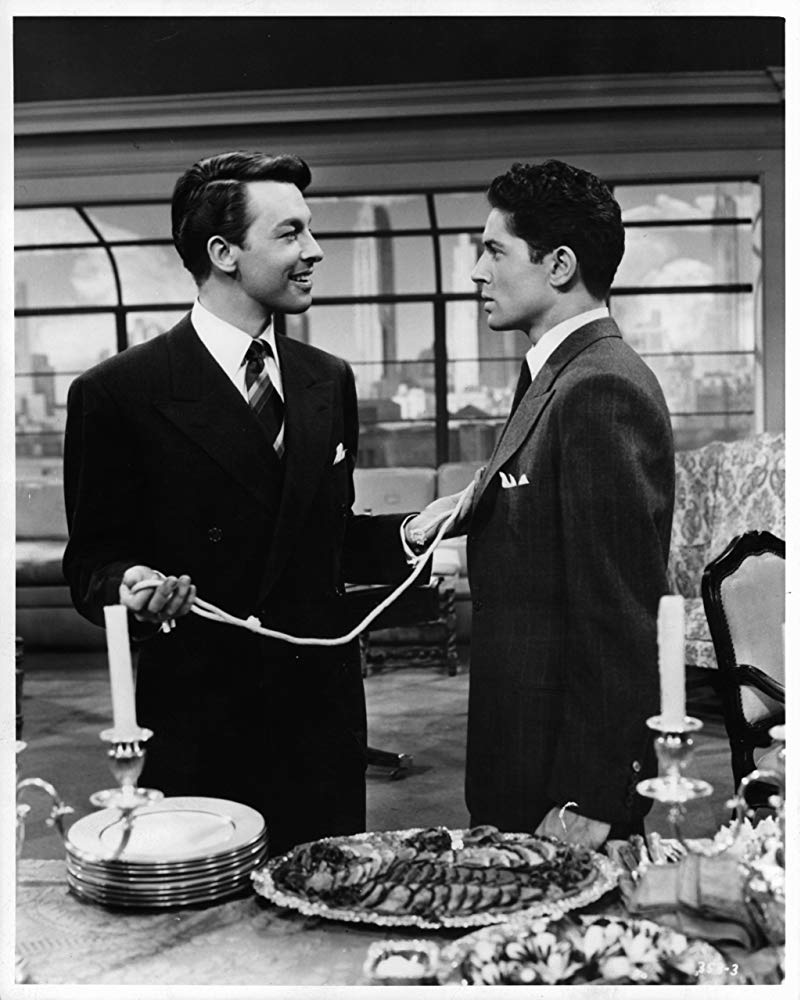
![]() |
| Despite the black and white stills, ROPE was Alfred Hitchcock's first color film. |
Actor/screenwriter Hume Cronyn adapted ROPE from the Hamilton play with Arthur Laurents writing the final screenplay. Ironically, Cronyn had a supporting part in Hitchcock's SHADOW OF A DOUBT (1943) as a neighbor who theorizes with Teresa Wright's father about different murder cases and who the culprit might be. In reality, Cronyn adapted ROPE from a play about two murderers trying to hide their crime. Hitchcock opens ROPE with a shock. A tight close up on David Kentley (Dick Hogan) with a rope around his neck as he's strangled by two of his former classmates Brandon Shaw (John Dall) and Phillip Morgan (Farley Granger) in the middle of the afternoon in their apartment. Brandon and Phillip should dispose of the body immediately but they hide it in an unlocked trunk in the living room. Brandon and Phillip are throwing a party later that evening. Brandon insists the trunk be used as a serving table.
Their unsuspecting house servant Mrs. Wilson (Edith Evanson) arrives soon after to prepare for the party. The guests begin to arrive including Janet (Joan Chandler), the dead David's fiancée and her ex-boyfriend Kenneth Lawrence (Douglas Dick); David's father Mr. Kentley (Sir Cedric Hardwicke) and David's aunt Mrs. Atwater (Constance Collier), and the most important guest of all Rupert Cadell (James Stewart), a former prep school housemaster to all the young men including Brandon and Phillip. Sociopath Brandon considers the murder a work of art and the party a diabolical way to get away with it under everyone's nose.
When the guests start to wonder where David is, the tension in ROPE begins to build. The topic of murder comes up which Mr. Kentley finds morbid. Phillip begins to show signs of cracking. This only emboldens Brandon. He repeatedly tries to reconnect Janet with her old flame Kenneth since David has failed to show. Mrs. Wilson reveals to Rupert that the two men have been acting strange all afternoon which arouses Rupert's curiosity. Rupert probes the two men. It's only when Rupert accidentally discovers a hat in the closet with David's initials that he truly realizes what his two former pupils have done.
The guests all leave for the evening. Brandon and Phillip believe they have gotten away with their perfect crime. They plan to drive up to Connecticut that night where they will dispose of David's body. But then Rupert calls. He has forgotten his cigarette case and asks if he can come back up to the apartment to look for it. Phillip doesn't want Rupert to come back up but Brandon relishes the opportunity. Rupert reveals he knows what Brandon and Phillip have done. Brandon tells Rupert the two men were inspired by Rupert's thesis about intellectual superiority and getting away with the murder of an inferior. Rupert wrestles a gun away from Phillip and calls the police. Phillip finds solace playing the piano as the three of them wait for the authorities.
ROPE is one of many Hitchcock films that has a handsome, well educated psychopath (or sociopath) committing murder. In ROPE's case, two handsome young men trying to get away with the perfect murder. From Ivor Novello in THE LODGER (1927) to Joseph Cotton in SHADOW OF A DOUBT to Robert Walker in STRANGERS ON A TRAIN (1951) and Anthony Perkins in PSYCHO (1960), these villains don't have scars or a missing eye or bad teeth. What's different with ROPE is that the two killers are homosexual (or it's implied). I couldn't find any evidence that the real killers Leopold and Loeb were gay but Hamilton's play has a homosexual subtext with even a subplot that Rupert had an affair with one of the boys. In 1948, the topic of homosexuality would have been too controversial to address yet Hitchcock doesn't shy away from it. John Dall as Brandon is the more confident, brazen partner. Farley Granger as Phillip is the weaker, more feminine one. The film doesn't imply that the two men murdered their classmate because they were gay (although their reactions after killing David are sexually charged). The murder was to impress their former teacher Rupert. They wanted to see if they could get away with murder, based in part on a thesis the young men had debated with Rupert on how a person with intellectual superiority could commit the perfect murder and get away with it. Only Brandon and Phillip have twisted Rupert's hypothetical idea into a terrifying reality.
Rupert's hypothetical argument was that the privileged can murder and get away with it because they are superior. The victims are the inferior. Rupert begins to unravel the mystery of David's absence from the party. When he confronts Brandon and Phillip and hears their rationale for the murder, Rupert realizes he's an unwitting third accomplice. It was Rupert's musings about superiority and inferiority that sparked Brandon and Phillip to kill. The two men warped Rupert's theory, choosing to play God. In a way, Rupert is as guilty as Brandon and Phillip. Only Rupert has a moral compass. He knows what's right and wrong.
If you are a fan of James Stewart, you remember he mostly appeared in comedies in the 30s and early 40s like DESTRY RIDES AGAIN (1939) and George Cukor's THE PHILADELPHIA STORY (1940). But when Stewart returned from World War II, he began to seek more serious roles. Even his first film after the war Frank Capra's IT'S A WONDERFUL LIFE (1946), Stewart mixes dramatic intensity with comedy as George Bailey. In ROPE, Stewart plays his first of four conflicted characters in Hitchcock films, his best troubled performance in his last with Hitchcock VERTIGO (1958). Stewart would play psychologically challenged roles in several Westerns for director Anthony Mann as well.
Stewart does a good job early in ROPE playing curious but not too suspicious. We the audience root for Rupert since we know who the murderers already are. We need Rupert to solve it. But Rupert's uncovering the murder reveals he may have inadvertently instigated it. Early in the party, Rupert jokes that murder should be an art. "And, as such, the privilege of committing it should be reserved for those few who are really superior individuals." He's had this lively conversation with Brandon and Phillip before. In the end, he realizes they put his hypothesis to the test. Brandon and Phillip may die in a gas chamber but Rupert will carry his role in a young man's death for the rest of his life.
The young handsome killers are played by John Dall and Farley Granger. Dall as the charismatic Brandon is the flashier role, the Alpha of the two men, a thrill seeker. He orchestrates the murder and party with equal aplomb. He has taken Rupert's hypothetical theory about "superiority" to a grisly level. He wants to prove he can get away with murder. "Murder can be an art, too. The power to kill can be just as satisfying as the power to create," Brandon boasts to Phillip. I'd never seen Dall in a film before. He nearly steals ROPE with his icy performance. Unfortunately, after a Best Supporting Actor Oscar nomination for THE CORN IS GREEN (1945), Dall's first film, his career never kicked off after ROPE even though he appeared in the film noir cult classic GUN CRAZY (1950) and in Stanley Kubrick's SPARTACUS (1960).
Farley Granger who plays Phillip, the weaker, more nervous of the pair would have a much more successful career after ROPE although mostly in television. Granger would play the wronged hero Guy Haines in Hitchcock's STRANGERS ON A TRAIN (1951). Granger's Phillip is the conscience of the two killers yet he's the one who strangled their friend David. Phillip's a nervous wreck as the guests arrive and begin to wonder where's David. Phillip calms himself by playing the piano. When Brandon recalls a story about Phillip strangling chickens on a farm, Phillip shouts, "I never strangled a chicken in my life!" It's almost a confession from Phillip, a plea to find the body and rid him of his guilt.
Sir Cedric Hardwicke as David's father is the only well known supporting cast member. Hardwicke also appeared in Hitchcock's SUSPICION (1941) and played Ludwig Frankenstein in THE GHOST OF FRANKENSTEIN (1942). Hardwicke was knighted in 1934 (hence the Sir) and had a successful stage and film career. Joan Chandler as Janet and Douglas Dick as ex-boyfriend Kenneth are fresh faces. Kenneth keeps joking how he's not very smart. He's lucky he didn't end up with the rope around his neck. Constance Collier as Mrs. Atwater, David's aunt, provides the comic relief. She provides some in-jokes when trying to remember the title of a film starring Cary Grant and Ingrid Bergman (it's Hitchcock's NOTORIOUS) or proclaiming her admiration for Cary Grant as she stands next to James Stewart (Grant's co-star in THE PHILADELPHIA STORY). Collier began acting in the silent era but her last film would be two years later with the 1950 film noir WHIRLPOOL directed by Otto Preminger. She would retire from film after that.
ROPE is Hitchcock at his most macabre. The murder weapon, a piece of rope, is almost a character of its own. First, we see it wrapped around David's throat. After he's disposed of in the trunk, Phillip finds it hanging from the side. Brandon twirls it as he hides it in the kitchen. But then, Brandon uses the murder weapon to tie some rare books together for Mr. Kentley, David's father. Finally, Rupert brings the rope back in view (having removed it offscreen from Mr. Kentley's books) when he accuses the two men of their crime. Whether it be a knife, a neck tie, scissors, or rope, Hitchcock often made the murder weapon a supporting character. The dialogue by Cronyn and Laurents is very ghoulish. Rupert goes on a hypothetical rant about how murdering people will free up a table at a good restaurant or better seats at the theater. Later, Mrs. Atwater (an amateur palm reader) tells Phillip that his hands will bring him great fame. Phillip yearns to be a pianist but it's his hands that killed David. It's funny, dark stuff from the Master of Suspense.
Besides Hitchcock taking on yet another technical challenge, the real heroes of ROPE are the Operators of the Camera Movement (four in all) as well as the production design team who had to move walls silently as the camera moved during the continuous long takes. ROPE is supposed to take place in real time (80 minutes in all). Except for a few straight cuts at dramatic junctures of the film, most of the cuts happen as the camera is blocked momentarily by a character's back. It's noticeable but the technique doesn't distract the audience from the plot.
The real life murderers Leopold and Loeb would go to court in the Trial of the Century. They were represented by the legendary attorney Clarence Darrow but even he couldn't save them. Leopold and Loeb would be convicted of the kidnapping and murder of 14 year old Bobby Franks and sentenced to life in prison. The killers and murder have spawned several plays and movies besides ROPE including Richard Fleischer's COMPULSION (1959) starring Orson Welles, Dean Stockwell, and Bradford Dillman.
ROPE would not be the first film that Hitchcock made based on real life events and people. THE WRONG MAN (1956) starring Henry Fonda is based on the real life story of an innocent man mistaken as an armed robber. And Hitchcock's PSYCHO based on the novel by Robert Bloch, some of the events are taken from the real life serial killer Ed Gein. As interesting an exercise and engaging a film as ROPE is, it would be a failure for Hitchcock at the box office. But like many films that failed initially with the public, ROPE'S reputation has grown over the years. It's not at the pantheon of great Hitchcock films but the second tier of entertaining near misses for the Master of Suspense.
Wednesday, August 15, 2018
Rebel Without A Cause (1955)
I have never been a rebel let alone a rebel with or without a cause. My defining rebel moment was in elementary school when a classmate and I were sent to the Principal's office for our exuberant back slapping of each other at a school assembly. It was at that moment that I decided I didn't like going to the Principal's office. My rebel days were over before they ever began. Even in high school, I was less than rebellious. Where as the character Jim Stark in Nicholas Ray's REBEL WITHOUT A CAUSE (1955) goes out at night even during the school week, CrazyFilmGuy was often home watching late night television on a Friday night while his friends were up to mischief.
REBEL WITHOUT A CAUSE has two major movements happening as it was released. A rebellious time for youth in the 50s and a new type of acting style. Rock and roll was just emerging with the likes of Elvis Presley, Chuck Berry, and Bill Haley stirring up teenagers with their hip swinging, toe tapping music. Movies were picking up on teenage alienation and rebellion with films like Richard Brooks BLACKBOARD JUNGLE (1955) based on the Evan Hunter novel. But unruly teenagers were usually depicted in the inner city or poorer parts of town. What makes REBEL WITHOUT A CAUSE noteworthy is these unruly kids are from the suburbs. Their parents are affluent, middle-class. As you watch REBEL WITHOUT A CAUSE, it becomes clear that the parents are as messed up as their kids.
James Dean became a star with REBEL WITHOUT A CAUSE. Dean's style of acting is unlike anything we had seen from actors in the 30s and 40s. Like Marlon Brando and Montgomery Clift, Dean came from the New York Actors Studio that emphasized realism, known as Method acting. Dean's anguish at times is frightening, his face and body contorted in pain. There's a primal authenticity to his acting similar to Brando's Stanley Kowalski in A STREETCAR NAMED DESIRE (1951) or Clift's Private Prewitt in FROM HERE TO ETERNITY (1953). Dean's acting style is perfect for his role as restless Jim Stark in REBEL WITHOUT A CAUSE.
Director Nicholas Ray who is credited with the story idea for REBEL WITHOUT A CAUSE had an up and down directing career. He had better success early with films like IN A LONELY PLACE (1950) and JOHNNY GUITAR (1954). REBEL WITHOUT A CAUSE may be Ray's most well known, successful move. REBEL'S screenplay is by Stewart Stern, adapted by Irving Schulman. REBEL is not shot in a gritty, black and white style you might expect for a teen drama. Ray shoots it in widescreen Cinemascope and in bright Warner Bros Color. It's a much more stylized movie than one would expect about teen angst. Ray even takes a page from Alfred Hitchcock using the L.A. landmark Griffith Observatory as a key location in the film.
We meet our three main teenage protagonists in REBEL WITHOUT A CAUSE on Easter night at the Los Angeles Juvenile Division. Jim Stark (James Dean) is brought in for "plain drunkenness." Judy (Natalie Wood) ran away from home after a fight with her father (William Hopper). John Crawford aka Plato (Sal Mineo) shot and killed some puppies. Jim and Judy meet with police juvenile officer Ray Fremick (Edward Platt). Jim's parents Frank Stark (Jim Backus), Carol Stark (Ann Doran), and his grandmother Mrs. Stark (Virginia Brissac) arrive to pick Jim up and take him home. Jim doesn't get along with his parents. Judy's mother picks her up and Plato goes home with the family maid (Marietta Canty).
Jim and his family have moved recently to Los Angeles from another town, fleeing some troubled past for Jim. It's Jim's first day at Dawson High School and a new start. It turns out Judy is literally the girl next door to Jim. Jim offers to drive Judy to school but she hangs out with a wild crowd led by her boyfriend Buzz Gunderson (Corey Allen) and his friends Goon (Dennis Hopper), Chick (Nick Adams), Crunch (Frank Mazzola), and Moose (Jack Grinnage). Their first day includes a field trip to the Griffith Park Observatory. Jim misses the bus so he drives to the planetarium. Jim tries to befriend Judy and her friends during the presentation but they only haze him. Only the outcast Plato wants to be friends with Jim. Later, behind the Observatory, Jim again tries to hang out with the group. Instead, Buzz challenges Jim to a knife fight. It's broken up by Dr. Minton (Ian Wolfe) from the Observatory. Buzz challenges Jim to a game of chicken with stolen cars out at Bruce Point that evening. No matter how hard Jim tries to avoid trouble, it follows him. Jim accepts the challenge.
Buzz and Jim meet at the Point. Everyone's there to watch including Judy and Plato. After the stolen cars are inspected, Jim and Buzz race each other toward the bluff in a dangerous game of chicken. Jim leaps safely from his car but Buzz's jacket gets caught on the door handle. Buzz goes over the cliff and dies. Buzz's gang splits the scene. Jim drives Judy and Plato home. Jim tells his parents what has happened. Jim's Dad wants him to lie to the police. Jim goes to the juvenile division looking for Fremick. He passes by Goon, Crunch, and Moose coming out of the police station. They think Jim is going to rat on them about Buzz's accident to the police. Fremick is out of the office. Jim returns home to find Judy waiting for him.
Jim takes Judy to an abandoned mansion near the Griffith Park Observatory. Crunch, Goon, and Moose track down Plato and steal his address book to find Jim's home. They terrorize Jim's parents but still can't locate Jim. Plato grabs a gun from his house and deduces Jim and Judy went to the dilapidated manor. Plato warns Jim that Goon and the others are looking for him. Crunch and his pals stumble across the mansion and see Jim's car. They sneak in. Plato shoots Crunch, wounding him. Scared, Plato flees the mansion, pursued by Jim. Plato breaks into the Griffith Observatory. The police show up. Jim and Judy follow Plato into the observatory to talk him into dropping the gun and giving himself up peacefully. But nothing ever ends peacefully with these angst ridden teenagers.
What's unique about REBEL WITHOUT A CAUSE is how dysfunctional the parents are. Yes, Jim Stark, Judy, and Plato all have their issues but much of their teenage problems stem from their equally flawed parents. And these parents are all middle to upper class. Jim's mother Carol domineers over his father Frank, almost bullying him. Frank is no strong role model for Jim. In one scene, Jim finds his emasculated father wearing Carol's apron over his suit, picking up breakfast he spilled on the carpet. He wants to be a buddy to Jim but when Jim asks for his advice, Frank turns meek, afraid that he'll anger his wife with any fatherly advice. It's enough to make a teenager like Jim become a rebel.
Judy has Daddy issues or maybe it's Judy's father has Judy issues. As Judy becomes a young woman, her father begins to lash out at her. He doesn't like her lipstick or the boys she hangs out with. Judy wants to be the apple in her father's eye but when her father calls Judy a "dirty tramp", Judy rebels by going out on Easter night and possibly soliciting for sex. In the opening scene, she appears to be sitting next to several other ladies of the night who have been rounded up. There are hints that Judy's relationship with her father may be incestuous.
At least Jim and Judy have parents. Poor Plato is raised by the family maid. Plato's father has walked out on the family years before. Plato's mother takes trips around the country leaving her son behind. This absence of parental love and guidance has played havoc on Plato. When we first meet him at the juvenile division, he's been arrested for shooting and killing puppies. That's pretty sick. The police still release him to the family maid. But Plato won't be done playing with guns.
I love films that use visual metaphors for the theme or psyche of the characters. REBEL WITHOUT A CAUSE has a multitude. The word chicken appears in various forms for instance. Jim Stark goes nuts when he's called a chicken. At times, he feels like one, running away from his past, so when he's accused, he'll fight for his honor. Buzz challenges Jim to a chicken run. They race stolen cars toward the edge of a bluff, playing a game of chicken to see who will blink or flinch or in this case jump out of the car first. Jim probably loses the race as he jumps out first but Buzz's sleeve is caught on the door knob. Buzz goes over the bluff and dies. But Jim still can't shake the chicken label. Buzz's thugs believe Jim is another type of a bird -- a stool pigeon -- when they see him going into the police station. They think Jim has ratted them out (Jim hasn't). When Crunch and Moose and Goon look for Jim at his house, they tie a chicken to his front porch. The real chicken in the Stark family, Jim's father Frank, removes the live chicken with some struggle.
The empty mansion that Jim, Judy, and Plato play around in represents the emptiness each teenager feels in their own family life. Jim aches for a father he can respect, a good role model. Judy yearns for her father's love, not sexual, just paternal. Plato feels deserted by both of his parents, forcing him to become a loner. Jim and Judy briefly play house in the mansion, pretending they're married and living what they believe to be an idealized union. But Goon and the other guys will ruin this idealistic charade when they lay siege to their playhouse.
"You're tearing me apart!" young Jim Stark wails to his parents early in the film. With those words, James Dean grabs you in REBEL WITHOUT A CAUSE and never lets go. Dean was one of the early Method actors following in the footsteps of Marlon Brando and Montgomery Clift. Dean is like a live wire, often twisting and contorting his face and body in the throes of teen frustration. Watch what Dean does with props in REBEL. Whether it's a milk bottle, a toy monkey, or a peep hole cover, Dean uses props in amazing, realistic ways. Dean would do something unexpected in a scene, not rehearsed, even surprising his co-stars with its realism like when Dean grabs his father played by Jim Backus and throws him onto the chair and then the ground (surprising Backus). Alas, we only got to enjoy James Dean for a short time. Dean appeared in three major films (EAST OF EDEN, REBEL WITHOUT A CAUSE, and GIANT) before he died way too young in a car accident at the age of 24. Dean would never see the premieres of REBEL WITHOUT A CAUSE or GIANT (1956).
It was thought that Natalie Wood was too clean cut and wholesome to play Judy in REBEL WITHOUT A CAUSE but Wood gives a good performance as the girl next door gone bad. Wood exudes a sexuality that seems almost forbidden based on her character's age. No wonder her father (William Hopper) gets jealous over her appearance. Wood appeared in some impressive movies early in her career from the young girl who believes in Santa in MIRACLE ON 34TH STREET (1947) to playing John Wayne's kidnapped niece in John Ford's THE SEARCHERS (1956). Wood appears in another youth gang related drama in the classic Robert Wise/Jerome Robbins musical WEST SIDE STORY (1961).
I had never seen Sal Mineo before watching REBEL WITHOUT A CAUSE. Mineo plays the doomed John "Plato" Crawford. Plato has no friends and absent parents when he joins the surrogate family of Jim Stark and Judy. Plato is the most conflicted of the three teenagers, driven to killing puppies at the start of the film. REBEL hints that Plato may be gay. The first clue is when he opens his school locker, revealing a single small photo of a Hollywood actor (supposedly Alan Ladd). Plato befriends Jim. Director Ray has Mineo as Plato give many long stares at the boyishly handsome Jim, indicating he has a crush on Jim. Plato's nickname comes from the Greek philosopher who is believed to have been homosexual. James Dean plays his emotions outwardly as Jim Stark but Sal Mineo seethes from within.
James Dean, Natalie Wood, and Sal Mineo are all excellent in REBEL WITHOUT A CAUSE. Sadly, each of them would die under unfortunate circumstances. As mentioned, Dean would die in a car crash prior to the release of REBEL. He was only 24 years old. Natalie Wood would have a successful career (SPLENDOR IN THE GRASS, THIS PROPERTY IS CONDEMNED). In 1981, while on a pleasure boat off Catalina Island with her husband actor Robert Wagner, Wood would mysteriously fall off the boat and drown. She was 43 years old. Sal Mineo's career spanned beyond REBEL WITHOUT A CAUSE with roles in Otto Preminger's EXODUS (1960) and John Ford's CHEYENNE AUTUMN (1964) as well as countless appearances in TV shows and movies. Mineo would be stabbed to death by a drifter in West Hollywood in 1976. Mineo was 37 years old. Three shining movie stars who tragically died before their time.
REBEL WITHOUT A CAUSE is peppered with familiar faces that would go on to play iconic roles either on TV or in the movies. Jim Backus as Jim's mousy father Frank would become well known as the millionaire Thurston Howell III shipwrecked on GILLIGAN'S ISLAND (1964-67). Backus also provided the voice for the nearsighted cartoon character MR. MAGOO. James Dean even does a brief imitation of Backus in REBEL. Edward Platt who plays the sympathetic juvenile officer Ray Fremick would go on to fame in GET SMART (1965-70) as Maxwell Smart's boss Chief.
William Hopper who plays Judy's father in REBEL WITHOUT A CAUSE would be forever known as lawyer Perry Mason's detective sidekick Paul Drake on PERRY MASON (1957-66). Hopper was the son of gossip columnist Hedda Hopper and the father of actor Dennis Hopper (BLUE VELVET) who makes his first screen appearance in REBEL WITHOUT A CAUSE. Dennis Hopper's role as Goon in REBEL may have been larger had it not been the fact that Hopper had a brief fling with Natalie Wood who also had a brief affair with the director Nicholas Ray (who was much older). Ray was not happy about the Hopper/Wood relationship. Apparently, he tried to have Hopper fired. When that didn't work, he limited Dennis's screen time. You'll notice Hopper doesn't have many lines in REBEL WITHOUT A CAUSE.
The legacy of REBEL WITHOUT A CAUSE lives on especially in the films of John Hughes including THE BREAKFAST CLUB (1985), Howard Deutch's PRETTY IN PINK (1986; written by Hughes), and Deutch's SOME KIND OF WONDERFUL (1987; also written by Hughes). Although lighter in tone, Hughes' stories deal with teenage loneliness and insecurities and absent or maladjusted parents much like REBEL WITHOUT A CAUSE did. Judd Nelson's Judd Bender in THE BREAKFAST CLUB is a combination of REBEL'S Jim Stark and Buzz Gunderson. Part vulnerable outsider, part tough guy. James Foley's RECKLESS (1984) is another nod to REBEL WITHOUT A CAUSE with cheerleader Daryl Hannah falling for rebellious football player Aidan Quinn (only Quinn sports a black jacket instead of Dean's red jacket).
But REBEL WITHOUT A CAUSE'S popularity and fame is all due to the iconic performance by James Dean and his legend and notoriety that grew after his untimely death. Dean is most identified with the restless youth Jim Stark from REBEL WITHOUT A CAUSE. We can only imagine what kind of career Dean might have had if he had lived longer. Would he have pushed the envelope like Brando and Clift or would he have settled into more respectable, traditional roles. Because of Dean's death, the door was left open for a young crop of up and coming Method actors to emerge like Paul Newman, Steve McQueen, and Warren Beatty. They picked up the mantle that Dean left behind. Even today, REBEL WITHOUT A CAUSE resonates in the eternal struggle between teenagers and parents to understand one another.
REBEL WITHOUT A CAUSE has two major movements happening as it was released. A rebellious time for youth in the 50s and a new type of acting style. Rock and roll was just emerging with the likes of Elvis Presley, Chuck Berry, and Bill Haley stirring up teenagers with their hip swinging, toe tapping music. Movies were picking up on teenage alienation and rebellion with films like Richard Brooks BLACKBOARD JUNGLE (1955) based on the Evan Hunter novel. But unruly teenagers were usually depicted in the inner city or poorer parts of town. What makes REBEL WITHOUT A CAUSE noteworthy is these unruly kids are from the suburbs. Their parents are affluent, middle-class. As you watch REBEL WITHOUT A CAUSE, it becomes clear that the parents are as messed up as their kids.
James Dean became a star with REBEL WITHOUT A CAUSE. Dean's style of acting is unlike anything we had seen from actors in the 30s and 40s. Like Marlon Brando and Montgomery Clift, Dean came from the New York Actors Studio that emphasized realism, known as Method acting. Dean's anguish at times is frightening, his face and body contorted in pain. There's a primal authenticity to his acting similar to Brando's Stanley Kowalski in A STREETCAR NAMED DESIRE (1951) or Clift's Private Prewitt in FROM HERE TO ETERNITY (1953). Dean's acting style is perfect for his role as restless Jim Stark in REBEL WITHOUT A CAUSE.
Director Nicholas Ray who is credited with the story idea for REBEL WITHOUT A CAUSE had an up and down directing career. He had better success early with films like IN A LONELY PLACE (1950) and JOHNNY GUITAR (1954). REBEL WITHOUT A CAUSE may be Ray's most well known, successful move. REBEL'S screenplay is by Stewart Stern, adapted by Irving Schulman. REBEL is not shot in a gritty, black and white style you might expect for a teen drama. Ray shoots it in widescreen Cinemascope and in bright Warner Bros Color. It's a much more stylized movie than one would expect about teen angst. Ray even takes a page from Alfred Hitchcock using the L.A. landmark Griffith Observatory as a key location in the film.
We meet our three main teenage protagonists in REBEL WITHOUT A CAUSE on Easter night at the Los Angeles Juvenile Division. Jim Stark (James Dean) is brought in for "plain drunkenness." Judy (Natalie Wood) ran away from home after a fight with her father (William Hopper). John Crawford aka Plato (Sal Mineo) shot and killed some puppies. Jim and Judy meet with police juvenile officer Ray Fremick (Edward Platt). Jim's parents Frank Stark (Jim Backus), Carol Stark (Ann Doran), and his grandmother Mrs. Stark (Virginia Brissac) arrive to pick Jim up and take him home. Jim doesn't get along with his parents. Judy's mother picks her up and Plato goes home with the family maid (Marietta Canty).
Jim and his family have moved recently to Los Angeles from another town, fleeing some troubled past for Jim. It's Jim's first day at Dawson High School and a new start. It turns out Judy is literally the girl next door to Jim. Jim offers to drive Judy to school but she hangs out with a wild crowd led by her boyfriend Buzz Gunderson (Corey Allen) and his friends Goon (Dennis Hopper), Chick (Nick Adams), Crunch (Frank Mazzola), and Moose (Jack Grinnage). Their first day includes a field trip to the Griffith Park Observatory. Jim misses the bus so he drives to the planetarium. Jim tries to befriend Judy and her friends during the presentation but they only haze him. Only the outcast Plato wants to be friends with Jim. Later, behind the Observatory, Jim again tries to hang out with the group. Instead, Buzz challenges Jim to a knife fight. It's broken up by Dr. Minton (Ian Wolfe) from the Observatory. Buzz challenges Jim to a game of chicken with stolen cars out at Bruce Point that evening. No matter how hard Jim tries to avoid trouble, it follows him. Jim accepts the challenge.
Buzz and Jim meet at the Point. Everyone's there to watch including Judy and Plato. After the stolen cars are inspected, Jim and Buzz race each other toward the bluff in a dangerous game of chicken. Jim leaps safely from his car but Buzz's jacket gets caught on the door handle. Buzz goes over the cliff and dies. Buzz's gang splits the scene. Jim drives Judy and Plato home. Jim tells his parents what has happened. Jim's Dad wants him to lie to the police. Jim goes to the juvenile division looking for Fremick. He passes by Goon, Crunch, and Moose coming out of the police station. They think Jim is going to rat on them about Buzz's accident to the police. Fremick is out of the office. Jim returns home to find Judy waiting for him.
Jim takes Judy to an abandoned mansion near the Griffith Park Observatory. Crunch, Goon, and Moose track down Plato and steal his address book to find Jim's home. They terrorize Jim's parents but still can't locate Jim. Plato grabs a gun from his house and deduces Jim and Judy went to the dilapidated manor. Plato warns Jim that Goon and the others are looking for him. Crunch and his pals stumble across the mansion and see Jim's car. They sneak in. Plato shoots Crunch, wounding him. Scared, Plato flees the mansion, pursued by Jim. Plato breaks into the Griffith Observatory. The police show up. Jim and Judy follow Plato into the observatory to talk him into dropping the gun and giving himself up peacefully. But nothing ever ends peacefully with these angst ridden teenagers.
What's unique about REBEL WITHOUT A CAUSE is how dysfunctional the parents are. Yes, Jim Stark, Judy, and Plato all have their issues but much of their teenage problems stem from their equally flawed parents. And these parents are all middle to upper class. Jim's mother Carol domineers over his father Frank, almost bullying him. Frank is no strong role model for Jim. In one scene, Jim finds his emasculated father wearing Carol's apron over his suit, picking up breakfast he spilled on the carpet. He wants to be a buddy to Jim but when Jim asks for his advice, Frank turns meek, afraid that he'll anger his wife with any fatherly advice. It's enough to make a teenager like Jim become a rebel.
Judy has Daddy issues or maybe it's Judy's father has Judy issues. As Judy becomes a young woman, her father begins to lash out at her. He doesn't like her lipstick or the boys she hangs out with. Judy wants to be the apple in her father's eye but when her father calls Judy a "dirty tramp", Judy rebels by going out on Easter night and possibly soliciting for sex. In the opening scene, she appears to be sitting next to several other ladies of the night who have been rounded up. There are hints that Judy's relationship with her father may be incestuous.
At least Jim and Judy have parents. Poor Plato is raised by the family maid. Plato's father has walked out on the family years before. Plato's mother takes trips around the country leaving her son behind. This absence of parental love and guidance has played havoc on Plato. When we first meet him at the juvenile division, he's been arrested for shooting and killing puppies. That's pretty sick. The police still release him to the family maid. But Plato won't be done playing with guns.
I love films that use visual metaphors for the theme or psyche of the characters. REBEL WITHOUT A CAUSE has a multitude. The word chicken appears in various forms for instance. Jim Stark goes nuts when he's called a chicken. At times, he feels like one, running away from his past, so when he's accused, he'll fight for his honor. Buzz challenges Jim to a chicken run. They race stolen cars toward the edge of a bluff, playing a game of chicken to see who will blink or flinch or in this case jump out of the car first. Jim probably loses the race as he jumps out first but Buzz's sleeve is caught on the door knob. Buzz goes over the bluff and dies. But Jim still can't shake the chicken label. Buzz's thugs believe Jim is another type of a bird -- a stool pigeon -- when they see him going into the police station. They think Jim has ratted them out (Jim hasn't). When Crunch and Moose and Goon look for Jim at his house, they tie a chicken to his front porch. The real chicken in the Stark family, Jim's father Frank, removes the live chicken with some struggle.
The empty mansion that Jim, Judy, and Plato play around in represents the emptiness each teenager feels in their own family life. Jim aches for a father he can respect, a good role model. Judy yearns for her father's love, not sexual, just paternal. Plato feels deserted by both of his parents, forcing him to become a loner. Jim and Judy briefly play house in the mansion, pretending they're married and living what they believe to be an idealized union. But Goon and the other guys will ruin this idealistic charade when they lay siege to their playhouse.
"You're tearing me apart!" young Jim Stark wails to his parents early in the film. With those words, James Dean grabs you in REBEL WITHOUT A CAUSE and never lets go. Dean was one of the early Method actors following in the footsteps of Marlon Brando and Montgomery Clift. Dean is like a live wire, often twisting and contorting his face and body in the throes of teen frustration. Watch what Dean does with props in REBEL. Whether it's a milk bottle, a toy monkey, or a peep hole cover, Dean uses props in amazing, realistic ways. Dean would do something unexpected in a scene, not rehearsed, even surprising his co-stars with its realism like when Dean grabs his father played by Jim Backus and throws him onto the chair and then the ground (surprising Backus). Alas, we only got to enjoy James Dean for a short time. Dean appeared in three major films (EAST OF EDEN, REBEL WITHOUT A CAUSE, and GIANT) before he died way too young in a car accident at the age of 24. Dean would never see the premieres of REBEL WITHOUT A CAUSE or GIANT (1956).
It was thought that Natalie Wood was too clean cut and wholesome to play Judy in REBEL WITHOUT A CAUSE but Wood gives a good performance as the girl next door gone bad. Wood exudes a sexuality that seems almost forbidden based on her character's age. No wonder her father (William Hopper) gets jealous over her appearance. Wood appeared in some impressive movies early in her career from the young girl who believes in Santa in MIRACLE ON 34TH STREET (1947) to playing John Wayne's kidnapped niece in John Ford's THE SEARCHERS (1956). Wood appears in another youth gang related drama in the classic Robert Wise/Jerome Robbins musical WEST SIDE STORY (1961).
I had never seen Sal Mineo before watching REBEL WITHOUT A CAUSE. Mineo plays the doomed John "Plato" Crawford. Plato has no friends and absent parents when he joins the surrogate family of Jim Stark and Judy. Plato is the most conflicted of the three teenagers, driven to killing puppies at the start of the film. REBEL hints that Plato may be gay. The first clue is when he opens his school locker, revealing a single small photo of a Hollywood actor (supposedly Alan Ladd). Plato befriends Jim. Director Ray has Mineo as Plato give many long stares at the boyishly handsome Jim, indicating he has a crush on Jim. Plato's nickname comes from the Greek philosopher who is believed to have been homosexual. James Dean plays his emotions outwardly as Jim Stark but Sal Mineo seethes from within.
James Dean, Natalie Wood, and Sal Mineo are all excellent in REBEL WITHOUT A CAUSE. Sadly, each of them would die under unfortunate circumstances. As mentioned, Dean would die in a car crash prior to the release of REBEL. He was only 24 years old. Natalie Wood would have a successful career (SPLENDOR IN THE GRASS, THIS PROPERTY IS CONDEMNED). In 1981, while on a pleasure boat off Catalina Island with her husband actor Robert Wagner, Wood would mysteriously fall off the boat and drown. She was 43 years old. Sal Mineo's career spanned beyond REBEL WITHOUT A CAUSE with roles in Otto Preminger's EXODUS (1960) and John Ford's CHEYENNE AUTUMN (1964) as well as countless appearances in TV shows and movies. Mineo would be stabbed to death by a drifter in West Hollywood in 1976. Mineo was 37 years old. Three shining movie stars who tragically died before their time.
REBEL WITHOUT A CAUSE is peppered with familiar faces that would go on to play iconic roles either on TV or in the movies. Jim Backus as Jim's mousy father Frank would become well known as the millionaire Thurston Howell III shipwrecked on GILLIGAN'S ISLAND (1964-67). Backus also provided the voice for the nearsighted cartoon character MR. MAGOO. James Dean even does a brief imitation of Backus in REBEL. Edward Platt who plays the sympathetic juvenile officer Ray Fremick would go on to fame in GET SMART (1965-70) as Maxwell Smart's boss Chief.
The legacy of REBEL WITHOUT A CAUSE lives on especially in the films of John Hughes including THE BREAKFAST CLUB (1985), Howard Deutch's PRETTY IN PINK (1986; written by Hughes), and Deutch's SOME KIND OF WONDERFUL (1987; also written by Hughes). Although lighter in tone, Hughes' stories deal with teenage loneliness and insecurities and absent or maladjusted parents much like REBEL WITHOUT A CAUSE did. Judd Nelson's Judd Bender in THE BREAKFAST CLUB is a combination of REBEL'S Jim Stark and Buzz Gunderson. Part vulnerable outsider, part tough guy. James Foley's RECKLESS (1984) is another nod to REBEL WITHOUT A CAUSE with cheerleader Daryl Hannah falling for rebellious football player Aidan Quinn (only Quinn sports a black jacket instead of Dean's red jacket).
But REBEL WITHOUT A CAUSE'S popularity and fame is all due to the iconic performance by James Dean and his legend and notoriety that grew after his untimely death. Dean is most identified with the restless youth Jim Stark from REBEL WITHOUT A CAUSE. We can only imagine what kind of career Dean might have had if he had lived longer. Would he have pushed the envelope like Brando and Clift or would he have settled into more respectable, traditional roles. Because of Dean's death, the door was left open for a young crop of up and coming Method actors to emerge like Paul Newman, Steve McQueen, and Warren Beatty. They picked up the mantle that Dean left behind. Even today, REBEL WITHOUT A CAUSE resonates in the eternal struggle between teenagers and parents to understand one another.
Wednesday, July 4, 2018
The Empire Strikes Back (1980) and Solo: A Star Wars Story (2018)
My viewing experience with the second installment in the original STAR WARS trilogy THE EMPIRE STRIKES BACK (1980) was much different than STAR WARS (1977). With STAR WARS, I waited in long lines, convinced my parents to join me the first time, and saw the film three times overall. For THE EMPIRE STRIKES BACK, I waited a few weeks after it was released. I was taking a Driver's Education class in the morning that summer. One day after class, I walked over to my favorite Westgate Theater and bought a ticket for EMPIRE. It was playing in the same large theater as STAR WARS had. But this time, the theater was empty. Or so I thought. As the film began, three young rascals sat behind me. They started lobbing popcorn at me. I put up with it for a few minutes but eventually eturned and scowled at them. It was not the glorious viewing experience that I had with STAR WARS.
Over time, THE EMPIRE STRIKES BACK has been championed by some critics and fans as the best STAR WARS film of the original trilogy. For CRAZYFILMGUY, nothing will ever replace the euphoria and joy when I saw STAR WARS. But as I've grown older and revisited the three films, I can see why THE EMPIRE STRIKES BACK has grown in popularity. EMPIRE has bigger battles and set pieces. EMPIRE introduces us to new characters in the STAR WARS universe like Jedi Master Yoda, scoundrel Lando Calrissian, and bounty hunter Boba Fett. Creator George Lucas turned the directing reins over to Irvin Kershner (THE EYES OF LAURA MARS) while remaining completely involved as producer. And EMPIRE gives much more screen time to one of my favorite characters in the STAR WARS universe Han Solo played by one of my favorite actors Harrison Ford.
Han Solo was a supporting character in STAR WARS. As played by Harrison Ford, Solo nearly stole the film from Luke Skywalker as the wisecracking mercenary pilot (along with his furry sidekick Chewbacca) of the Millennium Falcon. THE EMPIRE STRIKES BACK expands on the Han/Leia relationship barely touched on in STAR WARS. It plays up the developing brotherly bond between Luke and Han. It has fun with Han's coolness under pressure or when one of his plans fails to work. And THE EMPIRE STRIKES BACK introduces us to one of Han Solo's so-called friends, the suave but mysterious Lando Calrissian played by Billy Dee Williams.
Following in the footsteps of ROGUE ONE: A STAR WARS STORY (2016), we now have SOLO: A STAR WARS STORY (2018) directed by Ron Howard (A BEAUTIFUL MIND) that provides Han Solo's back story and how young Solo (Alden Ehrenreich) first crossed paths with Chewbacca, Lando Calrissian, and the Millennium Falcon. Interestingly, both THE EMPIRE STRIKES BACK and SOLO were co-written by the legendary writer/director Lawrence Kasdan. Kasdan co-wrote EMPIRE with Howard Hawks' favorite screenwriter Leigh Brackett (based on a story by George Lucas) and he co-wrote SOLO with his son Jake Kasdan. A year after THE EMPIRE STRIKES BACK was released, Kasdan would write Steven Spielberg's RAIDERS OF THE LOST ARK (1981). Now Indiana Jones and Han Solo are different characters but both were played perfectly by Harrison Ford. Kasdan may have seen what Ford could do with a character like Han Solo when creating Indiana Jones for RAIDERS. I think George Lucas saw the potential too.
THE EMPIRE STRIKES BACK jumps right into the midst of the rebellion, barely resembling STAR WARS except for its characters. Instead of the arid landscapes of Tattooine in STAR WARS, the film opens on the isolated icy planet of Hoth. Imperial troops have pushed the Alliance to the fringes of the galaxy. Luke Skywalker (Mark Hamill), Han Solo (Harrison Ford), and Princess Leia Organa (Carrie Fisher) are all part of the freedom fighters or Rebels. On a routine patrol outside their base, Luke is attacked by a snow monster known as a Wompa. When Luke doesn't return, Han rides out into a blizzard to find his friend. Han locates Luke who escaped the snow creature by using the Force. But remote space probes sent by Darth Vader (David Prowse) locate the rebel base. As Han and Leia prepare to evacuate the base, Luke and his team begin an aerial assault on giant Imperial Walkers (think space tanks).
The rebels manage to push several transports through the Empire blockade. Han, Leia, and Chewbacca follow last in the Millennium Falcon. Luke and the rebel fighters hassle the Walkers. But Luke has a vision from the departed Obi-Wan Kenobi (Alec Guinness) to go seek a Jedi Knight known as Yoda on the planet of Dagobah. Luke and R2D2 (Kenny Baker) deviate from the escape plan and venture out to locateYoda. Unable to shake Vader and the Imperial Tie Fighters, Han hides in a dangerous asteroid field. Luke lands on the swampy, primeval Dagobah. He finds a small, old green creature who turns out to be Yoda (Frank Oz). After some resistance, Yoda begins training Luke in the ways of the Jedi and harnessing the Force for good.
Darth Vader is summoned by the Emperor (Clive Revill) who alerts Vader about a disturbance in the Force. He warns Vader to be weary about Luke. Vader pledges to turn Luke to the dark side when he captures him. Vader hires a group of bounty hunters including fan favorite Boba Fett to find Han Solo. Imperial forces drop sonic charges onto the asteroid Han and Leia are hiding on. Han and Leia discover they're hiding inside a large eel like creature. The Millennium Falcon barely escapes from its jaws. Han decides to head to Vespin and a floating mining colony called Cloud City where an old "friend" of his named Lando Calrissian (Billy Dee Williams) seems to be running the place. Han hopes for safe haven with Lando. Luke discovers he can sense things in the future. He senses Han, Leia, Chewbacca, and C3PO (Anthony Daniels) may be in trouble. Yoda warns Luke he's not ready to use his skills yet but Luke takes his X-Wing Fighter and droid and plots a course for Cloud City.
Han, Leia, and the gang are greeted by Lando who seems accommodating enough. But then CP3O disappears. Lando takes them into a dining room where Vader and his stormtroopers await. Lando tells Han Vader arrived just before the Millennium Falcon. Vader plans on using Han and his friends to lure Luke to him. Vader gives Han to the bounty hunter Boba Fett who puts Han in carbon freeze to take back to the gangster Jabba the Hut. Luke arrives and squares off with Vader in a light saber duel. Lando breaks Leia and Chewbacca out of their detention. The three of them manage to rescue Luke before he falls off the floating colony after failing to defeat Vader. Fans and critics alike cried foul regarding the unresolved cliffhanger.
Never before had a film like THE EMPIRE STRIKES BACK ended so abruptly and without a satisfying conclusion. But let's remember. The STAR WARS series was a trilogy. EMPIRE was EPISODE V (or Part II in the trilogy). THE EMPIRE STRIKES BACK is like a Saturday morning serial. EMPIRE was meant to be the bridge between STAR WARS to the third installment THE RETURN OF THE JEDI (1983). But what a bridge. With a bigger budget, Lucas and his team were more emboldened to expand the plot, the characters, and the STAR WARS universe in THE EMPIRE STRIKES BACK. We learn more about the mystical Force and that Luke may possess it. We meet our first Jedi Knight since Obi-Wan Kenobi in the diminutive pointy eared Yoda. And, we learn there may be more to the Luke Skywalker/Darth Vader relationship than just colorful light sabers. No spoilers here but when Luke faces down a Darth Vader apparition on Dagobah and seemingly beheads it, Vader's helmet explodes revealing Luke's image inside looking back at the real Luke. What does it all mean? EMPIRE'S duel between Luke and Vader will explain all.
The best part of THE EMPIRE STRIKES BACK for me was Han Solo's larger role and expanding on the relationship between Han and Leia. Luke Skywalker's story is the soul of the STAR WARS trilogy but Han Solo has the cool Wookie sidekick, the gnarly space ship the Millennium Falcon, and that devil may care grin that can disguise danger or win a girl's heart like Leia's. In a way, Han and Leia are one of those couples in a Howard Hawks screwball comedy like BRINGING UP BABY (1938) or HIS GIRL FRIDAY (1940) trading insults with one another as they fall in love. That might explain why co-writer Leigh Brackett worked on the film. She co-wrote some of Hawks best films with bickering couples in love.
STAR WARS was knocked a bit for lacking in racial diversity when it was released. James Earl Jones was the only African-American actor in STAR WARS and it was only his voice as Darth Vader (British actor David Prowse wore the suit). So Lucas gives us our first visible black character with smuggler Lando Calrissian played by Billy Dee Williams in THE EMPIRE STRIKES BACK. I wasn't a big fan of Lando Calrissian (or Billy Dee Williams) when I first saw the film but Lando has grown on me over the years. It's fun to have another roguish character to play off Han Solo. Lando is more urbane than Han's blustery style. THE EMPIRE STRIKES BACK gives us tantalizing tidbits about Han and Lando's backstory. Lando claims the Millennium Falcon is his ship. So how did Han wrench it away from him? Lando's portrayed as a traitor soon after we meet him but we learn that he's not part of the Empire. In a way, he's an intergalactic Humphrey Bogart from CASABLANCA. "I stick my neck out for no one," Bogart's Rick Blaine would tell the French police officer Renault and the Nazis. Lando appears to follow that same mantra but he will end up rescuing Leia and Chewbacca in THE EMPIRE STRIKES BACK. Lando returns in the third film THE RETURN OF THE JEDI to bail out his old friend Han Solo from Jabba the Hut's palace.
After THE RETURN OF THE JEDI, we never saw the further exploits of Han Solo and Lando Calrissian. Yes, they lived on in STAR WARS comic books and novels but when George Lucas returned with THE PHANTOM MENACE (1999), ATTACK OF THE CLONES (2002), and THE REVENGE OF THE SITH (2005), those films preceded the original trilogy. Han and Lando didn't even exist. Finally, in 2015, Han Solo, Luke, and Leia appeared in THE FORCE AWAKENS but as their current older selves (no Lando Calrissian). We learn Han did marry Leia and they had a son Kylo Ren (Adam Driver). Chewbacca is still hanging with his pilot/smuggler friend. And Luke Skywalker had become Obi-Wan like, hiding out on a monastic island. I had my Han Solo fix but no flashbacks to his past.
Until news arrived that there was finally going to be a new Han Solo film about his early years. Two up and coming young directors Phil Lord and Christopher Miller (LEGO: THE MOVIE) were going to direct with a script by THE EMPIRE STRIKES BACK co-writer Lawrence Kasdan. All seemed right in the STAR WARS universe. Until directors Lord and Miller were fired three quarters of the way through the filming of SOLO. Director Ron Howard (APOLLO 13) was brought in to replace them. Reportedly, Howard reshot most of the film. Howard starred in the George Lucas film AMERICAN GRAFFITI (1973) and would later direct WILLOW (1988) which Lucas would produce. Could Howard salvage SOLO: A STAR WARS STORY?
The answer is yes. We first meet young Han on the grimy, gray streets of planet Corellia (he's an orphan and doesn't have a last name yet). Han and his first love Qi'ra (Emilia Clarke) are trying to escape the planet and the clutches of the worm-like slaver Lady Proxima (Linda Hunt) who runs the streets. Han dreams of becoming a pilot. Han and Qi'ra bribe their way onto a transport leaving Corellia but Proxima's goons snatch Qi'ra away at the last moment. Han enlists with the Empire (where he's given his last name Solo by the recruiting officer) so he can become a pilot but he's quickly kicked out of the academy. Han's forced to serve with the ground forces. Han stumbles across a group of rogue marauders led by Beckett (Woody Harrelson), Val (Thandie Newton), and Rio Durant (voiced by Jon Favreau). They want to steal an Imperial ship so they can use it to hijack a monorail transporting coaxium fuel. It's exactly the group of people Han wants to be associated with.
The monorail train is transporting the coaxium through a dangerous mountain pass. Beckett, Han, and the gang hijack the train but they're interrupted by a group of space pirates led by Enfys Nest (Erin Kellyman) and her Cloud Riders. Rio is mortally wounded in the attack. Han takes over flying the ship, rescuing Beckett but ultimately losing the precious fuel. Han and Beckett return empty handed to the space yacht of Beckett's boss, the red eyed gangster Dryden Vos (Paul Beckett), part of the Crimson Dawn Crime Syndicate. Working for Vos as his lieutenant is Han's old flame Qi'ra. Vos wishes to kill Beckett but Han convinces Vos they can steal unrefined coaxium from the mines on Kessel. He just needs another ship. Vos agrees with the plan but insists Qi'ra tag along.
Han seeks out the smuggler Lando Calrissian (Donald Glover). He hopes to win Lando's ship the Millennium Falcon in a card game. Lando cheats and keeps the Falcon but agrees to fly Han, Chewbacca, Beckett, and Qi'ra to Kessel for a cut of the profits. On Kessel, they find the coaxium but Lando's droid pilot L3-37 (Phoebe Waller-Bridge) starts a riot. L3-37 is damaged and Lando injured. Han flies the Falcon past an Imperial blockade, heading for a planet called Savareen to process the coaxium. Once again, the pirate Enfys shows up to grab the fuel. Instead of aiding Han, Lando takes off with the Falcon leaving Han to face Enfys alone. Only Enfys and her team are rebels fighting the crime syndicate and the Empire. Enfys just wants to keep the coaxium out of their hands. She wants Han to join their cause.
The third act of SOLO: A STAR WARS STORY is a series of double and triple crosses between Han, Vos, Beckett, Lando and Qi'ra. In a way, SOLO is a western, gangster film, and film noir all rolled into a space fantasy. Han will face off with Beckett like two gunslingers. Qi'ra will have her revenge on kingpin Vos but we learn she's working for another familiar STAR WARS villain (no spoiler here!). Han helps Enfys and her Cloud Riders keep the coaxium from the Syndicate and the Empire. Han and Chewbacca return to gamble with Lando for the Millennium Falcon again. Only this time, they're ready for Lando's sleight of hand.
Overall, CRAZYFILMGUY found SOLO: A STAR WARS STORY an enjoyable summer adventure with engaging characters and some decent action sequences. SOLO provides details on Han Solo's back story hinted at throughout the original STAR WARS films: how did Han meet Chewbacca? How did Han come to own Lando Calrissian's ship the Millennium Falcon? How did Han make the Kessel run in 12 parsecs? My favorite reveal is how Han and Chewbacca met. I expected them to meet in a space bar, arm wrestling or challenging each other to shots of some exotic beverage. SOLO reveals that Han is thrown into a fight pit after he's accused of desertion. Believing he's about to fight a ferocious, man eating monster (a homage to Luke Skywalker fighting Rancor in THE RETURN OF THE JEDI), a filthy, muddy Chewbacca emerges from a cave to battle him. Han speaks Wookie and convinces Chewbacca to escape with him. It's a funny scene, not what I expected for the origin of their relationship.
Unfortunately, we may never have a chance to see more of young Han Solo and Lando Calrissian. A STAR WARS hangover may have finally hit audiences. Although SOLO made over $350 million dollars worldwide, it cost $300 million dollars to make, mostly due to the extensive reshoots when director Howard replaced Lord and Miller. Some wondered did SOLO come out too soon after STAR WARS: THE LAST JEDI (2017) which was received with mixed reviews by critics and audiences alike. When I was kid, the STAR WARS films came out about two years apart and each one was an event. SOLO was released five months after THE LAST JEDI. Did the STAR WARS filmmakers and studio get greedy? Should they have waited a few more months? The answer is possibly yes. For me, I was ready and eager to see the SOLO movie about my favorite character in the STAR WARS universe.
There were questions about the casting. Was Alden Ehrenreich the right choice as young Han Solo? I liked the choice. Catch Ehrenreich in the Coen Brothers HAIL CAESAR! (2016) and he handles deadpan comedy very well as the naĂŻve Western movie star Hobie Doyle. I think anyone who has to follow in the footsteps of Harrison Ford has big shoes to fill. Ehrenreich has the cocky grin and the sly sense of humor to pull off his interpretation of a young Han. He won't make us forget Harrison Ford but he's fine as the younger version of Solo.
The supporting cast is good with recognizable faces but SOLO seems to be missing a little pizazz with its casting choices. Woody Harrelson as Beckett and Paul Bettany as Dryden Vos are solid but not flashy. Beckett is the father figure for the orphan Solo. Beckett's larcenous code will stay with Han Solo in future STAR WARS films although Solo will mature into a better person than Beckett. Bettany as crime boss Vos won't make us forget the slug like gangster Jabba the Hut from STAR WARS but he does have blood leak from his eyes when he's angry. Bettany has become accustomed to appearing in blockbuster films serving as the robot voice Jarvis in the IRON MAN films and more recently the android superhero Vision in THE AVENGERS:INFINITY WAR (2017).
Emilia Clarke (GAME OF THRONES) is seductive as Han's mysterious girlfriend Qi'ra but even she didn't entirely knock my socks off (and I'm a huge Clarke fan). The two supporting actors who stand out in SOLO are Phoebe Waller-Bridge as Lando's sarcastic droid pilot L3-37 and Donald Glover as pilot/gambler Lando Calrissian. The STAR WARS filmmakers have done a superb job giving their robots and droids personalities whether it's C-3PO (Anthony Daniels) and R2-D2 (Kenny Baker) in STAR WARS or more recently K-2SO (Alan Tudyk) in ROGUE ONE. L3-37 is the latest STAR WARS droid with a feminist twist. She nearly steals SOLO in her brief appearance.
Like a lot of the characters in SOLO (like L3-37 or Beckett's crime partner Val), I would have liked to have had more scenes with Lando Calrissian. Glover plays Lando as a cool cat in the galaxy. Like Beckett, Lando's gambling personality and thieving nature will influence Han later on in his adventures. But I wanted more of Lando. Lando was barely in the original STAR WARS films so I was hoping to learn more about him in SOLO. I guess I'll have to wait for the SOLO sequel. If there is one. Joonas Suotamo who first played Chewbacca in STAR WARS: THE LAST JEDI returns for SOLO. SOLO gives Chewbacca much more screen time than THE LAST JEDI did and Chewy's scenes with Solo are some of the funniest in the film. Suotamo took over wearing the hot, sweaty Chewbacca suit from Peter Mayhew who wrapped up playing the Wookie in THE FORCE AWAKENS.
Han Solo may be my favorite character in the STAR WARS saga because he's blue collar. He comes from humble roots (orphaned at a young age and fighting to survive on the streets of Corellia). Solo's got a chip on his shoulder against authority (the Empire) or anyone who doubts him (Beckett and his crew in SOLO). When he first encounters another type of authority (royalty) in the guise of Princess Leia in STAR WARS, Solo's not impressed. In THE EMPIRE STRIKES BACK, he mocks her, calling Leia "her worship." But deep down, Solo is impressed with Leia and her feistiness and resolve. Leia may remind Han of his first true love, Qi'ra.
SOLO: A STAR WARS STORY should satisfy fans like CrazyFilmGuy who have been craving to know about the Han Solo that we grew up and loved in the original STAR WARS trilogy including THE EMPIRE STRIKES BACK. Solo's backstory may go some directions that no one would have imagined but that's the reality of an origin story. Whether we get to see more of Han Solo, Lando Calrissian, Chewbacca, and Qi'ra remains to be seen. For now, we'll always have THE EMPIRE STRIKES BACK and SOLO to help fill our Han Solo fix.
Over time, THE EMPIRE STRIKES BACK has been championed by some critics and fans as the best STAR WARS film of the original trilogy. For CRAZYFILMGUY, nothing will ever replace the euphoria and joy when I saw STAR WARS. But as I've grown older and revisited the three films, I can see why THE EMPIRE STRIKES BACK has grown in popularity. EMPIRE has bigger battles and set pieces. EMPIRE introduces us to new characters in the STAR WARS universe like Jedi Master Yoda, scoundrel Lando Calrissian, and bounty hunter Boba Fett. Creator George Lucas turned the directing reins over to Irvin Kershner (THE EYES OF LAURA MARS) while remaining completely involved as producer. And EMPIRE gives much more screen time to one of my favorite characters in the STAR WARS universe Han Solo played by one of my favorite actors Harrison Ford.
Han Solo was a supporting character in STAR WARS. As played by Harrison Ford, Solo nearly stole the film from Luke Skywalker as the wisecracking mercenary pilot (along with his furry sidekick Chewbacca) of the Millennium Falcon. THE EMPIRE STRIKES BACK expands on the Han/Leia relationship barely touched on in STAR WARS. It plays up the developing brotherly bond between Luke and Han. It has fun with Han's coolness under pressure or when one of his plans fails to work. And THE EMPIRE STRIKES BACK introduces us to one of Han Solo's so-called friends, the suave but mysterious Lando Calrissian played by Billy Dee Williams.
Following in the footsteps of ROGUE ONE: A STAR WARS STORY (2016), we now have SOLO: A STAR WARS STORY (2018) directed by Ron Howard (A BEAUTIFUL MIND) that provides Han Solo's back story and how young Solo (Alden Ehrenreich) first crossed paths with Chewbacca, Lando Calrissian, and the Millennium Falcon. Interestingly, both THE EMPIRE STRIKES BACK and SOLO were co-written by the legendary writer/director Lawrence Kasdan. Kasdan co-wrote EMPIRE with Howard Hawks' favorite screenwriter Leigh Brackett (based on a story by George Lucas) and he co-wrote SOLO with his son Jake Kasdan. A year after THE EMPIRE STRIKES BACK was released, Kasdan would write Steven Spielberg's RAIDERS OF THE LOST ARK (1981). Now Indiana Jones and Han Solo are different characters but both were played perfectly by Harrison Ford. Kasdan may have seen what Ford could do with a character like Han Solo when creating Indiana Jones for RAIDERS. I think George Lucas saw the potential too.
THE EMPIRE STRIKES BACK jumps right into the midst of the rebellion, barely resembling STAR WARS except for its characters. Instead of the arid landscapes of Tattooine in STAR WARS, the film opens on the isolated icy planet of Hoth. Imperial troops have pushed the Alliance to the fringes of the galaxy. Luke Skywalker (Mark Hamill), Han Solo (Harrison Ford), and Princess Leia Organa (Carrie Fisher) are all part of the freedom fighters or Rebels. On a routine patrol outside their base, Luke is attacked by a snow monster known as a Wompa. When Luke doesn't return, Han rides out into a blizzard to find his friend. Han locates Luke who escaped the snow creature by using the Force. But remote space probes sent by Darth Vader (David Prowse) locate the rebel base. As Han and Leia prepare to evacuate the base, Luke and his team begin an aerial assault on giant Imperial Walkers (think space tanks).
The rebels manage to push several transports through the Empire blockade. Han, Leia, and Chewbacca follow last in the Millennium Falcon. Luke and the rebel fighters hassle the Walkers. But Luke has a vision from the departed Obi-Wan Kenobi (Alec Guinness) to go seek a Jedi Knight known as Yoda on the planet of Dagobah. Luke and R2D2 (Kenny Baker) deviate from the escape plan and venture out to locateYoda. Unable to shake Vader and the Imperial Tie Fighters, Han hides in a dangerous asteroid field. Luke lands on the swampy, primeval Dagobah. He finds a small, old green creature who turns out to be Yoda (Frank Oz). After some resistance, Yoda begins training Luke in the ways of the Jedi and harnessing the Force for good.
Darth Vader is summoned by the Emperor (Clive Revill) who alerts Vader about a disturbance in the Force. He warns Vader to be weary about Luke. Vader pledges to turn Luke to the dark side when he captures him. Vader hires a group of bounty hunters including fan favorite Boba Fett to find Han Solo. Imperial forces drop sonic charges onto the asteroid Han and Leia are hiding on. Han and Leia discover they're hiding inside a large eel like creature. The Millennium Falcon barely escapes from its jaws. Han decides to head to Vespin and a floating mining colony called Cloud City where an old "friend" of his named Lando Calrissian (Billy Dee Williams) seems to be running the place. Han hopes for safe haven with Lando. Luke discovers he can sense things in the future. He senses Han, Leia, Chewbacca, and C3PO (Anthony Daniels) may be in trouble. Yoda warns Luke he's not ready to use his skills yet but Luke takes his X-Wing Fighter and droid and plots a course for Cloud City.
Han, Leia, and the gang are greeted by Lando who seems accommodating enough. But then CP3O disappears. Lando takes them into a dining room where Vader and his stormtroopers await. Lando tells Han Vader arrived just before the Millennium Falcon. Vader plans on using Han and his friends to lure Luke to him. Vader gives Han to the bounty hunter Boba Fett who puts Han in carbon freeze to take back to the gangster Jabba the Hut. Luke arrives and squares off with Vader in a light saber duel. Lando breaks Leia and Chewbacca out of their detention. The three of them manage to rescue Luke before he falls off the floating colony after failing to defeat Vader. Fans and critics alike cried foul regarding the unresolved cliffhanger.
Never before had a film like THE EMPIRE STRIKES BACK ended so abruptly and without a satisfying conclusion. But let's remember. The STAR WARS series was a trilogy. EMPIRE was EPISODE V (or Part II in the trilogy). THE EMPIRE STRIKES BACK is like a Saturday morning serial. EMPIRE was meant to be the bridge between STAR WARS to the third installment THE RETURN OF THE JEDI (1983). But what a bridge. With a bigger budget, Lucas and his team were more emboldened to expand the plot, the characters, and the STAR WARS universe in THE EMPIRE STRIKES BACK. We learn more about the mystical Force and that Luke may possess it. We meet our first Jedi Knight since Obi-Wan Kenobi in the diminutive pointy eared Yoda. And, we learn there may be more to the Luke Skywalker/Darth Vader relationship than just colorful light sabers. No spoilers here but when Luke faces down a Darth Vader apparition on Dagobah and seemingly beheads it, Vader's helmet explodes revealing Luke's image inside looking back at the real Luke. What does it all mean? EMPIRE'S duel between Luke and Vader will explain all.
The best part of THE EMPIRE STRIKES BACK for me was Han Solo's larger role and expanding on the relationship between Han and Leia. Luke Skywalker's story is the soul of the STAR WARS trilogy but Han Solo has the cool Wookie sidekick, the gnarly space ship the Millennium Falcon, and that devil may care grin that can disguise danger or win a girl's heart like Leia's. In a way, Han and Leia are one of those couples in a Howard Hawks screwball comedy like BRINGING UP BABY (1938) or HIS GIRL FRIDAY (1940) trading insults with one another as they fall in love. That might explain why co-writer Leigh Brackett worked on the film. She co-wrote some of Hawks best films with bickering couples in love.
STAR WARS was knocked a bit for lacking in racial diversity when it was released. James Earl Jones was the only African-American actor in STAR WARS and it was only his voice as Darth Vader (British actor David Prowse wore the suit). So Lucas gives us our first visible black character with smuggler Lando Calrissian played by Billy Dee Williams in THE EMPIRE STRIKES BACK. I wasn't a big fan of Lando Calrissian (or Billy Dee Williams) when I first saw the film but Lando has grown on me over the years. It's fun to have another roguish character to play off Han Solo. Lando is more urbane than Han's blustery style. THE EMPIRE STRIKES BACK gives us tantalizing tidbits about Han and Lando's backstory. Lando claims the Millennium Falcon is his ship. So how did Han wrench it away from him? Lando's portrayed as a traitor soon after we meet him but we learn that he's not part of the Empire. In a way, he's an intergalactic Humphrey Bogart from CASABLANCA. "I stick my neck out for no one," Bogart's Rick Blaine would tell the French police officer Renault and the Nazis. Lando appears to follow that same mantra but he will end up rescuing Leia and Chewbacca in THE EMPIRE STRIKES BACK. Lando returns in the third film THE RETURN OF THE JEDI to bail out his old friend Han Solo from Jabba the Hut's palace.
After THE RETURN OF THE JEDI, we never saw the further exploits of Han Solo and Lando Calrissian. Yes, they lived on in STAR WARS comic books and novels but when George Lucas returned with THE PHANTOM MENACE (1999), ATTACK OF THE CLONES (2002), and THE REVENGE OF THE SITH (2005), those films preceded the original trilogy. Han and Lando didn't even exist. Finally, in 2015, Han Solo, Luke, and Leia appeared in THE FORCE AWAKENS but as their current older selves (no Lando Calrissian). We learn Han did marry Leia and they had a son Kylo Ren (Adam Driver). Chewbacca is still hanging with his pilot/smuggler friend. And Luke Skywalker had become Obi-Wan like, hiding out on a monastic island. I had my Han Solo fix but no flashbacks to his past.
Until news arrived that there was finally going to be a new Han Solo film about his early years. Two up and coming young directors Phil Lord and Christopher Miller (LEGO: THE MOVIE) were going to direct with a script by THE EMPIRE STRIKES BACK co-writer Lawrence Kasdan. All seemed right in the STAR WARS universe. Until directors Lord and Miller were fired three quarters of the way through the filming of SOLO. Director Ron Howard (APOLLO 13) was brought in to replace them. Reportedly, Howard reshot most of the film. Howard starred in the George Lucas film AMERICAN GRAFFITI (1973) and would later direct WILLOW (1988) which Lucas would produce. Could Howard salvage SOLO: A STAR WARS STORY?
The answer is yes. We first meet young Han on the grimy, gray streets of planet Corellia (he's an orphan and doesn't have a last name yet). Han and his first love Qi'ra (Emilia Clarke) are trying to escape the planet and the clutches of the worm-like slaver Lady Proxima (Linda Hunt) who runs the streets. Han dreams of becoming a pilot. Han and Qi'ra bribe their way onto a transport leaving Corellia but Proxima's goons snatch Qi'ra away at the last moment. Han enlists with the Empire (where he's given his last name Solo by the recruiting officer) so he can become a pilot but he's quickly kicked out of the academy. Han's forced to serve with the ground forces. Han stumbles across a group of rogue marauders led by Beckett (Woody Harrelson), Val (Thandie Newton), and Rio Durant (voiced by Jon Favreau). They want to steal an Imperial ship so they can use it to hijack a monorail transporting coaxium fuel. It's exactly the group of people Han wants to be associated with.
The monorail train is transporting the coaxium through a dangerous mountain pass. Beckett, Han, and the gang hijack the train but they're interrupted by a group of space pirates led by Enfys Nest (Erin Kellyman) and her Cloud Riders. Rio is mortally wounded in the attack. Han takes over flying the ship, rescuing Beckett but ultimately losing the precious fuel. Han and Beckett return empty handed to the space yacht of Beckett's boss, the red eyed gangster Dryden Vos (Paul Beckett), part of the Crimson Dawn Crime Syndicate. Working for Vos as his lieutenant is Han's old flame Qi'ra. Vos wishes to kill Beckett but Han convinces Vos they can steal unrefined coaxium from the mines on Kessel. He just needs another ship. Vos agrees with the plan but insists Qi'ra tag along.
Han seeks out the smuggler Lando Calrissian (Donald Glover). He hopes to win Lando's ship the Millennium Falcon in a card game. Lando cheats and keeps the Falcon but agrees to fly Han, Chewbacca, Beckett, and Qi'ra to Kessel for a cut of the profits. On Kessel, they find the coaxium but Lando's droid pilot L3-37 (Phoebe Waller-Bridge) starts a riot. L3-37 is damaged and Lando injured. Han flies the Falcon past an Imperial blockade, heading for a planet called Savareen to process the coaxium. Once again, the pirate Enfys shows up to grab the fuel. Instead of aiding Han, Lando takes off with the Falcon leaving Han to face Enfys alone. Only Enfys and her team are rebels fighting the crime syndicate and the Empire. Enfys just wants to keep the coaxium out of their hands. She wants Han to join their cause.
The third act of SOLO: A STAR WARS STORY is a series of double and triple crosses between Han, Vos, Beckett, Lando and Qi'ra. In a way, SOLO is a western, gangster film, and film noir all rolled into a space fantasy. Han will face off with Beckett like two gunslingers. Qi'ra will have her revenge on kingpin Vos but we learn she's working for another familiar STAR WARS villain (no spoiler here!). Han helps Enfys and her Cloud Riders keep the coaxium from the Syndicate and the Empire. Han and Chewbacca return to gamble with Lando for the Millennium Falcon again. Only this time, they're ready for Lando's sleight of hand.
Overall, CRAZYFILMGUY found SOLO: A STAR WARS STORY an enjoyable summer adventure with engaging characters and some decent action sequences. SOLO provides details on Han Solo's back story hinted at throughout the original STAR WARS films: how did Han meet Chewbacca? How did Han come to own Lando Calrissian's ship the Millennium Falcon? How did Han make the Kessel run in 12 parsecs? My favorite reveal is how Han and Chewbacca met. I expected them to meet in a space bar, arm wrestling or challenging each other to shots of some exotic beverage. SOLO reveals that Han is thrown into a fight pit after he's accused of desertion. Believing he's about to fight a ferocious, man eating monster (a homage to Luke Skywalker fighting Rancor in THE RETURN OF THE JEDI), a filthy, muddy Chewbacca emerges from a cave to battle him. Han speaks Wookie and convinces Chewbacca to escape with him. It's a funny scene, not what I expected for the origin of their relationship.
Unfortunately, we may never have a chance to see more of young Han Solo and Lando Calrissian. A STAR WARS hangover may have finally hit audiences. Although SOLO made over $350 million dollars worldwide, it cost $300 million dollars to make, mostly due to the extensive reshoots when director Howard replaced Lord and Miller. Some wondered did SOLO come out too soon after STAR WARS: THE LAST JEDI (2017) which was received with mixed reviews by critics and audiences alike. When I was kid, the STAR WARS films came out about two years apart and each one was an event. SOLO was released five months after THE LAST JEDI. Did the STAR WARS filmmakers and studio get greedy? Should they have waited a few more months? The answer is possibly yes. For me, I was ready and eager to see the SOLO movie about my favorite character in the STAR WARS universe.
There were questions about the casting. Was Alden Ehrenreich the right choice as young Han Solo? I liked the choice. Catch Ehrenreich in the Coen Brothers HAIL CAESAR! (2016) and he handles deadpan comedy very well as the naĂŻve Western movie star Hobie Doyle. I think anyone who has to follow in the footsteps of Harrison Ford has big shoes to fill. Ehrenreich has the cocky grin and the sly sense of humor to pull off his interpretation of a young Han. He won't make us forget Harrison Ford but he's fine as the younger version of Solo.
The supporting cast is good with recognizable faces but SOLO seems to be missing a little pizazz with its casting choices. Woody Harrelson as Beckett and Paul Bettany as Dryden Vos are solid but not flashy. Beckett is the father figure for the orphan Solo. Beckett's larcenous code will stay with Han Solo in future STAR WARS films although Solo will mature into a better person than Beckett. Bettany as crime boss Vos won't make us forget the slug like gangster Jabba the Hut from STAR WARS but he does have blood leak from his eyes when he's angry. Bettany has become accustomed to appearing in blockbuster films serving as the robot voice Jarvis in the IRON MAN films and more recently the android superhero Vision in THE AVENGERS:INFINITY WAR (2017).
Emilia Clarke (GAME OF THRONES) is seductive as Han's mysterious girlfriend Qi'ra but even she didn't entirely knock my socks off (and I'm a huge Clarke fan). The two supporting actors who stand out in SOLO are Phoebe Waller-Bridge as Lando's sarcastic droid pilot L3-37 and Donald Glover as pilot/gambler Lando Calrissian. The STAR WARS filmmakers have done a superb job giving their robots and droids personalities whether it's C-3PO (Anthony Daniels) and R2-D2 (Kenny Baker) in STAR WARS or more recently K-2SO (Alan Tudyk) in ROGUE ONE. L3-37 is the latest STAR WARS droid with a feminist twist. She nearly steals SOLO in her brief appearance.
Like a lot of the characters in SOLO (like L3-37 or Beckett's crime partner Val), I would have liked to have had more scenes with Lando Calrissian. Glover plays Lando as a cool cat in the galaxy. Like Beckett, Lando's gambling personality and thieving nature will influence Han later on in his adventures. But I wanted more of Lando. Lando was barely in the original STAR WARS films so I was hoping to learn more about him in SOLO. I guess I'll have to wait for the SOLO sequel. If there is one. Joonas Suotamo who first played Chewbacca in STAR WARS: THE LAST JEDI returns for SOLO. SOLO gives Chewbacca much more screen time than THE LAST JEDI did and Chewy's scenes with Solo are some of the funniest in the film. Suotamo took over wearing the hot, sweaty Chewbacca suit from Peter Mayhew who wrapped up playing the Wookie in THE FORCE AWAKENS.
Han Solo may be my favorite character in the STAR WARS saga because he's blue collar. He comes from humble roots (orphaned at a young age and fighting to survive on the streets of Corellia). Solo's got a chip on his shoulder against authority (the Empire) or anyone who doubts him (Beckett and his crew in SOLO). When he first encounters another type of authority (royalty) in the guise of Princess Leia in STAR WARS, Solo's not impressed. In THE EMPIRE STRIKES BACK, he mocks her, calling Leia "her worship." But deep down, Solo is impressed with Leia and her feistiness and resolve. Leia may remind Han of his first true love, Qi'ra.
SOLO: A STAR WARS STORY should satisfy fans like CrazyFilmGuy who have been craving to know about the Han Solo that we grew up and loved in the original STAR WARS trilogy including THE EMPIRE STRIKES BACK. Solo's backstory may go some directions that no one would have imagined but that's the reality of an origin story. Whether we get to see more of Han Solo, Lando Calrissian, Chewbacca, and Qi'ra remains to be seen. For now, we'll always have THE EMPIRE STRIKES BACK and SOLO to help fill our Han Solo fix.
Saturday, June 2, 2018
The Russians Are Coming, The Russians Are Coming (1966)
With Russia as popular in the national consciousness as ever, you would think we were back in the Cold War era of the 1950s and 1960s. Except now, instead of missile crisis and nuclear escalation, it's election tampering and possible collusion with our current administration. This seems to be a perfect time for CrazyFilmGuy to watch a comedy he's always wanted to watch about the hysteria of U.S./Russian relations during the Cold War called THE RUSSIANS ARE COMING, THE RUSSIANS ARE COMING (1966) directed by Norman Jewison (THE THOMAS CROWN AFFAIR, ROLLERBALL).
THE RUSSIANS ARE COMING, THE RUSSIANS ARE COMING is set on the Nantucket like fictional Gloucester Island. Watching RUSSIANS reminded me of another madcap film that had a big cast, multiple storylines, and Jonathan Winters (and in a cameo Carl Reiner). That film is Stanley Kramer's IT'S A MAD, MAD, MAD, MAD WORLD (1963). The connection to both films is screenwriter William Rose who co-wrote MAD, MAD, MAD WORLD and wrote THE RUSSIANS ARE COMING. Rose was a master at juggling lots of characters and comedic action. Rose wrote another fantastic comedy THE LADYKILLERS (1955) which had multiple characters in a funny heist film. Rose adapted THE RUSSIANS ARE COMING, THE RUSSIANS ARE COMING from a novel by Nathaniel Benchley called The Off Islanders. Benchley's son Peter would later write the shark thriller Jaws.
A Russian submarine accidentally beaches on a sand bar on Gloucester Island off the New England coast (with California's Bodega Bay standing in for the fictitious island). While the Captain (Theodore Bikel) and some of his crew remain on board, a small expedition led by Lieutenant Rozanov (Alan Arkin) come ashore to find a power boat to push their stuck vessel back into deeper water. Rozanov and his men stumble across a summer beach house rented by an American family. Walt Whittaker (Carl Reiner) is a comedy writer. Elspeth Whittaker (Eva Marie Saint) is his wife and they have two young children Pete and Annie. Their young son Pete (Sheldon Golomb) alerts his doubting parents that some men are in their garage but it's too late. Rozanov and his men intrude on the Whittaker's, steal their car and leave naĂŻve, nervous crew member Alexei Kolchin (John Philip Law) to guard the family at gun point until they return.
But Whittaker's car runs out of gas (he had warned the Russians the tank was low). The Russians walk the rest of the way to the sleepy coastal town of West Village. They overpower the postmaster Muriel Everett (Doro Merande) and steal her car. They find boats in the marina but there are too many people around. Meanwhile, the Whittaker's young nanny Alison Palmer (Andrea Dromm) arrives at the beach house, distracting Alexei enough for Walt to overpower him. Alexei flees to a nearby hill. The trussed up Muriel is discovered. She tells her rescuers it was the Russians who tied her up. Police Chief Link Mattocks (Brian Keith) is awakened to the situation (literally and figuratively). He contacts his deputy Norman Jonas (Jonathan Winters) to mobilize the rest of the town. Rozanov and his men are trapped.
The town gathers at the local bar to plan but hysteria and anarchy begin to emerge. An exasperated Deputy Jonas mutters, "We've got to get organized, we've got to get organized." But no one has actually seen the Russians. Police Chief Mattocks has to contend with the blustery local war hero Fendall Hawkins (Paul Ford) who tries to wrestle command away from him. Whittaker arrives in town (on a girl's bike) to explain why the Russians have landed on their island. But no one listens to him. A false report that Russian paratroopers have landed at the airport sends a contingent to investigate but they only find a few empty planes and the airport mechanic Stanley (Michael J. Pollard).
With most of the men out at the airfield, the Russians cut the phone lines and Rozanov grabs Whittaker (again). A few of the crew disguised as locals steal a boat. The Russian sub manages to free itself on its own. The Captain takes the submarine into port to pick up his men. Rozanov races back to the beach house to pick up Alexei with Whittaker in pursuit. The town people return from the airport. It's a stand off between the patriotic, gun toting Americans of Gloucester Island and two dozen Russian Naval men. Whittaker, his family, and Rozanov return to town just in time to try to deescalate the tension. The Russian Captain believes the town has kidnapped some of his men. He threatens to blow up the town. Fendall Hawkins manages to call an air force base to send two fighter jets to investigate. But an unlikely incident will unite the Americans and Russians together better than any politicians or generals ever could.
Stanley Kubrick's DR. STRANGELOVE (1964) had been released two years prior to THE RUSSIANS ARE COMING. I had read somewhere that RUSSIANS director Norman Jewison was an admirer of Kubrick. The similarities to DR. STRANGELOVE may have attracted Jewison to direct THE RUSSIANS ARE COMING. Both films deal with the Cold War and the icy relationship between the United States and the Soviet Union. THE RUSSIANS ARE COMING is more wacky and good natured than DR. STRANGELOVE'S dark humor and nihilistic point of view. Each film has a military authority figure that unnecessarily makes a bad decision. In DR. STRANGELOVE, it's rogue General Jack D. Ripper (Sterling Hayden) ordering a U.S. bomber to drop nuclear warheads on Russia. In THE RUSSIANS ARE COMING it's the Russian Submarine Captain (Theodore Bikel) trying to get a closer glance at the American shoreline and running aground by accident.
Hysteria runs amok in both THE RUSSIANS ARE COMING and DR. STRANGELOVE. Peter Sellers in multiple roles in DR. STRANGELOVE tries to stay calm as Group Captain Mandrake after Ripper starts the nuclear codes before killing himself. Later, as the U.S. President Merkin Muffley, Sellers attempts to soothe the anxiety of the Russian ambassador, the Russian premier (via telephone), and the generals of the War Room ("there's no fighting in the War Room"). Carl Reiner serves the same purpose in THE RUSSIANS ARE COMING. As the town of West Village mobilizes for what they think is a Russian invasion, Reiner's Walt Whittaker tries to explain to a panicked, armed militia that it's only nine Russians trying to borrow a boat to dislodge their stuck submarine. Whittaker, like the Russians, is a foreigner to the island. Whittaker is from the big city, most likely New York. The islanders are suspicious of Russians and visitors from the mainland. They don't trust anyone.
Where Kubrick's DR. STRANGELOVE envisions the world ending in nuclear devastation at the hands of the two super powers, Jewison and Rose see hope between the two countries in THE RUSSIANS ARE COMING, THE RUSSIANS ARE COMING. From composer Johnny Mandel's dueling patriotic anthems accompanying animated Stars and Stripes versus the Hammer and Sickle in the opening credits, we know RUSSIANS will be a comic tug of war. Instead of giving us a high level standoff between American and Russian generals and presidents, RUSSIANS looks at the two differing sides from a smaller microcosm: a small group of citizens on an American island versus two dozen weary seamen from a Russian submarine. In its sublime finale, THE RUSSIANS ARE COMING shows that if Americans and Russians can stop their distrust of each other and cooperate to rescue a young boy, why can't it extend globally. In the end, we're all the same whether you're American or Russian, Jewish or Palestinian black or white. "I wish not to hate...anybody!" Alexei Kolchin tells the pretty young Alison Palmer. She concurs. "It doesn't make sense to hate people. It's such a waste of time."
The two funniest characters in THE RUSSIANS ARE COMING are the vacationing American film writer Walt Whittaker (Carl Reiner) and the stranded Russian Navy Lieutenant Rozanov (Alan Arkin). Reiner's Whittaker is neurotic, trying to meet a deadline for a new musical comedy while dealing with his young, rambunctious kids. Whittaker is hurt when his young son Pete calls him a traitor for answering the Russians questions initially. In one very funny scene, Whittaker is tied up to the heavyset switchboard operator Alice Foss (Tessie O'Shea). Their escape attempt is hilarious as Reiner's face keeps ending up in uncomfortable parts of Alice or with her on top of him. Besides acting, Reiner would direct several Steve Martin films including THE JERK (1979) and THE MAN WITH TWO BRAINS (1983). Arkin has fun with Rozanov's lack of English. Rozanov begins to confuse the order of American words and names, calling his captive "Whittaker Walt." Rozanov has little patience. He's tired of dealing with clowns whether it's his commanding officer or an American father. He just wants to get home to Mother Russia. Arkin has had a lengthy film career, appearing in hit films from Arthur Hiller's comedy THE IN-LAWS (1979) to LITTLE MISS SUNSHINE (2006).
Two of my favorite actors are underutilized in THE RUSSIANS ARE COMING, THE RUSSIANS ARE COMING: Eva Marie Saint and Jonathan Winters. Saint captivated me in Elia Kazan's ON THE WATERFRONT (1954) as Marlon Brando's girlfriend and in Alfred Hitchcock's NORTH BY NORTHWEST (1959) as the cool blonde helping Cary Grant. In THE RUSSIANS ARE COMING, she has that unfortunate role of the wife. There are great wife roles but many wife roles are just window dressing. Saint and her on screen husband Carl Reiner have good chemistry but there's not much for Saint to do besides calm down her husband and resist a few mild flirtations from Rozanov. Saint's Elspeth Whittaker does come up with the idea in the finale on how to help the Russians get out of the harbor. I would have liked to see her involved more in the story.
Comedian Jonathan Winters is hard to miss with his big jowls and expressive eyes. Winters stood out amongst a huge cast in IT'S A MAD, MAD, MAD, MAD WORLD. He seems perfect as the ruffled police deputy Norman Jonas, trying to help Brian Keith's Police Chief Mattocks locate the elusive Russians. But THE RUSSIANS ARE COMING never really gives Winters much to do except act flustered (which he's very good at) and mutter constantly, "We've got to get organized!" Winters funniest scene has little to do with dialogue. It's the first time we meet Jonas. He's about to have breakfast with his harried wife and their large brood of children (the funny part is imagining the heavy set Jonas fathering so many kids) when he's called to action. It might explain his constant agitation. Winters speech to his kids before he joins the local civilian force is priceless.
There are a few other familiar faces in THE RUSSIANS ARE COMING. Brian Keith has a nice turn as the doubting local police chief Mattocks. Johnny Whittaker who plays the young red headed boy who inadvertently unites the two sides together at the end would work with Keith soon afterward on the hit TV series FAMILY AFFAIR (1966 to 1971). Fans may also remember Whittaker from the Saturday morning television show SIGMUND AND THE SEA MONSTERS (1973-75). Theodore Bikel as the Russian submarine captain would be familiar to audiences from his appearance in George Cukor's MY FAIR LADY (1964) and many other films and television appearances. Both Keith and Bikel have their moments in RUSSIANS moving finale.
If the plot of THE RUSSIANS ARE COMING, THE RUSSIANS ARE COMING depicting foreign countries invading the United States (accidentally or on purpose) looks familiar, Hollywood has tried the formula a few times since RUSSIANS. Dramatically, director John Milius made RED DAWN (1984) where the Russians really do invade America. Not surprisingly, Hollywood would remake RED DAWN in 2012, changing the invaders from Russians to North Koreans. Comedically, Steven Spielberg in 1979 would direct one of his few flops with the ambitious but overdone comedy 1941 about a coastal town in California that mistakenly thinks the Japanese are attacking the U.S. days after Pearl Harbor. Sounds a little bit like THE RUSSIANS ARE COMING, doesn't it?
A few last tidbits about THE RUSSIANS ARE COMING, THE RUSSIANS ARE COMING. Both actors Brian Keith and Alan Arkin could actually speak Russian although Keith doesn't need to use it as he play the American Police Chief Mattocks. Director Jewison films the opening sequence when the submarine becomes stuck entirely in Russian without any subtitles, lending to the film's authenticity and tension at the start of the film. A future film director would work on THE RUSSIANS ARE COMING, THE RUSSIANS ARE COMING. Hal Ashby who would go on to direct the anti-war film COMING HOME (1978) as well as Peter Sellers last comedy BEING THERE (1979) would co-edit THE RUSSIANS ARE COMING with J. Terry Williams. Ashby would edit several Norman Jewison films and won an Academy Award for editing Jewison's IN THE HEAT OF THE NIGHT (1967).
In light of today's climate, THE RUSSIANS ARE COMING, THE RUSSIANS ARE COMING is a comedy with a simple but clever message that is as relevant today as it was back in 1966. For all our paranoia and hatred and suspicions about people not like us, we're all the same. We may not talk the same languages or have the same skin color but we're all alike. THE RUSSIANS ARE COMING will make you laugh out loud but it will also tug at your heart.
THE RUSSIANS ARE COMING, THE RUSSIANS ARE COMING is set on the Nantucket like fictional Gloucester Island. Watching RUSSIANS reminded me of another madcap film that had a big cast, multiple storylines, and Jonathan Winters (and in a cameo Carl Reiner). That film is Stanley Kramer's IT'S A MAD, MAD, MAD, MAD WORLD (1963). The connection to both films is screenwriter William Rose who co-wrote MAD, MAD, MAD WORLD and wrote THE RUSSIANS ARE COMING. Rose was a master at juggling lots of characters and comedic action. Rose wrote another fantastic comedy THE LADYKILLERS (1955) which had multiple characters in a funny heist film. Rose adapted THE RUSSIANS ARE COMING, THE RUSSIANS ARE COMING from a novel by Nathaniel Benchley called The Off Islanders. Benchley's son Peter would later write the shark thriller Jaws.
A Russian submarine accidentally beaches on a sand bar on Gloucester Island off the New England coast (with California's Bodega Bay standing in for the fictitious island). While the Captain (Theodore Bikel) and some of his crew remain on board, a small expedition led by Lieutenant Rozanov (Alan Arkin) come ashore to find a power boat to push their stuck vessel back into deeper water. Rozanov and his men stumble across a summer beach house rented by an American family. Walt Whittaker (Carl Reiner) is a comedy writer. Elspeth Whittaker (Eva Marie Saint) is his wife and they have two young children Pete and Annie. Their young son Pete (Sheldon Golomb) alerts his doubting parents that some men are in their garage but it's too late. Rozanov and his men intrude on the Whittaker's, steal their car and leave naĂŻve, nervous crew member Alexei Kolchin (John Philip Law) to guard the family at gun point until they return.
But Whittaker's car runs out of gas (he had warned the Russians the tank was low). The Russians walk the rest of the way to the sleepy coastal town of West Village. They overpower the postmaster Muriel Everett (Doro Merande) and steal her car. They find boats in the marina but there are too many people around. Meanwhile, the Whittaker's young nanny Alison Palmer (Andrea Dromm) arrives at the beach house, distracting Alexei enough for Walt to overpower him. Alexei flees to a nearby hill. The trussed up Muriel is discovered. She tells her rescuers it was the Russians who tied her up. Police Chief Link Mattocks (Brian Keith) is awakened to the situation (literally and figuratively). He contacts his deputy Norman Jonas (Jonathan Winters) to mobilize the rest of the town. Rozanov and his men are trapped.
The town gathers at the local bar to plan but hysteria and anarchy begin to emerge. An exasperated Deputy Jonas mutters, "We've got to get organized, we've got to get organized." But no one has actually seen the Russians. Police Chief Mattocks has to contend with the blustery local war hero Fendall Hawkins (Paul Ford) who tries to wrestle command away from him. Whittaker arrives in town (on a girl's bike) to explain why the Russians have landed on their island. But no one listens to him. A false report that Russian paratroopers have landed at the airport sends a contingent to investigate but they only find a few empty planes and the airport mechanic Stanley (Michael J. Pollard).
With most of the men out at the airfield, the Russians cut the phone lines and Rozanov grabs Whittaker (again). A few of the crew disguised as locals steal a boat. The Russian sub manages to free itself on its own. The Captain takes the submarine into port to pick up his men. Rozanov races back to the beach house to pick up Alexei with Whittaker in pursuit. The town people return from the airport. It's a stand off between the patriotic, gun toting Americans of Gloucester Island and two dozen Russian Naval men. Whittaker, his family, and Rozanov return to town just in time to try to deescalate the tension. The Russian Captain believes the town has kidnapped some of his men. He threatens to blow up the town. Fendall Hawkins manages to call an air force base to send two fighter jets to investigate. But an unlikely incident will unite the Americans and Russians together better than any politicians or generals ever could.
Stanley Kubrick's DR. STRANGELOVE (1964) had been released two years prior to THE RUSSIANS ARE COMING. I had read somewhere that RUSSIANS director Norman Jewison was an admirer of Kubrick. The similarities to DR. STRANGELOVE may have attracted Jewison to direct THE RUSSIANS ARE COMING. Both films deal with the Cold War and the icy relationship between the United States and the Soviet Union. THE RUSSIANS ARE COMING is more wacky and good natured than DR. STRANGELOVE'S dark humor and nihilistic point of view. Each film has a military authority figure that unnecessarily makes a bad decision. In DR. STRANGELOVE, it's rogue General Jack D. Ripper (Sterling Hayden) ordering a U.S. bomber to drop nuclear warheads on Russia. In THE RUSSIANS ARE COMING it's the Russian Submarine Captain (Theodore Bikel) trying to get a closer glance at the American shoreline and running aground by accident.
Hysteria runs amok in both THE RUSSIANS ARE COMING and DR. STRANGELOVE. Peter Sellers in multiple roles in DR. STRANGELOVE tries to stay calm as Group Captain Mandrake after Ripper starts the nuclear codes before killing himself. Later, as the U.S. President Merkin Muffley, Sellers attempts to soothe the anxiety of the Russian ambassador, the Russian premier (via telephone), and the generals of the War Room ("there's no fighting in the War Room"). Carl Reiner serves the same purpose in THE RUSSIANS ARE COMING. As the town of West Village mobilizes for what they think is a Russian invasion, Reiner's Walt Whittaker tries to explain to a panicked, armed militia that it's only nine Russians trying to borrow a boat to dislodge their stuck submarine. Whittaker, like the Russians, is a foreigner to the island. Whittaker is from the big city, most likely New York. The islanders are suspicious of Russians and visitors from the mainland. They don't trust anyone.
Where Kubrick's DR. STRANGELOVE envisions the world ending in nuclear devastation at the hands of the two super powers, Jewison and Rose see hope between the two countries in THE RUSSIANS ARE COMING, THE RUSSIANS ARE COMING. From composer Johnny Mandel's dueling patriotic anthems accompanying animated Stars and Stripes versus the Hammer and Sickle in the opening credits, we know RUSSIANS will be a comic tug of war. Instead of giving us a high level standoff between American and Russian generals and presidents, RUSSIANS looks at the two differing sides from a smaller microcosm: a small group of citizens on an American island versus two dozen weary seamen from a Russian submarine. In its sublime finale, THE RUSSIANS ARE COMING shows that if Americans and Russians can stop their distrust of each other and cooperate to rescue a young boy, why can't it extend globally. In the end, we're all the same whether you're American or Russian, Jewish or Palestinian black or white. "I wish not to hate...anybody!" Alexei Kolchin tells the pretty young Alison Palmer. She concurs. "It doesn't make sense to hate people. It's such a waste of time."
The two funniest characters in THE RUSSIANS ARE COMING are the vacationing American film writer Walt Whittaker (Carl Reiner) and the stranded Russian Navy Lieutenant Rozanov (Alan Arkin). Reiner's Whittaker is neurotic, trying to meet a deadline for a new musical comedy while dealing with his young, rambunctious kids. Whittaker is hurt when his young son Pete calls him a traitor for answering the Russians questions initially. In one very funny scene, Whittaker is tied up to the heavyset switchboard operator Alice Foss (Tessie O'Shea). Their escape attempt is hilarious as Reiner's face keeps ending up in uncomfortable parts of Alice or with her on top of him. Besides acting, Reiner would direct several Steve Martin films including THE JERK (1979) and THE MAN WITH TWO BRAINS (1983). Arkin has fun with Rozanov's lack of English. Rozanov begins to confuse the order of American words and names, calling his captive "Whittaker Walt." Rozanov has little patience. He's tired of dealing with clowns whether it's his commanding officer or an American father. He just wants to get home to Mother Russia. Arkin has had a lengthy film career, appearing in hit films from Arthur Hiller's comedy THE IN-LAWS (1979) to LITTLE MISS SUNSHINE (2006).
Two of my favorite actors are underutilized in THE RUSSIANS ARE COMING, THE RUSSIANS ARE COMING: Eva Marie Saint and Jonathan Winters. Saint captivated me in Elia Kazan's ON THE WATERFRONT (1954) as Marlon Brando's girlfriend and in Alfred Hitchcock's NORTH BY NORTHWEST (1959) as the cool blonde helping Cary Grant. In THE RUSSIANS ARE COMING, she has that unfortunate role of the wife. There are great wife roles but many wife roles are just window dressing. Saint and her on screen husband Carl Reiner have good chemistry but there's not much for Saint to do besides calm down her husband and resist a few mild flirtations from Rozanov. Saint's Elspeth Whittaker does come up with the idea in the finale on how to help the Russians get out of the harbor. I would have liked to see her involved more in the story.
Comedian Jonathan Winters is hard to miss with his big jowls and expressive eyes. Winters stood out amongst a huge cast in IT'S A MAD, MAD, MAD, MAD WORLD. He seems perfect as the ruffled police deputy Norman Jonas, trying to help Brian Keith's Police Chief Mattocks locate the elusive Russians. But THE RUSSIANS ARE COMING never really gives Winters much to do except act flustered (which he's very good at) and mutter constantly, "We've got to get organized!" Winters funniest scene has little to do with dialogue. It's the first time we meet Jonas. He's about to have breakfast with his harried wife and their large brood of children (the funny part is imagining the heavy set Jonas fathering so many kids) when he's called to action. It might explain his constant agitation. Winters speech to his kids before he joins the local civilian force is priceless.
There are a few other familiar faces in THE RUSSIANS ARE COMING. Brian Keith has a nice turn as the doubting local police chief Mattocks. Johnny Whittaker who plays the young red headed boy who inadvertently unites the two sides together at the end would work with Keith soon afterward on the hit TV series FAMILY AFFAIR (1966 to 1971). Fans may also remember Whittaker from the Saturday morning television show SIGMUND AND THE SEA MONSTERS (1973-75). Theodore Bikel as the Russian submarine captain would be familiar to audiences from his appearance in George Cukor's MY FAIR LADY (1964) and many other films and television appearances. Both Keith and Bikel have their moments in RUSSIANS moving finale.
If the plot of THE RUSSIANS ARE COMING, THE RUSSIANS ARE COMING depicting foreign countries invading the United States (accidentally or on purpose) looks familiar, Hollywood has tried the formula a few times since RUSSIANS. Dramatically, director John Milius made RED DAWN (1984) where the Russians really do invade America. Not surprisingly, Hollywood would remake RED DAWN in 2012, changing the invaders from Russians to North Koreans. Comedically, Steven Spielberg in 1979 would direct one of his few flops with the ambitious but overdone comedy 1941 about a coastal town in California that mistakenly thinks the Japanese are attacking the U.S. days after Pearl Harbor. Sounds a little bit like THE RUSSIANS ARE COMING, doesn't it?
A few last tidbits about THE RUSSIANS ARE COMING, THE RUSSIANS ARE COMING. Both actors Brian Keith and Alan Arkin could actually speak Russian although Keith doesn't need to use it as he play the American Police Chief Mattocks. Director Jewison films the opening sequence when the submarine becomes stuck entirely in Russian without any subtitles, lending to the film's authenticity and tension at the start of the film. A future film director would work on THE RUSSIANS ARE COMING, THE RUSSIANS ARE COMING. Hal Ashby who would go on to direct the anti-war film COMING HOME (1978) as well as Peter Sellers last comedy BEING THERE (1979) would co-edit THE RUSSIANS ARE COMING with J. Terry Williams. Ashby would edit several Norman Jewison films and won an Academy Award for editing Jewison's IN THE HEAT OF THE NIGHT (1967).
In light of today's climate, THE RUSSIANS ARE COMING, THE RUSSIANS ARE COMING is a comedy with a simple but clever message that is as relevant today as it was back in 1966. For all our paranoia and hatred and suspicions about people not like us, we're all the same. We may not talk the same languages or have the same skin color but we're all alike. THE RUSSIANS ARE COMING will make you laugh out loud but it will also tug at your heart.
Subscribe to:
Comments (Atom)