Saturday, October 24, 2020

Frankenstein Meets the Wolf Man (1943)

We take it for granted in today's modern cinema that it's common place for super heroes to face off against one another like Iron Man, the Black Panther, and the Black Widow versus Captain America, Hawkeye, and Ant Man among others in CAPTAIN AMERICA: CIVIL WAR (2016) or BATMAN VS SUPERMAN: DAWN OF JUSTICE (2016). But the concept of a movie franchise having more than one of their characters appear together in a film has its origins with Universal's Movie Monsters series. In particular, it started with FRANKENSTEIN MEETS THE WOLF MAN (1943) where the Frankenstein monster encounters Larry Talbot aka the Wolf Man, the first time two of Universal's monsters appeared together in the same film.

FRANKENSTEIN MEETS THE WOLF MAN in a way is a sequel to the successful THE WOLF MAN that was released two years earlier in 1941 although it really comes after THE GHOST OF FRANKENSTEIN (1942) but more on that connection later.  THE WOLF MAN'S screenwriter Curt Siodmak who created much of the werewolf lore returns as the screenwriter for FRANKENSTEIN MEETS THE WOLF MAN. George Waggner who directed THE WOLF MAN stepped into the producing chair for FRANKENSTEIN MEETS THE WOLF MAN and handed the directing reins over to Roy William Neill, a capable director no stranger to atmospheric films having directed some of my favorite Sherlock Holmes films around the same time including THE SCARLET CLAW (1944) and HOUSE OF FEAR (1945). FRANKENSTEIN MEETS THE WOLF MAN returns several actors from THE WOLF MAN although not all of them in the same roles.  Lon Chaney, Jr is back as the tormented Larry Talbot and Maria Ouspenskaya as Talbot's surrogate mother, the gypsy woman Maleva.  But Patric Knowles and Bela Lugosi who had minor roles in THE WOLF MAN return as different but meatier characters in FRANKENSTEIN MEETS THE WOLF MAN including Lugosi in his first turn as Frankenstein's monster. Tying the entire Universal Monster Universe together is the under appreciated Dwight Frye who had iconic supporting roles as Dr. Frankenstein's assistant Fritz in FRANKENSTEIN (1931) and as the fly eating Renfield in DRACULA (also 1931). But Frye's brief period of horror film glory would fade and by 1943 Frye had but a minor role as the villager Rudi in FRANKENSTEIN MEETS THE WOLF MAN. Frye would die that same year, much too young.


The film opens in Lanwelly, Wales where two grave robbers (Tom Stevenson and Cyril Delevanti) break into the crypt of the Talbot family on a full moon to steal jewelry and money from the corpse of Larry Talbot (Lon Chaney, Jr). But they're in for a big surprise when Talbot awakens (more on why he's not a skeleton to come), grabbing one of the grave robber's hands. Talbot's found unconscious later on a village street, his skull fractured.  He's treated at Queen's Hospital in Cardiff where he's interviewed by Dr. Frank Mannering (Patric Knowles) and Inspector Owen (Dennis Hoey). The patient claims to be Larry Talbot, whose been dead for four years. He tells them he turns into a werewolf which gets Talbot a one way ticket to a straight-jacket. While Mannering and Owen visit Lanwelly to investigate Talbot's claim, Talbot turns into the Wolf Man that night, sneaking out of his hospital room to murder a policeman. After visiting the crypt and finding Talbot's body missing and one dead grave robber, Mannering calls to check on Talbot and learns he has escaped his confines back in Cardiff.

Talbot wanders into a gypsy camp where he's reunites with Maleva (Maria Ouspenskaya) whose son Bela turned Talbot into a werewolf in THE WOLF MAN. Maleva tells Larry she's heard of a man who might be able to help Talbot with his curse. With just a horse drawn carriage, Talbot and Maleva travel from Wales to the Bavarian like village of Vasaria. But the man Maleva is looking for, Dr. Frankenstein, is dead, according to the local bartender Vazec (Rex Evans). His castle lays in ruins beneath a dam above the village. Vazec kicks them out of his establishment. Talbot turns into a werewolf again and kills a local blind girl. Chased by the locals including Vazec, Franzec (Don Barclay) and Rudi (Dwight Frye), Talbot hides in the decrepit castle where he stumbles upon a frozen Frankenstein's monster (Bela Lugosi), entombed in a block of ice.


Talbot breaks the monster out of his icy tomb. He searches for the good doctor's diary with no luck but finds a photo of Dr. Frankenstein's daughter, the Baroness Elsa Frankenstein (Ilona Massey) in a secret safe. Talbot contacts Vasaria's Mayor (Lionel Atwill) about purchasing the ruins so he can meet the Baroness and inquire about her father's papers on life and death.  The Mayor invites Talbot and Elsa to the Festival of the New Wine celebration that night.  Dr. Mannering shows up at the party, following Talbot's rampage through Europe, intent on curing him. Talbot reveals to Mannering about Frankenstein's papers, piquing the doctor's interest. Frankenstein's monster wanders into the festival, nearly causing a riot.  Talbot grabs the monster and whisks him away on a carriage out of the village. Mannering pledges to Elsa to kill the monster.

Elsa takes Mannering to her father's decaying castle. Talbot and the monster are hiding there from the townspeople. Elsa shows them a secret compartment where her father's diary lies. Mannering rebuilds the laboratory in his quest to cure Talbot by drawing the Frankenstein monster's energy to rid Talbot of his werewolf curse. But Mannering falls into the trap that Elsa's Frankenstein family has fallen into of playing God. Elsa begs Mannering to forget his plan and just kill the Frankenstein's monster. Down below in Vasaria, the townspeople see those familiar flashing lights up at the ruins. As Mannering begins his experiment to save Talbot, the full moon emerges changing Talbot into the Wolf Man. The Wolf Man and the monster begin to fight.  As Mannering and Elsa flee, the bartender Vazec blows up the dam, bringing thousands of gallons of water onto the two monsters, destroying the castle ruins and apparently killing the Wolf Man and Frankenstein's monster (but we know better, right?). 

If you're looking for iconic horror atmosphere FRANKENSTEIN MEETS THE WOLF MAN is the film for you. Grave robbers, a spooky mausoleum, a dead man who comes back to life, castle ruins (with a dam, waterfall, and turbine next to it no less), icy catacombs, a decrepit laboratory waiting to roar back to life, and the prototype European village nearby are the classic horror ingredients that director Neill and screenwriter Siodmak provide. And where else will you find in the middle of a horror film a musical sequence during the Festival of the New Wine with the goofy song Faro-La, Faro-Li (Song of the New Wine) and lyrics like "Life is Short, Death is Long!" FRANKENSTEIN MEETS THE WOLF MAN covers all the bases.

Like the recent superhero duels, the Frankenstein's monster and the Wolf Man start out friendly enough. Talbot rescues Frankenstein from his icy prison. The monster tries to help Talbot find his master's papers on life and death. Even when Frankenstein wanders into Vasaria during the festival, starting a riot, Talbot pushes him onto a cart and races the monster out of town to save him. But their friendship can only go so far. After Elsa cuts the power to Mannering's experiment, fearing he's making Frankenstein strong again, Talbot transforms into the Wolf Man and Frankenstein breaks out of his restraints. The two titans of Universal Horror battle it out WWW Wrestling style as Vazec blows up the dam (a nice miniature by the special effects team) causing a torrent of water to cascade onto them and the castle ruins. It's a magnificent finale, reminiscent of Frankenstein dying in the burning windmill at the end of FRANKENSTEIN or the Frankenstein's bride pulling the lever to destroy the castle in BRIDE OF FRAKENSTEIN (1935). 


So the chronology for FRANKENSTEIN MEETS THE WOLFMAN in the Monster series is interesting. Just like the Marvel Universe mapped out a timeline for its superheroes progression and eventual team-ups, Universal had the same plan for its monsters. FRANKENSTEIN MEETS THE WOLF MAN appears to be a sequel to THE WOLF MAN but the introduction of Frankenstein in the film follows his demise in THE GHOST OF FRANKENSTEIN which came out after THE WOLF MAN.  At the finale of GHOST OF FRANKENSTEIN, Frankenstein's monster becomes blind after Ludwig Frankenstein's (Cedric Hardwicke) failed experiment to put the brain of Igor into the monster. So per Siodmak's screenplay for FRANKENSTEIN MEETS THE WOLF MAN, Lugosi played the monster as blind. This explains Lugosi sticking his arms out when walking (which would unintentionally become the standard for the monster in later Universal films).  He cannot see. But he could talk.  After filming was completed, the movie was previewed.  Audiences laughed at Frankenstein speaking Lugosi's Hungarian accent. All of Lugosi's dialogue was muted after the disastrous preview. FRANKENSTEIN MEETS THE WOLF MAN would be released soon after and became a huge hit. But movie fans would never realize (except a few brief shots where Lugosi's mouth is moving but no sound comes out) that Lugosi's performance is based on the monster's blindness. 

After the success of two horror monsters in one film, Universal would milk this idea for all its worth. The next year HOUSE OF FRANKENSTEIN (1944) would come out. Directed by Erle C. Kenton, HOUSE OF FRANKENSTEIN would have not two but three monsters (Lon Chaney Jr as the Wolf Man, Glenn Strange as Frankenstein's monster, and John Carradine as Dracula).  Boris Karloff (who had played Frankenstein's monster three times previously) would star but as the deranged scientist. 1945 would switch the house from Frankenstein to HOUSE OF DRACULA (also directed by Erle C. Kenton) and return all three monsters again.  Next, to spice things up (and add some comedy to the tired formula), Universal would unleash ABBOTT AND COSTELLO MEET FRANKENSTEIN (1948) starring the comedy team of Bud Abbott and Lou Costello mixing it up with the Wolf Man (Lon Chaney Jr again), Frankenstein's monster (Glenn Strange again) and Bela Lugosi in his last appearance as Dracula. Director Stephen Sommer who would successfully reboot THE MUMMY franchise in the early 1990s would try his magic again with VAN HELSING (2004) that turned Dracula's arch nemesis Van Helsing into an action hero (Hugh Jackman) who faces off against a werewolf, the Frankenstein's monster, and Dracula. Although it was received with mixed reviews, VAN HELSING was a loving homage to Universal's Movie Monsters and the crossover concept that began with FRANKENSTEIN MEETS THE WOLF MAN. 

Although Lon Chaney Jr is clearly the star of FRANKENSTEIN MEETS THE WOLF MAN, blonde bombshell Illona Massey gets top billing as the Teutonic Baroness Elsa Frankenstein, daughter to Ludwig Frankenstein. The Hungarian born actress was projected to be a singing movie star but found her way onto supernatural films like THE INVISIBLE AGENT (1942) and FRANKENSTEIN MEETS THE WOLF MAN. Check out her Heidi-like twisted braids for the film.  Patrick Knowles as Dr. Mannering is not the typical Frankenstein type doctor. For most of the film, he's caring and thoughtful, not crazy like other Dr. Frankenstein's such as Colin Clive or Basil Rathbone. He briefly acquires the God complex once he gets around the previous Frankenstein's lab equipment but Elsa quickly knocks some sense in him. Knowles began his career as the next Errol Flynn but ended up making several films with Flynn, usually as his brother or buddy i.e. THE ADVENTURES OF ROBIN HOOD (1937)

Lon Chaney Jr still seems to care about the role that made him famous as Larry Talbot in FRANKENSTEIN MEETS THE WOLF MAN after his success in THE WOLF MAN. By 1943, Chaney Jr had played Dracula, the Mummy, and even Frankenstein's monster in THE GHOST OF FRANKENSTEIN a year earlier with co-star Lugosi returning as Igor. Chaney could have slept walked through his Wolf Man role but he still brings empathy to the tormented character. Only in the later films like HOUSE OF FRANKENSTEIN and HOUSE OF DRACULA did Chaney seem bored by the Wolf Man character.

Bela Lugosi would play Frankenstein's Monster just once. He might have been drawn to the role with the chance to play the monster as a speaking creature even if blind. But as mentioned earlier, test audiences for FRANKENSTEIN MEETS THE WOLF MAN did not buy Lugosi's accent for the monster. His dialogue is lost on the cutting room floor and his interpretation as the monster watered down although he still brings a sly component to the monster. Lugosi was still a name and added cache to the already impressive cast. Horror film veterans Lionel Atwill (DOCTOR X) as the Mayor, Maria Ouspenskaya as Maleva, and Dwight Frye as townsperson Rudi make nice contributions to the film. And director Neill brings a couple of his favorite bit players from his Sherlock Holmes series to FRANKENSTEIN MEETS THE WOLF MAN with Dennis Hoey once again playing an inspector (he played Inspector Lestrade in the Holmes films) and the heavy (in weight and character type) Rex Evans (PURSUIT TO ALGIERS) as the bartending, dam busting Vazec. 

Some last fun monster odds and ends. One of the great mysteries in FRANKENSTEIN MEETS THE WOLF MAN is why isn't Talbot decomposed after four years of death when the graverobbers open his crypt. He's still human. Neither writer Siodmak or director Neill provide an explanation.  Horror fans have attributed Talbot's lycanthropy giving him a sort of suspended animation that allowed Talbot to appear normal. Dr. Mannering and Inspector Owen don't question it so why should we?  Surprisingly, FRANKENSTEIN MEETS THE WOLF MAN is the first film that actually shows the moon transforming Talbot into the Wolf Man.  The original THE WOLF MAN never showed the moon at all. Talbot just turned into a werewolf when he saw a pentagram on one of his victims. Director Neill decided not to always show Talbot go through the entire werewolf transformation (via time lapse) except for the first time in FRANKENSTEIN MEETS THE WOLF MAN.  My hunch is to save time and propel the plot faster. In later werewolf metamorphosis, Talbot is partly changed already.  An economical move by a director who shot the film in 28 days.

The cross over film that we're accustomed to today like the Hulk appearing in THOR:RAGNAROK (2017) or Iron Man/Tony Stark showing up in SPIDER MAN: HOMECOMING (also 2017) owes its origins to the creative minds behind the Universal Monster series beginning with FRANKENSTEIN MEETS THE WOLF MAN. As successful as FRANKENSTEIN MEETS THE WOLF MAN was both financially and creatively, it was also the beginning of the end for Universal's horror films which were about to run their course. World War II was soon to end and the horrors of war would abate meaning audiences no longer needed make believe horror to distract them.  But what a way to go out with the Wolf Man and Frankenstein's monster fighting to the death on screen while symbolically Universal was fighting to keep the Monsters series alive. 

Saturday, October 3, 2020

The Man With the Golden Gun (1974)

 Before we discuss Roger Moore's second stint as James Bond in THE MAN WITH THE GOLDEN GUN (1974), I want to give a shout out to the actor who plays Bond's nemesis in the film. THE MAN WITH THE GOLDEN GUN was in a way a rebirth for Christopher Lee to new audiences who had never seen the tall, suave actor. If they had seen Lee before, they would have seen him play every famous monster on the planet for Hammer Films in the 1950s.  Count Dracula in HORROR OF DRACULA (1959). Frankenstein's monster in THE CURSE OF FRANKENSTEIN (1957).  The mummy in THE MUMMY (1959). Lee continued into the 1960s making Hammer horror films. It was work but with his deep voice and distinguished looks, weren't there other roles Lee could play?

Lee was still playing Count Dracula and Fu Manchu when the great director Billy Wilder (SUNSET BOULEVARD) saw something in Lee, casting him as Sherlock Holmes older brother Mycroft in THE PRIVATE LIFE OF SHERLOCK HOLMES (1970).  Next would come nice supporting roles in Richard Lester's THE THREE MUSKETEERS (1973) and Robin Hardy's cult horror film THE WICKER MAN (1973). Lee's career renaissance was on the rise when director Guy Hamilton would pick Lee as Bond's adversary Francisco Scaramanga in THE MAN WITH THE GOLDEN GUN. Lee's popularity was such that he even appears on the Wings album cover Band on the Run with Paul & Linda McCartney and actor James Coburn among others.  Lee would have a long and illustrious career. Young filmmakers who loved Lee in his Hammer horror films would introduce him to a whole new generation of movie fans in films like Steven Spielberg's 1941, Joe Dante's GREMLINS 2: THE NEW BATCH (1990), Tim Burton's SLEEPY HOLLOW (1999),  George Lucas's STAR WARS: ATTACK OF THE CLONES (2002), and most famously as the evil wizard Saruman in Peter Jackson's THE LORD OF THE RINGS (2001 to 2003) trilogy.


Besides ON HER MAJESTY'S SECRET SERVICE (1969), I've probably watched THE MAN WITH THE GOLDEN GUN the least compared to all the Connery and early Roger Moore Bond films. Initially, I thought it didn't have the scope and pizazz of earlier films. There were no big explosions or legions of minions to fight Bond in some underground base. And Christopher Lee (who I have just praised) as the villain didn't have any scars or fancy villain name (he does have three nipples) that made him stand out. But with each viewing, my appreciation of THE MAN WITH THE GOLDEN GUN increases. With a screenplay by the two best Bond writers in the series Richard Maibaum and Tom Mankiewicz (adapted from Ian Fleming's novel) and directed by Bond veteran Guy Hamilton (his fourth and last 007 film), THE MAN WITH THE GOLDEN GUN is an underrated film that forces James Bond to face a foe who's his doppleganger, handsome and suave as James, good with the ladies, and who's paid to kill like Bond.

THE MAN WITH THE GOLDEN GUN plays with the conventions of the James Bond film. The opening sequence is usually reserved for a Bond mini-mission but in GOLDEN GUN we're introduced to the internationally famous assassin Francisco Scaramanga (Christopher Lee) relaxing on his exotic beach lair with his mistress Andrea Anders (Maud Adams) surrounded by limestone monoliths somewhere in the China Sea (actually Thailand's Phang Nga Bay). In a page out of the short story The Most Dangerous Game, Scaramanga has invited an American contract killer Rodney (Marc Lawrence) to try to kill him (he's even paid in advance). It's a game Scaramanga plays to keep sharp. Overseen by Scaramanga's diminutively sinister servant Nick Nack (Herve Villechaize), the deadly duel is played out with only one assassin surviving (guess who?). Cut to James Bond (Roger Moore) at MI6 headquarters in London meeting with his superior M (Bernard Lee).  A golden bullet with 007 etched on it has been addressed to Bond.  An invitation or warning from Scaramanga? No one has ever seen Scaramanga. Bond begins the hunt for the famed assassin.


Bond flies to Beirut first where a belly dancer named Saida (Carmen du Sautoy) has one of Scarmanga's golden bullets that killed a fellow British agent as a keepsake in her navel. Bond manages to swallow it during a fight in her dressing room with Russian thugs. After Q (Desmond Llewelyn) analyzes the bullet, Bond is off to Macau to find Lazar (Marne Maitland), the master craftsman who makes guns, rifles, and bullets for secretive clients like Scaramanga. With some subtle persuasion (Bond aiming one of Lazar's rifles at his crotch), Lazar reveals he drops off Scaramanga's golden bullets at a casino. Bond watches the hand-off from Lazar to the beautiful Ms. Andrea Anders. Bond follows Andrea on a ferry to Hong Kong. He's just about to confront her when Bond's fellow British operative Mary Goodnight (Britt Ekland) clumsily disrupts his surveillance.

Bond tracks Andrea to a swank hotel. After roughing her up a bit (then offering her champagne), Andrea reveals Scaramanga will be at the Bottoms Up Club to pick up his golden bullets. But when Bond goes to find him, he's nearly killed by a single shot by the assassin. It turns out Scaramanga's target was another patron of the club named Gibson, an energy expert, who had in his possession the Solex Agitator that could fix the world's current energy crisis. Nick Nack grabs the device in the confusion. Bond is whisked away by Hip (Soon-Tek Oh) with the Hong Kong police and taken to the half sunken ocean liner the Queen Elizabeth where M and Q have a secret headquarters. M suspects the Thai crime lord Hai Fat (Richard Loo) ordered the hit to steal the Solex Agitator and sell it to the highest bidder. Bond flies to Bangkok, Thailand to get the solar cell back.


Bond impersonates Scaramanga to meet Hai Fat but the crime lord is not tricked. Bond is forced to fight Fat's karate killers at his fighting school. After defeating Fat's best fighter, Bond flees, chased by Fat's men through Thailand's klongs (canals) and water markets. Scaramanga turns on Fat and kills him, taking the Solex Agitator to Bangkok. Andrea comes to Bond. She wants Scaramanga dead so she can be free. She steals the Solex Agitator from Scaramanga. The rendervous is a Thai boxing match but when Bond arrives, Andrea is dead and Scaramanga waiting for him. With the Solex Agitator back in his possession, Scaramanga and Nick Nack fly back to his beach island hideout (via a flying car) with Bond in pursuit. Scaramanga is delighted to have Bond as a guest. After showing Bond his plans for the Solex Agitator, Scaramanga and Bond face off in the film's finale mano a mano in Scaramanga's assassin funhouse where only one will survive (guess who?).

What makes THE MAN WITH THE GOLDEN GUN so interesting is the relationship between Bond and Scaramanga.  They are like two modern gunslingers. Scaramanga's Golden Gun vs Bond's Walther PBK. Scaramanga and Bond are two sides of the same coin with Scaramanga representing Bond's dark side. They both kill only Scaramanga kills for money (one million dollars per hit). Bond kills to protect his country and the world. They're both handsome, erudite, connoisseur's of beautiful women and fine food. When we see Scaramanga's shooting gallery in the film's opening with its house of mirrors, we know that Scaramanga and Bond will eventually meet there in the finale. The filmmakers cleverly begin it like a duel (another nod to gunslingers), each man with his back to one another. But like much of THE MAN WITH THE GOLDEN GUN, nothing is like what it seems.


A Bond film wouldn't be a Bond film without some sexual innuendo and symbolism but THE MAN WITH THE GOLDEN GUN might just be the most overt in both categories. Scaramanga's golden pistol is a phallic symbol for his prowess both in bed and assassinating his victims. Case in point, early in the film, Scaramanga's in a room across from a Macau casino. His mistress Andrea lies on the bed. Scaramanga begins making love with her (foreplay) but then cuts it short to peer out again. His target comes out of the casino. Scaramanga kills him with one golden bullet. The kill is Scaramanga's climax, his ejaculation. No wonder Andrea searches out Bond to kill Scaramanga. It's always coitus interruptus when she's with him. Scaramanga's pistol may be longer and bigger than Bond's Walther PBK. But does the length and size matter?  It's how you use it that matters. Scaramanga also has three nipples, a sign in some cultures of virility.

The Bond series has always stayed true to current movie trends.  See 1973's LIVE AND LET DIE (Car Chase films, THE FRENCH CONNECTION, and Blaxploitation films) or 1979's MOONRAKER (STAR WARS). Bruce Lee and karate films were all the rage so director Hamilton stages a karate school scene in GOLDEN GUN. But Bond films have also been connected to world events.  The early Bond films were steeped in the Cold War (FROM RUSSIA WITH LOVE, THUNDERBALL) that was going on between the U.S. and the Soviet Union. THE MAN WITH THE GOLDEN GUN is set during the real life 1974 Energy Crisis when several Arab countries proclaimed an oil embargo forcing countries worldwide to try and conserve energy. The key plot device in GOLDEN GUN is the Solex Agitator which can create sustainable energy for an entire country through solar power. First Hai Fat and then Scaramanga plan to sell it to the highest bidder. It's a timely topic pulled straight from the world headlines when THE MAN WITH THE GOLDEN GUN was filming. What's refreshing is the plot is not doomsday related although the Solex Agitator in the wrong hands could use it for nefarious purposes.


THE MAN WITH THE GOLDEN GUN would be Roger Moore's second appearance as the British agent James Bond. Roger Moore never looked uncomfortable as Bond (he would start to look older as Bond beginning with OCTOPUSSY) but Moore seems very at ease and in good form in GOLDEN GUN. The weight of filling Sean Connery's large shoes in Moore's debut LIVE AND LET DIE (1973) was off his shoulders. Moore had succeeded in taking over the role and making it his to own. Moore still shows a brutal side to Bond, especially in his interrogation of Andrea in her hotel room. But Moore easily slipped into humor as well. His scenes with Britt Ekland as Mary Goodnight are sweet and funny and Moore is a pro with quips during fight scenes and car chases.

For the Bond girls, the filmmakers go Scandanavian this time with the Swedish duo of Maud Adams and Britt Ekland as Bond love interests. The role of Andrea Anders (played by Adams) is more complicated and tragic than I originally understood. Andrea's in a delicate position. She wants to escape from the clutches of Scaramanga as his mistress but she knows he'll kill her if she does leave. She turns to Bond to kill Scaramanga with the knowledge her treachery might be her doom. I was not a big fan of Adams in GOLDEN GUN upon first viewing. But she has an ice goddess beauty to her that I must admit grew on me this time. Adams would appear in Norman Jewison's futuristic ROLLERBALL (1975) as James Caan's ex-wife. Adams returned to the Bond series for a second time as another Bond girl, this time as the titular title character in OCTOPUSSY (1983).

Britt Ekland as Mary Goodnight, Bond's counterpart, has the more comic part in THE MAN WITH THE GOLDEN GUN and she plays it well. Usually Bond ends up with the villain's girl but as I mentioned, GOLDEN GUN plays with the Bond conventions. Even though Goodnight is blonde, she doesn't come off as ditzy. She's a little clumsy and naive but she grows as an agent as the film progresses. The film teases us as Goodnight and Bond continually get close to making love several times only to be interrupted.  Ekland (who was briefly married to Peter Sellers and dated rock star Rod Stewart) would also appear in GET CARTER (1971) and THE WICKER MAN co-starring Christopher Lee.


One of screenwriter Mankiewicz's traits taking over the writing reins of the Bond series for three films was to highlight a second minor villain besides the main villain. In DIAMONDS ARE FOREVER (1971) the main villain was Blofeld but in the wings were his subordinates, the gay assassins Mr. Kidd and Mr. Wint. In THE MAN WITH THE GOLDEN GUN, Scaramanga has a miniature henchman in Nick Nack played by the French actor Herve Villachaize. Nick Nack is part maitre'd, part partner of Scaramanga's assassin games on his private island. Nick Nack has a Napoleon complex and occasionally exhibits some petulance towards Scaramanga.  After Scaramanga's dispatched, there's still Nick Nack for Bond to deal with. GOLDEN GUN would propel Villachaize into stardom and his most recognized role as Ricardo Montaban's servant Tattoo on the TV series FANTASY ISLAND (1977-1983). Sadly, Villachaize would commit suicide in 1993 at the age of 50. 

Fans of LIVE AND LET DIE no doubt rejoiced with the return of Clifton James as the Louisiana redneck sheriff J.W. Pepper.  The filmmakers cleverly have Pepper on vacation with his wife in Thailand where he encounters Bond.  Only this time, they're not adversaries but partners during an exciting car chase through Bangkok and an incredible 360 degree car jump over a small klong. Marc Lawrence who played tough guys and crooks in films like John  Huston's KEY LARGO (1948) and THE ASPHALT JUNGLE (1950) makes his second Bond appearance (the first was in DIAMONDS ARE FOREVER) as Rodney the Chicago contract killer Scaramanga faces in THE MAN WITH THE GOLDEN GUN'S opening sequence.  Lastly, with no CIA agent Felix Leiter in this film, Soon-Tek Oh plays Hong Kong police commissioner Hip (a surrogate Felix Leiter) who assists Bond navigate the Far East and track Scaramanga whereabouts.


Some Bond tidbits.  THE MAN WITH THE GOLDEN GUN would be the 9th and last Bond film co-produced by the remarkable team of Albert Broccoli and Harry Saltzman. Saltzman would leave the series and Broccoli would be sole producer going forward.  In a nice piece of irony, Christopher Lee who plays the villain Scaramanga was related to Bond creator and author Ian Fleming.  They were cousins. Although Scaramanga's island hideaway is supposed to be in the China Sea, the remarkable limestone islands are really Phang Nga Bay in Thailand. Scaramanga's island in the film is now called James Bond island and is a popular tourist attraction. All the locations in THE MAN WITH THE GOLDEN GUN are some of the most exotic in the series. The filmmakers incorporate a Chinese junk boat as one of Scaramanga's modes of escape. If you've never seen a junk, they are beautiful and a perfect symbol for Asia. Lastly, the first Bond trailer for THE MAN WITH THE GOLDEN GUN contains a few extra shots not seen in the actual film between Bond and Scaramanga's duel on the beach before they moved to Scaramanga's funhouse.  Check it out on THE MAN WITH THE GOLDEN GUN DVD. 

With all my praise of THE MAN WITH THE GOLDEN GUN as an underrated gem in the Bond canon, it has a few weak spots. The theme song sung by Lulu (who you ask? She's a Scottish Pop Star) is not one of the series strongest entries.  And a flying car that Scaramanga and Nick Nack utilize to flee Bond is mostly a model (due to the fact that the pilot of the real flying car died in an accident with the flying car prior to GOLDEN GUN'S filming).  Surprisingly, THE MAN WITH THE GOLDEN GUN would be the lowest grossing film up to this point in the Bond series despite the exotic locations and strong villain.

In retrospect, THE MAN WITH THE GOLDEN GUN was a watershed moment for the Bond series (it wouldn't be the last one).  The producing team that brought James Bond to the big screen dissolved with Harry Saltzman stepping away after this one. Director Guy Hamilton who directed probably the best Bond film of all time in GOLDFINGER (1964) and followed up in the 70s with some strong Bond films stepped away for good. But all was not lost. The series had its new James Bond in Roger Moore who would carry the mantle all the way to A VIEW TO A KILL (1985). THE MAN WITH A GOLDEN GUN is a hiccup to some, a diamond in the rough for me.  Instead of a doomsday scenario, it highlights a current world event at the time as well as the dangerous people that James Bond encounters in his line of work, this time a character very close to his own persona. 


.

Sunday, August 30, 2020

The Big Heat (1953)

If it wasn't for a certain chubby English director named Alfred Hitchcock who started to make a name for himself in the 20s and 30s before coming to America, the most famous foreign director to come to Hollywood from Europe might have been German (although born in Austria) director Fritz Lang.  In fact, Fritz Lang was more famous than Hitchcock initially with powerhouse films coming out of Germany from Lang like DR. MABUSE THE GAMBLER (1922), METROPOLIS (1927), and M (1931). Hitchcock's early films dealt with espionage and spies. Lang's films centered around the criminal underworld and darker aspects of society's underbelly.  Lang who was Jewish would flee Germany just as the Nazis began to gain power in the early 1930s. Hitchcock was probably influenced by Lang's early films and visual style.  Hitchcock's THE MAN WHO KNEW TOO MUCH (1934) feels like a Lang film and even has Lang's M star Peter Lorre in his first English speaking role. But where Hitchcock used his persona to garner publicity for his films and in turn became famous, Lang was a curmudgeon who fought with studios and actors, making it increasingly hard for him to find work later on.

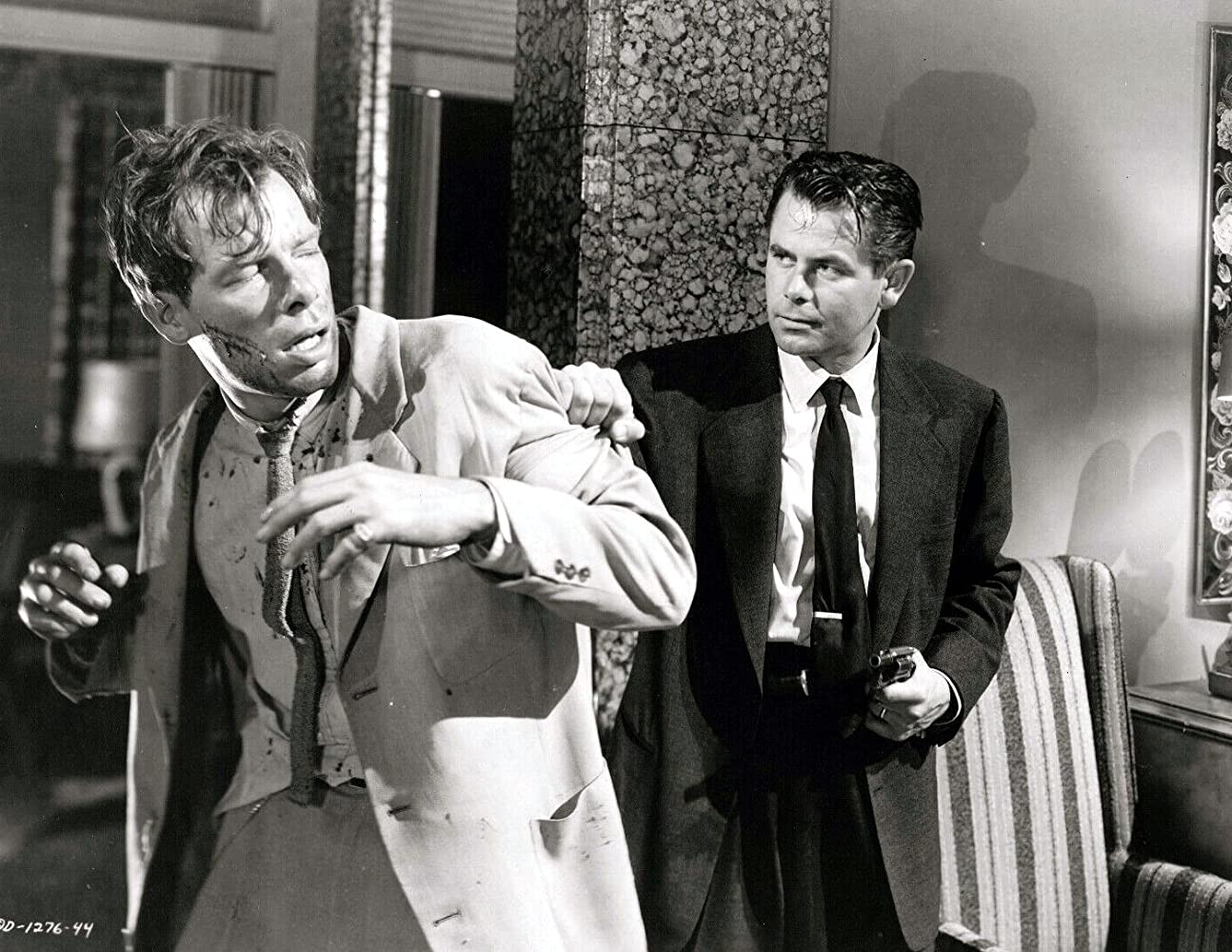
Fritz Lang became well known in the U.S. for his bleak film noirs like THE WOMAN IN THE WINDOW (1944) and SCARLET STREET (1945) both starring Edward G. Robinson. The closest he came to making Hitchcock like films were MINISTRY OF FEAR (1944) with Ray Milland and CLOAK AND DAGGER (1946) starring Gary Cooper. But watch MINISTRY OF FEAR with its German Expressionism and nightmare like quality and it's distinctively Lang and not Hitchcock.  In the 1950s Lang would begin to return to crime dramas only this time the urban American kind. THE BIG HEAT (1953) is my favorite.  Starring Glenn Ford, THE BIG HEAT has an early performance by tough guy Lee Marvin in a supporting role, the greatest, most sultry film noir femme fatale of all time Gloria Grahame, and the infamous coffee pot scene, shocking even by today's standards.

Directed by Fritz Lang, THE BIG HEAT'S screenplay is by Sydney Boehm from a Saturday Evening Post serial written by William P. McGivern, a former crime reporter in Philadelphia. THE BIG HEAT begins with a bang...literally. Police Sergeant Tom Duncan commits suicide in his study, a gunshot to the head. He leaves behind a confession addressed to the District Attorney which his wife Bertha Duncan (Jeannette Nolan) takes. But instead of calling the police first, Mrs. Duncan calls crime boss Mike Lagana (Alexander Scourby). They agree to talk later.  Assigned to the murder case is homicide detective Dave Bannion (Glenn Ford). A good honest cop, Bannion has a pretty, vivacious wife Katie (Jocelyn Brando) and a precocious daughter Joyce (Linda Bennett). Bannion interviews Mrs. Duncan but gets little information from her.  While having dinner, Bannion receives a tip.  He meets up with barfly Lucy Chapman (Dorothy Green) at a lounge called The Retreat. Lucy reveals she was having an affair with the deceased Tom Duncan. She says he didn't kill himself. He wanted a divorce from his wife.

Bannion returns to question Mrs. Duncan. She admits she knew about her husband's affair. The next day Bannion's notified that Lucy Chapman's tortured and beaten body was found outside the city.  Bannion's called into Lt. Ted Wilks (Willis Bouchey) office.  Wilks tells Bannion to lay off bothering the widow Mrs. Duncan. Bannion senses he's getting warmer in his investigation. He returns to the bar that Lucy frequented, asks the bartender Tierney (Peter Whitney) a few questions. When Bannion leaves, Tierney calls Lagana. Bannion receives a threatening phone at home that night. He visits Lagana and threatens the crime boss, roughing up Lagana's bodyguard George Rose (Chris Alcaide). Lagana asks his top fixer Vince Stone (Lee Marvin) to take care of Bannion. The next day, Wilks chews out Bannion a second time for visiting Lagana.  That night, as Bannion and his wife Katie prepare to catch a movie, Katie goes to start the car and pickup a babysitter.  She's killed by a car bomb meant for Bannion.

Police Commissioner Higgins (Howard Wendell) and Wilks assure Bannion they'll find the killer. Bannion doesn't buy it. He accuses the commissioner of working for Lagana.  Higgins suspends Bannion for insubordination.  Bannion moves out of his house and into a hotel room, too many memories of his wife Katie lingering. Joyce stays with a friend of Bannion's. Lagana visits Vince.  Vince had hired another contract killer Larry Gordon (Adam Williams) to handle Bannion. Larry mistakenly blew up Katie instead. Lagana is not happy with Vince. Bannion begins tracking down the car bomber. A lead at a wrecking yard steers Bannion back to The Retreat where Larry likes to hang out. Instead, Bannion encounters the sadistic Vince with his wisecracking moll Debby Marsh (Gloria Grahame). Bannion observes first hand Vince's ugly side when he burns Doris (Carolyn Jones), a cocktail waitress with his cigarette butt. Bannion kicks Vince out of the bar. Debby likes Bannion's style.  She tries to buy him a drink. Bannion refuses and leaves for his hotel room. Debby catches up with him outside and invites herself to Bannion's room. Larry pulls up in time to see the two of them leave together.

Bannion and Debby trade insults and jokes at his hotel room but nothing comes of it. Debby returns to Vince's penthouse. Jealous that Debby hung out with Bannion, Vince throws a scalding pot of coffee on Debby's face, scarring her. Lagana puts a contract out on Debby. She know too much. Debby returns to Bannion's hotel room, half her face bandaged up, wanting vengeance on Lagana and Vince. Bannion and Debby become an unlikely team. Bannion punches his way to answers, catching up with Larry, forcing him to talk then throwing him to his associates as a snitch. Vince will kill Larry (offscreen) for squealing. Debby confronts Mrs. Duncan. Debby wants the suicide/confession note. Mrs. Duncan won't give it to her so Debby shoots the widow.  Vince returns to his penthouse. Debby waits for her ex with a pot of coffee as Bannion joins her to take down Lagana, Vince, and the crime syndicate. 

Gangsters were all the rage in the movies in the early 30s like Mervyn LeRoy's LITTLE CAESAR (1931) and Howard Hawks SCARFACE (1932). The genre faded until after World War II when gangsters and organized crime returned first in real life (that's where Robert Kennedy made his name chasing gangsters as Attorney General) and then the movies.  The 1950s saw a rebirth of gangsters in films like Richard Brooks DEADLINE - U.S.A. (1952) with Humphrey Bogart and THE BIG HEAT.  

As I mentioned earlier, THE BIG HEAT starts with a bang within its first few frames and never lets up.  If THE BIG HEAT had been made today, it's violence would have tagged it with a hard R rating.  It feels like a James Ellroy novel. THE BIG HEAT pulsates with violence, but Lang shrewdly keeps most of the violence offscreen. But that doesn't stop the characters from describing it. Lucy Chapman's murder is described vividly. We're told she was tortured with burn marks on her body before she was strangled.  Only later does Lang reveal the culprit when we see the cold-blooded Vince extinguish his cigarette on a cocktail waitress's arm when she picked up some dice too quick. Even the infamous coffee pot scene happens offscreen.  I swear the first time I saw THE BIG HEAT, I saw Vince throw the hot coffee on Debby's face. That's how shocking the moment was.  Lang emphasizes the horror of the act with Debby's anguished howl.  

Lang sets up Ford's Dave Bannion perfectly as the perfect All-American cop with a pretty wife and cute daughter then destroys that image within thirty minutes, turning Bannion into a tortured wrecking ball, obsessed with finding his wife's killers after she's accidentally blown up by a car bomb meant for him. Bannion is the prototype of future vengeance seeking cops like Clint Eastwood's DIRTY HARRY (1971) or Bruce Willis's John McLane in DIE HARD (1988)Corruption also fuels Bannion's lust for retribution.  Everyone in Kenport in THE BIG HEAT is corrupt except the good cop Bannion. The police force, the police commissioner (we see him playing poker with Lagana's hired killer Vince Stone), bartenders, hookers, and even the widow Mrs. Gordon. All of them greased with dirty money from crime boss Mike Lagana.

For me, THE BIG HEAT is Fritz Lang's last great noir/crime film.  He would make two other interesting noir like films in the 50s -- WHILE THE CITY SLEEPS (1956) and BEYOND A REASONABLE DOUBT (also 1956) both starring Dana Andrews but they both have a televison style quality to them.  THE BIG HEAT is bathed in light and dark, shadows and low-key lighting making everyone look more sinister. Credit goes to Director of Photography Charles Lang, Jr who shot many of Billy Wilder's films including SABRINA (1954) and SOME LIKE IT HOT (1959). Lang also had a penchant for selecting supporting actors with distinct characteristics that stand out from the leads. The big boned Peter Whitney (THREE STRANGERS) with his bushy eyebrows as the bartender Tierney or the short, rotund Dan Seymour as Atkins the wrecking yard foreman or Edith Evanson as the spinster like secretary with the cane and thick glasses who identifies Larry as the bomber for Bannion. The car bomber Larry (Adam Williams) with his blonde hair and sniveling manner reminded me of a Lang favorite Dan Duryea who appeared in Lang's SCARLET STREET and MINISTRY OF FEAR. 

One of the best parts of THE BIG HEAT are the unlikely team of cop Dave Bannion and sarcastic hood girlfriend Debby Marsh who take down Lagana and his empire. Bannion and Debby meet half way through the film, courtesy of Debby's psychopath boyfriend Vince. Director Lang teases us that the recently widowed Bannion and the sexy, put upon girlfriend of Vince might hook up.  Debby invites herself to Bannion's hotel room and he lets her in. She even makes herself cozy on his bed. But Debby's really turned on that Bannion wasn't afraid of Vince and pushed him around like a stooge. The loss of Bannion's beloved wife and the loss of Debby's good looks unite both of them in a crusade to right the wrongs that have turned both of them into damaged goods.


Before I saw THE BIG HEAT, I only knew Glenn Ford as an older actor, having only seen him play a Rear Admiral in Jack Smight's World War II drama MIDWAY (1976). But Ford was quite a leading man in his early years.  He began a nice streak of leading man roles in the 1940s and 50s appearing in Charles Vidor's GILDA (1946) starring Rita Hayworth; Richard Brooks THE BLACKBOARD JUNGLE (1955) as a new teacher in an inner city high school, and as an outlaw leader in 3:10 TO YUMA (1957). Ford's perfect in THE BIG HEAT transforming from good guy to enforcer, busting balls and heads as he finds his wife's killers and cleans up a corrupt city.

Sexy noir siren Gloria Graham was just coming off winning the Academy Award for Best Supporting Actress in Vincente Minnelli's THE BAD AND BEAUTIFUL when she made THE BIG HEAT.  Grahame steals THE BIG HEAT in many ways.   She has all the best lines and brings humor and pathos to her character of Debby Marsh.  When Lee Marvin's Vince asks if she's wearing a new perfume, Graham's Debby retorts, "Something new. It attracts mosquitoes and repels men." Graham's half bandaged face after Vince throws hot coffee on her gives her a Phantom of the Opera like quality. 

The 1950s was Grahame's decade after first attracting attention in Frank Capra's IT'S A WONDERFUL LIFE (1946) with James Stewart and her first film noir turn in CROSSFIRE (1947) with Robert Mitchum. Grahame would co-star with Humphrey Bogart in Nicholas Ray's IN A LONELY PLACE (1950), win an Academy Award as an unhappy wife to writer Dick Powell in THE BAD AND THE BEAUTIFUL (1952), and appear in the big budget THE GREATEST SHOW ON EARTH (1952) directed by Cecil B. DeMille. Both Grahame and Glenn Ford would work with Fritz Lang the following year in HUMAN DESIRE (1954) co-starring Broderick Crawford where they would get the chance to play lovers.

Lee Marvin made his career playing anti-heroes in films like Robert Aldrich's THE DIRTY DOZEN (1966) and John Boorman's POINT BLANK (1967) but he began his career as a supporting actor with a humorous turn as Meatball in THE CAINE MUTINY (1954) and memorable bad guys in John Ford's THE MAN WHO SHOT LIBERTY VALANCE (1962) and as the sadistic psychopath Vince Stone in THE BIG HEAT. Even though Marvin's Vince is a terrible person, Marvin makes him charming and a bit sad.  When Bannion emasculates Vince in front of his friends at The Retreat, I felt sympathy for him. But it doesn't last long. Vince turns his embarrassment into rage, disfiguring Debby in a fit of anger. But Debby's a handful and she'll get her revenge on Vince, returning the hot coffee to the face favor to her ex.

Jocelyn Brando has a memorable, brief role as Bannion's wife Katie. She's not your typical suburban wife. She'll share a glass of beer or take a puff of Bannion's cigarette while making dinner for her husband. She's like one of the guys and Bannion loves her for that. Jocelyn Brando was the older sister of Marlon Brando (who knew!).  Glenn Ford even co-starred in THE TEAHOUSE OF THE AUGUST MOON (1956) with Marlon. Although she didn't have as well known a career as her little brother, Jocelyn would appear in a few more films like Jacques Tourneur's NIGHTFALL (1956) and work steadily in television for several decades.

THE BIG HEAT is a crackerjack crime drama, raw and visceral that has everything you want in a gritty gangster film: a handsome cop seeking vengeance; a villain to root against; a beautiful, sassy femme fatale, and a crime cartel that will go to all extremes to remain on top.  Directed by the expert hands of film noir master Fritz Lang, THE BIG HEAT is as shocking and powerful today as it was in 1953. 

Thursday, July 30, 2020

Do the Right Thing (1989)

Racial tensions in an urban city. A black man suffocated to death by the police. Rioting in the streets.  It sounds like I'm talking about the latest nightly newscast.  But these all happen in Spike Lee's DO THE RIGHT THING made in...1989.   Thirty one years ago, director Spike Lee's third feature film foreshadowed today's headlines and reminds us we haven't made much head way in race relations since 1989. I was going to revisit a past summer blockbuster BACK TO THE FUTURE (1985) directed by Robert Zemeckis this month but recent events involving the tragic deaths of George Floyd and Ahmaud Arbery, both African American men, changed my mind.  It's time to look back at a film and director who had his thumb on the pulse of racial discord and Black Lives Matter way before 2020 arrived.

"1989 the number another summer" belted out the rap band Public Enemy with Fight the Power over the opening credits of DO THE RIGHT THING. It was a hot summer afternoon in 1989 when a white kid from Portland, Oregon went to see DO THE RIGHT THING not in Brooklyn or Bedford Stuyvesant but the Beverly Cineplex Odeon theater on trendy Melrose and Beverly Blvd in Los Angeles, CA. For two hours, I was mesmerized by Lee's use of color, extreme close ups, Dutch (titlted) camera angles, and mixture of humor and drama as his story of a scorching summer day in Brooklyn, New York unfolded. Black, White, Puerto Rican, Italian, and Korean characters all intertwine until the heat and rising tensions reach a boiling point. For me, this is Spike Lee's masterpiece (better than MALCOLM X or BLACKKKLANSMAN which are both fine films). With DO THE RIGHT THING, Lee paved the way for a new generation of black filmmakers including John Singleton (BOYZ IN THE HOOD), Carl Franklin (ONE FALSE MOVE), and Ernest Dickerson (JUICE) who's was Lee's cinematographer for several of his films including DO THE RIGHT THING.


Lee, who wrote and directed DO THE RIGHT THING, sets his Greek like comedy/tragedy in the Brooklyn suburb of Bedford Stuyvesant where a mixture of different ethnic characters work and live in an uneasy alliance of racial unity. Set in a single, scorching summer day, we are first introduced to Mookie (Spike Lee) who lives with his sister Jade (real life sister Joie Lee). Mookie struggles to make ends meet, trying to support his Puerto Rican girlfriend Tina (Rosie Perez) and their young child Hector.  The local gathering place is Sal's Famous Pizzeria, owned and run by Sal (Danny Aiello) and his two sons Vito (Richard Edson) and Pino (John Turturro). Mookie works for Sal as their pizza delivery boy.

We soon meet more characters on the block. Buggin Out (Giancarlo Esposito), Mookie's friend, is a Nike wearing firebrand. Radio Raheem (Bill Nunn) walks around the streets with his gigantic boom box, blaring Public Enemy's Fight the Power, the anthem of the film. Da Mayor (Ossie Davis) and Mother Sister (Ruby Dee) are the patriarch and matriarch of the block. ML (Paul Benjamin), Sweet Dick Willie (Robin Harris), and Coconut Side (Frankie Faison) sit on the sidewalk under a beach umbrella, a Greek chorus observing daily life in the neighborhood. DJ Mister Senor Love Daddy (Samuel L. Jackson) on We Love FM 108 plays the tunes from a nearby building. The stuttering Smiley (Roger Guenveur Smith) tries to sell a photo of Martin Luther King and Malcolm X together to anyone he can stop. And keeping the peace, however tenuous, are Officer Ponte (Miguel Sandoval) and Officer Long (Rick Aiello).


As the day grows longer, fuses become shorter. Pino's weary of working for his father Sal in a neighborhood that's not Italian. Pino wants Sal to sell the pizzeria. Vito's tired of Pino picking on him. Mookie tells Vito he needs to stick up for himself, irritating Pino. Tina wants Mookie to visit her and their infant more. Raheem brings aggravation with his boom box, upsetting a group of Puerto Rican youths first with his loud music and later Korean grocery store owner Sonny (Steve Park) and his wife Kim (Ginny Yang). The entire neighborhood freaks out when Larry Bird jersey wearing Clifton (John Savage) accidentally scuffs up Buggin Out's new white Nike's. They fear gentrification as the only white guy on the block goes into his brownstone apartment. Mookie gets jealous when he catches Sal and Vito acting nice to his sister Jade. But the catalyst for the film's finale is when Buggin Out complains to Sal that his pizzeria only has photo of Italians like Frank Sinatra and John Travolta on its wall but no photos of black people. Buggin Out tries to organize a boycott of the pizzeria enraging Sal but the locals like Ahmad (Steve White), Cee (Martin Lawrence), Punchy (Leonard L. Thomas), and Ella (Christa Rivers) all like their pizza slices too much to join.

Dusk begins to fall on the neighborhood. Sal starts to close up for the night.  Ahmad, Cee, Punchy, and Ella beg for one last slice of pizza.  Sal gives in against Pino's wishes. But then Buggin Out and Radio Raheem show up, Raheem's boom box music cranked to the highest decibel.  Sal loses his cool and takes a baseball bat to the boom box. Radio Raheem leaps over the counter and attacks Sal, starting a fight that will move outside into the street, starting a tragic chain of events that will end in the unnecessary death of a black man and the destruction of a neighborhood institution. 


One of the strengths of DO THE RIGHT THING is every character is flawed, no matter their ethnicity. They all have their faults as well as their good sides. Sal's an Italian American who has set up his livelihood in a black neighborhood.  For the most part, Sal gets along with his black customers but Buggin Out and Radio Raheem get under his skin, revealing cracks in Sal's character.  Mookie seems like a good kid. He's a peacemaker at times between Sal's racist son Pino and Mookie's friends. But Mookie's not a good father or boyfriend.  Tina has to order a pizza to get Mookie to come see her and their son. And Radio Raheem may seem cool with his tricked out boom box but he plays his music too loud, not caring about the others around him. As the film unfolds, the racial divide between the multicultural block is revealed, punctuated by a brief montage in which director Lee has five different ethnic characters spew out racial epithets to the camera, breaking the third wall. 

DO THE RIGHT THING can be summed up by two quotes that director Lee shows at the end of the film.  One quote is from Martin Luther King preaching peace; the other quote is from Malcolm X condoning violence in self defense when necessary. DO THE RIGHT THING offers both choices and asks its characters and you to choose. The film shows most of the characters going through their lives, trying to get along, in a civil manner. But when overzealous policeman Officer Long goes too far in restraining Radio Raheem "because he had a radio", even Sal's most loyal customers turn on him and his pizzeria, needing to express their outrage at the racial injustice they have all just witnessed. It's Mookie of all people who sparks the riot.  Mookie tried to be the peacemaker but it didn't work. His friend is dead. What's it going to take to make people "wake up" as Spike Lee often says.  Peaceful protest or throwing a garbage can threw the pizzeria's window.


Director Lee doesn't just nail DO THE RIGHT THING'S racial tensions.  From a purely cinematic point of view, Lee and cinematographer Ernest Dickerson make bold choices visually that enhance the film. Lee and Dickerson shoot the characters in numerical groups of four, threes, and twos for dramatic effect. Close ups of characters are shot wide angle, often down low looking up or from up high looking down.  The camera is often tilted slightly to the left or right, making the world slightly out of balance.  It's the hottest day of the summer in Brooklyn so Lee uses warm colors to give the impression of heat.  The Greek Chorus sits in front of fire red brick wall. Teenagers turn on the fire hydrants to cool off, spraying anyone close by. Tina dumps her head in a bucket of ice water. The theater I watched DO THE RIGHT THING might have had air conditioning but the movie screen pulsated with heat both literally and emotionally. 

Watching DO THE RIGHT THING again, I didn't realize how many up and coming film stars got their start in this Spike Lee Joint.  Martin Lawrence (BAD BOYS) as Cee, Samuel L. Jackson (PULP FICTION) as the neighborhood DJ Senor Love Daddy, Giancarlo Esposito (BREAKING BAD) as Buggin Out, Bill Nunn (SPIDER MAN) as Radio Raheem, and in her film debut Rosie Perez (WHITE MEN CAN'T JUMP) as Mookie's girlfriend Tina all have small but key supporting roles in DO THE RIGHT THING. Even Spike Lee who had appeared in his previous two films SHE'S GOTTA HAVE IT (1986) and SCHOOL DAZE (1988) was not very well known until his performance as Mookie in DO THE RIGHT THING.  Lee would become more famous as an actor in a series of Nike commercials with basketball legend Michael Jordan (directed by Lee) where Lee reprised his goofy character Mars Blackmon from SHE'S GOTTA HAVE IT. Although most of the characters in DO THE RIGHT THING are not sympathetic, Mookie is our guide for the day, his pizza deliveries taking us to encounters with the diverse inhabitants of the block he lives on. 


Ossie Davis and Ruby Dee (who were married in real life) are the most well known black actors in the film.  Davis and Dee are touching as the elders on the block who have seen it all. Danny Aiello, fresh off his performance as Nicolas Cage's older brother in Norman Jewison's MOONSTRUCK (1987), is probably the most familiar face. Like many of the characters in the film, Aiello's Sal is hard to pin down. He's sympathetic at times but then changes with outbursts toward his sons or customers. John Turturro (BARTON FINK) and Richard Edson (PLATOON) as his sons Pino and Vito are excellent, representing both sides of Sal. Turturro could play Pino as a one dimensional bigot but he shows signs of humanity especially when Pino and Mookie discuss their favorite black athletes. Pino could be a better person like his brother Vito if  he could just get past his prejudices. Vito is the more easy going brother, the peacemaker between Sal and Pino. 

John Savage (THE DEER HUNTER) has a funny turn as the Larry Bird jersey wearing white guy on the block.  And Martin Scorsese favorite character actor Frank Vincent (GOODFELLAS) also has a brief appearance as an Italian man caught in the middle of a fire hydrant water fight. Spike Lee's sister Joie Lee who plays Mookie's sister Jade is one of the more likable characters in DO THE RIGHT THING. She gets under her brother's skin when she flirts innocently with Sal and Vito at the pizzeria. Like Pino getting on Vito for commiserating with blacks, Mookie takes Jade aside, expressing his dissatisfaction with Jade getting friendly with the Italian-Americans he works for. Everyone has prejudices that creep out. 


As I said at the beginning of this essay DO THE RIGHT THING foretells events happening in 2020 as well as the 1992 LA riots that happened just a few years after DO THE RIGHT THING came out in 1989.  Interestingly, when Spike Lee made his film, Lee was reacting to several incidents in New York where black people were either wrongly killed by authorities (Michael Stewart, Eleanor Bumpers) or the infamous Howard Beach incident where four black men whose car broke down in Queens, New York were beaten by a group of white youths after leaving a pizzeria. One of the black men, Michael Griffith, ran out onto a highway to escape his attackers and was hit and killed by a car. Out of these horrible incidents of injustice in New York City, Lee wrote DO THE RIGHT THING. At the time it may have seemed like a New York problem but history has ripped the band aid off to show racism and injustice is a national issue, one that has never really gone away.

Just as I followed Steven Spielberg, David Lynch, and Oliver Stone during their creative periods, Spike Lee was a revelation for me after DO THE RIGHT THING.  I couldn't wait to see what his next projects would be. Lee followed up DO THE RIGHT THING with MO BETTER BLUES (1990) starring Denzel Washington as a jazz trumpeter and JUNGLE FEVER (1991) starring Wesley Snipes and Annabella Sciorra dealing with interracial romance.  Although both well made, neither film captivated me like DO THE RIGHT THING. By the time Lee came out with his magnum opus MALCOLM X (1992) I had already moved on to the next up and coming directors (John Woo and Quentin Tarantino by that time).  I wouldn't rediscover Spike Lee again until his excellent heist film INSIDE MAN (2006) came out with an all star cast including Denzel Washington, Clive Owen, Jodie Foster, and Christopher Plummer. Spike Lee is the preeminent black director of our time, still making racially and socially interesting films like BLACKKKLANSMAN (2018) and the recent Vietnam drama DA 5 BLOODS (2020) for Netflix.


DO THE RIGHT THING was both praised and criticized when it was released.  Many were surprised that a film about racial discord could be so stylized.  But that's exactly what captivated me about the film.  DO THE RIGHT THING has a powerful social message but it's presented in a creative, fresh, eye popping way.  It reminds me of another stylized film about two street gangs that fought it out in the streets of New York -- Robert Wise and Jerome Robbins WEST SIDE STORY (1961).  DO THE RIGHT THING is more relevant than ever today.  Even as I type, every day Americans of all color and sexual orientation are protesting for a better, more equal future.  They are doing the right thing.

Sunday, June 28, 2020

The Razor's Edge (1946)

There is a time in our lives when we need to go somewhere and find ourselves, rediscover or reconnect, learn something new.  It could be for a weekend, a week, a month, a year, or longer. That time came for me after college. For sixteen years, I had been in school. Now I was on the cusp of adulthood, not certain what my job vocation would be. Before I was to enter the job market, I traveled to Europe for a couple of months to see different cultures, landscapes, people, and history.  It was one of the greatest times of my life.  THE RAZOR'S EDGE (1946), based on the novel by W. Somerset Maugham, is the story of one man's journey to seek enlightenment after returning home from the horrors of World War I.

During the Golden Age of Hollywood (which I consider the 30s thru the 50s), actors and actresses were often contracted to one studio for a defined period (although they could be loaned out to a rival studio from time to time). Humphrey Bogart, Errol Flynn, and James Cagney all had contracts with Warner Brothers. Spencer Tracy and Clark Gable were contracted with MGM.  THE RAZOR'S EDGE, made by 20th Century Fox, is full of Fox contract players. Lead Tyrone Power appeared in a variety of 20th Century Fox films including THE MARK OF ZORRO (1940).  Gene Tierney and Clifton Webb appeared in Fox's LAURA (1944) directed by Otto Preminger. And Anne Baxter who would win a Best Supporting Actress Academy Award for THE RAZOR'S EDGE would earn more rave reviews four years later in Fox's ALL ABOUT EVE (1950) directed by Joseph L. Mankiewicz. Fox Studio head Darryl F. Zanuck made sure he had all his best stars for THE RAZOR'S EDGE.


One of the things that made me want to watch THE RAZOR'S EDGE is its title.   What does it mean - the razor's edge? The term comes from a Hindu proverb. "The sharp edge of a razor is difficult to pass over; thus the wise say the path to Salvation is hard." Apparently, I wasn't the only one attracted to the title or the story.  Bill Murray, of all people, would not only star but co-write a remake of THE RAZOR'S EDGE in 1984 directed by John Byrum and co-starring Theresa Russell and Denholm Elliott (A ROOM WITH A VIEW). It would be Murray's first dramatic role . Although I have not seen the remake, the few articles I've glanced at indicate the more recent version was considered a bust after its release.

Directed by Edmund Goulding with a screenplay by Lamar Trotti based on the novel by W. Somerset Maugham (what a great name for a novelist), the 1946 THE RAZOR'S EDGE begins with the author W. Somerset Maugham (Herbert Marshall) passing through Chicago in 1919 and attending a party thrown by his wealthy expatriate friend Elliott Templeton (Clifton Webb) who's back in town to visit his sister Louise Bradley (Lucile Watson). Elliott's niece Isabel Bradley (Gene Tierney) is engaged to handsome Larry Darrell (Tyrone Power), a pilot recently back from World War I. Also in attendance at the party are Gray Maturin (John Payne) who's also in love with Isabel and Sophie MacDonald (Anne Baxter) a childhood friend of Isabel and Larry's. Templeton is not happy with Larry who has recently turned down a good job offer from Gray's wealthy father. Larry wants to "loaf" and travel. He's haunted by the loss of his friends who died in World War I. Isabel tells Larry to go travel before they get married. She'll wait for him. Larry takes her up on the offer and heads off for Paris.


Larry lives a bohemian life style in Paris as he seeks "the meaning of life."  Isabel and Elliott travel to Paris to visit Larry.  Isabel doesn't like Larry's free lifestyle.  She returns his engagement ring. Larry and Isabel have one last night out in Paris.  The passion is palpable but Isabel cuts it short.  She returns to Chicago and marries the more financially stable Gray. Larry finds himself working in a coal mine in France. He "doesn't believe in anything." One of his co-workers Kosti (Fritz Kortner), a former defrocked priest suggest Larry travel to India to seek enlightenment. Larry takes him up on the suggestion and makes the journey to India. Larry meets a Holy Man (Cecil Humphreys) who takes Larry up into the mountains where Larry rediscovers the beauty in life.

Larry returns to Paris.  He runs into Somerset who catches Larry up on his old friends.  Gray and Isabella were wiped out by the Crash of 1929 and lost everything.  Gray had a nervous breakdown. Elliott supports both of them and their two kids in Paris.  Somerset visits Isabel to tell her Larry is back in the city. Larry visits all of them in their apartment.  With what he learned in India, Larry cures Gray of his headaches with some simple mental exercises. They go to a working class French bar Rue de Lappe to celebrate and run into Larry's old childhood friend Sophie.  While Larry was away in India, Sophie was injured in a car accident in Chicago that killed her husband Bob MacDonald (Frank Latimore) and their daughter. Sophie moved to Paris where she's become a drunk. Moved by her misfortune, Larry helps Sophie to become sober. Larry and Sophie soon become engaged.


Isabel is furious that Larry and Sophie are to be married as Isabel has never stopped loving Larry. She's mad that Somerset doesn't agree with her. Somerset takes everyone out to the Ritz to celebrate the engagement. Isabel offers to buy Sophie a wedding dress as a token that she's not angry at Larry.  But when Sophie comes over to Isabel's apartment to try on the dress, Isabel tempts Sophie with a liqueur. Sophie relapses. Larry searches for Sophie, finding her in an opium den. Larry's beat up as he tries to recue her.  Sophie vanishes from Paris. Somerset returns to his residence on the French Rivera.  A year later, Somerset and Larry are reunited when Sophie's body is found in the harbor in Toulon. Larry is questioned but her murder remains unsolved. Elliott lays dying in Nice. Upset that he's not received an invitation from a princess he once helped, Larry visits the princess's secretary Miss Keith (Elsa Lanchester) and obtains an invitation, one last pleasure for Elliott before he dies. Larry decides to return to the United States via a steamer. Before he leaves, he questions Isabel if she provided alcohol to Sophie. Isabel admits to it. Larry reveals Sophie was murdered, a fact Isabel was not aware of. Isabel loses Larry for good as he returns to America.

THE RAZOR'S EDGE is a must see for any one like the protagonist Larry Darrell -- restless, self-sacrificing, and not attached to materialistic things.  Larry lives the bohemian life we all dream of. Moving to Paris. Biking through the countryside.  Taking classes at the Sorbonne. But he paid a price for this quest for self-fulfillment. Larry saw the horrors of World War I, saw a soldier killed saving his life. I liked Larry's attitude. When he returns from the Himalayas to discover his former fiancée is married to his best friend, he shows no jealousy, just love. Larry didn't know what he wanted in life after the war.  But his return from the Far East has given Larry a second chance. 


It's never implied in THE RAZOR'S EDGE but Larry, in a way, is like Jesus (both names even have five letters). Larry cures Gray from his terrible headaches and melancholy.  Larry helps his childhood friend Sophie when she's down and destitute and lifts her wayward soul back to the living. They get engaged. Larry even performs a good deed for the Elliott who never had a good word to say about him. While Larry shunned money, marriage, and a good job to search for something more meaningful in life, his more materialistic friends end up suffering setbacks and tragedy.  Larry harbors no ill feelings toward any of them.  Not even his ex-fiancée Isabel when she confesses she's the one who tempted Sophie back to the bottle, ultimately destroying Sophie's life.

Tyrone Power may have been better known for his swashbuckling roles in films like THE BLACK SWAN (1942) or PRINCE OF FOXES (1949) but he seems perfectly cast as everyman Larry Darrell who travels the world after his World War I experiences to seek enlightenment.  "If I ever acquire wisdom," Larry says, "I suppose I'll be wise enough to know what to do with it." Powers plays Larry with an even keel.  Larry never raises his voice, never judges, never shows too much or too less emotion. He's like a walking meditation. THE RAZOR'S EDGE and Power's next film, the film noir NIGHTMARE ALLEY  (1947) in which Powers plays a con man were two meaty roles that showed Powers could play more than pirates and knights. 

Opposite Powers is Gene Tierney who has the unenviable role of Isabel, Larry's former fiancee in THE RAZOR'S EDGE. Isabel cannot make a good choice for herself. Even though she encourages Larry to go to Paris, she ends up dropping him for the rich and established Gray. The Stock Market crashes and so does Gray and Isabel's fortunes. When Larry returns from India relaxed and different, Isabel reveals she's never stopped loving Larry. But Larry's too interested in helping others. Larry's engagement to Sophie drives Isabel mad with jealousy, causing her to make her greatest mistake -- tempting the newly sober Sophie with alcohol. Isabel's action will send Sophie spiraling to a terrible death and forever cut her off from the man she always loved but couldn't wait for - Larry Darrell. THE RAZOR'S EDGE is a good dramatic role for Tierney who appeared in several film noirs for 20th Century Fox including LAURA, WHIRLPOOL (1950), and WHERE THE SIDEWALK ENDS (1950) all directed by Otto Preminger. In a way, Tierney's Isabel is a femme fatale who can't see the good side in Larry's actions.


If you've never seen Anne Baxter in a film before, THE RAZOR'S EDGE is a good place to start. Unlike many actresses during that time period who played the same character over and over, Baxter had range. As Sophie MacDonald, Baxter arcs from the girl next door at the start of the film to a drunken harlot rescued by Larry if only temporarily. It's a tragic role and Baxter would win Best Supporting Actress as Sophie. Baxter probably should have won another Academy Award for ALL ABOUT EVE as aspiring actress Eve Harrington but fine performances by co-stars Bette Davis and Celeste Holm cancelled each other out for the award. Clifton Webb as Isabel's perennially grumpy rich uncle Elliott Templeton provides THE RAZOR'S EDGE with short bursts of humor. Elliott is a snob who loves to entertain. Elliott has "no friends, just acquaintances" Somerset tells Sophie at the film's opening party. Webb could play villains like in LAURA and as well as comedy such as the fastidious genius Mr. Belvedere in SITTING PRETTY (1948) and two other Belvedere sequels.

Although I had never heard or read about him before THE RAZOR'S EDGE, British director Edmund Goulding seems the perfect choice for the film. Goulding actually fought in World War I giving him some insight into Larry Darrell's psyche. Goulding directed the World War I flying film THE DAWN PATROL (1938) starring Errol  Flynn, David Niven, and Basil Rathbone.  Goulding was also familiar with author W. Somerset Maugham's works having directed OF HUMAN BONDAGE (also 1946) based on Maugham's novel for Warner Brothers starring Paul Henreid (CASABLANCA) and Eleanor Parker. His handling of THE RAZOR'S EDGE is never maudlin or sappy. The film moves at a brisk pace with lots of characters and location changes but we never feel lost or confused in the storytelling. Goulding would also direct Tyrone Powers in NIGHTMARE ALLEY a year later. Goulding would direct nine actors to Academy Award nominations with two of them winning (Baxter one of them). 


I hope to do an update to this post when I'm finally able to watch the 1984 version of THE RAZOR'S EDGE starring Bill Murray and directed by John Byrum.  I did watch the ninety second trailer and came away with a couple of quick thoughts.  The newer RAZOR'S EDGE looks to have some flashback sequences to World War I, a chance to show how Larry came away from that war scarred.  I was surprised that the original never had any flashbacks to Larry's war experiences.  The other highlight with the newer version are actual location filming in India for Larry's journey to the Far East. The India/Himalaya sequences in Goulding's THE RAZOR'S EDGE were never very satisfying. 

Whether Bill Murray (who would seem like the perfect actor to play a character who wants to "loaf") can pull off  a dramatic performance remains to be seen.  So for now, Goulding's THE RAZOR'S EDGE is the gold standard for Maugham's tale of one man's journey to spiritual enlightenment.  A strong cast, engaging story, and dramatic twists make THE RAZOR'S EDGE a classic adaptation of a classic novel. 

Sunday, May 31, 2020

Escape from New York (1981) and Escape from L.A. (1996)

With the recent lockdown of New York and California during the Coronavirus pandemic, it seems appropriate to return to the science fiction genre again this month to explore two films that dealt with lockdowns in those respective cities but in a different capacity. John Carpenter's ESCAPE FROM NEW YORK (1981) set in the slightly distant future is about a lockdown but not for pandemic reasons. Manhattan Island has become a maximum security prison for the entire country with a wall surrounding the Big Apple that would make Donald Trump jealous. In Carpenter's less successful sequel ESCAPE FROM L.A. (1996) Los Angeles becomes a penal colony after it breaks off into the Pacific after an earthquake. Both films star Kurt Russell as the eye patch wearing former special forces operative Snake Plissken.

1981 was a watershed moment for the horror/science fiction/adventure genre. A new wave of directors came out that year with films that floored movie fans and critics alike. Besides Carpenter's ESCAPE FROM NEW YORK, there were the twin werewolf films THE HOWLING directed by Joe Dante and John Landis's AN AMERICAN WEREWOLF IN LONDON, Canadian director David Cronenberg's horror/sci fi thriller SCANNERS, Australian filmmaker George Miller's post apocalyptic THE ROAD WARRIOR, and zombie king George Romero's modern take on King Arthur KNIGHTRIDERS. These directors established themselves as the new guard for horror/sci fi/fantasy. Steven Spielberg's RAIDERS OF THE LOST ARK also came out in 1981. Spielberg would executive produce future films made by Dante, Landis, and Miller.  Carpenter and Dante were film buffs whose movies were affectionate riffs on classics by their favorite directors like Howard Hawks or Frank Capra.  They also had an appreciation for older movie stars and character actors in their twilight years who appeared in some of their favorite classic films, actors like Kenneth Tobey (the original THE THING), Slim Pickens (DR. STRANGELOVE), John Carradine (HOUSE OF DRACULA), and Ernest Borgnine (THE WILD BUNCH) who would appear in films by these young directors.


ESCAPE FROM NEW YORK made a huge impression on me as a teenager. It's slightly futuristic setting would make me a fan of that genre and influence future films like Ridley Scott's BLADE RUNNER (1982), THE TERMINATOR (1984) directed by James Cameron (who worked on ESCAPE FROM NEW YORK as a Visual Effects cinematographer and Matte artist), and Paul Verhoeven's ROBOCOP (1987). Kurt Russell's Snake Plissken is a throwback to anti-hero characters from the 70s like Clint Eastwood's DIRTY HARRY (1971).  Carpenter continued his use of the Steadicam with smooth tracking shots down dark New York alleys and streets that I copied in my Super 8mm films.  I held ESCAPE FROM NEW YORK in such high regard that when Carpenter finally made a sequel 15  years later with ESCAPE FROM L.A., I couldn't bear to watch it. How could it top ESCAPE FROM NEW YORK?  Usually, I'm excited about sequels with one of my favorite characters but ESCAPE FROM NEW YORK was almost too perfect to build on. Was I afraid ESCAPE FROM L.A. would water down the original even with a bigger budget? I will explore that question shortly.

Written by John Carpenter and Nick Castle and directed by Carpenter, ESCAPE FROM NEW YORK was released in 1981 but takes place 16 years in the future. It's 1997 and the U.S. crime rate has hit 400%. Former Special Unit Forces soldier and current outlaw Snake Plissken (Kurt Russell) is about to go into the country's only maximum security prison - the city of New York - after a botched bank robbery. But a group of terrorists have hijacked Air Force One carrying the United States President (Donald Pleasence) headed to an important world summit to prevent nuclear war. The President is placed in an escape pod before the plane crash lands inside New York City killing everyone else on board. Police Commissioner for the United States Bob Hauk (Lee Van Cleef) scrambles a team to extract the President but they find the pod empty. A hissing psychopath named Romero (Frank Doubleday) warns Hauk the inmates have him and to leave. Hauk formulates a new plan.  He offers Snake a full pardon if he will infiltrate the prison and bring back the President. To ensure that Snake doesn't try to escape, two microscopic charges are placed in Plissken's neck, set to implode if he's not back in twenty four hours. Snake reluctantly accepts the offer.


With the use of a glider, Snake lands on top of one of the World Trade Towers.  Once on the ground, Snake tracks the President's pulse while avoiding the Crazies, denizens of the underground that emerge from manhole covers, looking for food.  Snake follows the signal to a theater where Cabbie (Ernest Borgnine) recognizes Snake. In the theater's basement, Snake finds the President's tracking device but it's a hobo wearing it not the President. Cabbie knows who's holding the President.  He tells Snake that the Duke of New York (Isaac Hayes) has the president.  The Duke is the kingpin of New York City and runs the prison. Cabbie takes Snake to meet Brain (Harry Dean Stanton) and his girl, the tough talking Maggie (Adrienne Barbeau). Brain and Maggie reside in the New York Public Library where Brain makes gasoline for the Duke. Snake and Brain have a past history together as criminals. With a gun pointed at him, Brain promises to take Snake to meet the Duke.

Brain and Maggie lead Snake to the Penn Train Station but it's a trap. Before Snake can free the President, he's captured by the Duke.  Brain tells the Duke that the President is needed for some urgent world matter.  The Duke plans on using the President as leverage to get out of New York. Snake is forced to battle the gigantic Slag (Ox Baker) gladiator style in a wrestling ring inside the train station.  Brain and Maggie use the distraction to kill Romero and grab the President.  Brain figures out that Snake's glider is up on the World Trade Center. Snake dispatches Slag. The Duke and his crew are alerted that Brain has stolen the President.


Snake races to stop Brain and Maggie.  He reaches the top of the World Trade Center only to find Brain and Maggie battling a group of Indians.  The glider is thrown off the building.  Snake leads them back to the ground where Cabbie picks them up.  They have to cross the 69th Street Bridge to reach the wall and Snake's extraction point but the bridge is heavily mined.  Only Brain knows the exact location of each land mine. Snake drives the cab over the bridge with the Duke and his chandelier adorned Cadillac in pursuit.  Time's running out for Snake as he races to get the President and himself over the wall before the Duke (and to a degree Police Commissioner Hauk) finish off Snake.

Director Carpenter talks on the DVD's featurette that he's always had a chip on his shoulder about authority. Carpenter's Snake Plissken is the epitome of an anti-authority character and maybe Carpenter's alter ego. Snake may have worked for the United States Special Forces and received a Purple Heart for his efforts in Leningrad and Siberia but he has no love for the police state that has become the United States.  One of the best scenes in ESCAPE FROM NEW YORK is when Hauk offers Snake the mission to rescue the President. "The President of what?" Snake sarcastically asks. Carpenter portrays the President (played by Donald Pleasence) as a bit of a buffoon. The Duke and Romero torment the President, using him as target practice and place a blonde wig on him in ridicule.  The President will have the last laugh with his captors but it doesn't show our commander-in-chief in the best light. In ESCAPE FROM NEW YORK, the President does not command respect. Carpenter snubs his nose at the authority figures of the world.


ESCAPE FROM NEW YORK is a subversive film. The Statue of Liberty, once a symbol of freedom that once welcomed immigrants from distant countries to America's shores, is now the headquarters for the United States Police Department, black clad enforcement officers enforcing martial law. The only visitors Lady Liberty greets now are the newest prisoners to Manhattan Island. At the end of the film, instead of the Stars and Stripes displayed horizontally, the United States flag is draped vertically like a Nazi banner, signaling a country off kilter. English actor Donald Pleasence plays the U.S. President, his accent hard to pin. Is he from the Ohio valley or the English midlands? We begin to root for the Duke of New York, Romero, Cabbie, Brain and Maggie along with Snake to get out of New York more than the bureaucratic President.

Watching ESCAPE FROM NEW YORK, it's hard to believe the film only cost between $5-6 million dollars. It's a testament to Carpenter and his crew's ingenuity that the film looks more expensive than it is.  Carpenter used Spielberg's production designer Joe Alves who worked on JAWS (1975) and CLOSE ENCOUNTERS OF THE THIRD KING (1978) to make a recently burned out section of St. Louis look like New York City. Only two shots in the film are actually shot in New York (one involving the Statue of Liberty at the start of the film sets the tone).  Director of Photography Dean Cundey who worked with Carpenter on his previous two films HALLOWEEN (1978) and THE FOG (1980) makes the night time look nightmarish with hellish garbage fires and glowing street lamps.  Cundey would later work with director Roger Zemeckis on WHO FRAMED ROGER RABBIT? (1988) and Steven Spielberg's JURASSIC PARK (1993).


We all knew Kurt Russell the kid actor from countless Disney films like THE COMPUTER WORE TENNIS SHOES (1969) or THE STRONGEST MAN IN THE WORLD (1976) but ESCAPE FROM NEW YORK changed Russell's career forever.  Russell was now an adult actor. Russell and Carpenter had just worked on the television film ELVIS (1979) co-starring Russell's then wife Season Hubley (who makes a brief appearance in ESCAPE FROM NEW YORK). Russell and Carpenter would team up again for THE THING (1982), BIG TROUBLE IN LITTLE CHINA (1986), and the Snake Plissken sequel ESCAPE FROM L.A.

Like many actor/director relationships, Russell would serve as Carpenter's alter ego. Russell plays Snake Plissken as Clint Eastwood Lite with an eye patch and a low, rasping voice. Snake is cool, never showing much excitement or fear whether running from the cannibalistic Crazies or battling a Fu Manchu moustached gladiator. Screenwriters Carpenter and Castle work in a funny tag line for several characters when they first come across Snake.  "I thought you were dead." ESCAPE FROM NEW YORK would establish Russell has a movie star and lead to roles with acclaimed directors like Mike Nichols in SILKWOOD (1983) and Robert Towne in TEQUILA SUNRISE (1988) co-starring MAD MAX star Mel Gibson.


Like most great films, the supporting cast plays a strong role in ESCAPE FROM NEW YORK'S appeal. Carpenter's casting choices are eclectic and spot on. Spaghetti western star Lee Van Cleef (often a bad guy in Sergio Leone westerns like THE GOOD, THE BAD, AND THE UGLY) as U.S. Police Commissioner Bob Hauk is inspired casting.  Hauk's cool tough persona is a nice counterpoint to Plissken's laconic anti-hero and the scenes between Van Cleef and Russell are some of the best in the movie.  Another great choice is Isaac Hayes as the Duke of New York. Hayes is most famous for writing and singing the theme song to SHAFT (1971) but later added acting to his repertoire (TV's SOUTH PARK).  With his deep voice and confident swagger, Hayes is commanding  as the leader of the city prison, both charismatic and brutal. Harry Dean Stanton has the comic role as Brain, one of the smarter convicts inside New York.  But Brain's world is turned upside down when Snake arrives.  They have a past. Brain left Snake holding the bag on a robbery. "God, I hate that guy," Brain moans to Maggie as Snake pushes them around.

Besides Van Cleef, Carpenter goes old school with legends Ernest Borgnine (THE DIRTY DOZEN, THE WILD BUNCH) as Cabbie, Plissken's guide for getting around New York and Donald Pleasence (THE GREAT ESCAPE) as the unsympathetic President who's downed plane spurs the plot of the film.  Pleasence worked with Carpenter in HALLOWEEN.  Besides Pleasence, Carpenter would utilize his repertoire of actors he worked with in the past including Tom Atkins (THE FOG) as Hauk's subordinate Rehme; Carpenter's then wife Adrienne Barbeau (THE FOG) as Brain's tough girlfriend Maggie; Charles Cyphers (ASSAULT ON  PRECINCT 13, HALLOWEEN) as the Secretary of State, and Frank Doubleday (ASSAULT ON PRECINCT 13) who steals all his scenes as the Duke's ghoulish henchman Romero.


Carpenter had some fun with his casting and character names in ESCAPE FROM NEW YORK. One of the Secret Service agents protecting the President on Air Force One early in the film is Steven Ford, son of former real life U.S. President Gerald Ford. Talk about art imitating life. Steven is the blonde agent with dark sunglasses. Carpenter makes a nice gesture to his fellow horror film director peers by giving a couple of minor characters their last names.  The Duke's creepy henchman Romero played by Frank Doubleday is a nod to DAWN OF THE DEAD director George Romero.  The lab technician who injects the tiny bombs in Snake's neck is named Cronenberg (John Strobel) after former medical student turned director David Cronenberg (THE BROOD).

As he did in HALLOWEEN and THE FOG, Carpenter in collaboration with Alan Howarth composed the music for ESCAPE FROM NEW YORK.  It's a simple soundtrack, synthesizer based but Carpenter and Howarth find catchy hooks and brooding beats that are compelling.  I've been humming the ESCAPE FROM NEW YORK theme song all this month. So imagine my surprise when I started to watch the Snake Plissken sequel ESCAPE FROM L.A. and the film opens with a more souped up version of the theme song courtesy of Carpenter and Shirley Walker.  It's a hint that the sequel had a bigger budget than the original. But does that mean ESCAPE FROM L.A. will be better than ESCAPE FROM NEW YORK?

I loved ESCAPE FROM NEW YORK and the Snake Plissken character so much that even I'm surprised I've never watched ESCAPE FROM L.A. until now.  But there was one factor that turned me off from watching it many years ago.  I saw a film clip where Snake and Pipeline (Peter Fonda) a hippie surfer are riding a tsunami wave down the middle of Los Angeles.  It just looked fake to me. Right then, I decided to not watch ESCAPE FROM L.A.  But recently I caught another scene on television where Snake is led into the Los Angeles Coliseum to do battle.  I didn't see the rest of the scene but the production design drew me back into contemplating watching it.  What's funny is now that I've watched ESCAPE FROM L.A., the surfing scene is better than I thought and the Coliseum scene does not live up to its early potential.


ESCAPE FROM L.A. came out 15 years after ESCAPE FROM NEW YORK. Due to NEW YORK'S success and popularity and the rise of Kurt Russell's career, ESCAPE FROM L.A. looks slicker and flashier than the original with a budget roughly ten times larger than NEW YORK'S. Russell loved the character so much that he not only stars in ESCAPE FROM L.A. but he produced the film with Debra Hill (Carpenter's producing partner) and co-wrote the screenplay with Carpenter and Hill. The knock on ESCAPE FROM L.A. is that it's too similar to ESCAPE FROM NEW YORK.  Let's see if that criticism is true or even valid as most sequels try to ride on the success of the original.

Like ESCAPE FROM NEW YORK, ESCAPE FROM L.A. is set about 16 years in the future from the film's release, in this case 2013.  A new conservative, moralist President (Cliff Robertson) leads the United States now.  He wages a war on the morally corrupt that inhabit the country.  After a 9.6 earthquake strikes Los Angeles, causing it to break off into the Pacific, the President deports all undesirables to the island of Los Angeles. But the President's daughter Utopia (A.J. Langer) steals a doomsday device from the Pentagon and hijacks Air Force Three.  She jettison from the plane in an escape pod to the island to join her revolutionary boyfriend Cuervo Jones (George Corraface), a Shining Path terrorist bent on revenge against the President for his exile. It just so happens that the most notorious outlaw in U.S. history, former war hero now America's Most Wanted, Snake Plissken (Kurt Russell) is about to be sent to Los Angeles Island. That is until U.S Police Force Commander Malloy (Stacy Keach) and the President make Snake a deal.  Bring back the doomsday device and he'll be pardoned for the 27 moral crimes he's committed.  Sound familiar?


Malloy's partner Brazen (Michelle Forbes) has scratched Snake as he was brought into the deportation center with Plutoxin 7, another deadly virus that can be neutralized once Snake brings back the doomsday box. Snake is outfitted with guns, a mouth dart, a hologram device, and a Bond-like one man submarine to infiltrate L.A. island. Instead of twenty four hours in NEW YORK, Plissken has ten hours to complete the mission. Snake makes landfall only to lose his submarine immediately to an aftershock. He comes across a group of armed surfers led by Pipeline (Peter Fonda) who points him toward Hollywood where Snake hopes to find one of Malloy's contacts.  Snake finds Hollywood overrun with hookers and the contact dead.  Snake encounters Map to the Stars Eddie (Steve Buscemi) who knows where everyone lives on this penal colony. Eddie tells Snake to go to Beverly Hills to find Cuervo.

As Snake's quest for Cuervo continues, he receives assistance from a mysterious woman named Taslima (Valeria Golino)), exiled to the island for her Muslim faith. She promises to help him find Cuervo. But they are ambushed by robed assailants (shades of THE OMEGA MAN) and taken to the Beverly Hills Hotel. The glitzy hotel has now become a haven for plastic surgery rejects. The hideous Surgeon General of Beverly Hills (Bruce Campbell) operates here and prepares to slice up Snake's perfect skin for a future surgery before Snake neutralizes him with a mouth dart. Snake escapes and gets picked up by Maps to the Stars Eddie who proceeds to drug Snake with his Fun Gun and takes him to Cuervo. Semi-conscious, Snake listens as Cuervo explains that the doomsday box can control the U.S. satellite system known as the Sword of Damocles. Cuervo plans on rendering all electronic devices and power grids useless with it.


Snake is taken to the Los Angeles Coliseum. Instead of battling a bloodthirsty gladiator, Snake's forced to play basketball and make several baskets within a short time frame or be shot. Snake beats their deadly game. He escapes and grabs the black box only to lose it in the sewers back to Utopia. Cuervo and company head to Orange County to a Disneyland like park called Happy Kingdom by the Sea to begin preparations to return to the mainland via helicopter. Snake's rescued from a tsunami by Pipeline. Snake runs into Eddie again.  Eddie takes Snake to the Queen Mary in Long Beach where Snake reconnects with a former criminal associate Hershe Las Palmas (Pam Grier), a transgender woman Snake knew previously as Carjack Malone. Using hang gliders, Snake, Hershe, and her Vietnamese gang the Saigon Shadows take off from the Hollywood sign and begin their assault to stop Cuervo, grab the doomsday device, and get off Los Angeles Island before the Plutoxin 7 kills Snake.

So the answer to my earlier question is ESCAPE FROM L.A. too similar to it predecessor ESCAPE FROM NEW YORK?  The answer is yes and no.  ESCAPE FROM L.A. does follow much of ESCAPE FROM NEW YORK'S plot structure incorporating similar character archetypes.  But ESCAPE FROM L.A. is a more complex, bigger version of ESCAPE FROM NEW YORK.  Carpenter and company paint on a bigger canvas and larger budget with their ideas. The film's locale is switched from the east coast to the west coast.  Once again, Snake Plissken is about to be incarcerated when he's yanked back to save the world. In NEW YORK, he goes in to rescue the President.  In L.A. it's the President's daughter Utopia but her father the President wants what Utopia took more than his daughter returned. Snake deals with another police authority in Stacy Keach. Lee Van Cleef's Bob Hauk in NEW YORK was a much more interesting antagonist for Snake than Keach's Malloy.  In NEW YORK, Snake entered New York City via glider.  In L.A. it's a one man mini-submarine that helps him reach the Los Angeles Island. In NEW YORK, Ernest Borgnine's Cabbie was Snake's tour guide for getting around Manhattan.  Steve Buscemi as Maps to the Stars Eddie is the perfect escort with his virtual maps for showing Snake around L.A. But Eddie is much more mercenary than Cabbie as he plays both sides for his own welfare.

The biggest disappointment in ESCAPE FROM L.A.'s following its predecessors plot structure is the Los Angeles Coliseum scene. Obviously, Carpenter didn't want to copy the sequence exactly. In NEW YORK, it made total sense to throw the famous Snake Plissken into a ring to face a gargantuan opponent for the inmates pleasure.  ESCAPE FROM L.A.'S Coliseum scene hints at a similar confrontation but the basketball gauntlet course instead is just plain wacky. Which leads to ESCAPE FROM L.A'S final analysis.  Much like my issue with Carpenter's BIG TROUBLE IN LITTLE CHINA, ESCAPE FROM L.A. suffers from too much campiness. There are many believable moments in ESCAPE FROM L.A. but there are too many unbelievable, silly sequences. I can suspend disbelief for Snake and Pipeline on surfboards riding a tsunami wave down Cahuenga Pass but then to leap from a surfboard onto Eddie's Cadillac strains the realms of physics.


But Carpenter, Russell, and Hill do make some interesting social/political commentary in ESCAPE FROM L.A. within the confines of the science fiction genre. Mainland California is the deportation site for those deemed by Cliff Robertson's Christian Conservative President as "unfit or immoral." It's not just criminals that get sent to Los Angeles Island but immigrants, atheists, and anyone the government considers "undesirable."  There's even Directive 17 -- if a person loses their citizenship, they're sent to the Island. ESCAPE FROM L.A. seems prophetic in today's America with its views of immigration and detention centers. Ironically, rewatching ESCAPE FROM NEW YORK, I had a cold shudder when the terrorists crash the plane into New York City.  A POV shot shows the New York skyline with the Twin Towers to the left.  The plane stays right, crashing into a non-descript building.  Carpenter never intended that moment to be anything more than fantasy but twenty years later, 9/11 would turn it into a tragic reality.

As in the original film, the President is not likable in ESCAPE FROM L.A. In fact, he's worse. He's like a televangelist, predicting an earthquake (fairly common in southern California) and condemning his enemies as immoral. He uses his lucky prediction to call himself divine and change the rules of the  Constitution. The President accepts a lifetime term in office. The President even orders Snake to kill his brain washed daughter. He just wants the doomsday weapon returned so he can misuse it for his benefit. In both films, Snake Plissken risks his life for dishonorable, corrupt leaders. But Snake has the final laugh, choosing to put the world in jeopardy for messing with the wrong dude and not honoring their original deal. Cliff Robertson is menacing as the morally righteous President.

Carpenter has fun with all of southern California's iconic locations and iconic natural phenomenas like earthquakes, acid rain, and the Santa Ana winds. When Snake's submarine weaves underwater to Los Angeles Island, he follows a sunken freeway, passing Universal Studios. A great white shark lunges at the submarine, Carpenter's wink to Spielberg's JAWS. Sunset and Hollywood Boulevard are represented by hookers and johns as far as Snake's one good eye can see.  Landmarks like the Beverly Hills Hotel, the Hollywood sign, and the L.A. Coliseum are utilized. Unable to use Disneyland for obvious trademark issues, Snake battles Cuervo at a remarkably similar looking amusement park called Happy Kingdom by the Sea. Maps to the Stars homes peddlers, plastic surgeons, and surfers which all thrive in Hollywood show up in ESCAPE FROM L.A. Production designer Lawrence G. Paull who created the neo-noir futuristic world for BLADE RUNNER supplies the nightmarish glitz of a post-apocalyptic, earthquake ravaged City of Angels.

The casting for ESCAPE FROM L.A. is as eclectic as ESCAPE FROM NEW YORK with Carpenter reaching back into the 1970s for a couple of supporting roles.  Steve Buscemi was hot after hitting it big in Quentin Tarantino's RESERVOIR DOGS (1992).  Buscemi often plays annoying characters (see the Coen Brothers FARGO) but his Maps to the Stars Eddie in L.A. is personable and friendly, if one could just trust the two faced swindler. B-movie star Bruce Campbell (EVIL DEAD) has a quick turn as the gruesome Surgeon General of Beverly Hills. Italian actress Valeria Golino who was the darling of the 90s in American films like Barry Levinson's RAIN MAN (1988) and Jim Abraham's HOT SHOTS (1991) also has a quick appearance as a brief love interest/guide for Snake. But love interests never last long in Snake Plissken films.  Golino's career slowed down in the U.S. and has returned to Italy where she makes most of her movies now.


Peter Fonda as the hippie surfer Pipeline is an inspired piece of casting.  Fonda was a 70s anti-hero in films like Dennis Hopper's EASY RIDER (1969) and John Hough's DIRTY MARY, CRAZY LARRY (1974). Fonda had gone AWOL from the silver screen when Carpenter reminded audiences about him in ESCAPE FROM L.A.  Fonda's career would bounce back and he would bee much more often in films like Steven Soderbergh's THE LIMEY (1999) with Terrence Stamp. Pam Grier as Hershe Las Palmas is the other 70s icon that Carpenter reminds us about.  Grier was the Queen of blaxploitation films like COFFY (1973) and FOXY BROWN (1974) playing tough, strong black women. Quentin Tarantino gets the credit for resurrecting Grier for his film JACKIE BROWN (1997) but Carpenter beat him to it a year earlier in ESCAPE FROM L.A..  Grier's Hershe is a daring role for 1996 playing a transgender criminal. The filmmakers even alter her voice, making Grier sound more masculine. 

Both ESCAPE FROM NEW YORK and ESCAPE FROM L.A. have endings that are not exactly upbeat but fit perfectly with the anti-authority feeling that Snake Plissken and to a larger degree director John Carpenter represent. I won't spoil the endings as you need to see both films for yourself.  But the final music selections - one on a cassette tape for NEW YORK and one on an interactive disc for L.A. are sublime. ESCAPE FROM NEW YORK ends with the theme song to American Bandstand. And how could ESCAPE FROM L.A. not be complete without Randy Newman's I Love LA. Both are upbeat songs but are utilized in a more subversive way in landscapes that are anything but idyllic. 

1981 provided me with three of my favorite movie characters.  Indiana Jones, Mad Max, and Snake Plissken. Different in every way but strong characters that yearned for sequels and future exploits. The sequel to ESCAPE FROM NEW YORK should have followed one of Snake Plissken's heists gone wrong,  uncovering a larger government conspiracy or a prequel following Snake's military missions in Leningrad or Siberia.  But I'm sure the urge to have Snake go to another American city in the future was too hard to resist.  ESCAPE FROM NEW YORK is perfect, a small movie that looks larger than it is, with engaging characters, a kick ass plot, and a smart aleck sense of humor.  ESCAPE FROM L.A. tries to capture the magic of the first film but with a bigger budget and more complicated, loftier plot.  ESCAPE FROM L.A. doesn't live up to its predecessor but I would still take two Snake Plissken films over one.